Who was Judi Chamberlin (1944-2010)?

Introduction

Judi Chamberlin (née Rosenberg; 30 October 1944 to 16 January 2010) was an American activist, leader, organiser, public speaker and educator in the psychiatric survivors movement. Her political activism followed her involuntary confinement in a psychiatric facility in the 1960s. She was the author of On Our Own: Patient-Controlled Alternatives to the Mental Health System, which is a foundational text in the Mad Pride movement.

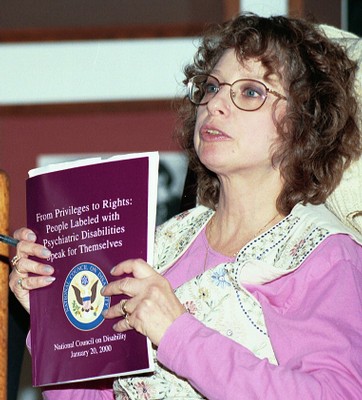
Judi Chamberlin upon the publication of the National Council on Disability’s federal report From Privileges to Rights.

Early Life

Judi Chamberlin was born Judith Rosenberg in Brooklyn in 1944. She was the only daughter of Harold and Shirley Jaffe Rosenberg. The family later changed their name to Ross. Her father was a factory worker when she was a child and later worked as an executive in the advertising industry. Her mother was employed as a school secretary. Chamberlin graduated from Midwood High School. After graduation, she had no plans of attending college and worked as a secretary instead.

Psychiatric Experience

There are real indignities and real problems when all facets of life are controlled—when to get up, to eat, to shower—and chemicals are put inside our bodies against our will. ( Judi Chamberlin, New York Times, 1981).

In 1966, at the age of twenty-one and recently married, Chamberlin suffered a miscarriage and, according to her own account, became severely depressed. Following psychiatric advice, she voluntarily signed herself into a psychiatric facility as an in-patient. However, after several voluntary admissions she was diagnosed with schizophrenia and involuntarily committed to a psychiatric ward at Mt. Sinai Hospital in New York state for a period of five months.

As an involuntary patient, she witnessed and experienced a range of abuses. Seclusion rooms and refractory wards were used for resistive patients, even when their forms of resistance were non-violent. The psychiatric medication she was given made her feel tired and affected her memory. As an involuntary patient she was unable to leave the facility and became, she said, “a prisoner of the system”. The derogation of her civil liberties that she experienced as an inmate provided the impetus for her activism as a member of the psychiatric survivor movement.

Activism

Remember back in MPLF? You put up a sign on the office wall that said, ‘End Psychiatric Oppression by Tuesday.’ That’s what I want. End psychiatric oppression by Tuesday. (Judi Chamberlin, in conversation with David W. Oaks, October 2009).

Following her discharge, Chamberlin became involved in the nascent psychiatric patients’ rights movement. In 1971 she joined the Boston-based Mental Patients Liberation Front (MPLF), and she also became associated with the Centre for Psychiatric Rehabilitation at Boston University. Her affiliation with this centre facilitated her role in co-founding the Ruby Rogers Advocacy and Drop-in-Centres, which are self-help institutions staffed by former psychiatric patients. and was also a founder and later a Director of Education of the National Empowerment Centre. The latter is also an ex-patient run organization that provides information, technical assistance, and support to users and survivors of the psychiatric system. Its mission statement declares its intent is to “carry a message of recovery, empowerment, hope and healing to people who have been labeled with mental illness”.

She was also involved with the National Association for Rights Protection and Advocacy and was an influential leader in the Mad Pride movement.

Chamberlin met David Oaks in 1976, when he was the chief executive of MindFreedom International. They were both members of the Mental Patients Liberation Front. She later became a board member of MindFreedom International, an umbrella organisation for approximately one hundred grass roots groups campaigning for the human rights of people labelled “mentally ill.”

In 1978, her book On Our Own: Patient Controlled Alternatives to the Mental Health System was published. It became the standard text of the psychiatric survivor movement, and in it Chamberlain coined the word “mentalism.” She used the word “mentalism” also in a book chapter in 1975.

She was a major contributor to the National Council on Disability’s report From Privileges to Rights: People Labelled with Psychiatric Disabilities Speak for Themselves, which was published in 2000. The report argued that psychiatric patients should enjoy the same basic human rights as other citizens and that patient privileges contingent on good behaviour within the psychiatric system, such as the ability to wear their own clothes, leave the confines of a psychiatric facility, or receive visitors, should instead be regarded as basic rights.

Chamberlin was elected as co-chair of the World Network of Users and Survivors of Psychiatry (WNUSP) at the launching conference and General Assembly in Vancouver, British Columbia, Canada in 2001, and served in this capacity until the next General Assembly in 2004. During this period she also served on the Panel of Experts advising the United Nations special rapporteur on disability, on behalf of WNUSP in its role as a Non-governmental organisation, representing psychiatric survivors.

She appears in the 2011 disability rights documentary Lives Worth Living.

Personal Life

Her marriages to Robert Chamberlin, Ted Chabasinski, and Howard Cahn ended in divorce. Chamberlin met Chabasinski, also an early member of the psychiatric survivor movement, in 1971 at the initial meeting of the Mental Patients Liberation Project in New York City. From 2006 until her death, Chamberlin’s partner was Martin Federman. She has one daughter, Julie Chamberlin, and three grandchildren, Edward, Kyle, and Vivian.

Death

Chamberlin died from chronic lung disease at her home in Arlington, Massachusetts on 16 January 2010.

This page is based on the copyrighted Wikipedia article < https://en.wikipedia.org/wiki/Judi_Chamberlin >; it is used under the Creative Commons Attribution-ShareAlike 3.0 Unported License (CC-BY-SA). You may redistribute it, verbatim or modified, providing that you comply with the terms of the CC-BY-SA.

What was AH v West London Mental Health Trust (2011)?

Introduction

AH vs West London Mental Health Trust was a landmark case in England, which established a legal precedent in 2011 when Albert Laszlo Haines (AH), a patient in Broadmoor Hospital, a high security psychiatric hospital, was able to exercise a right to a fully open public mental health review tribunal to hear his appeal for release. The case and the legal principles it affirmed have been described as opening up the secret world of tribunals and National Health Service secure units, and as having substantial ramifications for mental health professionals and solicitors, though how frequently patients will be willing or able to exercise the right is not yet clear.

The detention of Haines under the Mental Health Act 1983 had been continuous since 1986, mainly at Broadmoor Hospital run by West London Mental Health NHS Trust. The tribunal panel ultimately decided there were sufficient grounds for continued psychiatric detention but recommended better collaborative work towards psychiatric rehabilitation and gradual supported pathways to lower security then release to community mental health services.

Legal Process

Gaining the Right

Haines’s request for his mental health tribunal to be fully open to the public was first made in 2009 but was turned down twice by the First-tier Tribunal. The justification for the refusal included claims that: Haines’s primary intention was to air ‘subjective grievances’; his evidence would not be ‘objectively sensible’; he would be more difficult to control; the public would not be accurately informed; and the cost and the risk to the patient’s health and conduct were disproportionate to any possible benefits.

In 2010 the Upper Tribunal ruled that the First Tier had erred in law, having not correctly identified or applied the principles it should have. In effect it had failed to uphold the fundamental principle that open justice is a right and it is the exceptions that must be justified, rather than vice versa. In addition to such a principle in common law, under Article 6 of the European Convention on Human Rights (Right to a fair trial), reinforced by the Convention on the Rights of Persons with Disabilities (Article 13 Access to justice), detained psychiatric patients have the same right as non-disabled detainees to have their case heard in public, provided they are mentally capable of giving informed consent for their right to patient confidentiality to be waived.

The Upper Tribunal therefore set aside the First Tier’s decision, and was then at liberty to substitute its own decision. A short hearing was held for that purpose in February 2011, taking testimony from Broadmoor staff and Haines by video link. The panel concluded there was a sufficient rationale in Haines’s case to grant an open appeal hearing, and that this was not offset by possible risks or extra costs. Broadmoor Hospital, run by West London Mental Health NHS Trust since 2001, had fought the decision.

Engaging in the Hearing

The appeal hearing itself, the first ever to be open to the public and media, commenced in September 2011 in central London and lasted for two days. Mr Haines’s consultant psychiatrist, Dr Jose Romero-Urcelay, was cross-examined for one day. Haines’s ward clinical nurse manager, social worker and hospital ‘independent’ patient advocate also testified. Haines himself submitted a written report and testified for 20 minutes. Evidence was also heard from an independent social worker and from Albert Haines’s brother Leigh, who was offering to house and support him should he be released.

The decision was that Haines should not yet be released, even conditionally to a lower security facility. The reasons for the decision were published two weeks later, for the first time ever and contrary to a written representation submitted on behalf of Haines. The three-member panel headed by Judge McGregor-Johnson, Honorary Recorder, concluded that under the Mental Health Act Mr Haines was still considered to have a mental disorder of a nature or degree to justify detention in hospital for treatment, and that he still presented a sufficient risk to others and himself. However, Broadmoor Hospital staff were urged to find a way to better engage with Haines, even if that meant starting treatment on his own terms, and to put a clear pathway in place so that Haines could see an acceptable way to progress to lower security facilities and eventual release.

Haines’s solicitor, Kate Luscombe of the firm Duncan Lewis, said her client had received fair public support, had been able to air his grievances, and had followed the proceedings appropriately throughout; however she said Haines was disappointed at the final judgements and questioned whether his treatment over 25 years had promoted his rehabilitation. A spokesperson for West London NHS stated they were pleased the hearing was over due to the burden it being public put on the hospital’s resources, that they thought the verdict agreed that Broadmoor was the best treatment environment presently, but that they would continue to seek ways to engage Haines in treatment. Albert Haines’s sister Denise, however, stated that she believed Albert could not get the kind of help he needs at Broadmoor and fears he would not come out alive.

Personal Background

The legal process made extensive reference to Haines’s life as a child and adult, and he was the focus of some national press coverage which included personal interviews. Born in 1959 in Hammersmith, London, Albert Haines suffered neglect and abuse from a young age. He was put in residential care for many years, as were his three sisters and two brothers. A mental health assessment at just five years of age described him as ’emotionally maladjusted’. He was sexually and physically abused. After leaving residential homes once an adult, Haines stayed in hostels, bedsits or on the streets. He drank alcohol and took cannabis, cocaine and amphetamines. He was convicted of criminal damage in 1979 and in 1980 for possession of an offensive weapon. He was in and out of psychiatric hospitals.

In May 1986 while a patient of the Maudsley Hospital run by South London and Maudsley NHS Trust, Haines went in carrying a machete and a small knife. There is some disagreement between media reports as to whether he threatened staff and gave himself up, or tried to attack a member of staff but was prevented. No one was physically hurt. Later that year he pleaded guilty to attempted wounding. Rather than being sentenced to prison, he was sent to Broadmoor high-security psychiatric hospital for treatment under the Mental Health Act.

In 1992 Haines was transferred to the medium secure Three Bridges Unit in Ealing, London, also now run by West London Mental Health NHS Trust. While there he made successful visits out of hospital and worked in catering without incident, but after a confrontation with hospital staff involving being put in seclusion after brandishing a fire extinguisher and climbing onto the roof, he was returned to Broadmoor in 2008.

Psychiatric Context

According to the tribunal, Albert Haines was long diagnosed with a personality disorder – meaning an enduring and pervasive difficulty that developed by at least adolescence/early adulthood and which especially affects social interaction. The panel noted that several psychiatric reports have concluded that Haines demonstrates features of either emotionally unstable personality disorder and/or antisocial personality disorder. They also referred to childhood conduct disorder being demonstrated by his historical records. References were also made to ‘psychopathic disorder’, a legal category in the Mental Health Act 1983 which could cover any persistent mental disorder if it appeared to lead (in the individual case) to abnormally aggressive or irresponsible conduct; the category was abolished by amendments in the Mental Health Act 2007 which came into force in 2008. A separate political-administrative category of “Dangerous and Severe Personality Disorder” had been introduced in the UK from the turn of the 21st century, and one of four DSPD units nationwide was at Broadmoor Hospital although it is not clear whether Haines was considered under this category.

According to the tribunal, Mr Haines was also long found to have a mental illness in addition to underlying personality disorder, but in 2008 was rediagnosed as having a personality disorder only. Dr Romero-Urcelay of Broadmoor testified that Haines does suffer from a psychotic illness with specific persecutory delusions, at least since he was returned to Broadmoor from Three Bridges in 2008 and refused to accept any treatment from them. Other psychiatrists have not concluded that he has a psychotic illness at all, while others have gone further in concluding that he has a generalised psychosis which meets the criteria for schizoaffective disorder.

At his hearing, Haines disputed the diagnoses of personality disorder and psychosis, although he accepted that he had difficulties. He refused to accept the type of treatment offered by Broadmoor even if any release or step-down in security was conditional on it. He said that as a vulnerable young man he had looked to the experts for help but had been given multiple diagnoses, forced medication and incarceration. He said that trauma from his childhood abuse had not been properly recognised or reported for 25 years and that non-directive counselling had never been offered despite his asking for it ever since he could remember.

This page is based on the copyrighted Wikipedia article < https://en.wikipedia.org/wiki/AH_v_West_London_Mental_Health_Trust >; it is used under the Creative Commons Attribution-ShareAlike 3.0 Unported License (CC-BY-SA). You may redistribute it, verbatim or modified, providing that you comply with the terms of the CC-BY-SA.
Who was Elizabeth Packard (1816-1897)?

Introduction

Elizabeth Parsons Ware Packard (28 December 1816 to 25 July 1897), also known as E.P.W. Packard, was an American advocate for the rights of women and people accused of insanity. She was wrongfully committed to an insane asylum by her husband, who claimed that she had been insane for more than three years. At her trial, however, a jury concluded that she was not insane after only seven minutes of deliberation. She later founded the Anti-Insane Asylum Society, campaigning for divorced women to retain custody of their children.

Life

Elizabeth Packard

Elizabeth Packard, born in Ware, Massachusetts, was the oldest of three children and the only daughter of Samuel and Lucy Ware. Samuel was a Congregational minister in the Connecticut Valley of the Ware Congregational Church from 1810 to 1826. She was educated at the Amherst Female Seminary, where she studied French, algebra, and the new classics, thanks to the “adequate wealth” of her parents. In 1835, at age 19, she was diagnosed with brain fever, a nineteenth-century term for an illness thought to be caused by a severe emotional upset. When the family physician failed to help her, Samuel Ware decided to admit her to Worcester State Hospital, with Dr. Samuel Woodard at the helm; he was highly regarded for patient care. On the admission papers, Samuel Ware wrote that she suffered from “mental labor” from her occupation as a teacher. She remained in the hospital for six weeks.

At the insistence of her parents, Ware married Calvinist minister Theophilus Packard, fourteen years her senior and said to be “cold and domineering”, on 21 May 1839. The couple had six children: Theophilus (b. 1842), Ira Ware (b. 1844), Samuel Ware (b. 1847), Elizabeth Ware (b. 1850), George Hastings (b. 1853), and Arthur Dwight (b. 1858). They lived in Western Massachusetts until September 1854. Beginning in 1857, after having lived in Ohio and Iowa for short periods, the family moved to Manteno, Illinois, and appeared to have a peaceful and uneventful marriage.

Theophilus, however, held quite decisive religious beliefs. After many years of marriage, Elizabeth Packard outwardly questioned her husband’s beliefs and began expressing opinions that were contrary to his. While the main subject of their dispute was religion, the couple also disagreed on methods of child rearing and managing family finances, as well as the morality of slavery, with Elizabeth defending abolitionist John Brown, which embarrassed Theophilus.

When Illinois opened its first hospital for the mentally ill in 1851, the state legislature passed a law that within two years of its passage was amended to require a public hearing before a person could be committed against their will with the exception that a husband could have his wife committed without either a public hearing or her consent. In 1860, Theophilus Packard judged that his wife was “slightly insane”, a condition he attributed to “excessive application of body and mind”. He arranged for a doctor, J.W. Brown, to speak with her. The doctor pretended to be a sewing machine salesman. During their conversation, Elizabeth complained of her husband’s domination and his accusations to others that she was insane. Brown reported this conversation to Theophilus (along with the observation that Mrs. Packard “exhibited a great dislike to me”). Theophilus decided to have Elizabeth committed. She learned of this decision on 18 June 1860, when the county sheriff arrived at the Packard home to take her into custody.

Elizabeth Packard spent the next three years at the Jacksonville Insane Asylum in Jacksonville, Illinois (now the Jacksonville Developmental Centre). She was regularly questioned by doctors, but refused to agree that she was insane or to change her religious views. In June 1863, due, in part, to pressure from her children, who wished her to be released, the doctors declared that she was incurable and discharged her. Upon her discharge, Theophilus locked her in the nursery of their home and nailed the windows shut. Elizabeth managed to drop a letter complaining of this treatment out of the window, which was delivered to her friend Sarah Haslett. Sarah Haslett in turn delivered the letter to Judge Charles Starr, who issued a writ of habeas corpus ordering Theophilus to bring Elizabeth to his chambers to discuss the matter. After being presented with Theophilus’ evidence, Judge Starr scheduled a jury trial to allow a legal determination of Elizabeth’s sanity to take place.

Packard v. Packard

At the subsequent trial of Packard v. Packard, which lasted five days, Theophilus’s lawyers produced witnesses from his family who testified that Elizabeth had argued with her husband and tried to withdraw from his congregation. These witnesses concurred with Theophilus that this was a sign of insanity. The record from the Illinois State Hospital stating that Mrs. Packard’s condition was incurable was also entered into the court record.

Elizabeth’s lawyers, Stephen Moore and John W. Orr, responded by calling witnesses from the neighbourhood who knew the Packards but were not members of Theophilus’ church. These witnesses testified they never saw Elizabeth exhibit any signs of insanity, while discussing religion or otherwise. The final witness was Dr. Duncanson, who was both a physician and a theologian. Dr. Duncanson had interviewed Elizabeth and he testified that while not necessarily in agreement with all her religious beliefs, she was sane in his view, arguing that “I do not call people insane because they differ with me. I pronounce her a sane woman and wish we had a nation of such women.”

The jury deliberated for only seven minutes before deciding the case in Elizabeth’s favour. She was legally declared sane, and Judge Charles Starr, who had changed the trial from one about habeas corpus to one about sanity, issued an order that she should not be confined. As scholar Kathryn Burns-Howard described it, “we will never know Elizabeth’s true mental state or the details of her family life.”

Life after the Trial

When Elizabeth Packard returned to the home she shared with her husband in Manteno, Illinois, she found that the night before her release, her husband had rented their home to another family, sold her furniture, had taken her money, notes, wardrobe and children, and had left the state. She appealed to the Supreme Courts of both Illinois and Massachusetts, to where her husband had taken her children, but had no legal recourse, as married women in these states at the time had no legal rights to their property or children (refer to the term Coverture). As such, the Anti-Insane Asylum Society was formed.

Packard did not return to her former life, but became a national celebrity, publishing “an armload of books and criss-crossing the United States on a decades-long reform campaign”, not only advocating for married women’s rights and freedom of speech, but speaking out against “the power of insane asylums”. She became what some scholars call “a publicist and lobbyist for better insanity laws”. As scholar Kathryn Burns-Howard has argued, Packard reinvented herself in this role, earning enough to support her children and even her estranged husband, from whom she remained separated for the rest of her life. Ultimately, moderate supporters of women’s rights in the northern United States embraced her. Some argued that in the midst of the Civil War that a country in the midst of freeing slaves should do the same for others who suffered from abusive husbands. Some argue that she seemed oblivious to her racial prejudice in arguing that White women had a “moral and spiritual nature” and suffered more “spiritual agony” than formerly enslaved African-Americans. Even so, others say that her story provided “a stirring example of oppressed womanhood” that others did not.

Packard petitioned the Illinois and Massachusetts legislatures, and in 1869 legislation was passed in those states allowing married women equal rights to property and custody of their children. Upon the passing of this legislation, Packard’s husband voluntarily ceded custody of their children back to her, and her children came to live with her in Chicago.

Packard realized how narrow her legal victory had been, and that the underlying social principles which had led to her confinement still existed. She founded the Anti-Insane Asylum Society and published several books, including Marital Power Exemplified, or Three Years Imprisonment for Religious Belief (1864), Great Disclosure of Spiritual Wickedness in High Places (1865), The Mystic Key or the Asylum Secret Unlocked (1866), and The Prisoners’ Hidden Life, Or Insane Asylums Unveiled (1868). In 1867, the State of Illinois passed a “Bill for the Protection of Personal Liberty” which guaranteed that all people accused of insanity, including wives, had the right to a public hearing, as did Massachusetts.

Packard also saw similar laws passed in three other states. Even so, she was strongly attacked by medical professionals and anonymous citizens, unlike others such as Dorothea Dix, with her former doctor from the Jacksonville Insane Asylum, Dr. Andrew McFarland, who privately called her “a sort of Joan D’Arc in the matter of stirring up the personal prejudices”. As such, Elizabeth’s work on this front was “broadly unappreciated” while she was alive. She only received broader recognition, starting in the 1930s, by a well-known historian of mental illness, Albert Deutsch, and again in the 1960s from those who were “attacking the medical model of insanity”.

She died on 25 July 1897. In her obituary, The Inter Ocean described her as “the reformer of insane asylum methods”

Scholarship and Legacy

Scholars have written various books and articles about Elizabeth Packard. This has included articles by scholars Myra Samuels Himelhoch and Arthur H. Shaffer in 1979, Paul A. Lombardo in 1992, and Jennifer Rebecca Levinson in 2003. In 1991, Barbara Sapinsley wrote the first book which focused on Elizabeth Packard, entitled The Private War of Mrs. Packard. It was informed by Packard’s family in the late 1960s/early 1970s, and took 20 years to find a publisher. Linda V. Carlisle wrote another biography, published by University of Illinois Press in 2010, entitled Elizabeth Packard: A Noble Fight. In part, she focuses on individual legislation that Packard campaigned for and/or helped bring about. In 2021, Kate Moore wrote a detailed and highly researched story highlighting the character of kindness, service, and perseverance of Elizabeth Packard entitled The Woman They Could Not Silence: One Woman, Her Incredible Fight for Freedom, and the Men Who Tried to Make Her Disappear. Previously, in 2005, Barbara Hambly had referred to Elizabeth Packard, in some detail, in her novel on the insanity of Mary Todd Lincoln, entitled The Emancipator’s Wife: A Novel of Mary Todd Lincoln, since the 1867 law Packard advocated for required a jury trial for anyone who was “committed to an insane asylum.” Moore would later say that Packard was not mentally ill and was “merely independent,” and argued that people should “take inspiration from women like Elizabeth.” Troy Rondinone, a professor at Southern Connecticut State University, made a similar argument, arguing that people should remember “Packard’s battle for women in the mental health care system.”

Emily Mann wrote the play Mrs. Packard, which premiered in May 2007. In Mann’s play, Packard describes her life fully in the insane asylum; it is considered historically accurate.

On 10 August 2023, Illinois Governor J. B. Pritzker renamed the mental health hospital in Springfield Illinois from Andrew McFarland Mental Health Centre to the Elizabeth Packard Mental Health Centre, in Packard’s honour.

This page is based on the copyrighted Wikipedia article < https://en.wikipedia.org/wiki/Elizabeth_Packard >; it is used under the Creative Commons Attribution-ShareAlike 3.0 Unported License (CC-BY-SA). You may redistribute it, verbatim or modified, providing that you comply with the terms of the CC-BY-SA.

What is the World Federation for Mental Health?

Introduction

The World Federation for Mental Health (WFMH) is an international, multi-professional non-governmental organisation (NGO), including citizen volunteers and former patients. It was founded in 1948 in the same era as the United Nations (UN) and the World Health Organisation (WHO).

Outline

The goal of this international organisation includes;

  • The prevention of mental and emotional disorders;
  • The proper treatment and care of those with such disorders; and
  • And the promotion of mental health.

The Federation, through its members and contacts in more than 94 countries on six continents, has responded to international mental health crises through its role as the only worldwide grassroots advocacy and public education organisation in the mental health field. Its organisational and individual membership includes mental health workers of all disciplines, consumers of mental health services, family members, and concerned citizens. At its very outset the WFMH was concerned with educating both the public and influential professionals, and with human relations, with a view both to the health of individuals and that of groups and nations. The WFMH founding document, “Mental Health and World Citizenship”, understood “world citizenship” in terms of a “common humanity” respecting individual and cultural differences, and declared that “the ultimate goal of mental health is to help [people] live with their fellows in one world.

Members include mental health service providers and service users. In 2009, the World Fellowship for Schizophrenia and Allied Disorders, an international network of families of people with serious mental illness, merged with the World Federation. The World Federation has close ties with the World Health Organization. For many years after its founding, the WFMH was the only NGO of its kind with a close working relationship with UN agencies, particularly the WHO. In recent decades, though, a number of international mental health organisations, often limited to members of particular professions, have developed. In varying degree they have filled needs formerly addressed mainly by WFMH. The WFMH envisions a world in which mental health is a priority for all people. Public policies and programs reflect the crucial importance of mental health in the lives of individuals. The first Director General of the WHO, G. Brock Chisholm, who was a psychiatrist, was one of the leaders in forming the federation with the goal of creating a representative organisation that could consult with the UN on mental health issues.

The mission of the World Federation for Mental Health is to promote the advancement of mental health awareness, prevention of mental disorders, advocacy, and best practice recovery focused interventions worldwide. Mental health day is celebrated at the initiative of the World Federation of Mental Health and WHO supports this initiative through raising awareness on mental health issues using its strong relationships with the Ministries of health and civil society organisations across the globe. Mental Illness Awareness Week (MIAW) is an annual national public education campaign designed to help open the eyes of Canadians to the reality of mental illness. The week was established in 1992 by the Canadian Psychiatric Association, and is now coordinated by the Canadian Alliance on Mental Illness and Mental Health (CAMIMH) in cooperation with all its member organisations and many other supporters across Canada.

This page is based on the copyrighted Wikipedia article < https://en.wikipedia.org/wiki/World_Federation_for_Mental_Health >; it is used under the Creative Commons Attribution-ShareAlike 3.0 Unported License (CC-BY-SA). You may redistribute it, verbatim or modified, providing that you comply with the terms of the CC-BY-SA.
Who was Clifford Whittingham Beers (1876-1943)?

Introduction

Clifford Whittingham Beers (30 March 1876 to 09 July 1943) was the founder of the American mental hygiene movement.

Biography

Beers in 1908, from the frontispiece of his book.

Beers was born in New Haven, Connecticut, to Ida and Robert Beers on 30 March 1876. He was one of five children, all of whom would suffer from psychological distress and would spend time in mental institutions, including Beers himself (see “Clifford W. Beers, Advocate for the Insane”). He graduated from the Sheffield Scientific School at Yale in 1897, where he was business manager of The Yale Record and a member of Berzelius.

In 1900 he was first confined to a private mental institution for depression and paranoia. He would later be confined to another private hospital as well as a state institution. During these periods he experienced and witnessed serious maltreatment at the hands of the staff. His book A Mind That Found Itself (1908), an autobiographical account of his hospitalisation and the abuses he suffered, was widely and favourably reviewed, became a bestseller, and is still in print.

Beers gained the support of the medical profession and others in the work to reform the treatment of the mentally ill. In 1908 Beers founded the “Connecticut Society for Mental Hygiene”, now named Mental Health Connecticut. In 1909 Beers founded the “National Committee for Mental Hygiene”, renamed “National Mental Health Association”, now named “Mental Health America”, in order to continue the reform for the treatment of the mentally ill.

He also started the Clifford Beers Clinic in New Haven in 1913, the first outpatient mental health clinic in the United States.

Beers became Honorary President of the World Federation for Mental Health.

Beers was a leader in the field until his retirement in 1939. He died in Providence, Rhode Island, on 09 July 1943.

The Extra Mile in Washington, D.C., selected Beers as one of its 37 honourees. The Extra Mile pays homage to Americans like Beers who set their own self-interest aside to help others and successfully brought positive social change to the United States.

This page is based on the copyrighted Wikipedia article < https://en.wikipedia.org/wiki/Clifford_Whittingham_Beers >; it is used under the Creative Commons Attribution-ShareAlike 3.0 Unported License (CC-BY-SA). You may redistribute it, verbatim or modified, providing that you comply with the terms of the CC-BY-SA.

Who was Donald Winnicott?

Introduction

Donald Woods Winnicott (07 April 1896 to 25 January 1971) was an English paediatrician and psychoanalyst who was especially influential in the field of object relations theory and developmental psychology. He was a leading member of the British Independent Group of the British Psychoanalytical Society, President of the British Psychoanalytical Society twice (1956–1959 and 1965–1968), and a close associate of Marion Milner.

Winnicott is best known for his ideas on the true self and false self, the “good enough” parent, and borrowed from his second wife, Clare Winnicott, arguably his chief professional collaborator, the notion of the transitional object. He wrote several books, including Playing and Reality, and over 200 papers.

Early Life and Education

Winnicott was born on 07 April 1896 in Plymouth, Devon, to Sir John Frederick Winnicott and Elizabeth Martha, daughter of chemist and druggist William Woods, of Plymouth. Sir John Winnicott was a partner in the family firm, in business as hardware merchants and manufacturers, and was knighted in 1924 having served twice as mayor of Plymouth; he was also a magistrate and alderman. The Winnicott family were staunch, civic-minded Methodists.

The family was prosperous and ostensibly happy, but behind the veneer, Winnicott saw himself as oppressed by his mother, who tended toward depression, as well as by his two sisters and his nanny. He would eventually speak of ‘his own early childhood experience of trying to make “my living” by keeping his mother alive’. His father’s influence was that of an enterprising freethinker who encouraged his son’s creativity. Winnicott described himself as a disturbed adolescent, reacting against his own self-restraining “goodness” acquired from trying to assuage the dark moods of his mother. These seeds of self-awareness became the basis of his interest in working with troubled young people.

He first thought of studying medicine while at The Leys School, a boarding school in Cambridge, after fracturing his clavicle and recording in his diary that he wished he could treat himself. He began pre-clinical studies in biology, physiology and anatomy at Jesus College, Cambridge, in 1914 but, with the onset of World War I, his studies were interrupted when he was made a medical trainee at the temporary hospital in Cambridge. In 1917, he joined the Royal Navy as a medical officer on the destroyer HMS Lucifer.

Having graduated from Cambridge with a third-class degree, he began studies in clinical medicine at St Bartholomew’s Hospital Medical College in London. During this time, he learned from his mentor the art of listening carefully when taking medical histories from patients, a skill that he would later identify as foundational to his practice as a psychoanalyst.

Career

Winnicott completed his medical studies in 1920, and in 1923, the same year as his marriage to the artist Alice Buxton Winnicott (born Taylor). She was a potter and they married on 7 July 1923 in St Mary’s Church, Frensham. Alice had “severe psychological difficulties” and Winnicott arranged for her, and his own therapy, to address the difficulties this condition created. He obtained a post as physician at the Paddington Green Children’s Hospital in London, where he was to work as a paediatrician and child psychoanalyst for 40 years. In 1923 he began a ten-year psychoanalysis with James Strachey, and in 1927 he began training as an analytic candidate. Strachey discussed Winnicott’s case with his wife Alix Strachey, apparently reporting that Winnicott’s sex life was affected by his anxieties. Winnicott’s second analysis, beginning in 1936, was with Joan Riviere.

Winnicott rose to prominence as a psychoanalyst just as the followers of Anna Freud were in conflict with those of Melanie Klein for the right to be called Sigmund Freud’s “true intellectual heirs”. Out of the Controversial discussions during World War II, a compromise was reached with three more-or-less amicable groups within the psychoanalytic movement: the “Freudians”, the “Kleinians”, and the “Middle Group” of the British Psychoanalytical Society (the latter being called the “Independent Group”), to which Winnicott belonged, along with Ronald Fairbairn, Michael Balint, Masud Khan, John Bowlby, Marion Milner, and Margaret Little.

During the Second World War, Winnicott served as consultant paediatrician to the children’s evacuation programme. During the war, he met and worked with Clare Britton, a psychiatric social worker who became his colleague in treating children displaced from their homes by wartime evacuation. Winnicott was lecturing after the war and Janet Quigley and Isa Benzie of the BBC asked him to give over sixty talks on the radio between 1943 and 1966. His first series of talks in 1943 was titled “Happy Children.” As a result of the success of these talks, Quigley offered him total control over the content of his talks but this soon became more consultative as Quigley advised him on the correct pitch.[13]

After the war, he also saw patients in his private practice. Among contemporaries influenced by Winnicott was R.D. Laing, who wrote to Winnicott in 1958 acknowledging his help.

Winnicott divorced his first wife in 1949 and married Clare Britton (1906–1984) in 1951. A keen observer of children as a social worker and a psychoanalyst in her own right, she had an important influence on the development of his theories and likely acted as midwife to his prolific publications after they met.

Except for one book published in 1931 (Clinical Notes on Disorders of Childhood), all of Winnicott’s books were published after 1944, including The Ordinary Devoted Mother and Her Baby (1949), The Child and the Family (1957), Playing and Reality (1971), and Holding and Interpretation: Fragment of an Analysis (1986).

Winnicott died on 25 January 1971, following the last of a series of heart attacks and was cremated in London. Clare Winnicott oversaw the posthumous publication of several of his works.

Concept of Holding

Winnicott’s paediatric work with children and their mothers led to the development of his influential concept concerning the “holding environment”. Winnicott claimed that “the foundations of health are laid down by the ordinary mother in her ordinary loving care of her own baby”, central to which was the mother’s attentive holding of her child.

Winnicott considered that the “mother’s technique of holding, of bathing, of feeding, everything she did for the baby, added up to the child’s first idea of the mother”, as well as fostering the ability to experience the body as the place wherein one securely lives. Extrapolating the concept of holding from mother to family and the outside world, Winnicott saw as key to healthy development “the continuation of reliable holding in terms of the ever-widening circle of family and school and social life”.

Winnicott was influential in viewing the work of the psychotherapist as offering a substitute holding environment based on the mother/infant bond. Winnicott wrote: “A correct and well-timed interpretation in an analytic treatment gives a sense of being held physically that is more real…than if a real holding or nursing had taken place. Understanding goes deeper”.

His theoretical writings emphasised empathy, imagination, and, in the words of philosopher Martha Nussbaum, who has been a proponent of his work, “the highly particular transactions that constitute love between two imperfect people.”

Anti-Social Tendency

Connected to the concept of holding is what Winnicott called the anti-social tendency, something which he argued “may be found in a normal individual, or in one that is neurotic or psychotic”. The delinquent child, Winnicott thought, was looking for a sense of secure holding lacking in their family of origin from society at large. He considered antisocial behaviour as a cry for help, fuelled by a sense of loss of integrity, when the familial holding environment was inadequate or ruptured.

Play and the Sense of Being Real

One of the elements that Winnicott considered could be lost in childhood was what he called the sense of being – for him, a primary element, of which a sense of doing is only a derivative. The capacity for being – the ability to feel genuinely alive inside, which Winnicott saw as essential to the maintenance of a true self – was fostered in his view by the practice of childhood play.

In contrast to the emphasis in orthodox psychoanalysis upon generating insight into unconscious processes, Winnicott considered that playing was the key to emotional and psychological well-being. It is likely that he first came upon this notion from his collaboration in wartime with the psychiatric social worker, Clare Britton, (later a psychoanalyst and his second wife) who in 1945 published an article on the importance of play for children. By “playing”, he meant not only the ways that children of all ages play, but also the way adults “play” through making art, or engaging in sports, hobbies, humour, meaningful conversation, et cetera. At any age, he saw play as crucial to the development of authentic selfhood, because when people play they feel real, spontaneous and alive, and keenly interested in what they’re doing. He thought that insight in psychoanalysis was helpful when it came to the patient as a playful experience of creative, genuine discovery; dangerous when patients were pressured to comply with their analyst’s authoritative interpretations, thus potentially merely reinforcing a patient’s false self. Winnicott believed that it was only in playing that people are entirely their true selves, so it followed that for psychoanalysis to be effective, it needed to serve as a mode of playing.

Two of the techniques whereby Winnicott used play in his work with children were the squiggle game and the spatula game. The first involved Winnicott drawing a shape for the child to play with and extend (or vice versa) – a practice extended by his followers into that of using partial interpretations as a ‘squiggle’ for a patient to make use of.

The second, more famous instance involved Winnicott placing a spatula (tongue depressor) within the child’s reach for him to play with. Winnicott considered that “if he is just an ordinary baby he will notice the attractive object…and he will reach for it….[then] in the course of a little while he will discover what he wants to do with it”. From the child’s initial hesitation in making use of the spatula, Winnicott derived his idea of the necessary ‘period of hesitation’ in childhood (or analysis), which makes possible a true connection to the toy, interpretation or object presented for transference.

Many of Winnicott’s writings show his efforts to understand what helps people to be able to play, and on the other hand what blocks some people from playing. Babies can be playful when they’re cared for by people who respond to them warmly and playfully, like a mother who smiles and says, “Peek-a-boo!” when she sees her baby playfully peeking out from behind his hands. If the mother never responded playfully, sooner or later the baby would stop trying to elicit play from her. Indeed, Winnicott came to consider that “Playing takes place in the potential space between the baby and the mother-figure….[T]he initiation of playing is associated with the life experience of the baby who has come to trust the mother figure”. “Potential space” was Winnicott’s term for a sense of an inviting and safe interpersonal field in which one can be spontaneously playful while at the same time connected to others (again a concept that has been extrapolated to the practice of analysis).

Playing can also be seen in the use of a transitional object, Winnicott’s term for an object, such as a teddy bear, that has a quality for a small child of being both real and made-up at the same time. Winnicott pointed out that no one demands that a toddler explain whether his Binky is a “real bear” or a creation of the child’s own imagination, and went on to argue that it’s very important that the child is allowed to experience the Binky as being in an undefined, “transitional” status between the child’s imagination and the real world outside the child. For Winnicott, one of the most important and precarious stages of development was in the first three years of life, when an infant grows into a child with an increasingly separate sense of self in relation to a larger world of other people. In health, the child learns to bring his or her spontaneous, real self into play with others; in a false self disorder, the child has found it unsafe or impossible to do so, and instead feels compelled to hide the true self from other people, and pretend to be whatever they want instead. Playing with a transitional object can be an important early bridge between self and other, which helps a child develop the capacity to be genuine in relationships, and creative.

Playing for Winnicott ultimately extended all the way up from earliest childhood experience to what he called “the abstractions of politics and economics and philosophy and culture…this ‘third area’, that of cultural experience which is a derivative of play”.

True self and False Self

Winnicott wrote that “a word like self…knows more than we do.”. He meant that, while philosophical and psychoanalytic ideas about the self could be very complex and arcane, with a great deal of specialised jargon, there was a pragmatic usefulness to the ordinary word “self” with its range of traditional meanings. For example, where other psychoanalysts used the Freudian terminology of ego and id to describe different functions of a person’s psychology, Winnicott at times used “self” to refer to both. For Winnicott, the self is a very important part of mental and emotional well-being which plays a vital role in creativity. He thought that people were born without a clearly developed self and had to “search” for an authentic sense of self as they grew. “For Winnicott, the sense of feeling real, feeling in touch with others and with one’s own body and its processes was essential for living a life.”

True Self

“Only the true self can be creative and only the true self can feel real.” For Winnicott, the True Self is a sense of being alive and real in one’s mind and body, having feelings that are spontaneous and unforced. This experience of aliveness is what allows people to be genuinely close to others, and to be creative.

Winnicott thought that the “True Self” begins to develop in infancy, in the relationship between the baby and its primary caregiver (Winnicott typically refers to this person as “the mother”). One of the ways the mother helps the baby develop an authentic self is by responding in a welcoming and reassuring way to the baby’s spontaneous feelings, expressions, and initiatives. In this way the baby develops a confidence that nothing bad happens when she expresses what she feels, so her feelings don’t seem dangerous or problematic to her, and she doesn’t have to put undue attention into controlling or avoiding them. She also gains a sense that she is real, that she exists and her feelings and actions have meaning.

Winnicott thought that one of the developmental hurdles for an infant to get past is the risk of being traumatised by having to be too aware too soon of how small and helpless she really is. A baby who is too aware of real-world dangers will be too anxious to learn optimally. A good-enough parent is well enough attuned and responsive to protect the baby with an illusion of omnipotence, or being all-powerful. For example, a well-cared-for baby usually doesn’t feel hungry for very long before being fed. Winnicott thought the parents’ quick response of feeding the baby gives the baby a sense that whenever she’s hungry, food appears as if by magic, as if the baby herself makes food appear just by being hungry. To feel this powerful, Winnicott thought, allowed a baby to feel confident, calm and curious, and able to learn without having to invest a lot of energy into defences.

False Self

In Winnicott’s writing, the “False Self” is a defence, a kind of mask of behaviour that complies with others’ expectations. Winnicott thought that in health, a False Self was what allowed one to present a “polite and mannered attitude” in public.

But he saw more serious emotional problems in patients who seemed unable to feel spontaneous, alive or real to themselves anywhere, in any part of their lives, yet managed to put on a successful “show of being real”. Such patients suffered inwardly from a sense of being empty, dead or “phoney”.

Winnicott thought that this more extreme kind of False Self began to develop in infancy, as a defence against an environment that felt unsafe or overwhelming because of a lack of reasonably attuned caregiving. He thought that parents did not need to be perfectly attuned, but just “ordinarily devoted” or “good enough” to protect the baby from often experiencing overwhelming extremes of discomfort and distress, emotional or physical. But babies who lack this kind of external protection, Winnicott thought, had to do their best with their own crude defences.

One of the main defences Winnicott thought a baby could resort to was what he called “compliance”, or behaviour motivated by a desire to please others rather than spontaneously express one’s own feelings and ideas. For example, if a baby’s caregiver was severely depressed, the baby would anxiously sense a lack of responsiveness, would not be able to enjoy an illusion of omnipotence, and might instead focus his energies and attentions on finding ways to get a positive response from the distracted and unhappy caregiver by being a “good baby”. The “False Self” is a defence of constantly seeking to anticipate others’ demands and complying with them, as a way of protecting the “True Self” from a world that is felt to be unsafe.

Winnicott thought that the “False Self” developed through a process of introjection (a concept developed early on by Freud) or internalising one’s experience of others. Instead of basing his personality on his own unforced feelings, thoughts, and initiatives, the person with a “False Self” disorder would essentially be imitating and internalising other people’s behaviour – a mode in which he could outwardly come to seem “just like” his mother, father, brother, nurse, or whoever had dominated his world, but inwardly he would feel bored, empty, dead, or “phoney”. Winnicott saw this as an unconscious process: not only others but also the person himself would mistake his False Self for his real personality. But even with the appearance of success, and of social gains, he would feel unreal and lack the sense of really being alive or happy.

The division of the True and False self roughly develops from Freud’s (1923) notion of the Superego which compels the Ego to modify and inhibit libidinal Id impulses, possibly leading to excessive repression but certainly altering the way the environment is perceived and responded to. However it is not a close equation as the Id, Ego and Superego are complex and dynamic inter-related systems that do not fit well into such a dichotomy. The theory more closely resembles Carl Rogers’ simplified notions of the Real and Ideal self. According to Winnicott, in every person the extent of division between True and False Self can be placed on a continuum between the healthy and the pathological. The True Self, which in health gives the person a sense of being alive, real, and creative, will always be in part or in whole hidden; the False Self is a compliant adaptation to the environment, but in health it does not dominate the person’s internal life or block him from feeling spontaneous feelings, even if he chooses not to express them. The healthy False Self feels that it is still being true to the True Self. It can be compliant to expectations but without feeling that it has betrayed its “True Self”.

Winnicott on Carl Jung

Winnicott’s assessment of the other great pioneer of psychoanalysis, Carl Jung, appeared when he published an extensive review of Jung’s partially autobiographical work, Memories, Dreams, Reflections. In it Winnicott focuses on the first three chapters of the work that:

every psychoanalyst must read’ and in particular the first chapter, ‘First Years’. (Winnicott).

He discusses Jung’s evident early experiences of psychotic illness from around the age of four, from within his own theoretical framework. He goes on to comment on the relationship between Freud and Jung. He also discusses the Jungian ‘unconscious’ and Jung’s concept of the ‘self’.

Criticism and Influence

Winnicott’s theoretical elusiveness has been linked to his efforts to modify Kleinian views. Yet whereas from a Kleinian standpoint, his repudiation of the concepts of envy and the death drive were a resistant retreat from the harsh realities she had found in infant life, he has also been accused of being too close to Klein, of sharing in her regressive shift of focus away from the Oedipus complex to the pre-oedipal.

The psychoanalyst, Jan Abram, a former director of the Squiggle Foundation, intended to promote Winnicott’s work, who therefore may be said to be partisan, has proposed a coherent interpretation for the omission of Winnicott’s theories from many mainstream psychoanalytic trainings. His view of the environment and use of accessible everyday language, addressing the parent community, as opposed to just the Kleinian psychoanalytic community, may account in part for the distancing and making him somewhat “niche”.

Winnicott has also been accused of identifying himself in his theoretical stance with an idealised mother, in the tradition of mother (Madonna) and child. Related is his downplaying of the importance of the erotic in his work, as well as the Wordsworthian Romanticism of his cult of childhood play (exaggerated still further in some of his followers).

His theories of the true/false self may have been over-influenced by his own childhood experience of caring for a depressed mother, which resulted in the development of a prematurely mature self which he was only subsequently able to undo.

Nevertheless, Winnicott remains one of the few twentieth-century analysts who, in stature, breadth, minuteness of observations, and theoretical fertility can legitimately be compared to Sigmund Freud.

He has been a major influence for the American psychoanalyst Thomas Ogden, and the Italian psychoanalysts Giuseppe Civitarese and Antonino Ferro, all of which have cited Winnicott’s interest in play as being central to their work. He has also strongly influenced the work of Adam Phillips.

Along with Jacques Derrida, Winnicott is a fundamental resource for philosopher Bernard Stiegler’s What Makes Life Worth Living: On Pharmacology (2010).

This page is based on the copyrighted Wikipedia article < https://en.wikipedia.org/wiki/Donald_Winnicott >; it is used under the Creative Commons Attribution-ShareAlike 3.0 Unported License (CC-BY-SA). You may redistribute it, verbatim or modified, providing that you comply with the terms of the CC-BY-SA.

Who was Donald W. MacKinnon?

Introduction

Donald Wallace MacKinnon (09 January 1903 to 20 January 1987) was an American psychologist and professor at the University of California, Berkeley. He was known for researching the psychology of creativity.

Career

After receiving his Ph.D. from Harvard University in 1933, he became a professor at Bryn Mawr College, where he remained until 1947. From 1944 to 1946, he went on leave from Bryn Mawr College to direct the United States Office of Strategic Services’s Station S during World War II. He joined the faculty of the University of California, Berkeley in 1947, and became the founding director of the Institute of Personality Assessment and Research there in 1949. He remained the institute’s director until 1970, and used the skills he had learned during World War II at the institute. He was the president of the Division of Personality and Social Psychology from 1951 to 1952, and of the Western Psychological Association from 1963 to 1964. He retired from Berkeley in 1970. In 1973, he began a one-year stint as a visiting fellow at the Centre for Creative Leadership and an adjunct professor of psychology at the University of North Carolina, Chapel Hill.

This page is based on the copyrighted Wikipedia article < https://en.wikipedia.org/wiki/Donald_W._MacKinnon >; it is used under the Creative Commons Attribution-ShareAlike 3.0 Unported License (CC-BY-SA). You may redistribute it, verbatim or modified, providing that you comply with the terms of the CC-BY-SA.

Who was David Graham Cooper?

Introduction

David Graham Cooper (1931 in Cape Town, South Africa – 29 July 1986 in Paris, France) was a South African-born psychiatrist and theorist who was prominent in the anti-psychiatry movement.

Cooper graduated from the University of Cape Town in 1955. R.D. Laing claimed that Cooper underwent Soviet training to prepare him as an Anti Apartheid communist revolutionary, but after completing his course he never returned to South Africa out of fear that B.O.S.S. would eliminate him. He moved to London, where he worked at several hospitals. From 1961 to 1965 he ran an experimental unit for young people with schizophrenia called Villa 21, which he saw as a revolutionary ‘anti-hospital’ and a prototype for the later Kingsley Hall Community. In 1965, he was involved with Laing and others in establishing the Philadelphia Association. An “existential Marxist” he left the Philadelphia Association in the 1970s in a disagreement over its lack of political orientation. Cooper coined the term “anti-psychiatry” in 1967, and wrote the book Psychiatry and Anti-psychiatry in 1971.

Leading Concepts

Cooper believed that madness and psychosis are the manifestation of a disparity between one’s own ‘true’ identity and our social identity (the identity others give us and we internalise). Cooper’s ultimate solution was through revolution. To this end, Cooper travelled to Argentina as he felt the country was rife with revolutionary potential. He later returned to England before moving to France where he spent the last years of his life.

Cooper coined the term anti-psychiatry (see below) to describe opposition and opposing methods to the orthodox psychiatry of the time, although the term could easily describe the anti-psychiatrists’ view of orthodox psychiatry, i.e., anti-psychic healing.

He coordinated the Congress on the Dialectics of Liberation, held in London at The Roundhouse in Chalk Farm from 15 July to 30 July 1967. Participants included R. D. Laing, Paul Goodman, Allen Ginsberg, Herbert Marcuse and the Black Panthers’ Stokely Carmichael. Jean-Paul Sartre was scheduled to appear but cancelled at the last moment. The term “anti-psychiatry” was first used by David Cooper in 1967.

He was a founding member of the Philadelphia Association, London.

Family and The Death of the Family

Cooper describes how ‘during the end of the writing of this book against the family, I went through a profound spiritual and bodily crisis….The people who sat with me and tended to me with immense kindliness and concern during the worst of this crisis were my brother Peter and sister-in-law Carol…a true family’.

He had earlier described the need to break free from ‘one’s whole family past…in a way that is more personally effective than a simple aggressive rupture or crude acts of geographical separation’; as well as the kind of false autonomy which occurs when ‘people are still very much in the net of the internal family (and often the external family too) and compulsively search for rather less restricting replica family systems’.

The book may thus be seen as a self-reflexive attempt ‘to illustrate the power of the internal family, the family that one can separate from over thousands of miles and yet still remain in its clutches and be strangled by those clutches’.

The Language of Madness

In 1967, ‘David Cooper provided an introduction to Foucault’s Madness and Civilization which began “Madness has in our age become some sort of lost truth”‘ – a statement not atypical of ‘a time which posterity now readily regards as half-crazed’. Continuing the same line of thought, by the end of the following decade, ‘he elevated madness to the status of a liberatory force’ in his last publication. Here are a few typical utterances from The Language of Madness (Cooper 1980): “Madness is permanent revolution in the life of a person…a deconstitution of oneself with the implicit promise of return to a more fully realized world”‘.

This page is based on the copyrighted Wikipedia article < https://en.wikipedia.org/wiki/David_Cooper_(psychiatrist) >; it is used under the Creative Commons Attribution-ShareAlike 3.0 Unported License (CC-BY-SA). You may redistribute it, verbatim or modified, providing that you comply with the terms of the CC-BY-SA.

Who was Charles Brenner (1913-2008)?

Introduction

Charles Brenner (18 November 1913, in Boston to 19 May 2008) was an American psychoanalyst who served as president of the New York Psychoanalytic Society, and is perhaps best known for his contributions to drive theory, the structure of the mind, and conflict theory.

He was for half a century an exemplary figure for psychoanalysis in America, being termed by Janet Malcolm “the intransigent purist of American psychoanalysis”.

Early Contributions

Brenner first made his name as the author of the Elementary Textbook of Psychoanalysis, which Eric Berne paired with Freud’s Outline of Psychoanalysis as the best guide to the subject. In it he stressed for example how, unlike ‘conscience’, the superego functions mainly or entirely unconsciously.

He went on to co-author, with Jacob Arlow, Psychoanalytic Concepts and the Structural Theory, which, initially controversial, would become a standard advanced text. Brenner himself conceded that probably “my most significant influence was as author of An Elementary Textbook”.

Technique

While Brenner favoured a cool, aseptic analytic technique, and opposed the idea that the transference could be separated off from the so-called working alliance, he also challenged the mechanical use of the analysis of defences without consideration of the instinctual impulses involved.

Brenner pointed out that just as “it is presumptuous to act the analyst, unbidden, in a social or family situation. It is a technical lapse to be other than an analyst in one’s relations with an analytic patient”. His technique epitomised what Malcolm called “taking respect for individual experience and generosity of spirit toward human frailty very far indeed’”.

Late Revisions

Brenner has been notable for his readiness to challenge psychoanalytic dogmas, something perhaps most apparent with his late revision of Freud’s structural theory, culminating in his article “Conflict, Compromise Formation, and Structural Theory”(2002) which he himself considered “the most useful and valuable contribution I have been able to make to the field of psychoanalysis”.

His late development of conflict theory went back to Freud’s early concept of ‘compromise formation’, as well as drawing on Arlow’s idea of ‘fantasy function’ in a mixture of conservatism and innovation. Arguably the result was to produce the leading analytic theory for 21stC American psychoanalytic training.

Criticism

Brenner has been criticised for a tendency to follow his own theoretical furrow, rather than engage with other points of view.

This page is based on the copyrighted Wikipedia article < https://en.wikipedia.org/wiki/Charles_Brenner_(psychiatrist) >; it is used under the Creative Commons Attribution-ShareAlike 3.0 Unported License (CC-BY-SA). You may redistribute it, verbatim or modified, providing that you comply with the terms of the CC-BY-SA.

Who is Virginia Gonzalez Torres?

Introduction

Virginia Gonzalez Torres is a female human rights activist in Mexico who provides support and resources for the mentally ill. She is often referred to as the Dorothea Dix of Mexico.

Born into a wealthy family that owned a pharmacy chain, Virginia began a volunteer women’s programme at Sayago hospital in the 1980s. In her investigative role, she has sneaked into most of the public mental institutions in Mexico, sometimes posing as a patient, and she once smuggled the mayor of Mexico City into a men’s mental hospital to view the conditions there. More than once she has been beaten up at institutions when she was discovered inside hiding in the dark.

In 1992 Virginia helped make men’s mental hospital Ramirez Moreno infamous by filming conditions inside. In 1995, she helped draft a new mental health law.

A Look at the Soul

Virginia Gonzalez Torres was born in Mexico City, the daughter of Margarita Torres de la Parra and Roberto González Terán. He began his approach to the issue of human rights of the mentally ill when he faces 22 years to an episode that changed his life. Her older sister is hospitalised in a private psychiatric hospital in the United States, to be attended by depression. It was then that Virginia could see that, the psychiatric world, a world of confinement, punishment, neglect and suffering. When visiting her sister in the hospital daily, was awaken their interest in these places, then he realised that he had isolation rooms where patients could stay for days as part of treatment. Over the years Virginia was getting closer to the Psychiatric Hospital in Mexico now, his great ability to empathize with clients allowed them to look at the person behind the diagnosis and may feel their needs, was then given account that has found a cause to fight for the defence of human rights of people with mental illness.

Her Work in Civil Society

Virginia Gonzalez Torres prepares to visit psychiatric hospitals and is aware of the continuing human rights violations, lack of medical care, facilities deplorable lack of clothing and footwear, food in poor condition, in order that the deal was outrageous. Therefore decided to create the Mexican Foundation for Rehabilitation of Persons with mental illness, IAP, which started operations on 14 November 1980, being an institution of non-profit private assistance, is a pioneer in Mexico in the fight for respect for human rights of the mentally ill. In the same year, coordinating a community psychosocial rehabilitation program at the Hospital “José Sayago”, who then becomes a very significant place for Virginia, since the first public psychiatric hospital where he comes to begin what would later Psychiatric Reform in Mexico. Thus, by the Virginia Foundation continues to develop community programs aimed at the Psychosocial Rehabilitation in 1985 such as the “Centre Day” being the first programme of its kind in Mexico. Following this task in 1988, the Foundation is launching the program “Community Residence” thought in people with mental illness who have been discharged from public psychiatric hospitals and lack of family support and economic resources, this programme is free and supports users in their process of reintegration into society. Virginia González’s work was extended to other hospitals and in 1988 together with the Foundation organised a psychosocial rehabilitation program in the Psychiatric Hospital “Dr. Samuel Ramirez Moreno”. Virginia’s vision is to promote the participation of users of mental health services in the defence of their human rights, so the front of the Mexican Foundation for Psychosocial Rehabilitation, achieved during the keynote of the Congress of the World Mental Health, held in Mexico, involving users at the same time presented the “Charter of Human Rights of people suffering from mental illness and are hospitalised” as a cornerstone in the fight for the Defence of Human Rights. One of the legacies of Virginia Gonzalez Torres is the creation of citizen committees, who have the task of ensuring respect for human rights in their struggle for recognition has been achieved these committees to Secretary of Health and have access to all the administrative and budget of the institution. The first steering committee was established Psychiatric Hospital “Dr. Samuel Ramirez Moreno.”

Allegations of Human Rights Violations of the Mentally Ill

One of the tasks of the Foundation is publicly denounce human rights violations of people with mental illness in 1992, a complaint before the National Commission on Human Rights for violations at “Samuel Ramirez Moreno, this action is for a year after the Commission made a series of recommendations to address the abuse allegations.

Participation in the International Field

Virginia Gonzalez’s work has transcended the international field in 1994 during the session of the Human Rights Commission United Nations in Geneva, Switzerland, Virginia on behalf of the FMREM presented to the plenary of the Assembly a report on violations Human rights in Mexico’s public mental hospitals, thus manages to foreground the issue at international level that exists in Mexico.

Official Standard NOM-025-SSA2-1994

The tireless struggle of one of Virginia Gonzalez pays off when in 1995, holding with the foundation in the development of the NOM-025-SSA2-1994, which governs the provision of services in units of Hospital Care Medical-Psychiatric in Mexico. It gets its publication in July 1995 and will be included in the standard list of human rights of mentally ill in hospital, before the foundation promoted by addition of rules establishing the citizens’ committees in all Psychiatric Hospitals country.

Psychosocial Rehabilitation

Virginia Gonzalez believes that the asylum model Psychiatric Hospitals does not contribute to the rehabilitation of the mentally ill, advocates a new treatment, where users of such services have benefits to help them reintegrate into society, so in 1998, promotes actions that lead users to participate in the workshop receive financial support, promotes mental hospitals in the outputs of the user community, and organises workshops in four state psychiatric hospitals, which also manages the articles sold in stores within these mental hospitals are given at cost to users.

A Hope

Thanks to a public outcry by Virginia Gonzalez in 1999, closing the Ocaranza Psychiatric Hospital. At the same time there is a hope for the mentally ill who are admitted to this hospital, because in 2000, were inaugurated transitional villas hospital, whose goal is to leave the overcrowded and have a decent space in which to carry out activities that will lead to rehabilitation. They also open two halfway houses that support the reintegration of users who have been discharged from hospital.

Work from Government

The way Virginia has started from the Civil Society, perseverance and courage have enabled him to be recognised as the leading advocate of human rights of mental patients in Mexico. In 2000 assumed the post of Deputy Director of Psychosocial Rehabilitation in the Ministry of Health, from there its purpose is to generate large changes in psychiatric care for the benefit of the mentally ill. Virginia has not been a common public servant, but has shown its true commitment to defending human rights and is the first to withdraw if the government is not doing well, example is the mobilization that led in 2003 being a civil servant. A picket in front of the headquarters of the dependence of the Secretary of Health Julio Frenk require the Secretary to respond to patients ‘lifers’ with the system of psychiatric asylum. This mobilization makes the secretary agreed to install a desk, coordinated by Virginia Gonzalez Torres, to develop a plan to implement the so-called “Model Hidalgo” mental health care for the benefit of 2 000 400 patients who have been granted asylum different psychiatric hospitals in the country for 20 years, on average.

Miguel Hidalgo as a Role Model

This new model provides for the establishment of new structures of care and is based on respect for the rights of users to receive comprehensive medical care-psychiatric quality and warmth. The model provides a network of services with different alternatives for prevention, hospitalisation and social reintegration in the area of mental health.

National Council for Mental Health

In 2004, establishing the National Council of Mental Health and is named Virginia Technical Secretariat, recognising his work for over thirty years in the Defence of Human Rights of the Mentally Ill. During his tenure on the Council its main objective is to promote the Psychiatric Reform for the Restructuring of Psychiatric Services System and Mental Health in Mexico, which signed 27 states in 2006. This model is intended to implement the Miguel Hidalgo in the country. During his tenure on the Council, visit Virginia Psychiatric hospitals in the country, in 2005, visiting the Psychiatric Durango, realizes that this is the place where most frequently practice the use of electroshock, for what is against this practice, encouraged to seek other, less invasive to patients, makes a commitment to managing the inclusion of psychiatric medications in the catalogue of the Seguro Popular to the lack of medications is not an excuse to use the electric shocks. In January 2006, Virginia Gonzalez Torres, performing observations at Psychiatric Hospital “José Sayago”, found that he violated the human rights of detained 290 patients, with this panorama, the federal agency claims that the state government, “not unable or unwilling to intervene in the matter, “that allows the Health Department take responsibility for the Hospital to implement the model of psychiatric care Miguel Hidalgo.

Revolution in the Sayago Hospital

Virginia has been particularly attentive to the Hospital José Sayago, as it was in the place where he began his work with volunteer groups. On 19 October 2006 Villages were opened in the hospital transition Sayago Hospital, the latter being crucial action to continue implementing the Model Miguel Hidalgo on behalf of users. Later in the year 2009 takes action to continue the revolution within the hospital. A goal is to care for the users who are treated here is made from a humanistic approach, where doctors see the users as individuals and not as a diagnostic label, and they can receive quality medical care and warmth. With hospital nurses made a special approach recognises the importance of their work and urges them to comply with the highest quality standards but above all warmth. It serves the needs of nurses in training, human resources and materials. Propose an organisation of hospital units where work is organised with a multidisciplinary approach. Boost campaign is counting on me, count on you “for the purpose of bringing doctors and nurses to clients from a non-hierarchical position, but person to person.

Autism

A topic of interest to Virginia is the care of children with autism spectrum disorders, so that in 2009, opened the Autism Clinic, which provides specialized care during their first year of operation awarded 28, 800 and took care consultations more than 400 children. Another action in relation to Autism Walk was “Together for Autism” on 26 March to mark the World Day of Conscience on Autism, which is on 02 April, the walk had the participation of more than 3000 people.

Free Consultations for 2,009 Patients

A fight of Virginia Gonzalez Torres, has been to seek free of Mental Health Services, recognising that most people with these conditions can not afford medicines and consultations are required. Thus consultations given by the Centre City Comprehensive Mental Health does not charge any consultation. Following this, in 2009, following a dialogue work, the Chamber of Deputies proposing an agreement for exemption of payments to persons who are served annually in federal health facilities and lack of social insurance, or ISSSTE Seguro Popular Virginia Gonzalez Torres continues to lead the National Mental Health Council at the end of 2009 reported isolation rooms at the Psychiatric Hospital Adolfo. M. Nieto, a situation that eventually uncovered several irregularities that caused the dismissal of the authorities. He is currently working on amendments to the NOM-025-SSA, in order to continue promoting the reform of psychiatry in Mexico and thus make respect for human rights of the mentally ill is part of the daily life of all Mexicans.

This page is based on the copyrighted Wikipedia article < https://en.wikipedia.org/wiki/Virginia_Gonzalez_Torres >; it is used under the Creative Commons Attribution-ShareAlike 3.0 Unported License (CC-BY-SA). You may redistribute it, verbatim or modified, providing that you comply with the terms of the CC-BY-SA.