
An Overview of Emotional Contagion

Introduction

Emotional contagion is a form of social contagion that involves the spontaneous spread of emotions and related behaviours. Such emotional convergence can happen from one person to another, or in a larger group. Emotions can be shared across individuals in many ways, both implicitly or explicitly. For instance, conscious reasoning, analysis, and imagination have all been found to contribute to the phenomenon. The behaviour has been found in humans, other primates, dogs, and chickens.
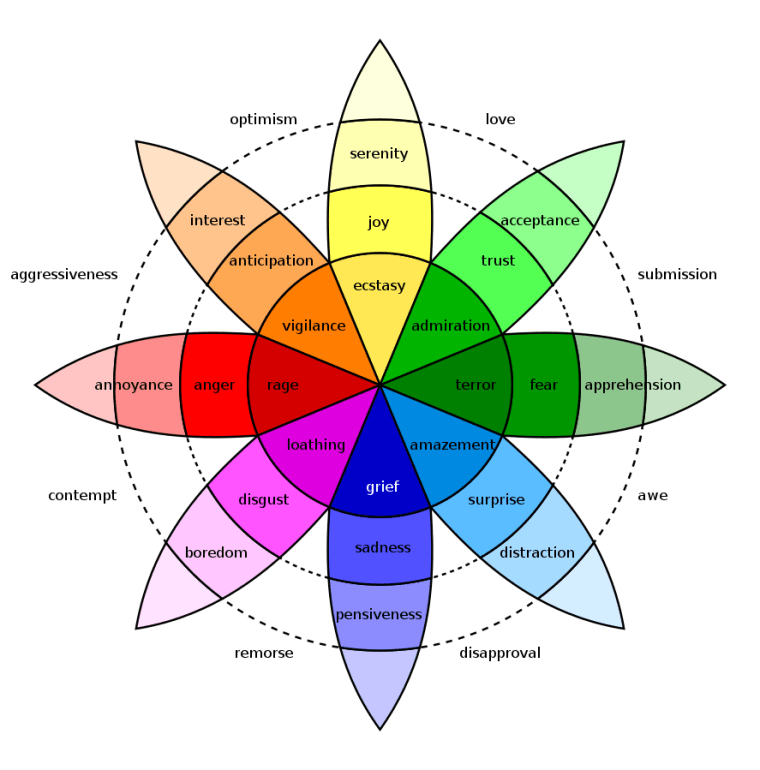
Plutchik Wheel

Emotional contagion is important to personal relationships because it fosters emotional synchrony between individuals. A broader definition of the phenomenon suggested by Schoenewolf is:

“a process in which a person or group influences the emotions or behavior of another person or group through the conscious or unconscious induction of emotion states and behavioral attitudes.”

One view developed by Elaine Hatfield, et al., is that this can be done through automatic mimicry and synchronisation of one’s expressions, vocalisations, postures, and movements with those of another person. When people unconsciously mirror their companions’ expressions of emotion, they come to feel reflections of those companions’ emotions.

In a 1993 paper, Psychologists Elaine Hatfield, John Cacioppo, and Richard Rapson define emotional contagion as “the tendency to automatically mimic and synchronize expressions, vocalizations, postures, and movements with those of another person’s [sic] and, consequently, to converge emotionally”. 

Hatfield, et al., theorise emotional contagion as a two-step process: First, we imitate people (e.g. if someone smiles at you, you smile back). Second, our own emotional experiences change based on the non-verbal signals of emotion that we give off. For example, smiling makes one feel happier, and frowning makes one feel worse. Mimicry seems to be one foundation of emotional movement between people.

Emotional contagion and empathy share similar characteristics, with the exception of the ability to differentiate between personal and pre-personal experiences, a process known as individuation. In The Art of Loving (1956), social psychologist Erich Fromm explores these differences, suggesting that autonomy is necessary for empathy, which is not found in emotional contagion.

Etymology

James Baldwin addressed “emotional contagion” in his 1897 work Social and Ethical Interpretations in Mental Development, though using the term “contagion of feeling”. Various 20th century scholars discussed the phenomena under the heading “social contagion”. The term “emotional contagion” first appeared in Arthur S. Reber’s 1985 The Penguin Dictionary of Psychology.

Influencing Factors

Several factors determine the rate and extent of emotional convergence in a group, including membership stability, mood-regulation norms, task interdependence, and social interdependence. Besides these event-structure properties, there are personal properties of the group’s members, such as openness to receive and transmit feelings, demographic characteristics, and dispositional affect that influence the intensity of emotional contagion.

Research

Research on emotional contagion has been conducted from a variety of perspectives, including organisational, social, familial, developmental, and neurological. While early research suggested that conscious reasoning, analysis, and imagination accounted for emotional contagion, some forms of more primitive emotional contagion are far more subtle, automatic, and universal.

Hatfield, Cacioppo, and Rapson’s 1993 research into emotional contagion reported that people’s conscious assessments of others’ feelings were heavily influenced by what others said. People’s own emotions, however, were more influenced by others’ nonverbal clues as to what they were really feeling. Recognizing emotions and acknowledging their origin can be one way to avoid emotional contagion. Transference of emotions has been studied in a variety of situations and settings, with social and physiological causes being two of the largest areas of research.

In addition to the social contexts discussed above, emotional contagion has been studied within organisations. Schrock, Leaf, and Rohr (2008) say organizations, like societies, have emotion cultures that consist of languages, rituals, and meaning systems, including rules about the feelings workers should, and should not, feel and display. They state that emotion culture is quite similar to “emotion climate”, otherwise known as morale, organisational morale, and corporate morale.  Furthermore, Worline, Wrzesniewski, and Rafaeli (2002): 318  mention that organizations have an overall “emotional capability”, while McColl-Kennedy, and Smith (2006)  examine “emotional contagion” in customer interactions. These terms arguably all attempt to describe a similar phenomenon; each term differs in subtle and somewhat indistinguishable ways.

Controversy

A controversial experiment demonstrating emotional contagion by using the social media platform Facebook was carried out in 2014 on 689,000 users by filtering positive or negative emotional content from their news feeds. The experiment sparked uproar among people who felt the study violated personal privacy. The 2014 publication of a research paper resulting from this experiment, “Experimental evidence of massive-scale emotional contagion through social networks”, a collaboration between Facebook and Cornell University, is described by Tony D. Sampson, Stephen Maddison, and Darren Ellis (2018) as a “disquieting disclosure that corporate social media and Cornell academics were so readily engaged with unethical experiments of this kind.” Tony D. Sampson et al. criticise the notion that “academic researchers can be insulated from ethical guidelines on the protection for human research subjects because they are working with a social media business that has ‘no obligation to conform’ to the principle of ‘obtaining informed consent and allowing participants to opt out’.” A subsequent study confirmed the presence of emotional contagion on Twitter without manipulating users’ timelines.

Beyond the ethical concerns, some scholars criticised the methods and reporting of the Facebook findings. John Grohol, writing for Psych Central, argued that despite its title and claims of “emotional contagion,” this study did not look at emotions at all. Instead, its authors used an application (called “Linguistic Inquiry and Word Count” or LIWC 2007) that simply counted positive and negative words in order to infer users’ sentiments. A shortcoming of the LIWC tool is that it does not understand negations. Hence, the tweet “I am not happy” would be scored as positive: “Since the LIWC 2007 ignores these subtle realities of informal human communication, so do the researchers.” Grohol concluded that given these subtleties, the effect size of the findings are little more than a “statistical blip.”

Kramer et al. (2014) found a 0.07%—that’s not 7 percent, that’s 1/15th of one percent!!—decrease in negative words in people’s status updates when the number of negative posts on their Facebook news feed decreased. Do you know how many words you’d have to read or write before you’ve written one less negative word due to this effect? Probably thousands.

Types

Emotions can be shared and mimicked in many ways. Taken broadly, emotional contagion can be either: implicit, undertaken by the receiver through automatic or self-evaluating processes; or explicit, undertaken by the transmitter through a purposeful manipulation of emotional states, to achieve a desired result.

Implicit

Unlike cognitive contagion, emotional contagion is less conscious and more automatic. It relies mainly on non-verbal communication, although emotional contagion can and does occur via telecommunication. For example, people interacting through e-mails and chats are affected by the other’s emotions, without being able to perceive the non-verbal cues.

One view, proposed by Hatfield and colleagues, describes emotional contagion as a primitive, automatic, and unconscious behaviour that takes place through a series of steps. When a receiver is interacting with a sender, he perceives the emotional expressions of the sender. The receiver automatically mimics those emotional expressions. Through the process of afferent feedback, these new expressions are translated into feeling the emotions the sender feels, thus leading to emotional convergence.

Another view, emanating from social comparison theories, sees emotional contagion as demanding more cognitive effort and being more conscious. According to this view, people engage in social comparison to see if their emotional reaction is congruent with the persons around them. The recipient uses the emotion as a type of social information to understand how he or she should be feeling. People respond differently to positive and negative stimuli; negative events tend to elicit stronger and quicker emotional, behavioural, and cognitive responses than neutral or positive events. So unpleasant emotions are more likely to lead to mood contagion than are pleasant emotions. Another variable is the energy level at which the emotion is displayed. Higher energy draws more attention to it, so the same emotional valence (pleasant or unpleasant) expressed with high energy is likely to lead to more contagion than if expressed with low energy.

Explicit

Aside from the automatic infection of feelings described above, there are also times when others’ emotions are being manipulated by a person or a group in order to achieve something. This can be a result of intentional affective influence by a leader or team member. Suppose this person wants to convince the others of something, he may do so by sweeping them up in his enthusiasm. In such a case, his positive emotions are an act with the purpose of “contaminating” the others’ feelings. A different kind of intentional mood contagion would be, for instance, giving the group a reward or treat, in order to alleviate their feelings.

The discipline of organisational psychology researches aspects of emotional labour. This includes the need to manage emotions so that they are consistent with organisational or occupational display rules, regardless of whether they are discrepant with internal feelings. In regard to emotional contagion, in work settings that require a certain display of emotions, one finds oneself obligated to display, and consequently feel, these emotions. If superficial acting develops into deep acting, emotional contagion is the byproduct of intentional affective impression management.

In Workplaces and Organisations

Intra-Group

Many organisations and workplaces encourage teamwork. Studies conducted by organisational psychologists highlight the benefits of work teams. Emotions come into play and a group emotion is formed.

The group’s emotional state influences factors such as cohesiveness, morale, rapport, and the team’s performance. For this reason, organisations need to take into account the factors that shape the emotional state of the work-teams, in order to harness the beneficial sides and avoid the detrimental sides of the group’s emotion. Managers and team leaders should be cautious with their behaviour, since their emotional influence is greater than that of a “regular” team member: leaders are more emotionally “contagious” than others.

Employee/Customer

The interaction between service employees and customers affects both customers’ assessments of service quality and their relationship with the service provider. Positive affective displays in service interactions are positively associated with important customer outcomes, such as intention to return and to recommend the store to a friend. It is the interest of organisations that their customers be happy, since a happy customer is a satisfied one. Research has shown that the emotional state of the customer is directly influenced by the emotions displayed by the employee/service provider via emotional contagion. But this influence depends on authenticity of the employee’s emotional display, such that if the employee is only surface-acting, the contagion is poor, in which case the beneficial effects will not occur.

Neurological Basis

Vittorio Gallese posits that mirror neurons are responsible for intentional attunement in relation to others. Gallese and colleagues at the University of Parma found a class of neurons in the premotor cortex that discharge either when macaque monkeys execute goal-related hand movements or when they watch others doing the same action. One class of these neurons fires with action execution and observation, and with sound production of the same action. Research in humans shows an activation of the premotor cortex and parietal area of the brain for action perception and execution.

Gallese says humans understand emotions through a simulated shared body state. The observers’ neural activation enables a direct experiential understanding. “Unmediated resonance” is a similar theory by Goldman and Sripada (2004). Empathy can be a product of the functional mechanism in our brain that creates embodied simulation. The other we see or hear becomes the “other self” in our minds. Other researchers have shown that observing someone else’s emotions recruits brain regions involved in:

  1. Experiencing similar emotions; and
  2. Producing similar facial expressions.

This combination indicates that the observer activates:

  1. A representation of the emotional feeling of the other individual which leads to emotional contagion; and
  2. A motor representation of the observed facial expression that could lead to facial mimicry.

In the brain, understanding and sharing other individuals’ emotions would thus be a combination of emotional contagion and facial mimicry. Importantly, more empathic individuals experience more brain activation in emotional regions while witnessing the emotions of other individuals.

Amygdala

The amygdala is one part of the brain that underlies empathy and allows for emotional attunement and creates the pathway for emotional contagion. The basal areas including the brain stem form a tight loop of biological connectedness, re-creating in one person the physiological state of the other. Psychologist Howard Friedman thinks this is why some people can move and inspire others. The use of facial expressions, voices, gestures and body movements transmit emotions to an audience from a speaker.

This page is based on the copyrighted Wikipedia article < https://en.wikipedia.org/wiki/Emotional_contagion >; it is used under the Creative Commons Attribution-ShareAlike 3.0 Unported License (CC-BY-SA). You may redistribute it, verbatim or modified, providing that you comply with the terms of the CC-BY-SA.

What is Behavioural Contagion?

Introduction

Behavioural contagion is a form of social contagion involving the spread of behaviour through a group (Social contagion involves behaviour, emotions, or conditions spreading spontaneously through a group or network). It refers to the propensity for a person to copy a certain behaviour of others who are either in the vicinity, or whom they have been exposed to. The term was originally used by Gustave Le Bon in his 1895 work The Crowd: A Study of the Popular Mind to explain undesirable aspects of behaviour of people in crowds. In the digital age, behavioural contagion is also concerned with the spread of online behaviour and information. A variety of behavioural contagion mechanisms were incorporated in models of collective human behaviour.

Behavioural contagion has been attributed to a variety of different factors. Often it is distinguished from collective behaviour that arises from a direct attempt at social influence. A prominent theory involves the reduction of restraints, put forth by Fritz Redl in 1949 and analysed in depth by Ladd Wheeler in 1966. Social psychologists acknowledge a number of other factors, which influence the likelihood of behavioural contagion occurring, such as deindividuation (Festinger, Pepitone, & Newcomb, 1952) and the emergence of social norms (Turner, 1964). In 1980, Freedman et al. have focused on the effects of physical factors on contagion, in particular, density and number.

J.O. Ogunlade (1979, p. 205) describes behavioural contagion as a “spontaneous, unsolicited and uncritical imitation of another’s behavior” that occurs when certain variables are met:

  • a) the observer and the model share a similar situation or mood (this is one way behavioural contagion can be readily applied to mob psychology);
  • b) the model’s behaviour encourages the observer to review his condition and to change it;
  • c) the model’s behaviour would assist the observer to resolve a conflict by reducing restraints, if copied; and
  • d) the model is assumed to be a positive reference individual.

Types of Contagion

Social contagion can occur through threshold models that assume that an individual needs to be convinced by a fraction of their social contacts above a given threshold to adopt a novel behaviour. Therefore, the number of exposures will not increase chances of contagion unless the number of source exposures pass a certain threshold. The threshold value can divide contagion processes to two types:

  • 1) Simple contagion; and
  • 2) Complex contagion.

Simple Contagion

The individual needs only one person displaying the novel behaviour to copy. For instance, cars travel in groups on a two-lane highway since the car in each cluster travels at a slower speed than the car behind it. This relative speed spreads through other cars who slow down to match the speed of the car in front.

Complex Contagion

The individual needs to be in contact with two or more sources exhibiting the novel behaviour. This is when copying behaviours needs reinforcement or encouragement from multiple sources. Multiple sources, especially close friends, can make imitation legitimate, credible and worthwhile due to collective effort put in. Examples of complex contagions can be copying risky behaviour or joining social movements and riots.

Factors

Strength of Ties

Social contagion in simple contagion models occurs most effectively through ‘weak’ and ‘long’ ties between social contacts. A ‘weak’ tie between two people means they do not interact as frequently and do not influence each other as close friends. However, a relationally ‘weak’ tie is structurally strong if it is ‘long’ because it connects socially distant people, showing greater outreach than a relationally ‘strong’ tie. These ‘long’ ties allow the flow of new information increasing rate of transmission that relationally strong ties cannot do. Even though close friends can strongly influence each other, they will not help each other learn about new opportunities, ideas or behaviours in socially distant settings if they all know the same things. Few ‘weak’ and ‘long’ ties can help spread information quickly between two socially distant strong networks of people. ‘Strong’ ties within those networks can help spread information amongst the peers.

On the other hand, complex social contagion processes require multiple sources of influence. This is not possible with few ‘weak’ ties: they need to be long and multiple in number to increase the probability of imitation between socially distant networks.

Structural Equivalence

However, social contagion can also occur in the absence of any ties during competition. This happens when two people are structurally equivalent i.e., they occupy the same position in a social network and have the same pattern of relationships with the same people. For instance, two students publishing the same kind of research under the same professor are structurally equivalent. The more similar their relations are with other people i.e. the more substitutable they are with one another, the more they will copy what the other is doing, if it makes them look better, to stay ahead of competition.

Reduction of Restraints

Behavioural contagion is a result of the reduction of fear or restraints – aspects of a group or situation which prevent certain behaviours from being performed (restraints or self-control is an aspect of inhibitory control, one of the core executive functions). Restraints are typically group-derived, meaning that the “observer”, the individual wishing to perform a certain behaviour, is constrained by the fear of rejection by the group, who would view this behaviour as a “lack of impulse control”.

An individual (the “observer”) wants to perform some behaviour, but that behaviour would violate the unspoken and accepted rules of the group or situation they are in; these rules are the restraints preventing the observer from performing that action. Once the restraints are broken or reduced the observer is then “free” to perform the behaviour; this is achieved by the “intervention” of the model. The model is another individual, in the same group or situation as the observer, who performs the behaviour which the observer wished to perform. Stephenson and Fielding (1971) describe this effect as “[Once] one member of a gathering has performed a commonly desired action, the payoffs for similar action or nonaction are materially altered. … [The] initiator, by his action, establishes an inequitable advantage over the other members of the gathering which they may proceed to nullify by following his example.”

Density and Number

Density refers to the amount of space available to a person – high density meaning there is less space per person – and number refers to the size of the group. Freedman (1975) put forth the intensification theory, which posits that high density makes the other people in a group more salient features of the environment, this magnifying the individual’s reaction to them. Research has shown that high density does in fact increase the likelihood of contagion (Freedman, 1975; Freedman, Birsky, & Cavoukian, 1980). Number also has an effect on contagion, but to a lesser degree than density.

Local Trend Imitation

However, the probability that an individual will copy a behaviour can also decrease with higher density and number of neighbours. For instance, a person might praise and go to a restaurant with good food based on others’ recommendations but avoid it when it becomes over-crowded. This depicts the local trend imitation phenomenon i.e. the adoption probability first increases with increase in number of adopted neighbours and then decreases.

Identity of the Model

Stephenson and Fielding (1971, p.81) state that the identity of the model is a factor that influences contagion. Depending on the behaviour, sex of the model may be a factor in the contagion of that behaviour being performed by other individuals – particularly in instances of adult models performing aggressive behaviour in the presence of children-observers (Bandura, Ross, & Ross, 1963) {Imitation of film-mediated aggressive models}. In this particular series of experiments – Albert Bandura’s Bobo doll experiments from 1961 and 1963 – where the behaviour of children was studied after the children watched an adult model punching a bobo doll and the model received a reward, a punishment, or there were no consequences, the analyses revealed that the male model influenced the participants’ behaviour to a greater extent than did the female model; this was true for both the aggressive and the nonaggressive male models (p.581).

Dominant Leaders

Aggressive behaviour or using coercion, fear or intimidation to imitate a behaviour is known as dominance. People are likely to follow dominant leaders to avoid the cost of punishment. However, such behaviour is more influential amongst children rather than adults: coercive children are thought to be more likeable whereas coercive adults are less likeable and, hence, influential.

Prestigious Influencers

While dominant behaviour is displayed in the animal kingdom as well, prestigious behaviour is unique to humans. Unlike animals, we understand the intentions behind someone’s actions rather than just being able to copy their movements precisely. This is important since it is easier to learn from the best models rather than learning by ourselves: We might know which behaviour contributes to someone’s success at mastering a skill. Hence, we look to see who everyone else is copying i.e. we tend to copy prestigious individuals. Prestigious people enjoy a high degree of influence and respect and are generally the people with the most information.

Ordinary People

A study done on the rate of information transmission via retweets on Twitter found that popular people i.e. people with a large following, are ‘inefficient hubs’ in spreading concepts. The more followers someone has, the more overloaded they are with information and lower the chances that they will retweet a particular message due to limited attention. Hence, rate of social contagion slows down.

Rather, social contagion can amplify amongst ‘ordinary’ users with low following if they are closely connected in a peer network. People are more likely to retweet messages by close friends to facilitate social bonding. Peers also have higher similar interests and are more influenced by each other than an ‘ordinary’ and ‘popular’ user who do not have mutual ties. Hence, social contagion can occur efficiently amongst tight community structures, in the absence of prestigious and dominant leaders.

Media

Mass media can greatly influence people’s opinions and amplify social contagion by reporting stories from socially distant and unconnected networks. They can help to turn minority opinions into the popular opinion, independent of the degree of connectivity between people.

Moreover, Bandura (1977) showed that children can learn and imitate fictitious characters on television.

Personality of the Observer

Ogunlade (1979) found that extroverts, who are described as impulsive and sociable individuals, are more likely to be susceptible to contagion than introverted individuals, who are described as reserved and emotionally controlled.

Social Norms

Gino, Ayal and Ariely (2009, p.394) state that an important factor influencing contagion is the degree to which the observer identifies with the others of the group. When identification with the rest of the group is strong, the behaviours of the others will have a larger influence.

However, high homophily or the likelihood of being connected to others with similar interests, can lead to both minority and majority groups overestimating their sizes and vice versa. This can cause people to falsely predict the frequency of their behaviour in the real world since they estimate based on their personal networks. When people overestimate the frequency of a particular behaviour, they may think that they are following social norms and, hence, are less willing to change. Encouraging interactions within heterophilic rather than homophilic social networks can facilitate social contagion more.

Similarities and Differences with Other Types of Social Influence

Contagion is only one of a myriad of types of social influence.

Conformity/Social Pressures

Conformity is a type of social influence that is very similar to contagion. It is almost identical to another type of social influence, “pressures toward uniformity” (social pressures) (Festinger, 1954), which differ only in the research techniques they are associated with (Wheeler, 1966, p.182).

Both conformity and contagion involve some sort of conflict, but differ in the roles other individuals play in that conflict. In conformity, the other individuals of the group try to pressure the observer into performing a behaviour; the model then performs some other behaviour in the vicinity of the observer. This results in the observer creating restraints against the pressured behaviour and a conflict between the pressured behaviour and the behaviour performed by the model. In the end, the observer either performs the model’s behaviour his-/herself, rejects the model, or pressures the model to perform the original pressured behaviour (Wheeler, Table 1). In contagion, the model’s behaviour results in the removing of restraints and the resolving of the conflict, while in conformity, the model’s behaviour results in the creation of restraints and of the conflict.

Social Facilitation

Social facilitation, another type of social influence, is distinguished from contagion, as well as from conformity and social pressures, by the lack of any marked conflict. It is said to occur when the performance of an instinctive pattern of behaviour by an individual acts as a releaser for the same behaviour in others, and so initiates the same line of action in the whole group (Thorpe, 1956, p.120). Bandura and Walters (1963, p.79), give the example of an adult, who has lost the unique aspects of the dialect of the region where they were raised, returns for a visit and “regains” those previously lost patterns of speech. Starch (1911) referred to this phenomenon as an “unintentional or unconscious imitation”.

Imitation

Imitation is different from contagion in that it is learned via reward and punishment and is generalised across situations. Imitation can also be a generic term for contagion, conformity, social pressures, and social facilitation.

Wheeler (1966)Dynamics of Selected Influence Processes
Stages in Influence ProcessBehavioural contagionSocial pressures and conformitySocial facilitation.
Observer’s Initial ConditionsInstigated to BN. Internal restraints against BN.Instigated to BP. No restraints.No restraints against BN or BP. No instigation to BN or BP.
Model’s BehaviourModel performs BN.Model performs BN.Model performs BN.
Hypothetical ProcessesReduction of model’s restraints against BN. Fear reduction.Creation of restraints against BP. Conflict between BN and BP.Cognitive-behavioural chaining, CS elicits CR, inertia overcome.
Observer’s BehaviourObserver performs BN.Observer performs BN (or rejects model or induces model to perform BP).Observer performs BN.

Notes:

  • BN = Initial behaviour.
  • BP = Pressured behaviour.
  • CS = Conditioned stimulus.
  • CR = Conditioned response.

Competition Contagion on Non-Competitors

While behavioural contagion is largely about how people might be affected by observations of the expressions or behaviour of others, research has also found contagion in the context of a competition where mere awareness of an ongoing competition can have an influence on noncompetitors’ task performance, without any information about the actual behaviour of the competitors.

Research

Effects of Group Pressure

Behavioural contagion, largely discussed in the behaviours of crowds, and closely related to emotional contagion, plays a large role in gatherings of two or more people. In the original Milgram experiment on obedience, for example, where participants, who were in a room with only the experimenter, were ordered to administer increasingly more severe electrical shocks as punishment to a person in another room (from here on referred to as the “victim”), the conflict or social restraint experienced by the participants was the obligation to not disobey the experimenter – even when shocking the victim to the highest shock level given, a behaviour which the participants saw as opposing their personal and social ideals (Milgram, 1965, p.129).

Milgram also conducted two other experiments, replications of his original obedience experiment, with the intent being to analyse the effect of group behaviour on participants: instead of the subject being alone with the experimenter, two confederates were utilised. In the first of the two experiments, “Groups for Disobedience”, the confederates defied the experimenter and refused to punish the victim (p.130). This produced a significant effect on the obedience of the participants: in the original experiment, 26 of the 40 participants administered the maximum shock; in the disobedient groups experiment, only 4 of 40 participants administered the highest level of voltage (Table 1). Despite this high correlation between shock level administered and the obedience of the group in the disobedient groups experiment, there was no significant correlation for the second of the replicated experiments: “Obedient Groups”, where the confederates did not disobey the experimenter and, when the participant voiced angst regarding the experiment and wished to stop administering volts to the victim, the confederates voiced their disapproval (p.133). Milgram concludes the study by remarking that “the insertion of group pressure in a direction opposite that of the experimenter’s commands produces a powerful shift toward the group. Changing the group movement does not yield a comparable shift in the [participant’s] performance. The group success in one case and failure in another can be traced directly to the configuration of motive and social forces operative in the starting situation.” That is, if the group’s attitudes are similar to or compatible with the participant’s/observer’s, there is a greater likelihood that the participant/observer will join with the group (p.134).

Overweight and Obesity

Network phenomena are relevant to obesity, which appears to spread through social ties. Teenagers of US Army families assigned to counties with higher obesity rates were more likely to become overweight or obese in a 2018 study. This effect could not be explained by self-selection (homophily) or shared built environments and is attributed to social contagion.

This page is based on the copyrighted Wikipedia article < https://en.wikipedia.org/wiki/Behavioral_contagion >; it is used under the Creative Commons Attribution-ShareAlike 3.0 Unported License (CC-BY-SA). You may redistribute it, verbatim or modified, providing that you comply with the terms of the CC-BY-SA.

What is Emotional Contagion?

Introduction

Emotional contagion is a form of social contagion that involves the spontaneous spread of emotions and related behaviours. Such emotional convergence can happen from one person to another, or in a larger group. Emotions can be shared across individuals in many ways, both implicitly or explicitly. For instance, conscious reasoning, analysis, and imagination have all been found to contribute to the phenomenon. The behaviour has been found in humans, other primates, dogs, and chickens.

Emotional contagion is important to personal relationships because it fosters emotional synchrony between individuals. A broader definition of the phenomenon suggested by Schoenewolf is “a process in which a person or group influences the emotions or behavior of another person or group through the conscious or unconscious induction of emotion states and behavioral attitudes.” One view developed by Elaine Hatfield, et al., is that this can be done through automatic mimicry and synchronisation of one’s expressions, vocalisations, postures, and movements with those of another person. When people unconsciously mirror their companions’ expressions of emotion, they come to feel reflections of those companions’ emotions.

In a 1993 paper, Psychologists Elaine Hatfield, John Cacioppo, and Richard Rapson define emotional contagion as “the tendency to automatically mimic and synchronize expressions, vocalizations, postures, and movements with those of another person’s [sic] and, consequently, to converge emotionally”. 

Hatfield, et al., theorise emotional contagion as a two-step process: First, we imitate people (e.g. if someone smiles at you, you smile back). Second, our own emotional experiences change based on the non-verbal signals of emotion that we give off. For example, smiling makes one feel happier, and frowning makes one feel worse. Mimicry seems to be one foundation of emotional movement between people.

Emotional contagion and empathy share similar characteristics, with the exception of the ability to differentiate between personal and pre-personal experiences, a process known as individuation. In The Art of Loving (1956), social psychologist Erich Fromm explores these differences, suggesting that autonomy is necessary for empathy, which is not found in emotional contagion.

Etymology

James Baldwin addressed “emotional contagion” in his 1897 work Social and Ethical Interpretations in Mental Development, though using the term “contagion of feeling”. Various 20th century scholars discussed the phenomena under the heading “social contagion”. The term “emotional contagion” first appeared in Arthur S. Reber’s 1985 The Penguin Dictionary of Psychology.

Influencing Factors

Several factors determine the rate and extent of emotional convergence in a group, including membership stability, mood-regulation norms, task interdependence, and social interdependence. Besides these event-structure properties, there are personal properties of the group’s members, such as openness to receive and transmit feelings, demographic characteristics, and dispositional affect that influence the intensity of emotional contagion.

Research

Research on emotional contagion has been conducted from a variety of perspectives, including organisational, social, familial, developmental, and neurological. While early research suggested that conscious reasoning, analysis, and imagination accounted for emotional contagion, some forms of more primitive emotional contagion are far more subtle, automatic, and universal.

Hatfield, Cacioppo, and Rapson’s 1993 research into emotional contagion reported that people’s conscious assessments of others’ feelings were heavily influenced by what others said. People’s own emotions, however, were more influenced by others’ nonverbal clues as to what they were really feeling. Recognising emotions and acknowledging their origin can be one way to avoid emotional contagion. Transference of emotions has been studied in a variety of situations and settings, with social and physiological causes being two of the largest areas of research.

In addition to the social contexts discussed above, emotional contagion has been studied within organizations. Schrock, Leaf, and Rohr (2008) say organisations, like societies, have emotion cultures that consist of languages, rituals, and meaning systems, including rules about the feelings workers should, and should not, feel and display. They state that emotion culture is quite similar to “emotion climate”, otherwise known as morale, organizational morale, and corporate morale.  Furthermore, Worline, Wrzesniewski, and Rafaeli (2002)  mention that organisations have an overall “emotional capability”, while McColl-Kennedy, and Smith (2006)  examine “emotional contagion” in customer interactions. These terms arguably all attempt to describe a similar phenomenon; each term differs in subtle and somewhat indistinguishable ways.

Controversy

A controversial experiment demonstrating emotional contagion by using the social media platform Facebook was carried out in 2014 on 689,000 users by filtering positive or negative emotional content from their news feeds. The experiment sparked uproar among people who felt the study violated personal privacy. The 2014 publication of a research paper resulting from this experiment, “Experimental evidence of massive-scale emotional contagion through social networks”, a collaboration between Facebook and Cornell University, is described by Tony D. Sampson, Stephen Maddison, and Darren Ellis (2018) as a “disquieting disclosure that corporate social media and Cornell academics were so readily engaged with unethical experiments of this kind.” Tony D. Sampson et al. criticise the notion that “academic researchers can be insulated from ethical guidelines on the protection for human research subjects because they are working with a social media business that has ‘no obligation to conform’ to the principle of ‘obtaining informed consent and allowing participants to opt out’.” A subsequent study confirmed the presence of emotional contagion on Twitter without manipulating users’ timelines.

Beyond the ethical concerns, some scholars criticised the methods and reporting of the Facebook findings. John Grohol, writing for Psych Central, argued that despite its title and claims of “emotional contagion,” this study did not look at emotions at all. Instead, its authors used an application (called “Linguistic Inquiry and Word Count” or LIWC 2007) that simply counted positive and negative words in order to infer users’ sentiments. A shortcoming of the LIWC tool is that it does not understand negations. Hence, the tweet “I am not happy” would be scored as positive: “Since the LIWC 2007 ignores these subtle realities of informal human communication, so do the researchers.” Grohol concluded that given these subtleties, the effect size of the findings are little more than a “statistical blip.”

Kramer et al. (2014) found a 0.07%—that’s not 7 percent, that’s 1/15th of one percent!!—decrease in negative words in people’s status updates when the number of negative posts on their Facebook news feed decreased. Do you know how many words you’d have to read or write before you’ve written one less negative word due to this effect? Probably thousands.

Types

Emotions can be shared and mimicked in many ways. Taken broadly, emotional contagion can be either: implicit, undertaken by the receiver through automatic or self-evaluating processes; or explicit, undertaken by the transmitter through a purposeful manipulation of emotional states, to achieve a desired result.

Implicit

Unlike cognitive contagion, emotional contagion is less conscious and more automatic. It relies mainly on non-verbal communication, although emotional contagion can and does occur via telecommunication. For example, people interacting through e-mails and chats are affected by the other’s emotions, without being able to perceive the non-verbal cues.

One view, proposed by Hatfield and colleagues, describes emotional contagion as a primitive, automatic, and unconscious behaviour that takes place through a series of steps. When a receiver is interacting with a sender, he perceives the emotional expressions of the sender. The receiver automatically mimics those emotional expressions. Through the process of afferent feedback, these new expressions are translated into feeling the emotions the sender feels, thus leading to emotional convergence.

Another view, emanating from social comparison theories, sees emotional contagion as demanding more cognitive effort and being more conscious. According to this view, people engage in social comparison to see if their emotional reaction is congruent with the persons around them. The recipient uses the emotion as a type of social information to understand how he or she should be feeling. People respond differently to positive and negative stimuli; negative events tend to elicit stronger and quicker emotional, behavioural, and cognitive responses than neutral or positive events. So unpleasant emotions are more likely to lead to mood contagion than are pleasant emotions. Another variable is the energy level at which the emotion is displayed. Higher energy draws more attention to it, so the same emotional valence (pleasant or unpleasant) expressed with high energy is likely to lead to more contagion than if expressed with low energy.

Explicit

Aside from the automatic infection of feelings described above, there are also times when others’ emotions are being manipulated by a person or a group in order to achieve something. This can be a result of intentional affective influence by a leader or team member. Suppose this person wants to convince the others of something, he may do so by sweeping them up in his enthusiasm. In such a case, his positive emotions are an act with the purpose of “contaminating” the others’ feelings. A different kind of intentional mood contagion would be, for instance, giving the group a reward or treat, in order to alleviate their feelings.

The discipline of organisational psychology researches aspects of emotional labour. This includes the need to manage emotions so that they are consistent with organisational or occupational display rules, regardless of whether they are discrepant with internal feelings. In regard to emotional contagion, in work settings that require a certain display of emotions, one finds oneself obligated to display, and consequently feel, these emotions. If superficial acting develops into deep acting, emotional contagion is the by-product of intentional affective impression management.

In Workplaces and Organisations

Intra-Group

Many organisations and workplaces encourage teamwork. Studies conducted by organisational psychologists highlight the benefits of work teams. Emotions come into play and a group emotion is formed.

The group’s emotional state influences factors such as cohesiveness, morale, rapport, and the team’s performance. For this reason, organizations need to take into account the factors that shape the emotional state of the work-teams, in order to harness the beneficial sides and avoid the detrimental sides of the group’s emotion. Managers and team leaders should be cautious with their behaviour, since their emotional influence is greater than that of a “regular” team member: leaders are more emotionally “contagious” than others.

Employee/Customer

The interaction between service employees and customers affects both customers’ assessments of service quality and their relationship with the service provider. Positive affective displays in service interactions are positively associated with important customer outcomes, such as intention to return and to recommend the store to a friend. It is the interest of organisations that their customers be happy, since a happy customer is a satisfied one. Research has shown that the emotional state of the customer is directly influenced by the emotions displayed by the employee/service provider via emotional contagion. But this influence depends on authenticity of the employee’s emotional display, such that if the employee is only surface-acting, the contagion is poor, in which case the beneficial effects will not occur.

Neurological Basis

Vittorio Gallese posits that mirror neurons are responsible for intentional attunement in relation to others. Gallese and colleagues at the University of Parma found a class of neurons in the premotor cortex that discharge either when macaque monkeys execute goal-related hand movements or when they watch others doing the same action. One class of these neurons fires with action execution and observation, and with sound production of the same action. Research in humans shows an activation of the premotor cortex and parietal area of the brain for action perception and execution.

Gallese says humans understand emotions through a simulated shared body state. The observers’ neural activation enables a direct experiential understanding. “Unmediated resonance” is a similar theory by Goldman and Sripada (2004).[citation needed] Empathy can be a product of the functional mechanism in our brain that creates embodied simulation. The other we see or hear becomes the “other self” in our minds. Other researchers have shown that observing someone else’s emotions recruits brain regions involved in:

  • (a) experiencing similar emotions; and
  • (b) producing similar facial expressions.

This combination indicates that the observer activates:

  • (a) a representation of the emotional feeling of the other individual which leads to emotional contagion; and
  • (b) a motor representation of the observed facial expression that could lead to facial mimicry.

In the brain, understanding and sharing other individuals’ emotions would thus be a combination of emotional contagion and facial mimicry. Importantly, more empathic individuals experience more brain activation in emotional regions while witnessing the emotions of other individuals.

Amygdala

The amygdala is one part of the brain that underlies empathy and allows for emotional attunement and creates the pathway for emotional contagion. The basal areas including the brain stem form a tight loop of biological connectedness, re-creating in one person the physiological state of the other. Psychologist Howard Friedman thinks this is why some people can move and inspire others. The use of facial expressions, voices, gestures and body movements transmit emotions to an audience from a speaker.

This page is based on the copyrighted Wikipedia article < https://en.wikipedia.org/wiki/Emotional_contagion >; it is used under the Creative Commons Attribution-ShareAlike 3.0 Unported License (CC-BY-SA). You may redistribute it, verbatim or modified, providing that you comply with the terms of the CC-BY-SA.