In excitotoxicity, nerve cells suffer damage or death when the levels of otherwise necessary and safe neurotransmitters such as glutamate become pathologically high, resulting in excessive stimulation of receptors. For example, when glutamate receptors such as the NMDA receptor or AMPA receptor encounter excessive levels of the excitatory neurotransmitter, glutamate, significant neuronal damage might ensue. Excess glutamate allows high levels of calcium ions (Ca2+) to enter the cell. Ca2+ influx into cells activates a number of enzymes, including phospholipases, endonucleases, and proteases such as calpain. These enzymes go on to damage cell structures such as components of the cytoskeleton, membrane, and DNA. In evolved, complex adaptive systems such as biological life it must be understood that mechanisms are rarely, if ever, simplistically direct. For example, NMDA in subtoxic amounts induces neuronal survival of otherwise toxic levels of glutamate.
Excitotoxicity may be involved in cancers, spinal cord injury, stroke, traumatic brain injury, hearing loss (through noise overexposure or ototoxicity), and in neurodegenerative diseases of the central nervous system such as multiple sclerosis, Alzheimer’s disease, amyotrophic lateral sclerosis (ALS), Parkinson’s disease, alcoholism, alcohol withdrawal or hyperammonaemia and especially over-rapid benzodiazepine withdrawal, and also Huntington’s disease. Other common conditions that cause excessive glutamate concentrations around neurons are hypoglycaemia. Blood sugars are the primary glutamate removal method from inter-synaptic spaces at the NMDA and AMPA receptor site. Persons in excitotoxic shock must never fall into hypoglycaemia. Patients should be given 5% glucose (dextrose) IV drip during excitotoxic shock to avoid a dangerous build up of glutamate around NMDA and AMPA neurons. When 5% glucose (dextrose) IV drip is not available high levels of fructose are given orally. Treatment is administered during the acute stages of excitotoxic shock along with glutamate antagonists. Dehydration should be avoided as this also contributes to the concentrations of glutamate in the inter-synaptic cleft and “status epilepticus can also be triggered by a build up of glutamate around inter-synaptic neurons.”
The harmful effects of glutamate on the central nervous system were first observed in 1954 by T. Hayashi, a Japanese scientist who stated that direct application of glutamate caused seizure activity, though this report went unnoticed for several years. D.R. Lucas and J.P. Newhouse, after noting that “single doses of [20–30 grams of sodium glutamate in humans] have … been administered intravenously without permanent ill-effects”, observed in 1957 that a subcutaneous dose described as “a little less than lethal”, destroyed the neurons in the inner layers of the retina in newborn mice. In 1969, John Olney discovered that the phenomenon was not restricted to the retina, but occurred throughout the brain, and coined the term excitotoxicity. He also assessed that cell death was restricted to postsynaptic neurons, that glutamate agonists were as neurotoxic as their efficiency to activate glutamate receptors, and that glutamate antagonists could stop the neurotoxicity.
In 2002, Hilmar Bading and co-workers found that excitotoxicity is caused by the activation of NMDA receptors located outside synaptic contacts. The molecular basis for toxic extrasynaptic NMDA receptor signalling was uncovered in 2020 when Hilmar Bading and co-workers described a death signalling complex that consists of extrasynaptic NMDA receptor and TRPM4. Disruption of this complex using NMDAR/TRPM4 interface inhibitors (also known as ‚interface inhibitors‘) renders extrasynaptic NMDA receptor non-toxic.
Pathophysiology
Excitotoxicity can occur from substances produced within the body (endogenous excitotoxins). Glutamate is a prime example of an excitotoxin in the brain, and it is also the major excitatory neurotransmitter in the central nervous system of mammals. During normal conditions, glutamate concentration can be increased up to 1mM in the synaptic cleft, which is rapidly decreased in the lapse of milliseconds. When the glutamate concentration around the synaptic cleft cannot be decreased or reaches higher levels, the neuron kills itself by a process called apoptosis.
This pathologic phenomenon can also occur after brain injury and spinal cord injury. Within minutes after spinal cord injury, damaged neural cells within the lesion site spill glutamate into the extracellular space where glutamate can stimulate presynaptic glutamate receptors to enhance the release of additional glutamate. Brain trauma or stroke can cause ischemia, in which blood flow is reduced to inadequate levels. Ischemia is followed by accumulation of glutamate and aspartate in the extracellular fluid, causing cell death, which is aggravated by lack of oxygen and glucose. The biochemical cascade resulting from ischemia and involving excitotoxicity is called the ischemic cascade. Because of the events resulting from ischemia and glutamate receptor activation, a deep chemical coma may be induced in patients with brain injury to reduce the metabolic rate of the brain (its need for oxygen and glucose) and save energy to be used to remove glutamate actively. (The main aim in induced comas is to reduce the intracranial pressure, not brain metabolism).
Increased extracellular glutamate levels leads to the activation of Ca2+ permeable NMDA receptors on myelin sheaths and oligodendrocytes, leaving oligodendrocytes susceptible to Ca2+ influxes and subsequent excitotoxicity. One of the damaging results of excess calcium in the cytosol is initiating apoptosis through cleaved caspase processing. Another damaging result of excess calcium in the cytosol is the opening of the mitochondrial permeability transition pore, a pore in the membranes of mitochondria that opens when the organelles absorb too much calcium. Opening of the pore may cause mitochondria to swell and release reactive oxygen species and other proteins that can lead to apoptosis. The pore can also cause mitochondria to release more calcium. In addition, production of adenosine triphosphate (ATP) may be stopped, and ATP synthase may in fact begin hydrolysing ATP instead of producing it, which is suggested to be involved in depression.
Inadequate ATP production resulting from brain trauma can eliminate electrochemical gradients of certain ions. Glutamate transporters require the maintenance of these ion gradients to remove glutamate from the extracellular space. The loss of ion gradients results in not only the halting of glutamate uptake, but also in the reversal of the transporters. The Na+-glutamate transporters on neurons and astrocytes can reverse their glutamate transport and start secreting glutamate at a concentration capable of inducing excitotoxicity. This results in a buildup of glutamate and further damaging activation of glutamate receptors.
On the molecular level, calcium influx is not the only factor responsible for apoptosis induced by excitoxicity. Recently, it has been noted that extrasynaptic NMDA receptor activation, triggered by both glutamate exposure or hypoxic/ischemic conditions, activate a CREB (cAMP response element binding) protein shut-off, which in turn caused loss of mitochondrial membrane potential and apoptosis. On the other hand, activation of synaptic NMDA receptors activated only the CREB pathway, which activates BDNF (brain-derived neurotrophic factor), not activating apoptosis
Exogenous Excitotoxins
Exogenous excitotoxins refer to neurotoxins that also act at postsynaptic cells but are not normally found in the body. These toxins may enter the body of an organism from the environment through wounds, food intake, aerial dispersion etc. Common excitotoxins include glutamate analogues that mimic the action of glutamate at glutamate receptors, including AMPA and NMDA receptors.
BMAA
The L-alanine derivative β-methylamino-L-alanine (BMAA) has long been identified as a neurotoxin which was first associated with the amyotrophic lateral sclerosis/parkinsonism–dementia complex (Lytico-bodig disease) in the Chamorro people of Guam. The widespread occurrence of BMAA can be attributed to cyanobacteria which produce BMAA as a result of complex reactions under nitrogen stress.
Following research, excitotoxicity appears to be the likely mode of action for BMAA which acts as a glutamate agonist, activating AMPA and NMDA receptors and causing damage to cells even at relatively low concentrations of 10 μM.[31] The subsequent uncontrolled influx of Ca2+ then leads to the pathophysiology described above. Further evidence of the role of BMAA as an excitotoxin is rooted in the ability of NMDA antagonists like MK801 to block the action of BMAA. More recently, evidence has been found that BMAA is mis-incorporated in place of L-serine in human proteins. A considerable portion of the research relating to the toxicity of BMAA has been conducted on rodents. A study published in 2016 with vervets (Chlorocebus sabaeus) in St. Kitts, which are homozygous for the apoE4 (APOE-ε4) allele (a condition which in humans is a risk factor for Alzheimer’s disease), found that vervets orally administered BMAA developed hallmark histopathology features of Alzheimer’s Disease including amyloid beta plaques and neurofibrillary tangle accumulation. Vervets in the trial fed smaller doses of BMAA were found to have correlative decreases in these pathology features. This study demonstrates that BMAA, an environmental toxin, can trigger neurodegenerative disease as a result of a gene/environment interaction.
While BMAA has been detected in brain tissue of deceased ALS/PDC patients, further insight is required to trace neurodegenerative pathology in humans to BMAA.
This page is based on the copyrighted Wikipedia article < https://en.wikipedia.org/wiki/Excitotoxicity >; it is used under the Creative Commons Attribution-ShareAlike 3.0 Unported License (CC-BY-SA). You may redistribute it, verbatim or modified, providing that you comply with the terms of the CC-BY-SA.
The glutamate hypothesis of schizophrenia models the subset of pathologic mechanisms of schizophrenia linked to glutamatergic signalling. The hypothesis was initially based on a set of clinical, neuropathological, and, later, genetic findings pointing at a hypofunction of glutamatergic signalling via NMDA receptors. While thought to be more proximal to the root causes of schizophrenia, it does not negate the dopamine hypothesis, and the two may be ultimately brought together by circuit-based models. The development of the hypothesis allowed for the integration of the GABAergic and oscillatory abnormalities into the converging disease model and made it possible to discover the causes of some disruptions.
Like the dopamine hypothesis, the development of the glutamate hypothesis developed from the observed effects of mind-altering drugs. However, where dopamine agonists can mimic positive symptoms with significant risks to brain structures during and after use, NMDA antagonists mimic some positive and negative symptoms with less brain harm, when combined with a GABAA activating drug. Likely, both dopaminergic and glutaminergic abnormalities are implicated in schizophrenia, from a profound alteration in the function of the chemical synapses, as well as electrical synaptic irregularities. These form a portion of the complex constellation of factors, neurochemically, psychologically, psychosocially, and structurally, which result in schizophrenia.
Alteration in the expression, distribution, autoregulation, and prevalence of specific glutamate heterodimers alters relative levels of paired G proteins to the heterodimer-forming glutamate receptor in question.
Namely: 5HT2A and mGlu2 form a dimer which mediates psychotomimetic and entheogenic effects of psychedelics; as such this receptor is of interest in schizophrenia. Agonists at either constituent receptor may modulate the other receptor allosterically; e.g. glutamate-dependent signalling via mGlu2 may modulate 5HT2A-ergic activity. Equilibrium between mGlu2/5HT2A is altered against tendency towards of psychosis by neuroleptic-pattern 5HT2A antagonists and mGlu2 agonists; both display antipsychotic activity. AMPA, the most widely distributed receptor in the brain, is a tetrameric ionotropic receptor; alterations in equilibrium between constituent subunits are seen in mGlu2/5HT2A antagonist (antipsychotic) administration- GluR2 is seen to be upregulated in the PFC while GluR1 downregulates in response to antipsychotic administration.
Reelin abnormalities may also be involved in the pathogenesis of schizophrenia via a glutamate-dependent mechanism. Reelin expression deficits are seen in schizophrenia, and reelin enhances expression of AMPA and NMDA alike. As such deficits in these two ionotropic glutamate receptors may be partially explained by altered reelin cascades. Neuregulin 1 deficits may also be involved in glutaminergic hypofunction as NRG1 hypofunction leads to schizophrenia-pattern behaviour in mice; likely due in part to reduced NMDA signalling via Src suppression.
The Role of Synaptic Pruning
Various neurotrophic factors dysregulate in schizophrenia and other mental illnesses, namely BDNF; expression of which is lowered in schizophrenia as well as in major depression and bipolar disorder. BDNF regulates in an AMPA-dependent mechanism – AMPA and BDNF alike are critical mediators of growth cone survival. NGF, another neurotrophin involved in maintenance of synaptic plasticity is similarly seen in deficit.
Dopaminergic excess, classically understood to result in schizophrenia, puts oxidative load on neurons; leading to inflammatory response and microglia activation. Similarly, toxoplasmosis infection in the CNS (positively correlated to schizophrenia) activates inflammatory cascades, also leading to microglion activation. The lipoxygenase-5 inhibitor minocycline has been seen to be marginally effective in halting schizophrenia progression. One of such inflammatory cascades’ downstream transcriptional target, NF-κB, is observed to have altered expression in schizophrenia.
In addition, CB2 is one of the most widely distributed glial cell-expressed receptors, downregulation of this inhibitory receptor may increase global synaptic pruning activity. While difference in expression or distribution is observed, when the CB2 receptor is knocked out in mice, schizophreniform behaviours manifest. This may deregulate synaptic pruning processes in a tachyphlaxis mechanism wherein immediate excess CB2 activity leads to phosphorylation of the receptor via GIRK, resultant in b-arrestin-dependent internalisation and subsequent trafficking to the proteasome for degradation.
The Role of Endogenous Antagonists
Alterations in production of endogenous NMDA antagonists such as agmatine and kynurenic acid have been shown in schizophrenia. Deficit in NMDA activity produces psychotomimetic effects, though it remains to be seen if the blockade of NMDA via these agents is causative or actually mimetic of patterns resultant from monoaminergic disruption.
AMPA, the most widely distributed receptor in the brain, mediates long term potentiation via activity-dependent modulation of AMPA density. GluR1 subunit-containing AMPA receptors are Ca2+ permeable while GluR2/3 subunit-positive receptors are nearly impermeable to calcium ions. In the regulated pathway, GluR1 dimers populate the synapse at a rate proportional to NMDA-ergic Ca2+ influx. In the constitutative pathway, GluR2/3 dimers populate the synapse at a steady state.
This forms a positive feedback loop, where a small trigger impulse degating NMDA from Mg2+ pore blockade results in calcium influx, this calcium influx then triggers trafficking of GluR1-containing(Ca2+ permeable) subunits to the PSD, such trafficking of GluR1-positive AMPA to the postsynaptic neuron allows for upmodulation of the postsynaptic neuron’s calcium influx in response to presynaptic calcium influx. Robust negative feedback at NMDA from kynurenic acid, magnesium, zinc, and agmatine prevents runaway feedback.
Misregulation of this pathway would sympathetically dysregulate LTP via disruption of NMDA. Such alteration in LTP may play a role, specifically in negative symptoms of schizophrenia, in creation of more broad disruptions such as loss of brain volume; an effect of the disease which antidopaminergics actually worsen, rather than treat.
The Role of a7 Nicotinic
Anandamide, an endocannabinoid, is an a7 nicotinic antagonist. Cigarettes, consumed far out of proportion by schizophrenics, contain nornitrosonicotine; a potent a7 antagonist. This may indicate a7 pentameter excess as a causative factor, or possibly as a method of self-medication to combat antipsychotic side effects. Cannabidiol, a FAAH inhibitor, increases levels in anandamide and may have antipsychotic effect; though results are mixed here as anandamide also is a cannabinoid and as such displays some psychotomimetic effect. However, a7 nicotinic agonists have been indicated as potential treatments for schizophrenia, though evidence is somewhat contradictory there is indication a7 nAChR is somehow involved in the pathogenesis of schizophrenia.
The Role of 5-HT
This deficit in activation also results in a decrease in activity of 5-HT1A receptors in the raphe nucleus. This serves to increase global serotonin levels, as 5-HT1A serves as an autoreceptor. The 5-HT1B receptor, also acting as an autoreceptor, specifically within the striatum, but also parts of basal ganglia then will inhibit serotonin release. This disinhibits frontal dopamine release. The local deficit of 5-HT within the striatum, basal ganglia, and prefrontal cortex causes a deficit of excitatory 5-HT6 signalling. This could possibly be the reason antipsychotics sometimes are reported to aggravate negative symptoms as antipsychotics are 5HT6 antagonists This receptor is primarily GABAergic, as such, it causes an excess of glutamatergic, noradrenergic, dopaminergic, and cholinergic activity within the prefrontal cortex and the striatum. An excess of 5-HT7 signaling within the thalamus also creates too much excitatory transmission to the prefrontal cortex. Combined with another critical abnormality observed in those with schizophrenia: 5-HT2A dysfunction, this altered signalling cascade creates cortical, thus cognitive abnormalities. 5-HT2A allows a link between cortical, thus conscious, and the basal ganglia, unconscious. Axons from 5-HT2A neurons in layer V of the cerebral cortex reach the basal ganglia, forming a feedback loop. Signalling from layer V of the cerebral cortex to the basal ganglia alters 5-HT2C signalling. This feedback loop with 5-HT2A/5-HT2C is how the outer cortex layers can exert some control over our neuropeptides, specifically opioid peptides, oxytocin and vasopressin. This alteration in this limbic-layer V axis may create the profound change in social cognition (and sometimes cognition as a whole) that is observed in schizophrenia. However, genesis of the actual alterations is a much more complex phenomena.
The Role of Inhibitory Transmission
The cortico-basal ganglia-thalamo-cortical loop is the source of the ordered input necessary for a higher level upper cortical loop. Feedback is controlled by the inhibitory potential of the cortices via the striatum. Through 5-HT2A efferents from layer V of the cortex transmission proceeds through the striatum into the globulus pallidus internal and substantia nigra pars compacta. This core input to the basal ganglia is combined with input from the subthalamic nucleus. The only primarily dopaminergic pathway in this loop is a reciprocal connection from the substantia nigra pars reticulata to the striatum.
Dopaminergic drugs such as dopamine releasing agents and direct dopamine receptor agonists create alterations in this primarily GABAergic pathway via increased dopaminergic feedback from the substantia nigra pars compacta to the striatum. However, dopamine also modulates other cortical areas, namely the VTA; with efferents to the amygdala and locus coeruleus, likely modulating anxiety and paranoid aspects of psychotic experience. As such, the glutamate hypothesis is probably not an explanation of primary causative factors in positive psychosis, but rather might possibly be an explanation for negative symptoms.
Again, thalamic input from layer V is a crucial factor in the functionality of the human brain. It allows the two sides to receive similar inputs, thus be able to perceive the same world. In psychosis, thalamic input loses much of its integrated character: hyperactive core feedback loops overwhelm the ordered output. This is due to excessive D2 and 5-HT2A activity. This alteration in input to the top and bottom of the cortex. The altered 5-HT signal cascade enhances the strength of excitatory thalamic input from layer V. This abnormality, enhancing the thalamic-cortical transmission cascade versus the corticostriatal control, creates a feedback loop, resulting in abnormally strong basal ganglia output.
The root of psychosis (experiences that cannot be explained, even within their own mind) is when basal ganglia input to layer V overwhelms the inhibitory potential of the higher cortexies resulting from striatal transmission. When combined with the excess prefrontal, specifically orbitofrontal transmission, from the hippocampus, this creates a brain prone to falling into self reinforcing belief.
However, given a specific environment, a person with this kind of brain (a human) can create a self-reinforcing pattern of maladaptive behaviour, from the altered the layer II/III and III/I axises, from the disinhibited thalamic output. Rationality is impaired, primarily as response to the deficit of oxytocin and excess of vasopressin from the abnormal 5HT2C activity.
Frontal cortex activity will be impaired, when combined with excess DA activity: the basis for the advancement of schizophrenia, but it is also the neurologic mechanism behind many other psychotic diseases as well. Heredation of schizophrenia may even be a result of conspecific “refrigerator parenting” techniques passed on though generations. However, the genetic component is the primary source of the neurological abnormalities which leave one prone to psychological disorders. Specifically, there is much overlap between bipolar disorder and schizophrenia, and other psychotic disorders.
Psychotic disorder is linked to excessive drug use, specifically dissociatives, psychedelics, stimulants, and marijuana.
Treatment
Alterations in serine racemase indicate that the endogenous NMDA agonist D-serine may be produced abnormally in schizophrenia and that d-serine may be an effective treatment for schizophrenia.
Schizophrenia is now treated by medications known as antipsychotics (or neuroleptics) that typically reduce dopaminergic activity because too much activity has been most strongly linked to positive symptoms, specifically persecutory delusions. Dopaminergic drugs do not induce the characteristic auditory hallucinations of schizophrenia. Dopaminergic drug abuse such as abuse of methamphetamine may result in a short lasting psychosis or provocation of a longer psychotic episode that may include symptoms of auditory hallucinations. The typical antipsychotics are known to have significant risks of side effects that can increase over time, and only show clinical effectiveness in reducing positive symptoms. Additionally, although newer atypical antipsychotics can have less affinity for dopamine receptors and still reduce positive symptoms, do not significantly reduce negative symptoms.
Psychotomimetic Glutamate Antagonists
Ketamine and PCP were observed to produce significant similarities to schizophrenia. Ketamine produces more similar symptoms (hallucinations, withdrawal) without observed permanent effects (other than ketamine tolerance). Both arylcyclohexamines have some(uM) affinity to D2 and as triple reuptake inhibitors. PCP is representative symptomatically, but does appear to cause brain structure changes seen in schizophrenia. Although unconfirmed, Dizocilpine discovered by a team at Merck seems to model both the positive and negative effects in a manner very similar to schizophreniform disorders.
Possible Glutamate based Treatment
An early clinical trial by Eli Lilly of the drug LY2140023 has shown potential for treating schizophrenia without the weight gain and other side-effects associated with conventional antipsychotics. A trial in 2009 failed to prove superiority over placebo or Olanzapine, but Lilly explained this as being due to an exceptionally high placebo response. However, Eli Lilly terminated further development of the compound in 2012 after it failed in phase III clinical trials. This drug acts as a selective agonist at metabotropic mGluR2 and mGluR3 glutamate receptors (the mGluR3 gene has previously been associated with schizophrenia).
Studies of glycine (and related co-agonists at the NMDA receptor) added to conventional antipsychotics have also found some evidence that these may improve symptoms in schizophrenia.
Animal Models
Research done on mice in early 2009 has shown that when the neuregulin-1\ErbB post-synaptic receptor genes are deleted, the dendritic spines of glutamate neurons initially grow, but break down during later development. This led to symptoms (such as disturbed social function, inability to adapt to predictable future stressors) that overlap with schizophrenia. This parallels the time delay for symptoms setting in with schizophrenic humans who usually appear to show normal development until early adulthood.
Disrupted in schizophrenia 1 is a gene that is disrupted in schizophrenia.
This page is based on the copyrighted Wikipedia article < https://en.wikipedia.org/wiki/Glutamate_hypothesis_of_schizophrenia >; it is used under the Creative Commons Attribution-ShareAlike 3.0 Unported License (CC-BY-SA). You may redistribute it, verbatim or modified, providing that you comply with the terms of the CC-BY-SA.
The dopamine hypothesis of schizophrenia or the dopamine hypothesis of psychosis is a model that attributes the positive symptoms of schizophrenia to a disturbed and hyperactive dopaminergic signal transduction.
The model draws evidence from the observation that a large number of antipsychotics have dopamine-receptor antagonistic effects. The theory, however, does not posit dopamine overabundance as a complete explanation for schizophrenia. Rather, the overactivation of D2 receptors, specifically, is one effect of the global chemical synaptic dysregulation observed in this disorder.
Some researchers have suggested that dopamine systems in the mesolimbic pathway may contribute to the ‘positive symptoms’ of schizophrenia, whereas problems concerning dopamine function within the mesocortical pathway may be responsible for the ‘negative symptoms’, such as avolition and alogia. Abnormal expression, thus distribution of the D2 receptor between these areas and the rest of the brain may also be implicated in schizophrenia, specifically in the acute phase. A relative excess of these receptors within the limbic system means Broca’s area, which can produce illogical language, has an abnormal connection to Wernicke’s area, which comprehends language but does not create it. Note that variation in distribution is observed within individuals, so abnormalities of this characteristic likely play a significant role in all psychological illnesses. Individual alterations are produced by differences within glutamatergic pathways within the limbic system, which are also implicated in other psychotic syndromes. Among the alterations of both synaptic and global structure, the most significant abnormalities are observed in the uncinate fasciculus and the cingulate cortex. The combination of these creates a profound dissymmetry of prefrontal inhibitory signaling, shifted positively towards the dominant side. Eventually, the cingulate gyrus becomes atrophied towards the anterior, due to long-term depression (LTD) and long-term potentiation (LTP) from the abnormally strong signals transversely across the brain. This, combined with a relative deficit in GABAergic input to Wernicke’s area, shifts the balance of bilateral communication across the corpus callosum posteriorly. Through this mechanism, hemispherical communication becomes highly shifted towards the left/dominant posterior. As such, spontaneous language from Broca’s can propagate through the limbic system to the tertiary auditory cortex. This retrograde signalling to the temporal lobes that results in the parietal lobes not recognising it as internal results in the auditory hallucinations typical of chronic schizophrenia.
In addition, significant cortical grey matter volume reductions are observed in this disorder. Specifically, the right hemisphere atrophies more, while both sides show a marked decrease in frontal and posterior volume. This indicates that abnormal synaptic plasticity occurs, where certain feedback loops become so potentiated, others receive little glutaminergic transmission. This is a direct result of the abnormal dopaminergic input to the striatum, thus (indirectly) disinhibition of thalamic activity. The excitatory nature of dopaminergic transmission means the glutamate hypothesis of schizophrenia is inextricably intertwined with this altered functioning. 5-HT also regulates monoamine neurotransmitters, including dopaminergic transmission. Specifically, the 5-HT2A receptor regulates cortical input to the basal ganglia and many typical and atypical antipsychotics are antagonists at this receptor. Several antipsychotics are also antagonists at the 5-HT2C receptor, leading to dopamine release in the structures where 5-HT2C is expressed; striatum, prefrontal cortex, nucleus accumbens, amygdala, hippocampus (all structures indicated in this disease), and currently thought to be a reason why antipsychotics with 5HT2C antagonistic properties improves negative symptoms. More research is needed to explain the exact nature of the altered chemical transmission in this disorder.
Recent evidence on a variety of animal models of psychosis, such as sensitization of animal behaviour by amphetamine, or phencyclidine (PCP, Angel Dust), or excess steroids, or by removing various genes (COMT, DBH, GPRK6, RGS9, RIIbeta), or making brain lesions in newborn animals, or delivering animals abnormally by Caesarian section, all induce a marked behavioural supersensitivity to dopamine and a marked rise in the number of dopamine D2 receptors in the high-affinity state for dopamine. This latter work implies that there are multiple genes and neuronal pathways that can lead to psychosis and that all these multiple psychosis pathways converge via the high-affinity state of the D2 receptor, the common target for all antipsychotics, typical or atypical. Combined with less inhibitory signalling from the thalamus and other basal ganglic structures, from hyoptrophy the abnormal activation of the cingulate cortex, specifically around Broca’s and Wernicke’s areas, abnormal D2 agonism can facilitate the self-reinforcing, illogical patterns of language found in such patients. In schizophrenia, this feedback loop has progressed, which produced the widespread neural atrophy characteristic of this disease. Patients on neuroleptic or antipsychotic medication have significantly less atrophy within these crucial areas. As such, early medical intervention is crucial in preventing the advancement of these profound deficits in bilateral communication at the root of all psychotic disorders. Advanced, chronic schizophrenia can not respond even to clozapine, regarded as the most effective antipsychotic, as such, a cure for highly advanced schizophrenia is likely impossible through the use of any modern antipsychotics, so the value of early intervention cannot be stressed enough.
Discussion
Evidence for the Dopamine Hypothesis
Stimulants such as amphetamine, and cocaine increase the levels of dopamine in the brain and can cause symptoms of psychosis, particularly after large doses or prolonged use. This is often referred to as “amphetamine psychosis” or “cocaine psychosis,” but may produce experiences virtually indistinguishable from the positive symptoms associated with schizophrenia. Similarly, those treated with dopamine enhancing levodopa for Parkinson’s disease can experience psychotic side effects mimicking the symptoms of schizophrenia. Up to 75% of patients with schizophrenia have increased signs and symptoms of their psychosis upon challenge with moderate doses of methylphenidate or amphetamine or other dopamine-like compounds, all given at doses at which control normal volunteers do not have any psychologically disturbing effects.
Some functional neuroimaging studies have also shown that, after taking amphetamine, patients diagnosed with schizophrenia show greater levels of dopamine release (particularly in the striatum) than non-psychotic individuals. However, the acute effects of dopamine stimulants include euphoria, alertness and over-confidence; these symptoms are more reminiscent of mania than schizophrenia. Since the 2000s, several PET studies have confirmed an altered synthesis capacity of dopamine in the nigrostriatal system demonstrating a dopaminergic dysregulation.
A group of drugs called the phenothiazines, including antipsychotics such as chlorpromazine, has been found to antagonise dopamine binding (particularly at receptors known as D2 dopamine receptors) and reduce positive psychotic symptoms. This observation was subsequently extended to other antipsychotic drug classes, such as butyrophenones including haloperidol. The link was strengthened by experiments in the 1970s which suggested that the binding affinity of antipsychotic drugs for D2 dopamine receptors seemed to be inversely proportional to their therapeutic dose. This correlation, suggesting that receptor binding is causally related to therapeutic potency, was reported by two laboratories in 1976.
People with Schizophrenia appear to have a high rate of self-medication with nicotine; the therapeutic effect likely occurs through dopamine modulation by nicotinic acetylcholine receptors.
However, there was controversy and conflicting findings over whether post-mortem findings resulted from drug tolerance to chronic antipsychotic treatment. Compared to the success of post-mortem studies in finding profound changes of dopamine receptors, imaging studies using SPECT and PET methods in drug naïve patients have generally failed to find any difference in dopamine D2 receptor density compared to controls. Comparable findings in longitudinal studies show: ” Particular emphasis is given to methodological limitations in the existing literature, including lack of reliability data, clinical heterogeneity among studies, and inadequate study designs and statistic,” suggestions are made for improving future longitudinal neuroimaging studies of treatment effects in schizophrenia A recent review of imaging studies in schizophrenia shows confidence in the techniques, while discussing such operator error. In 2007 one report said, “During the last decade, results of brain imaging studies by use of PET and SPECT in schizophrenic patients showed a clear dysregulation of the dopaminergic system.”
Recent findings from meta-analyses suggest that there may be a small elevation in dopamine D2 receptors in drug-free patients with schizophrenia, but the degree of overlap between patients and controls makes it unlikely that this is clinically meaningful. While the review by Laruelle acknowledged more sites were found using methylspiperone, it discussed the theoretical reasons behind such an increase (including the monomer-dimer equilibrium) and called for more work to be done to ‘characterise’ the differences. In addition, newer antipsychotic medication (called atypical antipsychotic medication) can be as potent as older medication (called typical antipsychotic medication) while also affecting serotonin function and having somewhat less of a dopamine blocking effect. In addition, dopamine pathway dysfunction has not been reliably shown to correlate with symptom onset or severity. HVA levels correlate trendwise to symptoms severity. During the application of debrisoquin, this correlation becomes significant.
Giving a more precise explanation of this discrepancy in D2 receptor has been attempted by a significant minority. Radioligand imaging measurements involve the monomer and dimer ratio, and the ‘cooperativity’ model. Cooperativitiy is a chemical function in the study of enzymes. Dopamine receptors interact with their own kind, or other receptors to form higher order receptors such as dimers, via the mechanism of cooperativity. Philip Seeman has said: “In schizophrenia, therefore, the density of [11C] methylspiperone sites rises, reflecting an increase in monomers, while the density of [11C] raclopride sites remains the same, indicating that the total population of D2 monomers and dimers does not change.” (In another place Seeman has said methylspiperone possibly binds with dimers) With this difference in measurement technique in mind, the above-mentioned meta-analysis uses results from 10 different ligands. Exaggerated ligand binding results such as SDZ GLC 756 (as used in the figure) were explained by reference to this monomer-dimer equilibrium.
According to Seeman, “…Numerous postmortem studies have consistently revealed D2 receptors to be elevated in the striata of patients with schizophrenia”. However, the authors were concerned the effect of medication may not have been fully accounted for. The study introduced an experiment by Anissa Abi-Dargham et al. (2000) in which it was shown medication-free live people with schizophrenia had more D2 receptors involved in the schizophrenic process and more dopamine. Since then another study has shown such elevated percentages in D2 receptors is brain-wide (using a different ligand, which did not need dopamine depletion). In a 2009 study, Abi-Dargham et al. confirmed the findings of her previous study regarding increased baseline D2 receptors in people with schizophrenia and showing a correlation between this magnitude and the result of amphetamine stimulation experiments.
Some animal models of psychosis are similar to those for addiction – displaying increased locomotor activity. For those female animals with previous sexual experience, amphetamine stimulation happens faster than for virgins. There is no study on male equivalent because the studies are meant to explain why females experience addiction earlier than males.
Even in 1986 the effect of antipsychotics on receptor measurement was controversial. An article in Science sought to clarify whether the increase was solely due to medication by using drug-naive people with schizophrenia: “The finding that D2 dopamine receptors are substantially increased in schizophrenic patients who have never been treated with neuroleptic drugs raises the possibility that dopamine receptors are involved in the schizophrenic disease process itself. Alternatively, the increased D2 receptor number may reflect presynaptic factors such as increased endogenous dopamine levels (16). In either case, our findings support the hypothesis that dopamine receptor abnormalities are present in untreated schizophrenic patients.” (The experiment used 3-N-[11C]methylspiperone – the same as mentioned by Seeman detects D2 monomers and binding was double that of controls.)
It is still thought that dopamine mesolimbic pathways may be hyperactive, resulting in hyperstimulation of D2 receptors and positive symptoms. There is also growing evidence that, conversely, mesocortical pathway dopamine projections to the prefrontal cortex might be hypoactive (underactive), resulting in hypostimulation of D1 receptors, which may be related to negative symptoms and cognitive impairment. The overactivity and underactivity in these different regions may be linked, and may not be due to a primary dysfunction of dopamine systems but to more general neurodevelopmental issues that precede them. Increased dopamine sensitivity may be a common final pathway. Gründer and Cumming assert that of those living with schizophrenia and other dopaminergic related illnesses, up to 25% of these patients may appear to have dopaminergic markers within the normal range.
Another finding is a six-fold excess of binding sites insensitive to the testing agent, raclopride; Seeman said this increase was probably due to the increase in D2 monomers. Such an increase in monomers may occur via the cooperativity mechanism which is responsible for D2High and D2Low, the supersensitive and lowsensitivity states of the D2 dopamine receptor. More specifically, “an increase in monomers, may be one basis for dopamine supersensitivity”.
Genetic and Other Biopsychosocial Risk Factors
Genetic evidence has suggested that there may be genes, or specific variants of genes, that code for mechanisms involved in dopamine function, which may be more prevalent in people experiencing psychosis or diagnosed with schizophrenia. Advanced technology has led to the possibility of performing Genome-Wide Association (GWA) studies. These studies identify frequently seen single nucleotide polymorphisms (SNP) that are associated with common, yet complex disorders. Genetic variants found due to GWA studies may offer insight concerning impairments in dopaminergic function. Dopamine-related genes linked to psychosis in this way include COMT, DRD4, and AKT1.
While genetics play an important role in the occurrence of schizophrenia, other biopsychosocial factors must also be taken into consideration. While focusing on the risk of schizophrenia in second generation migrants, Hennsler and colleagues relay that the dopamine hypothesis of schizophrenia may be an explanation. Some migrants who have had adverse experiences in their host country, such as racism, xenophobia, and poor living conditions, were found to have high stress levels, which increased dopaminergic neurotransmission. This increase in dopaminergic neurotransmission can be seen in the striatum and amygdala, both of which are areas in the brain that process aversive stimuli.
Evidence Against the Dopamine Hypothesis
Further experiments, conducted as new methods were developed (particularly the ability to use PET scanning to examine drug action in the brain of living patients) challenged the view that the amount of dopamine blocking was correlated with clinical benefit. These studies showed that some patients had over 90% of their D2 receptors blocked by antipsychotic drugs, but showed little reduction in their psychoses. This primarily occurs in patients who have had the psychosis for ten to thirty years. At least 90-95% of first-episode patients, however, respond to antipsychotics at low doses and do so with D2 occupancy of 60-70%. The antipsychotic aripiprazole occupies over 90% of D2 receptors, but this drug is both an agonist and an antagonist at D2 receptors.
Furthermore, although dopamine-inhibiting medications modify dopamine levels within minutes, the associated improvement in patient symptoms is usually not visible for at least several days, suggesting that dopamine may be indirectly responsible for the illness.
Similarly, the second generation of antipsychotic drugs – the atypical antipsychotics – were found to be just as effective as older typical antipsychotics in controlling psychosis, but more effective in controlling the negative symptoms, despite the fact that they have lower affinity for dopamine receptors than for various other neurotransmitter receptors. More recent work, however, has shown that atypical antipsychotic drugs such as clozapine and quetiapine bind and unbind rapidly and repeatedly to the dopamine D2 receptor. All of these drugs exhibit inverse agonistic effects at the 5-HT2A/2C receptors, meaning serotonin abnormalities are also involved in the complex constellation of neurologic factors predisposing one to the self reinforcing language-based psychological deficits found in all forms of psychosis.
The excitatory neurotransmitter glutamate is now also thought to be associated with schizophrenia. Phencyclidine (also known as PCP or “Angel Dust”) and ketamine, both of which block glutamate (NMDA) receptors, are known to cause psychosis at least somewhat resembling schizophrenia, further suggesting that psychosis and perhaps schizophrenia cannot fully be explained in terms of dopamine function, but may also involve other neurotransmitters.
Similarly, there is now evidence to suggest there may be a number of functional and structural anomalies in the brains of some people diagnosed with schizophrenia, such as changes in grey matter density in the frontal and temporal lobes. It appears, therefore, that there are multiple causes for psychosis and schizophrenia, including gene mutations and anatomical lesions. Many argue that other theories concerning the cause of schizophrenia may be more reliable in some cases, such as the glutamate hypothesis, GABA hypothesis, dysconnection hypothesis, and Bayesian inference hypothesis.
Psychiatrist David Healy has argued that drug companies have inappropriately promoted the dopamine hypothesis of schizophrenia as a deliberate and calculated simplification for the benefit of drug marketing.
Relationship with Glutamate
Research has shown the importance of glutamate receptors, specifically N-methyl-D-aspartate receptors (NMDARs), in addition to dopamine in the aetiology of schizophrenia. Abnormal NMDAR transmission may alter communication between cortical regions and the striatum. Mice with only 5% of the normal levels of NMDAR’s expressed schizophrenic-like behaviours seen in animal models of schizophrenia while mice with 100% of NMDAR’s behaved normally. Schizophrenic behaviour in low NMDAR mice has been effectively treated with antipsychotics that lower dopamine. NMDAR’s and dopamine receptors in the prefrontal cortex are associated with the cognitive impairments and working memory deficits commonly seen in schizophrenia. Rats that have been given a NMDAR antagonist exhibit a significant decrease in performance on cognitive tasks. Rats given a dopamine antagonist (antipsychotic) experience a reversal of the negative effects of the NMDAR antagonist. Glutamate imbalances appear to cause abnormal functioning in dopamine. When levels of glutamate are low dopamine is overactive and results in the expression schizophrenic symptoms.
Combined Networks of Dopamine, Serotonin, and Glutamate
Psychopharmacologist Stephen M. Stahl suggested in a review of 2018 that in many cases of psychosis, including schizophrenia, three interconnected networks based on dopamine, serotonin, and glutamate – each on its own or in various combinations – contributed to an overexcitation of dopamine D2 receptors in the ventral striatum.
This page is based on the copyrighted Wikipedia article < https://en.wikipedia.org/wiki/Dopamine_hypothesis_of_schizophrenia >; it is used under the Creative Commons Attribution-ShareAlike 3.0 Unported License (CC-BY-SA). You may redistribute it, verbatim or modified, providing that you comply with the terms of the CC-BY-SA.
Neurotransmitters are chemical messengers that transmit a signal from a neuron across the synapse to a target cell, which can be a different neuron, muscle cell, or gland cell. Neurotransmitters are chemical substances made by the neuron specifically to transmit a message.
Neurotransmitters are released from synaptic vesicles in synapses into the synaptic cleft, where they are received by neurotransmitter receptors on the target cell. Many neurotransmitters are synthesized from simple and plentiful precursors such as amino acids, which are readily available and only require a small number of biosynthetic steps for conversion. Neurotransmitters are essential to the function of complex neural systems. The exact number of unique neurotransmitters in humans is unknown, but more than 500 have been identified.
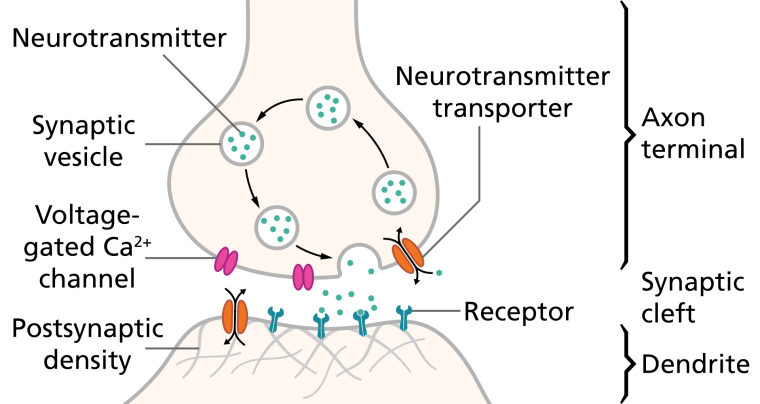
Structure of a typical chemical synapse.
Mechanism
Neurotransmitters are stored in synaptic vesicles, clustered close to the cell membrane at the axon terminal of the presynaptic neuron. Neurotransmitters are released into and diffuse across the synaptic cleft, where they bind to specific receptors on the membrane of the postsynaptic neuron. Binding of neurotransmitters may influence the postsynaptic neuron in either an excitation or inhibitory way, depolarising or repolarising it respectively.
Most of the neurotransmitters are about the size of a single amino acid; however, some neurotransmitters may be the size of larger proteins or peptides. A released neurotransmitter is typically available in the synaptic cleft for a short time before it is metabolised by enzymes, pulled back into the presynaptic neuron through reuptake, or bound to a postsynaptic receptor. Nevertheless, short-term exposure of the receptor to a neurotransmitter is typically sufficient for causing a postsynaptic response by way of synaptic transmission.
Generally, a neurotransmitter is released at the presynaptic terminal in response to a threshold action potential or graded electrical potential in the presynaptic neuron. However, low level ‘baseline’ release also occurs without electrical stimulation.
Discovery
Until the early 20th century, scientists assumed that the majority of synaptic communication in the brain was electrical. However, through histological examinations by Ramón y Cajal, a 20 to 40 nm gap between neurons, known today as the synaptic cleft, was discovered. The presence of such a gap suggested communication via chemical messengers traversing the synaptic cleft, and in 1921 German pharmacologist Otto Loewi confirmed that neurons can communicate by releasing chemicals. Through a series of experiments involving the vagus nerves of frogs, Loewi was able to manually slow the heart rate of frogs by controlling the amount of saline solution present around the vagus nerve. Upon completion of this experiment, Loewi asserted that sympathetic regulation of cardiac function can be mediated through changes in chemical concentrations. Furthermore, Otto Loewi is credited with discovering acetylcholine (ACh) – the first known neurotransmitter.
Identification
There are four main criteria for identifying neurotransmitters:
The chemical must be synthesized in the neuron or otherwise be present in it.
When the neuron is active, the chemical must be released and produce a response in some targets.
The same response must be obtained when the chemical is experimentally placed on the target.
A mechanism must exist for removing the chemical from its site of activation after its work is done.
However, given advances in pharmacology, genetics, and chemical neuroanatomy, the term “neurotransmitter” can be applied to chemicals that:
Carry messages between neurons via influence on the postsynaptic membrane.
Have little or no effect on membrane voltage, but have a common carrying function such as changing the structure of the synapse.
Communicate by sending reverse-direction messages that affect the release or reuptake of transmitters.
The anatomical localisation of neurotransmitters is typically determined using immunocytochemical techniques, which identify the location of either the transmitter substances themselves or of the enzymes that are involved in their synthesis. Immunocytochemical techniques have also revealed that many transmitters, particularly the neuropeptides, are co-localised, that is, a neuron may release more than one transmitter from its synaptic terminal. Various techniques and experiments such as staining, stimulating, and collecting can be used to identify neurotransmitters throughout the central nervous system.
Types
There are many different ways to classify neurotransmitters. Dividing them into amino acids, peptides, and monoamines is sufficient for some classification purposes.
Major neurotransmitters:
Amino acids: glutamate, aspartate, D-serine, gamma-Aminobutyric acid (GABA), and glycine.
Catecholamines: dopamine, norepinephrine (noradrenaline), and epinephrine (adrenaline).
Trace amines: phenethylamine, N-methylphenethylamine, tyramine, 3-iodothyronamine, octopamine, tryptamine, etc.
Peptides: oxytocin, somatostatin, substance P, cocaine and amphetamine regulated transcript, and opioid peptides.
Purines: adenosine triphosphate (ATP) and adenosine.
Others: acetylcholine (ACh), anandamide, etc.
In addition, over 50 neuroactive peptides have been found, and new ones are discovered regularly. Many of these are co-released along with a small-molecule transmitter. Nevertheless, in some cases, a peptide is the primary transmitter at a synapse. Beta-Endorphin is a relatively well-known example of a peptide neurotransmitter because it engages in highly specific interactions with opioid receptors in the central nervous system.
Single ions (such as synaptically released zinc) are also considered neurotransmitters by some, as well as some gaseous molecules such as nitric oxide (NO), carbon monoxide (CO), and hydrogen sulfide (H2S). The gases are produced in the neural cytoplasm and are immediately diffused through the cell membrane into the extracellular fluid and into nearby cells to stimulate production of second messengers. Soluble gas neurotransmitters are difficult to study, as they act rapidly and are immediately broken down, existing for only a few seconds.
The most prevalent transmitter is glutamate, which is excitatory at well over 90% of the synapses in the human brain. The next most prevalent is gamma-Aminobutyric Acid (GABA) which is inhibitory at more than 90% of the synapses that do not use glutamate. Although other transmitters are used in fewer synapses, they may be very important functionally: the great majority of psychoactive drugs exert their effects by altering the actions of some neurotransmitter systems, often acting through transmitters other than glutamate or GABA. Addictive drugs such as cocaine and amphetamines exert their effects primarily on the dopamine system. The addictive opiate drugs exert their effects primarily as functional analogues of opioid peptides, which, in turn, regulate dopamine levels.
Actions
Neurons form elaborate networks through which nerve impulses – action potentials – travel. Each neuron has as many as 15,000 connections with neighbouring neurons.
Neurons do not touch each other (except in the case of an electrical synapse through a gap junction); instead, neurons interact at contact points called synapses: a junction within two nerve cells, consisting of a miniature gap within which impulses are carried by a neurotransmitter. A neuron transports its information by way of a nerve impulse called an action potential. When an action potential arrives at the synapse’s presynaptic terminal button, it may stimulate the release of neurotransmitters. These neurotransmitters are released into the synaptic cleft to bind onto the receptors of the postsynaptic membrane and influence another cell, either in an inhibitory or excitatory way. The next neuron may be connected to many more neurons, and if the total of excitatory influences minus inhibitory influences is great enough, it will also “fire”. That is to say, it will create a new action potential at its axon hillock, releasing neurotransmitters and passing on the information to yet another neighbouring neuron.
Excitatory and Inhibitory
A neurotransmitter can influence the function of a neuron through a remarkable number of mechanisms. In its direct actions in influencing a neuron’s electrical excitability, however, a neurotransmitter acts in only one of two ways: excitatory or inhibitory. A neurotransmitter influences trans-membrane ion flow either to increase (excitatory) or to decrease (inhibitory) the probability that the cell with which it comes in contact will produce an action potential. Thus, despite the wide variety of synapses, they all convey messages of only these two types, and they are labelled as such. Type I synapses are excitatory in their actions, whereas type II synapses are inhibitory. Each type has a different appearance and is located on different parts of the neurons under its influence.
Type I (excitatory) synapses are typically located on the shafts or the spines of dendrites, whereas type II (inhibitory) synapses are typically located on a cell body. In addition, Type I synapses have round synaptic vesicles, whereas the vesicles of type II synapses are flattened. The material on the presynaptic and post-synaptic membranes is denser in a Type I synapse than it is in a type II, and the type I synaptic cleft is wider. Finally, the active zone on a Type I synapse is larger than that on a Type II synapse.
The different locations of type I and type II synapses divide a neuron into two zones: an excitatory dendritic tree and an inhibitory cell body. From an inhibitory perspective, excitation comes in over the dendrites and spreads to the axon hillock to trigger an action potential. If the message is to be stopped, it is best stopped by applying inhibition on the cell body, close to the axon hillock where the action potential originates. Another way to conceptualize excitatory-inhibitory interaction is to picture excitation overcoming inhibition. If the cell body is normally in an inhibited state, the only way to generate an action potential at the axon hillock is to reduce the cell body’s inhibition. In this “open the gates” strategy, the excitatory message is like a racehorse ready to run down the track, but first, the inhibitory starting gate must be removed.
Examples of Important Neurotransmitter Actions
As explained above, the only direct action of a neurotransmitter is to activate a receptor. Therefore, the effects of a neurotransmitter system depend on the connections of the neurons that use the transmitter, and the chemical properties of the receptors that the transmitter binds to.
Here are a few examples of important neurotransmitter actions:
Glutamate is used at the great majority of fast excitatory synapses in the brain and spinal cord. It is also used at most synapses that are “modifiable”, i.e. capable of increasing or decreasing in strength.
Modifiable synapses are thought to be the main memory-storage elements in the brain.
Excessive glutamate release can overstimulate the brain and lead to excitotoxicity causing cell death resulting in seizures or strokes.
Excitotoxicity has been implicated in certain chronic diseases including ischemic stroke, epilepsy, amyotrophic lateral sclerosis, Alzheimer’s disease, Huntington disease, and Parkinson’s disease.
GABA is used at the great majority of fast inhibitory synapses in virtually every part of the brain.
Many sedative/tranquilizing drugs act by enhancing the effects of GABA.
Correspondingly, glycine is the inhibitory transmitter in the spinal cord.
Acetylcholine was the first neurotransmitter discovered in the peripheral and central nervous systems.
It activates skeletal muscles in the somatic nervous system and may either excite or inhibit internal organs in the autonomic system.
It is distinguished as the transmitter at the neuromuscular junction connecting motor nerves to muscles.
The paralytic arrow-poison curare acts by blocking transmission at these synapses.
Acetylcholine also operates in many regions of the brain, but using different types of receptors, including nicotinic and muscarinic receptors.
Dopamine has a number of important functions in the brain; this includes regulation of motor behaviour, pleasures related to motivation and also emotional arousal.
It plays a critical role in the reward system; Parkinson’s disease has been linked to low levels of dopamine and schizophrenia has been linked to high levels of dopamine.
Serotonin is a monoamine neurotransmitter.
Most is produced by and found in the intestine (approximately 90%), and the remainder in central nervous system neurons.
It functions to regulate appetite, sleep, memory and learning, temperature, mood, behaviour, muscle contraction, and function of the cardiovascular system and endocrine system.
It is speculated to have a role in depression, as some depressed patients are seen to have lower concentrations of metabolites of serotonin in their cerebrospinal fluid and brain tissue.
Norepinephrine which is synthesized in the central nervous system and sympathetic nerves, modulates the responses of the autonomic nervous system, the sleep patterns, focus and alertness.
It is synthesized from tyrosine.
Epinephrine which is also synthesized from tyrosine is released in the adrenal glands and the brainstem.
It plays a role in sleep, with one’s ability to become and stay alert, and the fight-or-flight response.
Histamine works with the central nervous system (CNS), specifically the hypothalamus (tuberomammillary nucleus) and CNS mast cells.
Brain Neurotransmitter Systems
Neurons expressing certain types of neurotransmitters sometimes form distinct systems, where activation of the system affects large volumes of the brain, called volume transmission. Major neurotransmitter systems include the noradrenaline (norepinephrine) system, the dopamine system, the serotonin system, and the cholinergic system, among others. Trace amines have a modulatory effect on neurotransmission in monoamine pathways (i.e. dopamine, norepinephrine, and serotonin pathways) throughout the brain via signalling through trace amine-associated receptor 1.
Drug Effects
Understanding the effects of drugs on neurotransmitters comprises a significant portion of research initiatives in the field of neuroscience. Most neuroscientists involved in this field of research believe that such efforts may further advance our understanding of the circuits responsible for various neurological diseases and disorders, as well as ways to effectively treat and someday possibly prevent or cure such illnesses.
Drugs can influence behaviour by altering neurotransmitter activity. For instance, drugs can decrease the rate of synthesis of neurotransmitters by affecting the synthetic enzyme(s) for that neurotransmitter. When neurotransmitter syntheses are blocked, the amount of neurotransmitters available for release becomes substantially lower, resulting in a decrease in neurotransmitter activity. Some drugs block or stimulate the release of specific neurotransmitters. Alternatively, drugs can prevent neurotransmitter storage in synaptic vesicles by causing the synaptic vesicle membranes to leak. Drugs that prevent a neurotransmitter from binding to its receptor are called receptor antagonists. For example, drugs used to treat patients with schizophrenia such as haloperidol, chlorpromazine, and clozapine are antagonists at receptors in the brain for dopamine. Other drugs act by binding to a receptor and mimicking the normal neurotransmitter. Such drugs are called receptor agonists. An example of a receptor agonist is morphine, an opiate that mimics effects of the endogenous neurotransmitter β-endorphin to relieve pain. Other drugs interfere with the deactivation of a neurotransmitter after it has been released, thereby prolonging the action of a neurotransmitter. This can be accomplished by blocking re-uptake or inhibiting degradative enzymes. Lastly, drugs can also prevent an action potential from occurring, blocking neuronal activity throughout the central and peripheral nervous system. Drugs such as tetrodotoxin that block neural activity are typically lethal.
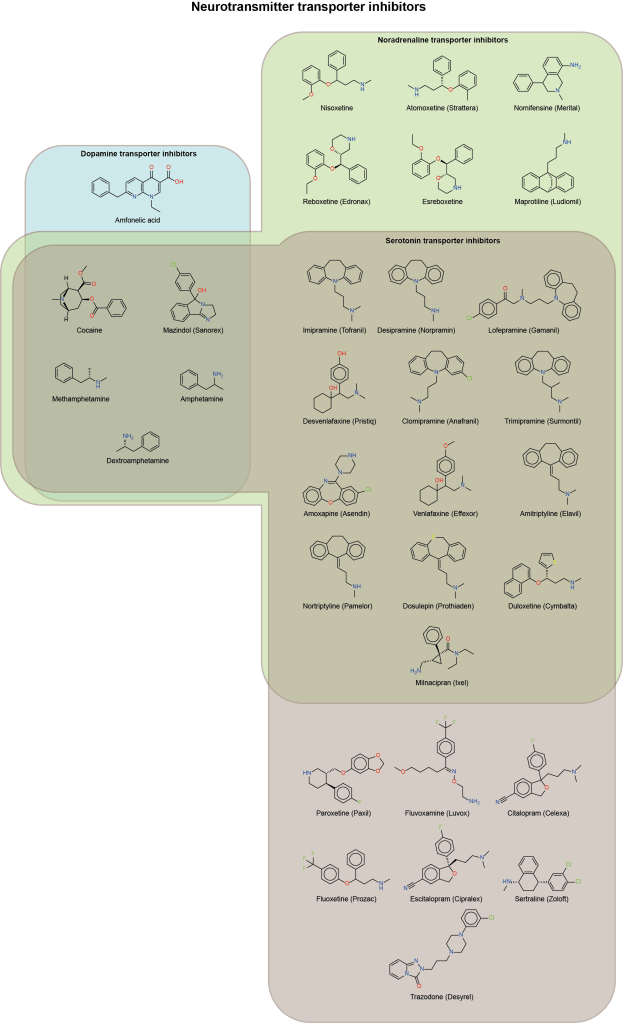
Drugs targeting the neurotransmitter of major systems affect the whole system, which can explain the complexity of action of some drugs. Cocaine, for example, blocks the re-uptake of dopamine back into the presynaptic neuron, leaving the neurotransmitter molecules in the synaptic gap for an extended period of time. Since the dopamine remains in the synapse longer, the neurotransmitter continues to bind to the receptors on the postsynaptic neuron, eliciting a pleasurable emotional response. Physical addiction to cocaine may result from prolonged exposure to excess dopamine in the synapses, which leads to the downregulation of some post-synaptic receptors. After the effects of the drug wear off, an individual can become depressed due to decreased probability of the neurotransmitter binding to a receptor. Fluoxetine is a selective serotonin re-uptake inhibitor (SSRI), which blocks re-uptake of serotonin by the presynaptic cell which increases the amount of serotonin present at the synapse and furthermore allows it to remain there longer, providing potential for the effect of naturally released serotonin. AMPT prevents the conversion of tyrosine to L-DOPA, the precursor to dopamine; reserpine prevents dopamine storage within vesicles; and deprenyl inhibits monoamine oxidase (MAO)-B and thus increases dopamine levels.
Agonists
An agonist is a chemical capable of binding to a receptor, such as a neurotransmitter receptor, and initiating the same reaction typically produced by the binding of the endogenous substance. An agonist of a neurotransmitter will thus initiate the same receptor response as the transmitter. In neurons, an agonist drug may activate neurotransmitter receptors either directly or indirectly. Direct-binding agonists can be further characterized as full agonists, partial agonists, inverse agonists.
Direct agonists act similar to a neurotransmitter by binding directly to its associated receptor site(s), which may be located on the presynaptic neuron or postsynaptic neuron, or both. Typically, neurotransmitter receptors are located on the postsynaptic neuron, while neurotransmitter autoreceptors are located on the presynaptic neuron, as is the case for monoamine neurotransmitters; in some cases, a neurotransmitter utilises retrograde neurotransmission, a type of feedback signalling in neurons where the neurotransmitter is released postsynaptically and binds to target receptors located on the presynaptic neuron. Nicotine, a compound found in tobacco, is a direct agonist of most nicotinic acetylcholine receptors, mainly located in cholinergic neurons. Opiates, such as morphine, heroin, hydrocodone, oxycodone, codeine, and methadone, are μ-opioid receptor agonists; this action mediates their euphoriant and pain relieving properties.
Indirect agonists increase the binding of neurotransmitters at their target receptors by stimulating the release or preventing the reuptake of neurotransmitters. Some indirect agonists trigger neurotransmitter release and prevent neurotransmitter reuptake. Amphetamine, for example, is an indirect agonist of postsynaptic dopamine, norepinephrine, and serotonin receptors in each their respective neurons; it produces both neurotransmitter release into the presynaptic neuron and subsequently the synaptic cleft and prevents their reuptake from the synaptic cleft by activating TAAR1, a presynaptic G protein-coupled receptor, and binding to a site on VMAT2, a type of monoamine transporter located on synaptic vesicles within monoamine neurons.
Antagonists
An antagonist is a chemical that acts within the body to reduce the physiological activity of another chemical substance (as an opiate); especially one that opposes the action on the nervous system of a drug or a substance occurring naturally in the body by combining with and blocking its nervous receptor.
There are two main types of antagonist: direct-acting Antagonist and indirect-acting Antagonists:
Direct-acting antagonist- which takes up space present on receptors which are otherwise taken up by neurotransmitters themselves.
This results in neurotransmitters being blocked from binding to the receptors. The most common is called Atropine.
Indirect-acting antagonist- drugs that inhibit the release/production of neurotransmitters (e.g., Reserpine).
Drug Antagonists
An antagonist drug is one that attaches (or binds) to a site called a receptor without activating that receptor to produce a biological response. It is therefore said to have no intrinsic activity. An antagonist may also be called a receptor “blocker” because they block the effect of an agonist at the site. The pharmacological effects of an antagonist, therefore, result in preventing the corresponding receptor site’s agonists (e.g. drugs, hormones, neurotransmitters) from binding to and activating it. Antagonists may be “competitive” or “irreversible”.
A competitive antagonist competes with an agonist for binding to the receptor. As the concentration of antagonist increases, the binding of the agonist is progressively inhibited, resulting in a decrease in the physiological response. High concentration of an antagonist can completely inhibit the response. This inhibition can be reversed, however, by an increase of the concentration of the agonist, since the agonist and antagonist compete for binding to the receptor. Competitive antagonists, therefore, can be characterised as shifting the dose–response relationship for the agonist to the right. In the presence of a competitive antagonist, it takes an increased concentration of the agonist to produce the same response observed in the absence of the antagonist.
An irreversible antagonist binds so strongly to the receptor as to render the receptor unavailable for binding to the agonist. Irreversible antagonists may even form covalent chemical bonds with the receptor. In either case, if the concentration of the irreversible antagonist is high enough, the number of unbound receptors remaining for agonist binding may be so low that even high concentrations of the agonist do not produce the maximum biological response.
Precursors
While intake of neurotransmitter precursors does increase neurotransmitter synthesis, evidence is mixed as to whether neurotransmitter release and postsynaptic receptor firing is increased. Even with increased neurotransmitter release, it is unclear whether this will result in a long-term increase in neurotransmitter signal strength, since the nervous system can adapt to changes such as increased neurotransmitter synthesis and may therefore maintain constant firing. Some neurotransmitters may have a role in depression and there is some evidence to suggest that intake of precursors of these neurotransmitters may be useful in the treatment of mild and moderate depression.
Catecholamine and Trace Amine Precursors
L-DOPA, a precursor of dopamine that crosses the blood–brain barrier, is used in the treatment of Parkinson’s disease. For depressed patients where low activity of the neurotransmitter norepinephrine is implicated, there is only little evidence for benefit of neurotransmitter precursor administration. L-phenylalanine and L-tyrosine are both precursors for dopamine, norepinephrine, and epinephrine. These conversions require vitamin B6, vitamin C, and S-adenosylmethionine. A few studies suggest potential antidepressant effects of L-phenylalanine and L-tyrosine, but there is much room for further research in this area.
Serotonin Precursors
Administration of L-tryptophan, a precursor for serotonin, is seen to double the production of serotonin in the brain. It is significantly more effective than a placebo in the treatment of mild and moderate depression. This conversion requires vitamin C.[24] 5-hydroxytryptophan (5-HTP), also a precursor for serotonin, is more effective than a placebo.
Diseases and Disorders
Diseases and disorders may also affect specific neurotransmitter systems. The following are disorders involved in either an increase, decrease, or imbalance of certain neurotransmitters.
Dopamine
For example, problems in producing dopamine (mainly in the substantia nigra) can result in Parkinson’s disease, a disorder that affects a person’s ability to move as they want to, resulting in stiffness, tremors or shaking, and other symptoms. Some studies suggest that having too little or too much dopamine or problems using dopamine in the thinking and feeling regions of the brain may play a role in disorders like schizophrenia or attention deficit hyperactivity disorder (ADHD). Dopamine is also involved in addiction and drug use, as most recreational drugs cause an influx of dopamine in the brain (especially opioid and methamphetamines) that produces a pleasurable feeling, which is why users constantly crave drugs.
Serotonin
Similarly, after some research suggested that drugs that block the recycling, or reuptake, of serotonin seemed to help some people diagnosed with depression, it was theorized that people with depression might have lower-than-normal serotonin levels. Though widely popularized, this theory was not borne out in subsequent research. Therefore, selective serotonin reuptake inhibitors (SSRIs) are used to increase the amounts of serotonin in synapses.
Glutamate
Furthermore, problems with producing or using glutamate have been suggestively and tentatively linked to many mental disorders, including autism, obsessive compulsive disorder (OCD), schizophrenia, and depression. Having too much glutamate has been linked to neurological diseases such as Parkinson’s disease, multiple sclerosis, Alzheimer’s disease, stroke, and ALS (amyotrophic lateral sclerosis).
Neurotransmitter Imbalance
Generally, there are no scientifically established “norms” for appropriate levels or “balances” of different neurotransmitters. It is in most cases pragmatically impossible to even measure levels of neurotransmitters in a brain or body at any distinct moments in time. Neurotransmitters regulate each other’s release, and weak consistent imbalances in this mutual regulation were linked to temperament in healthy people. Strong imbalances or disruptions to neurotransmitter systems have been associated with many diseases and mental disorders. These include Parkinson’s, depression, insomnia, Attention Deficit Hyperactivity Disorder (ADHD), anxiety, memory loss, dramatic changes in weight and addictions. Chronic physical or emotional stress can be a contributor to neurotransmitter system changes. Genetics also plays a role in neurotransmitter activities. Apart from recreational use, medications that directly and indirectly interact with one or more transmitter or its receptor are commonly prescribed for psychiatric and psychological issues. Notably, drugs interacting with serotonin and norepinephrine are prescribed to patients with problems such as depression and anxiety – though the notion that there is much solid medical evidence to support such interventions has been widely criticised. Studies shown that dopamine imbalance has an influence on multiple sclerosis and other neurological disorders
A neurotransmitter must be broken down once it reaches the post-synaptic cell to prevent further excitatory or inhibitory signal transduction. This allows new signals to be produced from the adjacent nerve cells. When the neurotransmitter has been secreted into the synaptic cleft, it binds to specific receptors on the postsynaptic cell, thereby generating a postsynaptic electrical signal. The transmitter must then be removed rapidly to enable the postsynaptic cell to engage in another cycle of neurotransmitter release, binding, and signal generation. Neurotransmitters are terminated in three different ways:
Diffusion:
The neurotransmitter detaches from receptor, drifting out of the synaptic cleft, here it becomes absorbed by glial cells.
Enzyme degradation:
Special chemicals called enzymes break it down.
Usually, astrocytes absorb the excess neurotransmitters and pass them on to enzymes or pump them directly into the presynaptic neuron.
Reuptake:
Re-absorption of a neurotransmitter into the neuron.
Transporters, or membrane transport proteins, pump neurotransmitters from the synaptic cleft back into axon terminals (the presynaptic neuron) where they are stored.
For example, choline is taken up and recycled by the pre-synaptic neuron to synthesize more ACh. Other neurotransmitters such as dopamine are able to diffuse away from their targeted synaptic junctions and are eliminated from the body via the kidneys, or destroyed in the liver. Each neurotransmitter has very specific degradation pathways at regulatory points, which may be targeted by the body’s regulatory system or drugs.






 Mental Health Matters
You must be logged in to post a comment.