Vantage sensitivity is a psychological concept related to environmental sensitivity, initially developed by Michael Pluess and Jay Belsky. It describes individual differences in response to positive experiences and supportive environmental influences. According to vantage sensitivity, people differ considerably in their sensitivity to positive aspects of the environment, with some people benefitting particularly strongly from positive experiences such as parental care, supportive relationships, and psychological interventions, whereas others tend to respond less or not at all.
The concept of vantage sensitivity is related to other theories of environmental sensitivity such as differential susceptibility according to which some people are more sensitive than others to both negative and positive experiences. Vantage sensitivity provides a specific theoretical perspective and terminology to describe individual differences in response to exclusively positive experiences.
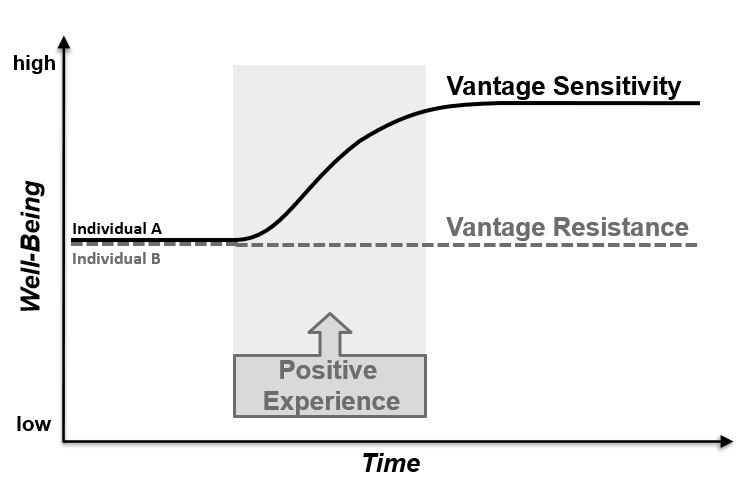
According to vantage sensitivity theory, people who benefit from positive experiences display vantage sensitivity as a function of vantage sensitivity factors (i.e. genetic, physiological, or psychological traits) whereas those who benefit less show vantage resistance due to the presence of vantage resistance factors (or the absence of vantage sensitivity factors). Differences in vantage sensitivity are considered to reflect neurobiological differences in the central nervous system, which are influenced by genetic as well as environmental factors.
Figure 1: Graphical illustration of vantage sensitivity; in response to a positive exposure, the level of functioning increases in Individual A, reflecting vantage sensitivity, whereas it remains unchanged in Individual B, reflecting vantage resistance.
Evidence
A growing number of studies provide empirical evidence for individual differences in vantage sensitivity across a wide range of established sensitivity markers, including genetic, physiological, and psychological ones.
Genetic Markers
Several studies report that differences in response to positive experiences are associated with genetic sensitivity. For example, Keers et al. created a polygenic score for environmental sensitivity based on thousands of gene variants and found that children with higher genetic sensitivity responded more strongly to higher quality of psychological treatment.
Physiological Markers
Studies suggest that a higher physiological reactivity to stress (indicated by cortisol) is associated with a stronger positive response to positive influences. For instance, a study testing the efficacy of exposure-based psychotherapy, a type of psychological treatment that is used with people suffering from panic disorders and agoraphobia, found that people whose cortisol response was higher during exposure were also more likely to recover faster and benefit more from the treatment.
Psychological Markers
A number of studies have shown that children who score high on the Highly Sensitive Child (HSC) scale, a psychometric tool designed to measure sensitivity, respond more positively to psychological interventions. For example, Nocentini et al. conducted a randomised controlled trial to investigate whether sensitivity was associated with greater response to a school-based anti-bullying intervention. Results indicated that sensitive children benefitted significantly more from the positive effects of the intervention. Vantage sensitivity has also been found to influence the socio-emotional well-being of young people in school. The wellbeing of sensitive adolescents increased in response to positive changes in the school environment. In adults, high sensitivity has been found to predict a greater response to positive pictures and increased leader-rated employee task performance.
This page is based on the copyrighted Wikipedia article < https://en.wikipedia.org/wiki/Vantage_sensitivity >; it is used under the Creative Commons Attribution-ShareAlike 3.0 Unported License (CC-BY-SA). You may redistribute it, verbatim or modified, providing that you comply with the terms of the CC-BY-SA.
The differential susceptibility theory proposed by Jay Belsky is another interpretation of psychological findings that are usually discussed according to the diathesis-stress model.
Both models suggest that people’s development and emotional affect are differentially affected by experiences or qualities of the environment. Where the Diathesis-stress model suggests a group that is sensitive to negative environments only, the differential susceptibility hypothesis suggests a group that is sensitive to both negative and positive environments.
A third model, the vantage-sensitivity model, suggests a group that is sensitive to positive environments only. All three models may be considered complementary, and have been combined into a general environmental sensitivity framework.
Differential Susceptibility versus Diathesis-Stress
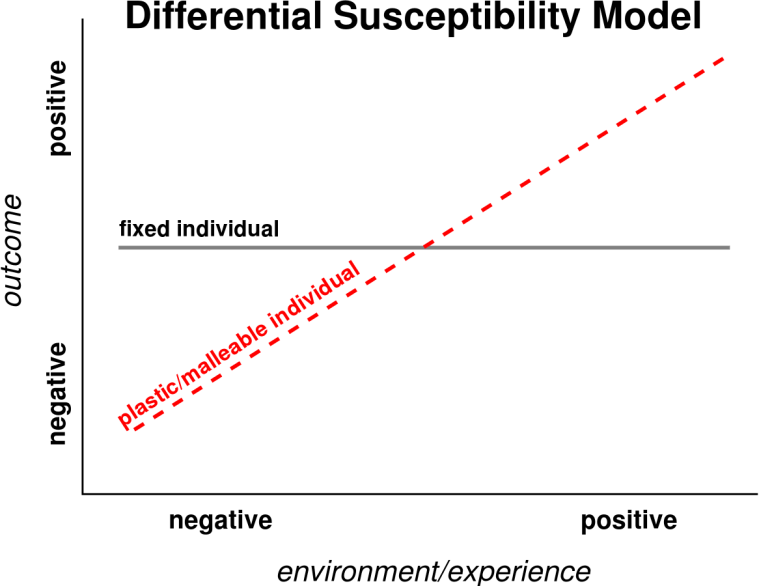
The idea that individuals vary in their sensitivity to their environment was historically framed in diathesis-stress or dual-risk terms. These theories suggested that some “vulnerable” individuals, due to their biological, temperamental and/or physiological characteristics (i.e. “diathesis” or “risk 1”), are more vulnerable to the adverse effects of negative experiences (i.e. “stress” or “risk 2”), while other “resilient” individuals are not affected by these negative experiences (see Figure 1). The differential susceptibility hypothesis and the related notion of biological sensitivity to context suggested that individuals thought to be “vulnerable” are not only sensitive to negative environments, but also to positive environments (see Figure 2). Thus, according to the differential susceptibility hypothesis, some individuals are “susceptible” or “plastic”, in that they are more influenced than others by environmental influences in a “for better and for worse” manner.
Figure 1. The diathesis-stress/dual-risk model. Developmental outcome as it relates to environmental quality. A “vulnerable” group experiences negative outcome when exposed to a negative environment, although this group is identical to the other, “resilient” group in a positive environment.
Figure 2. The differential susceptibility model. The lines depict two categorical groups that differ in their responsiveness to the environment: the “plastic” group is disproportionately more affected by both negative and positive environments compared to the “fixed” group.
Theoretical Background
Belsky suggests that evolution might select for some children who are more plastic, and others who are more fixed in the face of, for example, parenting styles.
Belsky offers that ancestral parents, just like parents today, could not have known (consciously or unconsciously) which childrearing practices would prove most successful in promoting the reproductive fitness of offspring – and thus their own inclusive fitness. As a result, and as a fitness optimising strategy involving bet hedging, natural selection might have shaped parents to bear children varying in plasticity. This way, if an effect of parenting had proven counterproductive in fitness terms, those children not affected by parenting would not have incurred the cost of developing in ways that ultimately proved “misguided”.
Importantly, natural selection might favour genetic lines with both plastic and fixed developmental and affective patterns. In other words, there is value to having both kinds at once. In light of inclusive-fitness considerations, children who were less malleable (and more fixed) would have “resistance” to parental influence. This could be adaptable some times, and maladaptive other times. Their fixedness would not only have benefited themselves directly, but even their more malleable siblings indirectly. This is because siblings, like parents and children, have 50% of their genes in common. By the same token, had parenting influenced children in ways that enhanced fitness, then not only would more plastic offspring have benefited directly by following parental leads, but so, too, would their parents and even their less malleable siblings who did not benefit from the parenting they received, again for inclusive-fitness reasons. The overall effect may be to temper some of the variability in parenting. That is, to make more conservative bets.
This line of evolutionary argument leads to the prediction that children should vary in their susceptibility to parental rearing and perhaps to environmental influences more generally. As it turns out, a long line of developmental inquiry, informed by a “transactional” perspective, has more or less been based on this unstated assumption.
Criteria for the Testing of Differential Susceptibility
Belsky, Bakermans-Kranenburg, & Van IJzendoorn, (2007) delineated a series of empirical requirements – or steps – for evidencing the differential susceptibility hypothesis. Particularly they identify tests that distinguish differential susceptibility from other interaction effects including diathesis-stress/dual-risk.
While diathesis-stress/dual-risk arises when the most vulnerable are disproportionately affected in an adverse manner by a negative environment but do not also benefit disproportionately from positive environmental conditions, differential susceptibility is characterised by a cross-over interaction: the susceptible individuals are disproportionately affected by both negative and positive experiences. A further criterion that needs to be fulfilled to distinguish differential susceptibility from diathesis-stress/dual-risk is the independence of the outcome measure from the susceptibility factor: if the susceptibility factor and the outcome are related, diathesis-stress/dual-risk is suggested rather than differential susceptibility. Further, environment and susceptibility factor must also be unrelated to exclude the alternative explanation that susceptibility merely represents a function of the environment. The specificity of the differential-susceptibility effect is demonstrated if the model is not replicated when other susceptibility factors (i.e. moderators) and outcomes are used. Finally, the slope for the susceptible subgroup should be significantly different from zero and at the same time significantly steeper than the slope for the non- (or less-) susceptible subgroup.
Susceptibility Markers and Empirical Evidence
Characteristics of individuals that have been shown to moderate environmental effects in a manner consistent with the differential susceptibility hypothesis can be subdivided into three categories: Genetic factors, endophenotypic factors, phenotypic factors.
Bakermans-Kranenburg and Van IJzendoorn (2006) were the first to test the differential susceptibility hypothesis as a function of Genetic Factors regarding the moderating effect of the dopamine receptor D4 7-repeat polymorphism (DRD4-7R) on the association between maternal sensitivity and externalizing behaviour problems in 47 families. Children with the DRD4-7R allele and insensitive mothers displayed significantly more externalizing behaviours than children with the same allele but with sensitive mothers. Children with the DRD4-7R allele and sensitive mothers had the least externalising behaviours of all whereas maternal sensitivity had no effect on children without the DRD4-7R allele.
Endophenotypic Factors have been examined by Obradovic, Bush, Stamperdahl, Adler and Boyce’s (2010). They investigated associations between childhood adversity and child adjustment in 338 5-year-olds. Children with high cortisol reactivity were rated by teachers as least prosocial when living under adverse conditions, but most prosocial when living under more benign conditions (and in comparison to children scoring low on cortisol reactivity).
Regarding characteristics of the category of Phenotypic Factors, Pluess and Belsky (2009) reported that the effect of child care quality on teacher-rated socioemotional adjustment varied as a function of infant temperament in the case of 761 4.5-year-olds participating in the NICHD Study of Early Child Care and Youth Development (NICHD Early Child Care Research Network, 2005). Children with difficult temperaments as infants manifest the most and least behaviour problems depending on whether they experienced, respectively, poor or good quality care (and in comparison to children with easier temperaments).
Table 1: List of Proposed Susceptibility Factors that emerge across studies, according to Belsky and colleagues.
This page is based on the copyrighted Wikipedia article < https://en.wikipedia.org/wiki/Differential_susceptibility >; it is used under the Creative Commons Attribution-ShareAlike 3.0 Unported License (CC-BY-SA). You may redistribute it, verbatim or modified, providing that you comply with the terms of the CC-BY-SA.




 Mental Health Matters
You must be logged in to post a comment.