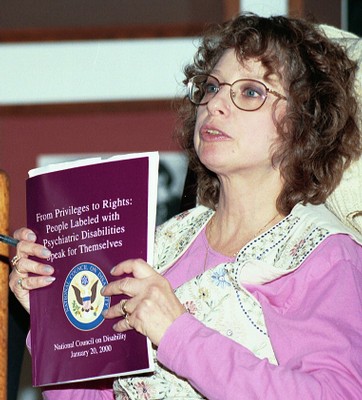
What is the World Network of Users and Survivors of Psychiatry?

Introduction

The World Network of Users and Survivors of Psychiatry (WNUSP) is an international organisation representing, and led by what it terms “survivors of psychiatry”. As of 2003, over 70 national organisations were members of WNUSP, based in 30 countries. The network seeks to protect and develop the human rights, disability rights, dignity and self-determination of those labelled ‘mentally ill’.

Activities

WNUSP has special consultative status with the United Nations. It contributed to the development of the UN’s Convention on the Rights of Persons with Disabilities. WNUSP has produced a manual to help people use it entitled “Implementation Manual for the United Nations Convention on the Rights of Persons with Disabilities”, edited by Myra Kovary.

WNUSP joined with other organisations to create the International Disability Caucus, which jointly represented organisations of people with disabilities and allies during the CRPD negotiations. WNUSP was part of the steering committee of the IDC, which maintained a principle of respecting the leadership of diverse constituencies on issues affecting them, and also maintained that the convention should be of equal value to all persons with disabilities irrespective of the type of disability or geographical location. Tina Minkowitz, WNUSP’s representative on the IDC steering committee, coordinated the IDC’s work on key articles of the CRPD, including those on legal capacity, liberty, torture and ill-treatment and integrity of the person. Since the adoption and entry into force of the CRPD, WNUSP has worked with other organisations in the International Disability Alliance and its CRPD Forum to guide the interpretation and application of the CRPD on these issues.

In 2007 at a Conference held in Dresden on “Coercive Treatment in Psychiatry: A Comprehensive Review”, the president and other leaders of the World Psychiatric Association met, following a formal request from the World Health Organisation, with several representatives from the user/survivor movement, including Judi Chamberlin (Co-chair of WNUSP), Mary Nettle and Peter Lehmann (Ex-chairs of the European Network of [Ex-] Users and Survivors of Psychiatry), Dorothea Buck (Honorary Chair of the German Federal Organisation of Users and Survivors of Psychiatry, and David Oaks (Director of MindFreedom International).

Salam Gómez and Jolijn Santegoeds are the current Co-Chairpersons of WNUSP.

Current International Representative and former co-chair of WNUSP is Tina Minkowitz, an international advocate and lawyer. She represented WNUSP in the Working Group convened by the UN to produce a draft text of the Convention on the Rights of Persons with Disabilities and contributed to a UN seminar on torture and persons with disabilities that resulted in an important report on the issue by Special Rapporteur on Torture Manfred Nowak in 2008.

Brief History

Since the 1970s, the psychiatric survivors movement has grown from a few scattered self-help groups to a worldwide network engaged in protecting civil rights and facilitation of efforts to provide housing, employment, public education, research, socialisation and advocacy programmes. The term ‘psychiatric survivor’ is used by individuals who identify themselves as having experienced human rights violations in the mental health system. WNUSP was established to further promote this movement and to respond on an international level to the oppression survivors continue to experience.

After initially meeting, in 1991, as the World Federation of Psychiatric Users at the biennial World Federation for Mental Health conference in Mexico, the network’s name was changed to WNUSP in 1997. In 2000, the WNUSP Secretariat was established in Odense, Denmark. In 2001, the network held its First General Assembly in Vancouver, British Columbia, with 34 groups from twelve countries represented, and adopted its governing statutes.

In 2004, the network held its Second General Assembly in Vejle, Denmark with 150 participants from 50 countries attending.

In 2007 WNUSP received ECOSOC special consultative status at the United Nations.

In 2009, WNUSP held its third General Assembly in Kampala, Uganda. It adopted the Kampala Declaration stating its positions on the CRPD, which was later expanded into a longer version adopted by consensus of the board and the participants in the Kampala GA.

ENUSP

The European Network of (Ex-) Users and Survivors of Psychiatry is the most important European NGO of (ex-) users and survivors. Forty-two representatives from 16 European countries met at a conference to found it in the Netherlands in October 1991. Every 2 years, delegates from the ENUSP members in more than 40 European countries meet at a conference where the policies for the coming period are set out. All delegates are (ex-)users and survivors of psychiatry. ENUSP is officially involved in consultations on mental health plans and policies of the European Union, World Health Organisation and other important bodies. Initial funding came from the Dutch government and from the European Commission but has since proved more difficult to secure. ENUSP is involved in commenting and debating declarations, position papers, policy guidelines of the EU, UN, WHO and other important bodies.

This page is based on the copyrighted Wikipedia article < https://en.wikipedia.org/wiki/World_Network_of_Users_and_Survivors_of_Psychiatry >; it is used under the Creative Commons Attribution-ShareAlike 3.0 Unported License (CC-BY-SA). You may redistribute it, verbatim or modified, providing that you comply with the terms of the CC-BY-SA.

Who is Ted Chabasinski?

Introduction

Ted Chabasinski (20 March 1937 to Present) is an American psychiatric survivor, human rights activist and attorney who lives in Berkeley, California. At the age of six, he was taken from his foster family’s home and committed to a New York psychiatric facility. Diagnosed with childhood schizophrenia, he underwent intensive electroshock therapy (now termed electroconvulsive therapy or ECT) and remained an inmate in a state psychiatric hospital until the age of seventeen. He subsequently trained as a lawyer and became active in the psychiatric survivors movement. In 1982, he was a leader in an initially successful campaign seeking to ban the use of electroshock in Berkeley, California.

Early Life

Chabasinski was born in New York to a Polish-born immigrant woman. His father was of Russian descent. In the period just before and after Chabasinski’s birth, his birth-mother, who was poor, unmarried and had been given a diagnosis of schizophrenia, was committed to a psychiatric facility. He was subsequently placed in the care of a foster family in the Bronx, New York. While an intelligent child, his social worker from the Foundling Hospital, a Miss Callaghan, thought him withdrawn and suspected that he was exhibiting the initial signs of an incipient schizophrenia. Chabasinski himself attributes this diagnosis to the then widespread opinion that mental illness was hereditary and thus, he contends, the social worker supervising his foster home placement was “looking for symptoms”.

In 1944, at six years of age, Chabasinski, then a shy and withdrawn child, was taken from his foster family and committed to the children’s ward of the psychiatric division of the Bellevue Hospital in Manhattan, New York. While in this ward, known as Unit PQ6, he was brought under the care of the celebrated child psychiatrist Lauretta Bender, now deceased, who is the clinician commonly credited with founding the study of childhood schizophrenia in the United States. She formally diagnosed Chabasinski as suffering from schizophrenia. He was one of the first children ever to receive ECT, which was then given in its unmodified form without either anaesthetic or muscle relaxant. Despite the strenuous protests of his foster parents against the treatment, he underwent ECT under a regressive and experimental protocol where the treatment was given at a more intensive frequency than was the norm for shock therapy. Chabasinski received ECT daily for a period of about three weeks, comprising approximately twenty sessions of the procedure.

Recalling the experience, Chabasinski stated:

I was one of 300 children involved in an experimental program … I remember being dragged down a hallway, thrown on a table and having a handkerchief stuffed in my mouth.

It made me want to die … I remember that they would stick a rag in my mouth so I wouldn’t bite through my tongue and that it took three attendants to hold me down. I knew that in the mornings that I didn’t get any breakfast that I was going to get shock treatment.

I wanted to die but I didn’t really know what death was. I knew that it was something terrible. Maybe I’ll be so tired after the next shock treatment I won’t get up, I won’t ever get up, and I’ll be dead. But I always got up. Something in me beyond my wishes made me put myself together again. I memorized my name, I taught myself to say my name. Teddy, Teddy, I’m Teddy … I’m here, I’m here, in this room, in this hospital. And my mommy’s gone … I would cry and realize how dizzy I was. The world was spinning around me and coming back to it hurt too much. I want to go down, I want to go where the shock treatment is sending me. I want to stop fighting and die…and something made me live, and go on living. I had to remember never to let anyone near me again.

In 1947, Bender published on 98 children aged between four and eleven years old who had been treated in the previous five years with intensive courses of ECT. These children received ECT daily for a typical course of approximately twenty treatments. This formed part of an experimental trend amongst a cadre of psychiatrists to explore the therapeutic impact of intensive regimes of ECT, which is also known as either regressive ECT or annihilation therapy. In the 1950s Bender abandoned ECT as a therapeutic practice for the treatment of children. In the same decade the results of her published work on the use of ECT in children was discredited after a study showing that the condition of the children so treated had either not improved or deteriorated.

Commenting on his experience as part of Bender’s therapeutic program Chabasinski said that, “It really made a mess of me … I went from being a shy kid who read a lot to a terrified kid who cried all the time.” Following his treatment, he spent ten years as an inmate of Rockland State Hospital, a psychiatric facility now known as the Rockland Psychiatric Centre.

Chabasinski was discharged from the Rockland State Hospital at the age of seventeen. He eventually went to college where he qualified as a lawyer.

Activism

Chabasinski has been active in the psychiatric survivors movement since 1971.

The Berkeley Ban

Chabasinski was Chairman of the Coalition to Stop Electroshock which in 1982 qualified an initiative measure, titled Initiative T., for municipal ballot to make the application of electroconvulsive therapy a misdemeanour in Berkeley, California, punishable with a $500 fine or up to six months imprisonment. Chabasinski was the author of the ballot question and, along with fellow psychiatric survivor Leonard Roy Frank, he was a leader in the campaign. The campaign group, supported by human rights organisations such as the Berkeley-based ex-patient group Network Against Psychiatric Assault, consisted of some 250 people approximately half of whom were former psychiatric patients with the majority of the remainder consisting of students from Berkeley and individual doctors who were opposed to ECT. The coalition’s entire campaign fund was in the region of $1,000. The American Psychiatric Association provided funds of $15,000 to campaign against the initiative. 2,500 people petitioned in support of the initiative exceeding the 1,400 signatures required to put the motion on the ballot.

At the time Chabasinski argued that the enforcement of the law governing consent to ECT in psychiatric facilities in the state of California was so lax that a total ban on the procedure was required. He and his fellow campaigners also claimed that ECT was a dangerous and barbaric treatment that could cause either long or short term memory loss, brain damage and that the procedure could even result in death. They also charged that when resident in a psychiatric institution the very concept of informed consent is meaningless.

During the campaign dozens of ex-psychiatric patients gave testimony against electroshock at a Berkeley City Council hearing. Protests were also held outside the Herrick Hospital, then the only facility in Berkeley where ECT was provided. In 1981 that facility administered ECT to 45 individuals. In order to collect and exceed the requisite number of signatures required to place Initiative T. on the ballot paper, members of the coalition campaigned outside supermarkets and went from door to door soliciting support.

The ballot was held on Tuesday 02 November 1982 and the measure passed with 25,380 voters, or 61.7%, supporting the ballot calling for a ban on ECT while 15,756 residents, or 38.2%, voted against the measure. Giving his perspective on why the measure had passed so resoundingly, Chabasinski stated that: “I think it’s a very sympathetic issue … Basically, they’re going ahead and causing brain damage just to subdue people.” Speculating on the possibility of extending the ban across the state of California and alluding to the wider aims behind the campaign he also said: “To be honest, this is one way of having a referendum on mental patients’ rights and the way they are treated”.

In response to the passage of the initiative the American Psychiatric Association asserted that plebiscite was not an appropriate means to arrive at a medical judgement on a complex issue. A spokesman for the association stated: “The voters have passed a law we believe is unnecessary, probably unconstitutional and … dangerous … We hope it will be overturned before doing harm by denying a seriously ill person access in Berkeley to treatment that could be lifesaving,” One of the two doctors who administered ECT at Herrick Hospital, Dr. Martin Rubinstein, contended that the vote to ban the procedure reflected “pathological consumerism” and constituted “another case of the inmates trying to run the asylum”. He further epitomised the ballot result as stemming from “an uninformed electorate [deliberating] on esoteric matters.”

In June 1983 Donald McCullom, an Alameda County Superior Court Judge, issued an injunction on the implementation of the ban on ECT. Initiative T. was overturned shortly thereafter following a successful legal challenge initiated by the American Psychiatric Association, on the constitutionality of the measure.

Other Roles

Chabasinski is the former directing attorney for Mental Health Consumer Concerns, (MHCC), and a former president of the board of Support Coalition International (SCI). He was also a board member of the successor organisation to the SCI, MindFreedom International and for which he acted as an attorney.

Eli Lilly and Zyprexa

In January 2007 Chabasinski acted as the attorney for the late psychiatric survivor activist and author Judi Chamberlin, the medical journalist and author of Mad in America and Anatomy of an Epidemic, Robert Whitaker, and the director of MindFreedom International David Oaks in opposing a motion by Eli Lilly to extend an injunction to conceal documents that revealed that the company had known for the previous decade of the potentially lethal effects of Zyprexa and had engaged in an illegal off-label marketing campaign.

This page is based on the copyrighted Wikipedia article < https://en.wikipedia.org/wiki/Ted_Chabasinski >; it is used under the Creative Commons Attribution-ShareAlike 3.0 Unported License (CC-BY-SA). You may redistribute it, verbatim or modified, providing that you comply with the terms of the CC-BY-SA.

An Overview of the Critical Psychiatry Network

Introduction

The Critical Psychiatry Network (CPN) is a psychiatric organisation based in the United Kingdom. It was created by a group of British psychiatrists who met in Bradford, England in January 1999 in response to proposals by the British government to amend the Mental Health Act 1983. They expressed concern about the implications of the proposed changes for human rights and the civil liberties of people with mental health illness. Most people associated with the group are practicing consultant psychiatrists in the United Kingdom’s National Health Service (NHS), among them Dr Joanna Moncrieff. A number of non-consultant grade and trainee psychiatrists are also involved in the network.

Participants in the Critical Psychiatry Network share concerns about psychiatric practice where and when it is heavily dependent upon diagnostic classification and the use of psychopharmacology. These concerns reflect their recognition of poor construct validity amongst psychiatric diagnoses and scepticism about the efficacy of anti-depressants, mood stabilisers and anti-psychotic agents. According to them, these concerns have ramifications in the area of the use of psychiatric diagnosis to justify civil detention and the role of scientific knowledge in psychiatry, and an interest in promoting the study of interpersonal phenomena such as relationship, meaning and narrative in pursuit of better understanding and improved treatment.

CPN has similarities and contrasts with earlier criticisms of conventional psychiatric practice, for example those associated with David Cooper, R.D. Laing and Thomas Szasz. Features of CPN are pragmatism and full acknowledgment of the suffering commonly associated with mental health difficulties. As a result, it functions primarily as a forum within which practitioners can share experiences of practice, and provide support and encouragement in developing improvements in mainstream NHS practice where most participants are employed.

CPN maintains close links with service user or survivor led organisations such as the Hearing Voices Network, Intervoice and the Soteria Network, and with like-minded psychiatrists in other countries. It maintains its own website. The network is open to any sympathetic psychiatrist, and members meet in person, in the UK, twice a year. It is primarily intended for psychiatrists and psychiatric trainees and full participation is not available to other groups.

Coercion and Social Control

The other involved the introduction of community treatment orders (CTOs) to make it possible to treat people against their wishes in the community. CPN submitted evidence to the Scoping Group set up by the government under Professor Genevra Richardson. This set out ethical and practical objections to CTOs, and ethical and human rights objections to the idea of reviewable detention. It was also critical of the concept of personality disorder as a diagnosis in psychiatry. In addition, CPN’s evidence called for the use of advance statements, crisis cards and a statutory right to independent advocacy as ways of helping to sustain autonomy at times of crisis. CPN also responded to government consultation on the proposed amendment, and the white paper.

The concern about these proposals caused a number of organisations to come together under the umbrella of the Mental Health Alliance to campaign in support of the protection of patients’ and carers’ rights, and to minimise coercion. CPN joined the Alliance’s campaign, but resigned in 2005 when it became clear that the Alliance would accept those aspects of the House of Commons Scrutiny Committee’s report that would result in the introduction of CTOs. Psychiatrists not identified with CPN shared the Network’s concern about the more coercive aspects of the government’s proposals, so CPN carried out a questionnaire survey of over two and a half thousand (2,500) consultant psychiatrists working in England seeking their views of the proposed changes. The responses (a response rate of 46%) indicated widespread concern in the profession about reviewable detention and CTOs.

The CPN was paid attention by Thomas Szasz who wrote: “Members of the CPN, like their American counterparts, criticise the proliferation of psychiatric diagnoses and ‘excessive’ use of psychotropic drugs, but embrace psychiatric coercions.”

The Role of Scientific Knowledge in Psychiatry

There is a strong view by CPN that contemporary psychiatry relies too much on the medical model, and attaches too much importance to a narrow biomedical view of diagnosis. This can, in part, be understood as the response of an earlier generation of psychiatrists to the challenge of what has been called ‘anti-psychiatry’. Psychiatrists such as David Cooper, R.D. Laing and Thomas Szasz (although the latter two rejected the term) were identified as part of a movement against psychiatry in the 1960s and 1970s. Stung by these attacks, as well as accusations that in any case psychiatrists could not even agree who was and who was not mentally ill, academic psychiatrists responded by stressing the biological and scientific basis of psychiatry through strenuous efforts to improve the reliability of psychiatric diagnosis based in a return to the traditions of one of the founding fathers of the profession, Emil Kraepelin.

The use of standardised diagnostic criteria and checklists may have improved the reliability of psychiatric diagnosis, but the problem of its validity remains. The investment of huge sums of money in Britain, America and Europe over the last half-century has failed to reveal a single, replicable difference between a person with a diagnosis of schizophrenia and someone who does not have the diagnosis. The case for the biological basis of common psychiatric disorders such as depression has also been greatly over-stated. This has a number of consequences:

First, the aggrandisement of biological research creates a false impression both inside and outside the profession of the credibility of the evidence used to justify drug treatments for disorders such as depression and schizophrenia. Reading clinical practice guidelines for the treatment of depression, for example, such as that produced for the UK National Health Service by the National Institute for Health and Clinical Excellence (NICE), one might be fooled into believing that the evidence for the efficacy of selective serotonin reuptake inhibitors (SSRIs) is established beyond question. In reality this is not the case, as re-examinations of drug trial data in meta-analyses, especially where unpublished data are included (publication bias means that researchers and drug companies do not publish negative findings for obvious commercial reasons), have revealed that most of the benefits seen in active treatment groups are also seen in the placebo groups.

As far as schizophrenia is concerned, neuroleptic drugs may have some short-term effects, but it is not the case that these drugs possess specific ‘anti-psychotic’ properties, and it is impossible to assess whether or not they confer advantages in long-term management of psychoses because of the severe disturbances that occur when people on long-term active treatment are withdrawn to placebos. These disturbances are traditionally interpreted as a ‘relapse’ of schizophrenia when in fact there are several possible interpretations for the phenomenon.

Another consequence of the domination of psychiatry by biological science is that the importance of contexts in understanding distress and madness is played down. This has a number of consequences. First, it obscures the true nature of what in fact are extremely complex problems. For example, if we consider depression to be a biological disorder remediable through the use of antidepressant tablets, then we may be excused from having to delve into the tragic circumstances that so often lie at the heart the experience. This is so in adults and children.

Meaning and Experience in Psychiatry

There is a common theme, here, with the work of David Ingleby whose chapter in Critical Psychiatry: The Politics of Mental Health sets out a detailed critique of positivism (the view that epistemology, or knowledge about the world is best served by empiricism and the scientific method rather than metaphysics). A common theme running through Laingian antipsychiatry, Ingleby’s critical psychiatry, contemporary critical psychiatry and postpsychiatry is the view that social, political and cultural realities play a vital role in helping us to understand the suffering and experience of madness. Like Laing, Ingleby stressed the importance of hermeneutics and interpretation in inquiries about the meaning of experience in psychiatry, and (like Laing) he drew on psychoanalysis as an interpretative aid, but his work was also heavily influenced by the critical theory of the Frankfurt School.

The most forceful critic of this view was R.D. Laing, who famously attacked the approach enshrined by Jaspers’ and Kraepelin’s work in chapter two of The Divided Self, proposing instead an existential-phenomenological basis for understanding psychosis. Laing always insisted that schizophrenia is more understandable than is commonly supposed. Mainstream psychiatry has never accepted Laing’s ideas, but many in CPN regard The Divided Self as central to twentieth century psychiatry. Laing’s influence continued in America through the work of the late Loren Mosher, who worked at the Tavistock Clinic in the mid-1960s, when he also spent time in Kingsley Hall witnessing Laing’s work. Shortly after his return to the US, Loren Mosher was appointed Director of Schizophrenia Research at the National Institute of Mental Health, and also the founding editor of the journal Schizophrenia Bulletin.

One of his most notable contributions to this area was setting up and evaluating the first Soteria House, an environment modelled on Kingsley Hall in which people experiencing acute psychoses could be helped with minimal drug use and a form of interpersonal phenomenology influenced by Heidegger. He also conducted evaluation studies of the effectiveness of Soteria. A recent systematic review of the Soteria model found that it achieved as good, and in some areas, better, clinical outcomes with much lower levels of medication (Soteria House was not anti-medication) than conventional approaches to drug treatment.

Efficacy

One comparison study showed 34% of patients of a ‘medical model’ team were still being treated after two years, compared with only 9% of patients of a team using a ‘non-diagnostic’ approach (less medication, little diagnosis, individual treatment plans tailored to the person’s unique needs). However the study comments that cases may have left the system in the ‘non-diagnostic’ approach, not because treatment had worked, but because (1) multi-agency involvement meant long-term work may have been continued by a different agency, (2) the starting question of ‘Do we think our service can make a positive difference to this young person’s life?’ rather than ‘What is wrong with this young person?’ may have led to treatment not being continued, and (3) the attitude of viewing a case as problematic when no improvement has occurred after five sessions may have led to treatment not being continued (rather than the case ‘drifting’ on in the system).

Critical Psychiatry and Postpsychiatry

Peter Campbell first used the term ‘postpsychiatry’ in the anthology Speaking Our Minds, which imagines what would happen in a world after psychiatry. Independently, Patrick Bracken and Philip Thomas coined the word later and used it as the title of a series of articles written for Openmind. This was followed by a key paper in the British Medical Journal and a book of the same name. This culminated with the publication by Bradley Lewis, a psychiatrist based in New York, of Moving Beyond Prozac, DSM, and the New Psychiatry: The Birth of Postpsychiatry.

According to Bracken, progress in the field of mental health is presented in terms of ‘breakthrough drugs’, ‘wonders of neuroscience’, ‘the Decade of the Brain’ and ‘molecular genetics’. These developments suited the interests of a relatively small number of academic psychiatrists, many of whom have interests in the pharmaceutical industry, although so far the promised insights into psychosis and madness were yet to be realized. Some psychiatrists have turned to another form of technology, Cognitive Behavioural Therapy, although this does draw attention to the person’s relationship with their experiences (such as voices or unusual beliefs), and focuses on helping them to find different ways of coping, it however, it is based on a particular set of assumptions about the nature of the self, the nature of thought, and how reality is constructed. The pros and cons of this have been explored in some detail in a recent publication.

Framing mental health problems as ‘technical’ in nature involves prioritising technology and expertise over values, relationships and meanings, the very things that emerge as important for service users, both in their narratives, and in service user-led research. For many service users these issues are of primary importance. Recent meta-analyses into the effectiveness of antidepressants and cognitive therapy in depression confirm that non-specific, non-technical factors (such as the quality of the therapeutic relationship as seen by the patient, and the placebo effect in medication) are more important than the specific factors.

Postpsychiatry tries to move beyond the view that we can only help people through technologies and expertise. Instead, it prioritises values, meanings and relationships and sees progress in terms of engaging creatively with the service user movement, and communities. This is especially important given the considerable evidence that in Britain, Black and Minority Ethnic (BME) communities are particularly poorly served by mental health services. For this reason an important practical aspect of postpsychiatry is the use of community development in order to engage with these communities. The community development project Sharing Voices Bradford is an excellent example of such an approach.

There are many commonalities between critical psychiatry and postpsychiatry, but it is probably fair to say that whereas postpsychiatry would broadly endorse most aspects of the work of critical psychiatry, the obverse does not necessarily hold. In identifying the modernist privileging of technical responses to madness and distress as a primary problem, postpsychiatry has looked to postmodernist thought for insights. Its conceptual critique of traditional psychiatry draws on ideas from philosophers such as Heidegger, Merleau-Ponty, Foucault and Wittgenstein.

Anti-Psychiatry and Critical Psychiatry

The word anti-psychiatry is associated with the South African psychiatrist David Cooper, who used it to refer to the ending of the ‘game’ the psychiatrist plays with his or her victim (patient). It has been widely used to refer to the writings and activities of a small group of psychiatrists, most notably R.D. Laing, Aaron Esterson, Cooper, and Thomas Szasz (although he rejects the use of the label in relation to his own work, as did Laing and Esterson), and sociologists (Thomas Scheff). Szasz discards even more what he calls the quackery of ‘antipsychiatry’ than the quackery of psychiatry.

Anti-psychiatry can best be understood against the counter-cultural context in which it arose. The decade of the 1960s was a potent mix of student rebellion, anti-establishment sentiment and anti-war (Vietnam) demonstrations. It saw the rise to prominence of feminism and the American civil rights movement and the Northern Ireland civil rights movement. Across the world, formerly colonised peoples were throwing off the shackles of colonialism. Some of these themes emerged in the Dialectics of Liberation, a conference organised by Laing and others in the Round House in London in 1968.

Critical Psychiatry Network – Activities

CPN is involved in four main areas of work, writing and the publication of academic and other papers, organising and participating in conferences, activism and support. A glance at the members’ publication page on the CPN website reveals in excess of a hundred papers, books and other articles published by people associated with the network over the last twelve years or so. These cover a wide range of topics, from child psychiatry, psychotherapy, the role of diagnosis in psychiatry, critical psychiatry, philosophy and postpsychiatry, to globalisation and psychiatry. CPN has also organised a number of conferences in the past, and continues to do so in collaboration with other groups and bodies. It has run workshops for psychiatrists and offers peer supervision face to face and via videolink. It also supports service user and survivor activists who campaign against the role of the pharmaceutical industry in psychiatry, and the campaign for the abolition of the schizophrenia label. The CPN has published a statement in support.

This page is based on the copyrighted Wikipedia article < https://en.wikipedia.org/wiki/Critical_Psychiatry_Network >; it is used under the Creative Commons Attribution-ShareAlike 3.0 Unported License (CC-BY-SA). You may redistribute it, verbatim or modified, providing that you comply with the terms of the CC-BY-SA.

The Shrink Next Door

Introduction

The Shrink Next Door is a podcast by Wondery that tells the story of Isaac Herschkopf, a psychiatrist who abused his relationship with his patients to exploit them for personal gain. The podcast was written and hosted by Joe Nocera. The podcast premiered on 21 May 2019, and consists of 14 episodes.

On 23 April 2020, it was announced that Apple Inc. had given a straight-to-series order for an 8-episode limited series based on The Shrink Next Door for Apple TV+, and it began airing on 12 November 2021. The adaptation is written by Emmy winning writer Georgia Pritchett and directed by Michael Showalter. Dr. Isaac Herschkopf is played by Paul Rudd, and Martin Markowitz is played by Will Ferrell.

Episodes

EpisodeTitleDate
1Welcome to the Neighbourhood21 May 2019
2Sibling Rivalry21 May 2019
3Easy Mark Markowitz23 May 2019
4The Familia28 May 2019
5The Last Straw04 June 2019
6What Did I Do To You?11 June 2019
7Update18 June 2019
8Charged07 August 2019
9My Dinner With Ike14 July 2020
10The Decision22 April 2021
11Interview with Will Ferrell and Paul Rudd12 November 2021
12Interview with Kathryn Hahn and Casey Wilson19 November 2021
13How Michael Showalter Translated the Podcast to the TV Screen03 December 2021
14How Georgia Pritchett Filled in the Blanks17 December 2021

Release

The series aired between 12 November 2021 and 17 December 2021.

The Shrink Next Door was the number one podcast for three weeks straight on Apple’s podcast charts. It won the 2020 Webby Award for Documentary in the category Podcasts.

Miniseries

The Shrink Next Door is an American psychological black comedy-drama miniseries developed by Georgia Pritchett based on the podcast of the same title by Joe Nocera. The miniseries premiered on Apple TV+ on 12 November 2021. The podcast and TV series are both based on the real life story of psychologist Isaac Herschkopf, who in 2021 was determined by New York’s Department of Health to have violated “minimal acceptable standards of care in the psychotherapeutic relationship”.

Outline

Psychiatrist Dr. Ike Herschkopf inserts himself into the life of one of his patients, Marty Markowitz.

Cast

  • Main:
    • Will Ferrell as Martin “Marty” Markowitz
    • Paul Rudd as Dr. Isaac “Ike” Herschkopf
    • Kathryn Hahn as Phyllis Shapiro
    • Casey Wilson as Bonnie Herschkopf
    • Cornell Womack as Bruce
  • Recurring:
    • Sarayu Blue as Miriam
    • Robin Bartlett as Cathy
    • Gable Swanlund as Nancy
    • Richard Aaron Anderson as Joel
    • Allan Wasserman as Rabbi Sherman
    • Christina Vidal as Hannah
  • Guest:
    • Lindsey Kraft as Deborah
    • Lisa Rinna as herself
    • Carlos Lacámara as Benny
    • Annie Korzen as Esther
    • Mindy Sterling as Mrs. Zicherman

Episodes

Number 01: The Consultation

In 1982, Martin “Marty” Markowitz visits Dr. Isaac “Ike” Herschkopf under the advice of his sister, Phyllis Shapiro, in order to help with his anxiety attacks and grief after their parents’ recent deaths. Ike’s unconventional method manages to help Marty as he takes him outside to play basketball and eat lunch, and he helps Marty with a problem concerning his recently broken-up girlfriend. Satisfied with his first session, Marty decides to return while also forming a bond with Ike. In 2010, Ike hosts a party at a large house, while later in the night, the caretaker vandalises the backyard in anger and frustration. The caretaker is revealed to be Marty.

Number 02: The Ceremony

Nearing Marty’s 40th birthday, Ike suggests he have a second bar mitzvah as Marty had not enjoyed his first due to anxiety and stomach problems. Phyllis, however, is against the idea, believing it will dishonour the memories of their parents. Marty and Ike go ahead with it anyway and Phyllis complains to her rabbi, causing him to lodge a complaint to Ike’s rabbi, who, in turn, warns him about it. Marty later berates Phyllis and they have an argument. On his birthday, Marty proceeds with the second bar mitzvah, though most of the people who show up are Ike’s wife and friends. Meanwhile, Phyllis, believing Marty will abandon the idea, prepares his birthday celebration with her kids, only to be left in tears when Marty doesn’t show.

Number 03: The Treatment

Phyllis asks Marty to open the family’s trust fund so she can hire a better lawyer during her divorce. Ike gives Marty a business opportunity when a Broadway show requires his help to make a large curtain for the stage. The curtain ends up costing too much, and Marty’s staff are unenthusiastic at solving the problem. Marty brings Ike to the company to motivate them, and they manage to solve the issue. Alarmed at the increasing closeness between the two, Phyllis visits Ike for a session, which ends badly. Marty later gets into another argument with her and refuses to unlock the trust. While Marty is out with Ike, Phyllis visits his apartment but becomes angered at seeing how close her brother is to Ike. She then robs their parents’ jewels from his vault. Returning home and reading Phyllis’ message, Marty calls Ike and asks for help, in the process revealing his large inheritance. Realising the extent of Marty’s wealth, Ike inserts himself into Marty’s life even further.

Number 04: The Foundation

Marty cuts Phyllis out of his life and hires Ike as a consultant at the fabric company, annoying the company staff. Ike becomes a father to twin girls, but refuses to hire help even as his wife, Bonnie, becomes overwhelmed. This prompts her to hire the help anyway using her own money. Under Ike’s influence, Marty starts a foundation with him, mostly using Marty’s money. Marty later scores a date with Hannah, a girl who works at a frame shop that he and Ike often visit. Ike suggests taking her out to an expensive charity gala on a date. During the gala, both Hannah and Marty become uncomfortable at Ike’s blatant claims and his irresponsible use of Marty’s money. The night ends with Marty having a heart attack and being hospitalised after Ike spends $20,000 of Marty’s money during an auction. Ike later warns Hannah that she should let go of Marty for the good of his recovery.

Number 05: The Family Tree

In 1990, Ike’s father passes away. Marty is invited to the funeral and offers Ike’s family to stay in his Hamptons house for the weekend. Ike begins taking over the house, convincing Marty to redecorate, having him sleep in the guest house instead of the master bedroom, and extending his stay in the house indefinitely as he plans on writing his novel, while making Marty type it on his own. Disliking a large tree in the backyard, Ike tries to have Marty chop it down, but he refuses as it was a tree that his parents planted when they bought the house. Ike becomes angered and threatens to leave, forcing Marty to chop down the tree later in the night in order to salvage his relationship with him. One year later, under Ike’s advice, Marty buys the property next door and combines it with the house.

Number 06: The Party

Ike begins throwing a series of parties at Marty’s Hamptons house, while making Marty serve his guests. In 1997, Marty witnesses Bonnie break down during one of the parties, saying that she does not recognise her husband anymore. In 2007, during another party, Marty meets with Miriam, another of Ike’s patients. She tells him about how Ike previously convinced her to cut off her relationship with her own mother, which she deeply regrets as she missed her death. While in town, Marty meets with a neighbour who talks about Phyllis’ current life, making him realise how much he missed over the last few years. He attempts to run away from Ike but can’t bring himself to do so. While heading back to the city, Miriam’s bus suddenly breaks down; however, it is revealed to be a ploy by Ike to strand Miriam at a nearby gas station while he cuts her off, stating that she is a toxic person.

Number 07: The Breakthrough

In 2010, Ike angrily refuses a plan to move the foundation to New Jersey to keep it from going under. Marty is diagnosed with a hernia and undergoes surgery. Ike never visits him during his recovery. Marty escapes the hospital after four days and confronts Ike, finding out that he was hosting another party at the Hamptons house. Ike attempts to convince Marty that he did everything he could to help him, but when Marty finds out one of his koi fish has died as a result of Ike’s neglect, he breaks down in front of Bonnie, saying he can’t do it anymore. Later that night, Marty begins vandalising the backyard as seen in the first episode. When Marty misses his next therapy session, Ike tries to contact him, only to find that he has moved the foundation to New Jersey without his knowledge. Ike confronts him but is fired from the foundation by Marty as a result.

Number 08: The Verdict

Marty returns to therapy with Ike, wanting to give him another chance. Ike continues with his old ways by having Marty as his best man at the renewal of his wedding vows, even though he and Bonnie have been separated for years. Marty tries to reconnect with Phyllis through her daughter, Nancy, but she angrily rebuffs him. When Marty finds out that the reason Hannah never called him back was because of Ike, he cuts off contact with him for good. Phyllis later confronts Marty approaching Nancy, but she ends up reconciling with him. Ike shows up while Marty and Phyllis are burning his stuff from the house, attempting to convince him again about Phyllis’ toxicity. Marty finally stands up for himself and tells him to leave. One year later, Marty has fully reconnected with Phyllis and her family. He has also sued Ike in an attempt to get his license revoked. Ike tries to insert himself back into Marty’s life one last time, but Marty, now immune to him, says he feels absolutely nothing. The textual epilogue shows that Ike’s license was eventually revoked in 2021, and that Marty has never returned to therapy.

Production

It was announced in February 2020 that a television adaptation of the podcast The Shrink Next Door was in development, in which Will Ferrell and Paul Rudd would star. The series was greenlit and ordered by Apple TV+ in April. Kathryn Hahn and Casey Wilson were added as leads in November, with Sarayu Blue cast in a recurring role in February 2021.

Filming began in November 2020, in Los Angeles and finished in March 2021.

What was the Alleged Lunatics’ Friend Society?

Introduction

The Alleged Lunatics’ Friend Society was an advocacy group started by former asylum patients and their supporters in 19th-century Britain. The Society campaigned for greater protection against wrongful confinement or cruel and improper treatment, and for reform of the lunacy laws. The Society is recognised today as a pioneer of the psychiatric survivors movement.

Bethlem Royal Hospital Main Building.

Background

There was concern in the United Kingdom in the 19th century about wrongful confinement in private madhouses, or asylums, and the mistreatment of patients, with tales of such abuses appearing in newspapers and magazines. The Madhouses Act 1774 had introduced a process of certification and a system for licensing and inspecting private madhouses, but had been ineffectual in reducing abuses or allaying public anxiety. Doctors in the 19th century were establishing themselves as arbiters of sanity but were reliant on subjective diagnoses and tended to equate insanity with eccentric or immoral behaviour. Public suspicion of their motives was also aroused by the profits that were made from private madhouses.

In 1838, Richard Paternoster, a former civil servant in the East India Company, was discharged after 41 days in a London madhouse (William Finch’s madhouse at Kensington House) having been detained following a disagreement with his father over money. Once free, he published, via his solicitors, a letter in The Times announcing his release. The letter was read by John Perceval, a son of prime minister Spencer Perceval. Perceval had spent three years in two of the most expensive private asylums in England, Brislington House in Bristol, run by Quaker Edward Long Fox, and Ticehurst Asylum in Sussex. His treatment had been brutal in the Brislington House; at Ticehurst the regime was more humane but his release had been delayed. Perceval contacted Paternoster and they were soon joined by several former patients and others: William Bailey (an inventor and business man who had spent several years in madhouses); Lewis Phillips (a glassware manufacturer who had been incarcerated in Thomas Warburton’s asylum); John Parkin (a surgeon and former asylum patient); Captain Richard Saumarez (whose father was the surgeon Richard Saumarez and whose two brothers were Chancery lunatics); and Luke James Hansard (a philanthropist from the family of parliamentary printers). This group was to form the core of the Alleged Lunatics’ Friend Society, although the Society would not be formally founded until 1845.

The group began their campaign by sending letters to the press, lobbying Members of Parliament (MPs) and government officials, and publishing pamphlets. John Perceval was elected to the Board of Poor Law Guardians in the parish of Kensington (although he was opposed to the New Poor Law) and was able to join magistrates on their visits of inspection to asylums. Richard Paternoster and Lewis Phillips brought court cases against the people who had incarcerated them. John Perceval published two books about his experience. Richard Paternoster wrote a series of articles for The Satirist magazine; these were published in 1841 as a book called The Madhouse System.

Formation

On 07 July 1845, Richard Paternoster, John Perceval and a number of others formed the Alleged Lunatics’ Friend Society. A pamphlet published in March the following year set out the aims with which the Society was founded:

At a meeting of several Gentlemen feeling deeply interested in behalf of their fellow-creatures, subjected to confinement as lunatic patients.

It was unanimously resolved: … That this Society is formed for the protection of the British subject from unjust confinement, on the grounds of mental derangement, and for the redress of persons so confined; also for the protection of all persons confined as lunatic patients from cruel and improper treatment. That this Society will receive applications from persons complaining of being unjustly treated, or from their friends, aid them in obtaining legal advice, and otherwise assist and afford them all proper protection.

That the Society will endeavour to procure a reform in the laws and treatment affecting the arrest, detention, and release of persons treated as of unsound mind…

John Perceval was listed as the honorary secretary, Luke James Hansard as treasurer, and Henry F. Richardson as honorary solicitor (Gilbert Bolden would later become the Society’s lawyer). Sixteen vice-presidents included both Tory and Liberal MPs; notable amongst them was the radical MP for Finsbury, Thomas Duncombe. New legislation, championed by Lord Ashley, was being introduced in parliament (the Lunacy Act 1845 and County Asylums Act 1845) and the creation of a formal society put the group in a better position to influence legislators. Four days after the Society was founded Thomas Duncombe spoke in the House of Commons, arguing for the postponement of new legislation pending a select committee of inquiry, and detailing a number of cases of wrongful confinement that had come to the Society’s attention. The legislation however went ahead, and the Society would have to wait until 1859 for an inquiry, although the Society’s supporters in parliament managed to secure a number of clauses to safeguard patients in the 1845 Act.

Although the Society had influential supporters such as Thomas Duncombe and Thomas Wakley (surgeon, radical MP for Finsbury and coroner), they did not gain widespread public support, probably never having more than sixty members and relying upon their own money for funding. A critical article in The Times of 1846 revealed the views and prejudices that the Society would have to counter:

We can scarcely understand what such a society can propose to accomplish … There have been, no doubt, many cases of grievous oppression in which actual lunatics have been treated with cruelty, and those who are only alleged to be insane have been most unlawfully imprisoned … These, however, are evils to be checked by the law and not tampered with … by a body of private individuals … Some of the names we have seen announced suggest to us the possibility that the promoters of this scheme are not altogether free from motives of self-preservation. There is no objection to a set of gentlemen joining together in this manner for their own protection … but we think they should be satisfied to take care of themselves, without tendering their services to all who happen to be in the same position.

John Perceval replied that the law afforded patients insufficient protection, and that the Society existed to give legal advice to individuals and draw the government’s attention to abuses as well as to encourage a more general discussion about the nature of insanity. In response to the article’s reference to the fact that several members of the Society had been patients in asylums, Perceval had this to say:

I would remind the writer of that article, that men are worthy of confidence in the province of their own experience, and as the wisest and best of mankind hold the tenure of their health and reasoning faculties on the will of an Inscrutable Providence, and great wits to madness are allied, he will do well to consider that their fate may be his own, and to assist them in saving others in future from like injustice and cruelties, which the ignorance of the fondest relations may expose patients to, as well as the malice of their enemies.

Social worker Nicholas Hervey, who has written the most extensive history of the Alleged Lunatics’ Friend Society, suggested that a number of factors may have contributed to the lack of wider public support, namely: alignment with radical political circles; endorsement of localist views, rather than support of the Lunacy Commission’s centralism; fearless exposure of upper-class sensibilities regarding privacy on matters concerning insanity, thus alienating wealthy potential supporters; attacks on the new forms of moral treatment in asylums (what John Perceval referred to as “repression by mildness and coaxing”).

Achievements

As well as lobbying parliament and campaigning through the media and public meetings, during the next twenty years or so the Society took up the cases of at least seventy patients, including the following examples:

  • Dr Edward Peithman was a German tutor who had been falsely imprisoned in Bethlem Hospital for fourteen years after he had tried to gain access to Prince Albert. John Perceval took up his case and, after the Commissioners in Lunacy released him in February 1854, took him home with him to Herne Bay. Dr Peithman promptly tried to speak to Prince Albert again, and was committed to Hanwell Asylum. Again Perceval obtained his release, this time escorting him back to Germany.
  • Jane Bright was a member of a wealthy Leicestershire family, the Brights of Skeffington Hall. She was seduced by a doctor who took most of her money and left her pregnant. Soon after the birth of her child, her brothers had her committed to Northampton Hospital. On her release she enlisted Gilbert Bolden, the Society’s solicitor, to help her recover the remains of her fortune from her family.
  • Anne Tottenham was a Chancery lunatic who was removed from the garden of Effra Hall Asylum in Brixton by Admiral Saumarez. This course of action was a rare exception to the Society’s more usual rule of following legal routes to secure the release of patients who had been wrongly confined.
  • Charles Verity was serving a two-year prison sentence when he was transferred to Northampton Hospital. He contacted John Perceval in 1857 about abuses in the refractory ward and the Society secured an inquiry.396 The Commissioners in Lunacy reported in 1858 that charges of cruelty and ill-usage had been established against attendants and the culprits had been dismissed.

Not all the Society’s cases were successful:

  • James Hill (father of Octavia Hill) was a Wisbech corn merchant, banker, proprietor of the newspaper the Star of the East and founder of the United Advancement Society. He had been declared bankrupt and had been committed to Kensington House Asylum. After his release in 1851 the Society helped him sue the proprietor of Kensington House, Dr Francis Philps, for wrongful confinement but the case was unsuccessful.
  • Captain Arthur Childe, son of William Lacon Childe, MP, of Kinlet Hall in Shropshire, was a Chancery lunatic who had been found to be of unsound mind by a lunacy inquisition in 1854. The Society applied on his behalf for another lunacy inquisition in 1855, claiming he was now of sound mind. The Society was unsuccessful; the jury found Captain Childe to be of unsound mind and there was a quarrel about costs.

The Society was successful in drawing attention to abuses in a number of asylums. Notable amongst these was Bethlem Hospital, which, as a charitable institution, had been exempt from inspection under the 1845 Lunacy Act. The help of the Society was enlisted by patients and they persuaded the home secretary to allow the Commissioners in Lunacy to inspect the asylum. The Commissioner’s critical report in 1852 led to reforms. Together with magistrate Purnell Bransby Purnell, the Society ran a campaign to expose abuses in asylums in Gloucestershire.

One of the aims of the Society had always been to persuade parliament to conduct a committee of inquiry into the lunacy laws. This, after numerous petitions, they finally achieved in 1859. John Perceval, Admiral Saumarez, Gilbert Bolden and Anne Tottenham (a patient they had rescued from Effra House Asylum) gave evidence to the committee. The results were disappointing; the committee made a number of recommendations in their 1860 report but these were not put into place.

Legacy

The Society’s activities appear to have come to an end in 1860s. Admiral Saumarez died in 1866, and Gilbert Bolden had a young family and moved to Birmingham. In 1862 John Perceval wrote a letter to the magazine John Bull:

I am sorry to say that this Society is so little supported, in spite of the great good it has done, and is in consequence so entirely disorganised, that I have repeatedly proposed to the committee that we should agree to a dissolution of it, and I have only consented to continue acting with them, and to lend my name to what is rather a myth than a reality, from their representation that however insignificant we were, we had still been able to effect a great deal of good, and might still be further successful.

Nicholas Hervey concluded:

The Society’s importance lies in the wide panorama of ideas it laid before Shaftesbury’s Board. Unrestrained by the traditions of bureaucratic office, it was free to explore a variety of alternatives for care of the insane, many of which were too visionary or impolitic to stand a chance of implementation. The difficulty it faced was the blinkered perspective of the Commission and of Shaftesbury in particular … it would not be an exaggeration of the Society’s worth to say that patients’ rights, asylum care, and medical accountability all suffered with its demise in the 1860s.

The cause for lunacy law reform was taken up by Louisa Lowe’s Lunacy Law Reform Association, whose aims were very similar to those of the Alleged Lunatics’ Friend Society. In more recent years the Society has been recognised as a pioneer of advocacy and the psychiatric survivors movement.

This page is based on the copyrighted Wikipedia article < https://en.wikipedia.org/wiki/Alleged_Lunatics%27_Friend_Society >; it is used under the Creative Commons Attribution-ShareAlike 3.0 Unported License (CC-BY-SA). You may redistribute it, verbatim or modified, providing that you comply with the terms of the CC-BY-SA.

An Overview of the Duplessis Orphans

Introduction

Maurice Duplessis in 1952.

The Duplessis Orphans (French: les Orphelins de Duplessis) were a population of Canadian children wrongly certified as mentally ill by the provincial government of Quebec and confined to psychiatric institutions in the 1940s and 1950s. Many of these children were deliberately miscertified in order to acquire additional subsidies from the federal government. They are named for Maurice Duplessis, who served as Premier of Quebec for five non-consecutive terms between 1936 and 1959. The controversies associated with Duplessis, and particularly the corruption and abuse concerning the Duplessis orphans, have led to the popular historic conception of his term as Premier as La Grande Noirceur (“The Great Darkness”) by its critics.

The Duplessis Orphans have accused both the government of Quebec and the Roman Catholic Church of wrongdoing. The Catholic Church has denied involvement in the scandal, and disputes the claims of those seeking financial compensation for harm done.

It is believed to be the largest case of child abuse in Canadian history outside of the Canadian Indian residential school system.

Background

During the 1940s and 1950s, limited social services were available to residents of Quebec. Before the Quiet Revolution of the 1960s, most of the social services available were provided through the Roman Catholic Church. Among their charges were people considered to be socially vulnerable: those living in poverty, alcoholics or other individuals deemed unable to retain work, unwed mothers, and orphans.

The Catholic Church urged many mothers to admit children to orphanages despite not having been formally orphaned due to their “bastard” status (being born to unwed mothers). Some of these orphanages were operated by Roman Catholic religious institutions, due to a lack of secular investment in social services; they encouraged unwed mothers to leave their children there, so that they might be raised in the Roman Catholic church. Maternity homes for unwed mothers, too, then prevalent, often encouraged the giving up of these “bastard” children.

The Loi sur les Asiles d’aliénés (Lunatic Asylum Act) of 1909 governed mental institution admissions until 1950. The law stated the mentally ill could be committed for three reasons: to care for them, to help them, or as a measure to maintain social order in public and private life. However, the act did not define what a disruption of social order was, leaving the decision to admit patients up to psychiatrists.

The provincial government of Union Nationale Premier Maurice Duplessis received subsidies from the federal government for building hospitals, but received substantially fewer subsidies to support orphanages. Government contributions were only $1.25 a day for orphans, but $2.75 a day for psychiatric patients. This disparity in funding provided a strong financial incentive for reclassification. Under Duplessis, the provincial government was responsible for a significant number of healthy older children being deliberately classified as mentally ill and sent to psychiatric hospitals, based on diagnoses made for fiscal reasons. Duplessis also signed an order-in-council which changed the classification of orphanages into hospitals in order to provide them with federal subsidies.

A commission in the early 1960s investigating mental institutions after Duplessis’ death revealed one-third of the 22,000 patients classified as “mentally ill” were classified as such for the province’s financial benefit, and not due to any real psychiatric deficit. Following the publication of the Bédard report in 1962, the province ceased retaining the institutional notion of “asylum”. When many of the orphans reached adulthood, in light of these institutional changes, they were permitted to leave the facilities.

Impacts on Orphans

Years later, long after these institutions were closed, survivors of the asylums began to speak out about child abuse which they endured at the hands of some staff and medical personnel. Many who have spoken publicly about their experiences claim that they had been abused physically and sexually, and were subjected to lobotomies, electroshock and straitjackets.

In a psychiatric study completed by one of the involved hospitals, middle-aged Duplessis Orphans reported more physical and mental impairments than the control group. In addition, the orphans were less likely to be married or to have a healthy social life. 80% reported they had suffered a traumatic experience between the ages of 7 and 18. Over 50% said they had undergone physical, mental, or sexual abuse. About 78% reported difficulty functioning socially or emotionally in their adult life.

Legal Recourse in the 1990s

By the 1990s, about 3,000 survivors and a large group of supporters formed the Duplessis Orphans Committee, seeking damages from the Quebec provincial government. In March 1999, the provincial government made an offer of approximately CAD$15,000 as full compensation to each of the victims. The offer was rejected and the provincial government was harshly criticised, with Quebec’s ombudsman at the time, Daniel Jacoby, saying that the government’s handling of the affair trivialised the abuse alleged by the victims. In 2001, the claimants received an increased offer from the provincial government for a flat payment of $10,000 per person, plus an additional $1,000 for each year of wrongful confinement to a mental institution. The offer amounted to approximately $25,000 per orphan, but did not include any compensation for alleged victims of sexual or other abuse.

After the offer was accepted by representatives of the Duplessis Orphans Committee, the result was bitterly contested by other members upon learning that under the terms of the settlement, the committee’s lawyer, president, and former public relations official would receive six- to seven-figure payments, in comparison with the paltry amount given to the actual victims. The committee subsequently voted to replace both the president and the public relations official. Critics of the judgment pointed out that three of the bureaucrats running the government’s compensation program were being paid over $1,000 per day for work, whereas the orphans themselves received the same amount of money for an entire year of their confinement.

Seven religious communities were involved in operating some of the facilities: the Sisters of Providence, the Sisters of Mercy, the Grey Nuns of Montreal, the Sisters of Charity of Quebec, the Little Franciscans of Mary, the Brothers of Notre-Dame-de-la-Misericorde, and the Brothers of Charity. When the settlement with the provincial government was reached, the orphans agreed to drop any further legal action against the Catholic Church. This offended some survivors; in 2006, one of the Orphans, Martin Lécuyer, stated:

“It’s important for me, that the Church, the priests, that they recognize they were responsible for the sexual abuse, and the aggression. It’s not for the government to set that peace… It’s an insult, and it’s the biggest proof that the government is an accomplice of the Church.”

Aftermath

In 1999, researchers Léo-Paul Lauzon and Martin Poirier issued a report arguing that both the Quebec provincial government and the Catholic Church made substantial profits by falsely certifying thousands of Quebec orphans as mentally ill during Duplessis’ premiership. The authors made a conservative estimate that religious groups received $70 million in subsidies (measured in 1999 dollars) by claiming the children as “mentally deficient”, while the government saved $37 million simply by having one of its orphanages redesignated from an educational institution to a psychiatric hospital. A representative of a religious order involved with the orphanages accused the authors of making “false assertions”. In 2010, it was estimated that approximately 300–400 of the original Duplessis orphans were still alive.

On 04 March 1999, after a criminal investigation where 240 Duplessis orphans alleged 321 criminal accusations against those in charge of the hospitals, former Quebec Premier Lucien Bouchard declared a public apology to the orphans, but “without blaming or imputing legal responsibility to anyone.”

Fate of Human Remains

In 2004, some Duplessis orphans asked the Quebec government to unearth an abandoned cemetery in the east end of Montreal, which they believed to have held the remains of orphans who may have been the subject of human experimentation. According to testimony by individuals who were at the Cité de St-Jean-de-Dieu insane asylum, the orphans in the asylum’s care were routinely used as non-consensual experimental subjects, and many died as a consequence. The group wanted the government to exhume the bodies so that autopsies may be performed. In November 2010, the Duplessis orphans made their case before the United Nations Human Rights Council. In 2021, preliminary ground-penetrating radar analyses on grounds around former Canadian Indian residential schools allegedly indicated the presence of unmarked graves that could include the remains of Indigenous children that were also mainly administered by Christian churches. This has spurred further calls for the Quebec government and the Catholic Church to excavate former psychiatric hospital sites where the orphans were committed, with a class action lawsuit launched in 2018 denouncing the earlier settlement as “an insult” and not a “true apology” by the government and religious organisations.

This page is based on the copyrighted Wikipedia article < https://en.wikipedia.org/wiki/Duplessis_Orphans >; it is used under the Creative Commons Attribution-ShareAlike 3.0 Unported License (CC-BY-SA). You may redistribute it, verbatim or modified, providing that you comply with the terms of the CC-BY-SA.

An Overview of the Psychiatric Survivors Movement

Introduction

The psychiatric survivors movement (more broadly consumer/survivor/ex-patient movement) is a diverse association of individuals who either currently access mental health services (known as consumers or service users), or who have experienced interventions by psychiatry that were unhelpful, harmful, abusive, or illegal.

The psychiatric survivors movement arose out of the civil rights movement of the late 1960s and early 1970s and the personal histories of psychiatric abuse experienced by patients. The key text in the intellectual development of the survivor movement, at least in the US, was Judi Chamberlin’s 1978 text On Our Own: Patient Controlled Alternatives to the Mental Health System. Chamberlin was an ex-patient and co-founder of the Mental Patients’ Liberation Front. Coalescing around the ex-patient newsletter Dendron, in late 1988 leaders from several of the main national and grassroots psychiatric survivor groups felt that an independent, human rights coalition focused on problems in the mental health system was needed. That year the Support Coalition International (SCI) was formed. SCI’s first public action was to stage a counter-conference and protest in New York City, in May, 1990, at the same time as (and directly outside of) the American Psychiatric Association’s annual meeting. In 2005, the SCI changed its name to MindFreedom International with David W. Oaks as its director.

Common themes are “talking back to the power of psychiatry”, rights protection and advocacy, self-determination, and building capacity for lived experience leadership. While activists in the movement may share a collective identity to some extent, views range along a continuum from conservative to radical in relation to psychiatric treatment and levels of resistance or patienthood.

Brief History

Precursors

The modern self-help and advocacy movement in the field of mental health services developed in the 1970s, but former psychiatric patients have been campaigning for centuries to change laws, treatments, services and public policies. “The most persistent critics of psychiatry have always been former mental hospital patients”, although few were able to tell their stories publicly or to openly confront the psychiatric establishment, and those who did so were commonly considered so extreme in their charges that they could seldom gain credibility. In 1620 in England, patients of the notoriously harsh Bethlem Hospital banded together and sent a “Petition of the Poor Distracted People in the House of Bedlam (concerned with conditions for inmates)” to the House of Lords. A number of ex-patients published pamphlets against the system in the 18th century, such as Samuel Bruckshaw (1774), on the “iniquitous abuse of private madhouses”, and William Belcher (1796) with his “Address to humanity, Containing a letter to Dr Munro, a receipt to make a lunatic, and a sketch of a true smiling hyena”. Such reformist efforts were generally opposed by madhouse keepers and medics.

In the late 18th century, moral treatment reforms developed which were originally based in part on the approach of French ex-patient turned hospital-superintendent Jean-Baptiste Pussin and his wife Margueritte. From 1848 in England, the Alleged Lunatics’ Friend Society campaigned for sweeping reforms to the asylum system and abuses of the moral treatment approach. In the United States, The Opal (1851–1860) was a ten volume Journal produced by patients of Utica State Lunatic Asylum in New York, which has been viewed in part as an early liberation movement. Beginning in 1868, Elizabeth Packard, founder of the Anti-Insane Asylum Society, published a series of books and pamphlets describing her experiences in the Illinois insane asylum to which her husband had her committed.

Early 20th Century

A few decades later, another former psychiatric patient, Clifford W. Beers, founded the National Committee on Mental Hygiene, which eventually became the National Mental Health Association. Beers sought to improve the plight of individuals receiving public psychiatric care, particularly those committed to state institutions. His book, A Mind that Found Itself (1908), described his experience with mental illness and the treatment he encountered in mental hospitals. Beers’ work stimulated public interest in more responsible care and treatment. However, while Beers initially blamed psychiatrists for tolerating mistreatment of patients, and envisioned more ex-patient involvement in the movement, he was influenced by Adolf Meyer and the psychiatric establishment, and toned down his hostility as he needed their support for reforms. His reliance on rich donors and his need for approval from experts led him to hand over to psychiatrists the organization he helped establish. In the UK, the National Society for Lunacy Law Reform was established in 1920 by angry ex-patients sick of their experiences and complaints being patronisingly discounted by the authorities who were using medical “window dressing” for essentially custodial and punitive practices. In 1922, ex-patient Rachel Grant-Smith added to calls for reform of the system of neglect and abuse she had suffered by publishing “The Experiences of an Asylum Patient”.

We Are Not Alone (WANA) was founded by a group of patients at Rockland State Hospital in New York (now the Rockland Psychiatric Centre) in the mid to late 1940s, and continued to meet as an ex-patient group. Their goal was to provide support and advice and help others make the difficult transition from hospital to community. At this same time, a young social worker in Detroit, Michigan, was doing some pioneering work with psychiatric patients from the “back wards” of Wayne County Hospital. Prior to the advent of psychotropic medication, patients on the “back wards” were generally considered to be “hopelessly sick.” John H. Beard began his work on these wards with the conviction that these patients were not totally consumed by illness but retained areas of health. This insight led him to involve the patients in such normal activities as picnics, attending a baseball game, dining at a fine restaurant, and then employment. Fountain House had, by now, recognised that the experience of the illness, together with a poor or interrupted work history often denied members the opportunity to obtain employment. Many lived in poverty and never got the chance to even try working on a job.

The hiring of John H. Beard as executive director in 1955 changed all of that. The creation of what we now know to be Transitional Employment transformed Fountain House as many members began venturing from the clubhouse into real jobs for real wages in the community. Importantly, these work opportunities were in integrated settings and not just with other persons with disabilities. The concept of what was normal was pervasive in all of what Fountain House set out to do. Thus, Fountain House became a place of both social and vocational rehabilitation, addressing the disabilities that so often accompany having a serious mental illness and setting the wheels in motion for a life of recovery and not disability.

Originated by crusaders in periods of liberal social change, and appealing not so much to other sufferers as to elite groups with power, when the early reformer’s energy or influence waned, mental patients were again mostly friendless and forgotten.

1950s to 1970s

The 1950s saw the reduction in the use of lobotomy and shock therapy. These used to be associated with concerns and much opposition on grounds of basic morality, harmful effects, or misuse. Towards the 1960s, psychiatric medications came into widespread use and also caused controversy relating to adverse effects and misuse. There were also associated moves away from large psychiatric institutions to community-based services (later to become a full-scale deinstitutionalisation), which sometimes empowered service users, although community-based services were often deficient. There has been some discussion within the field about the usefulness of antipsychotic medications in a world with a decreasing tolerance for institutionalisation:

“With the advent of the modern antipsychotic medications and psychosocial treatments, the great majority are able to live in a range of open settings in the community—with family, in their own apartments, in board-and-care homes, and in halfway houses.”

Coming to the fore in the 1960s, an anti-psychiatry movement challenged the fundamental claims and practices of mainstream psychiatry. The ex-patient movement of this time contributed to, and derived much from, antipsychiatry ideology, but has also been described as having its own agenda, described as humanistic socialism. For a time, the movement shared aims and practices with “radical therapists”, who tended to be Marxist. However, the consumer/survivor/ex-patients gradually felt that the radical therapists did not necessarily share the same goals and were taking over, and they broke away from them in order to maintain independence.

By the 1970s, the women’s movement, gay rights movement, and disability rights movements had emerged. It was in this context that former mental patients began to organize groups with the common goals of fighting for patients’ rights and against forced treatment, stigma and discrimination, and often to promote peer-run services as an alternative to the traditional mental health system. Unlike professional mental health services, which were usually based on the medical model, peer-run services were based on the principle that individuals who have shared similar experiences can help themselves and each other through self-help and mutual support. Many of the individuals who organized these early groups identified themselves as psychiatric survivors. Their groups had names such as Insane Liberation Front and the Network Against Psychiatric Assault. NAPA co-founder Leonard Roy Frank founded (with colleague Wade Hudson) Madness Network News in San Francisco in 1972.

In 1971 the Scottish Union of Mental Patients was founded. In 1973 some of those involved founded the Mental Patients’ Union in London.

Dorothy Weiner and about 10 others, including Tom Wittick, established the Insane Liberation Front in the spring of 1970 in Portland, Oregon. Though it only lasted six months, it had a notable influence in the history of North American ex-patients groups. News that former inmates of mental institutions were organising was carried to other parts of North America. Individuals such as Howard Geld, known as Howie the Harp for his harmonica playing, left Portland where he been involved in ILF to return to his native New York to help found the Mental Patients Liberation Project in 1971. During the early 1970s, groups spread to California, New York, and Boston, which were primarily antipsychiatry, opposed to forced treatment including forced drugging, shock treatment and involuntary committal. In 1972, the first organised group in Canada, the Mental Patients Association, started to publish In A Nutshell, while in the US the first edition of the first national publication by ex-mental patients, Madness Network News, was published in Oakland, continuing until 1986.

Some all-women groups developed around this time such as Women Against Psychiatric Assault, begun in 1975 in San Francisco.

In 1978 Judi Chamberlin’s book On Our Own: Patient Controlled Alternatives to the Mental Health System was published. It became the standard text of the psychiatric survivors movement, and in it Chamberlin coined the word “mentalism.”

The major spokespeople of the movement have been described in generalities as largely white, middle-class and well-educated. It has been suggested that other activists were often more anarchistic and anti-capitalist, felt more cut off from society and more like a minority with more in common with the poor, ethnic minorities, feminists, prisoners & gay rights than with the white middle classes. The leaders were sometimes considered to be merely reformist and, because of their “stratified position” within society, to be uncomprehending of the problems of the poor. The “radicals” saw no sense in seeking solutions within a capitalist system that creates mental problems. However, they were united in considering society and psychiatric domination to be the problem, rather than people designated mentally ill.

Some activists condemned psychiatry under any conditions, voluntary or involuntary, while others believed in the right of people to undergo psychiatric treatment on a voluntary basis. Voluntary psychotherapy, at the time mainly psychoanalysis, did not therefore come under the same severe attack as the somatic therapies. The ex-patients emphasized individual support from other patients; they espoused assertiveness, liberation, and equality; and they advocated user-controlled services as part of a totally voluntary continuum. However, although the movement espoused egalitarianism and opposed the concept of leadership, it is said to have developed a cadre of known, articulate, and literate men and women who did the writing, talking, organizing, and contacting. Very much the product of the rebellious, populist, anti-elitist mood of the 1960s, they strived above all for self-determination and self-reliance. In general, the work of some psychiatrists, as well as the lack of criticism by the psychiatric establishment, was interpreted as an abandonment of a moral commitment to do no harm. There was anger and resentment toward a profession that had the authority to label them as mentally disabled and was perceived as infantilising them and disregarding their wishes.

1980s and 1990s

By the 1980s, individuals who considered themselves “consumers” of mental health services rather than passive “patients” had begun to organise self-help/advocacy groups and peer-run services. While sharing some of the goals of the earlier movement, consumer groups did not seek to abolish the traditional mental health system, which they believed was necessary. Instead, they wanted to reform it and have more choice. Consumer groups encouraged their members to learn as much as possible about the mental health system so that they could gain access to the best services and treatments available. In 1985, the National Mental Health Consumers’ Association was formed in the United States.

A 1986 report on developments in the United States noted that “there are now three national organizations … The ‘conservatives’ have created the National Mental Health Consumers’ Association … The ‘moderates’ have formed the National Alliance of Mental Patients … The ‘radical’ group is called the Network to Abolish Psychiatry”. Many, however, felt that they had survived the psychiatric system and its “treatments” and resented being called consumers. The National Association of Mental Patients in the United States became the National Association of Psychiatric Survivors. “Phoenix Rising: The Voice of the Psychiatrized” was published by ex-inmates (of psychiatric hospitals) in Toronto from 1980 to 1990, known across Canada for its antipsychiatry stance.

In late 1988, leaders from several of the main national and grassroots psychiatric survivor groups decided an independent coalition was needed, and Support Coalition International (SCI) was formed in 1988, later to become MindFreedom International. In addition, the World Network of Users and Survivors of Psychiatry (WNUSP), was founded in 1991 as the World Federation of Psychiatric Users (WFPU), an international organisation of recipients of mental health services.

An emphasis on voluntary involvement in services is said to have presented problems to the movement since, especially in the wake of deinstitutionalisation, community services were fragmented and many individuals in distressed states of mind were being put in prisons or re-institutionalised in community services, or became homeless, often distrusting and resisting any help.

Science journalist Robert Whitaker has concluded that patients rights groups have been speaking out against psychiatric abuses for decades – the torturous treatments, the loss of freedom and dignity, the misuse of seclusion and restraints, the neurological damage caused by drugs – but have been condemned and dismissed by the psychiatric establishment and others. Recipients of mental health services demanded control over their own treatment and sought to influence the mental health system and society’s views.

The Movement Today

In the United States, the number of mental health mutual support groups (MSG), self-help organisations (SHO) (run by and for mental health consumers and/or family members) and consumer-operated services (COS) was estimated in 2002 to be 7,467. In Canada, CSI’s (Consumer Survivor Initiatives) are the preferred term. “In 1991 Ontario led the world in its formal recognition of CSI’s as part of the core services offered within the mental health sector when it began to formally fund CSI’s across the province. Consumer Survivor Initiatives in Ontario Building an Equitable Future’ (2009, p.7). The movement may express a preference for the “survivor” label over the “consumer” label, with more than 60% of ex-patient groups reported to support anti-psychiatry beliefs and considering themselves to be “psychiatric survivors.” There is some variation between the perspective on the consumer/survivor movement coming from psychiatry, anti-psychiatry or consumers/survivors themselves.

The most common terms in Germany are “Psychiatrie-Betroffene” (people afflicted by/confronted with psychiatry) and “Psychiatrie-Erfahrene” (people who have experienced psychiatry). Sometimes the terms are considered as synonymous but sometimes the former emphasizes the violence and negative aspects of psychiatry. The German national association of (ex-)users and survivors of psychiatry is called the Bundesverband Psychiatrie-Erfahrener (BPE).

There are many grassroots self-help groups of consumers/survivors, local and national, all over the world, which are an important cornerstone of empowerment. A considerable obstacle to realising more consumer/survivor alternatives is lack of funding. Alternative consumer/survivor groups like the National Empowerment Centre in the US which receive public funds but question orthodox psychiatric treatment, have often come under attack for receiving public funding[14] and been subject to funding cuts.

As well as advocacy and reform campaigns, the development of self-help and user/survivor controlled services is a central issue. The Runaway-House in Berlin, Germany, is an example. Run by the Organisation for the Protection from Psychiatric Violence, it is an antipsychiatric crisis centre for homeless survivors of psychiatry where the residents can live for a limited amount of time and where half the staff members are survivors of psychiatry themselves. In Helsingborg, Sweden, the Hotel Magnus Stenbock is run by a user/survivor organization “RSMH” that gives users/survivors a possibility to live in their own apartments. It is financed by the Swedish government and run entirely by users. Voice of Soul is a user/survivor organization in Hungary. Creative Routes is a user/survivor organization in London, England, that among other support and advocacy activities puts on an annual “Bonkersfest”.

WNUSP is a consultant organization for the United Nations. After a “long and difficult discussion”, ENUSP and WNUSP (European and World Networks of Users and Survivors of Psychiatry) decided to employ the term (ex-)users and survivors of psychiatry in order to include the identities of the different groups and positions represented in these international NGOs. WNUSP contributed to the development of the UN’s Convention on the Rights of Persons with Disabilities and produced a manual to help people use it entitled “Implementation Manual for the United Nations Convention on the Rights of Persons with Disabilities”, edited by Myra Kovary. ENUSP is consulted by the European Union and World Health Organisation.

In 2007 at a Conference held in Dresden on “Coercive Treatment in Psychiatry: A Comprehensive Review”, the president and other leaders of the World Psychiatric Association met, following a formal request from the World Health Organisation, with four representatives from leading consumer/survivor groups.

The National Coalition for Mental Health Recovery (formerly known as National Coalition for Mental Health Consumer/Survivor Organisations) campaigns in the United States to ensure that consumer/survivors have a major voice in the development and implementation of health care, mental health, and social policies at the state and national levels, empowering people to recover and lead a full life in the community.

The United States Massachusetts-based Freedom Centre provides and promotes alternative and holistic approaches and takes a stand for greater choice and options in treatments and care. The centre and the New York-based Icarus Project (which does not self-identify as a consumer/survivor organisation but has participants that identify as such) have published a Harm Reduction Guide To Coming Off Psychiatric Drugs and were recently a featured charity in Forbes business magazine.

Mad pride events, organised by loosely connected groups in at least seven countries including Australia, South Africa, the United States, Canada, the United Kingdom and Ghana, draw thousands of participants. For some, the objective is to continue the destigmatisation of mental illness. Another wing rejects the need to treat mental afflictions with psychotropic drugs and seeks alternatives to the “care” of the medical establishment. Many members of the movement say they are publicly discussing their own struggles to help those with similar conditions and to inform the general public.

Survivor David Oaks, director of MindFreedom, hosted a monthly radio show and the Freedom Centre initiated a weekly FM radio show now syndicated on the Pacifica Network, Madness Radio, hosted by Freedom Centre co-founder Will Hall.

A new International Coalition of National Consumer/User Organisations was launched in Canada in 2007, called Interrelate.

Impact

Research into consumer/survivor initiatives (CSIs) suggests they can help with social support, empowerment, mental wellbeing, self-management and reduced service use, identity transformation and enhanced quality of life. However, studies have focused on the support and self-help aspects of CSIs, neglecting that many organisations locate the causes of members’ problems in political and social institutions and are involved in activities to address issues of social justice.

A 2006 series of studies in Canada compared individuals who participated in CSIs with those who did not. The two groups were comparable at baseline on a wide range of demographic variables, self-reported psychiatric diagnosis, service use, and outcome measures. After a year and a half, those who had participated in CSIs showed significant improvement in social support and quality of life (daily activities), less days of psychiatric hospitalization, and more were likely to have stayed in employment (paid or volunteer) and/or education. There was no significant difference on measures of community integration and personal empowerment, however. There were some limitations to the findings; although the active and nonactive groups did not differ significantly at baseline on measures of distress or hospitalisation, the active group did have a higher mean score and there may have been a natural pattern of recovery over time for that group (regression to the mean). The authors noted that the apparent positive impacts of consumer-run organisations were achieved at a fraction of the cost of professional community programmes.

Further qualitative studies indicated that CSIs can provide safe environments that are a positive, welcoming place to go; social arenas that provide opportunities to meet and talk with peers; an alternative worldview that provides opportunities for members to participate and contribute; and effective facilitators of community integration that provide opportunities to connect members to the community at large. System-level activism was perceived to result in changes in perceptions by the public and mental health professionals (about mental health or mental illness, the lived experience of consumer/survivors, the legitimacy of their opinions, and the perceived value of CSIs) and in concrete changes in service delivery practice, service planning, public policy, or funding allocations. The authors noted that the evidence indicated that the work benefits other consumers/survivors (present and future), other service providers, the general public, and communities. They also noted that there were various barriers to this, most notably lack of funding, and also that the range of views represented by the CSIs appeared less narrow and more nuanced and complex than previously, and that perhaps the consumer/survivor social movement is at a different place than it was 25 years ago.

A significant theme that has emerged from consumer/survivor work, as well as from some psychiatrists and other mental health professionals, has been a recovery model which seeks to overturn therapeutic pessimism and to support sufferers to forge their own personal journey towards the life they want to live; some argue, however, that it has been used as a cover to blame people for not recovering or to cut public services.

There has also been criticism of the movement. Organised psychiatry often views radical consumerist groups as extremist, as having little scientific foundation and no defined leadership, as “continually trying to restrict the work of psychiatrists and care for the seriously mentally ill”, and as promoting disinformation on the use of involuntary commitment, electroconvulsive therapy, stimulants and antidepressants among children, and neuroleptics among adults. However, opponents consistently argue that psychiatry is territorial and profit-driven and stigmatizes and undermines the self-determination of patients and ex-patients. The movement has also argued against social stigma or mentalism by wider society.

People in the US, led by figures such as psychiatrists E. Fuller Torrey and Sally Satel, and some leaders of the National Alliance on Mental Illness, have lobbied against the funding of consumer/survivor groups that promote antipsychiatry views or promote social and experiential recovery rather than a biomedical model, or who protest against outpatient commitment. Torrey has said the term “psychiatric survivor” used by ex-patients to describe themselves is just political correctness and has blamed them, along with civil rights lawyers, for the deaths of half a million people due to suicides and deaths on the street. His accusations have been described as inflammatory and completely unsubstantiated, however, and issues of self-determination and self-identity has been said to be more complex than that.

This page is based on the copyrighted Wikipedia article < https://en.wikipedia.org/wiki/Psychiatric_survivors_movement >; it is used under the Creative Commons Attribution-ShareAlike 3.0 Unported License (CC-BY-SA). You may redistribute it, verbatim or modified, providing that you comply with the terms of the CC-BY-SA.

What is Sanism?

Introduction

Sanism, saneism, mentalism, or psychophobia refers to the systemic discrimination against or oppression of individuals perceived to have a mental disorder or cognitive impairment. This discrimination and oppression are based on numerous factors such as stereotypes about neurodiversity. Mentalism impacts individuals with autism, learning disorders, ADHD (attention deficit hyperactivity disorder), FASD (foetal alcohol spectrum disorder), bipolar, schizophrenia, personality disorders, stuttering, tics, intellectual disabilities, and other cognitive impairments.

Mentalism may cause harm through a combination of social inequalities, insults, indignities, and overt discrimination. Some examples of these include refusal of service and the denial of human rights.

Mentalism does not only describe how individuals are treated by the general public. The concept also encapsulates how individuals are treated by mental health professionals, the legal system and other institutions.

The term “sanism” was coined by Morton Birnbaum, a physician, lawyer, and mental health advocate. Judi Chamberlin coined the term “mentalism” in a chapter of the book Women Look at Psychiatry.

Definition

The terms mentalism, from “mental”, and sanism, from “sane”, have become established in some contexts, although concepts such as social stigma, and in some cases ableism, may be used in similar but not identical ways. While mentalism and sanism are used interchangeably, sanism is becoming predominant in certain circles, such as academics. Those who identify as mad, mad advocates, and in a socio-political context where sanism is gaining ground as a movement. The movement of sanism is an act of resistance among those who identify as mad, consumer survivors, and mental health advocates. In academia evidence of this movement can be found in the number of recent publications about sanism and social work practice.

Etymologies

The term “sanism” was coined by Morton Birnbaum during his work representing Edward Stephens, a mental health patient, in a legal case in the 1960s. Birnbaum was a physician, lawyer and mental health advocate who helped establish a constitutional right to treatment for psychiatric patients along with safeguards against involuntary commitment. Since first noticing the term in 1980, New York legal professor Michael L. Perlin subsequently continued its use.

In 1975 Judi Chamberlin coined the term mentalism in a book chapter of Women Look at Psychiatry. The term became more widely known when she used it in 1978 in her book On Our Own: Patient Controlled Alternatives to the Mental Health System, which for some time became the standard text of the psychiatric survivor movement in the US. People began to recognise a pattern in how they were treated, a set of assumptions which most people seemed to hold about mental (ex-)patients regardless of whether they applied to any particular individual at any particular time – that they were incompetent, unable to do things for themselves, constantly in need of supervision and assistance, unpredictable, likely to be violent or irrational etc. It was realised that not only did the general public express mentalist ideas, so did ex-patients, a form of internalised oppression.

As of 1998 these terms have been adopted by some consumers/survivors in the UK and the US, but had not gained general currency. This left a conceptual gap filled in part by the concept of ‘stigma’, but this has been criticised for focusing less on institutionalised discrimination with multiple causes, but on whether people perceive mental health issues as shameful or worse than they are. Despite its use, a body of literature demonstrated widespread discrimination across many spheres of life, including employment, parental rights, housing, immigration, insurance, health care and access to justice. However, the use of new “isms” has also been questioned on the grounds that they can be perceived as divisive, out of date, or a form of undue political correctness. The same criticisms, in this view, may not apply so much to broader and more accepted terms like ‘discrimination’ or ‘social exclusion’.

There is also the umbrella term ableism, referring to discrimination against those who are (perceived as) disabled. In terms of the brain, there is the movement for the recognition of neurodiversity. The term ‘psychophobia’ (from psyche and phobia) has occasionally been used with a similar meaning.

Social Division

Mentalism at one extreme can lead to a categorical dividing of people into an empowered group assumed to be normal, healthy, reliable, and capable, and a powerless group assumed to be sick, disabled, crazy, unpredictable, and violent. This divide can justify inconsiderate treatment of the latter group and expectations of poorer standards of living for them, for which they may be expected to express gratitude. Further discrimination may involve labelling some as “high functioning” and some as “low-functioning”; while this may enable the targeting of resources, in both categories human behaviours are recast in pathological terms. According to Coni Kalinowski (a psychiatrist at the University of Nevada and Director of Mojave Community Services[16]) and Pat Risser (a mental health consultant and self-described former recipient of mental health services).

The discrimination can be so fundamental and unquestioned that it can stop people truly empathising (although they may think they are) or genuinely seeing the other point of view with respect. Some mental conditions can impair awareness and understanding in certain ways at certain times, but mentalist assumptions may lead others to erroneously believe that they necessarily understand the person’s situation and needs better than they do themselves.

Reportedly even within the disability rights movement internationally, “there is a lot of sanism”, and “disability organisations don’t always ‘get’ mental health and don’t want to be seen as mentally defective.” Conversely, those coming from the mental health side may not view such conditions as disabilities in the same way.

Some national government-funded charities view the issue as primarily a matter of stigmatising attitudes within the general public, perhaps due to people not having enough contact with those (diagnosed with) mental illness, and one head of a schizophrenia charity has compared mentalism to the way racism may be more prevalent when people don’t spend time together throughout life. A psychologist who runs The Living Museum facilitating current or former psychiatric patients to exhibit artwork, has referred to the attitude of the general public as psychophobia.

Clinical Terminology

Mentalism may be codified in clinical terminology in subtle ways, including in the basic diagnostic categories used by psychiatry (as in the DSM or ICD). There is some ongoing debate as to which terms and criteria may communicate contempt or inferiority, rather than facilitate real understanding of people and their issues.

Some oppose the entire process as labelling and some have responded to justifications for it – for example that it is necessary for clinical or administrative purposes. Others argue that most aspects could easily be expressed in a more accurate and less offensive manner.

Some clinical terms may be used far beyond the usual narrowly defined meanings, in a way that can obscure the regular human and social context of people’s experiences. For example, having a bad time may be assumed to be decompensation; incarceration or solitary confinement may be described as treatment regardless of benefit to the person; regular activities like listening to music, engaging in exercise or sporting activities, or being in a particular physical or social environment (milieu), may be referred to as therapy; all sorts of responses and behaviours may be assumed to be symptoms; core adverse effects of drugs may be termed side effects.

The former director of a US-based psychiatric survivors organization focused on rights and freedoms, David Oaks, has advocated the taking back of words like “mad”, “lunatic”, “crazy” or “bonkers”. While acknowledging that some choose not to use such words in any sense, he questions whether medical terms like “mentally ill”, “psychotic” or “clinically depressed” really are more helpful or indicative of seriousness than possible alternatives. Oaks says that for decades he has been exploring the depths of sanism and has not yet found an end, and suggests it may be the most pernicious ‘ism’ because people tend to define themselves by their rationality and their core feelings. One possible response is to critique conceptions of normality and the problems associated with normative functioning around the world, although in some ways that could also potentially constitute a form of mentalism. After his 2012 accident breaking his neck and subsequent retirement, Oaks refers to himself as “PsychoQuad” on his personal blog.

British writer Clare Allen argues that even reclaimed slang terms such as “mad” are just not accurate. In addition, she sees the commonplace mis-use of concepts relating to mental health problems – including for example jokes about people hearing voices as if that automatically undermines their credibility – as equivalent to racist or sexist phrases that would be considered obviously discriminatory. She characterises such usage as indicating an underlying psychophobia and contempt.

Blame

Interpretations of behaviours, and applications of treatments, may be done in an judgmental way because of an underlying mentalism, according to critics of psychiatry. If a recipient of mental health services disagrees with treatment or diagnosis, or does not change, they may be labelled as non-compliant, uncooperative, or treatment-resistant. This is despite the fact that the issue may be healthcare provider’s inadequate understanding of the person or their problems, adverse medication effects, a poor match between the treatment and the person, stigma associated with the treatment, difficulty with access, cultural unacceptability, or many other issues.

Mentalism may lead people to assume that someone is not aware of what they are doing and that there is no point trying to communicate with them, despite the fact that they may well have a level of awareness and desire to connect even if they are acting in a seemingly irrational or self-harming way. In addition, mental health professionals and others may tend to equate subduing a person with treatment; a quiet client who causes no community disturbance may be deemed improved no matter how miserable or incapacitated that person may feel as a result.

Clinicians may blame clients for not being sufficiently motivated to work on treatment goals or recovery, and as acting out when things are not agreed with or are found upsetting. But some commentators suggest that in the majority of cases this is actually due to the client having been treated in a disrespectful, judgmental, or dismissive manner. Nevertheless, such behaviour may be justified by characterising the client as demanding, angry or needing limits. To overcome this, it has been suggested that power-sharing should be cultivated and that when respectful communication breaks down, the first thing that needs to be asked is whether mentalist prejudices have been expressed.

Neglect

Mentalism has been linked to negligence in monitoring for adverse effects of medications (or other interventions), or to viewing such effects as more acceptable than they would be for others. This has been compared to instances of maltreatment based on racism. Mentalism has also been linked to neglect in failing to check for, or fully respect, people’s past experiences of abuse or other trauma.

Treatments that do not support choice and self-determination may cause people to re-experience the helplessness, pain, despair, and rage that accompanied the trauma, and yet attempts to cope with this may be labelled as acting out, manipulation, or attention-seeking.

In addition, mentalism can lead to “poor” or “guarded” predictions of the future for a person, which could be an overly pessimistic view skewed by a narrow clinical experience. It could also be made impervious to contrary evidence because those who succeed can be discounted as having been misdiagnosed or as not having a genuine form of a disorder – the no true Scotsman fallacy. While some mental health problems can involve very substantial disability and can be very difficult to overcome in society, predictions based on prejudice and stereotypes can be self-fulfilling because individuals pick up on a message that they have no real hope, and realistic hope is said to be a key foundation of recovery. At the same time, a trait or condition might be considered more a form of individual difference that society needs to include and adapt to, in which case a mentalist attitude might be associated with assumptions and prejudices about what constitutes normal society and who is deserving of adaptations, support, or consideration.

Institutional Discrimination

This may be apparent in physical separation, including separate facilities or accommodation, or in lower standards for some than others. Mental health professionals may find themselves drawn into systems based on bureaucratic and financial imperatives and social control, resulting in alienation from their original values, disappointment in “the system”, and adoption of the cynical, mentalist beliefs that may pervade an organisation. However, just as employees can be dismissed for disparaging sexual or ethnic remarks, it is argued by some commentators that staff who are entrenched in negative stereotypes, attitudes, and beliefs about those labelled with mental disorders need to be removed from service organizations. A related theoretical approach, known as expressed emotion, has also focused on negative interpersonal dynamics relating to care givers, especially within families. However, the point is also made by some commentators that institutional and group environments can be challenging from all sides, and that clear boundaries and rights are required for everyone.

The mental health professions have themselves been criticised. While social work (also known as clinical social work) has appeared to have more potential than others to understand and assist those using services, and has talked a lot academically about anti-oppressive practice intended to support people facing various -isms, it has allegedly failed to address mentalism to any significant degree. The field has been accused, by social work professionals with experience of using services themselves, of failing to help people identify and address what is oppressing them; of unduly deferring to psychiatric or biomedical conventions particularly in regard to those deemed most unwell; and of failing to address its own discriminatory practices, including its conflicts of interest in its official role aiding the social control of patients through involuntary commitment.

In the “user/survivor” movement in England, Pete Shaughnessy, a founder of mad pride, concluded that the National Health Service is “institutionally mentalist and has a lot of soul searching to do in the new Millennium”, including addressing the prejudice of its office staff. He suggested that when prejudice is applied by the very professionals who aspire to eradicate it, it raises the question of whether it will ever be eradicated. Shaughnessy committed suicide in 2002.

The psychiatric survivors movement has been described as a feminist issue, because the problems it addresses are “important for all women because mentalism acts as a threat to all women” and “mentalism threatens women’s families and children.” A psychiatric survivor and professional has said that “Mentalism parallels sexism and racism in creating an oppressed underclass, in this case of people who have received psychiatric diagnosis and treatment”. She reported that the most frequent complaint of psychiatric patients is that nobody listens, or only selectively in the course of trying to make a diagnosis.

On a society-wide level, mentalism has been linked to people being kept in poverty as second class citizens; to employment discrimination keeping people living on handouts; to interpersonal discrimination hindering relationships; to stereotypes promoted through the media spreading fears of unpredictability and dangerousness; and to people fearing to disclose or talk about their experiences.

Law

With regard to legal protections against discrimination, mentalism may only be covered under general frameworks such as the disability discrimination acts that are in force in some countries, and which require a person to say that they have a disability and to prove that they meet the criteria.

In terms of the legal system itself, the law is traditionally based on technical definitions of sanity and insanity, and so the term “sanism” may be used in response. The concept is well known in the US legal community, being referred to in nearly 300 law review articles between 1992 and 2013, though is less well known in the medical community.

Michael Perlin, Professor of Law at New York Law School, has defined sanism as “an irrational prejudice of the same quality and character as other irrational prejudices that cause and are reflected in prevailing social attitudes of racism, sexism, homophobia, and ethnic bigotry that permeates all aspects of mental disability law and affects all participants in the mental disability law system: litigants, fact finders, counsel, and expert and lay witnesses.”

Perlin notes that sanism affects the theory and practice of law in largely invisible and socially acceptable ways, based mainly on “stereotype, myth, superstition, and deindividualization.” He believes that its “corrosive effects have warped involuntary civil commitment law, institutional law, tort law, and all aspects of the criminal process (pretrial, trial and sentencing).” According to Perlin, judges are far from immune, tending to reflect sanist thinking that has deep roots within our culture. This results in judicial decisions based on stereotypes in all areas of civil and criminal law, expressed in biased language and showing contempt for mental health professionals. Moreover, courts are often impatient and attribute mental problems to “weak character or poor resolve”.

Sanist attitudes are prevalent in the teaching of law students, both overtly and covertly, according to Perlin. He notes that this impacts on the skills at the heart of lawyering such as “interviewing, investigating, counselling and negotiating”, and on every critical moment of clinical experience: “the initial interview, case preparation, case conferences, planning litigation (or negotiation) strategy, trial preparation, trial and appeal.”

There is also widespread discrimination by jurors, who Perlin characterizes as demonstrating “irrational brutality, prejudice, hostility, and hatred” towards defendants where there is an insanity defence. Specific sanist myths include relying on popular images of craziness; an ‘obsession’ with claims that mental problems can be easily faked and experts duped; assuming an absolute link between mental illness and dangerousness; an ‘incessant’ confusion and mixing up of different legal tests of mental status; and assuming that defendants acquitted on insanity defences are likely to be released quickly. Although there are claims that neuroimaging has some potential to help in this area, Perlin concludes that it is very difficult to weigh the truth or relevance of such results due to the many uncertainties and limitations, and as it may be either disregarded or over-hyped by scientists, lawyers or in the popular imagination. He believes “the key to an answer here is a consideration of sanism”, because to a great extent it can “overwhelm all other evidence and all other issues in this conversation”. He suggests that “only therapeutic jurisprudence has the potential power to ‘strip the sanist facade’.”

Perlin has suggested that the international Convention on the Rights of Persons with Disabilities is a revolutionary human rights document which has the potential to be the best tool to challenge sanist discrimination.

He has also addressed the topic of sanism as it affects which sexual freedoms or protections are afforded to psychiatric patients, especially in forensic facilities.

Sanism in the legal profession can affect many people in communities who at some point in their life struggle with some degree of mental health problems, according to Perlin. This may unjustly limit their ability to legally resolve issues in their communities such as: “contract problems, property problems, domestic relations problems, and trusts and estates problems.”

Susan Fraser, a lawyer in Canada who specialises in advocating for vulnerable people, argues that sanism is based on fear of the unknown, reinforced by stereotypes that dehumanise individuals. She argues that this causes the legal system to fail to properly defend patients’ rights to refuse potentially harmful medications; to investigate deaths in psychiatric hospitals and other institutions in an equal way to others; and to fail to properly listen to and respect the voices of mental health consumers and survivors.

Education

Similar issues have been identified by Perlin in how children are dealt with in regard to learning disabilities, including in special education. In any area of law, he points out, two of the most common sanist myths are presuming that persons with mental disabilities are faking, or that such persons would not be disabled if they only tried harder. In this particular area, he concludes that labelled children are stereotyped in a process rife with racial, class and gender bias. Although intended to help some children, he contends that in reality it can be not merely a double-edged sword but a triple, quadruple or quintuple edged sword. The result of sanist prejudices and misconceptions, in the context of academic competition, is that “we are left with a system that is, in many important ways, stunningly incoherent”.

Oppression

A spiral of oppression experienced by some groups in society has been identified, according to some commentators. Firstly, oppressions occur on the basis of perceived or actual differences (which may be related to broad group stereotypes such as racism, sexism, classism, ageism, homophobia etc.). This can have negative physical, social, economic and psychological effects on individuals, including emotional distress and what might be considered mental health problems. Then, society’s response to such distress may be to treat it within a system of medical and social care rather than (also) understanding and challenging the oppressions that gave rise to it, thus reinforcing the problem with further oppressive attitudes and practices, which can lead to more distress, and so on in a vicious cycle. In addition, due to coming into contact with mental health services, people may become subject to the oppression of mentalism, since society (and mental health services themselves) have such negative attitudes towards people with a psychiatric diagnosis, thus further perpetuating oppression and discrimination.

People suffering such oppression within society may be drawn to more radical political action, but sanist structures and attitudes have also been identified in activist communities. This includes cliques and social hierarchies that people with particular issues may find very difficult to break into or be valued by. There may also be individual rejection of people for strange behaviour that is not considered culturally acceptable, or alternatively insensitivity to emotional states including suicidality, or denial that someone has issues if they appear to act normally.

This page is based on the copyrighted Wikipedia article < https://en.wikipedia.org/wiki/Sanism >; it is used under the Creative Commons Attribution-ShareAlike 3.0 Unported License (CC-BY-SA). You may redistribute it, verbatim or modified, providing that you comply with the terms of the CC-BY-SA.

Who was Leonard Roy Frank (1932-2015)?

Introduction

Leonard Roy Frank (15 July 1932 to 15 January 2015) was an American human rights activist, psychiatric survivor, editor, writer, aphorist, and lecturer.

Frank lived in San Francisco from 1959 until his death, where he managed an art gallery before he began collecting quotations. It was Leonard Roy Frank who discovered notable artist G. Mark Mulleian in 1969 and displayed his work at the Frank gallery.

Frank graduated from the Wharton School of the University of Pennsylvania in 1954. He then served in the US Army and later sold real estate. In 1962, in San Francisco, Frank was committed to a psychiatric hospital for being ‘paranoid schizophrenic‘ and given insulin shock therapy treatments and dozens of electroconvulsive therapy (ECT) treatments.

By 1972, Frank worked at Madness Network News. In December 1973, he and Wade Hudson founded Network Against Psychiatric Assault (NAPA), a patients’ and survivors’ advocacy group.

Of ECT, Frank wrote: “Over the last thirty-five years I have researched the various shock procedures, particularly electroshock or ECT, have spoken with hundreds of ECT survivors, and have corresponded with many others. From all these sources and my own experience, I have concluded that ECT is a brutal, dehumanising, memory-destroying, intelligence lowering, brain-damaging, brainwashing, life-threatening technique.”

Due to his years of anti-ECT testimony and activism, Linda Andre wrote in Doctors of Deception, “If Marilyn Rice was the Queen of Shock, Leonard Roy Frank was the King.”

The author Peter Lehmann called Frank “one of the important people who helped to develop the theory and practice of French: humanistic antipsychiatry” and mentioned him in Lehmann’s “Expression of Gratitude on the Occasion of the Award of an Honorary Doctoral Degree by the School of Psychology of the Aristotle University of Thessaloniki (Greece), September 28, 2010”.

A published author, Frank compiled numerous books of quotes and passages, as well as writing about his own experiences.

Published Works

  • The History of Shock Treatment (1978). ISBN 0-9601376-1-0
  • Influencing Minds: A Reader in Quotations (1994). Feral House. ISBN 978-0-922915-25-5
  • Electroschock (1996). In Peter Lehmann, Schöne neue Psychiatrie, Vol. 1: Wie Chemie und Strom auf Geist und Psyche wirken (pp. 287–319). Berlin: Antipsychiatrieverlag. ISBN 978-3-925931-09-3.
  • Random House Webster’s Quotationary (1998). Random House. ISBN 0-679-44850-0
  • Random House Webster’s Wit and Humor Quotationary (2003). Random House. ISBN 0-375-70931-2
  • Freedom: Quotes and Passages from the World’s Greatest Freethinkers (2003)
  • Electroshock: The Case Against (2005). (With Robert F. Morgan, Peter Breggin, John Friedberg, Berton Roueche, Bertram Karon). IPI Publishing. ISBN 0-920702-82-1
  • Wit: The Greatest Things Ever Said (2009). Random House
  • Inspiration: The Greatest Things Ever Said (2009). Random House
  • The Electroshock Quotationary
  • Love Quotes: 300 Sayings and Poems.

This page is based on the copyrighted Wikipedia article < https://en.wikipedia.org/wiki/Icarus_Project >; it is used under the Creative Commons Attribution-ShareAlike 3.0 Unported License (CC-BY-SA). You may redistribute it, verbatim or modified, providing that you comply with the terms of the CC-BY-SA.

Who was Judi Chamberlin (1944-2010)?

Introduction

Judi Chamberlin (née Rosenberg; 30 October 1944 to 16 January 2010) was an American activist, leader, organiser, public speaker and educator in the psychiatric survivors movement. Her political activism followed her involuntary confinement in a psychiatric facility in the 1960s. She was the author of On Our Own: Patient-Controlled Alternatives to the Mental Health System, which is a foundational text in the Mad Pride movement.

Judi Chamberlin upon the publication of the National Council on Disability’s federal report From Privileges to Rights.

Early Life

Judi Chamberlin was born Judith Rosenberg in Brooklyn in 1944. She was the only daughter of Harold and Shirley Jaffe Rosenberg. The family later changed their name to Ross. Her father was a factory worker when she was a child and later worked as an executive in the advertising industry. Her mother was employed as a school secretary. Chamberlin graduated from Midwood High School. After graduation, she had no plans of attending college and worked as a secretary instead.

Psychiatric Experience

There are real indignities and real problems when all facets of life are controlled—when to get up, to eat, to shower—and chemicals are put inside our bodies against our will. ( Judi Chamberlin, New York Times, 1981).

In 1966, at the age of twenty-one and recently married, Chamberlin suffered a miscarriage and, according to her own account, became severely depressed. Following psychiatric advice, she voluntarily signed herself into a psychiatric facility as an in-patient. However, after several voluntary admissions she was diagnosed with schizophrenia and involuntarily committed to a psychiatric ward at Mt. Sinai Hospital in New York state for a period of five months.

As an involuntary patient, she witnessed and experienced a range of abuses. Seclusion rooms and refractory wards were used for resistive patients, even when their forms of resistance were non-violent. The psychiatric medication she was given made her feel tired and affected her memory. As an involuntary patient she was unable to leave the facility and became, she said, “a prisoner of the system”. The derogation of her civil liberties that she experienced as an inmate provided the impetus for her activism as a member of the psychiatric survivor movement.

Activism

Remember back in MPLF? You put up a sign on the office wall that said, ‘End Psychiatric Oppression by Tuesday.’ That’s what I want. End psychiatric oppression by Tuesday. (Judi Chamberlin, in conversation with David W. Oaks, October 2009).

Following her discharge, Chamberlin became involved in the nascent psychiatric patients’ rights movement. In 1971 she joined the Boston-based Mental Patients Liberation Front (MPLF), and she also became associated with the Centre for Psychiatric Rehabilitation at Boston University. Her affiliation with this centre facilitated her role in co-founding the Ruby Rogers Advocacy and Drop-in-Centres, which are self-help institutions staffed by former psychiatric patients. and was also a founder and later a Director of Education of the National Empowerment Centre. The latter is also an ex-patient run organization that provides information, technical assistance, and support to users and survivors of the psychiatric system. Its mission statement declares its intent is to “carry a message of recovery, empowerment, hope and healing to people who have been labeled with mental illness”.

She was also involved with the National Association for Rights Protection and Advocacy and was an influential leader in the Mad Pride movement.

Chamberlin met David Oaks in 1976, when he was the chief executive of MindFreedom International. They were both members of the Mental Patients Liberation Front. She later became a board member of MindFreedom International, an umbrella organisation for approximately one hundred grass roots groups campaigning for the human rights of people labelled “mentally ill.”

In 1978, her book On Our Own: Patient Controlled Alternatives to the Mental Health System was published. It became the standard text of the psychiatric survivor movement, and in it Chamberlain coined the word “mentalism.” She used the word “mentalism” also in a book chapter in 1975.

She was a major contributor to the National Council on Disability’s report From Privileges to Rights: People Labelled with Psychiatric Disabilities Speak for Themselves, which was published in 2000. The report argued that psychiatric patients should enjoy the same basic human rights as other citizens and that patient privileges contingent on good behaviour within the psychiatric system, such as the ability to wear their own clothes, leave the confines of a psychiatric facility, or receive visitors, should instead be regarded as basic rights.

Chamberlin was elected as co-chair of the World Network of Users and Survivors of Psychiatry (WNUSP) at the launching conference and General Assembly in Vancouver, British Columbia, Canada in 2001, and served in this capacity until the next General Assembly in 2004. During this period she also served on the Panel of Experts advising the United Nations special rapporteur on disability, on behalf of WNUSP in its role as a Non-governmental organisation, representing psychiatric survivors.

She appears in the 2011 disability rights documentary Lives Worth Living.

Personal Life

Her marriages to Robert Chamberlin, Ted Chabasinski, and Howard Cahn ended in divorce. Chamberlin met Chabasinski, also an early member of the psychiatric survivor movement, in 1971 at the initial meeting of the Mental Patients Liberation Project in New York City. From 2006 until her death, Chamberlin’s partner was Martin Federman. She has one daughter, Julie Chamberlin, and three grandchildren, Edward, Kyle, and Vivian.

Death

Chamberlin died from chronic lung disease at her home in Arlington, Massachusetts on 16 January 2010.

This page is based on the copyrighted Wikipedia article < https://en.wikipedia.org/wiki/Judi_Chamberlin >; it is used under the Creative Commons Attribution-ShareAlike 3.0 Unported License (CC-BY-SA). You may redistribute it, verbatim or modified, providing that you comply with the terms of the CC-BY-SA.