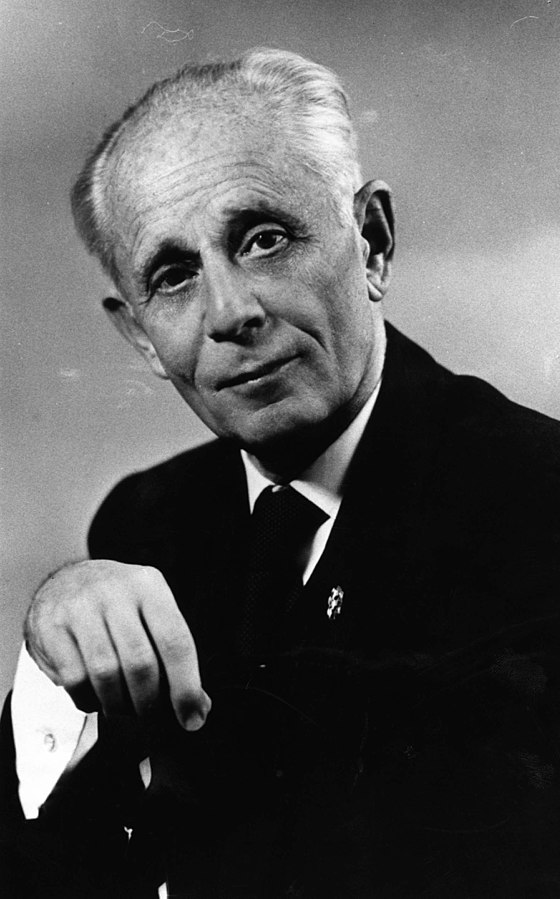
1966 – Ignace Lepp, Estonian-French priest and psychologist (b. 1909).
Ignace Lepp
Ignace Lepp (born John Robert Lepp; 26 October 1909 to 29 May 1966), was a French writer of Estonian origin.
According to his book Atheism in Our Time, Lepp was an atheist and Marxist for many years and claimed to have occupied important positions in the communist party with whom he later became very disillusioned. He then converted to Roman Catholicism and was ordained a priest in 1941. He wrote many non-fiction books including some about atheism, religion, and later psychiatry, as he was a psychologist and psychoanalyst.
He wrote among other books: The Ways of Friendship, The Psychology of Loving, The Authentic Existence, The Communication of Existences. He also wrote The faith of men; meditations inspired by Teilhard de Chardin (Teilhard et la foi des homme), about the French thinker Pierre Teilhard de Chardin.
André Green (12 March 1927 to 22 January 2012) was a French psychoanalyst.
Life and Career
André Green was born in Cairo, Egypt, to non observant Jewish parents. He studied medicine (specialising in psychiatry) at Paris Medical School and worked at several hospitals. Then, in 1965, after having finished his training as a psychoanalyst, he became a member of the Paris Psychoanalytic Society (SPP), of which he was the president from 1986 to 1989. From 1975 to 1977 he was a vice president of the International Psychoanalytical Association and from 1979 to 1980 a professor at University College London. He died, aged 84, in Paris.
André Green was the author of numerous papers and books on the theory and practice of psychoanalysis and the psychoanalytic criticism of culture and literature, many of which have also appeared in English translations.
Intellectual Development
Encounter with Lacan
In the early 1960s, Green could be found attending Lacan’s seminar, without abandoning his affiliation to the SPP – a bold decision which for some time enabled him to straddle the competing strands of French psychoanalysis from an independent position. As the decade progressed however, he moved further from Lacan, and finally broke with the latter in 1970 by criticising his concept of the signifier for its neglect of affect.
By doing so, he replaced the SPP’s normally defensive approach towards Lacanianism with a direct theoretical confrontation. Most tellingly, Green points out that whereas “Lacan is saying that the unconscious is structured like a language…when you read Freud, it is obvious that this proposition doesn’t work for a minute. Freud very clearly opposes the unconscious (which he says is constituted by thing-presentations and nothing else) to the pre-conscious. What is related to language can only belong to the pre-conscious”.
The Greenian Synthesis
Over the decades since, R. Horacio Etchegoyen concluded that what he called “the complex itinerary of Andre Green’s prolific work” has continued to demonstrate the intellectually independent way in which “Green is a Freudian analyst who has managed to integrate in a lucid synthesis the influence of authors as diverse as Lacan, Bion, and, especially, Winnicott”.
The result was to make André Green one of the most important psychoanalytic thinkers of our times – the creator of what has been called a Greenian theory of psychoanalysis (Kohon, 1999). Building on Freudian metapsychology, Green elaborated a further theory of the unrepresentable, relating thinking to absence as well as to sexuality.
While containing a multiplicity of local contributions – on the central phobic position; subjective disengagement; unconscious recognition; the dead mother; and more – the Greenian psychoanalytic framework has been seen as a totality, producing something greater than the sum of its parts.
Theoretical Contributions
On the Work of the Negative
A significant part of Green’s contribution to contemporary psychoanalysis has centred on his exploration of ‘the different modalities of the work of the negative’. He has highlighted the way ‘accepting the negation of what was there is necessary for relationships to new things to become possible’ – the way that ‘to accept the reality of lack…opens the door, through a process of working-through, to new experience, new ideals and new object-relationships’.
On the Analytic Setting
For Green, the analytic setting is in itself a recreation of psychic reality. ‘The symbolism of the setting comprises a triangular paradigm, uniting the three polarities of the dream (narcissism), of maternal caring (from the mother, following Winnicott), and of the prohibition of incest (from the father, following Freud). What the psychoanalytic apparatus gives rise to, then, is the symbolisation of the unconscious structure of the Oedipus Complex ‘.
On Dreams
Dreams are, ‘for Andre Green, negative states trying to accede to symbolization’, so that, as ‘summed up by Adam Phillips: “Dreams and affects, and states of emptiness or absence have been the essential perplexities of Green’s work because they are the areas of experience…in which the nature of representation itself is put at risk”‘.
Moral Narcissism
Green saw moral narcissism as the attempt to elevate oneself above ordinary human needs and attachments – an ascetic attempt at creating an impregnable sense of moral superiority.
This page is based on the copyrighted Wikipedia article <https://en.wikipedia.org/wiki/Andr%C3%A9_Green_(psychoanalyst) >; it is used under the Creative Commons Attribution-ShareAlike 3.0 Unported License (CC-BY-SA). You may redistribute it, verbatim or modified, providing that you comply with the terms of the CC-BY-SA.
1860 – James McKeen Cattell, American psychologist and academic (d. 1944).
1941 – Uta Frith, German developmental psychologist.
1947 – Catherine G. Wolf, American psychologist and computer scientist (d.2018).
People (Deaths)
1969 – Elisabeth Geleerd, Dutch-American psychoanalyst (b. 1909).
James McKeen Cattell
James McKeen Cattell (25 May 1860 to 20 January 1944), American psychologist, was the first professor of psychology in the United States, teaching at the University of Pennsylvania, and long-time editor and publisher of scientific journals and publications, most notably the journal Science. He also served on the board of trustees for Science Service, now known as Society for Science & the Public (or SSP), from 1921 to 1944.
At the beginning of Cattell’s career, many scientists regarded psychology as, at best, a minor field of study, or at worst a pseudoscience such as phrenology. Perhaps more than any of his contemporaries, Cattell helped establish psychology as a legitimate science, worthy of study at the highest levels of the academy. At the time of his death, The New York Times hailed him as “the dean of American science.” Yet Cattell may be best remembered for his uncompromising opposition to American involvement in World War I. His public opposition to the draft led to his dismissal from his position at Columbia University, a move that later led many American universities to establish tenure as a means of protecting unpopular beliefs.
Uta Frith
Dame Uta Frith DBE, FRS, FBA, FMedSci (née Aurnhammer; born 25 May 1941) is a German-British developmental psychologist at the Institute of Cognitive Neuroscience at University College London.
She has pioneered much of the current research into autism and dyslexia. She has written several books on these subjects, arguing for autism to be seen as a mental condition rather than as one caused by parenting. Her Autism: Explaining the Enigma introduces the cognitive neuroscience of autism. She is credited with creating the Sally-Anne test along with fellow scientists Alan Leslie and Simon Baron-Cohen. She also pioneered the work on child dyslexia. Among students she has mentored are Tony Attwood, Maggie Snowling, Simon Baron-Cohen and Francesca Happé.
Catherine G. Wolf
Catherine Gody Wolf (25 May 1947 to 07 February 2018) was an American psychologist and expert in human-computer interaction.
She was the author of more than 100 research articles and held six patents in the areas of human-computer interaction, artificial intelligence, and collaboration. Wolf was known for her work at IBM’s Thomas J. Watson Research Centre in Yorktown Heights, NY, where she was a 19-year staff researcher.
In the late 1990s, Wolf was diagnosed with Amyotrophic lateral sclerosis (ALS), better known as Lou Gehrig’s disease. Despite a rapid physical deterioration, Wolf was still able to communicate with the world via electronic sensory equipment, including a sophisticated brain-computer interface. Remarkably, with almost no voluntary physical functions remaining, she published novel research into the fine-scale abilities of ALS patients.
Elizabeth Geleerd
Elisabeth Rozetta Geleerd Loewenstein (20 March 1909 to 25 May 1969) was a Dutch-American psychoanalyst.
Born to an upper-middle-class family in Rotterdam, Geleerd studied psychoanalysis in Vienna, then London, under Anna Freud. Building a career in the United States, she became one of the nation’s major practitioners in child and adolescent psychoanalysis throughout the mid-20th century. Geleerd specialised in the psychoanalysis of psychosis, including schizophrenia, and was an influential writer on psychoanalysis in childhood schizophrenia. She was one of the first writers to consider the concept of borderline personality disorder in childhood.
Geleerd was married to fellow psychoanalyst Rudolph Loewenstein from 1946 until her death; they had one child. She developed a reputation as a particularly skilled and empathetic clinician, described as having a “sensitive, searching, and romantic” temperament; she was also regarded as an independent thinker who would present her ideas forcefully even when their topics were sensitive enough for other psychoanalysts to avoid. Suffering from chronic illness for much of her adult life, Geleerd died at the age of 60 in New York in 1969.
1878 – Lillian Moller Gilbreth, American psychologist and engineer (d. 1972).
People (Deaths)
2012 – Jacqueline Harpman, Belgian psychoanalyst and author (b. 1929).
Lillian Moller Gilbreth
Lillian Evelyn Gilbreth (née Moller; 24 May 1878 to 02 January 1972) was an American psychologist, industrial engineer, consultant, and educator who was an early pioneer in applying psychology to time-and-motion studies.
She was described in the 1940s as “a genius in the art of living.” Gilbreth, one of the first female engineers to earn a Ph.D., is considered to be the first industrial/organisational psychologist. She and her husband, Frank Bunker Gilbreth, were efficiency experts who contributed to the study of industrial engineering, especially in the areas of motion study and human factors. Cheaper by the Dozen (1948) and Belles on Their Toes (1950), written by two of their children (Ernestine and Frank Jr.) tell the story of their family life and describe how time-and-motion studies were applied to the organisation and daily activities of their large family. Both books were later made into feature films.
Jacqueline Harpman
Jacqueline Harpman (05 July 1929 to 24 May 2012) was a Belgian writer who wrote in French.
She was born on 05 July 1929, in Brussels, Belgium, and was later well known for her books written in French. She also worked as a psychoanalyst and lived in Etterbeek, Brussels. She died on 24 May 2012, in Brussels, Belgium, after having been severely ill for a long time. She was 82.
János Hugo Bruno “Hans” Selye CC (Hungarian: Selye János; 26 January 1907 to 16 October 1982) was a pioneering Hungarian-Canadian endocrinologist who conducted important scientific work on the hypothetical non-specific response of an organism to stressors.
Although he did not recognise all of the many aspects of glucocorticoids, Selye was aware of their role in the stress response. Charlotte Gerson considers him the first to demonstrate the existence of biological stress.
Hans Selye in the 1970s.
Biography
Selye was born in Vienna, Austria-Hungary on 26 January 1907 and grew up in Komárom (the town with Hungarian majority in present day Slovakia was cut by the Treaty of Trianon in 1920). Selye’s father was a doctor of Hungarian ethnicity and his mother was Austrian. He became a Doctor of Medicine and Chemistry in Prague in 1929 and went on to do pioneering work in stress and endocrinology at Johns Hopkins University, McGill University, and the Université de Montréal. He was nominated for the Nobel Prize in Physiology or Medicine for the first time in 1949. Although he received a total of 17 nominations in his career, he never won the prize.
Selye died on 16 October 1982 in Montreal, Quebec, Canada. He often returned to visit Hungary, giving lectures as well as interviews in Hungarian television programs. He conducted a lecture in 1973 at the Hungarian Scientific Academy in Hungarian and observers noted that he had no accent, despite spending many years abroad. His book The Stress of Life appeared in Hungarian as Az Életünk és a stressz in 1964 and became a bestseller. Selye János University, the only Hungarian-language university in Slovakia, was named after him. Selye’s mother was killed by gunfire during Hungary’s anti-Communist revolt of 1956.
Stress Research
Selye’s interest in stress began when he was in medical school; he had observed that patients with various chronic illnesses like tuberculosis and cancer appeared to display a common set of symptoms that he attributed to what is now commonly called stress. After completing his medical degree and a doctorate degree in organic chemistry at the German University of Prague, he received a Rockefeller Foundation fellowship to study at Johns Hopkins in Baltimore and later moved to the Department of Biochemistry at McGill University in Montreal where he studied under the sponsorship of James Bertram Collip. While working with laboratory animals, Selye observed a phenomenon that he thought resembled what he had previously seen in chronic patients. Rats exposed to cold, drugs, or surgical injury exhibited a common pattern of responses to these stressors (A stressor is a chemical or biological agent, environmental condition, external stimulus or an event seen as causing stress to an organism).
Selye initially (circa 1940s) called this the “general adaptation syndrome” (at the time it was also called “Selye’s syndrome”), but he later rebaptised it with the simpler term “stress response”. According to Selye the general adaptation syndrome is triphasic, involving an initial alarm phase followed by a stage of resistance or adaptation and, finally, a stage of exhaustion and death (these phases were established largely on the basis of glandular states). Working with doctoral student Thomas McKeown (1912-1988), Selye published a report that used the word “stress” to describe these responses to adverse events.
His last inspiration for general adaptation syndrome came from an experiment in which he injected mice with extracts of various organs. He at first believed he had discovered a new hormone, but was proved wrong when every irritating substance he injected produced the same symptoms (swelling of the adrenal cortex, atrophy of the thymus, gastric and duodenal ulcers). This, paired with his observation that people with different diseases exhibit similar symptoms, led to his description of the effects of “noxious agents” as he at first called it. He later coined the term “stress”, which has been accepted into the lexicon of most other languages.
Selye argued that stress differs from other physical responses in that it is identical whether the provoking impulse is positive or negative. He called negative stress “distress” and positive stress “eustress“.
The system whereby the body copes with stress, the hypothalamic-pituitary-adrenal axis (HPA axis) system, was also first described by Selye.
Selye has acknowledged the influence of Claude Bernard (who developed the idea of milieu intérieur) and Walter Cannon’s “homeostasis”. Selye conceptualised the physiology of stress as having two components: a set of responses which he called the “general adaptation syndrome”, and the development of a pathological state from ongoing, unrelieved stress.
While the work attracted continued support from advocates of psychosomatic medicine, many in experimental physiology concluded that his concepts were too vague and unmeasurable. During the 1950s, Selye turned away from the laboratory to promote his concept through popular books and lecture tours. He wrote for both non-academic physicians and, in an international bestseller entitled The Stress of Life (1956). From the late 1960s, academic psychologists started to adopt Selye’s concept of stress, and he followed The Stress of Life with two other books for the general public, From Dream to Discovery: On Being a Scientist (1964) and Stress without Distress (1974).
He worked as a professor and director of the Institute of Experimental Medicine and Surgery at the Université de Montréal. In 1975 he created the International Institute of Stress, and in 1979, Selye and Arthur Antille started the Hans Selye Foundation. Later Selye and eight Nobel laureates founded the Canadian Institute of Stress.
In 1968 he was made a Companion of the Order of Canada. In 1976, he was awarded the Loyola Medal by Concordia University.
Controversy and Involvement with the Tobacco Industry
Although it was not widely known at the time, Selye began consulting for the tobacco industry starting in 1958; he had previously sought funding from the industry, but had been denied. Later, New York attorney Edwin Jacob contacted Selye as he prepared a defence against liability actions brought against tobacco companies. The companies wanted Selye’s help in arguing that the recognized correlation between smoking and cancer was not proof of causality. The firm offered to pay Selye $1000 to make a statement supporting this claim. He agreed but refused to testify. Tobacco industry lawyers reported that Selye was willing to incorporate industry advice when writing about smoking and stress. One lawyer advised him to “comment on the unlikelihood of there being a mechanism by which smoking could cause cardiovascular disease” and to emphasize the “stressful” effect that anti-smoking messages had on the US population.
Publicly, Selye never declared his consultancy work for the tobacco industry. In a 1967 letter to “Medical Opinion and Review”, he argued against government over-regulation of science and public health, implying that his views on smoking were objective: “I purposely avoided any mention of government-supported research because, being too largely dependent upon it, I may not be able to view the subject objectively. However, I do not use … cigarettes so let these examples suffice.” In June 1969, Selye (then director of the Institute of Experimental Pathology, University of Montreal) testified before the Canadian House of Commons Health Committee against anti-smoking legislation, opposing advertising restrictions, health warnings, and restrictions on tar and nicotine. For his testimony Selye was funded $50 000 per year for a 3-year “special project”, by William Thomas Hoyt (executive of Council for Tobacco Research) with another $50,000 a year pledged by the Canadian tobacco industry. His comments on smoking were used worldwide, Philip Morris (Tobacco company) used Selye’s statements on the benefits of smoking to argue against the use of health warnings on tobacco products in Sweden. Similarly, in 1977 the Australian Cigarette Manufacturers quoted Selye extensively in their submission to the Australian Senate Standing Committee on Social Welfare.
In 1999, the United States Department of Justice brought an anti-racketeering case against 7 tobacco companies (British American Tobacco, Brown & Williamson, Philip Morris, Liggett, American Tobacco Company, RJ Reynolds, and Lorillard), the Council for Tobacco Research, and the Tobacco Institute. As a result, the industry’s influence on stress research was revealed.
This page is based on the copyrighted Wikipedia article <https://en.wikipedia.org/wiki/Hans_Selye >; it is used under the Creative Commons Attribution-ShareAlike 3.0 Unported License (CC-BY-SA). You may redistribute it, verbatim or modified, providing that you comply with the terms of the CC-BY-SA.
1912 – John Curtis Gowan, American psychologist and academic (d. 1986).
John Curtis Gowan
John Curtis Gowan (21 May 1912 to 02 December 1986) was a psychologist who studied, along with E. Paul Torrance, the development of creative capabilities in children and gifted populations.
John Curtis Gowan was born 21 May 1912 in Boston, Massachusetts. Graduating from Thayer Academy, Braintree, Massachusetts, in 1929, John Gowan was only 17 when he entered Harvard University, earning his undergraduate degree four years later. A master’s degree in mathematics followed; he then moved to Culver, Indiana, where he was employed as a counsellor and mathematics teacher at Culver Military Academy from 1941 to 1952. Earning a doctorate from UCLA, he became a member of the founding faculty at the California State University at Northridge, where he taught as a professor of Educational Psychology from 1953 until 1975, when he retired with emeritus status.
Dr. Gowan became interested in gifted children after the Russians gained superiority in space with the 1957 launch of Sputnik. He formed the National Association for Gifted Children the following year. He was the group’s executive director and president from 1975 to 1979 and over the years wrote more than 100 articles and fourteen books on gifted children, teacher evaluation, child development, and creativity.
While at Northridge, he developed a program to train campus counsellors, was nominated in 1973 as outstanding professor, and had been a counsellor, researcher, Fulbright lecturer, and visiting professor at various schools including the University of Singapore, the University of Canterbury in Christchurch, New Zealand, the University of Hawaii, and Connecticut State College. He was a fellow of the American Psychological Association and was also a colleague of the Creative Education Foundation.
Besides his work in Educational Psychology as specifically related to gifted children, he also had an interest in psychic (or psychedelic) phenomena as it relates to human creativity. His work in this area was inspired by the writings of Aldous Huxley and Carl Jung. Based on his work in creativity and with gifted children, Dr. Gowan developed a model of mental development that derived from the work of Jean Piaget and Erik Erikson, but also included adult development beyond the ordinary adult successes of career and family building, extending into the emergence and stabilisation of extraordinary development and mystical states of consciousness. He described the entire spectrum of available states in his classic Trance, Art, & Creativity (1975), with its different modalities of spiritual and aesthetic expression. He also devised a test for self-actualisation, (as defined by Abraham Maslow), called the Northridge Developmental Scale.
Dr. Gowan died on 02 December 1986. He was survived by his adult twin children from his first marriage, John Gowan Jr. of Albany, NY and Ann Gowan Curry, of Anchorage, Alaska as well as seven grandchildren and his second wife Jane Thompson Gowan. His godson, Cameron Scott Matheson sang at his memorial service which was attended by friends and colleagues.
2014 – Sandra Bem, American psychologist and academic (b. 1944).
Sandra Bem
Sandra Ruth Lipsitz Bem (22 June 1944 to 20 May 2014) was an American psychologist known for her works in androgyny and gender studies.
Her pioneering work on gender roles, gender polarisation and gender stereotypes led directly to more equal employment opportunities for women in the United States.
1920 – Tina Strobos, Dutch psychiatrist known for rescuing Jews during World War II (d. 2012).
People (Deaths)
1987 – James Tiptree, Jr., American psychologist and author (b. 1915).
Tina Strobos
Tina Strobos, née Tineke Buchter (19 May 1920 to 27 February 2012), was a Dutch physician and psychiatrist from Amsterdam, known for her resistance work during World War II. While a young medical student, she worked with her mother and grandmother to rescue more than 100 Jewish refugees as part of the Dutch resistance during the Nazi occupation of the Netherlands. Strobos provided her house as a hiding place for Jews on the run, using a secret attic compartment and warning bell system to keep them safe from sudden police raids. In addition, Strobos smuggled guns and radios for the resistance and forged passports to help refugees escape the country. Despite being arrested and interrogated nine times by the Gestapo, she never betrayed the whereabouts of a Jew.
After the war, Strobos completed her medical degree and became a psychiatrist. She studied under Anna Freud in England. Strobos later emigrated to the United States to study psychiatry under a Fulbright scholarship, and she subsequently settled in New York. She married twice and had three children. Strobos built a career as a family psychiatrist, receiving the Elizabeth Blackwell Medal in 1998 for her medical work, and finally retired from active practice in 2009.
In 1989, Strobos was honoured as Righteous Among the Nations by Yad Vashem for her rescue work. In 2009, she was recognised for her efforts by the Holocaust and Human Rights Education Centre of New York City.
James Tiptree Jr.
Alice Bradley Sheldon (born Alice Hastings Bradley; 24 August 1915 to 19 May 1987) was an American science fiction and fantasy author better known as James Tiptree Jr., a pen name she used from 1967 to her death. It was not publicly known until 1977 that James Tiptree Jr. was a woman. From 1974 to 1985 she also used the pen name Raccoona Sheldon. Tiptree was inducted into the Science Fiction Hall of Fame in 2012.
Tiptree’s debut story collection, Ten Thousand Light-Years from Home, was published in 1973 and her first novel, Up the Walls of the World, was published in 1978. Her other works include 1973 novelette “The Women Men Don’t See”, 1974 novella “The Girl Who Was Plugged In”, 1976 novella “Houston, Houston, Do You Read?”, 1985 novel Brightness Falls from the Air, and 1990 short story “Her Smoke Rose Up Forever”.
2019 – Austin Eubanks, American addiction recovery advocate, survivor of the Columbine shooting (b. 1981).
Austin Eubanks
Stephen Austin Eubanks (07 October 1981 to 18 May 2019) was an American motivational speaker on addiction and recovery.
He was a survivor of the Columbine High School massacre, in which his best friend, 17-year-old Corey DePooter, was killed and Eubanks was shot in his hand and knee. Eubanks struggled with opioid addiction after the shooting. Eubanks was the chief operations officer for the Foundry Treatment Centre.
Columbine Shooting
The Columbine High School massacre was a school shooting and attempted bombing that occurred on 20 April 1999, at Columbine High School in Columbine, Colorado, United States.
The perpetrators, twelfth grade (senior) students Eric Harris and Dylan Klebold, murdered 12 students and one teacher. Ten students were killed in the school library, where the pair subsequently committed suicide. Twenty-one additional people were injured by gunshots, and gunfire was also exchanged with the police. Another three people were injured trying to escape. At the time, it was the deadliest high school shooting in US history. The shooting has inspired dozens of copycat killings, including many deadlier shootings across the world. The word “Columbine” has become a byword for school shootings.
In addition to the shootings, Harris and Klebold planted several homemade bombs in the school, although they failed to detonate. Two bombs were set up as diversions at another location away from the school, one of which (partially) detonated. The motive remains unclear, but they had planned for around a year and hoped to massacre the most victims in US history, which at the time meant exceeding the death toll of the Oklahoma City bombing.
The police were slow to enter the school and were heavily criticized for not intervening during the shooting. The incident resulted in the introduction of the Immediate Action Rapid Deployment tactic, which is used in active shooter situations. Columbine also resulted in an increased emphasis on school security with zero tolerance policies. Debates and moral panic were sparked over guns and gun control laws, high school cliques, subcultures (e.g. goths), outcasts, and school bullying, as well as teenage use of pharmaceutical antidepressants, the Internet and violence in video games and movies.
Many impromptu memorials were created after the massacre, including victims Rachel Scott’s car and John Tomlin’s truck. Fifteen crosses for the victims and shooters were also erected on top of a hill in Clement Park. The crosses for Harris and Klebold were removed later following controversy. The Columbine Memorial began planning as a permanent memorial in June 1999 and opened to the public on 21 September 2007.
1990 – The General Assembly of the World Health Organisation (WHO) eliminates homosexuality from the list of psychiatric diseases.
People (Deaths)
1964 – Nandor Fodor, Hungarian-American psychologist and parapsychologist (b. 1895).
Nandor Fodor
Nandor Fodor (13 May 1895 to 17 May 1964) was a British and American parapsychologist, psychoanalyst, author and journalist of Hungarian origin.
Fodor was born in Beregszász, Hungary. He received a doctorate in law from the Royal Hungarian University of Science in Budapest. He moved to New York to work as a journalist and to Britain in 1929 where he worked for a newspaper company.
Fodor was one of the leading authorities on poltergeists, haunting and paranormal phenomena usually associated with mediumship. Fodor, who was at one time Sigmund Freud’s associate, wrote on subjects like prenatal development and dream interpretation, but is credited mostly for his magnum opus, Encyclopaedia of Psychic Science, first published in 1934. Fodor was the London correspondent for the American Society for Psychical Research (1935-1939). He worked as an editor for the Psychoanalytic Review and was a member of the New York Academy of Sciences.
Fodor in the 1930s embraced paranormal phenomena but by the 1940s took a break from his previous work and advocated a psychoanalytic approach to psychic phenomena. He published sceptical newspaper articles on mediumship, which caused opposition from spiritualists.
Among the subjects he closely studied was the case of Gef the talking mongoose.


 Mental Health Matters
You must be logged in to post a comment.