On This Day … 22 January

People (Births)

  • 1913 – Henry Bauchau, Belgian psychoanalyst and author (d. 2012).
  • 1932 – Berthold Grünfeld, Norwegian psychiatrist and academic (d. 2007).

Henry Bauchau

Henry Bauchau (22 January 1913 to 21 September 2012) was a Belgian psychoanalyst, lawyer, and author of French prose and poetry.

He became a trial lawyer in Brussels in 1936 and was a member of the Belgian Resistance in the Ardennes during World War II.

Berthold Grunfeld

Berthold Grünfeld (22 January 1932 to 20 August 2007) was a Norwegian psychiatrist, sexologist, and professor of social medicine at the University of Oslo. He was also a recognised expert in forensic psychiatry, often employed by Norwegian courts to examine insanity defence pleas.

Grünfeld was born in Bratislava in what was then Czechoslovakia. In 1939, when he was seven, he and 34 other Jewish children were separated from their families in an attempt by Nansenhjelpen to rescue them from the early manifestations of the Holocaust. The group of children was sent by train to Norway via Berlin, after having been told they would never again see their parents.

Once in Norway, Grünfeld was first placed at the Jewish children’s home in Oslo, then lived as a foster child with a Jewish family in Trondheim before returning to the orphanage. During the occupation of Norway, Grünfeld avoided capture and deportation by fleeing with members of the Norwegian Resistance in 1942 to neutral Sweden, where he stayed until the war ended. He returned to the children’s home in 1946. The Jewish community funded his education.

Berthold Grünfeld earned his medical degree in 1960, when he also met his future wife Gunhild. He was awarded his doctorate in medicine in 1973 based on a dissertation on abortion. In 1993, he was made professor of social medicine at the University of Oslo.

Grünfeld was noted for his academic contributions within sexology, on the issues of abortion and euthanasia, and within forensic psychology. In addition to his advocacy and teaching, he acted as an expert witness in criminal cases, and as a consultant on human relations and sexology for Oslo Helseråd. His dissertation influenced the reform of abortion laws in Norway.

Grünfeld and his wife had three children and six grandchildren. In 2005, his daughter Nina Grünfeld made a film, Origin Unknown, about her efforts to research her father’s background and heritage. Among other things, she found that his mother had worked as a prostitute and was murdered in the death camp at Sobibor.

What is Capgras Delusion?

Introduction

Capgras delusion is a psychiatric disorder in which a person holds a delusion that a friend, spouse, parent, or other close family member (or pet) has been replaced by an identical impostor. It is named after Joseph Capgras (1873-1950), a French psychiatrist.

The Capgras delusion is classified as a delusional misidentification syndrome, a class of delusional beliefs that involves the misidentification of people, places, or objects. It can occur in acute, transient, or chronic forms. Cases in which patients hold the belief that time has been “warped” or “substituted” have also been reported.

The delusion most commonly occurs in individuals diagnosed with paranoid schizophrenia but has also been seen in brain injury, dementia with Lewy bodies, and other dementia. It presents often in individuals with a neurodegenerative disease, particularly at an older age. It has also been reported as occurring in association with diabetes, hypothyroidism, and migraine attacks. In one isolated case, the Capgras delusion was temporarily induced in a healthy subject by the drug ketamine. It occurs more frequently in females, with a female to male ratio of approximately 3 to 2.

Signs and Symptoms

The following two case reports are examples of the Capgras delusion in a psychiatric setting:

Example 01

Mrs. D, a 74-year-old married housewife, recently discharged from a local hospital after her first psychiatric admission, presented to our facility for a second opinion. At the time of her admission earlier in the year, she had received the diagnosis of atypical psychosis because of her belief that her husband had been replaced by another unrelated man. She refused to sleep with the impostor, locked her bedroom and door at night, asked her son for a gun, and finally fought with the police when attempts were made to hospitalise her. At times she believed her husband was her long deceased father. She easily recognised other family members and would misidentify her husband only.

Example 02

Diane was a 28-year-old single woman who was seen for an evaluation at a day hospital program in preparation for discharge from a psychiatric hospital. This was her third psychiatric admission in the past five years. Always shy and reclusive, Diane first became psychotic at age 23. Following an examination by her physician, she began to worry that the doctor had damaged her internally and that she might never be able to become pregnant. The patient’s condition improved with neuroleptic treatment but deteriorated after discharge because she refused medication. When she was admitted eight months later, she presented with delusions that a man was making exact copies of people—”screens”—and that there were two screens of her, one evil and one good. The diagnosis was schizophrenia with Capgras delusion. She was disheveled and had a bald spot on her scalp from self-mutilation.

Example 03

The following case is an instance of the Capgras delusion resulting from a neurodegenerative disease:

Fred, a 59-year-old man with a high school qualification, was referred for neurological and neuropsychological evaluation because of cognitive and behavioural disturbances. He had worked as the head of a small unit devoted to energy research until a few months before. His past medical and psychiatric history was uneventful. […] Fred’s wife reported that about 15 months from onset he began to see her as a “double” (her words). The first episode occurred one day when, after coming home, Fred asked her where Wilma was. On her surprised answer that she was right there, he firmly denied that she was his wife Wilma, whom he “knew very well as his sons’ mother”, and went on plainly commenting that Wilma had probably gone out and would come back later. […] Fred presented progressive cognitive deterioration characterised both by severity and fast decline. Apart from [Capgras disorder], his neuropsychological presentation was hallmarked by language disturbances suggestive of frontal-executive dysfunction. His cognitive impairment ended up in a severe, all-encompassing frontal syndrome.

Causes

It is generally agreed that the Capgras delusion has a complex and organic basis caused by structural damage to organs and can be better understood by examining neuroanatomical damage associated with the syndrome.

In one of the first papers to consider the cerebral basis of the Capgras delusion, Alexander, Stuss and Benson pointed out in 1979 that the disorder might be related to a combination of frontal lobe damage causing problems with familiarity and right hemisphere damage causing problems with visual recognition.

Further clues to the possible causes of the Capgras delusion were suggested by the study of brain-injured patients who had developed prosopagnosia. In this condition, patients are unable to recognise faces consciously, despite being able to recognise other types of visual objects. However, a 1984 study by Bauer showed that even though conscious face recognition was impaired, patients with the condition showed autonomic arousal (measured by a galvanic skin response measure) to familiar faces, suggesting that there are two pathways to face recognition – one conscious and one unconscious.

In a 1990 paper published in the British Journal of Psychiatry, psychologists Hadyn Ellis and Andy Young hypothesized that patients with Capgras delusion may have a “mirror image” or double dissociation of prosopagnosia, in that their conscious ability to recognise faces was intact, but they might have damage to the system that produces the automatic emotional arousal to familiar faces. This might lead to the experience of recognising someone while feeling something was not “quite right” about them. In 1997, Ellis and his colleagues published a study of five patients with Capgras delusion (all diagnosed with schizophrenia) and confirmed that although they could consciously recognise the faces, they did not show the normal automatic emotional arousal response. The same low level of autonomic response was shown in the presence of strangers. Young (2008) has theorised that this means that patients with the disease experience a “loss” of familiarity, not a “lack” of it. Further evidence for this explanation comes from other studies measuring galvanic skin responses (GSR) to faces. A patient with Capgras delusion showed reduced GSRs to faces in spite of normal face recognition. This theory for the causes of Capgras delusion was summarised in Trends in Cognitive Sciences in 2001.

William Hirstein and Vilayanur S. Ramachandran reported similar findings in a paper published on a single case of a patient with Capgras delusion after brain injury. Ramachandran portrayed this case in his book Phantoms in the Brain[24] and gave a talk about it at TED 2007. Since the patient was capable of feeling emotions and recognising faces but could not feel emotions when recognising familiar faces, Ramachandran hypothesizes that the origin of Capgras syndrome is a disconnection between the temporal cortex, where faces are usually recognised, and the limbic system, involved in emotions. More specifically, he emphasizes the disconnection between the amygdala and the inferotemporal cortex.

In 2010, Hirstein revised this theory to explain why a person with Capgras syndrome would have the particular reaction of not recognizing a familiar person. Hirstein explained the theory as follows:

My current hypothesis on Capgras, which is a more specific version of the earlier position I took in the 1997 article with V. S. Ramachandran. According to my current approach, we represent the people we know well with hybrid representations containing two parts. One part represents them externally: how they look, sound, etc. The other part represents them internally: their personalities, beliefs, characteristic emotions, preferences, etc. Capgras syndrome occurs when the internal portion of the representation is damaged or inaccessible. This produces the impression of someone who looks right on the outside, but seems different on the inside, i.e., an impostor. This gives a much more specific explanation that fits well with what the patients actually say. It corrects a problem with the earlier hypothesis in that there are many possible responses to the lack of an emotion upon seeing someone.

Furthermore, Ramachandran suggests a relationship between the Capgras syndrome and a more general difficulty in linking successive episodic memories because of the crucial role emotion plays in creating memories. Since the patient could not put together memories and feelings, he believed objects in a photograph were new on every viewing, even though they normally should have evoked feelings (e.g. a person close to him, a familiar object, or even himself). Others like Merrin and Silberfarb (1976) have also proposed links between the Capgras syndrome and deficits in aspects of memory. They suggest that an important and familiar person (the usual subject of the delusion) has many layers of visual, auditory, tactile, and experiential memories associated with them, so the Capgras delusion can be understood as a failure of object constancy at a high perceptual level.

Most likely, more than just an impairment of the automatic emotional arousal response is necessary to form the Capgras delusion, as the same pattern has been reported in patients showing no signs of delusions. Ellis suggested that a second factor explains why this unusual experience is transformed into a delusional belief; this second factor is thought to be an impairment in reasoning, although no definitive impairment has been found to explain all cases. Many have argued for the inclusion of the role of patient phenomenology in explanatory models of the Capgras syndrome in order to better understand the mechanisms that enable the creation and maintenance of delusional beliefs.

Capgras syndrome has also been linked to reduplicative paramnesia, another delusional misidentification syndrome in which a person believes a location has been duplicated or relocated. Since these two syndromes are highly associated, it has been proposed that they affect similar areas of the brain and therefore have similar neurological implications. Reduplicative paramnesia is understood to affect the frontal lobe, and thus it is believed that Capgras syndrome is also associated with the frontal lobe. Even if the damage is not directly to the frontal lobe, an interruption of signals between other lobes and the frontal lobe could result in Capgras syndrome.

Diagnosis

Because it is a rare and poorly understood condition, there is no definitive way to diagnose the Capgras delusion. Diagnosis is primarily made on a psychiatric evaluation of the patient, who is most likely brought to a psychiatrist’s attention by a family member or friend believed to be an imposter by the person under the delusion.

Treatment

Treatment has not been well studied and so there is no evidence-based approach. Treatment is generally therapy, often with support of antipsychotic medication.

Brief History

Capgras syndrome is named after Joseph Capgras, a French psychiatrist who first described the disorder in 1923 in his paper co-authored by Jean Reboul-Lachaux, on the case of a French woman, “Madame Macabre,” who complained that corresponding “doubles” had taken the places of her husband and other people she knew. Capgras and Reboul-Lachaux first called the syndrome “l’illusion des sosies”, which can be translated literally as “the illusion of look-alikes.”

The syndrome was initially considered a purely psychiatric disorder, the delusion of a double seen as symptomatic of schizophrenia, and purely a female disorder (though this is now known not to be the case) often noted as a symptom of hysteria. Most of the proposed explanations initially following that of Capgras and Reboul-Lachaux were psychoanalytical in nature. It was not until the 1980s that attention was turned to the usually co-existing organic brain lesions originally thought to be essentially unrelated or accidental. Today, the Capgras syndrome is understood as a neurological disorder, in which the delusion primarily results from organic brain lesions or degeneration.

In Popular Culture

In the Memoirs Found in a Bathtub novel by the Polish writer Stanisław Lem, first published in 1961, the narrator inhabits a paranoid dystopia where nothing is as it seems, chaos seems to rule all events, and everyone is deeply suspicious of everyone. In the end, it is revealed that the world is filled by phantom body doubles.

A central character in Richard Powers’s 2006 novel The Echo Maker suffers from Capgras Delusion subsequent to traumatic brain injury.

The protagonist in the movie Synecdoche, New York, who is named Caden Cotard (played by Philip Seymour Hoffman), goes to see his ex-wife at her apartment, and, as he enters the building, one of the resident call boxes is taped with the name “Capgras”. He is then misidentified as his ex-wife’s cleaning lady, Ellen Bascomb, as he tries to enter the apartment, and, later in the film, he actually comes to play the role of Ellen Bascomb in his own play. Throughout the film, Cotard enlists actor-doubles to play actors, and, as the film progresses, the actor-doubles are in turn then given actors-doubles.

In “Dorado Falls,” an episode from the seventh season of the television series Criminal Minds, a Navy SEAL develops Capgras delusion as the result of an automobile accident. His experience with classified military missions causes him to become extremely paranoid, and he begins killing the people he sees on a regular basis, believing them to have been replaced by duplicates who are plotting against him.

On This Day … 21 Janaury

People (Births)

  • 1887 – Wolfgang Köhler, German psychologist and phenomenologist (d. 1967).

Wolfgang Kohler

Wolfgang Köhler (21 January 1887 to 11 June 1967) was a German psychologist and phenomenologist who, like Max Wertheimer and Kurt Koffka, contributed to the creation of Gestalt psychology.

During the Nazi regime in Germany, he protested against the dismissal of Jewish professors from universities, as well as the requirement that professors give a Nazi salute at the beginning of their classes. In 1935 he left the country for the United States, where Swarthmore College in Pennsylvania offered him a professorship. He taught with its faculty for 20 years, and did continuing research. A Review of General Psychology survey, published in 2002, ranked Köhler as the 50th most cited psychologist of the 20th century.

What is the Karpman Drama Triangle?

Introduction

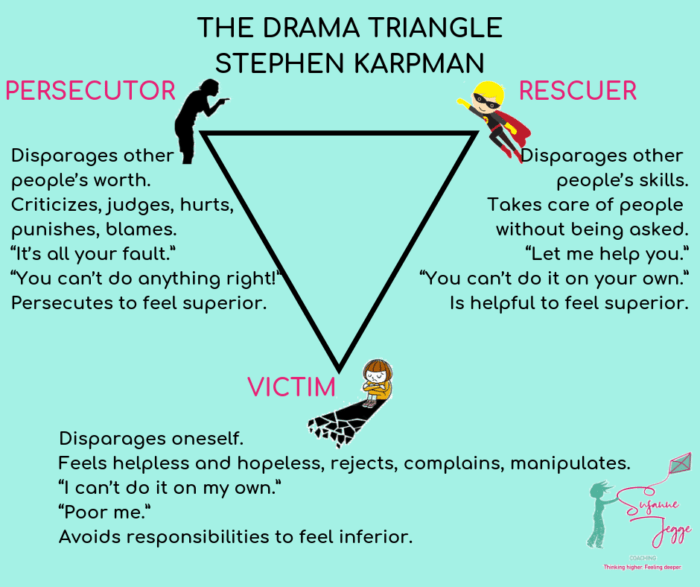
The drama triangle is a social model of human interaction – the triangle maps a type of destructive interaction that can occur among people in conflict.

The drama triangle model is a tool used in psychotherapy, specifically transactional analysis.

The triangle of actors in the drama are oppressors, victims and rescuers.

Refer to Triangulation (Psychology).

The Theory

Stephen Karpman used triangles to map conflicted or drama-intense relationship transactions. The Karpman Drama Triangle models the connection between personal responsibility and power in conflicts, and the destructive and shifting roles people play. He defined three roles in the conflict; Persecutor, Rescuer (the one up positions) and Victim (one down position). Karpman placed these three roles on an inverted triangle and referred to them as being the three aspects, or faces of drama.

  • The Victim:
    • The Victim in this model is not intended to represent an actual victim, but rather someone feeling or acting like one.
    • The Victim’s stance is “Poor me!”
    • The Victim feels victimised, oppressed, helpless, hopeless, powerless, ashamed, and seems unable to make decisions, solve problems, take pleasure in life, or achieve insight.
    • The Victim, if not being persecuted, will seek out a Persecutor and also a Rescuer who will save the day but also perpetuate the Victim’s negative feelings.
  • The Rescuer:
    • The rescuer’s line is “Let me help you.”
    • A classic enabler, the Rescuer feels guilty if they do not go to the rescue.
    • Yet their rescuing has negative effects: It keeps the Victim dependent and does not allow the Victim permission to fail and experience the consequences of their choices.
    • The rewards derived from this rescue role are that the focus is taken off of the rescuer.
    • When they focus their energy on someone else, it enables them to ignore their own anxiety and issues.
    • This rescue role is also pivotal because their actual primary interest is really an avoidance of their own problems disguised as concern for the victim’s needs.
  • The Persecutor:
    • A.k.a. Villain.
    • The Persecutor insists, “It’s all your fault.”
    • The Persecutor is controlling, blaming, critical, oppressive, angry, authoritarian, rigid, and superior.

Initially, a drama triangle arises when a person takes on the role of a victim or persecutor. This person then feels the need to enlist other players into the conflict. As often happens, a rescuer is encouraged to enter the situation. These enlisted players take on roles of their own that are not static, and therefore various scenarios can occur. The victim might turn on the rescuer, for example, while the rescuer then switches to persecution.

The reason that the situation persist is that each participant has their (frequently unconscious) psychological wishes/needs met without having to acknowledge the broader dysfunction or harm done in the situation as a whole. Each participant is acting upon their own selfish needs, rather than acting in a genuinely responsible or altruistic manner. Any character might “ordinarily come on like a plaintive victim; it is now clear that the one can switch into the role of Persecutor providing it is ‘accidental’ and the one apologises for it”.

The motivations of the rescuer are the least obvious. In the terms of the triangle, the rescuer has a mixed or covert motive and benefits egoically in some way from being “the one who rescues”. The rescuer has a surface motive of resolving the problem and appears to make great efforts to solve it, but also has a hidden motive to not succeed, or to succeed in a way in which they benefit. They may get a self-esteem boost, for example, or receive respected rescue status, or derive enjoyment by having someone depend on them and trust them and act in a way that ostensibly seems to be trying to help, but at a deeper level plays upon the victim in order to continue getting a payoff.

The relationship between the victim and the rescuer may be one of co-dependency. The rescuer keeps the victim dependent by encouraging their victimhood. The victim gets their needs met by having the rescuer take care of them.

Participants generally tend to have a primary or habitual role (victim, rescuer, persecutor) when they enter into drama triangles. Participants first learn their habitual role in their family of origin. Even though participants each have a role with which they most identify, once on the triangle, participants rotate through all the three positions.

Each triangle has a “payoff” for those playing it. The “antithesis” of a drama triangle lies in discovering how to deprive the actors of their payoff.

Use

Through popular usage and the work of Karpman and others, Karpman’s triangle has been adapted for use in structural analysis and transactional analysis.

Historical Context

Family Therapy Movement

After World War II, therapists observed that while many battle-torn veteran patients readjusted well after returning to their families, some patients did not; some even regressed when they returned to their home environment. Researchers felt that they needed an explanation for this and began to explore the dynamics of family life – and thus began the family therapy movement. Prior to this time, psychiatrists and psychoanalysts focused on the patient’s already-developed psyche and downplayed outside detractors. Intrinsic factors were addressed and extrinsic reactions were considered as emanating from forces within the person.

Transaction Analysis

In the 1950s, Eric Berne developed transactional analysis, a method for studying interactions between individuals. This approach was profoundly different than that of Freud. While Freud relied on asking patients about themselves, Berne felt that a therapist could learn by observing what was communicated (words, body language, facial expressions) in a transaction. So instead of directly asking the patient questions, Berne would frequently observe the patient in a group setting, noting all of the transactions that occurred between the patient and other individuals.

Triangles/Triangulation

The theory of triangulation was originally published in 1966 by Murray Bowen as one of eight parts of Bowen’s family systems theory. Murray Bowen, a pioneer in family systems theory, began his early work with schizophrenics at the Menninger Clinic, from 1946 to 1954. Triangulation is the “process whereby a two-party relationship that is experiencing tension will naturally involve third parties to reduce tension”. Simply put, when people find themselves in conflict with another person, they will reach out to a third person. The resulting triangle is more comfortable as it can hold much more tension because the tension is being shifted around three people instead of two.

Bowen studied the dyad of the mother and her schizophrenic child while he had them both living in a research unit at the Menninger clinic. Bowen then moved to the National Institute of Mental Health (NIMH), where he resided from 1954 to 1959. At the NIMH Bowen extended his hypothesis to include the father-mother-child triad. Bowen considered differentiation and triangles the crux of his theory, Bowen Family Systems Theory. Bowen intentionally used the word triangle rather than triad. In Bowen Family Systems Theory, the triangle is an essential part of the relationship.

Couples left to their own resources oscillate between closeness and distance. Two people having this imbalance often have difficulty resolving it by themselves. To stabilise the relationship, the couple often seek the aid of a third party to help re-establish closeness. A triangle is the smallest possible relationship system that can restore balance in a time of stress. The third person assumes an outside position. In periods of stress, the outside position is the most comfortable and desired position. The inside position is plagued by anxiety, along with its emotional closeness. The outsider serves to preserve the inside couple’s relationship. Bowen noted that not all triangles are constructive – some are destructive.

Pathological/Perverse Triangles

In 1968, Nathan Ackerman conceptualised a destructive triangle. Ackerman stated “we observe certain constellations of family interactions which we have epitomised as the pattern of family interdependence, roles those of destroyer or persecutor, the victim of the scapegoating attack, and the family healer or the family doctor. Ackerman also recognise the pattern of attack, defence, and counterattack, as shifting roles.

Karpman Triangle and Eric Berne

In 1968, Stephen Karpman, who had an interest in acting and was a member of the Screen Actors Guild, chose “drama triangle” rather than “conflict triangle” as, here, the Victim in his model is not intended to represent an actual victim, but rather someone feeling or acting like one. He first published his theory in an article entitled “Fairy Tales and Script Drama Analysis”. His article, in part, examined the fairy tale “Little Red Riding Hood” to illustrate its points. Karpman was, at the time, a recent graduate of Duke University School of Medicine and was doing post post-graduate studies under Berne. Berne, who founded the field transactional analysis, encouraged Karpman to publish what Berne referred to as “Karpman’s triangle”. Karpman’s article was published in 1968. In 1972, Karpman received the Eric Berne Memorial Scientific Award for the work.

Transactional Analysis

Eric Berne, a Canadian-born psychiatrist, created the theory of transactional analysis, in the middle of the 20th century, as a way of explaining human behaviour. Berne’s theory of transactional analysis was based on the ideas of Freud but was distinctly different. Freudian psychotherapists focused on talk therapy as a way of gaining insight to their patients’ personalities. Berne believed that insight could be better discovered by analysing patients’ social transactions.

Games in transactional analysis refers to a series of transactions that is complementary (reciprocal), ulterior, and proceeds towards a predictable outcome. In this context, the Karpman Drama Triangle is a “game”.

Games are often characterised by a switch in roles of players towards the end. The number of players may vary. Games in this sense are devices used (often unconsciously) by people to create a circumstance where they can justifiably feel certain resulting feelings (such as anger or superiority) or justifiably take or avoid taking certain actions where their own inner wishes differ from societal expectations. They are always a substitute for a more genuine and full adult emotion and response which would be more appropriate. Three quantitative variables are often useful to consider for games:

  • Flexibility:
    • “The ability of the players to change the currency of the game (that is, the tools they use to play it).
    • “Some games…can be played properly with only one kind of currency, while others, such as exhibitionistic games, are more flexible”, so that players may shift from words, to money, to parts of the body.
  • Tenacity:
    • “Some people give up their games easily, others are more persistent”, referring to the way people stick to their games and their resistance to breaking with them.
  • Intensity:
    • “Some people play their games in a relaxed way, others are more tense and aggressive.
    • Games so played are known as easy and hard games, respectively”, the latter being played in a tense and aggressive way.

The consequences of games may vary from small paybacks to paybacks built up over a long period to a major level. Based on the degree of acceptability and potential harm, games are classified into three categories, representing first degree games, second degree games, and third degree games:

  • Socially acceptable.
  • Undesirable but not irreversibly damaging.
  • May result in drastic harm.

The Karpman triangle was an adaptation of a model that was originally conceived to analyse the play-action pass and the draw play in American football and later adapted as a way to analyse movie scripts. Karpman is reported to have doodled thirty or more diagram types before settling on the triangle. Karpman credits the movie Valley of the Dolls as being a testbed for refining the model into what Berne coined as the Karpman Drama Triangle.

Karpman now has many variables of the Karpman triangle in his fully developed theory, besides role switches. These include space switches (private-public, open-closed, near-far) which precede, cause, or follow role switches, and script velocity (number of role switches in a given unit of time). These include the Question Mark triangle, False Perception triangle, Double Bind triangle, The Indecision triangle, the Vicious Cycle triangle, Trapping triangle, Escape triangle, Triangles of Oppression, and Triangles of Liberation, Switching in the triangle, and the Alcoholic Family triangle.

While transactional analysis is the method for studying interactions between individuals, one researcher postulates that drama-based leaders can instil an organisational culture of drama. Persecutors are more likely to be in leadership positions and a persecutor culture goes hand in hand with cutthroat competition, fear, blaming, manipulation, high turnover and an increased risk of lawsuits. There are also victim cultures which can lead to low morale and low engagement as well as an avoidance of conflict, and rescuer cultures which can be characterised as having a high dependence on the leader, low initiative and low innovation.

Therapeutic Models

The Winner’s Triangle was published by Acey Choy in 1990 as a therapeutic model for showing patients how to alter social transactions when entering a triangle at any of the three entry points. Choy recommends that anyone feeling like a victim think more in terms of being vulnerable and caring, that anyone cast as a persecutor adopt an assertive posture, and anyone recruited to be a rescuer should react by being “caring”.

  • Vulnerable: A victim should be encouraged to accept their vulnerability, problem solve, and be more self-aware.
  • Assertive: A persecutor should be encouraged to ask for what they want, be assertive, but not be punishing.
  • Caring: A rescuer should be encouraged to show concern and be caring, but not over-reach and problem solve for others.

The Power of TED, first published in 2009, recommends that the “victim” adopt the alternative role of creator, view the persecutor as a challenger, and enlist a coach instead of a rescuer.

  • Creator:
    • Victims are encouraged to be outcome-oriented as opposed to problem-oriented and take responsibility for choosing their response to life challenges.
    • They should focus on resolving “dynamic tension” (the difference between current reality and the envisioned goal or outcome) by taking incremental steps toward the outcomes he or she is trying to achieve.
  • Challenger:
    • A victim is encouraged to see a persecutor as a person (or situation) that forces the creator to clarify his or her needs, and focus on their learning and growth.
  • Coach:
    • A rescuer should be encouraged to ask questions that are intended to help the individual to make informed choices.
    • The key difference between a rescuer and a coach is that the coach sees the creator as capable of making choices and of solving his or her own problems.
    • A coach asks questions that enable the creator to see the possibilities for positive action, and to focus on what he or she does want instead of what he or she does not want.

What is Motivational Interviewing?

Introduction

Motivational interviewing (MI) is a counselling approach developed in part by clinical psychologists William R. Miller and Stephen Rollnick. It is a directive, client-centred counselling style for eliciting behaviour change by helping clients to explore and resolve ambivalence. Compared with non-directive counselling, it is more focused and goal-directed, and departs from traditional Rogerian client-centred therapy through this use of direction, in which therapists attempt to influence clients to consider making changes, rather than engaging in non-directive therapeutic exploration. The examination and resolution of ambivalence is a central purpose, and the counsellor is intentionally directive in pursuing this goal. MI is most centrally defined not by technique but by its spirit as a facilitative style for interpersonal relationship.

Core concepts evolved from experience in the treatment of problem drinkers, and MI was first described by Miller (1983) in an article published in the journal Behavioural and Cognitive Psychotherapy. Miller and Rollnick elaborated on these fundamental concepts and approaches in 1991 in a more detailed description of clinical procedures.

Overview

Motivational interviewing (MI) is a person-centred strategy. It is used to elicit patient motivation to change a specific negative behaviour. MI engages clients, elicits change talk and evokes patient motivation to make positive changes. For example, change talk can be elicited by asking the patient questions such as: “How might you like things to be different?” or “How does __ interfere with things that you would like to do?”

Unlike clinical interventions and treatment, MI is the technique where the interviewer (clinician) assists the interviewee (patient) in changing a behaviour by expressing their acceptance of the interviewee without judgement. By this, MI incorporates the idea that every single patient may be in differing stages of readiness levels and may need to act accordingly to the patient’s levels and current needs. Change may occur quickly or may take considerable time, depending on the client. Knowledge alone is usually not sufficient to motivate change within a client, and challenges in maintaining change should be thought of as the rule, not the exception. The incorporation of MI can help patients resolve their uncertainties and hesitancies that may stop them from their inherent want of change in relation to a certain behaviour or habit. At the same time, it can be seen that MI ensures that the participants are viewed more as team members to solve a problem rather than a clinician and patient. Hence, this technique can be attributed to a collaboration that respects sense of self and autonomy.

To be more successful at motivational interviewing, a clinician must have a strong sense of “purpose, clear strategies and skills for such purposes”. This ensures that the clinician knows what goals they are trying to achieve prior to entering into motivational interviewing. Additionally, clinicians need to have well-rounded and established interaction skills including asking open ended questions, reflective listening, affirming and reiterating statements back to the patient. Such skills are used in a dynamic where the clinician actively listens to the patient then repackages their statements back to them while highlighting what they have done well. In this way, it can improve their self-confidence for change.

Furthermore, at the same time the clinician needs to keep in mind the following five principles when practicing MI.

Express Empathy

This means to listen and express empathy to patients through the use of reflective listening. In this step, the clinician listens and presents ideas the patient has discussed in a different way, rather than telling the patient what to do. This hopes to ensure that the patient feels respected and that there are no judgments given when they express their thoughts, feelings and experiences but instead, shows the patient that the clinician is genuinely interested about the patient and their circumstances. This aims to strengthen the relationship between the two parties and ensures it is a collaboration, and allows the patient to feel that the clinician is supportive and therefore will be more willing to be open about their real thoughts.

Develop Discrepancy

This means to assist patients in developing discrepancies between the current self and what they want to be like in the future after a change has taken place. The main goal of this principle is to increase the patient’s awareness that there are consequences to their current behaviours. This allows the patient to realize the negatives aspects and issues the particular behaviour that MI is trying to change can cause. This realisation can help and encourage the patient towards a dedication to change as they can see the discrepancy between their current behaviour and desired behaviour. It is important that the patient be the one making the arguments for change and realise their discrepancies themselves. An effective way to do this is for the clinician to participate in active reflective listening and repacking what the patient has told them and delivering it back to them.

Avoid Arguments

During the course of MI the clinician may be inclined to argue with a patient, especially when they are ambivalent about their change and this is especially true when “resistance” is met from the patient. If the clinician tries to enforce a change, it could exacerbate the patient to become more withdrawn and can cause degeneration of what progress had been made thus far and decrease rapport with the patient. Arguments can cause the patient to become defensive and draw away from the clinician which is counterproductive and diminishes any progress that may have been made. When patients become a little defensive and argumentative, it usually is a sign to change the plan of attack. The biggest progress made towards behaviour change is when the patient makes their own arguments instead of the clinician presenting it to them.

Roll with Resistance

“Rolling with resistance” is now an outdated concept in MI; in the third edition of Miller & Rollnick’s textbook Motivational Interviewing: Helping People Change, the authors indicated that they had completely abandoned the word “resistance” as well as the term “rolling with resistance”, due to the term’s tendency to blame the client for problems in the therapy process and obscure different aspects of ambivalence. “Resistance”, as the idea was previously conceptualised before it was abandoned in MI, can come in many forms such as arguing, interrupting, denying and ignoring. Part of successful MI is to approach the “resistance” with professionalism, in a way that is non-judgmental and allows the patient to once again affirm and know that they have their autonomy and that it is their choice when it comes to their change.

Support Self-Efficacy

Strong self-efficacy can be a significant predictor of success in behaviour change. In many patients there is an issue of the lack of self-efficacy. They may have tried multiple times on their own to create a change in their behaviour (e.g. trying to cease smoking, losing weight, sleep earlier) and because they have failed it causes them to lose their confidence and hence lowers their self-efficacy. Therefore, it is clear to see how important it is for the patient to believe that they are self-efficient and it is the clinician’s role to support them by means of good MI practice and reflective listening. By reflecting on what the patient had told them, the clinician can accentuate the patient’s strengths and what they have been successful in (e.g. commending a patient who had stopped smoking for a week instead of straining on the fact they failed). By highlighting and suggesting to the patient areas in which they have been successful, this can be incorporated into future attempts and can improve their confidence and efficacy to believe that they are capable of change.

While there are as many differences in technique, the underlying spirit of the method remains the same and can be characterized in a few key points:

  • Motivation to change is elicited from the client, and is not imposed from outside forces.
  • It is the client’s task, not the counsellor’s, to articulate and resolve the client’s ambivalence.
  • Direct persuasion is not an effective method for resolving ambivalence.
  • The counselling style is generally quiet and elicits information from the client.
  • The counsellor is directive, in that they help the client to examine and resolve ambivalence.
  • Readiness to change is not a trait of the client, but a fluctuating result of interpersonal interaction.
  • The therapeutic relationship resembles a partnership or companionship.

Ultimately, practitioners must recognize that motivational interviewing involves collaboration not confrontation, evocation not education, autonomy rather than authority, and exploration instead of explanation. Effective processes for positive change focus on goals that are small, important to the client, specific, realistic, and oriented in the present and/or future.

Four Processes

There are four steps used in motivational interviewing. These help to build trust and connection between the patient and the clinician, focus on areas that may need to be changed and find out the reasons the patient may have for changing or holding onto a behaviour. This helps the clinician to support and assist the patient in their decision to change their behaviour and plan steps to reach this behavioural change. These steps do not always happen in this order.

Engaging

In this step, the clinician gets to know the patient and understands what is going on in the patient’s life. The patient needs to feel comfortable, listened to and fully understood from their own point of view. This helps to build trust with the patient and builds a relationship where they will work together to achieve a shared goal. The clinician must listen and show empathy without trying to fix the problem or make a judgement. This allows the patient to open up about their reasons for change, hopes, expectations as well as the barriers and fears that are stopping the patient from changing. The clinician must ask open ended questions which helps the patient to give more information about their situation, so they feel in control and that they are participating in the decision-making process and the decisions are not being made for them. This creates an environment that is comfortable for the patient to talk about change. The more trust the patient has towards the clinician, the more likely it is reduce resistance, defensiveness, embarrassment or anger the patient may feel when talking about a behavioural issue. Overall, the patient is more likely to come back to follow up appointments, follow an agreed plan and get the benefit of the treatment.

Focusing

This is where the clinician helps the patient find and focus on an area that is important to them, where they are unsure or are struggling to make a change. This step is also known as the “WHAT?” of change. The goal is for the clinician to understand what is important to the patient without pushing their own ideas on the patient. The clinician needs to ask questions to understand the reasons if and why the patient would be motivated to change and choose a goal to reach together. The patient must feel that they share the control with the clinician about the direction and agree on a goal. The clinician will then aim to help the patient order the importance of their goals and point out the current behaviours that get in the way of achieving their new goal or “develop discrepancy” between their current and desired behaviours. The focus or goal can come from the patient, situation or the clinician. There are three styles of focusing; directing, where the clinician can direct the patient towards a particular area for change; following, where the clinician let the patient decide the goal and be led by the patient’s priorities, and; guiding, where the clinician leads the patient to uncover an area of importance.

Evoking

In this step the clinician asks questions to get the patient to open up about their reasons for change. This step is also known as the “WHY?” of change. Often when a patient puts this into words it reinforces their reasons to change and they find out they have more reasons to change rather than to stay the same. Usually, there is one reason that is stronger than the others to motivate the patient to change their behaviour. The clinician needs to listen and recognise “change talk”, where the patient is uncovering how they would go about change and are coming up with their own solutions to their problems. The clinician should support and encourage the patient when they talk about ways and strategies to change, as the patient is more likely to follow a plan they set for themselves. When the patient is negative or is resisting change the clinician should “roll with resistance” where they do not affirm or encourage the negative points but highlight the ways and reasons the person has come up with to change. The clinician must resist arguing or the “righting reflex” where they want to fix the problem or challenge the patient’s negative thoughts. This comes across as they are not working together and causes the patient to resist change even more. The clinician’s role is to ask questions that guide the patient to come up with their own solution to change. The best time to give advice is if the patient asks for it, if the patient is stuck with coming up with ideas, the clinician can ask permission to give advice and then give details, but only after the patient has come up with their own ideas first. If the clinician focuses more on their own reasons they believe the patient should change this would not come across as genuine to the patient and this would reduce the bond they made in the engaging process.

Planning

In this step the clinician helps the patient in planning how to change their behaviour and encourages their commitment to change. This step is also known as the “HOW?” of change. The clinician asks questions to judge how ready the patient is to change and helps to guide the patient in coming up with their own step by step action plan. They can help to strengthen the patient’s commitment to changing, by supporting and encouraging when the patient uses “commitment talk” or words that show their commitment to change. In this step the clinician can listen and recognise areas that may need more work to get to the core motivation to change or help the patient to overcome uneasiness that is still blocking their behavioural change. In doing this, they help to strengthen the patients motivation and support that they are capable of achieving this goal on their own. The clinician should help the patient to come up with SMART goals which are; Specific, Measurable, Achievable, Relevant and Time bound. This helps to set benchmarks and measure how their behaviour has changed towards their new goal.

Adaptations

Motivational Enhancement Therapy

Motivational enhancement therapy is a time-limited four-session adaptation used in Project MATCH, a US-government-funded study of treatment for alcohol problems and the Drinkers’ Check-up, which provides normative-based feedback and explores client motivation to change in light of the feedback.

Motivational interviewing is supported by over 200 randomised controlled trials across a range of target populations and behaviours including substance abuse, health-promotion behaviours, medical adherence, and mental health issues.

Motivational Interviewing Groups

MI groups are highly interactive, focused on positive change, and harness group processes for evoking and supporting positive change. They are delivered in four phases:

  1. Engaging the group.
  2. Evoking member perspectives.
  3. Broadening perspectives and building momentum for change.
  4. Moving into action.

Behaviour Change Counselling

Behaviour change counselling (BCC) is an adaptation of MI which focuses on promoting behaviour change in a healthcare setting using brief consultations. BCC’s main goal is to understand the patient’s point of view, how they’re feeling and their idea of change. It was created with a “more modest goal in mind”, as it simply aims to “help the person talk through the why and how of change” and encourage behaviour change. It focuses on patient-centred care and is based on several overlapping principles of MI, such as respect for patient choice, asking open-ended questions, empathetic listening and summarizing. Multiple behaviour change counselling tools were developed to assess and scale the effectiveness of behaviour change counselling in promoting behaviour change such as the Behaviour Change Counselling Index (BECCI) and the Behaviour Change Counselling Scale (BCCS).

Behaviour Change Counselling Scale


The Behaviour Change Counselling Scale (BCCS) is a tool used to assess lifestyle counselling using BCC, focusing on feedback on the skill achieved. “Items of BCCS were scored on 1-7 Likert scales and items were tallied into 4 sub-scales, reflecting the 3 skill-sets: MI and readiness assessment, behaviour modification, and emotion management”.

The data obtained is then presented on: item characteristics, sub-scale characteristics, interrater reliability, test-retest reliability and construct validity.

Based on a study conducted by Vallis, the results suggest that BCCS is a potentially useful tool in assessing BCC and aid to training practitioners as well as assessing training outcomes.

Behaviour Change Counselling Index

The Behaviour Change Counselling Index (BECCI) is a BCC tool that assesses general practitioner behaviour and incites behaviour change through talking about change, encouraging the patient to think about change and respecting the patient’s choices in regards to behaviour change. BECCI was developed to assess a practitioner’s competence in the use of Behaviour Change Counselling (BCC) methods to elicit behaviour change. Used primarily for the use of learning practitioners in a simulated environment to practice and learn the skills of BCC. It “provides valuable information about the standard of BCC that practitioners were trained to deliver in studies of BCC as an intervention”. Rather than the result and response from the patient, the tool emphasizes and measures the practitioner’s behaviours, skills and attitude. Results from the study show that after receiving training in BCC, practitioners show great improvement based on BECCI. However, as BECCI has only been used in a simulated clinical environment, more study is required to assess its reliability in a real patient environment. Furthermore, it focuses heavily on practitioner behaviour rather than patient behaviour. Therefore, BECCI may be useful for trainers to assess the reliability and effectiveness of BCC skills but further research and use is required, especially in a real consultation environment.

Technology Assisted Motivational Interview

Technology Assisted Motivational Interview (TAMI) is “used to define adaptations of MI delivered via technology and various types of media”. This may include technological devices and creations such as computers, mobile phones, telephones, videos and animations. A review of multiple studies shows the potential effectiveness of the use of technology in delivering motivational interviewing consultations to encourage behaviour change. However, some limitations include: the lack of empathy that may be expressed through the use of technology and the lack of face-to-face interaction may either produce a positive or negative effect on the patient. Further studies are required to determine whether face-to-face consultations to deliver MI is more effective in comparison to those delivered via technology.

Limitations

Underlying Mental Health Conditions

Patients with an underlying mental illness present one such limitation to motivational interviewing. In a case where the patient suffers from an underlying mental illness such as depression, anxiety, bipolar disease, schizophrenia or other psychosis, more intensive therapy may be required to induce a change. In these instances, the use of motivational interviewing as a technique to treat outward-facing symptoms, such as not brushing teeth, may be ineffective where the root cause of the problem stems from the mental illness. When working with these patients, it is important to recognise that only so much can be done at certain levels. The treating therapists should, therefore, ensure the patient is referred to the correct medical professional to treat the cause of the behaviour, and not simply one of the symptoms.

Pre-Contemplation

Patients in the pre-contemplation stage of the stages of change present a further limitation to the model. If the patient is in this stage, they will not consider they have a problem and therefore are unlikely to be receptive to motivational interviewing techniques. It is important that motivational interviewers are well trained in the approach to be taken when handling these patients. Well intended messages can have the opposite effect of pushing the patient away or causing them to actively rebel. In these instances discussing how the issue may be affecting the patient must be handled very delicately and introduced carefully. Suggesting less harmful ways of dealing with the client’s issue and helping them recognize danger signs may be a better approach to plant the seed aiding their progression to the contemplation stage.

Motivation

Professionals attempting to encourage people to make a behavioural change often underestimate the effect of motivation. Simply advising clients how detrimental their current behaviour is and providing advice on how to change their behaviour will not work if the client lacks motivation. Many people have full knowledge of how dangerous smoking is yet they continue the practice. Research has shown that a client’s motivation to alter behaviour is largely influenced by the way the therapist relates to them.

Therapist/Client Trust

Clients who do not like or trust their health care professionals are likely to become extremely resistant to change. In order to prevent this, the therapist must take time to foster an environment of trust. Even when the therapist can clearly identify the issues at hand it is important to have the patient feels the session is collaborative and that they are not being lectured to. Confrontational approaches by well-meaning therapists will inhibit the process.

Time Limitations

Time limits placed on therapists during consultations also have the potential to impact significantly on the quality of motivational interviewing. Appointments may be limited to a brief or single visit with a patient; for example, a client may attend the dentist with a toothache due to a cavity. The oral health practitioner or dentist may be able to broach the subject of a behaviour change, such as flossing or diet modification but the session duration may not be sufficient when coupled with other responsibilities the health practitioner has to the health and wellbeing of the patient. For many clients, changing habits may involve reinforcement and encouragement which is not possible in a single visit. Some patients, once treated, may not return for a number of years or may even change practitioners or practices, meaning the motivational interview is unlikely to have sufficient effect.

Training Deficiencies

While psychologists, mental health counsellors, and social workers are generally well trained and practiced in delivering motivational interviewing, other health-care professionals are generally provided with only a few hours of basic training. Although perhaps able to apply the underpinning principles of motivational interviewing, these professionals generally lack the training and applied skills to truly master the art of dealing with the patient’s resistant statements in a collaborative manner. It is important that therapists know their own limitations and are prepared to refer clients to other professionals when required.

Group Treatment

Although studies are somewhat limited, it appears that delivering motivational interviewing, in a group may be less effective than when delivered one-on-one. Research continues into this area however what is clear is that groups change the dynamics of a situation and the therapist needs to ensure that group control is maintained and input from group members does not derail the process for some clients.

Applications

Motivational interviewing was initially developed for the treatment of substance abuse, but MI is continuously being applied across health fields and beyond that. The following fields have used the technique of MI.

Brief Intervention

Brief intervention and MI are both techniques used to empower behavioural change within individuals. Behavioral interventions “generally refer to opportunistic interventions by non-specialists (e.g. GPs) offered to patients who may be attending for some unrelated condition”. Due to speculation in the health industry the use of brief intervention has been deemed to be used too loosely and the implementation of MI is increasing rapidly.

Classroom Management

Motivational interviewing has been incorporated into managing a classroom. Due to the nature of MI where it elicits and evokes behavioural change within an individual it has shown to be effective in a classroom especially when provoking behaviour change within an individual. In association with MI, the classroom check-up method is incorporated which is a consultation model that addresses the need for classroom level support.

Coaching

Motivational interviewing has been implemented in coaching, specifically health-based coaching to aid in a better lifestyle for individuals. A study titled “Motivational interviewing-based health coaching as a chronic care intervention” was conducted to evaluate if MI had an impact on individuals health who were assessed as chronically ill. The study’s results showed that the group that MI was applied to had “improved their self-efficacy, patient activation, lifestyle change and perceived health status”.

Environmental Sustainability

Initially motivational interviewing was implemented and formulated to elicit behavioural change in individuals suffering from substance abuse. However, MI has been reformed and has multiple uses. One of these uses include of stabilising the surrounding environment of an individual. This is completed by allowing the individual to evoke behavioural change within themselves and elicit motivation to change certain habits, for example substance abuse. By motivating the individual, it allows them to maintain the environment surrounding them to eliminate factors of temptation. However, if relapse occurs it is normal and is bound to happen.

Mental Disorders

Motivational interviewing was originally developed by William R. Miller and Stephen Rollnick in the 1980s in order to aid people with substance abuse disorders. However, it has also been implemented to help aid in established models with mental disorders such as anxiety and depression. Currently an established model known as cognitive behavioural therapy (CBT) is being implemented to aid in these issues. Research suggests that with collaborating motivational interviewing and CBT has proved to be effective as they have both shown to be effective. A study was conducted as a randomised cluster trial that suggests that when MI was implemented it “associated with improved depressive symptoms and remission rate”. There is currently insufficient research papers to prove the effect of MI in mental disorders. However, it is increasingly being applied and more research is going into it.

Dual Diagnosis

Dual diagnosis can be defined as a “term that is used to describe when a person is experiencing both mental health problems and substance misuse”. Motivational interviewing is used as a preventative measure for individuals suffering from both a mental health issue and substance misuse due to the nature of MI eliciting behavioural change in individuals.

Problem Gambling

Gambling issues are on the rise and it is becoming a struggle for therapists to maintain it. Research suggests that many individuals “even those who actively seek and start gambling treatment, do not receive the full recommended course of therapy”. Motivational interviewing has been widely used and adapted by therapists to overcome gambling issues, it is used in collaboration with cognitive behavioural therapy and self-directed treatments. The goal of using MI in an individual who is having issues with gambling is to recognize and overcome those barriers and “increase overall investment in therapy by supporting an individual’s commitment to changing problem behaviours”.

Parenting

Motivational interviewing is implemented to evoke behavioural change in an individual. Provoking behavioural change includes the recognising of the issue from an individual. A research was conducted by utilising motivational interviewing to help promote oral regime and hygiene within children under the supervision of a parent. In this research the experimental group which was parents who received MI education in the form of a “pamphlet, watched a videotape, as well as received an MI counselling session and six follow-up telephone calls”. The mothers who had received the MI counselling session showed that “children in the MI group exhibited significantly less new caries (decayed or filled surfaces)” in contrast to the children in the control group. This suggests that the application of MI with parenting can significantly impact outcomes regarding the children of the parent.

Substance Dependence

Motivational interviewing was initially developed in order to aid people with substance abuse, specifically alcohol. Due to the results it displayed MI can be implemented into any substance abuse or dependence treatment. Research that was conducted utilised MI with a cocaine-detoxification programme. This research had found that out of the 105 randomly assigned patients, the randomly assigned group that underwent MI treatment indicated that “completers who received MI increased use of behavioural coping strategies and had fewer cocaine-positive urine samples on beginning the primary treatment”. This evidence suggests that the application of MI in substance dependent individuals has a positive impact in aiding the individual to overcome this issue.

A 2016 Cochrane review focused on alcohol misuse in young adults in 84 trials found no substantive, meaningful benefits for MI for preventing alcohol misuse or alcohol-related problems.

What is Peer Mentoring?

Introduction

Peer mentoring is a form of mentorship that usually takes place between a person who has lived through a specific experience (peer mentor) and a person who is new to that experience (the peer mentee). An example would be an experienced student being a peer mentor to a new student, the peer mentee, in a particular subject, or in a new school. Peer mentors are also used for health and lifestyle changes. For example, clients, or patients, with support from peers, may have one-on-one sessions that meet regularly to help them recover or rehabilitate.

Peer mentoring provides individuals who have suffered from a specific life experience the chance to learn from those who have recovered, or rehabilitated, following such an experience. Peer mentors provide education, recreation and support opportunities to individuals. The peer mentor may challenge the mentee with new ideas, and encourage the mentee to move beyond the things that are most comfortable. Most peer mentors are picked for their sensibility, confidence, social skills and reliability.

Critics of peer mentoring insist that little is known of the nature of peer mentoring relationships and that there are few consistent studies indicating the outcomes of peer mentoring beyond good feelings among peers and the development of friendships. Peer mentoring led by senior students may discourage diversity and prevent critical analysis of the higher education system.

Refer to Peer Support, Peer Support Specialist, and Support Group.

Programme Design Characteristics

The frequency with which peer mentors and mentees meet varies according to the particular mentoring programme. Some pairs may make contact once a month, while others may meet 3-4 times per month or more. It is usually advised that mentors and mentees meet more often in the beginning of the relationship in order to establish a good foundation. Mentors and mentees may maintain contact through email, telephone or in-person meetings. Peer mentoring organisations may also set up social events for those participating in the programme. These events provide good opportunities for increased social interaction between mentors and mentees.

The compatibility of mentor and mentee is a factor that should be taken into consideration when choosing pairs. Mentors and mentees may benefit from having similar backgrounds, interests and life experiences. Age, gender, ethnicity, language preferences, and education may be taken into consideration when pairing mentors with mentees.

The quality of the peer mentoring relationship is important for mentees to experience positive results. A mentor relationship is more successful when the mentor cares for the whole person and not just the academic or career side of a person. Successful mentors tend to be available, knowledgeable, educated in diversity issues, empathic, personable, encouraging, supportive, and passionate. Although this is not an exhaustive list of qualities, they have been shown to be important for successful mentoring relationships. It is important to keep qualities like this in mind when recruiting and training mentors.

The objectives of a peer mentoring programme should be well-defined and measurable. The effectiveness of the program should be monitored to ensure that the objectives are being met. One way to monitor the effectiveness of a programme is to administer evaluations to the mentors and mentees.

In Education

Peer mentoring in education was promoted during the 1960s by educator and theorist Paulo Freire:

“The fundamental task of the mentor is a liberatory task. It is not to encourage the mentor’s goals and aspirations and dreams to be reproduced in the mentees, the students, but to give rise to the possibility that the students become the owners of their own history. This is how I understand the need that teachers have to transcend their merely instructive task and to assume the ethical posture of a mentor who truly believes in the total autonomy, freedom, and development of those he or she mentors.”

Peer mentors appear mainly in secondary schools where students moving up from primary schools may need assistance in settling into the new schedule and lifestyle of secondary school life. However peer mentoring can occur at the grade school level, the undergraduate level, and the graduate school level. The goals of the programme may vary according to the level, the educational institution or the discipline.

Peer mentors in secondary schools aid in the transition of younger students from primary school to secondary school. They may assist mentees with their school work and study skills, peer pressure (such as pressure to use drugs or have sex), issues with attendance and behaviour, and typical family problems. Youth mentors are persons for children or adolescents to spend time with, often to compensate for absent family members or an inadequate home environment. Mentoring programmes for youth can be especially useful for students who are suffering from a lack of social support, and who therefore may be susceptible to delinquency.

Peer mentors for undergraduates may assist newly admitted students with time management, study skills, organisational skills, curriculum planning, administrative issues, test preparation, term paper preparation, goal setting, and grade monitoring. Additionally, such mentors may provide other forms of social support for the student, such as friendship, networking, and aiding the student’s adjustment to college life.

A peer mentor at the graduate school level may assist new students in selecting an advisor, negotiating the advisor/advisee relationship, preparation for major examinations, publishing articles, searching for jobs, and adjusting to the rigors of graduate school life.

In Higher Education

Peer mentoring in higher education has enjoyed a good name and is seen favourably by both educational administrators and students. During the last decade, peer mentoring has expanded and is found in most colleges and universities, frequently as a means to outreach, retain, and recruit minority students. Peer mentoring is used extensively in higher education for several reasons:

  • Benefits attributed to classical mentoring (when an older adult mentors a younger person) can translate to peer mentoring relationships, mainly when the peer mentor and the mentee have similar backgrounds.
    • Some colleges and university campuses have encouraged peer mentorship programs to aid retention of under-represented populations, such as women in economics.
  • The lack of role models or volunteers forces administrators and student leaders to use students as peer mentors of other students – usually first year students, ethnic minorities, and women – in order to guide, support, and instruct junior students;
  • Because peer mentoring programmes require a low budget for administration and/or development, they become a cheap alternative to support students perceived as likely to fail.

Advantages in Education

Peer mentoring may help new students adapt to a new academic environment faster. The relationship between the mentor and mentee gives the mentee a sense of being connected to the larger community where they may otherwise feel lost. Mentors are chosen because they are academically successful and because they possess good communication, social and leadership skills. As a consequence, mentors serve as positive role models for the students, guiding them towards academic and social success. Mentors provide support, advice, encouragement, and even friendship to students. Peer mentoring may improve student retention rates.

Mentors also stand to benefit from the mentor/mentee relationship. Mentors develop friendships through their participation in mentoring programmes and usually derive satisfaction from helping a younger student, and possibly shaping his or her life in a positive way. Mentors may also be paid, and they may receive other benefits such as prioritised registration, course credit, and references.

In higher education tutorial settings, the benefits of peer mentoring programmes also extend to class tutors. Using grounded theory techniques, Outhred and Chester found that five themes underlie their experiences:

  1. Role exploration;
  2. Sharing responsibility;
  3. Regulation of the peer-tutored groups;
  4. Harnessing the peer tutors’ role; and
  5. Community.

Criticisms

Peer mentoring programmes usually target ethnic minorities, people with disabilities and women. This approach tends to be conceived out of the “deficiency model” where multi-ethnic students, women and students with disabilities are perceived as being in need of help and unlikely to succeed unless senior students or successful adults help them. One of the main criticisms of peer mentoring is the lack of research to show how peer mentoring relationships work, how they develop, and what their outcomes are. Also, the nature of being either a mentor or mentee and at the same time a peer can make the relationship a dual one where other identities also converge. Some peer mentoring programmes promote assimilation among ethnic minority students because of the use of student role models who are perceived as successful in social and educational environments characterised by majority students. These role models then become the people that peer mentees strive to imitate or emulate. A more subtle criticism of peer mentoring refers to their lack of supervision and structure: most peer mentoring programmes led by undergraduate students rarely have direct supervision of full-time university staff.

Given the fact that students are led by other students who serve as peer mentors, critics say that university staff may free themselves from their responsibility to listen and help first year students classified as peer mentees, the group with the largest attrition rate in higher education. Without extensive training and supervision, senior students who serve as mentors may offer unreliable guidance to peer mentees. There is little research on what happens within peer mentoring relationships. Maryann Jacobi, in an extensive meta-analysis of mentoring research, concludes by asking, “Does mentoring help students succeed in college? If so, how? Both theoretical and empirical answers to these questions are lacking.” Stephanie Budge states:

“The concept of mentoring has become increasingly popular over the past few decades. Mentoring has been advertised as necessary in order for students and employees to flourish in their environment. However, the lack of research concerning peer mentoring programmes in particular is surprising. While there is an abundance of articles on the topic of mentoring in the educational setting, authors must be held to more stringent research standards and more definitional consistency. In addition to higher quality research, the fundamental flaws within peer mentoring programs need to be corrected before these programs can reach their full potential on college campuses.”

Peer mentoring in higher education usually focuses on social, academic, and cultural skills that can help students graduate from colleges and universities, and how the educational system works (e.g. how to apply for financial aid, how to register for classes, how to write papers, how to choose a major, etc.). The knowledge students receive usually comes from senior students who serve as peer mentors.

Although peer mentoring programmes are appealing to most people and seem easy to implement and develop, there is little research to suggest that peer mentoring gives the same results as classical mentoring.

Versus Classical Mentoring

Morton-Cooper and Palmer distinguish between classical mentoring (also known as primary mentoring) and contract or facilitated mentoring. Classical mentoring is characterized as an informal, often spontaneous enabling relationship between an older mentor and a younger mentee, based on a shared wish to work together, usually for a long period, without financial compensation for the mentor.

Peer mentoring differs from classical mentoring in two aspects. First, in peer mentoring mentors and mentees are close in age, experience, educational level, and they may also overlap in their personal identities, which are usually the criteria for matching, but this may leave junior students vulnerable to peer pressure and unsupervised rivalry. Second, peer mentoring programmes are semi-structured planned programmes with specific guidelines and frequently with a set number of meetings and activities within a predetermined amount of time. Students who enrol in peer mentoring programmes tend to be matched mostly according to major course of study, gender, language of preference, and ethnic background, and those students who share the largest number of similarities tend to become peers in the peer mentoring relationship. Little research is available to know what happens between peer mentors and peer mentees who have different characteristics.

Cross-Age

The Handbook of Youth Mentoring provides the following definition of cross-age peer mentoring:

“Peer mentoring involves an interpersonal relationship between two youths of different ages that reflects a greater degree of hierarchical power imbalance than is typical of a friendship and in which the goal is for the older youth to promote one or more aspects of the younger youth’s development. Peer mentoring refers to a sustained (long-term), usually formalized (i.e. program-based), developmental relationship. The relationship is “developmental” in that the older peer’s goal is to help guide the younger mentee’s development in domains such as interpersonal skills, self-esteem and conventional connectedness and attitudes (e.g. future motivation, hopefulness).”

Cross-age mentoring can be distinguished from peer mentoring by the fact that the mentor is in a higher grade level and/or is older than the mentee. Whereas in peer mentoring students of the same age are paired together based on varying levels of achievement. Karcher (2007) also notes:

“Cross-age peer mentoring programs utilize structure, meet for more than ten meetings, do not focus primarily on deficit or problem reduction, and require an age span of at least two years.”

Advantages of Cross Age Mentoring

In general, cross-age mentoring programmes can involve a tutoring or teaching component, personal mentorship and guidance, or both, and they incorporate many of the advantages of other forms of peer mentorship. Because student mentors are closer in age, knowledge, authority and cognitive development than adult mentors, mentees often feel freer to express ideas, ask questions, and take risks. These similarities also make it easier for mentors to understand personal and academic problems that the mentee may be experiencing, and present solutions in a more understandable and relevant way. Furthermore, unlike same-age peer mentoring, cross-age programmes can prevent feelings of inferiority on the part of the mentee when they are mentored or tutored by a student of the same age or status. Thus, mentors who are slightly older than their mentees can take advantage of the higher status provided by their age difference while enjoying increased compatibility with their students. The specific benefits of cross-age mentoring/tutoring are numerous, and are briefly described here in three main categories:

  • Increased academic achievement;
  • Improved interpersonal skills; and
  • Personal development.

Cross-age mentorship, and tutoring programmes in particular, support the academic achievement and learning process of both the mentor and the mentee. Mentees benefit from increased personalised attention in a one-on-one setting and can work at their own pace. Sessions are customised for the mentee’s individual questions, needs, and learning styles, and mentees gain a greater mastery of the material and concepts, while developing creativity and critical thinking skills. The mentor may also gain a deeper understanding of the material or subject that they are teaching, as this relationship often encourages a deeper dedication to their own studies so that they may more effectively communicate what they have learned. The mentor gains a deeper sense of responsibility, dedication, and pride in being able to help a peer, while both students take pride in mutual accomplishments and successes. Ultimately, cross-age mentorship programmes may increase retention and graduation rates, especially among minority students.

In addition to improved learning and transmission of information, the mentorship process allows both students to develop more effective interpersonal communication skills. Mentees learn how to effectively form and pose questions, seek advice, and practice active listening and concentration. Similarly, the mentors gain valuable practice in effective teaching strategies. This format fosters increased self-esteem, empathy and patience in both participants, potentially creating new friendships and breaking down social barriers for students struggling to adjust to a new academic setting. Often the mentor will serve as an important role-model, and can model academic skills and work habits as well as personal values (e.g. dedication to service, empathy, and internal motivation). This relationship can be pivotal for the success of new or underserved students in academia by providing an opportunity for peers to discuss academic issues, career choices, research ideas, and personal matters.

Monitoring and Evaluation

Cross-age mentoring programmes require careful consideration of the goals, objectives and the available human, physical and financial resources in order to ultimately assess the progress made by the participants and the overall usefulness of the programme. Frequent assessment is important as it gives valuable insight into how well the cross-age mentoring curriculum is organised and implemented, and provides positive reinforcement for both the mentor and mentee. Mentors should be pre-screened according to their academic proficiency and attitudes to ensure that they will be able to meet the needs of a mentee. Moreover, mentors will also benefit from ongoing training, supervision and psychological support by teachers, administrators, parents and other members of the community.

In the Workplace

Peer mentoring can offer employees a valuable source of support and information in the workplace. Peer mentoring offers a low cost way to train new employees or to upgrade the skills of less experienced workers. Mentees may feel more comfortable learning from a peer than in a hierarchical setting. Mentors as well as mentees may also benefit from the bonds they form with colleagues. In 1978 Edgar Schein described multiple roles for successful mentors in the work setting. New employees who are paired with a mentor are twice as likely to remain in their job than those who do not receive mentorship.

In Health Care

Peer mentoring has been shown to increase resistance to stress-related anxiety and depression in patients, or clients, affected by chronic illness or mental health issues. Mental health peer mentors and peer support groups help clients change their lifestyle and adhere to a more productive healthy lifestyle by adjusting habits and helping them realise helpful ways of coping and taking on personal responsibility. Peer mentors can also help patients prepare for medical and surgical procedures and adhere to treatment regimes. Peer mentoring has been implemented in programmes to support survivors of traumatic brain injury, cancer patients, dialysis patients, diabetics persons with spinal cord injuries, and to reduce HIV transmission and increase adherence to treatment in HIV-positive IV drug users. Peer mentoring is also used in training health care workers.

Other Applications

Peer mentoring has also been used to prevent gang violence in schoolchildren and teens, to support young people who have been sexually exploited, to improve the quality of child care among economically disadvantaged first-time mothers, and to improve performance in military recruits.

What is a Peer Support Specialist?

Introduction

A peer support specialist is a person with “lived experience” who has been trained to support those who struggle with mental health, psychological trauma, or substance use. Their personal experience of these challenges provide peer support specialists with expertise that professional training cannot replicate.

Some roles filled by peer support specialists include assisting their peers in articulating their goals for recovery, learning and practicing new skills, helping them monitor their progress, supporting them in their treatment, modelling effective coping techniques and self-help strategies based on the specialist’s own recovery experience, supporting them in advocating for themselves to obtain effective services, and developing and implementing recovery plans.

In 2007, the US Department of Health and Human Services recognised peer support services as an evidence-based practice. It also informed all 50 state Medicaid directors that The Centres for Medicare and Medicaid Services would pay for peer support services, provided that peer support specialists – like other types of healthcare providers – were governed by a statewide training and credentialing programme. As of 2016, 42 US states, the District of Columbia, and the Veterans’ Administration have adopted such programmes to train and certify individuals to work as peer support specialists.

Refer to Peer Support and Support Groups.

Recovery Planning

Recovery plans can take many forms. A key component of the recovery management model is a personal recovery plan which is drawn up by the individual looking for support, and reviewed with an RSS. This plan is instrumental for individuals in the process of their recovery.

Central to such plans are the overall health and well-being of each individual, not just their mental health. Components often include support groups and individual therapy, basic health care maintenance, stable housing, improvements in family life and personal relationships, and community connections. The plan may also include education goals, vocational development and employment. Some plans outline a timetable for monitoring, and/or a plan for re-engagement when needed to balance the health and overall quality of life of each individual.

Peer recovery support specialists can be found in an increasing variety of settings, including community-based recovery centres. Funding for peer recovery programmes comes from a combination of federal and state agencies as well as local and national charities and grant programmes, such as Catholic Charities and the United Way.

Training and Certification

When peer support specialists work in publicly funded services, they are required to meet government and state certification requirements. Since the adaptation of the Recovery Management Model by state and federal agencies, peer support specialist courses have been offered by numerous state, non-profit and for-profit entities such as Connecticut Community for Addiction Recovery, PRO-ACT (Pennsylvania Recovery Organisation-Achieving Community Together), The McShin Foundation, Tennessee Certified Peer Recovery Specialist Training and Programme, Appalachian Consulting Group, and the State of New York’s Office of Addiction Services. PARfessionals has developed the first internationally approved online training programme for peer support specialists in the fields of mental health and addiction recovery. In addition, numerous for-profit firms offer peer support specialist training. Training includes courses on the ethics of a recovery coach, recovery coaching core competencies, clinical theories as stages of change, motivational interviewing, and co-occurring disorders.

Core Competencies

Adapted for the recovery support specialist by William L. White:

  • Outreach worker:
    • Identifies and engages hard-to-reach individuals.
    • Offers living proof of the transformative power of recovery and makes recovery attractive.
  • Motivator:
    • Exhibits faith in client’s capacity for change, encourages and celebrates their recovery achievements, and mobilises internal and external recovery.
  • Resources:
    • Encourages the client’s self-advocacy and economic self-sufficiency.
  • Ally and confidant:
    • Genuinely cares and listens to the client, can be trusted with confidences, and can identify areas of potential growth.
  • Truth-teller:
    • Provides feedback on the recovery progress.
    • Identifies areas which have presented or may present roadblocks to continued abstinence.
  • Role model and mentor:
    • Offers their life as living proof of the transformative power of recovery and provides stage-appropriate recovery education.
  • Planner:
    • Facilitates the transition from a professionally directed treatment plan to a client-developed and directed personal recovery plan.
    • Assists in structuring daily activities around this plan.
  • Problem solver:
    • Helps resolve personal and environmental obstacles to recovery.
  • Resource broker:
    • Is knowledgeable of information, for individuals or for their families, about sources of sober housing, recovery conducive employment, health and social services, and recovery support.
    • Matches the individuals with particular support groups or twelve-step meetings.
  • Monitor or companion:
    • When the client will be best served with regular, around the clock attendance, or attendance for a set number of hours per day, the client may need a sober companion.
    • This companion can be available for travel in and out of the country.
    • The sober companion processes each client’s response to professional services and mutual aid exposures to enhance engagement, reduce attrition, and resolve problems in the relationship.
    • The companion provides early re-intervention and recovery re-initiation services.
  • Tour guide:
    • Introduces newcomers into the culture of recovery; provides an orientation to recovery roles, rules, rituals, language, etiquette; and opens doors for opportunities for community participation.
  • Advocate:
    • Provides an invaluable service for those resistant to remaining abstinent from drugs and/or alcohol, but who must do so due to legal, medical, family or contractual obligations.
    • Helps the individual’s families navigate complex social, service and legal systems.
  • Educator:
    • Provides a client with normative information about the stages of recovery.
    • They can facilitate the process necessary to remain free from the addiction, inform client of the professional helpers within the community and about the prevalence, pathways, and lifestyles of long-term recovery.
  • Community organiser:
    • Every member of the community support centre helps develop and expand recovery support resources, enhances cooperative relationships between professional service organisations and local recovery support groups, cultivates opportunities for people in recovery to participate in volunteerism, and performs other acts of service to the community.
  • Lifestyle consultant/coach:
    • Supports the client through challenges arising from everyday activities.
    • For some, this is done through several one-on-one sessions each week, while some clients prefer daily telephone contact.
    • Assists individuals and their families to develop sobriety-based rituals of daily living; and encourages activities across religious, spiritual, and secular frameworks that enhance life’s meaning and purpose.
  • Friend:
    • Provides sober companionship; a social bridge from the culture of addiction and mental illness to the culture of recovery.

What is a Support Group?

Introduction

In a support group, members provide each other with various types of help, usually nonprofessional and nonmaterial, for a particular shared, usually burdensome, characteristic. Members with the same issues can come together for sharing coping strategies, to feel more empowered and for a sense of community.

Help may take the form of providing and evaluating relevant information, relating personal experiences, listening to and accepting others’ experiences, providing sympathetic understanding and establishing social networks.

A support group may also work to inform the public or engage in advocacy.

Refer to Peer Support and Peer Support Specialist.

Background

Formal support groups may appear to be a modern phenomenon, but they supplement traditional fraternal organisations such as Freemasonry in some respects, and may build on certain supportive functions (formerly) carried out in (extended) families.

Other types of groups formed to support causes, including causes outside of themselves, are more often called advocacy groups, interest groups, lobby groups, pressure groups or promotional groups. Trade unions and many environmental groups, for example, are interest groups.

The term support group in this article refers to peer-to-peer support.

Maintaining Contact

Support groups maintain interpersonal contact among their members in a variety of ways. Traditionally, groups meet in person in sizes that allow conversational interaction. Support groups also maintain contact through printed newsletters, telephone chains, internet forums, and mailing lists. Some support groups are exclusively online (see below).

Membership in some support groups is formally controlled, with admission requirements and membership fees. Other groups are “open” and allow anyone to attend an advertised meeting, for example, or to participate in an online forum.

Management by Peers or Professionals

A self-help support group is fully organised and managed by its members, who are commonly volunteers and have personal experience in the subject of the group’s focus. These groups may also be referred to as fellowships, peer support groups, lay organisations, mutual help groups, or mutual aid self-help groups. Most common are 12-step groups such as Alcoholics Anonymous and self-help groups for mental health.

Professionally operated support groups are facilitated by professionals who most often do not share the problem of the members, such as social workers, psychologists, or members of the clergy. The facilitator controls discussions and provides other managerial service. Such professionally operated groups are often found in institutional settings, including hospitals, drug-treatment centres and correctional facilities. These types of support group may run for a specified period of time, and an attendance fee is sometimes charged.

Types of Support Group

In the case of a disease, an identity or a pre-disposition, for example, a support group will provide information, act as a clearing-house for experiences, and may serve as a public relations voice for sufferers, other members, and their families. Groups for high IQ or LGBTQIA+ individuals, for example, differ in their inclusivity, but both connect people on the basis of identity or pre-disposition.

For more temporary concerns, such as bereavement or episodic medical conditions, a support group may veer more towards helping those involved to overcome or push through their condition/experience.

Some support groups and conditions for which such groups may be formed are:

  • Addiction.
  • Alcoholics Anonymous.
  • Anxiety disorders.
  • Bereavement.
  • Cancer.
  • Diabetes.
  • Debtors Anonymous.
  • Domestic violence.
  • Eating disorders.
  • Gamblers Anonymous.
  • Grief.
  • Infertility.
  • Mental Health.
  • Sexual abuse survivors.
  • Stuttering.
  • Suicide prevention.

Online Support Groups

Since at least 1982, the Internet has provided a venue for support groups. Discussing online self-help support groups as the precursor to e-therapy, Martha Ainsworth notes that “the enduring success of these groups has firmly established the potential of computer-mediated communication to enable discussion of sensitive personal issues.”

In one study of the effectiveness of online support groups among patients with head and neck cancer, longer participation in online support groups were found to result in a better health-related quality of life.

Appropriate Groups Still Difficult to Find

A researcher from University College London says the lack of qualitative directories, and the fact that many support groups are not listed by search engines can make finding an appropriate group difficult. Even so, he does say that the medical community needs “to understand the use of personal experiences rather than an evidence-based approach… these groups also impact on how individuals use information. They can help people learn how to find and use information: for example, users swap Web sites and discuss Web sites.”

It is not difficult to find an online support group, but it is hard to find a good one. In the article What to Look for in Quality Online Support Groups, John M. Grohol gives tips for evaluating online groups and states: “In good online support groups, members stick around long after they’ve received the support they were seeking. They stay because they want to give others what they themselves found in the group. Psychologists call this high group cohesion, and it is the pinnacle of group achievement.”

Benefits and Pitfalls

Several studies have shown the importance of the Internet in providing social support, particularly to groups with chronic health problems. Especially in cases of uncommon ailments, a sense of community and understanding in spite of great geographical distances can be important, in addition to sharing of knowledge.

Online support groups, online communities for those affected by a common problem, give mutual support and provide information, two often inseparable features. They are, according to Henry Potts of University College London, “an overlooked resource for patients.” Many studies have looked at the content of messages, while what matters is the effect that participation in the group has on the individual. Potts complains that research on these groups has lagged behind, particularly on the groups which are set up by the people with the problems, rather than by researchers and healthcare professionals. User-defined groups can share the sort of practical knowledge that healthcare professionals can overlook, and they also impact on how individuals find, interpret and use information.

There are many benefits to online support groups that have been found through research studies. Although online support group users are not required to be anonymous, a study conducted by Baym (2010) finds that anonymity is beneficial to those who are lonely or anxious. This does not pertain to some people seeking support groups, because not all are lonely and/or anxious, but for those who are, online support groups are a great outlet where one can feel comfortable honestly expressing themselves because the other users do not know who they are.

A study was conducted by Walther and Boyd (2000) and they found a common trend to why people find online support groups appealing. First, the social distance between members online reduced embarrassment and they appreciated the greater range of expertise offered in the larger online social network. Next, they found that anonymity increased one’s confidence in providing support to others and decreased embarrassment. The users of the social support websites were more comfortable being able to reread and edit their comments and discussion forum entries before sending them, and they have access to the website any time during the day. Each of these characteristics of online support groups are not offered when going to an in-person support group.

In a study conducted by Gunther Eysenbach, John Powell, Marina Englesakis, Carlos Rizo, and Anita Stern (2004), the researchers found it difficult to draw conclusions on the effectiveness of online peer-to-peer support groups. In online support groups, people must have the desire to support and help each other, and many times participants go on the sites in order to get help themselves or are limited to a certain subgroup.

An additional benefit to online support groups is that participation is asynchronous. This means that it is not necessary for all participants to be logged into the forum simultaneously in order to communicate. An experience or question can be posted and others can answer questions or comment on posts whenever they are logged in and have an appropriate response. This characteristic allows for participation and mass communication without having to worry about time constraints. Additionally, there are 24-hour chat rooms and spaces for focused conversation at all times of the day or night. This allows users to get the support they need whenever they need it, while remaining comfortable and, if they so wish, anonymous.

Mental Health

Although there has been relatively little research on the effectiveness of online support groups in mental health, there is some evidence that online support groups can be beneficial. Large randomised controlled trials have both found positive effects and failed to find positive effects.

What is Peer Support?

Introduction

Peer support occurs when people provide knowledge, experience, emotional, social or practical help to each other. It commonly refers to an initiative consisting of trained supporters (although it can be provided by peers without training), and can take a number of forms such as peer mentoring, reflective listening (reflecting content and/or feelings), or counselling. Peer support is also used to refer to initiatives where colleagues, members of self-help organisations and others meet, in person or online, as equals to give each other connection and support on a reciprocal basis.

Peer support is distinct from other forms of social support in that the source of support is a peer, a person who is similar in fundamental ways to the recipient of the support; their relationship is one of equality. A peer is in a position to offer support by virtue of relevant experience: they have “been there, done that” and can relate to others who are now in a similar situation. Trained peer support workers such as peer support specialists and peer counsellors receive special training and are required to obtain Continuing Education Units, like clinical staff. Some other trained peer support workers may also be law-enforcement personnel and firefighters as well as emergency medical responders.

Refer to Support Group and Peer Support Specialist.

Underlying Theory

The effectiveness of peer support is believed to derive from a variety of psychosocial processes described best by Dr. Karen Fortuna in 2019 as “social support, experiential knowledge, social learning theory, social comparison theory, the helper-therapy principle, and self-determination theory.”

  • Social support is the existence of positive psychosocial interactions with others with whom there is mutual trust and concern. Positive relationships contribute to positive adjustment and buffer against stressors and adversities by offering:
    1. Emotional support (esteem, attachment, and reassurance);
    2. Instrumental support (material goods and services);
    3. Companionship; and
    4. Information support (advice, guidance, and feedback).
  • Experiential knowledge is specialised information and perspectives that people obtain from living through a particular experience such as substance abuse, a physical disability, chronic physical or mental illness, or a traumatic event such as combat, a natural disaster, domestic violence or a violent crime, sexual abuse, or imprisonment.
    • Experiential knowledge tends to be unique and pragmatic and when shared contributes to solving problems and improving quality of life.
  • Social learning theory postulates that peers, because they have undergone and survived relevant experiences, are more credible role models for others.
    • Interactions with peers who are successfully coping with their experiences or illness are more likely to result in positive behaviour change.
  • Social comparison means that individuals are more comfortable interacting with others who share common characteristics with themselves, such as a psychiatric illness, in order to establish a sense of normalcy.
    • By interacting with others who are perceived to be better than them, peers are given a sense of optimism and something to strive toward.
  • The helper-therapy principle proposes that there are four significant benefits to those who provide peer support:
    1. Increased sense of interpersonal competence as a result of making an impact on another person’s life;
    2. Development of a sense of equality in giving and taking between himself or herself and others;
    3. Helper gains new personally-relevant knowledge while helping; and
    4. The helper receives social approval from the person they help, and others.
  • Self-determination means that individuals have the right to determine their own future – people are more likely to act on their own decisions rather than decisions made by others for them.

In Schools and Education

Peer Mentoring

Refer to Peer Mentoring.

Peer mentoring takes place in learning environments such as schools, usually between an older more experienced student and a new student. Peer mentors appear mainly in secondary schools where students moving up from primary schools may need assistance in settling into the whole new schedule and lifestyle of secondary school life. Peer mentoring is also used in the workplace as a means of orienting new employees. New employees who are paired with a peer mentor are twice as likely to remain in their job than those who do not receive mentorship.

Peer Listening

This form of peer support is widely used within schools. Peer supporters are trained, normally from within schools or universities, or sometimes by outside organisations, such as Childline’s CHIPS (Childline In Partnership With Schools) programme, to be “active listeners”. Within schools, peer supporters are normally available at break or lunch times.

Peer Mediation

Peer mediation is a means of handling incidents of bullying by bringing the victim and the bully together under mediation by one of their peers.

Peer Helper in Sports

A peer helper in sports works with young adults in sports such as football, soccer, track, volleyball, baseball, cheerleading, swimming, and basketball. They may provide help with game tactics (e.g. keeping your eye on the ball), emotional support, training support, and social support.

In Health

In Mental Health

Refer to Peer Support Specialist.

Peer support can occur within, outside or around traditional mental health services and programmes, between two people or in groups. Peer support is increasingly being offered through digital health like text messaging and smartphone apps. Peer support is a key concept in the recovery approach and in consumer-operated services programmes. Consumers/clients of mental health programmes have also formed non-profit self-help organisations, and serve to support each other and to challenge associated stigma and discrimination. The role of peer workers in mental health services was the subject of a conference in London in April 2012, jointly organised by the Centre for Mental Health and the NHS Confederation. Research has shown that peer-run self-help groups yield improvement in psychiatric symptoms resulting in decreased hospitalisation, larger social support networks and enhanced self-esteem and social functioning. There is considerable variety in the ways that peer support is defined and conceptualised as it relates to mental health services. In some cases, clinicians, psychiatrists, and other staff who do not necessarily have their own experiences of receiving psychiatric treatment are being trained, often by psychiatric survivors, in peer support as an approach to building relationships that are genuine, mutual, and non-coercive.

For Anxiety and Depression

In Canada, the LEAF (Living Effectively with Anxiety and Fear) Programme is a peer-led support group for cognitive-behavioural therapy of persons with mild to moderate panic disorders.

In a 2011 meta-analysis of seven randomised trials that compared a peer support intervention to group cognitive-behavioural therapy in patients suffering from depression, peer support interventions were found to improve depression symptoms more than usual care alone and results may be comparable to those of group cognitive behavioural therapy. These findings suggest that peer support interventions have the potential to be effective components of depression care, and they support the inclusion of peer support in recovery-oriented mental health treatment.

Several studies have shown that peer support reduces fear during stressful situations such as combat and domestic violence and may mitigate posttraumatic stress disorder. The 1982 Vietnam-Era Veterans Adjustment Survey showed that PTSD was highest in those men and women who lacked positive social support from family, friends, and society in general.

For First Responders

Peer support programmes have also been implemented to address stress and psychological trauma among law-enforcement personnel and firefighters as well as emergency medical responders. Peer support is an important component of the critical incident stress management programme used to alleviate stress and trauma among disaster first responders.

For Survivors of Trauma

Peer support has been used to help survivors of trauma, such as refugees, cope with stress and deal with difficult living conditions. Peer support is integral to the services provided by the National Centre for Trauma-Informed Care. Other programmes have been designed for female victims of domestic violence and for women in prison.

Survivor Corps defines peer support for trauma survivors as “Encouragement and assistance provided by a colleague who has overcome similar difficulties to engender self-confidence and autonomy and to enable the survivor to make his or her own decisions and implement them.” Peer support is a fundamental strategy in the rehabilitation of landmine survivors in Afghanistan, Bosnia, El Salvador and Vietnam. A study of 470 amputee survivors of war-related violence in six countries showed that nearly one hundred percent said they had benefited from peer support.

A peer support program operated by the Centre d’Encadrement et de Développement des Anciens Combattants in Burundi with support from the Centre for International Stabilization and Recovery and Action on Armed Violence has assisted survivors of war-related violence, including women with disabilities, and female ex-combatants since 2010. A similar programme in Rwanda works with survivors of the Rwandan genocide. Peer support has been recommended as a fundamental part of victim assistance programmes for survivors of war-related violence.

A 1984 study on the impact of peer support and support groups for victims of domestic violence showed that 146 battered women found women’s peer support groups the most helpful source of a range of available treatments. The women in these groups appeared to give direct advice and to act as role models. A 1986 study on 70 adolescent mothers considered to be at risk for domestic violence showed that peer support improved cognitive problem-solving skills, self-reinforcement, and parenting competence.

Pandora’s Aquarium, an online support group operating as part of Pandora’s Project, offers peer support to survivors of rape and sexual abuse and their friends and family.

In Addiction

Twelve-step programmes for overcoming substance misuse and other addiction recovery groups are often based on peer support. Since the 1930s Alcoholics Anonymous has promoted peer support between new members and their sponsors: “The process of sponsorship is this: an alcoholic who has made some progress in the recovery programme shares that experience on a continuous, individual basis with another alcoholic who is attempting to attain or maintain sobriety through AA.” Other addiction recovery programmes rely on peer support without following the twelve-step model.

In Chronic Illness

Peer support has been beneficial for many people living with diabetes. Diabetes encompasses all aspects of people’s lives, often for decades. Support from peers can offer emotional, social, and practical assistance that helps people do the things they need to do to stay healthy. Peer support groups for diabetics complement and enhance other health care services. J.F. Caro is the co-founder and Chief Scientific Officer of one of such groups named Peer for Progress.

Peer support has also been provided for people with cancer and HIV. The Breast Cancer Network of Strength trains peer counsellors to work with breast cancer survivors.

For People with Disabilities

Peer support is considered to be a key component of the independent living movement and has been widely used by organisations that work with people with disabilities, including the Amputee Coalition of America (ACA) and Survivor Corps. Since 1998 the ACA has operated a National Peer Network for survivors of limb loss. The Blinded Veterans Association has recently launched Operation Peer Support (OPS), a programme designed to support men and women returning to the US blinded or experiencing significant visual impairment in connection with their military service. Peer support has also benefited survivors of traumatic brain injury and their families. There is also FacingDisability for Families Facing Spinal Cord Injuries, which has a peer counselling programme in addition to 1,000 videos drawn from interviews of people with spinal cord injuries, their families, caregivers and experts.

For Veterans and Their Families

Several programmes exist that provide peer support for military veterans in the US and Canada. In 2010 the Military Women to Women Peer Support Group was established in Helena, Montana.

The Tragedy Assistance Programme for Survivors (TAPS) provides peer support, crisis care, casualty casework assistance, and grief and trauma resources for families of members of the US military. Operation Peer Support (OPS) is a programme for US military veterans who were blinded or have significant visual impairment.

In January 2013 Senator Patty Murray, Chairman of the United States Senate Committee on Veterans’ Affairs, sponsored an amendment of the National Defence Authorisation Act (S.3254) that would require peer counselling as part of a comprehensive suicide prevention programme for US veterans.

For Veterans with PTSD

Peer support outreach for those exposed to traumatic events refers to programmes that seek to identify and reach out to those suffering from or at risk for mental health problems following a traumatic event as a means of connecting those people to mental health services. Paraprofessional peers are defined as having a shared background as the target population and work closely with and supplement the services of the mental healthcare team. These peers are trained in certain interventions (such as Psychological/Mental Health First Aid) and are closely supervised by professional mental healthcare personnel. Peer support for recovery from PTSD refers to programmes in which someone with lived experience of PTSD, who experienced a significant reduction in symptoms, provides formal services to those who have not yet made significant steps in recovery from his or her condition. The peer support for recovery model focuses on improvement in overall health and wellness, and has long been successful in the treatment of SMI (serious mental illness) but is relatively new for PTSD.

A further review of existing literature found that carefully recruited, trained, supervised, and supported paraprofessionals can deliver mental health interventions effectively, and may be valuable in communities with fewer resources for mental healthcare.

Researchers at the Palo Alto VA National Center for PTSD also conducted focus groups at the VA Palo Alto Health Care System Trauma Recovery Programmes, a PTSD Residential Rehabilitation Programme, and a Women’s Trauma Recovery Programme to determine veteran and staff perceptions of informal peer support interventions already in place. Four themes were identified, including:

  • Peer support contributing to a feeling of social connectedness;
  • Positive role modelling by the peer support provider;
  • Peer support augmenting care offered by professional providers; and
  • Peer supporter acting as a ‘culture broker’ and orienting recipients to mental health treatment.

These findings have been put into practice through a peer support programme for veterans in the Sonora, Stockton, and Modesto VA outpatient clinics. The clinics are part of the Palo Alto Veterans Affairs Healthcare System that extend to more rural parts of northern California. The program is funded through grants in support of new treatment approaches to serve veterans in rural, traditionally underserved areas. Leadership for the program comes from the Menlo Park division of the Palo Alto VA system.

The peer support programme has been operational since 2012 with over 268 unique veterans seen between 2012 and 2015. The two peer support providers involved in the programme are veterans of the Vietnam and Iraq wars, respectively, and after having recovered from their own mental health disorders utilize their experiences to help their fellow veterans. The two providers have been responsible for leading between 5 and 7 groups each week as well as conducting telephone outreach and one-on-one engagement visits. These services have successfully helped to augment the often overburdened mental health treatment teams at the central valley outpatient VA clinics.

The peer support programme has been described in several publications. A personal story of success was featured in Stanford Medicine magazine and the collaborative nature of the programme was described in the recently published book, Partnerships for Mental Health.

For People at Work

Trauma risk management (TRiM) is a work-place based peer support for use in helping to protect the mental health of employees who have been exposed to traumatic stress. The TRiM process enables non-healthcare staff to monitor and manage colleagues. TRiM peer support training provides TRiM Practitioners with a background understanding of psychological trauma and its effects. TRiM was developed in the UK by military mental health professionals including Professor Neil Greenberg. There have been numerous scientific publications into the use of TRiM which have demonstrated it to be an acceptable and effective method of peer support. Similar to TRiM, the sustaining resilience at work (StRaW) peer support system is delivered by trained peers who are able to assist colleagues exposed to significant non-traumatic stressors, originating either at work or at home, and either support and mentor them or help them access professional support. StRaW was developed by March on Stress Ltd and early research again shows it to be a credible and effective way of supporting staff at work.

Sex Workers

Several peer based organisations exist for sex workers. The aim of these organisations is to support the health, rights and well being of sex workers and advocate on their behalf for law reform in order to make working safer. Sex work is work and there are many people who willingly choose it as a job/career. While sex trafficking does exist, not everyone who does sex work is doing so under duress. Social stigma is a major hurdle sex workers encounter, with many people trying to ‘save’ them. Peer support workers and peer educators are seen as best practice by the Sex Industry Network (SIN) when engaging with community members because peers can understand that someone could willingly choose to do sex work.

What is Advocacy?

Introduction

Advocacy is an activity by an individual or group that aims to influence decisions within political, economic, and social institutions. Advocacy includes activities and publications to influence public policy, laws and budgets by using facts, their relationships, the media, and messaging to educate government officials and the public.

Advocacy can include many activities that a person or organisation undertakes including media campaigns, public speaking, commissioning and publishing research. Lobbying (often by lobby groups) is a form of advocacy where a direct approach is made to legislators on a specific issue or specific piece of legislation.

Research has started to address how advocacy groups in the United States and Canada are using social media to facilitate civic engagement and collective action.

An advocate is someone who provides advocacy support to people who need it.

Read in conjunction with A Brief Overview of Advocacy in Fife (Scotland).

Forms of Advocacy

There are several forms of advocacy, each representing a different approach in a way to initiate changes in the society. One of the most popular forms is social justice advocacy.

The initial definition does not encompass the notions of power relations, people’s participation and a vision of a just society as promoted by social justice advocates. For them, advocacy represents the series of actions taken and issues highlighted to change the “what is” into a “what should be”, considering that this “what should be” is a more decent and a more just society. Those actions, which vary with the political, economic and social environment in which they are conducted, have several points in common. They:

  • Question the way policy is administered.
  • Participate in the agenda-setting as they raise significant issues.
  • Target political systems “because those systems are not responding to people’s needs”.
  • Are inclusive and engaging.
  • Propose policy solutions.
  • Open up space for public argumentation.

Other forms of advocacy include:

  • Budget advocacy:
    • Another aspect of advocacy that ensures proactive engagement of Civil Society Organisations with the government budget to make the government more accountable to the people and promote transparency.
    • Budget advocacy also enables citizens and social action groups to compel the government to be more alert to the needs and aspirations of people in general and the deprived sections of the community.
  • Bureaucratic advocacy:
    • People considered “experts” have more chance to succeed at presenting their issues to decision-makers.
    • They use bureaucratic advocacy to influence the agenda, although at a slower pace.
  • Express versus issue advocacy:
    • These two types of advocacy when grouped together usually refers to a debate in the United States whether a group is expressly making their desire known that voters should cast ballots in a particular way, or whether a group has a long-term issue that isn’t campaign and election season specific.
  • Health advocacy:
    • Supports and promotes patients’ health care rights as well as enhance community health and policy initiatives that focus on the availability, safety and quality of care.
  • Ideological advocacy:
    • In this approach, groups fight, sometimes during protests, to advance their ideas in the decision-making circles.
  • Interest-group advocacy:
    • Lobbying is the main tool used by interest groups doing mass advocacy.
    • It is a form of action that does not always succeed at influencing political decision-makers as it requires resources and organisation to be effective.
  • Legislative advocacy:
    • The “reliance on the state or federal legislative process” as part of a strategy to create change.
  • Mass advocacy:
    • Any type of action taken by large groups (petitions, demonstrations, etc.).
  • Media advocacy:
    • The strategic use of the mass media as a resource to advance a social or public policy initiative.
    • In Canada, for example, the Manitoba Public Insurance campaigns illustrate how media advocacy was used to fight alcohol and tobacco-related health issues.
    • One can also consider the role of health advocacy and the media in the enactment of municipal smoking bylaws in Canada between 1970 and 1995.
  • Special education advocacy:
    • Advocacy with a specific focus on the educational rights of students with disabilities.

Different contexts in which advocacy is used:

  • In a legal/law context:
    • An advocate is the title of a specific person who is authorised/appointed in some way to speak on behalf of a person in a legal process.
  • In a political context:
    • An advocacy group is an organised collection of people who seek to influence political decisions and policy, without seeking election to public office.
  • In a social care context:
    • Both terms (and more specific ones such as “independent advocacy”) are used in the UK in the context of a network of interconnected organisations and projects which seek to benefit people who are in difficulty (primarily in the context of disability and mental health).
  • In the context of inclusion:
    • Citizen Advocacy organisations (or programmes) seek to cause benefit by reconnecting people who have become isolated.
    • Their practice was defined in two key documents: CAPE, and Learning from Citizen Advocacy Programmes.

Advocacy Tactics

Margaret E. Keck and Kathryn Sikkink have observed four types of advocacy tactics:

  • Information politics: quickly and credibly generating politically usable information and moving it to where it will have the most impact.
  • Symbolic politics: calling upon symbols, actions, or stories that make sense of a situation for an audience that is frequently far away.
  • Leverage politics: calling upon powerful actors to affect a situation where weaker members of a network are unlikely to have influence.
  • Accountability politics: efforts to hold powerful actors to their previously stated policies or principles.

These tactics have been also observed within advocacy organisations outside the USA.

Aims of Advocacy

Advocacy in all its forms seeks to ensure that people, particularly those who are most vulnerable in society, are able to:

  • Have their voice heard on issues that are important to them.
  • Defend and safeguard their rights.
  • Have their views and wishes genuinely considered when decisions are being made about their lives.
  • Leading a change towards a greater social justice and equality.

Advocacy is a process of supporting and enabling people to:

  • Express their views and concerns.
  • Access information and services.
  • Defend and promote their rights and responsibilities.
  • Explore choices and options.

Use of the Internet

Groups involved in advocacy work have been using the Internet to accomplish organisational goals. It has been argued that the Internet helps to increase the speed, reach and effectiveness of advocacy-related communication as well as mobilisation efforts, suggesting that social media are beneficial to the advocacy community.

Other Examples

Advocacy activities may include conducting an exit poll or the filing of an amicus brief.

Topics

People advocate for a large number and variety of topics. Some of these are clear-cut social issues that are universally agreed to be problematic and worth solving, such as human trafficking. Others – such as abortion – are much more divisive and inspire strongly-held opinions on both sides. There may never be a consensus on this latter type of issues, but intense advocacy is likely to remain. In the United States, any issue of widespread debate and deeply-divided opinion can be referred to as a social issue. The Library of Congress has assembled an extensive list of social issues in the United States, ranging from vast ones like abortion to same-sex marriage to smaller ones like hacking and academic cheating.

Topics that appear to involve advancing a certain positive ideal are often known as causes. A particular cause may be very expansive in nature – for instance, increasing liberty or fixing a broken political system. For instance in 2008, US presidential candidate Barack Obama utilised such a meaning when he said, “this was the moment when we tore down barriers that have divided us for too long; when we rallied people of all parties and ages to a common cause.” Change.org and Causes are two popular websites that allow people to organise around a common cause.

Topics upon which there is universal agreement that they need to be solved include, for example, human trafficking, poverty, water and sanitation as a human right.

“Social issues” as referred to in the United States also include topics (also known as “causes”) intended by their advocates to advance certain ideals (such as equality) include: civil rights, LGBT rights, women’s rights, environmentalism, and veganism.

Transnational Advocacy

Advocates and advocacy groups represent a wide range of categories and support several issues as listed on worldadvocacy.com. The Advocacy Institute, a US-based global organisation, is dedicated to strengthening the capacity of political, social, and economic justice advocates to influence and change public policy.

The phenomenon of globalisation draws a special attention to advocacy beyond countries’ borders. The core existence of networks such as World Advocacy or the Advocacy Institute demonstrates the increasing importance of transnational advocacy and international advocacy. Transnational advocacy networks are more likely to emerge around issues where external influence is necessary to ease the communication between internal groups and their own government. Groups of advocates willing to further their mission also tend to promote networks and to meet with their internal counterparts to exchange ideas.

Transnational advocacy is increasingly playing a role in advocacy for migrants rights, and migrant advocacy organisations have strategically called upon governments and international organisations for leverage.

Transnational advocates spend time with local interest groups in order to better understand their views and wishes.