Posts

On This Day … 18 January [2023]

People (Births)

  • 1932 – Robert Anton Wilson, American psychologist, author, poet, and playwright (d. 2007).

Robert Anton Wilson

Robert Anton Wilson (born Robert Edward Wilson; 18 January 1932 to 11 January 2007) was an American author, futurist, psychologist, and self-described agnostic mystic. Recognised within Discordianism as an Episkopos, pope and saint, Wilson helped publicise Discordianism through his writings and interviews.

Wilson described his work as an “attempt to break down conditioned associations, to look at the world in a new way, with many models recognized as models or maps, and no one model elevated to the truth”. His goal was “to try to get people into a state of generalized agnosticism, not agnosticism about God alone but agnosticism about everything.”

In addition to writing several science-fiction novels, Wilson also wrote non-fiction books on extrasensory perception, mental telepathy, metaphysics, paranormal experiences, conspiracy theory, sex, drugs and what Wilson called “quantum psychology”.

Following a career in journalism and as an editor, notably for Playboy, Wilson emerged as a major countercultural figure in the mid-1970s, comparable to one of his co-authors, Timothy Leary, as well as Terence McKenna.

What is Psychoneuroimmunology?

Introduction

Psychoneuroimmunology (PNI), also referred to as psychoendoneuroimmunology (PENI) or psychoneuroendocrinoimmunology (PNEI), is the study of the interaction between psychological processes and the nervous and immune systems of the human body. It is a subfield of psychosomatic medicine. PNI takes an interdisciplinary approach, incorporating psychology, neuroscience, immunology, physiology, genetics, pharmacology, molecular biology, psychiatry, behavioural medicine, infectious diseases, endocrinology, and rheumatology.

The main interests of PNI are the interactions between the nervous and immune systems and the relationships between mental processes and health. PNI studies, among other things, the physiological functioning of the neuroimmune system in health and disease; disorders of the neuroimmune system (autoimmune diseases; hypersensitivities; immune deficiency); and the physical, chemical and physiological characteristics of the components of the neuroimmune system in vitro, in situ, and in vivo.

Brief History

Interest in the relationship between psychiatric syndromes or symptoms and immune function has been a consistent theme since the beginning of modern medicine.

Claude Bernard, a French physiologist of the Muséum national d’Histoire naturelle (National Museum of Natural History in English), formulated the concept of the milieu interieur in the mid-1800s. In 1865, Bernard described the perturbation of this internal state: “… there are protective functions of organic elements holding living materials in reserve and maintaining without interruption humidity, heat and other conditions indispensable to vital activity. Sickness and death are only a dislocation or perturbation of that mechanism” (Bernard, 1865). Walter Cannon, a professor of physiology at Harvard University coined the commonly used term, homeostasis, in his book The Wisdom of the Body, 1932, from the Greek word homoios, meaning similar, and stasis, meaning position. In his work with animals, Cannon observed that any change of emotional state in the beast, such as anxiety, distress, or rage, was accompanied by total cessation of movements of the stomach (Bodily Changes in Pain, Hunger, Fear and Rage, 1915). These studies looked into the relationship between the effects of emotions and perceptions on the autonomic nervous system, namely the sympathetic and parasympathetic responses that initiated the recognition of the freeze, fight or flight response. His findings were published from time to time in professional journals, then summed up in book form in The Mechanical Factors of Digestion, published in 1911.

Hans Selye, a student of Johns Hopkins University and McGill University, and a researcher at Université de Montréal, experimented with animals by putting them under different physical and mental adverse conditions and noted that under these difficult conditions the body consistently adapted to heal and recover. Several years of experimentation that formed the empiric foundation of Selye’s concept of the General Adaptation Syndrome. This syndrome consists of an enlargement of the adrenal gland, atrophy of the thymus, spleen, and other lymphoid tissue, and gastric ulcerations.

Selye describes three stages of adaptation, including an initial brief alarm reaction, followed by a prolonged period of resistance, and a terminal stage of exhaustion and death. This foundational work led to a rich line of research on the biological functioning of glucocorticoids.

Mid-20th century studies of psychiatric patients reported immune alterations in psychotic individuals, including lower numbers of lymphocytes and poorer antibody response to pertussis vaccination, compared with nonpsychiatric control subjects. In 1964, George F. Solomon, from the University of California in Los Angeles, and his research team coined the term “psychoimmunology” and published a landmark paper: “Emotions, immunity, and disease: a speculative theoretical integration.”

Origins

In 1975, Robert Ader and Nicholas Cohen, at the University of Rochester, advanced PNI with their demonstration of classic conditioning of immune function, and they subsequently coined the term “psychoneuroimmunology”. Ader was investigating how long conditioned responses (in the sense of Pavlov’s conditioning of dogs to drool when they heard a bell ring) might last in laboratory rats. To condition the rats, he used a combination of saccharin-laced water (the conditioned stimulus) and the drug Cytoxan, which unconditionally induces nausea and taste aversion and suppression of immune function. Ader was surprised to discover that after conditioning, just feeding the rats saccharin-laced water was associated with the death of some animals and he proposed that they had been immunosuppressed after receiving the conditioned stimulus. Ader (a psychologist) and Cohen (an immunologist) directly tested this hypothesis by deliberately immunizing conditioned and unconditioned animals, exposing these and other control groups to the conditioned taste stimulus, and then measuring the amount of antibody produced. The highly reproducible results revealed that conditioned rats exposed to the conditioned stimulus were indeed immunosuppressed. In other words, a signal via the nervous system (taste) was affecting immune function. This was one of the first scientific experiments that demonstrated that the nervous system can affect the immune system.

In the 1970s, Hugo Besedovsky, Adriana del Rey and Ernst Sorkin, working in Switzerland, reported multi-directional immune-neuro-endocrine interactions, since they show that not only the brain can influence immune processes but also the immune response itself can affect the brain and neuroendocrine mechanisms. They found that the immune responses to innocuous antigens triggers an increase in the activity of hypothalamic neurons and hormonal and autonomic nerve responses that are relevant for immunoregulation and are integrated at brain levels. On these bases, they proposed that the immune system acts as a sensorial receptor organ that, besides its peripheral effects, can communicate to the brain and associated neuro-endocrine structures its state of activity. These investigators also identified products from immune cells, later characterized as cytokines, that mediate this immune-brain communication.

In 1981, David L. Felten, then working at the Indiana University School of Medicine, and his colleague JM Williams, discovered a network of nerves leading to blood vessels as well as cells of the immune system. The researchers also found nerves in the thymus and spleen terminating near clusters of lymphocytes, macrophages, and mast cells, all of which help control immune function. This discovery provided one of the first indications of how neuro-immune interaction occurs.

Ader, Cohen, and Felten went on to edit the groundbreaking book Psychoneuroimmunology in 1981, which laid out the underlying premise that the brain and immune system represent a single, integrated system of defence.

In 1985, research by neuropharmacologist Candace Pert, of the National Institutes of Health at Georgetown University, revealed that neuropeptide-specific receptors are present on the cell walls of both the brain and the immune system. The discovery that neuropeptides and neurotransmitters act directly upon the immune system shows their close association with emotions and suggests mechanisms through which emotions, from the limbic system, and immunology are deeply interdependent. Showing that the immune and endocrine systems are modulated not only by the brain but also by the central nervous system itself affected the understanding of emotions, as well as disease.

Contemporary advances in psychiatry, immunology, neurology, and other integrated disciplines of medicine has fostered enormous growth for PNI. The mechanisms underlying behaviourally induced alterations of immune function, and immune alterations inducing behavioural changes, are likely to have clinical and therapeutic implications that will not be fully appreciated until more is known about the extent of these interrelationships in normal and pathophysiological states.

The Immune-Brain Loop

PNI research looks for the exact mechanisms by which specific neuroimmune effects are achieved. Evidence for nervous-immunological interactions exist at multiple biological levels.

The immune system and the brain communicate through signalling pathways. The brain and the immune system are the two major adaptive systems of the body. Two major pathways are involved in this cross-talk: the Hypothalamic-pituitary-adrenal axis (HPA axis), and the sympathetic nervous system (SNS), via the sympathetic-adrenal-medullary axis (SAM axis). The activation of SNS during an immune response might be aimed to localise the inflammatory response.

The body’s primary stress management system is the HPA axis. The HPA axis responds to physical and mental challenge to maintain homeostasis in part by controlling the body’s cortisol level. Dysregulation of the HPA axis is implicated in numerous stress-related diseases, with evidence from meta-analyses indicating that different types/duration of stressors and unique personal variables can shape the HPA response. HPA axis activity and cytokines are intrinsically intertwined: inflammatory cytokines stimulate adrenocorticotropic hormone (ACTH) and cortisol secretion, while, in turn, glucocorticoids suppress the synthesis of proinflammatory cytokines.

Molecules called pro-inflammatory cytokines, which include interleukin-1 (IL-1), Interleukin-2 (IL-2), interleukin-6 (IL-6), Interleukin-12 (IL-12), Interferon-gamma (IFN-Gamma) and tumour necrosis factor alpha (TNF-alpha) can affect brain growth as well as neuronal function. Circulating immune cells such as macrophages, as well as glial cells (microglia and astrocytes) secrete these molecules. Cytokine regulation of hypothalamic function is an active area of research for the treatment of anxiety-related disorders.

Cytokines mediate and control immune and inflammatory responses. Complex interactions exist between cytokines, inflammation and the adaptive responses in maintaining homeostasis. Like the stress response, the inflammatory reaction is crucial for survival. Systemic inflammatory reaction results in stimulation of four major programs:

  • The acute-phase reaction.
  • Sickness behaviour.
  • The pain programme.
  • The stress response.

These are mediated by the HPA axis and the SNS. Common human diseases such as allergy, autoimmunity, chronic infections and sepsis are characterised by a dysregulation of the pro-inflammatory versus anti-inflammatory and T helper (Th1) versus (Th2) cytokine balance. Recent studies show pro-inflammatory cytokine processes take place during depression, mania and bipolar disease, in addition to autoimmune hypersensitivity and chronic infections.

Chronic secretion of stress hormones, glucocorticoids (GCs) and catecholamines (CAs), as a result of disease, may reduce the effect of neurotransmitters, including serotonin, norepinephrine and dopamine, or other receptors in the brain, thereby leading to the dysregulation of neurohormones. Under stimulation, norepinephrine is released from the sympathetic nerve terminals in organs, and the target immune cells express adrenoreceptors. Through stimulation of these receptors, locally released norepinephrine, or circulating catecholamines such as epinephrine, affect lymphocyte traffic, circulation, and proliferation, and modulate cytokine production and the functional activity of different lymphoid cells.

Glucocorticoids also inhibit the further secretion of corticotropin-releasing hormone from the hypothalamus and ACTH from the pituitary (negative feedback). Under certain conditions stress hormones may facilitate inflammation through induction of signalling pathways and through activation of the Corticotropin-releasing hormone.

These abnormalities and the failure of the adaptive systems to resolve inflammation affect the well-being of the individual, including behavioural parameters, quality of life and sleep, as well as indices of metabolic and cardiovascular health, developing into a “systemic anti-inflammatory feedback” and/or “hyperactivity” of the local pro-inflammatory factors which may contribute to the pathogenesis of disease.

This systemic or neuro-inflammation and neuroimmune activation have been shown to play a role in the aetiology of a variety of neurodegenerative disorders such as Parkinson’s and Alzheimer’s disease, multiple sclerosis, pain, and AIDS-associated dementia. However, cytokines and chemokines also modulate central nervous system (CNS) function in the absence of overt immunological, physiological, or psychological challenges.

Psychoneuroimmunological Effects

There are now sufficient data to conclude that immune modulation by psychosocial stressors and/or interventions can lead to actual health changes. Although changes related to infectious disease and wound healing have provided the strongest evidence to date, the clinical importance of immunological dysregulation is highlighted by increased risks across diverse conditions and diseases. For example, stressors can produce profound health consequences. In one epidemiological study, all-cause mortality increased in the month following a severe stressor – the death of a spouse. Theorists propose that stressful events trigger cognitive and affective responses which, in turn, induce sympathetic nervous system and endocrine changes, and these ultimately impair immune function. Potential health consequences are broad, but include rates of infection HIV progression cancer incidence and progression, and high rates of infant mortality.

Understanding Stress and Immune Function

Stress is thought to affect immune function through emotional and/or behavioural manifestations such as anxiety, fear, tension, anger and sadness and physiological changes such as heart rate, blood pressure, and sweating. Researchers have suggested that these changes are beneficial if they are of limited duration, but when stress is chronic, the system is unable to maintain equilibrium or homeostasis; the body remains in a state of arousal, where digestion is slower to reactivate or does not reactivate properly, often resulting in indigestion. Furthermore, blood pressure stays at higher levels.

In one of the earlier PNI studies, which was published in 1960, subjects were led to believe that they had accidentally caused serious injury to a companion through misuse of explosives. Since then decades of research resulted in two large meta-analyses, which showed consistent immune dysregulation in healthy people who are experiencing stress.

In the first meta-analysis by Herbert and Cohen in 1993, they examined 38 studies of stressful events and immune function in healthy adults. They included studies of acute laboratory stressors (e.g. a speech task), short-term naturalistic stressors (e.g. medical examinations), and long-term naturalistic stressors (e.g. divorce, bereavement, caregiving, unemployment). They found consistent stress-related increases in numbers of total white blood cells, as well as decreases in the numbers of helper T cells, suppressor T cells, and cytotoxic T cells, B cells, and natural killer cells (NK). They also reported stress-related decreases in NK and T cell function, and T cell proliferative responses to phytohaemagglutinin [PHA] and concanavalin A [Con A]. These effects were consistent for short-term and long-term naturalistic stressors, but not laboratory stressors.

In the second meta-analysis by Zorrilla et al. in 2001, they replicated Herbert and Cohen’s meta-analysis. Using the same study selection procedures, they analysed 75 studies of stressors and human immunity. Naturalistic stressors were associated with increases in number of circulating neutrophils, decreases in number and percentages of total T cells and helper T cells, and decreases in percentages of natural killer cell (NK) cells and cytotoxic T cell lymphocytes. They also replicated Herbert and Cohen’s finding of stress-related decreases in NKCC and T cell mitogen proliferation to phytohaemagglutinin (PHA) and concanavalin A (Con A).

A study done by the American Psychological Association did an experiment on rats, where they applied electrical shocks to a rat, and saw how interleukin-1 was released directly into the brain. Interleukin-1 is the same cytokine released when a macrophage chews on a bacterium, which then travels up the vagus nerve, creating a state of heightened immune activity, and behavioural changes.

More recently, there has been increasing interest in the links between interpersonal stressors and immune function. For example, marital conflict, loneliness, caring for a person with a chronic medical condition, and other forms on interpersonal stress dysregulate immune function.

Communication Between the Brain and Immune System

  • Stimulation of brain sites alters immunity (stressed animals have altered immune systems).
  • Damage to brain hemispheres alters immunity (hemispheric lateralisation effects).
  • Immune cells produce cytokines that act on the CNS.
  • Immune cells respond to signals from the CNS.

Communication Between Neuroendocrine and Immune System

  • Glucocorticoids and catecholamines influence immune cells.
  • Hypothalamic Pituitary Adrenal axis releases the needed hormones to support the immune system.
  • Activity of the immune system is correlated with neurochemical/neuroendocrine activity of brain cells.

Connections Between Glucocorticoids and Immune System

  • Anti-inflammatory hormones that enhance the organism’s response to a stressor.
  • Prevent the overreaction of the body’s own defence system.
  • Overactivation of glucocorticoid receptors can lead to health risks.
  • Regulators of the immune system.
  • Affect cell growth, proliferation and differentiation.
  • Cause immunosuppression which can lead to an extended amount of time fighting off infections.
  • High basal levels of cortisol are associated with a higher risk of infection.
  • Suppress cell adhesion, antigen presentation, chemotaxis and cytotoxicity.
  • Increase apoptosis.

Corticotropin-Releasing Hormone (CRH)

Release of corticotropin-releasing hormone (CRH) from the hypothalamus is influenced by stress.

  • CRH is a major regulator of the HPA axis/stress axis.
  • CRH Regulates secretion of Adrenocorticotropic hormone (ACTH).
  • CRH is widely distributed in the brain and periphery.
  • CRH also regulates the actions of the Autonomic nervous system ANS and immune system.

Furthermore, stressors that enhance the release of CRH suppress the function of the immune system; conversely, stressors that depress CRH release potentiate immunity.

  • Central mediated since peripheral administration of CRH antagonist does not affect immunosuppression.
  • HPA axis/stress axis responds consistently to stressors that are new, unpredictable and that have low-perceived control.
  • As cortisol reaches an appropriate level in response to the stressor, it deregulates the activity of the hippocampus, hypothalamus, and pituitary gland which results in less production of cortisol.

Relationships Between Prefrontal Cortex Activation and Cellular Senescence

  • Psychological stress is regulated by the prefrontal cortex (PFC).
  • The PFC modulates vagal activity.
  • Prefrontally modulated and vagally mediated cholinergic input to the spleen reduces inflammatory responses.

Pharmaceutical Advances

Glutamate agonists, cytokine inhibitors, vanilloid-receptor agonists, catecholamine modulators, ion-channel blockers, anticonvulsants, GABA agonists (including opioids and cannabinoids), COX inhibitors, acetylcholine modulators, melatonin analogues (such as Ramelton), adenosine receptor antagonists and several miscellaneous drugs (including biologics like Passiflora edulis) are being studied for their psychoneuroimmunological effects.

For example, SSRIs, SNRIs and tricyclic antidepressants acting on serotonin, norepinephrine, dopamine and cannabinoid receptors have been shown to be immunomodulatory and anti-inflammatory against pro-inflammatory cytokine processes, specifically on the regulation of IFN-gamma and IL-10, as well as TNF-alpha and IL-6 through a psychoneuroimmunological process. Antidepressants have also been shown to suppress TH1 upregulation.

Tricyclic and dual serotonergic-noradrenergic reuptake inhibition by SNRIs (or SSRI-NRI combinations), have also shown analgesic properties additionally. According to recent evidences antidepressants also seem to exert beneficial effects in experimental autoimmune neuritis in rats by decreasing Interferon-beta (IFN-beta) release or augmenting NK activity in depressed patients.

These studies warrant investigation of antidepressants for use in both psychiatric and non-psychiatric illness and that a psychoneuroimmunological approach may be required for optimal pharmacotherapy in many diseases. Future antidepressants may be made to specifically target the immune system by either blocking the actions of pro-inflammatory cytokines or increasing the production of anti-inflammatory cytokines.

The endocannabinoid system appears to play a significant role in the mechanism of action of clinically effective and potential antidepressants and may serve as a target for drug design and discovery. The endocannabinoid-induced modulation of stress-related behaviours appears to be mediated, at least in part, through the regulation of the serotoninergic system, by which cannabinoid CB1 receptors modulate the excitability of dorsal raphe serotonin neurons. Data suggest that the endocannabinoid system in cortical and subcortical structures is differentially altered in an animal model of depression and that the effects of chronic, unpredictable stress (CUS) on CB1 receptor binding site density are attenuated by antidepressant treatment while those on endocannabinoid content are not.

The increase in amygdalar CB1 receptor binding following imipramine treatment is consistent with prior studies which collectively demonstrate that several treatments which are beneficial to depression, such as electroconvulsive shock and tricyclic antidepressant treatment, increase CB1 receptor activity in subcortical limbic structures, such as the hippocampus, amygdala and hypothalamus. And preclinical studies have demonstrated the CB1 receptor is required for the behavioural effects of noradrenergic based antidepressants but is dispensable for the behavioural effect of serotonergic based antidepressants.

Extrapolating from the observations that positive emotional experiences boost the immune system, Roberts speculates that intensely positive emotional experiences – sometimes brought about during mystical experiences occasioned by psychedelic medicines – may boost the immune system powerfully. Research on salivary IgA supports this hypothesis, but experimental testing has not been done.

This page is based on the copyrighted Wikipedia article < https://en.wikipedia.org/wiki/Psychoneuroimmunology >; it is used under the Creative Commons Attribution-ShareAlike 3.0 Unported License (CC-BY-SA). You may redistribute it, verbatim or modified, providing that you comply with the terms of the CC-BY-SA.

On This Day … 17 January [2023]

People (Births)

  • 1881 – Harry Price, English psychologist and author (d. 1948).
  • 1887 – Ola Raknes, Norwegian psychoanalyst and philologist (d. 1975).
  • 1945 – Anne Cutler, Australian psychologist and academic.

Harry Price

Harry Price (17 January 1881 to 29 March 1948) was a British psychic researcher and author, who gained public prominence for his investigations into psychical phenomena and exposing fraudulent spiritualist mediums. He is best known for his well-publicised investigation of the purportedly haunted Borley Rectory in Essex, England.

Ola Raknes

Ola Raknes (17 January 1887 to 28 January 1975) was a Norwegian psychologist, philologist and non-fiction writer. Born in Bergen, Norway, he was internationally known as a psychoanalyst in the Reichian tradition. He has been described as someone who spent his entire life working with the conveying of ideas through many languages and between different epistemological systems of reference, science and religion. For large portions of his life he was actively contributing to the public discourse in Norway. He has also been credited for his contributions to strengthening and enriching the Nynorsk language and its use in the public sphere.

Raknes was known as a thorough philologist and a controversial therapist. Internationally he was known as one of Wilhelm Reich’s closest students and defenders.

Anne Cutler

Elizabeth Anne Cutler FRS FBA FASSA (17 January 1945 to 07 June 2022) was an Australian psycholinguist, who served as director emeritus of the Max Planck Institute for Psycholinguistics. A pioneer in her field, Cutler’s work focused on human listeners’ recognition and decoding of spoken language. Following her retirement from the Max Planck Institute in 2012, she took a professorship at the MARCS Institute for Brain, Behaviour and Development, Western Sydney University.

On This Day … 15 January [2023]

People (Births)

  • 1877 – Lewis Terman, American psychologist, eugenicist, and academic (d. 1956).
  • 1958 – Boris Tadić, Serbian psychologist and politician, 16th President of Serbia.

Lewis Terman

Lewis Madison Terman (15 January 1877 to 21 December 1956) was an American psychologist and author. He was noted as a pioneer in educational psychology in the early 20th century at the Stanford Graduate School of Education. He is best known for his revision of the Stanford-Binet Intelligence Scales and for initiating the longitudinal study of children with high IQs called the Genetic Studies of Genius. He was a prominent eugenicist and was a member of the Human Betterment Foundation. He also served as president of the American Psychological Association. A Review of General Psychology survey, published in 2002, ranked Terman as the 72nd most cited psychologist of the 20th century, in a tie with G. Stanley Hall.

Boris Tadic

Boris Tadić (born 15 January 1958) is a Serbian politician who served as the president of Serbia from 2004 to 2012.

Born in Sarajevo, he graduated from the University of Belgrade with a degree in psychology. He later worked as a journalist, military psychologist, and as a teacher at the First Belgrade Gymnasium.

What is Health Realisation?

Introduction

Health realisation (HR) is a resiliency approach to personal and community psychology first developed in the 1980s by Roger C. Mills and George Pransky, and based on ideas and insights these psychologists elaborated from attending the lectures of philosopher and author Sydney Banks. HR first became known for its application in economically and socially marginalised communities living in highly stressful circumstances (refer to Community Applications below).

HR focuses on the nature of thought and how it affects one’s experience of the world. Students of HR are taught that they can change how they react to their circumstances by becoming aware that they are creating their own experience as they respond to their thoughts, and by connecting to their “innate health” and “inner wisdom.”

HR also goes under the earlier name of “Psychology of Mind” and most recently “Three Principles” understanding.

The Health Realisation Model

In the Health Realisation (“HR”) model, all psychological phenomena, from severe disorder to glowing health, are presented as manifestations of three operative “principles” first formulated as principles of human experience by Sydney Banks:

  • Mind – the universal energy that animates all of life, the source of innate health and well-being.
  • Consciousness – the ability to be aware of one’s life.
  • Thought – the power to think and thereby to create one’s experience of reality.

“Mind” has been likened to the electricity running a movie projector, and “Thought” to the images on the film. “Consciousness” is likened to the light from the projector that throws the images onto the screen, making them appear real.

According to HR, people experience their reality and their circumstances through the constant filter of their thoughts. Consciousness makes that filtered reality seem “the way it really is.” People react to it as if this were true. But, when their thinking changes, reality seems different and their reactions change. Thus, according to HR, people are constantly creating their own experience of reality via their thinking.

People tend to experience their reality as stressful, according to HR, when they are having insecure or negative thoughts. But HR suggests that such thoughts do not have to be taken seriously. When one chooses to take them more lightly, according to HR, the mind quiets down and positive feelings emerge spontaneously. Thus, HR also teaches that people have health and well-being already within them (in HR this is known as “innate health”), ready to emerge as soon as their troubled thinking calms down. When this happens, according to HR, people also gain access to common sense, and they can tap into the universal capacity for creative problem solving or “inner wisdom.” Anecdotal reports suggest that, when a person grasps the understanding behind HR in an experiential way, an expansive sense of emotional freedom and well-being can result.

Health Realisation as Therapy

In contrast to psychotherapies that focus on the content of the clients’ dysfunctional thinking, HR focuses on “innate health” and the role of “Mind, Thought, and Consciousness” in creating the clients’ experience of life.

The HR counsellor does not attempt to get clients to change their thoughts, “think positive”, or “reframe” negative thoughts to positive ones. According to HR, one’s ability to control one’s thoughts is limited and the effort to do so can itself be a source of stress. Instead, clients are encouraged to consider that their “minds are using thought to continuously determine personal reality at each moment.”

HR characterizes feelings and emotions as indicators of the quality of one’s thinking. Within the HR model, unpleasant feelings or emotions, or stressful feelings, indicate that one’s thinking is based on insecurity, negative beliefs, conditioning or learned patterns that are not necessarily appropriate to the live moment here and now. They simultaneously indicate that the individual has temporarily lost sight of what HR asserts is his or her own role in creating experience. Pleasant or desired feelings (such as a sense of well-being, gratitude, compassion, peace, etc.) indicate, within the HR model, that the quality of one’s thinking is exactly as it needs to be.

HR holds that the therapeutic “working through” of personal issues from the past to achieve wholeness is unnecessary. According to the HR model, people are already whole and healthy. The traumas of the past are only important to the extent that the individual lets them influence his or her thoughts in the present. According to HR, one’s “issues” and memories are just thoughts, and the individual can react to them or not. The more the clients’ experience is that they themselves are creating their own painful feelings via their own “power of Thought,” HR suggests, the less these feelings bother them. Sedgeman has compared this to what happens when we make scary faces at ourselves in the mirror: because we know it is just us, it is impossible to scare ourselves that way.

Thus HR deals with personal insecurities and dysfunctional patterns almost en masse, aiming for an understanding of the “key role of thought”, an understanding that ideally allows the individual to step free at once from a large number of different patterns all connected by insecure thinking. With this approach, it is rare for the practitioner to delve into specific content beyond the identification of limiting thoughts. When specific thoughts are considered to be limiting or based on insecurity or conditioning, the counsellor encourages the individual to disengage from them.

Relationships

From the perspective of HR, relationship problems result from the partners’ low awareness of their role in creating their own experience via thought and consciousness. Partners who respond to HR reportedly stop blaming and recriminating and react to each other differently. HR counsellors aim to get couples to consider that each one’s own feelings are not determined by one’s partner and that the great majority of issues that previously snarled their interactions were based on insecure, negative, and conditioned thinking. HR counsellors further suggest that every person goes through emotional ups and downs and that one’s thinking in a “down” mood is likely to be distorted. HR teaches that it is generally counterproductive to try to “talk through” relationship problems when the partners are in a bad mood. Instead HR suggests that partners wait until each has calmed down and is able to discuss things from a place of inner comfort and security.

Chemical Dependency and Addiction

HR sees chemical dependency and related behaviours as a response to a lack of a sense of self-efficacy, rather than the result of disease. That is, some people who are, in HR terms, “unaware” of their own “innate health” and their own role in creating stress via their thoughts turn to alcohol, drugs, or other compulsive behaviours in the attempt to quell their stressful feelings and regain some momentary sense of control. HR aims to offer deeper relief by showing that negative and stressful feelings are self-generated and thus can be self-quieted and it seeks to provide a pathway to well-being that does not depend on external circumstances.

Community Applications

The Health Realisation (“HR”) model has been applied in a variety of challenging settings. An early project, which garnered national publicity under the leadership of Roger Mills, introduced HR to residents of a pair of low-income housing developments in Miami known as Modello and Homestead Gardens. After three years, there were major documented reductions in crime, drug dealing, teenage pregnancy, child abuse, child neglect, school absenteeism, unemployment, and families on public assistance. Jack Pransky has chronicled the transformation that unfolded there, in his book Modello, A Story of Hope for the Inner City and Beyond.

Later projects in some of the most severely violence-ridden housing developments in New York, Minnesota, and California and in other communities in California, Hawaii, and Colorado built upon the early experience in the Modello/Homestead work. The Coliseum Gardens housing complex in Oakland, California, for example, had previously had the fourth highest homicide rate of such a complex in the US, but after HR classes were launched, the homicide rate began to decline. Gang warfare and ethnic clashes between Cambodian and African-American youth ceased. In 1997, Sargeant Jerry Williams was awarded the California Wellness Foundation Peace Prize on behalf of the Health Realisation Community Empowerment Project at Coliseum Gardens. By the year 2006, there had been no homicides in the Complex for nine straight years.

The HR model has also found application in police departments, prisons, mental health clinics, community health clinics and nursing, drug and alcohol rehabilitation programmes, services for the homeless, schools, and a variety of state and local government programmes. The County of Santa Clara, California, for example, has established a Health Realisation Services Division which provides HR training to County employees and the public. The Services Division “seeks to enhance the life of the individual by teaching the understanding of the psychological principles of Mind, Thought and Consciousness, and how these principles function to create our life experience,” and to “enable them to live healthier and more productive lives so that the community becomes a model of health and wellness.” The Department of Alcohol and Drug Services introduced HR in Santa Clara County in 1994. The Health Realisation Services Division has an approved budget of over $800,000 (gross expenditure) for FY 2008, a 41% increase over 2007, at a time when a number of programmes within the Alcohol and Drug Services Department have sustained budget cuts.

HR community projects have received grant funding from a variety of sources. For example, grant partners for the Visitacion Valley Community Resiliency Project, a five-year, multimillion-dollar community revitalisation project, have included Wells Fargo Bank, Charles Schwab Corporation Foundation, Charles and Helen Schwab Foundation, Isabel Allende Foundation, Pottruck Family Foundation, McKesson Foundation, Richard and Rhoda Goldman Fund, S.H. Cowell Foundation, San Francisco Foundation, Evelyn & Walter Haas, Jr. Fund, Milagro Foundation, and Dresdner RCM Global Investors. Other projects based upon the HR approach have been funded by the National Institute of Mental Health, the US Department of Justice, the National Institute on Drug Abuse, the California Wellness Foundation, and the Shinnyo-en Foundation.

Ongoing community projects organised by the Centre for Sustainable Change, a non-profit organisation founded by Dr. Roger Mills and Ami Chen Mills-Naim, are funded by the W.K. Kellogg Foundation. The Centre for Sustainable Change works in partnership with grassroots organisations in Des Moines, Iowa; Charlotte, North Carolina; and the Mississippi Delta to bring Three Principles training to at-risk communities under the umbrella of the National Community Resiliency Project. The Centre also works with schools, agencies and corporations.

Organisational Applications

From the original applications, as people in the business world have been introduced to HR or the “Three Principles” (as the core understanding is known), they have started to bring these ideas into the business world they have come from. The approach has been introduced to people in medicine, law, investment and financial services, technology, marketing, manufacturing, publishing, and a variety of other commercial and financial roles. It has been reported anecdotally to have had significant impact in the areas of individual performance and development, teamwork, leadership, change and diversity. According to HR/Three Principles adherents, these results flow naturally as the individuals exposed to the ideas learn how their thoughts have been creating barriers to others and barriers to their own innate creativity, common sense, and well being. As people learn how to access their full potential more consistently, HR adherents say, they get better results with less effort and less stress in less time.

Two peer-reviewed articles on effectiveness with leadership development were published in professional journals in 2008 (ADHR) and 2009 (ODJ):

  • C.L. Polsfuss & A.Ardichvili, “Three Principles Psychology: Applications in Leadership Development & Coaching”, Advances in Developing Human Resources Journal, 2008; 10; 671 doi:10.1177/1523422308322205. Online article at: http://adh.sagepub.com/cgi/content/abstract/10/5/671.
  • C.L. Polsfuss & A.Ardichvili, “State of Mind as the Master Competency for High-Performance Leadership”, Organizational Development Journal, Volume 27, Number 3, Fall 2009.

Philosophical Context

Health Realisation (“HR”) rests on the non-academic philosophy of Sydney Banks, which Mr. Banks has expounded upon in several books. Mr. Banks was a day labourer with no education beyond ninth grade (age 14) in Scotland who, in 1973, reportedly had a profound insight into the nature of human experience. Mr. Banks does not particularly attempt to position his ideas within the larger traditions of philosophy or religion; he is neither academically trained nor well read. His philosophy focuses on the illusory, thought-created nature of reality, the three principles of “Mind”, “Thought”, and “Consciousness”, the potential relief of human suffering that can come from a fundamental shift in personal awareness and understanding and the importance of a direct, experiential grasp of these matters, as opposed to a mere intellectual comprehension or analysis. Mr. Banks suggests that his philosophy is best understood not intellectually but by “listening for a positive feeling;” and a grasp of HR is said to come through a series of “insights,” that is, shifts in experiential understanding.

Teaching of Health Realisation

Health Realisation (“HR”), like Sydney Banks’s philosophy, is deliberately not taught as a set of “techniques” but as an experiential “understanding” that goes beyond a simple transfer of information. There are no steps, no uniformly appropriate internal attitudes, and no techniques within it. The “health of the helper” is considered crucial; that is, trainers or counsellors ideally will “live in the understanding that allows them to enjoy life,” and thereby continuously model their understanding of HR by staying calm and relaxed, not taking things personally, assuming the potential in others, displaying common sense, and listening respectfully to all. Facilitators ideally teach in the moment, from “what they know” (e.g. their own experience), trusting that they will find the right words to say and the right approach to use in the immediate situation to stimulate the students’ understanding of the “Three Principles”. Rapport with students and a positive mood in the session or class are more important than the specific content of the facilitator’s presentation.

Evaluations of Health Realisation

A 2007 peer-reviewed article evaluating the effectiveness of HR suggests that the results of residential substance abuse treatment structured around the teaching of HR are equivalent to those of treatment structured around 12-step programmes. The authors note that “these results are consistent with the general findings in the substance abuse literature, which suggests that treatment generally yields benefits, irrespective of approach.”

A small peer-reviewed study in preparation for a planned larger study evaluated the teaching of HR/Innate Health via a one-and-a-half-day seminar, as a stress- and anxiety-reduction intervention for HIV-positive patients. All but one of the eight volunteer participants in the study showed improved scores on the Brief Symptom Inventory after the seminar, and those participants who scored in the “psychiatric outpatient” range at the beginning of the seminar all showed improvement that was sustained upon follow-up one month later. The study’s authors concluded that “The HR/IH psychoeducational approach deserves further study as a brief intervention for stress-reduction in HIV-positive patients.”

A 2007 pilot study funded by the National Institutes of Health evaluated HR in lowering stress among Somali and Oromo refugee women who had experienced violence and torture in their homelands, but for whom Western-style psychotherapeutic treatment of trauma was not culturally appropriate. The pilot study showed that “the use of HR with refugee trauma survivors was feasible, culturally acceptable, and relevant to the participants.” In a post-intervention focus group, “many women reported using new strategies to calm down, quiet their minds and make healthier decisions.” Co-investigator Cheryl Robertson, Assistant Professor in the School of Nursing at the University of Minnesota, was quoted as saying, “This is a promising intervention that doesn’t involve the use of highly trained personnel. And it can be done in the community.”

The Visitacion Valley Community Resiliency Project (VVCRP) was reviewed by an independent evaluator hired by the Pottruck Foundation. Her final report notes that “Early program evaluation…found that the VVCRP was successful in reducing individuals’ feelings of depression and isolation, and increasing their sense of happiness and self-control. The cumulative evaluation research conducted on the VVCRP and the HR model in general concludes that HR is a powerful tool for changing individuals’ beliefs and behaviours.” In the Summary of Case Studies, the report goes on to state, “The VVCRP was effective over a period of five years of sustained involvement in two major neighbourhood institutions…at influencing not just individuals, but also organisational policies, practices, and culture. This level of organisational influence is impressive when the relatively modest level of VVCRP staff time and resources invested into making these changes is taken into account. The pivotal levers of change at each organisation were individual leaders who were moved by the HR principles to make major changes in their own beliefs, attitudes, and behaviours, and then took the initiative to inspire, enable, and mandate similar changes within their organisations. This method of reaching “critical mass” of HR awareness within these organisations appears to be both efficient and effective when the leadership conditions are right. However, this pathway to change is vulnerable to the loss of the key individual leader.”

Research Efforts on Effectiveness

Pransky has reviewed the research on HR (through 2001) in relation to its results for prevention and education, citing about 20 manuscripts, most of which were conference papers, and none peer-reviewed journal articles, although two were unpublished doctoral dissertations. (Kelley (2003) cites two more unpublished doctoral dissertations.) Pransky concludes:

“Every study of Health Realization and its various incarnations, however weak or strong the design, has shown decreases in problem behaviors and internally experienced problems. This approach appears to reduce problem behaviors and to improve mental health and well-being. At the very least, this suggests the field of prevention should further examine the efficacy of this … approach by conducting independent, rigorous, controlled, longitudinal studies….”

Criticism

In a criticism of the philosophy of Sydney Banks and, by implication, the HR approach, Bonelle Strickling, a psychotherapist and Professor of Philosophy, is quoted in an article in the Vancouver Sun as objecting that “it makes it appear as if people can, through straightforward positive thinking, ‘choose’ to transcend their troubled upbringings and begin leading a contented life.” She goes on to say that “it can be depressing for people to hear it’s supposed to be that easy. It hasn’t been my experience that people can simply choose not to be negatively influenced by their past.” Referring to Banks’s own experience, she says, “Most people are not blessed with such a life-changing experience…. When most people change, it usually happens in a much more gradual way.” Strickling, however, displays by her very criticism, a lack in understanding of the Health Realization approach which has nothing at all to do with “choosing” or “positive thinking”.

The West Virginia Initiative for Innate Health (at West Virginia University Health Sciences Centre), which promotes HR/Innate Health and the philosophy of Sydney Banks through teaching, writing, and research, was the centre of controversy soon after its inception in 2000 as the Sydney Banks Institute for Innate Health. Initiated by Robert M. D’Alessandri, the Dean of the medical school there, the institute reportedly was criticized as pushing “junk science,” and Banks’s philosophy was characterized as “a kind of bastardized Buddhism” and “New Age.” William Post, an orthopaedic surgeon who quit the medical school because of the institute, was reported along with other unnamed professors to have accused the Sydney Banks Institute of promoting religion in a state-funded institution, and Harvey Silvergate, a civil-liberties lawyer, was quoted as agreeing that “essentially [the institute] seems like a cover for a religious-type belief system which has been prettified in order to be secular and even scientific.”

There is, however, no organised religion associated with the principles uncovered by Mr. Banks.

A Dr. Blaha, who resigned as chairman of Orthopaedics at WVU, was quoted as criticising the institute as being part of a culture at the Health Sciences Centre that, in his view, places too much emphasis on agreement, consensus, and getting along. Other professors reportedly supported the institute.

Anthony DiBartolomeo, chief of the rheumatology section, was quoted as calling it “a valuable addition” to the health-sciences centre, saying its greatest value was in helping students, residents, and patients deal with stress.

Reportedly in response to the controversy, the WVIIH changed its name from The Sydney Banks Institute to the West Virginia Initiative for Innate Health, although its mission remains unchanged.

Support for Specific Tenets of HR from other Philosophies and Approaches

Some of the tenets of HR are consistent with the theories of philosophers, authors and researchers independently developing other approaches to change and psychotherapy.

A large body of peer-reviewed case literature in psychotherapy by Milton Erickson, M.D., founding president of the American Society for Clinical Hypnosis, and others working in the field of Ericksonian psychotherapy, supports the notion that lasting change in psychotherapy can occur rapidly without directly addressing clients’ past problematic experiences.

Many case examples and a modest body of controlled outcome research in solution focused brief therapy (SFBT), have likewise supported the notion that change in psychotherapy can occur rapidly, without delving into the clients’ past negative experiences. Proponents of SFBT suggest that such change often occurs when the therapist assists clients to step out of their usual problem-oriented thinking.

The philosophy of social constructionism, which is echoed in SFBT, asserts that reality is reproduced by people acting on their interpretations and their knowledge of it. (HR asserts that thought creates one’s experience of the world.)

A major body of peer-reviewed research on “focusing”, a change process developed by philosopher Eugene Gendlin, supports the theory that progress in psychotherapy is dependent on something clients do inside themselves during pauses in the therapy process, and that a particular internal activity – “focusing” – can be taught to help clients improve their progress. The first step of the six-step process used to teach focusing involves setting aside one’s current worries and concerns to create a “cleared space” for effective inner reflection. Gendlin has called this first step by itself “a superior stress-reduction method”. (HR emphasizes the importance of quieting one’s insecure and negative thinking to reduce stress and gain access to “inner wisdom,” “common sense,” and well-being.)

Positive psychology emphasizes the human capacity for health and well-being, asserts the poor correlation between social circumstances and individual happiness, and insists on the importance of one’s thinking in determining one’s feelings.

Work by Herbert Benson argues that humans have an innate ‘breakout principle’ which provides creative solutions and peak experiences which allow the restoration of a ‘new-normal’ state of higher functioning. This breakout principle is activated by severing connections with current circular or repetitive thinking. This is heavily reminiscent of Health Realisation discussion of the Principle of Mind and of how it is activated.

Finally, resilience research, such as that by Emmy Werner, has demonstrated that many high-risk children display resilience and develop into normal, happy adults despite problematic developmental histories.

See also National Resilience Resource Centre LLC additional discussion of resilience research and complimentary science found on the Research page at http://www.nationalresilienceresource.com .

This page is based on the copyrighted Wikipedia article < https://en.wikipedia.org/wiki/Health_realization >; it is used under the Creative Commons Attribution-ShareAlike 3.0 Unported License (CC-BY-SA). You may redistribute it, verbatim or modified, providing that you comply with the terms of the CC-BY-SA.
On This Day … 14 January [2023]

People (Deaths)

  • 1949 – Harry Stack Sullivan, American psychiatrist and psychoanalyst (b. 1892).

Harry Stack Sullivan

Herbert “Harry” Stack Sullivan (21 February 1892 to 14 January 1949) was an American Neo-Freudian psychiatrist and psychoanalyst who held that “personality can never be isolated from the complex interpersonal relationships in which [a] person lives” and that “[t]he field of psychiatry is the field of interpersonal relations under any and all circumstances in which [such] relations exist”. Having studied therapists Sigmund Freud, Adolf Meyer, and William Alanson White, he devoted years of clinical and research work to helping people with psychotic illness.

What is Vantage Sensitivity?

Introduction

Vantage sensitivity is a psychological concept related to environmental sensitivity, initially developed by Michael Pluess and Jay Belsky. It describes individual differences in response to positive experiences and supportive environmental influences. According to vantage sensitivity, people differ considerably in their sensitivity to positive aspects of the environment, with some people benefitting particularly strongly from positive experiences such as parental care, supportive relationships, and psychological interventions, whereas others tend to respond less or not at all.

Refer to Diathesis-Stress Model.

Background

The concept of vantage sensitivity is related to other theories of environmental sensitivity such as differential susceptibility according to which some people are more sensitive than others to both negative and positive experiences. Vantage sensitivity provides a specific theoretical perspective and terminology to describe individual differences in response to exclusively positive experiences.

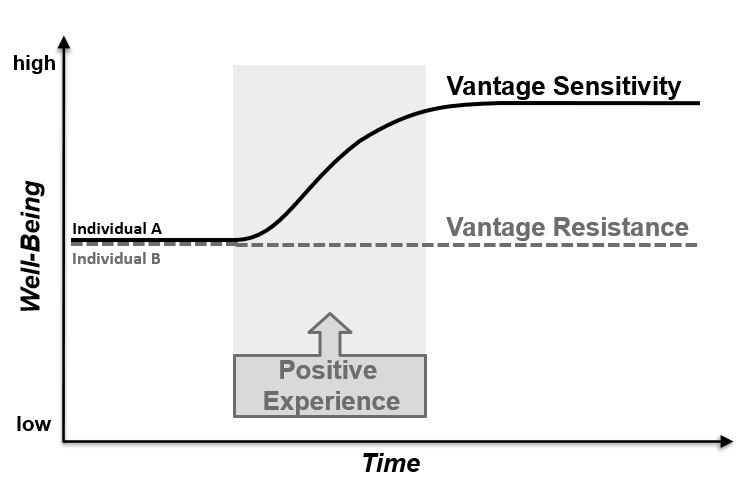
According to vantage sensitivity theory, people who benefit from positive experiences display vantage sensitivity as a function of vantage sensitivity factors (i.e. genetic, physiological, or psychological traits) whereas those who benefit less show vantage resistance due to the presence of vantage resistance factors (or the absence of vantage sensitivity factors). Differences in vantage sensitivity are considered to reflect neurobiological differences in the central nervous system, which are influenced by genetic as well as environmental factors.

Figure 1: Graphical illustration of vantage sensitivity; in response to a positive exposure, the level of functioning increases in Individual A, reflecting vantage sensitivity, whereas it remains unchanged in Individual B, reflecting vantage resistance.

Evidence

A growing number of studies provide empirical evidence for individual differences in vantage sensitivity across a wide range of established sensitivity markers, including genetic, physiological, and psychological ones.

Genetic Markers

Several studies report that differences in response to positive experiences are associated with genetic sensitivity. For example, Keers et al. created a polygenic score for environmental sensitivity based on thousands of gene variants and found that children with higher genetic sensitivity responded more strongly to higher quality of psychological treatment.

Physiological Markers

Studies suggest that a higher physiological reactivity to stress (indicated by cortisol) is associated with a stronger positive response to positive influences. For instance, a study testing the efficacy of exposure-based psychotherapy, a type of psychological treatment that is used with people suffering from panic disorders and agoraphobia, found that people whose cortisol response was higher during exposure were also more likely to recover faster and benefit more from the treatment.

Psychological Markers

A number of studies have shown that children who score high on the Highly Sensitive Child (HSC) scale, a psychometric tool designed to measure sensitivity, respond more positively to psychological interventions. For example, Nocentini et al. conducted a randomised controlled trial to investigate whether sensitivity was associated with greater response to a school-based anti-bullying intervention. Results indicated that sensitive children benefitted significantly more from the positive effects of the intervention. Vantage sensitivity has also been found to influence the socio-emotional well-being of young people in school. The wellbeing of sensitive adolescents increased in response to positive changes in the school environment. In adults, high sensitivity has been found to predict a greater response to positive pictures and increased leader-rated employee task performance.

This page is based on the copyrighted Wikipedia article < https://en.wikipedia.org/wiki/Vantage_sensitivity >; it is used under the Creative Commons Attribution-ShareAlike 3.0 Unported License (CC-BY-SA). You may redistribute it, verbatim or modified, providing that you comply with the terms of the CC-BY-SA.

What is Differential Susceptibility?

Introduction

The differential susceptibility theory proposed by Jay Belsky is another interpretation of psychological findings that are usually discussed according to the diathesis-stress model.

Both models suggest that people’s development and emotional affect are differentially affected by experiences or qualities of the environment. Where the Diathesis-stress model suggests a group that is sensitive to negative environments only, the differential susceptibility hypothesis suggests a group that is sensitive to both negative and positive environments.

A third model, the vantage-sensitivity model, suggests a group that is sensitive to positive environments only. All three models may be considered complementary, and have been combined into a general environmental sensitivity framework.

Differential Susceptibility versus Diathesis-Stress

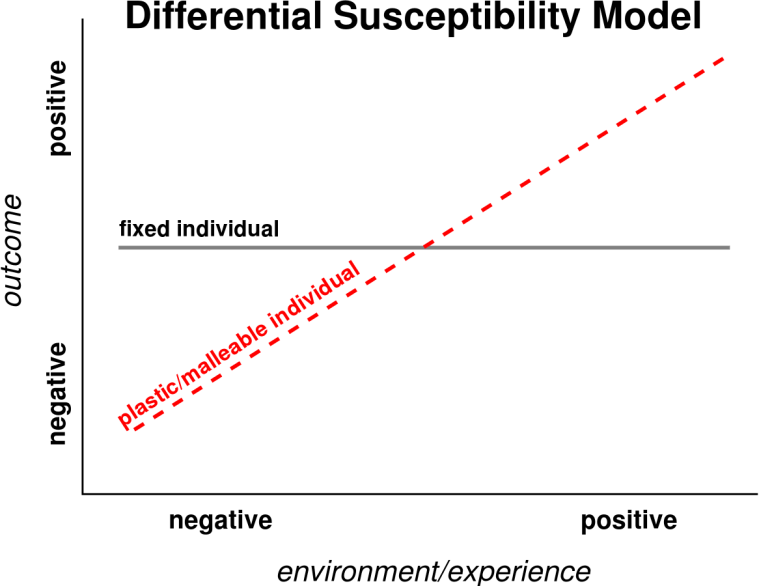
The idea that individuals vary in their sensitivity to their environment was historically framed in diathesis-stress or dual-risk terms. These theories suggested that some “vulnerable” individuals, due to their biological, temperamental and/or physiological characteristics (i.e. “diathesis” or “risk 1”), are more vulnerable to the adverse effects of negative experiences (i.e. “stress” or “risk 2”), while other “resilient” individuals are not affected by these negative experiences (see Figure 1). The differential susceptibility hypothesis and the related notion of biological sensitivity to context suggested that individuals thought to be “vulnerable” are not only sensitive to negative environments, but also to positive environments (see Figure 2). Thus, according to the differential susceptibility hypothesis, some individuals are “susceptible” or “plastic”, in that they are more influenced than others by environmental influences in a “for better and for worse” manner.

Figure 1. The diathesis-stress/dual-risk model. Developmental outcome as it relates to environmental quality. A “vulnerable” group experiences negative outcome when exposed to a negative environment, although this group is identical to the other, “resilient” group in a positive environment.
Figure 2. The differential susceptibility model. The lines depict two categorical groups that differ in their responsiveness to the environment: the “plastic” group is disproportionately more affected by both negative and positive environments compared to the “fixed” group.

Theoretical Background

Belsky suggests that evolution might select for some children who are more plastic, and others who are more fixed in the face of, for example, parenting styles.

Belsky offers that ancestral parents, just like parents today, could not have known (consciously or unconsciously) which childrearing practices would prove most successful in promoting the reproductive fitness of offspring – and thus their own inclusive fitness. As a result, and as a fitness optimising strategy involving bet hedging, natural selection might have shaped parents to bear children varying in plasticity. This way, if an effect of parenting had proven counterproductive in fitness terms, those children not affected by parenting would not have incurred the cost of developing in ways that ultimately proved “misguided”.

Importantly, natural selection might favour genetic lines with both plastic and fixed developmental and affective patterns. In other words, there is value to having both kinds at once. In light of inclusive-fitness considerations, children who were less malleable (and more fixed) would have “resistance” to parental influence. This could be adaptable some times, and maladaptive other times. Their fixedness would not only have benefited themselves directly, but even their more malleable siblings indirectly. This is because siblings, like parents and children, have 50% of their genes in common. By the same token, had parenting influenced children in ways that enhanced fitness, then not only would more plastic offspring have benefited directly by following parental leads, but so, too, would their parents and even their less malleable siblings who did not benefit from the parenting they received, again for inclusive-fitness reasons. The overall effect may be to temper some of the variability in parenting. That is, to make more conservative bets.

This line of evolutionary argument leads to the prediction that children should vary in their susceptibility to parental rearing and perhaps to environmental influences more generally. As it turns out, a long line of developmental inquiry, informed by a “transactional” perspective, has more or less been based on this unstated assumption.

Criteria for the Testing of Differential Susceptibility

Belsky, Bakermans-Kranenburg, & Van IJzendoorn, (2007) delineated a series of empirical requirements – or steps – for evidencing the differential susceptibility hypothesis. Particularly they identify tests that distinguish differential susceptibility from other interaction effects including diathesis-stress/dual-risk.

While diathesis-stress/dual-risk arises when the most vulnerable are disproportionately affected in an adverse manner by a negative environment but do not also benefit disproportionately from positive environmental conditions, differential susceptibility is characterised by a cross-over interaction: the susceptible individuals are disproportionately affected by both negative and positive experiences. A further criterion that needs to be fulfilled to distinguish differential susceptibility from diathesis-stress/dual-risk is the independence of the outcome measure from the susceptibility factor: if the susceptibility factor and the outcome are related, diathesis-stress/dual-risk is suggested rather than differential susceptibility. Further, environment and susceptibility factor must also be unrelated to exclude the alternative explanation that susceptibility merely represents a function of the environment. The specificity of the differential-susceptibility effect is demonstrated if the model is not replicated when other susceptibility factors (i.e. moderators) and outcomes are used. Finally, the slope for the susceptible subgroup should be significantly different from zero and at the same time significantly steeper than the slope for the non- (or less-) susceptible subgroup.

Susceptibility Markers and Empirical Evidence

Characteristics of individuals that have been shown to moderate environmental effects in a manner consistent with the differential susceptibility hypothesis can be subdivided into three categories: Genetic factors, endophenotypic factors, phenotypic factors.

Bakermans-Kranenburg and Van IJzendoorn (2006) were the first to test the differential susceptibility hypothesis as a function of Genetic Factors regarding the moderating effect of the dopamine receptor D4 7-repeat polymorphism (DRD4-7R) on the association between maternal sensitivity and externalizing behaviour problems in 47 families. Children with the DRD4-7R allele and insensitive mothers displayed significantly more externalizing behaviours than children with the same allele but with sensitive mothers. Children with the DRD4-7R allele and sensitive mothers had the least externalising behaviours of all whereas maternal sensitivity had no effect on children without the DRD4-7R allele.

Endophenotypic Factors have been examined by Obradovic, Bush, Stamperdahl, Adler and Boyce’s (2010). They investigated associations between childhood adversity and child adjustment in 338 5-year-olds. Children with high cortisol reactivity were rated by teachers as least prosocial when living under adverse conditions, but most prosocial when living under more benign conditions (and in comparison to children scoring low on cortisol reactivity).

Regarding characteristics of the category of Phenotypic Factors, Pluess and Belsky (2009) reported that the effect of child care quality on teacher-rated socioemotional adjustment varied as a function of infant temperament in the case of 761 4.5-year-olds participating in the NICHD Study of Early Child Care and Youth Development (NICHD Early Child Care Research Network, 2005). Children with difficult temperaments as infants manifest the most and least behaviour problems depending on whether they experienced, respectively, poor or good quality care (and in comparison to children with easier temperaments).

Table 1: List of Proposed Susceptibility Factors that emerge across studies, according to Belsky and colleagues.

This page is based on the copyrighted Wikipedia article < https://en.wikipedia.org/wiki/Differential_susceptibility >; it is used under the Creative Commons Attribution-ShareAlike 3.0 Unported License (CC-BY-SA). You may redistribute it, verbatim or modified, providing that you comply with the terms of the CC-BY-SA.
What is Distress Tolerance?

Introduction

Distress tolerance is an emerging construct in psychology that has been conceptualised in several different ways. Broadly, it refers to an individual’s:

“perceived capacity to withstand negative emotional and/or other aversive states (e.g. physical discomfort), and the behavioral act of withstanding distressing internal states elicited by some type of stressor.”

Some definitions of distress tolerance have also specified that the endurance of these negative events occur in contexts in which methods to escape the distressor exist.

Measurement

In the literature, differences in conceptualisations of distress tolerance have corresponded with two methods of assessing this construct.

As self-report inventories fundamentally assess an individual’s perception and reflection of constructs related to the self; self-report measures of distress tolerance (i.e. questionnaires) specifically focus on the perceived ability to endure distressful states, broadly defined. Some questionnaires focus specifically on emotional distress tolerance (e.g. the distress tolerance scale), some on distress tolerance of negative physical states (e.g. discomfort intolerance scale), and others focus specifically on tolerance of frustration as an overarching process of distress tolerance (e.g. frustration-discomfort scale).

In contrast, studies that incorporate behavioural or biobehavioural assessments of distress tolerance provide information about real behaviour rather than an individual’s perceptions. Examples of stress-inducing tasks include those that require the individual to persist in tracing a computerised mirror under timed conditions (i.e. computerised mirror tracing persistence task) or complete a series of time-sensitive math problems for which incorrect answers produce an aversive noise (i.e. computerised paced auditory serial addition task). Some behavioural tasks are conceptualised to assess physical distress tolerance, and require individuals to hold their breath for as long as possible (breath holding task).

As this is a nascent field of research, the relationships between perceptual and behavioural assessments of distress tolerance have not been clearly elucidated. Disentangling distinct components of emotional/psychological distress tolerance and physical distress tolerance within behavioural tasks also remains a challenge in the literature.

Theoretical Structures

Several models about the structural hierarchy of distress tolerance have been proposed. Some work suggests that physical and psychological tolerance are distinct constructs. Specifically, sensitivity to feelings of anxiety and tolerance of negative emotional states may be related to each other as aspects of a larger construct representing sensitivity and tolerance of affect broadly; discomfort surrounding physical stressors, however, was found to be an entirely separate construct not associated with sensitivity to emotional states. Notably, this preliminary work was conducted with self-report measures and findings are cross-sectional in nature. The authors advise that additional longitudinal work is necessary to corroborate these relationships and elucidate directions of causality.

Recent work expands on the distinctness of emotional and physical distress tolerance to a higher-order construct of global experiential distress tolerance. This framework draws upon tolerance constructs that have been historically studied as distinct from distress tolerance. The five following constructs are framed as lower-order factors for the global distress tolerance construct, and include:

  • Tolerance of uncertainty, or “the tendency to react emotionally, cognitively, or behaviourally to uncertain situations”.
  • Tolerance of ambiguity, or “the perceived tolerance of complicated, foreign, and/or vague situations of stimuli”.
  • Tolerance of frustration, or “the perceived capacity to withstand aggravation (e.g. thwarted life goals)”.
  • Tolerance of negative emotional states, or “the perceived capacity to withstand internal distress”.
  • Tolerance of physical sensations, or “the perceived capacity to withstand uncomfortable physical sensations”.

Within models that solely conceptualise distress tolerance as the ability to endure negative emotional states, distress tolerance is hypothesized to be multidimensional. This includes individual processes related to the anticipation of and experience with negative emotions, such as perceived and actual ability to tolerate the negative emotion, the appraisal of a given situation as acceptable or not, the degree to which an individual can regulate his/her emotion in the midst of a negative emotional experience, and amount of attention dedicated to processing the negative emotion.

Biological Bases

There are several candidate biological neural network mechanisms for distress tolerance. These proposed brain areas are based on the conceptualisation of distress tolerance as a function of reward learning. Within this framework, individuals learn to attune to and pursue reward; reduction of tension in escaping from a stressor is similarly framed as a reward and thus can be learned. Individuals differ in how quickly and for how long they display preferences for pursuing reward or in the case of distress tolerance, escaping from a distressful stimulus. Therefore, brain regions that are activated during reward processing and learning are hypothesized to also serve as neurobiological substrates for distress tolerance. For instance, activation intensity of dopamine neurons projecting to the nucleus accumbens, ventral striatum, and prefrontal cortex is associated with an individual’s predicted value of an immediate reward during a learning task. As the firing rate for these neurons increases, individuals predict high values of an immediate reward. During instances in which the predicted value is correct, the basal rate of neuronal firing remains the same. When the predicted reward value is below the actual value, neuronal firing rates increase when the reward is received, resulting in a learned response. When the expected reward value is below the actual value, the firing rate of these neurons decreases below baseline levels, resulting in a learned shift that reduces expectancies about reward value. It is posited that these same dopaminergic firing rates are associated with distress tolerance, in that learning the value of escaping a distressing stimulus is analogous to an estimation of an immediate reward There are several potential clinical implications if these posited distress tolerance substrates are corroborated. It may suggest that distress tolerance is malleable among individuals; interventions that change neuronal firing rates may shift predicted values of behaviours intended to escape a distressor and provide relief, thereby increasing distress tolerance.

Other neural areas may be implicated in moderating this reward learning process. Excitability of inhibitory medium spiny neurons in the nucleus accumbens and ventral striatum have been found to moderate the association between the value of an immediate reward and probability of pursuing reward or relief. Within rats, it has been demonstrated that increasing the excitability of these neurons via increased CREB expression resulted in an increased amount of time that the rats would keep their tail still when a noxious thermal paste was applied, as well as an increased amount of time spent in the open arms of a complex maze; these behaviours have been conceptualised as analogous distress tolerance in response to pain and anxiety.

Associations with Psychopathology

Distress tolerance is an emerging research topic in clinical psychology because it has been posited to contribute to the development and maintenance of several types of mental disorders, including mood and anxiety disorders such as major depressive disorder and generalised anxiety disorder, substance use and addiction, and personality disorders. In general, research on distress tolerance have found associations with these disorders that are tied closely to specific conceptualisations of distress tolerance. For instance, Borderline Personality Disorder is posited to be maintained through a chronic unwillingness to engage in or tolerate emotionally distressful states. Similarly, susceptibility to developing anxiety disorders is often characterised by low emotional distress tolerance. Low distress tolerance of both physical and emotional states is perceived to be a risk factor in maintaining and escalating addiction. Distress tolerance is particularly important in neurobiological theories that posit that advanced stages of addiction are driven by use of a substance to avoid physical and psychological withdrawal symptoms.

As a result of this interest in distress tolerance and its relationship with clinical psychopathology, several psychosocial treatments have been developed to improve distress tolerance among populations that are traditionally resistant to treatment. Many of these interventions (e.g. acceptance-based emotion regulation therapy) aims to boost distress tolerance by increasing the willingness to engage with emotion and meta-skills of acceptance of emotional conflict. Other behavioural interventions include components of building distress tolerance for various treatment targets, including acceptance and commitment therapy (ACT), dialectical behaviour therapy (DBT), functional analytic psychotherapy, integrative behavioural couples therapy, and mindfulness-based cognitive therapy. Multiple studies suggest that such distress tolerance interventions may be effective in treating generalised anxiety disorder, depression, and borderline personality disorder.

Therapy Approaches to Improving Distress Tolerance

ACT and DBT are therapy approaches which include specific focus on distress tolerance.

This page is based on the copyrighted Wikipedia article < https://en.wikipedia.org/wiki/Distress_tolerance >; it is used under the Creative Commons Attribution-ShareAlike 3.0 Unported License (CC-BY-SA). You may redistribute it, verbatim or modified, providing that you comply with the terms of the CC-BY-SA.

On This Day … 12 January [2023]

People (Births)

  • 1896 – David Wechsler, Romanian-American psychologist and author (d. 1981).
  • 1914 – Mieko Kamiya, Japanese psychiatrist and psychologist (d. 1979).
  • 1941 – Fiona Caldicott, English psychiatrist and psychotherapist (d. 2021).

David Wechsler

David Wechsler (12 January 1896 to 02 May 1981) was a Romanian-American psychologist. He developed well-known intelligence scales, such as the Wechsler Adult Intelligence Scale (WAIS) and the Wechsler Intelligence Scale for Children (WISC). A Review of General Psychology survey, published in 2002, ranked Wechsler as the 51st most cited psychologist of the 20th century.

Mieko Kamiya

Mieko Kamiya (神谷 美恵子, Kamiya Mieko, 12 January 1914 to 22 October 1979) was a Japanese psychiatrist who treated leprosy patients at Nagashima Aiseien Sanatorium. She was known for translating books on philosophy. She worked as a medical doctor in the Department of Psychiatry at Tokyo University following World War II. She was said to have greatly helped the Ministry of Education and the General Headquarters, where the Supreme Commander of the Allied Powers stayed, in her role as an English-speaking secretary, and served as an adviser to Empress Michiko. She wrote many books as a highly educated, multi-lingual person; one of her books, titled On the Meaning of Life (Ikigai Ni Tsuite in Japanese), based on her experiences with leprosy patients, attracted many readers.

Fiona Caldicott

Dame Fiona Caldicott, DBE, FMedSci, FRCP, FRCPI, FRCPsych, FRCGP (née Soesan; 12 January 1941 to 15 February 2021) was a British psychiatrist and psychotherapist who also served as Principal of Somerville College, Oxford She was the National Data Guardian for Health and Social Care in England until her death.