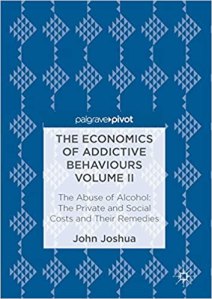
Book: The Economics Of Addictive Behaviours – Volume II

Book Title:

The Economics Of Addictive Behaviours – Volume II: The Private and Social Costs of Alcohol and Their Remedies.

Author(s): John Joshua.

Year: 2017.

Edition: First (1ed).

Publisher: Palgrave Macmillan.

Type(s): Hardcover, Paperback, and Kindle.

Synopsis:

This title discusses the phenomenon of alcohol abuse as a behavioural disease and the associated costs. The author details alcohol’s status as a psychoactive drug; he notes, however, that in contrast to other psychoactive drugs, alcohol has been widely culturally accepted in Western countries and legally available, except in isolated incidents for a short period of time. Joshua considers which policies are being correctly utilised so as to reduce the abuse of alcohol, and how these policies may operate on a supply and demand model. Whereas programs of prevention and treatment operate on the demand side of alcohol abuse, legislation is directed at the supply side of alcohol; that is, dealing with marketing – product, promotion, point of sales and price.

This is the second title in a four volume series ‘The Economics of Addictive Behaviours’, consisting of three additional volumes on smoking, illicit drug abuse and overeating.

Can We Use Telehealth to Reach Underserved Veterans?

Research Paper Title

The Impact of Co-occurring Anxiety and Alcohol Use Disorders on Video Telehealth Utilisation Among Rural Veterans.

Background

Co-occurring anxiety and alcohol use disorders lead to poorer treatment outcomes for both disorders.

Compounding risk for poor outcomes related to these disorders, individuals living in rural areas face barriers receiving evidence-based mental health treatment.

Video to home telehealth (VTH) has been implemented broadly within the Veterans Health Administration to improve access to care for rural veterans. However, VTH may not be utilised equally across disorders and comorbidities, including co-occurring anxiety and alcohol use disorders, potentially contributing to gaps in care that are not available in person.

Methods

A cohort of veterans who received at least one VTH mental health visit between fiscal years 2016-2019 was compiled from VA administrative data.

Multilevel linear growth curve models were used to examine growth in VTH use over time among veterans with anxiety only, alcohol use disorder only, and co-occurring disorders.

Results

Fixed effects were significant for both time and diagnosis group and a significant interaction between time and group.

For each subsequent fiscal year, the percentage of total MH visits that were VTH increased for all groups but less so for those with co-occurring anxiety and alcohol use diagnoses.

Conclusions

Despite VTH being an important tool to reach underserved rural veterans, rural veterans with AUD and co-occurring anxiety and AUD are at risk for not receiving care using this modality.

Findings suggest that veterans with co-occurring anxiety and AUD are especially at risk for being underserved, given that a major goal of VTH is to increase access to mental health services.

Reference

Ecker, A.H., Amspoker, A.B., Hogan, J.B. & Lindsay, J.A. (2020) The Impact of Co-occurring Anxiety and Alcohol Use Disorders on Video Telehealth Utilization Among Rural Veterans. Journal of Technology in Behavioral Science. 1-6. doi: 10.1007/s41347-020-00150-x. Online ahead of print.

Does Hardiness Protect Against Alcohol Use in Soldiers?

Research Paper Title

Hardiness Protects Against Problematic Alcohol Use in Male, but Not Female, Soldiers.

Background

Military service members are at high risk for problematic substance use compared with the general population; deployment and combat exposure further increases this risk.

It is thus critical to identify resiliency factors that can buffer the negative effects of military experiences and potentially prevent problematic alcohol use.

The current research examines the extent to which psychological hardiness predicts lower risk of problematic alcohol use and explores potential sex differences in this association.

Methods

Data are from Operation: SAFETY, an ongoing study of US Army Reserve/National Guard soldiers.

Negative binomial regression models examined the relation between baseline hardiness, assessed by the 15-item Dispositional Resiliency Scale, and problematic alcohol use at the 1-year follow-up, assessed by the Alcohol Use Disorders Identification Test (N = 260), controlling for baseline combat exposure (Combat Exposure subscale, Deployment Risk and Resilience Inventory-2) and baseline quantity and frequency of alcohol use.

To examine the impact of hardiness on men and women, models were stratified by sex.

Results

In final, adjusted models, hardiness predicted lower risk of problematic alcohol use (adjusted risk ratio = 0.98; p < .05) for male soldiers and was unrelated to alcohol use for female soldiers (adjusted risk ratio = 1.01; p > .05).

Post hoc analyses explored the impact of each dimension of hardiness (i.e., commitment, control, and challenge) on problematic alcohol use.

Conclusions

Hardiness assessment may complement existing screening tools to identify high-risk populations; interventions to promote hardiness may help in preventing problematic alcohol use, particularly among male soldiers.

Reference

Kulak, J.A., Homish, D.L., Hoopsick, R.A., Fillo, J., Bartone, P.T. & Homish, G.G. (2020) Hardiness Protects Against Problematic Alcohol Use in Male, but Not Female, Soldiers. Psychological Services. doi: 10.1037/ser0000409. Online ahead of print.

Qualified Withdrawal Treatment (QWT) & Alcohol Use Disorders (AUD)

Research Paper Title

The potential effects of an extended alcohol withdrawal treatment programme on morbidity and mortality among inpatients in the German city of Bremen: a simulation study.

Background

According to the German guidelines, people with severe alcohol use disorders (AUDs) should receive withdrawal treatment.

Compared to somatic withdrawal treatment (SWT), extended duration and psychosocial elements of so-called “qualified withdrawal treatment” (QWT) aim to reduce relapse rates.

Despite promising results of prospective studies on QWT, only few German inpatients seeking withdrawal treatment receive QWT.

The researchers estimated the potential effects on mortality and morbidity for higher proportions of treatment-seeking patients receiving QWT rather than SWT in the German city of Bremen.

Methods

In 2016 and 2017, 2051 inpatients were admitted to two specialised hospitals for withdrawal treatment.

The potential beneficial effects of QWT over SWT were estimated by simulating treatment outcomes taken from two prospective studies.

Outcomes comprised number and length of all-cause hospitalisations within 5 years, as well as abstinence and all-cause mortality rates within 28 months.

Outcomes were estimated for actual and increased rates of QWT (25, 50%) among inpatients seeking alcohol treatment.

Results

In the selected hospitals, 170 patients (8%) received QWT. If 25% of AUD inpatients were to receive QWT, benefits in abstinence rates (+ 18%), the total number of hospitalisations (- 9%) and hospital days (- 10%) could be expected.

If 50% of AUD inpatients were to receive QWT, benefits in abstinence rates (+ 45%), the total number of hospitalisations (- 23%) and hospital days (- 26%) were more pronounced, in addition to reductions in mortality (- 20%).

Conclusions

Increasing the proportion of people with severe AUD enrolled in extended withdrawal treatment programmes (such as QWT) may contribute to reduce overall alcohol-attributable burden of disease.

Randomised controlled trials or other prospective studies controlling for confounding factors are needed to determine the potential at the population level.

Reference

Manthey, J., Lindemann, C., Kraus, L., Reimer, J., Verthein, U., Schulte, B. & Rehm, J. (2020) The potential effects of an extended alcohol withdrawal treatment programme on morbidity and mortality among inpatients in the German city of Bremen: a simulation study. Substance Abuse Treatment, Prevention, and Policy. 15(1):1. doi: 10.1186/s13011-019-0249-7.