
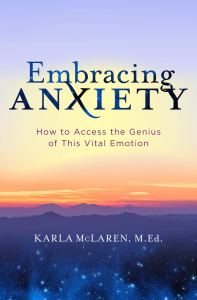
Book: Embracing Anxiety – How to Access the Genius of This Vital Emotion

Book Title:

Embracing Anxiety – How to Access the Genius of This Vital Emotion.

Author(s): Karla McLaren.

Year: 2020.

Edition: First (1ed).

Publisher: Sounds True.

Type(s): Paperback and Kindle.

Synopsis:

An in-depth guide for engaging with anxiety–not as an affliction, but as an essential source of foresight, intuition, and energy for completing your tasks and projects.

If you are facing anxiety, you’ve probably got one thing on your mind – how to make it go away. But what if this challenging emotion were actually trying to help?

When we ignore or repress our anxiety,” teaches Karla McLaren, it can overwhelm us. But when we learn to welcome it with skill, we can access its remarkable gifts.

Engaged with wisely, anxiety is your task completion ally – it helps you to focus, plan, take action, and fulfill your goals. With Embracing Anxiety, you will join this acclaimed educator and researcher to explore:

  • Principles and practices to befriend your anxiety at every level of intensity (before it overwhelms you).
  • Strategies to engage with anxiety as a source of foresight, conscientiousness, and motivation.
  • Why fear, confusion, and panic are not the same as anxiety, and tools to work with each effectively.
  • How anxiety blends with anger, depression, and other emotions, and how to clarify these compounded states.
  • Using McLaren’s Conscious Questioning practice to engage with anxiety and garner its insights.
  • How to embrace procrastination and get things done.

When you identify, listen to, and act on anxiety skillfully, you support its purpose, teaches McLaren, and allow it to recede naturally until it is needed again. With Embracing Anxiety, you’ll learn how to get this powerful emotion on your side.

Eco-Anxiety, Like Climate Change, is on the Rise

If the prospect of climate change makes you stressed, anxious or depressed, you are not alone.

With reports of some children becoming terrified by climate change and the protest group Extinction Rebellion holding ‘grief-tending workshops’, there is an increasing awareness of so-called eco-anxiety.

A UK Council for Psychotherapy conference met in London on 19 October 2019 to discuss how best to manage such anxiety.

While there is little quantitative evidence about eco-anxiety yet, here are eight approaches that commentators suggest may help.

1. Live More in Alignment with your Values

  • The effect of individual actions can be very small, but changing how you live to be more compatible with your ideals can help with eco-anxiety.
  • You could eat less meat and dairy, drive less and stop buying and disposing of so many items, for example.

2. Give your Hone an Energy Health Check

  • Household energy use accounts for 14% cent of total UK greenhouse gas emissions.
  • Reducing your home’s energy use can help you take some ownership of your consumption.
  • Make sure you have good insulation and draught-proof windows and doors, and try putting on an extra layer of clothing rather than turning up your heating.

3. Cut Back on Flying

  • The Swedish concept of flygskam (“flight shame”) has recently gained wider attention, but a minority is responsible for the lion’s share of emissions from flights.
  • A 2014 analysis found that 15% of adults in the UK account for 70% of flights taken, so it is those who take three or more flights a year who will make the most difference by cutting back.
  • If taking fewer flights could put your job at risk, try switching from business class to standard, as this uses a plane’s capacity more efficiently.

4. Do not Feel Ashamed

  • In relation to flygskam, billions of people fly.
  • Your individual actions are not actually capable of solving climate change.
  • While altering how you live and travel may help you by letting your life be more aligned with your values, you
  • should not feel ashamed for not being able to fully comply with these.
  • The systems in which we are all enmeshed essentially force us to harm the planet, and yet we (can) put all that shame on our own shoulders.

5. Focus on Changing Systems, Not Yourself

  • Accepting that we cannot get where we want to be through individual action can have therapeutic benefits.
  • A complete narcissistic focus on the self is not healthy.
  • Instead, you can have a much more meaningful impact by working with others to lobby governments.
  • For example by:
    • Letting your MP, local councillors, and and mayor know that you think action on climate change is important; and
    • Writing to your bank or pension provider to ask if you can opt out of funds that invest in fossil fuels.

6. Find Like-Minded People

  • Find a community of like-minded individuals so you can express and share your feelings of eco-anxiety.
  • Saying that you can not solve climate change alone and joining a group of some kind will help you to make friends.
  • Socialisation is an important aspect in mental health.

7. Protect and Nurture Local Green Spaces

  • Getting involved in community environment projects may help your mental health, as well as being good for the planet.
  • Green spaces absorb carbon dioxide, cool down urban areas in hot weather, reduce flood risk, and provide habitats for wildlife.
  • Additionally, a recent study found that spending 2 hours a week outdoors in nature is linked to better health and well-being.
  • Make an excuse to find some time outside every day.

8. Bring Others with You

  • Consider the importance of talking about your experiences – the challenges as well as the positives – and bringing other people along with you.
  • Talking about the practical things people can do in their day-to-day lives can give them some sense of control back, which can really improve people’s well-being.