What are the Key Tenets for Developing a Unit-Based Army Resilience Programme?

Research Paper Title

The Process of Developing a Unit-Based Army Resilience Programme.

Background

The researchers review military doctrine, military public health data, medical literature, and educational literature with the intent of condensing key precepts into a succinct, pragmatic description of the essential steps for leaders looking to build a resilience programme to provide secondary prevention services.

Results

Although there continues to be a shortage of high-level evidence in support of specific preventive programmes, there are numerous large-scale reviews of prevention and health promotion efforts.

When combined with population-specific analyses, several essential concepts emerge as most relevant for smaller-scale prevention programmes.

Conclusions

The key tenets that programme leaders should embrace to optimise programme effectiveness include:

  • Utilisation of an instructional design approach;
  • Focus on evidence-based practices, and
  • Teaching resilience skills in order to decrease risk factors and increase protective factors for improved mental health outcomes.

Reference

Dragonetti, J.D., Gifford, T.W. & Yang, M.S. (2020) The Process of Developing a Unit-Based Army Resilience Program. Current Psychiatry Reports. 22(9), pp.48. doi: 10.1007/s11920-020-01169-w.

Does Hardiness Protect Against Alcohol Use in Soldiers?

Research Paper Title

Hardiness Protects Against Problematic Alcohol Use in Male, but Not Female, Soldiers.

Background

Military service members are at high risk for problematic substance use compared with the general population; deployment and combat exposure further increases this risk.

It is thus critical to identify resiliency factors that can buffer the negative effects of military experiences and potentially prevent problematic alcohol use.

The current research examines the extent to which psychological hardiness predicts lower risk of problematic alcohol use and explores potential sex differences in this association.

Methods

Data are from Operation: SAFETY, an ongoing study of US Army Reserve/National Guard soldiers.

Negative binomial regression models examined the relation between baseline hardiness, assessed by the 15-item Dispositional Resiliency Scale, and problematic alcohol use at the 1-year follow-up, assessed by the Alcohol Use Disorders Identification Test (N = 260), controlling for baseline combat exposure (Combat Exposure subscale, Deployment Risk and Resilience Inventory-2) and baseline quantity and frequency of alcohol use.

To examine the impact of hardiness on men and women, models were stratified by sex.

Results

In final, adjusted models, hardiness predicted lower risk of problematic alcohol use (adjusted risk ratio = 0.98; p < .05) for male soldiers and was unrelated to alcohol use for female soldiers (adjusted risk ratio = 1.01; p > .05).

Post hoc analyses explored the impact of each dimension of hardiness (i.e., commitment, control, and challenge) on problematic alcohol use.

Conclusions

Hardiness assessment may complement existing screening tools to identify high-risk populations; interventions to promote hardiness may help in preventing problematic alcohol use, particularly among male soldiers.

Reference

Kulak, J.A., Homish, D.L., Hoopsick, R.A., Fillo, J., Bartone, P.T. & Homish, G.G. (2020) Hardiness Protects Against Problematic Alcohol Use in Male, but Not Female, Soldiers. Psychological Services. doi: 10.1037/ser0000409. Online ahead of print.

Are Soldiers-in-training Likely to Seek Help when Experiencing a Problem?

Research Paper Title

Identifying Risk and Resilience Factors Associated With the Likelihood of Seeking Mental Health Care Among U.S. Army Soldiers-in-Training

Background

The Department of Defence aims to maintain mission readiness of its service members. Therefore, it is important to understand factors associated with treatment seeking in order to identify areas of prevention and intervention early in a soldier’s career that can promote positive functioning and increase their likelihood of seeking mental health care when necessary.

Methods

Using a theory of planned behaviour lens, this study identified potential barriers (risk) and facilitators (resilience) to treatment seeking among 24,717 soldiers-in-training who participated in the New Soldiers Study component of the “Army Study to Assess Risk and Resilience in Servicemembers” (Army STARRS). Hierarchal linear regression modelling and independent samples t-tests were used to examine associations between demographics and study variables, intersections of risk and resilience, and to explore differences in the likelihood of seeking help based on mental health diagnoses.

Results

A four-stage hierarchical linear regression was conducted, using likelihood of help-seeking as the dependent variable, to identify the most salient factors related to help-seeking. “Step one” of the analysis revealed soldiers-in-training who identified as female, Hispanic or Other ethnicity, and married, divorced, or separated reported a greater likelihood of seeking help. “Step two” of the analysis indicated soldiers-in-training with a history of sexual trauma, experience of impaired parenting, and clinical levels of mental health symptomatology (anxiety, depression, PTSD) reported a greater likelihood of seeking help.

Inversely, soldiers-in-training with a history of emotional trauma and parental absence/separation reported a lower likelihood of seeking help. “Step three” of the analysis demonstrated soldiers-in-training with a prior history of seeking help and larger social networks had a greater likelihood of seeking help. “Step four” of the analysis revealed several interactive effects between risk and resilience factors.

Specifically, soldiers-in-training who reported greater depressive symptomatology in combination with prior history of treatment seeking reported a greater likelihood of help seeking, whereas soldiers-in-training who reported prior sexual trauma and PTSD in combination with large social networks reported a lower likelihood of seeking help. Finally, a greater percentage of soldiers-in-training with clinical levels of anxiety, depression, and PTSD indicated they would likely seek help in comparison to soldiers-in-training without clinical symptoms.

Conclusions

Findings suggest few soldiers-in-training are likely to seek help when experiencing a problem. General efforts to encourage help-seeking when needed are warranted with particular focus on subsets of soldiers-in-training (e.g., men, those with a history of some adverse childhood experiences).

Strengths of this study include the examination of a large sample of soldiers-in-training to identify possible leverage points for early intervention or prevention prior to entering stressful military operating environments.

Limitations of this study include the examination of only one military branch and exclusion of soldiers not “in-training.”

Future studies could consider replicating the current study using a sample of military personnel longitudinally to track behavioral trends as well as looking at military populations outside of basic combat training.

Reference

Duncan, J.M., Reed-Fitzke, K., Ferraro, A.J., Wojciak, A.S., Smith, K.M. & Sanchez, K. (2020) Identifying Risk and Resilience Factors Associated With the Likelihood of Seeking Mental Health Care Among U.S. Army Soldiers-in-Training. Military Medicine. doi: 10.1093/milmed/usz483. Online ahead of print.

Book: Community-Based Psychological First Aid

Book Title:

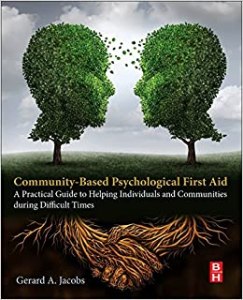
Community-Based Psychological First Aid: A Practical Guide to Helping Individuals and Communities during Difficult Times.

Author(s): Gerard A. Jacobs.

Year: 2016.

Edition: First (1st).

Publisher: Butterworth-Heinemann.

Type(s): Paperback and Kindle.

Synopsis:

Community-Based Psychological First Aid: A Practical Guide to Helping Individuals and Communities during Difficult Times presents a practical method for helping those in need in difficult times.

No advanced training in psychology is needed to use it. Injuries from disasters, terrorist events, and civil unrest are not just physical.

These events also cause psychological trauma that can do lasting damage.

Psychological First Aid (PFA) draws on human resilience and aims to reduce stress systems and help those affected recover.

It is not professional psychotherapy, and those providing this kind of aid do not need a degree to help.

Gerard Jacobs has developed this community-based method of delivering PFA over 20 years and has taught it in over 30 countries.

Along with the easy-to-follow method, Jacobs includes examples of how this works in action in different situations, and presents scenarios to practice.

Unique in its approach of community engagement to train community members to help each other, this guide is an excellent resource for local emergency managers to engage in whole community emergency management.

Resilience Training: Guided Self-reflection as an Alternative to Coping Skills in Military Officer Cadets

Research Paper Title

Strengthening resilience in military officer cadets: A group-randomized controlled trial of coping and emotion regulatory self-reflection training.

Background

This group-randomised control trial examined the efficacy of guided coping and emotion regulatory self-reflection as a means to strengthen resilience by testing the effects of the training on anxiety and depression symptoms and perceived stressor frequency after an intensive stressor period.

Methods

The sample was 226 officer cadets training at the Royal Military College, Australia. Cadets were randomised by platoon to the self-reflection (n = 130) or coping skills training (n = 96). Surveys occurred at 3 time points: baseline, immediately following the final reflective session (4-weeks post-baseline), and longer-term follow-up (3-months post-initial follow-up).

Results

There were no significant baseline differences in demographic or outcome variables between the intervention groups. On average, cadets commenced the resilience training with mild depression and anxiety symptoms. Analyses were conducted at the individual-level after exploring group-level effects.

No between-groups differences were observed at initial follow-up. At longer-term follow-up, improvements in mental health outcomes were observed for the self-reflection group, compared with the coping skills group, on depression (Cohen’s d = 0.55; 95% CI [0.24, 0.86]), anxiety symptoms (Cohen’s d = 0.69; 95% CI [0.37, 1.00]), and perceived stressor frequency (Cohen’s d = 0.46; 95% CI [0.15, 0.77]).

Longitudinal models demonstrated a time by condition interaction for depression and anxiety, but there was only an effect of condition for perceived stressor frequency. Mediation analyses supported an indirect effect of the intervention on both anxiety and depression via perceived stressor frequency.

Conclusions

Findings provide initial support for the use of guided self-reflection as an alternative to coping skills approaches to resilience training.

Reference

Crane, M.F., Boga, D., Karin, E., Gucciardi, D.F., Rapport, F., Callen, J. & Sinclair, L. (2019) Strengthening resilience in military officer cadets: A group-randomized controlled trial of coping and emotion regulatory self-reflection training. Journal of Consulting and Clinical Psychology. 87(2), pp.125-140. doi: 10.1037/ccp0000356. Epub 2018 Nov 29.