An Overview of Opponent-Process Theory

Introduction

Opponent-process theory is a psychological and neurological model that accounts for a wide range of behaviours, including colour vision. This model was first proposed in 1878 by Ewald Hering, a German physiologist, and later expanded by Richard Solomon, a 20th-century psychologist.

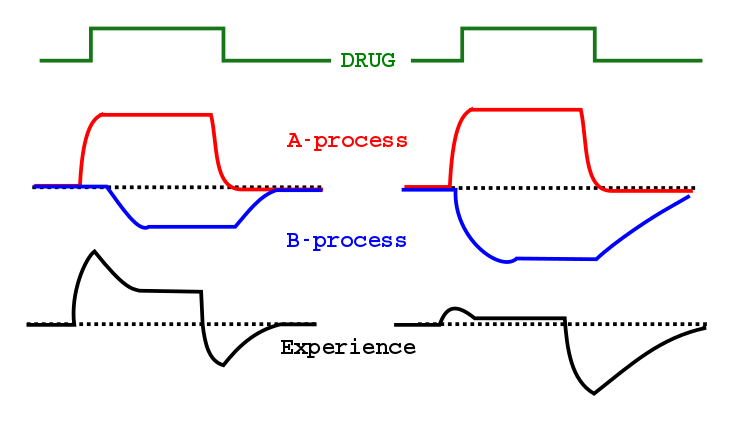
Opponent-process theory of drug addiction.

Visual Perception

The opponent-process theory was first developed by Ewald Hering. He noted that there are colour combinations that we never see, such as reddish-green or bluish-yellow. Opponent-process theory suggests that colour perception is controlled by the activity of three opponent systems. In the theory, he postulated about three independent receptor types which all have opposing pairs: white and black, blue and yellow, and red and green.

These three pairs produce combinations of colours for us through the opponent process. Furthermore, according to this theory, for each of these three pairs, three types of chemicals in the retina exist, in which two types of chemical reactions can occur. These reactions would yield one member of the pair in their building up phase, or anabolic process, whereas they would yield the other member while in a destructive phase, or a catabolic process.

The colours in each pair oppose each other. Red-green receptors cannot send messages about both colours at the same time. This theory also explains negative afterimages; once a stimulus of a certain colour is presented, the opponent colour is perceived after the stimulus is removed because the anabolic and catabolic processes are reversed. For example, red creates a positive (or excitatory) response while green creates a negative (or inhibitory) response. These responses are controlled by opponent neurons, which are neurons that have an excitatory response to some wavelengths and an inhibitory response to wavelengths in the opponent part of the spectrum.

According to this theory, colour blindness is due to the lack of a particular chemical in the eye. The positive after-image occurs after we stare at a brightly illuminated image on a regularly lighted surface and the image varies with increases and decreases in the light intensity of the background.

The veracity of this theory, however, has recently been challenged. The main evidence for this theory derived from recordings of retinal and thalamic (LGN) cells, which were excited by one colour and suppressed by another. Based on these oppositions, the cells were called “Blue-yellow”, “Green-red” and “black-white” opponent cells. In a recent review of the literature, Pridmore notes that the definition of the colour ‘green’ has been very subjective and inconsistent and that most recordings of retinal and thalamic (LGN) neurons were of Red-cyan colour, and some of Green-magenta colour. As these colours are complementary and not opponent, he proposed naming these neurons as complementary cells.

A-Process

A-process refers to the one of the emotional internal processes or responses of the opponent-process theory. The A-process is largely responsible for the initial, usually fast and immediate, emotional reaction to a stimulus. The theory considers it a primary process which may be affectively positive or negative, but never neutral. The theory also proposes that this process automatically causes a B-process, which is subjectively and physiologically opposite in direction to the A-process.

There is a peak response to any emotional stimulus which usually occurs rapidly, usually out of shock, but lasts only as long as the stimulus is present. In a physiological sense, the a-process is where the pupils dilate, the heart rate increases, and the adrenaline rushes.

A- and B-Processes

The A- and B-processes are consequently and temporarily linked but were believed to depend on different neurobiological mechanisms. B-Process, the other part of opponent-process theory, occurs after the initial shock, or emotion and is evoked after a short delay. A-process and B-process overlap in somewhat of an intermediate area. While A-process is still in effect, B-process starts to rise, ultimately levelling out a-process’ initial spike in emotion. A-process ends once the stimulus is terminated, leaves, or ends. Physiologically, this is where breathing returns to normal, pulse slows back to its normal rate, and heart rate starts to drop. The B-process can be thought of as the “after-reaction”. Once B-process has ended, the body returns to homeostasis and emotions return to baseline.

Research on the brain mechanisms of drug addiction showed how the A-process is equated with the pleasure derived from drugs and once it weakens, it is followed by the strengthening of the B-process, which are the withdrawal symptoms.

Motivation and Emotion

Richard Solomon developed a motivational theory based on opponent processes. Basically he states that every process that has an affective balance (i.e. is pleasant or unpleasant) is followed by a secondary, “opponent process”. This opponent process sets in after the primary process is quieted. With repeated exposure, the primary process becomes weaker while the opponent process is strengthened.

The most important contribution is Solomon’s findings on work motivation and addictive behaviour. According to opponent-process theory, drug addiction is the result of an emotional pairing of pleasure and the emotional symptoms associated with withdrawal. At the beginning of drug or any substance use, there are high levels of pleasure and low levels of withdrawal. Over time, however, as the levels of pleasure from using the drug decrease, the levels of withdrawal symptoms increase.

The theory was supported in a study Solomon conducted along with J.D. Corbit in 1974, in which the researchers analysed the emotions of skydivers. It was found that beginners have greater levels of fear than more experienced skydivers, but less pleasure upon landing. However, as the skydivers kept on jumping, there was an increase in pleasure and a decrease in fear. A similar experiment was done with dogs. Dogs were put into a so-called Pavlov harness and were shocked with electricity for 10 seconds. This shock was the stimulus of the experiment. In the initial stage (consisting of the first few stimuli) the dogs experienced terror and panic. Then, when they stopped the stimuli, the dogs became stealthy and cautious. The experiment continued, and after many stimuli, the dogs went from unhappy to joyful and happy after the shocks stopped altogether. In the opponent-process model, this is the result of a shift over time from fear to pleasure in the fear-pleasure emotion pair.

Another example of opponent processes is the use of nicotine. In the terms of Hedonism, one process (the initial process) is a hedonic reaction that is prompted by the use of nicotine. The user gains positive feelings through the inhalation of nicotine. This is then counteracted, or opposed, by the second, drug-opposite effect (the opponent process). The drug-opposite effect holds hedonic properties that are negative, which would be the decrease in positive feelings gained by the inhalation of nicotine. The counteraction takes place after the initial hedonic response as a means to restore homeostasis. In short, the use of nicotine jumpstarts an initial, pleasurable response. It is then counteracted by the opponent process that brings one back to their original level of homeostasis. The negative feelings begin to take hold again, which in this case would be the craving of nicotine. Repeated use of the substance will continue to strengthen the opponent process, but the feelings gained through the initial process will remain constant. This dynamic explains tolerance, which is the increase in the amount of drug/substance that is needed to overcome the opponent process that is increasing in strength. This also explains withdrawal syndrome, which occurs by the negative, drug-opposite effects remaining after the initial, pleasurable process dies out.

Leo Hurvich and Dorothea Jameson proposed a neurological model of a general theory of neurological opponent processing in 1974. This led to Ronald C. Blue & Wanda E. Blue’s general model of Correlational Holographic Opponent Processing. This model proposes that habituation is a neurological holographic wavelet interference of opponent processes that explains learning, vision, hearing, taste, balance, smell, motivation, and emotions.

Beyond addictive behaviour, opponent-process theory can in principle explain why processes (i.e. situations or subjective states) that are aversive and unpleasant can still be rewarding. For instance, after being exposed to a stressful situation (cold pressor test), human participants showed greater physiological signs of well-being than those in the control condition. Self-report measures and subjective ratings show that relief from physical pain can induce pleasant feelings, and a reduction of negative affect. Accordingly, opponent-process theory can also help to explain psychopathological behaviour such as non-suicidal self-injury.

This page is based on the copyrighted Wikipedia article < https://en.wikipedia.org/wiki/Opponent-process_theory#Motivation_and_emotion >; it is used under the Creative Commons Attribution-ShareAlike 3.0 Unported License (CC-BY-SA). You may redistribute it, verbatim or modified, providing that you comply with the terms of the CC-BY-SA.


On This Day … 01 March

Events

  • Zero Discrimination Day.
  • Self-injury Awareness Day (international).

Zero Discrimination Day

Zero Discrimination Day is an annual day celebrated on 01 March each year by the United Nations (UN) and other international organisations. The day aims to promote equality before the law and in practice throughout all of the member countries of the UN. The day was first celebrated on 01 March 2014, and was launched by UNAIDS Executive Director Michel Sidibé on 27 February of that year with a major event in Beijing.

In February 2017, UNAIDS called on people to “make some noise around zero discrimination, to speak up and prevent discrimination from standing in the way of achieving ambitions, goals and dreams.”

The day is particularly noted by organisations like UNAIDS that combat discrimination against people living with HIV/AIDS. “HIV related stigma and discrimination is pervasive and exists in almost every part of the world including our Liberia”, according to Dr. Ivan F. Camanor, Chairman of the National AIDS Commission of Liberia. The UN Development Programme also paid tribute in 2017 to LGBTI people with HIV/AIDS who face discrimination.

Campaigners in India have used this day to speak out against laws making discrimination against the LGBTI community more likely, especially during the previous campaign to repeal the law (Indian Penal Code, s377) that used to criminalise homosexuality in that country, before that law was overturned by the Indian Supreme Court in September 2018.

In 2015, Armenian Americans in California held a ‘die-in’ on Zero Discrimination Day to remember the victims of the Armenian genocide.

Self-Injury Awareness Day

Self-injury Awareness Day (SIAD) (also known as Self-Harm Awareness Day) is a grassroots annual global awareness event / campaign on 01 March, where on this day, and in the weeks leading up to it and after, some people choose to be more open about their own self-harm, and awareness organisations make special efforts to raise awareness about self-harm and self-injury. Some people wear an orange awareness ribbon, write “LOVE” on their arms, draw a butterfly on their wrists in awareness of “the Butterfly Project” wristband or beaded bracelet to encourage awareness of self-harm. The goal of the people who observe SIAD is to break down the common stereotypes surrounding self-harm and to educate medical professionals about the condition.

What is Self-Injury Awareness Day?

Introduction

The orange ribbon of self-harm awareness.

Self-injury Awareness Day (SIAD) (also known as Self-Harm Awareness Day) is a grassroots annual global awareness event/campaign on 01 March, where on this day, and in the weeks leading up to it and after, some people choose to be more open about their own self-harm, and awareness organisations make special efforts to raise awareness about self-harm and self-injury.

Some people wear an orange awareness ribbon, write “LOVE” on their arms, draw a butterfly on their wrists in awareness of “the Butterfly Project” wristband or beaded bracelet to encourage awareness of self-harm. The goal of the people who observe SIAD is to break down the common stereotypes surrounding self-harm and to educate medical professionals about the condition.

Background

Depression and self-harm often go hand-in-hand, though there are many other reasons people self-harm. As many as two million Americans currently engage in self-harm, with methods like cutting, burning, scratching, bruising, and hitting themselves, along with other more harmful methods. It’s said that these behaviours promote feelings of control and help relieve tension, while helping the person express their emotions and escape the numbness that accompanies depression.

SIAD was created to spread awareness and understanding of self-injury, which is often misrepresented and misunderstood in the mainstream. Those who self-harm are often left feeling alone and afraid to reach out for help because they fear they will be seen as “crazy”.

Participating Organisations

Organisations involved in SIAD include:

  • Sociedad Internacional de Autolesión.
  • LifeSIGNS (Self-Injury Guidance & Network Support).
  • Self-Injury Foundation.
  • YoungMinds.
  • ChildLine.
  • The Mix (a UK digital charity).
  • Adolescent Self-Injury Foundation.
  • Cars for hope.

On This Day … 01 March

Events

  • Self-injury Awareness Day.
  • Zero Discrimination Day.

Self-Injury Awareness Day

Self-injury Awareness Day (SIAD) (also known as Self-Harm Awareness Day) is a grassroots annual global awareness event/campaign on 01 March, where on this day, and in the weeks leading up to it and after, some people choose to be more open about their own self-harm, and awareness organisations make special efforts to raise awareness about self-harm and self-injury. Some people wear an orange awareness ribbon, write “LOVE” on their arms, draw a butterfly on their wrists in awareness of “the Butterfly Project” wristband or beaded bracelet to encourage awareness of self-harm. The goal of the people who observe SIAD is to break down the common stereotypes surrounding self-harm and to educate medical professionals about the condition.

Background

Depression and self-harm often go hand-in-hand, though there are many other reasons people self-harm. As many as two million Americans currently engage in self-harm, with methods like cutting, scratching, bruising, and hitting themselves, along with other more harmful methods. It’s said that these behaviours promote feelings of control and help relieve tension, while helping the person express their emotions and escape the numbness that accompanies depression.

SIAD was created to spread awareness and understanding of self-injury, which is often misrepresented and misunderstood in the mainstream. Those who self-harm are often left feeling alone and afraid to reach out for help because they fear they’ll be seen as “crazy.”

Participating Organisations

Many organizations are now getting involved in SIAD. Some of them include:

  • Sociedad Internacional de Autolesión.
  • LifeSIGNS (Self-Injury Guidance & Network Support).
  • Self-Injury Foundation.
  • YoungMinds.
  • ChildLine.
  • The Mix.
  • Adolescent Self-Injury Foundation.
  • Cars for Hope.

Zero Discrimination Day

Zero Discrimination Day is an annual day celebrated by the United Nations (UN) and other international organisations. The day aims to promote equality before the law and in practice throughout all of the member countries of the UN. The day was first celebrated on 01 March 2014, and was launched by UNAIDS Executive Director Michel Sidibé on 27 February of that year with a major event in Beijing.

In February 2017, UNAIDS called on people to “make some noise around zero discrimination, to speak up and prevent discrimination from standing in the way of achieving ambitions, goals and dreams.”

The day is particularly noted by organisations like UNAIDS that combat discrimination against people living with HIV/AIDS. “HIV related stigma and discrimination is pervasive and exists in almost every part of the world including our Liberia”, according to Dr. Ivan F. Camanor, Chairman of the National AIDS Commission of Liberia. The UN Development Programme also paid tribute in 2017 to LGBTI people with HIV/AIDS who face discrimination.

Campaigners in India have used this day to speak out against laws making discrimination against the LGBTI community more likely, especially during the previous campaign to repeal the law (Indian Penal Code, s377) that used to criminalise homosexuality in that country, before that law was overturned by the Indian Supreme Court in September 2018.

In 2015, Armenian Americans in California held a ‘die-in’ on Zero Discrimination Day to remember the victims of the Armenian Genocide.

Interoceptive Impairment & Non-Suicidal Self-Injury

Research Paper Title

A multi-measure examination of interoception in people with recent nonsuicidal self-injury.

Background

Self-injurious behaviors (SIB) are highly dangerous, yet prediction remains weak. Novel SIB correlates must be identified, such as impaired interoception. This study examined whether two forms of interoceptive processing (accuracy and sensibility) for multiple sensations (general, cardiac, and pain) differed between people with and without recent nonsuicidal self-injury (NSSI).

Methods

Participants were adults with recent (n = 48) NSSI and with no history of SIBs (n = 55). Interoceptive sensibility was assessed with self-reports. Interoceptive accuracy for cardiac sensations was assessed using the heartbeat tracking task. Interoceptive accuracy for pain was assessed with a novel metric that mirrored the heartbeat tracking test.

Results

Participants with recent NSSI reported significantly lower interoceptive sensibility for general sensations relative to people without SIBs. Groups did not differ on interoceptive sensibility for cardiac sensations or pain. Groups also did not differ on interoceptive accuracy for cardiac sensations. The NSSI group exhibited significantly lower interoceptive accuracy for pain compared with the No SIB group.

Conclusions

Interoceptive impairment in people with NSSI may vary by interoceptive domain and sensation type. Diminished interoceptive accuracy for sensations relevant to the pathophysiology of self-injury may be a novel SIB correlate.

Reference

Forrest, L.N. & Smith, A.R. (2021) A multi-measure examination of interoception in people with recent nonsuicidal self-injury. Suicide & Life-Threatening Behaviour. doi: 10.1111/sltb.12732. Online ahead of print.

Young People & Impulsivity in the Short-Term Build up to Self-Harm

Research Paper Title

What young people say about impulsivity in the short-term build up to self-harm: A qualitative study using card-sort tasks.

Background

Youth who self-harm report high levels of trait impulsivity and identify impulsive behaviour as a proximal factor directly preceding a self-harm act. Yet, impulsivity is a multidimensional construct and distinct impulsivity-related facets relate differentially to self-harm outcomes.

Studies have yet to examine if and how a multidimensional account of impulsivity is meaningful to individual experiences and understandings of self-harm in youth.

The researchers explored the salience and context of multidimensional impulsivity within narratives of self-harm, and specifically in relation to the short-term build-up to a self-harm episode.

Methods

Fifteen community-based adolescents (aged 16-22 years) attending Further Education (FE) colleges in the UK took part in individual face-to-face sessions (involving exploratory card-sort tasks and semi-structured interviews) which explored factors relating to self-harm, impulsivity and the broader emotional, developmental and cognitive context. Session data were analysed thematically.

Results

Two overarching themes, and associated subthemes, were identified:

  1. ‘How I respond to strong negative emotions’; and
  2. ‘Impulse versus deliberation – How much I think through what I’m doing before I do it’.

Self-harm was typically a quick, impulsive act in the context of overwhelming emotion, underpinned by cognitive processing deficits. The dynamic tension between emotion-based impulsivity and controlled deliberation was articulated in the immediate moments before self-harm. However, impulsive responses were perceived as modifiable. Where self-harm patterns were established, these related to habitual behaviour and quick go-to responses. Young people identified with a multidimensional conception of impulsivity and described the impulsive context of a self-harm act as dynamic, contextual, and developmentally charged.

Conclusions

Findings have implications for youth-focused work. Card-task frameworks are recommended to scaffold and facilitate discussion with young people, particularly where topics are sensitive, complex and multifactorial.

Reference

Lockwood, J., Townsend, E., Allen, H., Daley, D. & Sayal, K. (2020) What young people say about impulsivity in the short-term build up to self-harm: A qualitative study using card-sort tasks. PLoS One. 15(12), pp.e0244319. doi: 10.1371/journal.pone.0244319. eCollection 2020.