Is There a Link between News Coverage & Trauma Symptoms?

When something terrible happens in the world, it’s not uncommon to scroll through social media or flip through television channels in search of news coverage. But such media exposure may fuel post-traumatic stress symptoms for years afterwards – and could also drive someone to consume further distressing media.

With high-consequence events where we do not know why they happened, there is a fundamental drive to want to consume information until you get your head around it. Research suggests it may be a function of threat avoidance or wanting to return to some kind of rational understanding of the world around us.

Roxane Silver at the University of California, Irvine, and her colleagues surveyed a representative sample of more than 4400 US residents in the days after the 2013 Boston Marathon bombing. Each person was also asked how many hours of related media coverage they consumed in three follow-up periods:

  • Six months after the bombing;
  • On its second anniversary; and
  • Five days after the 2016 mass shooting in the Pulse nightclub in Florida.

On average, the people surveyed consumed about 6 hours of media a day about the Boston bombing immediately after the event and a little more than 3 hours per day of media about the Pulse shooting.

Those who sought out more media about the bombing – whether or not they had a history of mental health conditions – were more likely to have trauma-related stress symptoms, such as upsetting thoughts, flashbacks and emotional distress, six months later (Thompson et al., 2019).

Two years after the bombing, such people were also more likely to worry about other events of mass violence occurring in the future, and consumed more coverage of the subsequent Pulse shooting.

References

Thompson, R.R., Jones, N.M., Holman, E.A. & Silver, R.C. (2019) Media Exposure to Mass Violence Events can Fuel a Cycle of Distress. Science Advances. 5(4), eaav3502. DOI: 10.1126/sciadv.aav3502.

Whyte, C. (2019) New Coverage Link to Trauma Symptoms. New Scientist. 27 April 2019, pp.16.

The Mental Health Continuum

Mental health and illness has sometime been described as a spectrum.

People at one end of the line or spectrum are very well, and those at the other end are very unwell with a serious mental illness.

In the middle might be people who have minor mental health problems.

This idea is not a very helpful method to understand mental health, as it can lead us to make false assumptions.

For example, one may falsely assume that most people are ‘well’ and that a few people, who are a long way removed at the other end of the spectrum, are ‘ill’ or ‘mad’.

This assumption creates a distance between people and causes fear. Another assumption is that once you know your place on the spectrum, it is where you will stay unless something dramatic happens to change it.

This denies the fact that we can make a big difference to our own mental health, both positively and negatively.

It also does not take account of the fact that our mental health changes a lot over relatively short periods of time.

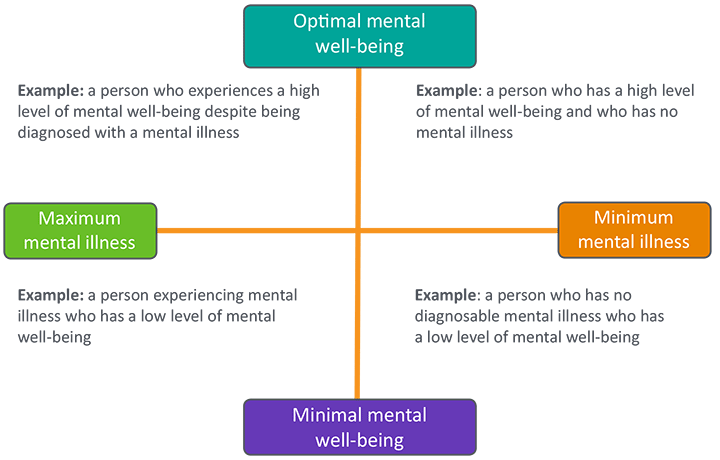
A different and more helpful way of thinking about mental health is the continuum (Figure 1).

The four quadrants of the mental health continuum represent different possible times and situations in a person’s life.

On the right hand side of the diagram, two possible situations are described. Even if a person has no diagnosable illness, they can have either positive or negative mental well-being. Usually the person’s mental health will be affected by life events. If faced with redundancy or the break up of a long-term relationship, the person may find themselves at the lower end of the continuum, experiencing poor mental well-being. If things are going well and the person is looking after their emotional, mental, and physical health they may be higher up the continuum.

Similarly, on the left hand side of the diagram we see that a person with a diagnosed illness can also be experiencing either positive or negative mental well-being.

With the right treatment and proper supports in place, the person can live a happy and fulfilled life whether or not they are experiencing symptoms. Living life to the full may involve having meaningful things to do, having good relationships, a satisfying social life, and good self esteem. On the other hand, without the right treatment and support the person may experience negative mental health.

Being at the lower end of the mental health continuum puts people at greater risk of suicide, whether they have a mental illness or not.

Given that 1 in 4 adults will experience mental health problems at some time in their lives, we can see that it is possible for us to move into all four corners of the continuum at different times.

Knowing that mental health changes over time can help us to look after our own well-being. It can also help us to be more understanding and supportive of others when they are experiencing poor mental health.

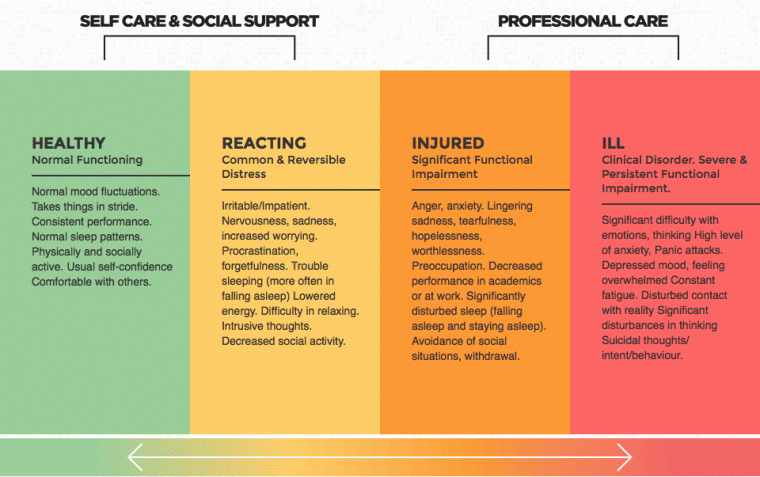
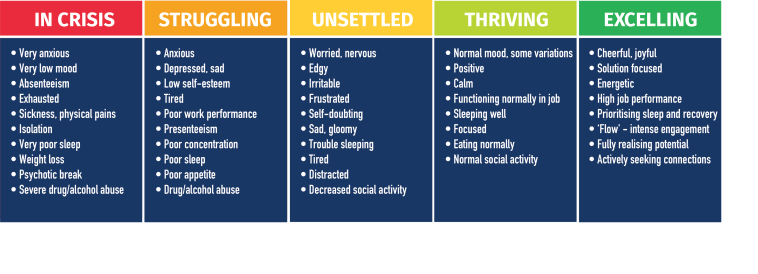
There are other ways to look at the mental health continuum.