What is Cognitive Analytic Therapy?

Introduction

Cognitive analytic therapy (CAT) is a form of psychological therapy initially developed in the United Kingdom by Anthony Ryle.

This time-limited therapy was developed in the context of the UK’s National Health Service (NHS) with the aim of providing effective and affordable psychological treatment which could be realistically provided in a resource constrained public health system. It is distinctive due to its intensive use of reformulation, its integration of cognitive and analytic practice and its collaborative nature, involving the patient very actively in their treatment.

The CAT practitioner aims to work with the patient to identify procedural sequences; chains of events, thoughts, emotions and motivations that explain how a target problem (for example self-harm) is established and maintained. In addition to the procedural sequence model, a second distinguishing feature of CAT is the use of reciprocal roles (RRs). These identify problems as occurring between people and not within the patient. RRs may be set up in early life and then be replayed in later life; for example someone who as a child felt neglected by parents perceived as abandoning might be vulnerable to feelings of abandonment in later life (or indeed neglect themselves).

Background

As the name implies, CAT evolved as an integrative therapy based on ideas from cognitive and analytic therapies. CAT was also influenced in part by George Kelly’s constructivism. Kelly had developed personal construct theory and the repertory grid method, and Kelly’s approach to therapy “offered a model of nonauthoritarian practice” that psychotherapist Anthony Ryle found appealing.

Ryle, a general practitioner and analytically trained psychotherapist, was undertaking research into psychotherapy practice using repertory grids in the 1970s. He found that the themes eventually addressed in analytic work were in fact present in transcripts from the very first sessions. However the slow, exploratory nature of traditional analytic therapy meant that these were not always addressed early and assertively, with the result that therapy, while effective, took a long time to produce results. In a 1979 paper, he proposed a shorter, more active form of therapy which integrated elements from cognitive therapy practice (such as goal setting and Socratic questioning) into analytic practice. This would include explicitly formulating the problems experienced by the patient, and sharing this formulation with the patient to engage them in psychotherapy as a co-operative enterprise.

Subsequently CAT has been influenced by ideas from the work of Soviet psychologist Lev Vygotsky and Russian philosopher Mikhail Bakhtin. From Vygotsky come concepts such as the zone of proximal development (ZPD) and scaffolding. The ZPD implies that new tasks set for the patient (for example, tolerating anxiety about social situations) should extend what they do beyond their current capabilities, but only by a small and achievable amount. Scaffolding involves the therapist providing support for the patient’s efforts to change, but varying this level of support as the patient’s needs change.

Bakhtin provided concepts such as dialogism from which come techniques such as Dialogical Sequence Analysis. This is a structured attempt to identify and visually display sequences of behaviour, thinking, and emotions so that the patient becomes more aware of these and can start to modify them.

In Practice

The model emphasises collaborative work with the client, and focuses on the understanding of the patterns of maladaptive behaviours. The aim of the therapy is to enable the client to recognise these patterns, understand their origins, and subsequently to learn alternative strategies in order to cope better.

The approach is always time-limited, typically taking place over 8-24 weekly sessions (the precise number being agreed at the start of therapy). Sixteen sessions is probably the most common length. In the first quarter of the therapy (the Reformulation phase) the therapist collects all the relevant information, asking the patient about present day problems and also earlier life experiences. At that point the therapist writes a reformulation letter to the client. This letter summarises the therapist’s understanding of the client’s problems. Particular attention is given to understanding the connection between childhood patterns of behaviour and their impact on adult life. The letter is agreed between patient and therapist and forms the basis for the rest of the work.

After the reformulation letter the patient may be asked to complete diaries or rating sheets to record the occurrence of problems and their context. During this period (known as the Recognition phase) patient and therapist construct a diagrammatic formulation to illustrate the unhelpful procedures which maintain problems for the patient. The aim of this phase is to enable the patient to recognise when and how problems occur.

In the second half of the therapy work moves into the Revision phase, where patient and therapist identify and practice “exits” from the procedural diagram established in the previous phase. For example, a problematic procedure might move a patient from feeling angry to taking an overdose. An exit might involve expressing the anger in some way as an alternative to self-injuring behaviour.

At the end of the therapy, patient and therapist each write “goodbye letters” which they exchange, summarising what has been achieved in the therapy and what remains to be done. After the end of the agreed number of weekly sessions, planned follow-up sessions take place to monitor and support the changes that have been made. Typically, a 16-session CAT might be followed up by a single session one month after the end of therapy, and a final one three months later.

Evidence Base

CAT has been the subject of a number of research studies published in peer-reviewed journals. These include randomised controlled trials (RCTs) and other kinds of study. The approach is too new for any systematic reviews of RCTs to have been conducted, and therefore is not yet explicitly recommended by name by the UK National Institute for Health and Clinical Excellence (NICE). However NICE has recommended that there should be further research of CAT, for example in borderline personality disorder. A review of CAT research evidence published in 2014 reported that although there were five randomised controlled trials published, research evidence into the approach was dominated by small-scale, practice-based studies. These tended to be with complex and severe clinical groups; 44% of studies reviewed involved personality disorder. A review of CAT looking back over the 30 years to its beginnings contains a meta-analysis of 11 outcome studies of CAT. The overall number of patients treated in the studies was 324 and the average effect size across all studies was 0.83 (95% confidence interval 0.66-1.00). This is a large effect and suggests that CAT is efficacious in treating mental health problems.

Evidence from Randomised Controlled Trials

CAT has been shown to lead to subjective improvement in people with anorexia nervosa. It has also been shown to produce significant improvements in adolescents with a diagnosis of borderline personality disorder. A different trial suggested that CAT for adult patients with personality disorders also showed improvements in symptoms and interpersonal functioning, as against controls who deteriorated on these measures. CAT has also been shown to improve patients’ management of diabetes. An RCT of the use of a CAT-informed assessment for young people who had self-harmed suggested that it was effective in increasing rates of attendance at community follow-up.

Evidence from Other Methodologies

Comparative studies have suggested CAT to be at least as effective as other forms of brief psychotherapy, person-centred therapy and cognitive behavioural therapy, and interpersonal psychotherapy.

Case series and single case studies have also been published describing the use of CAT in:

  • Depression.
  • Dissociative psychosis.
  • The treatment of offenders.
  • Brain injury.
  • Deliberate self-harm.
  • Dissociative identity disorder.
  • Histrionic personality disorder.
  • Panic disorder.
  • Psychological problems in multiple sclerosis.
  • With carers of people with dementia.
  • Morbid jealousy.
  • Borderline personality disorder.
  • Paranoid personality disorder.
  • Survivors of child sexual abuse.

Book: Cognitive Analytic Therapy and the Politics of Mental Health

Book Title:

Cognitive Analytic Therapy and the Politics of Mental Health.

Author(s): Rachel Pollard and Julie Lloyd (Editors).

Year: 2018.

Edition: First (1st).

Publisher: Routledge.

Type(s): Hardcover, Paperback, and Kindle.

Synopsis:

Cognitive Analytic Therapy and the Politics of Mental Health provides an overview of the development of cognitive analytic therapy (CAT), and illuminates how the political context affects the way in which therapists consider their work and facilitates their practice.

This book examines how CAT contributes to wider debates over ‘the politics of mental health’. With contributions from those working in services – including adult mental health, learning disabilities and child and adolescent therapists – the writers consider how contemporary politics devolves responsibility for mental illness onto those suffering distress. The evolving political and social attitudes clients bring to therapy are also addressed in several chapters, and there is a focus on groups in society who have been marginalized and neglected in mental and physical health services.

Cognitive Analytic Therapy and the Politics of Mental Health offers a fresh understanding of the contemporary politics of mental health that will be of interest to all therapists and mental health professionals.

Book: Cognitive Analytic Supervision

Book Title:

Cognitive Analytic Supervision: A Relational Approach.

Author(s): Deborah Pickvance (Editor).

Year: 2016.

Edition: First (1st).

Publisher: Routledge.

Type(s): Hardcover, Paperback, and Kindle.

Synopsis:

Cognitive Analytic Supervision: A relational approach is the first book to present a cognitive analytic perspective on psychotherapy supervision. This edited collection of original chapters reflects the ways in which CAT therapists and supervisors have developed the model and used it in diverse settings. It is a significant contribution to the literature on relational psychotherapy supervision, written by established CAT supervisors, trainers and therapists who, together, have an enormous amount of professional and clinical experience.
The book covers important areas such as:

  • The relational theory and practice of CAT supervision.
  • A cognitive analytic conceptualisation of narcissistic difficulties.
  • Intercultural issues in supervision (based on CAT training experience in India).
  • Ethical and clinical dilemmas in supervision.
  • Supervision of consultancy work.

Cognitive Analytic Supervision will be of interest to CAT supervisors, therapists and trainee supervisors, as well as supervisors and therapists working in other therapeutic models, in particular those with a relational approach. This book may be a useful bridge into relationally informed supervision for therapists who do not have an explicitly relational focus.

Book: Cognitive Analytic Therapy

Book Title:

Cognitive Analytic Therapy: Distinctive Features (Psychotherapy and Counselling Distinctive Features).

Author(s): Claire Corbridge, Laura Brummer, and Philippa Coid.

Year: 2017.

Edition: First (1st).

Publisher: Routledge.

Type(s): Hardcover, Paperback, and Kindle.

Synopsis:

Cognitive Analytic Therapy: Distinctive Features offers an introduction to what is distinctive about this increasingly popular method. Written by three Cognitive Analytic Therapists, with many years’ experience, it provides an accessible, bitesize overview of this increasingly used psychological therapy. Using the popular Distinctive Features format, this book describes 15 theoretical features and 15 practical techniques of Cognitive Analytic Therapy.

Cognitive Analytic Therapy will be a valuable source for students, professionals in training and practising therapists, as well as other psychotherapists, counsellors and mental health professionals wishing to learn more about the distinctive features of this important therapy.

Book: Cognitive Analytic Therapy and Borderline Personality Disorder

Book Title:

Cognitive Analytic Therapy and Borderline Personality Disorder : The Model and the Method

Author(s): Anthony Ryle.

Year: 1997.

Edition: First (1st).

Publisher: John Wiley & Sons.

Type(s): Paperback and Kindle.

Synopsis:

Borderline Personality Disorder patients are impulsive, unstable and destructive, hurting themselves and those around them, including those who seek to help them. This has resulted in a widespread reluctance to treat them and a pessimism about treatment.

In the experience of the authors this pessimism is unjustified, because for many patients a relatively brief intervention can be effective in cost-benefit terms as well as human terms. The interventions illustrated here have been used to treat outpatients for 15 years.

The results indicate that treatments can achieve clinically significant changes in the course of 16 24 sessions, in a substantial proportion of patients. While CAT shares some ideas and methods with other approaches, it introduces many new features and is uniquely integrated at both the theoretical and practical level. The early joint reformulation of patients problems serves to contain destructiveness and to create a working alliance. Also, the use of reformulation to teach self-reflection and avoid collusive responses from the therapist, throughout the therapy, represents a powerful new technique.

The book offers a critical appraisal of current ideas and practices, contrasting with these the ways in which CAT mobilises the patient s own resources. The authors argue that CAT should have a place in any service seeking to help these difficult patients.

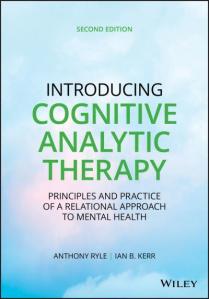
Book: Introducing Cognitive Analytic Therapy

Book Title:

Introducing Cognitive Analytic Therapy: Principles and Practice of a Relational Approach to Mental Health.

Author(s): Anthony Ryle and Ian B. Kerr.

Year: 2020.

Edition: Second (2nd).

Publisher: Wiley.

Type(s): Paperback and Kindle.

Synopsis:

Cognitive Analytic Therapy (CAT) is an increasingly popular approach to therapy that is now widely recognised as a genuinely integrative and fundamentally relational model of psychotherapy. This new edition of the definitive text to CAT offers a systematic and comprehensive introduction to its origins, development, and practice. It also provides a fully updated overview of developments in the theory, research, and applications of CAT, including clarification and re-statement of basic concepts, such as reciprocal roles and reciprocal role procedures, as well as extensions into new areas of expertise.

Introducing Cognitive Analytic Therapy: Principles and Practice of a Relational Approach to Mental Health, 2nd Edition starts with a brief account of the scope and focus of CAT and how it evolved and explains the main features of its practice. It next offers a brief account of a relatively straightforward therapy to give readers a sense of the unfolding structure and style of a time-limited CAT. Following that are chapters that consider the normal and abnormal development of the Self and that introduce influential concepts from Vygotskian, Bakhtinian and developmental psychology. Subsequent chapters describe selection and assessment; reformulation; the course of therapy; the ‘ideal model’ of therapist activity and its relation to the supervision of therapists; applications of CAT in various patient groups and settings and in treating personality type disorders; use in ‘reflective practice’; a CAT perspective on the ‘difficult’ patient; and systemic and ‘contextual’ approaches.

  • Presents an updated introduction and overview of the principles and practice of cognitive analytic therapy (CAT).
  • Updates the first edition with developments from the last decade, in which CAT theory has deepened and the approach has been applied to new patient groups and extended far beyond its roots.
  • Includes detailed, applicable ‘how to’ descriptions of CAT in practice.
  • Includes references to CAT published works and suggestions for further reading within each chapter.
  • Includes a glossary of terms and several appendices containing the CAT Psychotherapy File; a summary of CAT competences extracted from Roth and Pilling; the Personality Structure Questionnaire; and a description of repertory grid basics and their use in CAT.
  • Co-written by the creator of the CAT model, Anthony Ryle, in collaboration with leading CAT practitioner, trainer, and researcher, Ian B. Kerr.

Introducing Cognitive Analytic Therapy is the definitive book for CAT practitioners and CAT trainees at skills, practitioner, and psychotherapy levels. It should also be of considerable interest and relevance to mental health professionals of all orientations, including clinical psychologists, psychiatrists, counselors, mental health nurses, to those working in forensic and various institutional settings, and to a range of other health care and social work professionals.