
An Overview of Motivated Reasoning

Introduction

Motivated reasoning (motivational reasoning bias) is a cognitive and social response in which individuals, consciously or sub-consciously, allow emotion-loaded motivational biases to affect how new information is perceived. Individuals tend to favour evidence that coincides with their current beliefs and reject new information that contradicts them, despite contrary evidence.

Motivated reasoning overlaps with confirmation bias. Both favour evidence supporting one’s beliefs, at the same time dismissing contradictory evidence. However, confirmation bias is mainly a sub-conscious (innate) cognitive bias. In contrast, motivated reasoning (motivational bias) is a sub-conscious or conscious process by which one’s emotions control the evidence supported or dismissed. For confirmation bias, the evidence or arguments can be logical as well as emotional.

Motivated reasoning can be classified into two categories:

  1. Accuracy-oriented (non-directional), in which the motive is to arrive at an accurate conclusion, irrespective of the individual’s beliefs; and
  2. Goal-oriented (directional), in which the motive is to arrive at a particular conclusion.

Refer to Motivated Forgetting, Emotional Reasoning, and Motivated Tactician.

Definitions

Motivated reasoning is a cognitive and social response, in which individuals, consciously or unconsciously, allow emotion-loaded motivational biases to affect how new information is perceived. Individuals tend to favour arguments that support their current beliefs and reject new information that contradicts these beliefs.

Motivated reasoning, confirmation bias and cognitive dissonance are closely related. Both motivated reasoning and confirmation bias favour evidence supporting one’s beliefs, at the same time dismissing contradictory evidence. Motivated reasoning (motivational bias) is an unconscious or conscious process by which personal emotions control the evidence that is supported or dismissed. However, confirmation bias is mainly an unconscious (innate, implicit) cognitive bias, and the evidence or arguments utilised can be logical as well as emotional. More broadly, it is feasible that motivated reasoning can moderate cognitive biases generally, including confirmation bias.

Individual differences such as political beliefs can moderate the emotional/motivational effect. In addition, social context (groupthink, peer pressure) also partly controls the evidence utilised for motivated reasoning, particularly in dysfunctional societies. Social context moderates emotions, which in turn moderate beliefs.

Motivated reasoning differs from critical thinking, in which beliefs are assessed with a sceptical but open-minded attitude.

Cognitive Dissonance

Individuals are compelled to initiate motivated reasoning to lessen the amount of cognitive dissonance they feel. Cognitive dissonance is the feeling of psychological and physiological stress and unease between two conflicting cognitive and/or emotional elements (such as the desire to smoke, despite knowing it is unhealthy). According to Leon Festinger, there are two paths individuals can engage in to reduce the amount of distress: the first is altering behaviour or cognitive bias; the second, more common path is avoiding or discrediting information or situations that would create dissonance.

Research suggests that reasoning away contradictions is psychologically easier than revising feelings. Emotions tend to colour how “facts” are perceived. Feelings come first, and evidence is used in service of those feelings. Evidence that supports what is already believed is accepted; evidence which contradicts those beliefs is not.

Mechanisms: Cold and Hot Cognition

The notion that motives or goals affect reasoning has a long and controversial history in social psychology. This is because supportive research could be reinterpreted in entirely cognitive non-motivational terms (the hot versus cold cognition controversy). This controversy existed because of a failure to explore mechanisms underlying motivated reasoning.

Early research on how humans evaluated and integrated information supported a cognitive approach consistent with Bayesian probability, in which individuals weighted new information using rational calculations (“cold cognition”). More recent theories endorse these cognitive processes as only partial explanations of motivated reasoning, but have also introduced motivational[1] or affective (emotional) processes (“hot cognition”).

Kunda Theory

Ziva Kunda reviewed research and developed a theoretical model to explain the mechanism by which motivated reasoning results in bias. Motivation to arrive at a desired conclusion provides a level of arousal, which acts as an initial trigger for the operation of cognitive processes. To participate in motivated reasoning, either consciously or subconsciously, an individual first needs to be motivated. Motivation then affects reasoning by influencing the knowledge structures (beliefs, memories, information) that are accessed and the cognitive processes used.

Lodge–Taber Theory

Milton Lodge and Charles Taber introduced an empirically supported model in which affect is intricately tied to cognition, and information processing is biased toward support for positions that the individual already holds. Their model has three components:

  • On-line processing, in which, when called on to make an evaluation, people instantly draw on stored information which is marked with affect;
  • A component by which affect is automatically activated along with the cognitive node to which it is tied; and
  • An “heuristic mechanism” for evaluating new information, which triggers a reflection on “How do I feel?” about this topic. This process results in a bias towards maintaining existing affect, even in the face of other, disconfirming information.

This theory is developed and evaluated in their book The Rationalizing Voter (2013). David Redlawsk (2002) found that the timing of when disconfirming information was introduced played a role in determining bias. When subjects encounter incongruity during an information search, the automatic assimilation and update process is interrupted. This results in one of two outcomes:

  • Subjects may enhance attitude strength in a desire to support existing affect (resulting in degradation in decision quality and potential bias); or
  • Subjects may counter-argue existing beliefs in an attempt to integrate the new data.

This second outcome is consistent with research on how processing occurs when one is tasked with accuracy goals.

To summarise, the two models differ in that Kunda identifies a primary role for cognitive strategies such as memory processes, and the use of rules in determining biased information selection, whereas Lodge and Taber identify a primary role for affect in guiding cognitive processes and maintaining bias.

Neuroscientific Evidence

A neuroimaging study by Drew Westen and colleagues does not support the use of cognitive processes in motivated reasoning, lending greater support to affective processing as a key mechanism in supporting bias. This study, designed to test the neural circuitry of individuals engaged in motivated reasoning, found that motivated reasoning “was not associated with neural activity in regions previously linked with cold reasoning tasks [Bayesian reasoning] nor conscious (explicit) emotion regulation”.

This neuroscience data suggests that “motivated reasoning is qualitatively distinct from reasoning when people do not have a strong emotional stake in the conclusions reached.” However, if there is a strong emotion attached during their previous round of motivated reasoning and that emotion is again present when the individual’s conclusion is reached, a strong emotional stake is then attached to the conclusion. Any new information in regards to that conclusion will cause motivated reasoning to reoccur. This can create pathways within the neural network that further ingrain the reasoned beliefs of that individual along similar neural networks to where logical reasoning occurs. This causes the strong emotion to reoccur when confronted with contradictory information, time and time again. This is referred to by Lodge and Taber as affective contagion. But instead of “infecting” other individuals, the emotion “infects” the individual’s reasoning pathways and conclusions.

Categories

Motivated reasoning can be classified into two categories:

  1. Accuracy-oriented (non-directional), in which the motive is to arrive at an accurate conclusion, irrespective of the individual’s beliefs; and
  2. Goal-oriented (directional), in which the motive is to arrive at a particular conclusion.

Politically motivated reasoning, in particular, is strongly directional.

Despite their differences in information processing, an accuracy-motivated and a goal-motivated individual can reach the same conclusion. Both accuracy-oriented and directional-oriented messages move in the desired direction. However, the distinction lies in crafting effective communication, where those who are accuracy motivated will respond better to credible evidence catered to the community, while those who are goal-oriented will feel less threatened when the issue is framed to fit their identity or values.

Accuracy-Oriented (Non-Directional) Motivated Reasoning

Several works on accuracy-driven reasoning suggest that when people are motivated to be accurate, they expend more cognitive effort, attend to relevant information more carefully, and process it more deeply, often using more complex rules.

Kunda asserts that accuracy goals delay the process of coming to a premature conclusion, in that accuracy goals increase both the quantity and quality of processing—particularly in leading to more complex inferential cognitive processing procedures. When researchers manipulated test subjects’ motivation to be accurate by informing them that the target task was highly important or that they would be expected to defend their judgments, it was found that subjects utilized deeper processing and that there was less biasing of information. This was true when accuracy motives were present at the initial processing and encoding of information. In reviewing a line of research on accuracy goals and bias, Kunda concludes, “several different kinds of biases have been shown to weaken in the presence of accuracy goals”. However, accuracy goals do not always eliminate biases and improve reasoning: some biases (e.g. those resulting from using the availability heuristic) might be resistant to accuracy manipulations. For accuracy to reduce bias, the following conditions must be present:

  • Subjects must possess appropriate reasoning strategies.
  • They must view these as superior to other strategies.
  • They must be capable of using these strategies at will.

However, these last two conditions introduce the construct that accuracy goals include a conscious process of utilising cognitive strategies in motivated reasoning. This construct is called into question by neuroscience research that concludes that motivated reasoning is qualitatively distinct from reasoning in which there is no strong emotional stake in the outcomes. Accuracy-oriented individuals who are thought to use “objective” processing can vary in information updating, depending on how much faith they place in a provided piece of evidence and inability to detect misinformation that can lead to beliefs that diverge from scientific consensus.

Goal-Oriented (Directional) Motivated Reasoning

Directional goals enhance the accessibility of knowledge structures (memories, beliefs, information) that are consistent with desired conclusions. According to Kunda, such goals can lead to biased memory search and belief construction mechanisms. Several studies support the effect of directional goals in selection and construction of beliefs about oneself, other people and the world.

Cognitive dissonance research provides extensive evidence that people may bias their self-characterisations when motivated to do so. Other biases such as confirmation bias, prior attitude effect and disconfirmation bias could contribute to goal-oriented motivated reasoning. For example, in one study, subjects altered their self-view by viewing themselves as more extroverted when induced to believe that extroversion was beneficial.

Michael Thaler of Princeton University, conducted a study that found that men are more likely than women to demonstrate performance-motivated reasoning due to a gender gap in beliefs about personal performance. After a second study was conducted the conclusion was drawn that both men and women are susceptible to motivated reasoning, but certain motivated beliefs can be separated into genders.

The motivation to achieve directional goals could also influence which rules (procedural structures, such as inferential rules) are accessed to guide the search for information. Studies also suggest that evaluation of scientific evidence may be biased by whether the conclusions are in line with the reader’s beliefs.

In spite of goal-oriented motivated reasoning, people are not at liberty to conclude whatever they want merely because of that want. People tend to draw conclusions only if they can muster up supportive evidence. They search memory for those beliefs and rules that could support their desired conclusion or they could create new beliefs to logically support their desired goals.

Case Studies

Smoking

When an individual is trying to quit smoking, they might engage in motivated reasoning to convince themselves to keep smoking. They might focus on information that makes smoking seem less harmful while discrediting any evidence which emphasizes any dangers associated with the behaviour. Individuals in situations like this are driven to initiate motivated reasoning to lessen the amount of cognitive dissonance they feel. This can make it harder for individuals to quit and lead to continued smoking, even though they know it is not good for their health.

Political Bias

Peter Ditto and his students conducted a meta-analysis in 2018 of studies relating to political bias. Their aim was to assess which US political orientation (left/liberal or right/conservative) was more biased and initiated more motivated reasoning. They found that both political orientations are susceptible to bias to the same extent. The analysis was disputed by Jonathan Baron and John Jost, to whom Ditto and colleagues responded. Reviewing the debate, Stuart Vyse concluded that the answer to the question of whether US liberals or conservatives are more biased is: “We don’t know.”

On 22 April 2011, The New York Times published a series of articles attempting to explain the Barack Obama citizenship conspiracy theories. One of these articles by political scientist David Redlawsk explained these “birther” conspiracies as an example of political motivated reasoning. US presidential candidates are required to be born in the US. Despite ample evidence that President Barack Obama was born in the US state of Hawaii, many people continue to believe that he was not born in the US, and therefore that he was an illegitimate president. Similarly, many people believe he is a Muslim (as was his father), despite ample lifetime evidence of his Christian beliefs and practice (as was true of his mother). Subsequent research by others suggested that political partisan identity was more important for motivating “birther” beliefs than for some other conspiracy beliefs such as 9/11 conspiracy theories.

Climate Change

Despite a scientific consensus on climate change, citizens are divided on the topic, particularly along political lines. A significant segment of the American public has fixed beliefs, either because they are not politically engaged, or because they hold strong beliefs that are unlikely to change. Liberals and progressives generally believe, based on extensive evidence, that human activity is the main driver of climate change. By contrast, conservatives are generally much less likely to hold this belief, and a subset believes that there is no human involvement, and that the reported evidence is faulty (or even fraudulent). A prominent explanation is political directional motivated reasoning, in that conservatives are more likely to reject new evidence that contradicts their long established beliefs. In addition, some highly directional climate deniers not only discredit scientific information on human-induced climate change but also to seek contrary evidence that leads to a posterior belief of greater denial.

A study by Robin Bayes and colleagues of the human-induced climate change views of 1,960 members of the Republican Party found that both accuracy and directional motives move in the desired direction, but only in the presence of politically motivated messages congruent with the induced beliefs.

Social Media

Social media is used for many different purposes and ways of spreading opinions. It is the number one place people go to get information and most of that information is complete opinion and bias. The way this applies to motivated reasoning is the way it spreads. “However, motivated reasoning suggests that informational uses of social media are conditioned by various social and cultural ways of thinking”. All ideas and opinions are shared and makes it very easy for motivated reasoning and biases to come through when searching for an answer or just facts on the internet or any news source.

COVID-19

In the context of the COVID-19 pandemic, people who refuse to wear masks or get vaccinated may engage in motivated reasoning to justify their beliefs and actions. They may reject scientific evidence that supports mask-wearing and vaccination and instead seek out information that supports their pre-existing beliefs, such as conspiracy theories or misinformation. This can lead to behaviours that are harmful to both themselves and others.

In a 2020 study, Van Bavel and colleagues explored the concept of motivated reasoning as a contributor to the spread of misinformation and resistance to public health measures during the COVID-19 pandemic. Their results indicated that people often engage in motivated reasoning when processing information about the pandemic, interpreting it to confirm their pre-existing beliefs and values. The authors argue that addressing motivated reasoning is critical to promoting effective public health messaging and reducing the spread of misinformation. They suggested several strategies, such as reframing public health messages to align with individuals’ values and beliefs. In addition, they suggested using trusted sources to convey information by creating social norms that support public health behaviours.

Outcomes and Tackling Strategies

The outcomes of motivated reasoning derive from “a biased set of cognitive processes—that is, strategies for accessing, constructing, and evaluating beliefs. The motivation to be accurate enhances use of those beliefs and strategies that are considered most appropriate, whereas the motivation to arrive at particular conclusions enhances use of those that are considered most likely to yield the desired conclusion.” Careful or “reflective” reasoning has been linked to both overcoming and reinforcing motivated reasoning, suggesting that reflection is not a panacea, but a tool that can be used for rational or irrational purposes depending on other factors. For example, when people are presented with and forced to think analytically about something complex that they lack adequate knowledge of (i.e. being presented with a new study on meteorology whilst having no degree in the subject), there is no directional shift in thinking, and their extant conclusions are more likely to be supported with motivated reasoning. Conversely, if they are presented with a more simplistic test of analytical thinking that confronts their beliefs (i.e. seeing implausible headlines as false), motivated reasoning is less likely to occur and a directional shift in thinking may result.

Hostile Media Effect

Research on motivated reasoning tested accuracy goals (i.e. reaching correct conclusions) and directional goals (i.e. reaching preferred conclusions). Factors such as these affect perceptions; and results confirm that motivated reasoning affects decision-making and estimates. These results have far reaching consequences because, when confronted with a small amount of information contrary to an established belief, an individual is motivated to reason away the new information, contributing to a hostile media effect. If this pattern continues over an extended period of time, the individual becomes more entrenched in their beliefs.

Tipping Point

However, recent studies have shown that motivated reasoning can be overcome. “When the amount of incongruency is relatively small, the heightened negative affect does not necessarily override the motivation to maintain [belief].” However, there is evidence of a theoretical “tipping point” where the amount of incongruent information that is received by the motivated reasoner can turn certainty into anxiety. This anxiety of being incorrect may lead to a change of opinion to the better.

This page is based on the copyrighted Wikipedia article < https://en.wikipedia.org/wiki/Motivated_reasoning >; it is used under the Creative Commons Attribution-ShareAlike 3.0 Unported License (CC-BY-SA). You may redistribute it, verbatim or modified, providing that you comply with the terms of the CC-BY-SA.

An Overview of Neuroepigenetics

Introduction

Neuroepigenetics is the study of how epigenetic changes to genes affect the nervous system. These changes may effect underlying conditions such as addiction, cognition, and neurological development.

Mechanisms

Neuroepigenetic mechanisms regulate gene expression in the neuron. Often, these changes take place due to recurring stimuli. Neuroepigenetic mechanisms involve proteins or protein pathways that regulate gene expression by adding, editing or reading epigenetic marks such as methylation or acetylation. Some of these mechanisms include ATP-dependent chromatin remodelling, LINE1, and prion protein-based modifications. Other silencing mechanisms include the recruitment of specialised proteins that methylate DNA such that the core promoter element is inaccessible to transcription factors and RNA polymerase. As a result, transcription is no longer possible. One such protein pathway is the REST co-repressor complex pathway. There are also several non-coding RNAs that regulate neural function at the epigenetic level. These mechanisms, along with neural histone methylation, affect arrangement of synapses, neuroplasticity, and play a key role in learning and memory.

Methylation

DNA methyltransferases (DNMTs) are involved in regulation of the electrophysiological landscape of the brain through methylation of CpGs. Several studies have shown that inhibition or depletion of DNMT1 activity during neural maturation leads to hypomethylation of the neurons by removing the cell’s ability to maintain methylation marks in the chromatin. This gradual loss of methylation marks leads to changes in the expression of crucial developmental genes that may be dosage sensitive, leading to neural degeneration. This was observed in the mature neurons in the dorsal portion of the mouse prosencephalon, where there was significantly greater amounts of neural degeneration and poor neural signalling in the absence of DNMT1. Despite poor survival rates amongst the DNMT1-depleted neurons, some of the cells persisted throughout the lifespan of the organism. The surviving cells reaffirmed that the loss of DNMT1 led to hypomethylation in the neural cell genome. These cells also exhibited poor neural functioning. In fact, a global loss of neural functioning was also observed in these model organisms, with the greatest amounts neural degeneration occurring in the prosencephalon.

Other studies showed a trend for DNMT3a and DNMT3b. However, these DNMT’s add new methyl marks on unmethylated DNA, unlike DNMT1. Like DNMT1, the loss of DNMT3a and 3b resulted in neuromuscular degeneration two months after birth, as well as poor survival rates amongst the progeny of the mutant cells, even though DNMT3a does not regularly function to maintain methylation marks. This conundrum was addressed by other studies which recorded rare loci in mature neurons where DNMT3a acted as a maintenance DNMT. The Gfap locus, which codes for the formation and regulation of the cytoskeleton of astrocytes, is one such locus where this activity is observed. The gene is regularly methylated to downregulate glioma related cancers. DNMT inhibition leads to decreased methylation and increased synaptic activity. Several studies show that the methylation-related increase or decrease in synaptic activity occurs due to the upregulation or downregulation of receptors at the neurological synapse. Such receptor regulation plays a major role in many important mechanisms, such as the ‘fight or flight’ response. The glucocorticoid receptor (GR) is the most studied of these receptors. During stressful circumstances, there is a signalling cascade that begins from the pituitary gland and terminates due to a negative feedback loop from the adrenal gland. In this loop, the increase in the levels of the stress response hormone results in the increase of GR. Increase in GR results in the decrease of cellular response to the hormone levels. It has been shown that methylation of the I7 exon within the GR locus leads to a lower level of basal GR expression in mice. These mice were more susceptible to high levels of stress as opposed to mice with lower levels of methylation at the I7 exon. Up-regulation or down-regulation of receptors through methylation leads to change in synaptic activity of the neuron.

Hypermethylation, CpG Islands, and Tumour Suppressing Genes

CpG Islands (CGIs) are regulatory elements that can influence gene expression by allowing or interfering with transcription initiation or enhancer activity. CGIs are generally interspersed with the promoter regions of the genes they affect and may also affect more than one promoter region. In addition they may also include enhancer elements and be separate from the transcription start site. Hypermethylation at key CGIs can effectively silence expression of tumour suppressing genes and is common in gliomas. Tumour suppressing genes are those which inhibit a cell’s progression towards cancer. These genes are commonly associated with important functions which regulate cell-cycle events. For example, PI3K and p53 pathways are affected by CGI promoter hypermethylation, this includes the promoters of the genes CDKN2/p16, RB, PTEN, TP53 and p14ARF. Importantly, glioblastomas are known to have high frequency of methylation at CGIs/promoter sites. For example, Epithelial Membrane Protein 3 (EMP3) is a gene which is involved in cell proliferation as well as cellular interactions. It is also thought to function as a tumour suppressor, and in glioblastomas is shown to be silenced via hypermethylation. Furthermore, introduction of the gene into EMP3-silenced neuroblasts results in reduced colony formation as well as suppressed tumour growth. In contrast, hypermethylation of promoter sites can also inhibit activity of oncogenes and prevent tumorigenesis. Such oncogenic pathways as the transformation growth factor (TGF)-beta signalling pathway stimulate cells to proliferate. In glioblastomas the overactivity of this pathway is associated with aggressive forms of tumour growth. Hypermethylation of PDGF-B, the TGF-beta target, inhibits uncontrolled proliferation.

Hypomethylation and Aberrant Histone Modification

Global reduction in methylation is implicated in tumorigenesis. More specifically, wide spread CpG demethylation, contributing to global hypomethylation, is known to cause genomic instability leading to development of tumours. An important effect of this DNA modification is its transcriptional activation of oncogenes. For example, expression of MAGEA1 enhanced by hypomethylation interferes with p53 function.

Aberrant patterns of histone modifications can also take place at specific loci and ultimately manipulate gene activity. In terms of CGI promoter sites, methylation and loss of acetylation occurs frequently at H3K9. Furthermore, H3K9 dimethylation and trimethylation are repressive marks which, along with bivalent differentially methylated domains, are hypothesized to make tumour suppressing genes more susceptible to silencing. Abnormal presence or lack of methylation in glioblastomas are strongly linked to genes which regulate apoptosis, DNA repair, cell proliferation, and tumour suppression. One of the best known examples of genes affected by aberrant methylation that contributes to formation of glioblastomas is MGMT, a gene involved in DNA repair which encodes the protein O6-methylguanine-DNA methyltransferase. Methylation of the MGMT promoter is an important predictor of the effectiveness of alkylating agents to target glioblastomas. Hypermethylation of the MGMT promoter causes transcriptional silencing and is found in several cancer types including glioma, lymphoma, breast cancer, prostate cancer, and retinoblastoma.

Neuroplasticity

Neuroplasticity refers to the ability of the brain to undergo synaptic rearrangement as a response to recurring stimuli. Neurotrophin proteins play a major role in synaptic rearrangement, amongst other factors. Depletion of neurotrophin BDNF or BDNF signalling is one of the main factors in developing diseases such as Alzheimer’s disease, Huntington’s disease, and depression. Neuroplasticity can also occur as a consequence of targeted epigenetic modifications such as methylation and acetylation. Exposure to certain recurring stimuli leads to demethylation of particular loci and remethylation in a pattern that leads to a response to that particular stimulus. Like the histone readers, erasers and writers also modify histones by removing and adding modifying marks respectively. An eraser, neuroLSD1, is a modified version of the original Lysine Demethylase 1(LSD1) that exists only in neurons and assists with neuronal maturation. Although both versions of LSD1 share the same target, their expression patterns are vastly different and neuroLSD1 is a truncated version of LSD1. NeuroLSD1 increases the expression of immediate early genes (IEGs) involved in cell maturation. Recurring stimuli lead to differential expression of neuroLSD1, leading to rearrangement of loci. The eraser is also thought to play a major role in the learning of many complex behaviors and is way through which genes interact with the environment.

Neurodegenerative Diseases

Alzheimer’s Disease

Alzheimer’s disease (AD) is a neurodegenerative disease known to progressively affect memory and incite cognitive degradation. Epigenetic modifications both globally and on specific candidate genes are thought to contribute to the aetiology of this disease. Immunohistochemical analysis of post-mortem brain tissues across several studies have revealed global decreases in both 5-methylcytosine (5mC) and 5-hydroxymethylcytosine (5hmC) in AD patients compared with controls. However, conflicting evidence has shown elevated levels of these epigenetic markers in the same tissues. Furthermore, these modifications appear to be affected early on in tissues associated with the pathophysiology of AD. The presence of 5mC at the promoters of genes is generally associated with gene silencing. 5hmC, which is the oxidised product of 5mC, via ten-eleven-translocase (TET), is thought to be associated with activation of gene expression, though the mechanisms underlying this activation are not fully understood.

Regardless of variations in results of methylomic analysis across studies, it is known that the presence of 5hmC increases with differentiation and aging of cells in the brain. Furthermore, genes which have a high prevalence of 5hmC are also implicated in the pathology of other age related neurodegenerative diseases, and are key regulators of ion transport, neuronal development, and cell death. For example, over-expression of 5-Lipoxygenase (5-LOX), an enzyme which generates pro-inflammatory mediators from arachidonic acid, in AD brains is associated with high prevalence of 5hmC at the 5-LOX gene promoter region.

Amyotrophic Lateral Sclerosis

DNA modifications at different transcriptional sites have been shown to contribute to neurodegenerative diseases. These include harmful transcriptional alterations such as those found in motor neuron functionality associated with Amyotrophic Lateral Sclerosis (ALS). Degeneration of upper and lower motor neurons, which contributes to muscle atrophy in ALS patients, is linked to chromatin modifications among a group of key genes. One important site that is regulated by epigenetic events is the hexanucleotide repeat expansion in C9orf72 within the chromosome 9p21. Hypermethylation of the C9orf72 related CpG Islands is shown to be associated with repeat expansion in ALS affected tissues. Overall, silencing of the C9orf72 gene may result in haploinsufficiency, and may therefore influence the presentation of disease. The activity of chromatin modifiers is also linked to prevalence of ALS. DNMT3A is an important methylating agent and has been shown to be present throughout the central nervous systems of those with ALS. Furthermore, over-expression of this de novo methyl transferase is also implicated in cell death of motor-neuron analogues.

Mutations in the FUS gene, that encodes an RNA/DNA binding protein, are causally linked to ALS. ALS patients with such mutations have increased levels of DNA damage. The protein encoded by the FUS gene is employed in the DNA damage response. It is recruited to DNA double-strand breaks and catalyses recombinational repair of such breaks. In response to DNA damage, the FUS protein also interacts with histone deacetylase I, a protein employed in epigenetic alteration of histones. This interaction is necessary for efficient DNA repair. These findings suggest that defects in epigenetic signalling and DNA repair contribute to the pathogenesis of ALS.

Neuro-oncology

A multitude of genetic and epigenetic changes in DNA profiles in brain cells are thought to be linked to tumourgenesis. These alterations, along with changes in protein functions, are shown to induce uncontrolled cell proliferation, expansion, and metastasis. While genetic events such as deletions, translocations, and amplification give rise to activation of oncogenes and deactivation of tumour suppressing genes, epigenetic changes silence or up-regulate these same genes through key chromatin modifications.

Neurotoxicity

Neurotoxicity refers to damage made to the central or peripheral nervous systems due to chemical, biological, or physical exposure to toxins. Neurotoxicity can occur at any age and its effects may be short-term or long-term, depending on the mechanism of action of the neurotoxin and degree of exposure.

Certain metals are considered essential due to their role in key biochemical and physiological pathways, while the remaining metals are characterized as being nonessential. Nonessential metals do not serve a purpose in any biological pathway and the presence and accumulation in the brain of most can lead to neurotoxicity. These nonessential metals, when found inside the body compete with essential metals for binding sites, upset antioxidant balance, and their accumulation in the brain can lead to harmful side effects, such as depression and intellectual disability. An increase in nonessential heavy metal concentrations in air, water and food sources, and household products has increased the risk of chronic exposure.

Acetylation, methylation and histone modification are some of the most common epigenetic markers. While these changes do not directly affect the DNA sequence, they are able to alter the accessibility to genetic components, such as the promoter or enhancer regions, necessary for gene expression. Studies have shown that long-term maternal exposure to lead (Pb) contributes to decreased methylation in areas of the foetal epigenome, for example the interspaced repetitive sequences (IRSs) Alu1 and LINE-1. The hypomethylation of these IRSs has been linked to increased risk for cancers and autoimmune diseases later in life. Additionally, studies have found a relationship between chronic prenatal Pb exposure and neurological diseases, such as Alzheimer’s and schizophrenia, as well as developmental issues. Furthermore, the acetylation and methylation changes induced by overexposure to lead result in decreased neurogenesis and neuron differentiation ability, and consequently interfere with early brain development.

Overexposure to essential metals can also have detrimental consequences on the epigenome. For example, when manganese, a metal normally used by the body as a cofactor, is present at high concentrations in the blood it can negatively affect the central nervous system. Studies have shown that accumulation of manganese leads to dopaminergic cell death and consequently plays a role in the onset of Parkinson’s disease (PD). A hallmark of Parkinson’s disease is the accumulation of α-Synuclein in the brain. Increased exposure to manganese leads to the downregulation of protein kinase C delta (PKCδ) through decreased acetylation and results in the misfolding of the α-Synuclein protein that allows aggregation and triggers apoptosis of dopaminergic cells.

Research

The field has only recently seen a growth in interest, as well as in research, due to technological advancements that facilitate better resolution of the minute modifications made to DNA. However, even with the significant advances in technology, studying the biology of neurological phenomena, such as cognition and addiction, comes with its own set of challenges. Biological study of cognitive processes, especially with humans, has many ethical caveats. Some procedures, such as brain biopsies of Rett Syndrome patients, usually call for a fresh tissue sample that can only be extricated from the brain of deceased individual. In such cases, the researchers have no control over the age of brain tissue sample, thereby limiting research options. In case of addiction to substances such as alcohol, researchers utilise mouse models to mirror the human version of the disease (even though mouse models do not translate very well to human models). However, the mouse models are administered greater volumes of ethanol than humans normally consume in order to obtain more prominent phenotypes. Therefore, while the model organism and the tissue samples provide an accurate approximation of the biology of neurological phenomena, these approaches do not provide a complete and precise picture of the exact processes underlying a phenotype or a disease.

Neuroepigenetics had also remained underdeveloped due to the controversy surrounding the classification of genetic modifications in matured neurons as epigenetic phenomena. This discussion arises due to the fact that neurons do not undergo mitosis after maturation, yet the conventional definition of epigenetic phenomena emphasizes heritable changes passed on from parent to offspring. However, various histone modifications are placed by epigenetic modifiers such as DNA methyltransferases (DNMT) in neurons and these marks regulate gene expression throughout the life span of the neuron. The modifications heavily influence gene expression and arrangement of synapses within the brain. Finally, although not inherited, most of these marks are maintained throughout the life of the cell once they are placed on chromatin.

This page is based on the copyrighted Wikipedia article < https://en.wikipedia.org/wiki/Neuroepigenetics >; it is used under the Creative Commons Attribution-ShareAlike 3.0 Unported License (CC-BY-SA). You may redistribute it, verbatim or modified, providing that you comply with the terms of the CC-BY-SA.
What is Binding and Retrieval in Action Control?

Introduction

Binding and Retrieval in Action Control (BRAC) is a theoretical framework to explain basic psychological functions at the intersection of perception and motor control. It takes a cognitive approach by capturing how events are represented in the cognitive system. Its two core mechanisms – binding and retrieval of feature codes – explain a variety of observations in basic psychological experiments within a compact and parsimonious framework.

Binding and Retrieval

Many influential theories have proposed that the human cognitive system represents events in terms of distributed feature codes. For instance, colour and shape of an object in the visual field give rise to neural activity in distinct brain areas. This distributed activity has to be synchronized to create a visual impression of this object. In other words: Distributed features are bound into integrated representations.

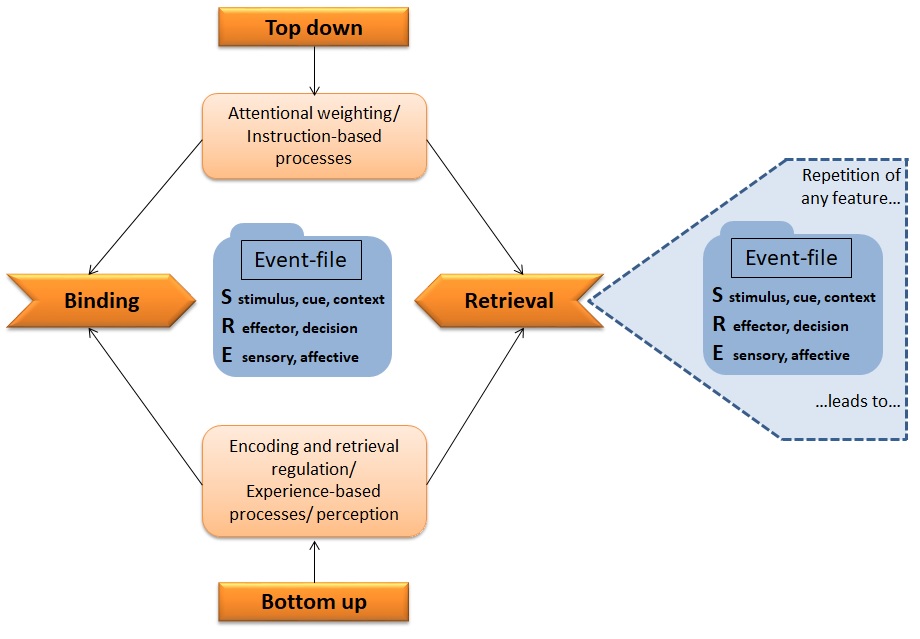
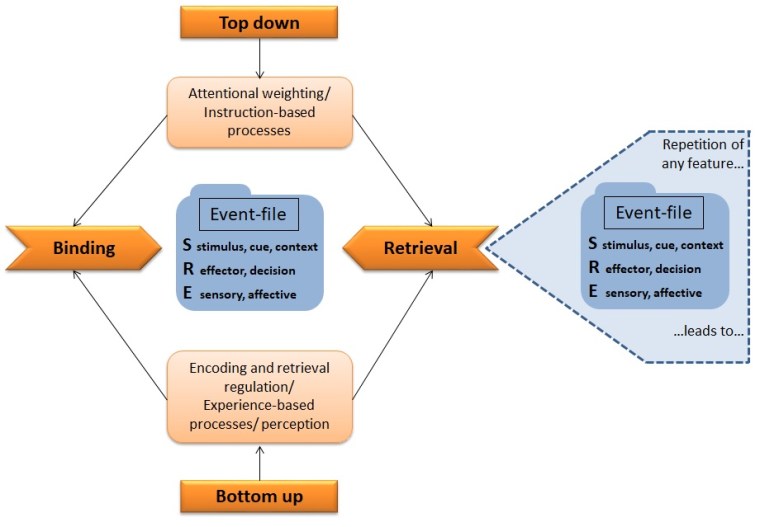
Graphical summary of the BRAC framework. Click to enlarge.

Crucially, the BRAC framework suggests that such bindings persist in time. They further integrate features from distinct events, such as features relating to the current stimulation, the agent’s motor response, and corresponding effects of this response. The BRAC framework imports the theoretical concept of common coding of sensory and action events in a shared representational format, allowing for direct interactions and associations of perceptual and action features.

Compound representations of such features are labelled event files. Once bound, re-encountering any feature will retrieve previously stored event files. Because these event files contain features of a previous response, such retrieval provides an efficient shortcut by recycling previously used feature codes.

The BRAC framework emphasizes that binding and retrieval are separate mechanisms. They can therefore be subject to different influences as shown above. These influence can stem from top down factors and bottom up factors alike. Disentangling these separable contributions of binding and retrieval is a major goal of current work inspired by the BRAC framework.

Experimental Observations

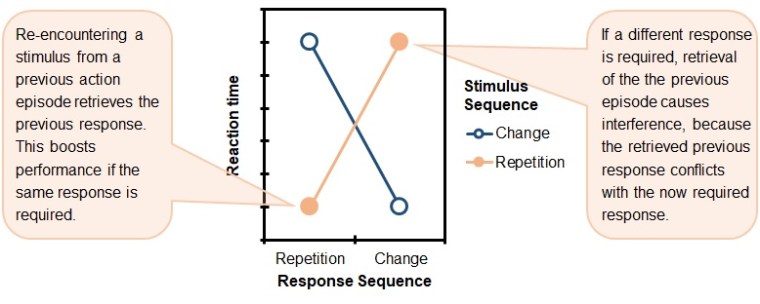
The BRAC framework highlights the sequential dependency of human actions. Corresponding binding and retrieval effects have been observed in a range of experimental setups, including prime-probe experiments and sequential choice reaction tasks. Key measures in these studies have been reaction times and error rates for speeded responses. These performance measures vary as a joint function of feature sequences for responses and corresponding stimulation: Stimulus repetitions (as compared to stimulus changes) from one occasion to the next facilitate response repetitions rather than response changes. The picture below shows an idealised pattern of results as predicted by the BRAC framework.

Idealised results from a behavioural experiment that measures performance (reaction times) in successive choice responses as a function of response sequence and stimulus sequence for two successive responses.

Current Research

A key question of current research on the BRAC framework concerns the relation of short-term binding on the one hand, and long-term learning of stable associations on the other hand. Further unresolved questions pertain to the moment that binding takes place, and to possible bottom-up and top-down influences on both binding and retrieval.

This page is based on the copyrighted Wikipedia article < https://en.wikipedia.org/wiki/Binding_and_Retrieval_in_Action_Control >; it is used under the Creative Commons Attribution-ShareAlike 3.0 Unported License (CC-BY-SA). You may redistribute it, verbatim or modified, providing that you comply with the terms of the CC-BY-SA.
What is the Cognitive Behavioural Analysis System of Psychotherapy?

Introduction

The cognitive behavioural analysis system of psychotherapy (CBASP) is a talking therapy, a synthesis model of interpersonal and cognitive and behavioural therapies developed by James P. McCullough Jr. of Virginia Commonwealth University specifically for the treatment of all varieties of DSM-IV chronic depression.

McCullough writes that chronic depression (i.e. depressive disorder in adults that lasts continuously for two or more years, or one year continuously in adolescents), particularly the type beginning during adolescence (early-onset), is essentially a refractory mood disorder arising from traumatic experiences or interpersonal psychological insults delivered by the patient’s significant others (nuclear or extended family).

Basic Assumptions

Absence of felt interpersonal safety in patients. Chronic mood (e.g., chronic depression) denotes an absence of felt safety as regards (a) the precipitating (original) trauma event(s) or on a less sudden and violent level, (b) maltreating-hurtful significant others who have inflicted psychological insults on the individual through interpersonal rejection, harsh punishment, censure, or emotional abandonment/neglect. The lack of felt safety (c) has been transferred to a generalized fear of interpersonal relationships.

For patients, more often than not, “people are hell” to borrow a phrase from Jean-Paul Sartre. Whether the aetiology includes sudden trauma or psychological insults, the predominant coping strategy that maintains the dysphoric mood condition is an interpersonal avoidance of persons in the home, at work, or in the social environment. The patient’s successful situational and interpersonal avoidance pattern is the major treatment issue when the chronically depressed individual enters psychotherapy.

No change is possible as long as interpersonal avoidance patterns remain. As noted above, no emotional modification or termination of the chronic depression mood is possible apart from terminating patient interpersonal avoidance by enabling them to encounter the original precipitating trauma (violent/sudden event) or the psychological insults that stem from chronic interpersonal punishment, abuse or emotional neglect. The active arena where change processes are targeted and occur in CBASP psychotherapy involves the current interpersonal milieu within which the patient functions.

Treatment Strategies

In-session focus exercises in an atmosphere of felt safety help patients confront the feared stimuli and modify the Pavlovian fear driving the refractory emotional state. Learning appropriate non-avoidant ways to deal with the fear stimuli also decreases Skinnerian avoidance behaviour and prepares the way for mood change. In the beginning of therapy, it should be remembered that the chronic mood associated with trauma or psychological insults may involve stimulus events that remain tacit knowledge (out of awareness) for patients (i.e. the pain, fear and anxiety are clearly observable but the actual precipitating and maintaining stimuli may not be clearly understood or recognised by the patient). Material derived from the Significant Other History (SOH) often illustrates the tacit knowledge dimension of the patient’s avoidance patterns. In summary, another way to describe what’s going on in the beginning of therapy is to say that patients are avoiding others (including the therapist) and not responding to the interpersonal environment. Interpersonal avoidance always dictates that the patient’s primary focus remains on himself or herself (i.e. patients stay “in their heads”). In such a psychosocial functioning state, these individuals remain helpless and hopeless and continue to respond to themselves in a solitary and never-ending circle of pain, fear, anxiety (and depression); hence, they are unable to connect with their interpersonal world in any informing way.

Therapist Role

A feature of CBASP is the interpersonal role of the psychotherapist. CBASP clinicians enact a “disciplined personal involvement role” to heal the injurious interpersonal traumas and psychological insults patients have received at the hands of harmful significant others.

Outcome Goals of Treatment and Beyond

The goals of CBASP treatment are (1) to connect patients perceptually and behaviourally to the interpersonal world they live in so that their behaviour is informed by environmental (interpersonal) influences; (2) CBASP teaches patients how to make themselves feel better emotionally as well as how to maintain affective control; (3) patients are taught to negotiate interpersonal relationships successfully which means that patients acquire the requisite skills to obtain desirable interpersonal goals; finally, patients learn the crucial importance of “maintaining” the treatment gains after psychotherapy ends. Maintaining the gains requires daily practice of the in-session learning which protects (perpetuates) the extinction of the old pathological patterns of behaviour. Post-therapy practice for the rest of their lives holds in abeyance the ever-present danger of relapse and recurrence.

Combination Treatment

A large-scale study, published in 2000 by Martin Keller of Brown Medical School and others, compared the (then available) antidepressant Serzone (aka Nefazodone) with CBASP. Six hundred and eighty-one patients with severe chronic depression (some with other psychiatric illnesses) were enrolled in the trial, and were assigned to either Serzone, CBASP, or combination Serzone-CBASP for 12 weeks. The response rates to either Serzone or CBASP alone were 55 percent and 52 percent, respectively, for the 76 percent who completed the study. In other words, a little more than half of the completers in those two arms of the trial reduced their depression by 50 percent or better.

The Serzone findings roughly correspond with many other trial results for antidepressants, and underscore a major weakness in these drugs—that while they are effective, the benefit is often marginal and the treatment outcome problematic. Similarly, the CBASP findings validate other studies finding talking therapy about equal in efficacy to taking antidepressants.

The results for the combination drug-therapy group, however, were surprising, with 85% of the completing patients achieving a 50 percent reduction in symptoms or better. 42% in the combination group achieved remission (a virtual elimination of all depressive symptoms) compared to 22% in the Serzone group and 24% in the CBASP group.

The authors of the frequently cited study noted that “the rates of response and remission in the combined-treatment group were substantially higher than those that might have been anticipated on the basis of the outcomes of previous trials in similar patients.” Their figures show that treating depression with a combination of both an anti-depressant drug and a form of cognitive behaviour therapy can be highly effective, giving substantially better results than other methods of dealing with depression.

This page is based on the copyrighted Wikipedia article < https://en.wikipedia.org/wiki/Cognitive_behavioral_analysis_system_of_psychotherapy >; it is used under the Creative Commons Attribution-ShareAlike 3.0 Unported License (CC-BY-SA). You may redistribute it, verbatim or modified, providing that you comply with the terms of the CC-BY-SA.
An Overview of Positive Neuroscience

Introduction

Broadly defined, positive neuroscience is the study of what the brain does well.

Instead of studying mental illness, positive neuroscientists focus on valued cognitive qualities that serve to enrich personal life and/or society. Topics in positive neuroscience overlap heavily with those of positive psychology, but use neuroimaging techniques to extend beyond the behavioural level and explain the neurobiology which underpins “positive” cognitive phenomena such as intelligence, creativity, optimism, and healthy aging.

Background

Though positive neuroscience is only beginning to be recognised as an emerging field, empirical research of optimal or exceptional brain functioning has been conducted at least as far back as the 1970s. Early work was confined to the use of lesion studies, and thus was only very case-specific. Human electroencephalography, first practiced in 1920, was applied to the study of creativity in the early 1970s.

As in vivo brain imaging has become more sophisticated, investigations of positive neuroscience phenomena have incorporated multiple functional neuroimaging techniques (functional magnetic resonance imaging (fMRI) and Positron Emission Tomography (PET)) and structural imaging (Diffusion MRI, voxel-based morphometry, in vivo magnetic resonance spectroscopy). Examples of research centres currently active in the field of positive neuroscience include Martin Seligman’s lab at the University of Pennsylvania and Rex Jung’s lab at the University of New Mexico, supported by The Mind Research Network.

The Templeton Foundation

In 2009, the John Templeton Foundation and a committee of advisors at the University of Pennsylvania put out a call for grant proposals aimed at investigators “conducting research aimed at gaining a better understanding of the ways in which the brain enables flourishing.” Qualifying projects had to “apply tools of neuroscience to positive psychological concepts”, and focus on one of the following areas:

  • Virtue, strength, and positive emotion: What are the neural bases of the cognitive and affective capacities that enable virtues such as discipline, persistence, honesty, compassion, love, curiosity, social and practical intelligence, courage, creativity, and optimism?
  • Exceptional abilities: What is special about the brains of exceptional individuals and what can we learn from them?
  • Meaning and positive purpose: How does the brain enable individuals and groups to find meaning and achieve larger goals?
  • Decisions, values, and free will: How does the brain enable decisions based on values and how can decision-making be improved? What can neuroscience reveal about the nature of human freedom?
  • Religious belief, prayer, and meditation: How do religious and spiritual practices affect neural function and behaviour?

Fifteen research projects are now underway as part of the Positive Neuroscience Project.

This page is based on the copyrighted Wikipedia article < https://en.wikipedia.org/wiki/Positive_neuroscience >; it is used under the Creative Commons Attribution-ShareAlike 3.0 Unported License (CC-BY-SA). You may redistribute it, verbatim or modified, providing that you comply with the terms of the CC-BY-SA.

A Brief Overview of Agency (Sociology)

Introduction

In social science, agency is the capacity of individuals to have the power and resources to fulfil their potential. For instance, structure consists of those factors of influence (such as social class, religion, gender, ethnicity, ability, customs, etc.) that determine or limit agents and their decisions. The influences from structure and agency are debated—it is unclear to what extent a person’s actions are constrained by social systems.

One’s agency is one’s independent capability or ability to act on one’s will. This ability is affected by the cognitive belief structure which one has formed through one’s experiences, and the perceptions held by the society and the individual, of the structures and circumstances of the environment one is in and the position one is born into. Disagreement on the extent of one’s agency often causes conflict between parties, e.g. parents and children.

Refer to Agency (Psychology) and Dignity of Risk.

Brief History

The overall concept of agency has existed since the Enlightenment where there was debate over whether human freedom was expressed through instrumental rationality or moral and norm-based action. John Locke argued in favour of freedom being based on self-interest. His rejection of the binding on tradition and the concept of the social contract led to the conception of agency as the capacity of human beings to shape the circumstances in which they live. Jean-Jacques Rousseau explored an alternative conception of this freedom by framing it as a moral will. There was a bifurcation between the rational-utilitarian and non-rational-normative dimensions of action that Immanuel Kant addressed. Kant saw freedom as normative grounded individual will, governed by the categorical imperative. These ideas were the point of departure for concerns regarding non-rational, norm-oriented action in classical sociological theory contrasting with the views on the rational instrumental action.

These definitions of agency remained mostly unquestioned until the nineteenth century, when philosophers began arguing that the choices humans make are dictated by forces beyond their control. For example, Karl Marx argued that in modern society, people were controlled by the ideologies of the bourgeoisie, Friedrich Nietzsche argued that man made choices based on his own selfish desires, or the “will to power” and, famously, Paul Ricœur added Freud – as a third member of the “school of suspicion” – who accounted for the unconscious determinants of human behaviour. Ludwig Wittgenstein’s talk of rule-following and private language arguments in his Philosophical Investigations has also made its way into the discussion of agency, in the work of Charles Taylor for example.

Definitions and Processes

Agency has also been defined in the American Journal of Sociology as a temporally embedded process that encompasses three different constitutive elements: iteration, projectivity and practical evaluation. Each of these elements is a component of agency as a whole. They are used to study different aspects of agency independently to make conclusions about the bigger concept. The iteration element of agency refers to the selective reactivation of past patterns of thought and action. In this way, actors have routine actions in response to typical situations that help them sustain identities, interactions and institutions over time. The projective element encompasses the process of imagining possible future trajectories of action connected to the actor’s hopes, fears, and desires for the future. The last element, the practical-evaluative element, entails the capacity of people to make practical and normative judgements amongst alternative possible actions in response to a context, a demand or a presently evolving situation.

Hewson’s Classification

Martin Hewson, Associate at the York Centre for International and Security Studies, York University, describes three types of agency: individual, proxy, and collective. Individual agency is when a person acts on their own behalf, whereas proxy agency is when an individual acts on behalf of someone else (such as an employer). Collective agency occurs when people act together, such as a social movement. Hewson also identifies three properties of human beings that give rise to agency: intentionality, power, and rationality. Human beings act with intention and are goal oriented. They also have differing amounts of abilities and resources resulting in some having greater agency (power) than others. Finally, human beings use their intellect to guide their actions and predict the consequences of their actions.

In Conversation

In his work on conversational agency, David R. Gibson defines agency as action that furthers an actor’s idiosyncratic objectives in the face of localised constraints that also have the potential of suppressing the very same action. Constraints such as who is speaking, how is participation shifted among participants, and topical and relevance constraints can impact the possibility of expressing agency. Seizing the moment when the “looseness” of such constraints allows, enables users to express what Gibson calls “colloquial agency”.

Feelings

Social psychologist Daniel Wegner discusses how an “illusion of control” may cause people to take credit for events that they did not cause. These false judgments of agency occur especially under stress, or when the results of the event were ones that the individual desired (also see self-serving biases). Janet Metcalfe and her colleagues have identified other possible heuristics, or rules of thumb that people use to make judgments of agency. These include a “forward model” in which the mind actually compares two signals to judge agency: the feedback from a movement, but also an “efferent copy” – a mental prediction of what that movement feedback should feel like. Top down processing (understanding of a situation, and other possible explanations) can also influence judgments of agency. Furthermore, the relative importance of one heuristic over another seems to change with age.

From an evolutionary perspective, the illusion of agency would be beneficial in allowing social animals to ultimately predict the actions of others. If one considers themself a conscious agent, then the quality of agency would naturally be intuited upon others. As it is possible to deduce another’s intentions, the assumption of agency allows one to extrapolate from those intentions what actions someone else is likely to perform.

Under other conditions, cooperation between two subjects with a mutual feeling of control is what James M. Dow, Associate Professor of Philosophy at Hendrix College, defines as “joint agency.” According to various studies on optimistic views of cooperation, “the awareness of doing things together jointly suggest that the experience of subjects engaging in cooperation involves a positive here and now experience of the activity being under joint control.” Shared agency increases the amount of control between those cooperating in any given situation, which, in return, could have negative effects on individuals that the partners in control associate with. If joint agency is held by two people that are already in a position of power, the partners’ heightened feeling of agency directly affects those who are inferior to them. The inferiors’ sense of agency will most likely decrease upon the superiors’ joint control because of intimidation and solitude factors. Although working together towards a common goal tends to cause an increased feeling of agency, the inflation of control could have many unforeseen consequences.

Children

Children’s sense of agency is often not taken into account because of the common belief that they are not capable of making their own rational decisions without adult guidance.

This page is based on the copyrighted Wikipedia article < https://en.wikipedia.org/wiki/Agency_(sociology) >; it is used under the Creative Commons Attribution-ShareAlike 3.0 Unported License (CC-BY-SA). You may redistribute it, verbatim or modified, providing that you comply with the terms of the CC-BY-SA.

What is Anosognosia?

Introduction

Anosognosia is a condition in which a person with a disability is cognitively unaware of having it due to an underlying physical or psychological (e.g. PTSD, Stockholm syndrome, schizophrenia, bipolar disorder, dementia) condition.

Anosognosia can result from physiological damage to brain structures, typically to the parietal lobe or a diffuse lesion on the fronto-temporal-parietal area in the right hemisphere, and is thus a neuropsychiatric disorder. A deficit of self-awareness, it was first named by the neurologist Joseph Babinski in 1914. Phenomenologically, anosognosia has similarities to denial, which is a psychological defence mechanism; attempts have been made at a unified explanation. Anosognosia is sometimes accompanied by asomatognosia, a form of neglect in which patients deny ownership of body parts such as their limbs. The term is from Ancient Greek ἀ- a-, ‘without’, νόσος nosos, ‘disease’ and γνῶσις gnōsis, ‘knowledge’. It is also considered a disorder that makes the treatment of the patient more difficult, since it may affect negatively the therapeutic relationship.

Causes

Relatively little has been discovered about the cause of the condition since its initial identification. Recent empirical studies tend to consider anosognosia a multi-componential syndrome or multi-faceted phenomenon. That is it can be manifested by failure to be aware of a number of specific deficits, including motor (hemiplegia), sensory (hemianaesthesia, hemianopia), spatial (unilateral neglect), memory (dementia), and language (receptive aphasia) due to impairment of anatomo-functionally discrete monitoring systems.

Anosognosia is relatively common following different causes of brain injury, such as stroke and traumatic brain injury; for example, anosognosia for hemiparesis (weakness of one side of the body) with onset of acute stroke is estimated at between 10% and 18%. However, it can appear to occur in conjunction with virtually any neurological impairment. It is more frequent in the acute than in the chronic phase and more prominent for assessment in the cases with right hemispheric lesions than with the left. Anosognosia is not related to global mental confusion, cognitive flexibility, other major intellectual disturbances, or mere sensory/perceptual deficits.

The condition does not seem to be directly related to sensory loss but is thought to be caused by damage to higher level neurocognitive processes that are involved in integrating sensory information with processes that support spatial or bodily representations (including the somatosensory system). Anosognosia is thought to be related to unilateral neglect, a condition often found after damage to the non-dominant (usually the right) hemisphere of the cerebral cortex in which people seem unable to attend to, or sometimes comprehend, anything on a certain side of their body (usually the left).

Anosognosia can be selective in that an affected person with multiple impairments may seem unaware of only one handicap, while appearing to be fully aware of any others. This is consistent with the idea that the source of the problem relates to spatial representation of the body. For example, anosognosia for hemiplegia may occur with or without intact awareness of visuo-spatial unilateral neglect. This phenomenon of double dissociation can be an indicator of domain-specific disorders of awareness modules, meaning that in anosognosia, brain damage can selectively impact the self-monitoring process of one specific physical or cognitive function rather than a spatial location of the body.

There are also studies showing that the manoeuvre of vestibular stimulation could temporarily improve both the syndrome of spatial unilateral neglect and of anosognosia for left hemiplegia. Combining the findings of hemispheric asymmetry to the right, association with spatial unilateral neglect, and the temporal improvement on both syndromes, it is suggested there can be a spatial component underlying the mechanism of anosognosia for motor weakness and that neural processes could be modulated similarly. There were some cases of anosognosia for right hemiplegia after left hemisphere damage, but the frequency of this type of anosognosia has not been estimated.

Anosognosia may occur as part of receptive aphasia, a language disorder that causes poor comprehension of speech and the production of fluent but incomprehensible sentences. A patient with receptive aphasia cannot correct his own phonetics errors and shows “anger and disappointment with the person with whom s/he is speaking because that person fails to understand her/him”. This may be a result of brain damage to the posterior portion of the superior temporal gyrus, believed to contain representations of word sounds. With those representations significantly distorted, patients with receptive aphasia are unable to monitor their mistakes. Other patients with receptive aphasia are fully aware of their condition and speech inhibitions, but cannot monitor their condition, which is not the same as anosognosia and therefore cannot explain the occurrence of neologistic jargon.

Psychiatry

Although largely used to describe unawareness of impairment after brain injury or stroke, the term “anosognosia” is occasionally used to describe the lack of insight shown by some people with anorexia nervosa. They do not seem to recognise that they have a mental illness. There is evidence that anosognosia related to schizophrenia may be the result of frontal lobe damage. E. Fuller Torrey, a psychiatrist and schizophrenia researcher, has stated that among those with schizophrenia and bipolar disorder, anosognosia is the most prevalent reason for not taking medications.

Diagnosis

Clinically, anosognosia is often assessed by giving patients an anosognosia questionnaire in order to assess their metacognitive knowledge of deficits. However, neither of the existing questionnaires applied in the clinics are designed thoroughly for evaluating the multidimensional nature of this clinical phenomenon; nor are the responses obtained via offline questionnaire capable of revealing the discrepancy of awareness observed from their online task performance. The discrepancy is noticed when patients showed no awareness of their deficits from the offline responses to the questionnaire but demonstrated reluctance or verbal circumlocution when asked to perform an online task. For example, patients with anosognosia for hemiplegia may find excuses not to perform a bimanual task even though they do not admit it is because of their paralysed arms.

A similar situation can happen to patients with anosognosia for cognitive deficits after traumatic brain injury when monitoring their errors during the tasks regarding their memory and attention (online emergent awareness) and when predicting their performance right before the same tasks (online anticipatory awareness). It can also occur among patients with dementia and anosognosia for memory deficit when prompted with dementia-related words, showing possible pre-attentive processing and implicit knowledge of their memory problems. Patients with anosognosia may also overestimate their performance when asked in first-person formed questions but not from a third-person perspective when the questions referring to others.

When assessing the causes of anosognosia within stroke patients, CT scans have been used to assess where the greatest amount of damage is found within the various areas of the brain. Stroke patients with mild and severe levels of anosognosia (determined by response to an anosognosia questionnaire) have been linked to lesions within the temporoparietal and thalamic regions, when compared to those who experience moderate anosognosia, or none at all. In contrast, after a stroke, people with moderate anosognosia have a higher frequency of lesions involving the basal ganglia, compared to those with mild or severe anosognosia.

Treatment

In regard to anosognosia for neurological patients, no long-term treatments exist. As with unilateral neglect, caloric reflex testing (squirting ice cold water into the left ear) is known to temporarily ameliorate unawareness of impairment. It is not entirely clear how this works, although it is thought that the unconscious shift of attention or focus caused by the intense stimulation of the vestibular system temporarily influences awareness. Most cases of anosognosia appear to simply disappear over time, while other cases can last indefinitely. Normally, long-term cases are treated with cognitive therapy to train patients to adjust for their inoperable limbs (though it is believed that these patients still are not “aware” of their disability). Another commonly used method is the use of feedback – comparing clients’ self-predicted performance with their actual performance on a task in an attempt to improve insight.

Neurorehabilitation is difficult because, as anosognosia impairs the patient’s desire to seek medical aid, it may also impair their ability to seek rehabilitation. A lack of awareness of the deficit makes cooperative, mindful work with a therapist difficult. In the acute phase, very little can be done to improve their awareness, but during this time, it is important for the therapist to build a therapeutic alliance with patients by entering their phenomenological field and reducing their frustration and confusion. Since severity changes over time, no single method of treatment or rehabilitation has emerged or will likely emerge.

In regard to psychiatric patients, empirical studies verify that, for individuals with severe mental illnesses, lack of awareness of illness is significantly associated with both medication non-compliance and re-hospitalisation. Fifteen percent of individuals with severe mental illnesses who refuse to take medication voluntarily under any circumstances may require some form of coercion to remain compliant because of anosognosia. Coercive psychiatric treatment is a delicate and complex legal and ethical issue.

One study of voluntary and involuntary inpatients confirmed that committed patients require coercive treatment because they fail to recognise their need for care. The patients committed to the hospital had significantly lower measures of insight than the voluntary patients.

Anosognosia is also closely related to other cognitive dysfunctions that may impair the capacity of an individual to continuously participate in treatment. Other research has suggested that attitudes toward treatment can improve after involuntary treatment and that previously committed patients tend later to seek voluntary treatment.

This page is based on the copyrighted Wikipedia article <https://en.wikipedia.org/wiki/Anosognosia >; it is used under the Creative Commons Attribution-ShareAlike 3.0 Unported License (CC-BY-SA). You may redistribute it, verbatim or modified, providing that you comply with the terms of the CC-BY-SA.

What is Thought Suppression?

Introduction

Thought suppression is a psychological defence mechanism. It is a type of motivated forgetting in which an individual consciously attempts to stop thinking about a particular thought.

It is often associated with obsessive-compulsive disorder (OCD). OCD is when a person will repeatedly (usually unsuccessfully) attempt to prevent or “neutralise” intrusive distressing thoughts centred on one or more obsessions. It is also thought to be a cause of memory inhibition, as shown by research using the think/no think paradigm. Thought suppression is relevant to both mental and behavioural levels, possibly leading to ironic effects that are contrary to intention. Ironic process theory is one cognitive model that can explain the paradoxical effect.

When an individual tries to suppress thoughts under a high cognitive load, the frequency of those thoughts increases and becomes more accessible than before. Evidence shows that people can prevent their thoughts from being translated into behaviour when self-monitoring is high; this does not apply to automatic behaviours though, and may result in latent, unconscious actions. This phenomenon is made paradoxically worse by increasing the amount of distractions a person has, although the experiments in this area can be criticised for using impersonal concurrent tasks, which may or may not properly reflect natural processes or individual differences.

Empirical Work (1980s)

In order for thought suppression and its effectiveness to be studied, researchers have had to find methods of recording the processes going on in the mind. One experiment designed with this purpose was performed by Wegner, Schneider, Carter & White. They asked participants to avoid thinking of a specific target (e.g. a white bear) for five minutes, but if they did, they were told then to ring a bell. After this, participants were told that for the next five minutes they were to think about the target. There was evidence that unwanted thoughts occurred more frequently in those who used thought suppression compared to those who were not. Furthermore, there was also evidence that during the second stage, those who had used thought suppression had a higher frequency of target thoughts than did those who had not used thought suppression; later coined the rebound effect. This effect has been replicated and can even be done with implausible targets, such as the thought of a “green rabbit”. From these implications, Wegner eventually developed the “ironic process theory”.

Improved Methodology (1990s)

To better elucidate the findings of thought suppression, several studies have changed the target thought. Roemer and Borkovec found that participants who suppressed anxious or depressing thoughts showed a significant rebound effect. Furthermore, Wenzlaff, Wegner, & Roper demonstrated that anxious or depressed subjects were less likely to suppress negative, unwanted thoughts. Despite Rassin, Merkelbach and Muris reporting that this finding is moderately robust in the literature, some studies were unable to replicate results. However, this may be explained by a consideration of individual differences.

Recent research found that for individuals with low anxiety and high desirability traits (repressors), suppressed anxious autobiographical events initially intruded fewer times than in other groups (low, high, and high defensive anxious groups), but intruded more often after one week. This difference in coping style may account for the disparities within the literature. That said, the problem remains that the cause of the paradoxical effect may be in the thought tapping measures used (e.g. bell ringing). Evidence from Brown (1990) that showed participants were very sensitive to frequency information prompted Clarke, Ball and Pape to obtain participants’ aposterio estimates of the number of intrusive target thoughts and found the same pattern of paradoxical results. However, even though such a method appears to overcome the problem, it and all the other methodologies use self-report as the primary form of data-collection. This may be problematic because of response distortion or inaccuracy in self-reporting.

Behavioural Domain

Thought suppression also has the capability to change human behaviour. Macrae, Bodenhausen, Milne, and Jetten found that when people were asked not to think about the stereotypes of a certain group (e.g. a “skinhead”), their written descriptions about a group member’s typical day contained less stereotypical thoughts. However, when they were told they were going to meet an individual they had just written about, those in the suppression group sat significantly farther away from the “skinhead” (just by virtue of his clothes being present). These results show that even though there may have been an initial enhancement of the stereotype, participants were able to prevent this from being communicated in their writing; this was not true for their behaviour though.

Further experiments have documented similar findings. In one study from 1993, when participants were given cognitively demanding concurrent tasks, the results showed a paradoxical higher frequency of target thoughts than controls. However other controlled studies have not shown such effects. For example, Wenzlaff and Bates found that subjects concentrating on a positive task experienced neither paradoxical effects nor rebound effects – even when challenged with cognitive load. Wenzlaff and Bates also note that the beneficiality of concentration in their study participants was optimised when the subjects employed positive thoughts.

Some studies have shown that when test subjects are under what Wegner refers to as a “cognitive load” (for instance, using multiple external distractions to try to suppress a target thought), the effectiveness of thought suppression appears to be reduced. However, in other studies in which focused distraction is used, long term effectiveness may improve. That is, successful suppression may involve less distractors. For example, in 1987 Wegner, Schneider, Carter & White found that a single, pre-determined distracter (e.g. a red Volkswagen) was sufficient to eliminate the paradoxical effect post-testing. Evidence from Bowers and Woody in 1996 is supportive of the finding that hypnotised individuals produce no paradoxical effects. This rests on the assumption that deliberate “distracter activity” is bypassed in such an activity.

Cognitive Dynamics

When the cognitive load is increased, thought suppression typically becomes less effective. For example, in the white bear experiment, many general distractions in the environment (for instance a lamp, a light bulb, a desk etc.) might later serve as reminders of the object being suppressed (these are also referred to as “free distraction”). Some studies, however, are unable to find this effect for emotional thoughts in hypnotized individuals when one focused distraction is provided. In an attempt to account for these findings, a number of theorists have produced cognitive models of thought suppression. Wegner suggested in 1989 that individuals distract themselves using environmental items. Later, these items become retrieval cues for the thought attempting to be suppressed. This iterative process leaves the individual surrounded by retrieval cues, ultimately causing the rebound effect. Wegner hypothesized that multiple retrieval cues not being forged explains, in part, the effectiveness of focused distraction (i.e. a reduction of mental load). This is because there may be an ideal balance between the two processes; if the cognitive demand that is not too heavy, then the monitoring processes will not supersede it.

Individual differences may also play a role in regards to the ironic thought process.

Thought suppression has been seen as a form of “experiential avoidance”. Experiential avoidance is when an individual attempts to suppress, change, or control unwanted internal experiences (thoughts, feelings, bodily sensations, memories, etc.). This line of thinking supports relational frame theory.

Other Methodologies

Thought suppression has been shown to be a cause of inhibition in several ways. Two commonly-used methods to study this relationship are the list method and the item method. In this list method, participants study two lists of words, one after the other. After studying the first list, some participants are told to forget everything that they have just learned, while others are not given this instruction. After studying both lists, participants are asked to recall the words on both lists. These experiments typically find that participants who were told to forget the first list do not remember as many words from that list, suggesting that they have been suppressed due to the instruction to forget. In the item method, participants study individual words rather than lists. After each word is shown, participants are told to either remember or forget the word. As in experiments using the list method, the words followed by the instruction to forget are more poorly remembered. Some researchers believe that these two methods result in different types of forgetting. According to these researchers, the list method results in inhibition of the forgotten words, but the item method results in some words being remembered better than the others, without a specific relation to forgetting.

Think/No Think Paradigm

A paradigm from 2009 to study how suppression relates to inhibition is the think/no think paradigm. In these experiments, participants study pairs of words. An example of a possible word pair is roach-ordeal. After all the word pairs are learned, the participants see the first word of the pair and are either told to think about the second word (think phase) or not to think about the second word (no think phase). The no think phase is when suppression occurs. Some pairs were never presented after the initial study portion of the study, and these trials serve as the control group. At the end of the experiment, the participants try to remember all of the word pairs based on the first word. Studies could also use the “independent probe” method, which gives the category and first letter of the second word of the pair. Typically, regardless of the method used, results show that the no-think trials result in worse memory than the think trials, which supports the idea that suppression leads to inhibition in memory. Although this methodology was first done using word pairs, experiments have been conducted using pictures and autobiographical memories as stimuli, with the same results.

Research has also shown that doing difficult counting tasks at the same time as a think/no think task leads to less forgetting in the no think condition, which suggests that suppression takes active mental energy to be successful. Furthermore, the most forgetting during the no think phase occurs when there is a medium amount of brain activation while learning the words. The words are never learned if there is too little activation, and the association between the two words is too strong to be suppressed during the no think phase if there is too much activation. However, with medium activation, the word pairs are learned but able to be suppressed during the no think phase.

fMRI studies have shown two distinct patterns of brain activity during suppression tasks. The first is that there is less activity in the hippocampus, the brain area responsible for forming memories. The second is an increase of brain activity in the dorsolateral prefrontal cortex, especially in cases where suppression is harder. Researchers think that this region works to prevent memory formation by preventing the hippocampus from working.

This methodology can also be used to study thought substitution by adding an instruction during the no think phase for participants to think of a different word rather than the word being suppressed. This research shows that thought substitution can lead to increased levels of forgetting compared to suppression without a thought substitution instruction. This research also suggests that thought substitution, while used as a suppression strategy during the no think phase, may work differently than suppression. Some researchers argue that thinking of something different during the no think phase forms a new association with the first word than the original word pair, which results in interference when using this strategy, which is different than the inhibition that results from simply not thinking about something.

Dream Influence

Dreams occur mainly during the rapid eye movement (REM) sleep and are composed of images, ideas, emotions, and sensations. Although more research needs to be done on this subject, dreams are said to be linked to the unconscious mind. Thought suppression has an influence on the subject matter of the unconscious mind and by trying to restrain particular thoughts, there is a high chance of them showing up in one’s dreams.

Ironic Control Theory

Ironic control theory, also known as “ironic process theory”, states that thought suppression “leads to an increased occurrence of the suppressed content in waking states”. The irony lies in the fact that although people try not to think about a particular subject, there is a high probability that it will appear in one’s dreams regardless. There is a difference for individuals who have a higher tendency of suppression; they are more prone to psychopathological responses such as “intrusive thoughts, including depression, anxiety and obsessional thinking”. Due to these individuals having higher instances of thought suppression, they experience dream rebound more often.

Cognitive load also plays a role in ironic control theory. Studies have shown that a greater cognitive load results in an increased possibility of dream rebound occurring. In other words, when one tries to retain a heavy load of information before going to sleep, there is a high chance of that information manifesting itself within the dream. There is a greater degree of dream rebound in those with a higher cognitive load opposed to those whose load was absent. With the enhancement of a high cognitive load, ironic control theory states thought suppression is more likely to occur and lead to dream rebound.

Dream Rebound

Dream rebound is when suppressed thoughts manifest themselves in one’s dreams. Self-control is a form of thought suppression and when one dreams, that suppressed item has a higher chance of appearing in the dream. For example, when an individual is attempting to quit smoking, they may dream about themselves smoking a cigarette. Emotion suppression has also been found to trigger dream rebound. Recurrence of emotional experiences act as pre-sleep suggestions, ultimately leading to the suppressed thoughts presenting themselves within the dream. One effecting factor of dream rebound is the changes in the prefrontal lobes during rapid-eye movement sleep. Suppressed thoughts are more accessible during REM sleep, as a result of operating processes having a diminished effectiveness. This leads to pre-sleep thoughts becoming more available “with an increased activity of searching for these suppressed thought[s]”. There are other hypotheses regarding REM sleep and dream rebound. For instance, weak semantic associations, post REM sleep, are more accessible than any other time due to weak ironic monitoring processes becoming stronger. More research is needed to further understand what exactly causes dream rebound.

What is Inhibitory Control?

Introduction

Inhibitory control, also known as response inhibition, is a cognitive process – and more specifically an executive function – that permits an individual to inhibit their impulses and natural, habitual, or dominant behavioural responses to stimuli (e.g. prepotent responses) in order to select a more appropriate behaviour that is consistent with completing their goals.

Self-control is an important aspect of inhibitory control. For example, successfully suppressing the natural behavioural response to eat cake when one is craving it while dieting requires the use of inhibitory control.

The prefrontal cortex, caudate nucleus, and subthalamic nucleus are known to regulate inhibitory control cognition. Inhibitory control is impaired in both addiction and attention deficit hyperactivity disorder. In healthy adults and ADHD individuals, inhibitory control improves over the short term with low (therapeutic) doses of methylphenidate or amphetamine. Inhibitory control may also be improved over the long-term via consistent aerobic exercise.

Tests

An inhibitory control test is a neuropsychological test that measures an individual’s ability to override their natural, habitual, or dominant behavioural response to a stimulus in order to implement more adaptive goal-oriented behaviours. Some of the neuropsychological tests that measure inhibitory control include the Stroop task, go/no-go task, Simon task, Flanker task, anti-saccade tasks, delay of gratification tasks, and stop-signal tasks.

Gender Differences

Females tend to have a greater basal capacity to exert inhibitory control over undesired or habitual behaviours and respond differently to modulatory environmental contextual factors relative to males. For example, listening to music tends to significantly improve the rate of response inhibition in females, but reduces the rate of response inhibition in males.

Linking Brain Imagery, Brain Tumours, and Cognitive & Mental Disorders in Adults

Research Paper Title

Brain tumours, cognitive and mental disorders in adults.

Background

Cognitive and mental disorders are observed in 15-20% of brain tumours, and can be the first symptoms.

The severity of cognitive deficits varies from attention and reasoning disorders to major syndromes such as delirium, amnesic syndrome or dementia.

Mental disorders range from apathy, irritability to major depressive or psychotic symptoms.

Cognitive and mental disorders are related to many factors including the localisation and nature of the tumour, peritumoral and remote changes, and personal susceptibility.

The diagnosis of brain tumour is presently made by brain imagery, but the difficulty remains to determine when imagery is to be used in cognitive or mental disorders.

Reference

Derouesne, C. (2020) Brain tumors, cognitive and mental disorders in adults. Geriatrie et Psychologie Neuropsychiatrie du Vieillissement. 13(2), pp.187-194. doi: 10.1684/pnv.2015.0533.