What is Reduced Affect Display?

Introduction

Reduced affect display, sometimes referred to as emotional blunting, is a condition of reduced emotional reactivity in an individual.

It manifests as a failure to express feelings (affect display) either verbally or nonverbally, especially when talking about issues that would normally be expected to engage the emotions. Expressive gestures are rare and there is little animation in facial expression or vocal inflection. Reduced affect can be symptomatic of autism, schizophrenia, depression, posttraumatic stress disorder, depersonalisation disorder, schizoid personality disorder or brain damage. It may also be a side effect of certain medications (e.g. antipsychotics and antidepressants).

Reduced affect should be distinguished from apathy and anhedonia, which explicitly refer to a lack of emotion, whereas reduced affect is a lack of emotional expression (affect display) regardless of whether emotion (underlying affect) is actually reduced or not.

Types

Constricted Affect

A restricted or constricted affect is a reduction in an individual’s expressive range and the intensity of emotional responses.

Blunted and Flat Affect

Blunted affect is a lack of affect more severe than restricted or constricted affect, but less severe than flat or flattened affect. “The difference between flat and blunted affect is in degree. A person with flat affect has no or nearly no emotional expression. He or she may not react at all to circumstances that usually evoke strong emotions in others. A person with blunted affect, on the other hand, has a significantly reduced intensity in emotional expression”.

Shallow Affect

Shallow affect has equivalent meaning to blunted affect. Factor 1 of the Psychopathy Checklist identifies shallow affect as a common attribute of psychopathy.

Brain Structures

Individuals with schizophrenia with blunted affect show different regional brain activity in fMRI scans when presented with emotional stimuli compared to individuals with schizophrenia without blunted affect. Individuals with schizophrenia without blunted affect show activation in the following brain areas when shown emotionally negative pictures: midbrain, pons, anterior cingulate cortex, insula, ventrolateral orbitofrontal cortex, anterior temporal pole, amygdala, medial prefrontal cortex, and extrastriate visual cortex. Individuals with schizophrenia with blunted affect show activation in the following brain regions when shown emotionally negative pictures: midbrain, pons, anterior temporal pole, and extrastriate visual cortex.

Limbic Structures

Individuals with schizophrenia with flat affect show decreased activation in the limbic system when viewing emotional stimuli. In individuals with schizophrenia with blunted affect neural processes begin in the occipitotemporal region of the brain and go through the ventral visual pathway and the limbic structures until they reach the inferior frontal areas. Damage to the amygdala of adult rhesus macaques early in life can permanently alter affective processing. Lesioning the amygdala causes blunted affect responses to both positive and negative stimuli. This effect is irreversible in the rhesus macaques; neonatal damage produces the same effect as damage that occurs later in life. The macaques’ brain cannot compensate for early amygdala damage even though significant neuronal growth may occur. There is some evidence that blunted affect symptoms in schizophrenia patients are not a result of just amygdala responsiveness, but a result of the amygdala not being integrated with other areas of the brain associated with emotional processing, particularly in amygdala-prefrontal cortex coupling. Damage in the limbic region prevents the amygdala from correctly interpreting emotional stimuli in individuals with schizophrenia by compromising the link between the amygdala and other brain regions associated with emotion.

Brainstem

Parts of the brainstem are responsible for passive emotional coping strategies that are characterized by disengagement or withdrawal from the external environment (quiescence, immobility, hyporeactivity), similar to what is seen in blunted affect. Individuals with schizophrenia with blunted affect show activation of the brainstem during fMRI scans, particularly the right medulla and the left pons, when shown “sad” film excerpts. The bilateral midbrain is also activated in individuals with schizophrenia diagnosed with blunted affect. Activation of the midbrain is thought to be related to autonomic responses associated with perceptual processing of emotional stimuli. This region usually becomes activated in diverse emotional states. When the connectivity between the midbrain and the medial prefrontal cortex is compromised in individuals with schizophrenia with blunted affect an absence of emotional reaction to external stimuli results.

Prefrontal Cortex

Individuals with schizophrenia, as well as patients being successfully reconditioned with quetiapine for blunted affect, show activation of the prefrontal cortex (PFC). Failure to activate the PFC is possibly involved in impaired emotional processing in individuals with schizophrenia with blunted affect. The mesial PFC is activated in aver individuals in response to external emotional stimuli. This structure possibly receives information from the limbic structures to regulate emotional experiences and behaviour. Individuals being reconditioned with quetiapine, who show reduced symptoms, show activation in other areas of the PFC as well, including the right medial prefrontal gyrus and the left orbitofrontal gyrus.

Anterior Cingulate Cortex

A positive correlation has been found between activation of the anterior cingulate cortex and the reported magnitude of sad feelings evoked by viewing sad film excerpts. The rostral subdivision of this region is possibly involved in detecting emotional signals. This region is different in individuals with schizophrenia with blunted affect.

Diagnoses

Schizophrenia

Patients with schizophrenia have long been recognized as showing “flat or inappropriate affect, with splitting of feelings from events … feelings seem flat instead of being in contact with what is going on”. One study of flat affect in schizophrenia found that “flat affect was more common in men, and was associated with worse current quality of life” as well as having “an adverse effect on course of illness”.

The study also reported a “dissociation between reported experience of emotion and its display” – supporting the suggestion made elsewhere that “blunted affect, including flattened facial expressiveness and lack of vocal inflection … often disguises an individual’s true feelings.” Thus, feelings may merely be unexpressed, rather than totally lacking. On the other hand, “a lack of emotions which is due not to mere repression but to a real loss of contact with the objective world gives the observer a specific impression of ‘queerness’ … the remainders of emotions or the substitutes for emotions usually refer to rage and aggressiveness”. In the most extreme cases, there is a complete “dissociation from affective states”.

Another study found that when speaking, individuals with schizophrenia with flat affect demonstrate less inflection than normal controls and appear to be less fluent. Normal subjects appear to express themselves using more complex syntax, whereas flat affect subjects speak with fewer words, and fewer words per sentence. Flat affect individuals’ use of context-appropriate words in both sad and happy narratives are similar to that of controls. It is very likely that flat affect is a result of deficits in motor expression as opposed to emotional processing. The moods of display are compromised, but subjective, autonomic, and contextual aspects of emotion are left intact.

Post-Traumatic Stress Disorder

Post-traumatic stress disorder (PTSD) was previously known to cause negative feelings, such as depressed mood, re-experiencing and hyperarousal. However, recently, psychologists have started to focus their attention on the blunted affects and also the decrease in feeling and expressing positive emotions in PTSD patients. Blunted affect, or emotional numbness, is considered one of the consequences of PTSD because it causes a diminished interest in activities that produce pleasure (anhedonia) and produces feelings of detachment from others, restricted emotional expression and a reduced tendency to express emotions behaviourally. Blunted affect is often seen in veterans as a consequence of the psychological stressful experiences that caused PTSD. Blunted affect is a response to PTSD, it is considered one of the central symptoms in post-traumatic stress disorders and it is often seen in veterans who served in combat zones. In PTSD, blunted affect can be considered a psychological response to PTSD as a way to combat overwhelming anxiety that the patients feel. In blunted affect, there are abnormalities in circuits that also include the prefrontal cortex.

Assessment

In making assessments of mood and affect the clinician is cautioned that “it is important to keep in mind that demonstrative expression can be influenced by cultural differences, medication, or situational factors”; while the layperson is warned to beware of applying the criterion lightly to “friends, otherwise [he or she] is likely to make false judgments, in view of the prevalence of schizoid and cyclothymic personalities in our ‘normal’ population, and our [US] tendency to psychological hypochondriasis”.

R.D. Laing in particular stressed that “such ‘clinical’ categories as schizoid, autistic, ‘impoverished’ affect … all presuppose that there are reliable, valid impersonal criteria for making attributions about the other person’s relation to [his or her] actions. There are no such reliable or valid criteria”.

Differential Diagnosis

Blunted affect is very similar to anhedonia, which is the decrease or cessation of all feelings of pleasure (which thus affects enjoyment, happiness, fun, interest, and satisfaction). In the case of anhedonia, emotions relating to pleasure will not be expressed as much or at all because they are literally not experienced or are decreased. Both blunted affect and anhedonia are considered negative symptoms of schizophrenia, meaning that they are indicative of a lack of something. There are some other negative symptoms of schizophrenia which include avolition, alogia and catatonic behaviour.

Closely related is alexithymia – a condition describing people who “lack words for their feelings. They seem to lack feelings altogether, although this may actually be because of their inability to express emotion rather than from an absence of emotion altogether”. Alexithymic patients however can provide clues via assessment presentation which may be indicative of emotional arousal.

“If the amygdala is severed from the rest of the brain, the result is a striking inability to gauge the emotional significance of events; this condition is sometimes called ‘affective blindness'”. In some cases, blunted affect can fade, but there is no conclusive evidence of why this can occur.

What is Emotionality?

Introduction

Emotionality is the observable behavioural and physiological component of emotion. It is a measure of a person’s emotional reactivity to a stimulus.

Most of these responses can be observed by other people, while some emotional responses can only be observed by the person experiencing them. Observable responses to emotion (i.e. smiling) do not have a single meaning. A smile can be used to express happiness or anxiety, while a frown can communicate sadness or anger. Emotionality is often used by experimental psychology researchers to operationalise emotion in research studies.

Early Theories

By the late 1800s, many high-quality contributions became interested in analysing emotion because of the works of psychologists and scientists such as Wilhelm Wundt, George Stout, William McDougall, William James, and George Herbert Mead. William James preferred to focus on the physiological aspects of emotional response, although he did not disregard the perceptual or cognitive components. William McDougall thought of emotion as the articulation of a natural response built on instinct. Other psychologists reasoned that although gestures express emotion, this is not the entirety of their function. Wundt analysed that emotion portrays both expression and communication.

As Irrational

One of the oldest views of emotion is that emotion indicates inferiority. In early psychology, it was believed that passion (emotion) was a part of the soul inherited from the animals and that it must be controlled. Solomon identified that in the Romantic movement of the eighteenth and nineteenth centuries, reason and emotion were discovered to be opposites.

As Physiological

Physiological responses to emotion originate in the central nervous system, the autonomic nervous system, and the endocrine system. Some of the responses include: heart rate, sweating, rate and depth of respiration, and electrical activity in the brain. Many researchers have attempted to find a connection between specific emotions and a corresponding pattern of physiological responses, but the results have been inconclusive.

Later Theories

The significant theories of emotion can be divided into three primary categories: physiological, neurological, and cognitive. Physiological theories imply that activity within the body can be accountable for emotions. Neurological theories suggest that activity within the brain leads to emotional responses. Lastly, cognitive theories reason that thoughts and other mental activity have a vital role in the stimulation of emotions. Common sense suggests that people first become consciously aware of their emotions and that the physiological responses follow shortly after. Theories by James-Lange, Cannon-Bard, and Schachter-Singer contradict the common-sense theory.

James-Lange

The James-Lange theory of emotion was proposed by psychologist William James and physiologist Carl Lange. This theory suggests that emotions occur as a result of physiological responses to outside stimuli or events. For example, this theory suggests that if someone is driving down the road and sees the headlights of another car heading toward them in their lane, their heart begins to race (a physiological response) and then they become afraid (fear being the emotion).

Cannon-Bard

The Cannon-Bard theory, which was conceptualized by Walter Cannon and Phillip Bard, suggests that emotions and their corresponding physiological responses are experienced simultaneously. Using the previous example, when someone sees the car coming toward them in their lane, their heart starts to race and they feel afraid at the same time.

Schachter-Singer

Stanley Schachter and Jerome Singer proposed a theory also known as the two-factor theory of emotion, which implies emotion have two factors: physical arousal and cognitive label. This suggests that if the physiological activity occurs first, then it must cognitively be distinguished as the cause of the arousal and labelled as an emotion. Using the example of someone seeing a car coming towards them in their lane, their heart would start to race and they would identify that they must be afraid if their heart is racing, and from there they would begin to feel fear.

Gender Differences

The opposition of rational thought and emotion is believed to be paralleled by the similar opposition between male and female. A traditional view is that “men are seen as rational and women as emotional, lacking rationality.” However, in spite of these ideas, and in spite of gender differences in the prevalence of mood disorders, the empirical evidence on gender differences in emotional responding is mixed.

When engaging in social interaction, studies show that women smile significantly more than men do. It is difficult to determine the exact difference between males and females to explain this disparity. It is possible that this difference in expression of emotions is due to societal influences and conformity to gender roles. However, this may not fully explain why men smile less than women do.

The male gender role involves characteristics such as strength, expert knowledge, and a competitive nature. Smiling may be stereotypically associated with weakness. Men may feel that if they engage in this perceived weakness, it may contradict their attempts to show strength and other traits of the male gender role. Another broad explanation for the contrast in male and female gender expression is that women have reported to experience greater levels of emotional intensity than men, in both positive and negative aspects, which could naturally lead to greater emotional response. It has also been reported that men are more likely to confide in female companions, revealing their emotions and intimacy, while females are typically comfortable confiding in both genders. This suggests that men are more particular about how they express the emotions they feel, potentially relating back to gender roles.

Across Cultures

There are six universal emotions which expand across all cultures. These emotions are happiness, sadness, anger, fear, surprise, and disgust. Debate exists about whether contempt should be combined with disgust. According to Ekman (1992), each of these emotions have universally corresponding facial expressions as well.

In addition to the facial expressions that are said to accompany each emotion, there is also evidence to suggest that certain autonomic nervous system (ANS) activity is associated with the three emotions of fear, anger, and disgust. Ekman theorizes that these specific emotions are associated with the universal physiological responses due to evolution. It would not be expected to observe the same physiological responses for emotions not specifically linked to survival, such as happiness or sadness.

Ekman’s theories were early challenged by James A. Russell, and have since been tested by a variety of researchers, with ambiguous results. This seems to reflect methodological problems relating to both display rules and to the components of emotion. Current thinking favours a mix of underlying universality combined with significant cultural differences in the articulation and expression of emotion. Emotions serve different functions in different cultures.

Positive

Positive emotionality is the ability to control positive mood and emotions, people with positive emotions seek for social reward. Positive emotionality can be a preventive factor in blocking out certain types of mental illness. In a study of a sample of 1,655 youth (54% girls; 7-16 years), it found that the higher their positive emotionality was, the lower their depression would be. Depression was considered by its definition of the inability to receive positive emotions or pleasure. The youth’s temperament, adaptive emotion regulation (ER) strategies, and depressive symptoms were determined through a questionnaire. The study also reported that depressive symptoms could be reduced through emotion regulation of positive mood. A study by Charles T. Taylor et al. linked being exposed to positive emotions before a surgery to less anxiety and a decrease in having symptoms after treatment.

Negative

Negative emotionality is the opposite of positive emotionality. People are unable to control their positive mood and emotions. Everyone experiences negative emotionality in different levels, there are different factors that effect each individual in a different way. Negative emotionality effects many aspects of our lives in terms of coping and the relationship that people share with one another. Neuroticism is one of the biggest factors found in negative emotionality. Someone on the higher spectrum of neuroticism is often more anxious and enjoy the feelings of their negative emotion. Some research suggests that obese children compared to children who are not obese have higher levels of negative emotionality and the ability to control emotions.

What is the Differential Susceptibility Hypothesis?

Introduction

The differential susceptibility hypothesis proposed by Jay Belsky is another interpretation of psychological findings that are usually discussed according to the diathesis-stress model.

Both models suggest that people’s development and emotional affect are differentially susceptible to experiences or qualities of the environment. Where the Diathesis-stress model suggests a distinct and mostly negativity-sensitive group, Belsky describes a group that is sensitive to negative experiences but also to positive experiences. These models may be complementary, if some individuals are dually or uniquely positivity-sensitive, while other people are uniquely negativity-sensitive.

Differential Susceptibility versus Diathesis-Stress

The idea that individuals vary in their responsivity to negative qualities of the environment is generally framed in diathesis-stress or dual-risk terms. That is, some individuals, due to their biological, temperamental and/or behavioural characteristics (i.e. “diathesis” or “risk 1”), are more vulnerable to the adverse effects of negative experiences (i.e., “stress” or “risk 2”), whereas others are relatively resilient with respect to them (see Figure 1, an adaptation of Bakermans-Kranenburg and van IJzendoorn’s (2007) Figure 1). A fundamentally different, even if not competing view, of the very same phenomenon is central to Belsky’s differential susceptibility hypothesis and Boyce and Ellis’ (2005) related notion of biological sensitivity to context: Individuals do not simply vary in the degree to which they are vulnerable to the negative effects of adverse experience but, more generally, in their developmental plasticity.

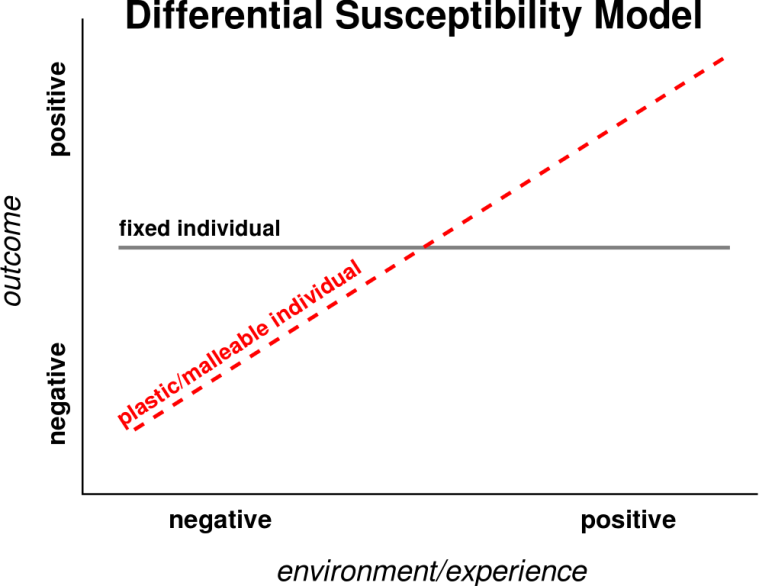
On this hypothesis, more “plastic” or malleable individuals are more susceptible than others to environmental influences in a for-better-and-for-worse manner. That is, susceptible to both the adverse developmental sequelae associated with negative environments and the positive developmental consequences of supportive ones. Less susceptible individuals, in contrast, are less affected by rearing conditions, be they presumptively supportive or undermining of well being (see Figure 2, an adaptation of Bakermans-Kranenburg and Van IJzendoorn’s (2007) Figure 1).

Figure 1. The diathesis-stress/dual-risk model. Developmental outcome as it relates to environmental quality. A “vulnerable” group experiences negative outcome when exposed to a negative environment, although this group is identical to the other, “resilient” group in a positive environment.
Figure 2. The differential susceptibility model. The lines depict two categorical groups that differ in their responsiveness to the environment: the “plastic” group is disproportionately more affected by both negative and positive environments compared to the “fixed” group.

Theoretical Background

Belsky suggests that evolution might select for some children who are more plastic, and others who are more fixed in the face of, for example, parenting styles.

Belsky offers that ancestral parents, just like parents today, could not have known (consciously or unconsciously) which childrearing practices would prove most successful in promoting the reproductive fitness of offspring – and thus their own inclusive fitness. As a result, and as a fitness optimising strategy involving bet hedging, natural selection might have shaped parents to bear children varying in plasticity. This way, if an effect of parenting had proven counterproductive in fitness terms, those children not affected by parenting would not have incurred the cost of developing in ways that ultimately proved “misguided”.

Importantly, natural selection might favour genetic lines with both plastic and fixed developmental and affective patterns. In other words, there is value to having both kinds at once. In light of inclusive-fitness considerations, children who were less malleable (and more fixed) would have “resistance” to parental influence. This could be adaptable some times, and maladaptive other times. Their fixedness would not only have benefited themselves directly, but even their more malleable siblings indirectly. This is because siblings, like parents and children, have 50% of their genes in common. By the same token, had parenting influenced children in ways that enhanced fitness, then not only would more plastic offspring have benefited directly by following parental leads, but so, too, would their parents and even their less malleable siblings who did not benefit from the parenting they received, again for inclusive-fitness reasons. The overall effect may be to temper some of the variability in parenting. That is, to make more conservative bets.

This line of evolutionary argument leads to the prediction that children should vary in their susceptibility to parental rearing and perhaps to environmental influences more generally. As it turns out, a long line of developmental inquiry, informed by a “transactional” perspective, has more or less been based on this unstated assumption.

Criteria for the Testing of Differential Susceptibility

Belsky, Bakermans-Kranenburg, & Van IJzendoorn, (2007) delineated a series of empirical requirements – or steps – for evidencing the differential susceptibility hypothesis. Particularly they identify tests that distinguish differential susceptibility from other interaction effects including diathesis-stress/dual-risk.

While diathesis-stress/dual-risk arises when the most vulnerable are disproportionately affected in an adverse manner by a negative environment but do not also benefit disproportionately from positive environmental conditions, differential susceptibility is characterised by a cross-over interaction: the susceptible individuals are disproportionately affected by both negative and positive experiences. A further criterion that needs to be fulfilled to distinguish differential susceptibility from diathesis-stress/dual-risk is the independence of the outcome measure from the susceptibility factor: if the susceptibility factor and the outcome are related, diathesis-stress/dual-risk is suggested rather than differential susceptibility. Further, environment and susceptibility factor must also be unrelated to exclude the alternative explanation that susceptibility merely represents a function of the environment. The specificity of the differential-susceptibility effect is demonstrated if the model is not replicated when other susceptibility factors (i.e. moderators) and outcomes are used. Finally, the slope for the susceptible subgroup should be significantly different from zero and at the same time significantly steeper than the slope for the non- (or less-) susceptible subgroup.

Susceptibility Markers and Empirical Evidence

Characteristics of individuals that have been shown to moderate environmental effects in a manner consistent with the differential susceptibility hypothesis can be subdivided into three categories:

  • Genetic factors;
  • Endophenotypic factors; and
  • Phenotypic factors.

Bakermans-Kranenburg and Van IJzendoorn (2006) were the first to test the differential susceptibility hypothesis as a function of Genetic Factors regarding the moderating effect of the dopamine receptor D4 7-repeat polymorphism (DRD4-7R) on the association between maternal sensitivity and externalising behaviour problems in 47 families. Children with the DRD4-7R allele and insensitive mothers displayed significantly more externalising behaviours than children with the same allele but with sensitive mothers. Children with the DRD4-7R allele and sensitive mothers had the least externalising behaviours of all whereas maternal sensitivity had no effect on children without the DRD4-7R allele.

Endophenotypic Factors have been examined by Obradovic, Bush, Stamperdahl, Adler and Boyce’s (2010). They investigated associations between childhood adversity and child adjustment in 338 5-year-olds. Children with high cortisol reactivity were rated by teachers as least prosocial when living under adverse conditions, but most prosocial when living under more benign conditions (and in comparison to children scoring low on cortisol reactivity).

Regarding characteristics of the category of Phenotypic Factors, Pluess and Belsky (2009) reported that the effect of child care quality on teacher-rated socioemotional adjustment varied as a function of infant temperament in the case of 761 4.5-year-olds participating in the NICHD Study of Early Child Care and Youth Development (NICHD Early Child Care Research Network, 2005). Children with difficult temperaments as infants manifest the most and least behaviour problems depending on whether they experienced, respectively, poor or good quality care (and in comparison to children with easier temperaments).

Table 1: List of Proposed Susceptibility Factors that emerge across studies, according to Belsky and colleagues.

What is Emotional Dysregulation?

Introduction

Emotional dysregulation is a term used in the mental health community that refers to emotional responses that are poorly modulated and do not lie within the accepted range of emotive response.

Refer to Emotional Self-Regulation.

Emotional dysregulation can be associated with an experience of early psychological trauma, brain injury, or chronic maltreatment (such as child abuse, child neglect, or institutional neglect/abuse), and associated disorders such as reactive attachment disorder. Emotional dysregulation may be present in people with psychiatric disorders such as attention deficit hyperactivity disorder, autism spectrum disorders, bipolar disorder, borderline personality disorder, complex post-traumatic stress disorder, and foetal alcohol spectrum disorders. In such cases as borderline personality disorder and complex post-traumatic stress disorder, hypersensitivity to emotional stimuli causes a slower return to a normal emotional state. This is manifested biologically by deficits in the frontal cortices of the brain.

Possible manifestations of emotional dysregulation include extreme tearfulness, angry outbursts or behavioural outbursts such as destroying or throwing objects, aggression towards self or others, and threats to kill oneself. Emotional dysregulation can lead to behavioural problems and can interfere with a person’s social interactions and relationships at home, in school, or at place of employment.

Etymology

The word “dysregulation” is a neologism created by combining the prefix “dys-” to “regulation”. According to Webster’s Dictionary, dys- has various roots and is of Greek origin. With Latin and Greek roots, it is akin to Old English tō-, te- “apart” and in Sanskrit dus- “bad, difficult.” It is frequently confused with the spelling “disregulation” with the prefix “dis” meaning “the opposite of” or “absence of”.

Child psychopathology

There are links between child emotional dysregulation and later psychopathology. For instance, ADHD symptoms are associated with problems with emotional regulation, motivation, and arousal. One study found a connection between emotional dysregulation at 5 and 10 months, and parent-reported problems with anger and distress at 18 months. Low levels of emotional regulation behaviours at 5 months were also related to non-compliant behaviours at 30 months. While links have been found between emotional dysregulation and child psychopathology, the mechanisms behind how early emotional dysregulation and later psychopathology are related are not yet clear.

Symptoms

Smoking, self-harm, eating disorders, and addiction have all been associated with emotional dysregulation. Somatoform disorders may be caused by a decreased ability to regulate and experience emotions or an inability to express emotions in a positive way. Individuals who have difficulty regulating emotions are at risk for eating disorders and substance abuse as they use food or substances as a way to regulate their emotions. Emotional dysregulation is also found in people who have an increased risk of developing a mental disorder, in particularly an affective disorder such as depression or bipolar disorder.

Early Childhood

Research has shown that failures in emotional regulation may be related to the display of acting out, externalizing disorders, or behaviour problems. When presented with challenging tasks, children who were found to have defects in emotional regulation (high-risk) spent less time attending to tasks and more time throwing tantrums or fretting than children without emotional regulation problems (low-risk). These high-risk children had difficulty with self-regulation and had difficulty complying with requests from caregivers and were more defiant. Emotional dysregulation has also been associated with childhood social withdrawal. Common signs of emotional dysregulation in early childhood include isolation, throwing things, screaming, lack of eye contact, refusing to speak, rocking, running away, crying, dissociating, high levels of anxiety, or inability to be flexible.

Internalising Behaviours

Emotional dysregulation in children can be associated with internalizing behaviours including:

  • Exhibiting emotions too intense for a situation.
  • Difficulty calming down when upset.
  • Difficulty decreasing negative emotions.
  • Being less able to calm themselves.
  • Difficulty understanding emotional experiences.
  • Becoming avoidant or aggressive when dealing with negative emotions.
  • Experiencing more negative emotions.

Externalising Behaviours

Emotional dysregulation in children can be associated with externalizing behaviours including:

  • Exhibiting more extreme emotions.
  • Difficulty identifying emotional cues.
  • Difficulty recognizing their own emotions.
  • Focusing on the negative.
  • Difficulty controlling their attention.
  • Being impulsive.
  • Difficulty decreasing their negative emotions.
  • Difficulty calming down when upset.

Protective Factors

Early experiences with caregivers can lead to differences in emotional regulation. The responsiveness of a caregiver to an infant’s signals can help an infant regulate their emotional systems. Caregiver interaction styles that overwhelm a child or that are unpredictable may undermine emotional regulation development. Effective strategies involve working with a child to support developing self-control such as modelling a desired behaviour rather than demanding it.

The richness of an environment that a child is exposed to helps the development of emotional regulation. An environment must provide appropriate levels of freedom and constraint. The environment must allow opportunities for a child to practice self-regulation. An environment with opportunities to practice social skills without over-stimulation or excessive frustration helps a child develop self-regulation skills.

Emotional Dysregulation and Substance Use

Several variables have been explored to explain the connection between emotional dysregulation and substance use in young adults, such as child maltreatment, cortisol levels, family environment, and symptoms of depression and anxiety. Vilhena-Churchill and Goldstein (2014) explored the association between childhood maltreatment and emotional dysregulation. More severe childhood maltreatment was found to be associated with an increase in difficulty regulating emotion, which in turn was associated with a greater likelihood of coping by using marijuana. Kliewer et al. (2016) performed a study on the relationship between negative family emotional climate, emotional dysregulation, blunted anticipatory cortisol, and substance use in adolescents. Increased negative family emotional climate was found to be associated with high levels of emotional dysregulation, which was then associated with increased substance use. Girls were seen to have blunted anticipatory cortisol levels, which was also associated with an increase in substance use. Childhood events and family climate with emotional dysregulation are both factors seemingly linked to substance use. Prosek, Giordano, Woehler, Price, and McCullough (2018) explored the relationship between mental health and emotional regulation in collegiate illicit substance users. Illicit drug users reported higher levels of depression and anxiety symptoms. Emotional dysregulation was more prominent in illicit drug users in the sense that they had less clarity and were less aware of their emotions when the emotions were occurring.

Treatment

While cognitive behavioural therapy is the most widely prescribed treatment for such psychiatric disorders, a commonly prescribed psychotherapeutic treatment for emotional dysregulation is dialectical behavioural therapy, a psychotherapy which promotes the use of mindfulness, a concept called dialectics, and emphasizes the importance of validation and maintaining healthy behavioural habits.

When diagnosed as being part of ADHD, norepinephrine and dopamine reuptake inhibitors such as methylphenidate (Ritalin) and atomoxetine are often used.

References

Kliewer, W., Riley, T., Zaharakis, N., Borre, A., Drazdowski, T.K. & Jäggi, L. (2016) Emotion Dysregulation, Anticipatory Cortisol, and Substance Use in Urban Adolescents. Personality and Individual Differences. 99, pp.200-205. doi:10.1016/j.paid.2016.05.011. PMC 5082236. PMID 27795602.

Prosek, E.A., Giordano, A.L., Woehler, E.S., Price, E. & McCullough, R. (2018) Differences in Emotion Dysregulation and Symptoms of Depression and Anxiety among Illicit Substance Users and Nonusers. Substance Use & Misuse. 53(11), pp.1915-1918. doi:10.1080/10826084.2018.1436563. PMID 29465278. S2CID 3411848.

Vilhena-Churchill, N. & Goldstein, A.L. (2014) Child Maltreatment and Marijuana Problems in Young Adults: Examining the Role of Motives and Emotion Dysregulation. Child Abuse & Neglect. 38(5), pp.962-972. doi:10.1016/j.chiabu.2013.10.009. PMID 24268374.

What is Affective Neuroscience?

Introduction

Affective neuroscience is the study of the neural mechanisms of emotion.

This interdisciplinary field combines neuroscience with the psychological study of personality, emotion, and mood. The putative existence of ‘basic emotions’ and their defining attributes represents a long lasting and yet unsettled issue in the field.

The term was coined by neuroscientist Jaak Panksepp, at a time when cognitive neuroscience focused on non-emotional cognition, such as attention or memory.

Brain Areas

Emotions are thought to be related to activity in brain areas that direct our attention, motivate our behaviour, and choose the significance of what is going on around us. Pioneering work by Paul Broca (1878), James Papez (1937), and Paul D. MacLean (1952) suggested that emotion is related to a group of structures in the centre of the brain called the limbic system, which includes the hypothalamus, cingulate cortex, hippocampi, and other structures. Research has shown that limbic structures are directly related to emotion, but other structures have been found to be of greater emotional relevance.

The following brain structures are currently thought to be involved in emotion:

Limbic System

  • Amygdala:
    • The amygdalae are two small, round structures located anterior to the hippocampi near the temporal poles.
    • The amygdalae are involved in detecting and learning which parts of our surroundings are important and have emotional significance.
    • They are critical for the production of emotion, and may be particularly so for negative emotions, especially fear.
    • Multiple studies have shown amygdala activation when perceiving a potential threat; various circuits allow the amygdala to use related past memories to better judge the possible threat.
  • Thalamus:
    • The thalamus is involved in relaying sensory and motor signals to the cerebral cortex, especially visual stimuli.
    • The thalamus plays an important role in regulating states of sleep and wakefulness.
  • Hypothalamus:
    • The hypothalamus is involved in producing a physical output associated with an emotion as well as in reward circuits.
  • Hippocampus:
    • The hippocampus is a structure of the medial temporal lobes that is mainly involved in memory.
    • It works to form new memories and also connects senses such as visual input, smell or sound to memories.
    • The hippocampus allows long term memories to be stored and retrieves them when necessary.
    • Memories are used within the amygdala to help evaluate stimulae.
  • Fornix:
    • The fornix is the main output pathway from the hippocampus to the mammillary bodies.
    • It has been identified as a main region in controlling spatial memory functions, episodic memory and executive functions.
  • Mammillary body:
    • Mammillary bodies are important for recollective memory.
  • Olfactory bulb:
    • The olfactory bulbs are the first cranial nerves, located on the ventral side of the frontal lobe.
    • They are involved in olfaction, the perception of odours.
  • Cingulate gyrus:
    • The cingulate gyrus is located above the corpus callosum and is usually considered to be part of the limbic system.
    • The parts of the cingulate gyrus have different functions, and are involved with affect, visceromotor control, response selection, skeletomotor control, visuospatial processing, and in memory access.
    • A part of the cingulate gyrus is the anterior cingulate cortex, which is thought to play a central role in attention and behaviourally demanding cognitive tasks.
    • It may be particularly important with regard to conscious, subjective emotional awareness.
    • This region of the brain may play an important role in the initiation of motivated behaviour.
    • The subgenual cingulate is more active during both experimentally induced sadness and during depressive episodes.

Other Brain Structures

  • Basal ganglia:
    • Basal ganglia are groups of nuclei found on either side of the thalamus.
    • Basal ganglia play an important role in motivation, action selection and reward learning.
  • Orbitofrontal cortex:
    • The orbitofrontal cortex is a major structure involved in decision making and the influence by emotion on that decision.
  • Prefrontal cortex:
    • The prefrontal cortex is the front of the brain, behind the forehead and above the eyes.
    • It appears to play a critical role in the regulation of emotion and behaviour by anticipating consequences.
    • It may play an important role in delayed gratification by maintaining emotions over time and organising behaviour toward specific goals.
  • Ventral striatum:
    • The ventral striatum is a group of subcortical structures thought to play an important role in emotion and behaviour.
    • One part of the ventral striatum called the nucleus accumbens is thought to be involved in the experience of pleasure.
    • Individuals with addictions experience increased activity in this area when they encounter the object of their addiction.
  • Insula:
    • The insular cortex is thought to play a critical role in the bodily experience of emotion, as it is connected to other brain structures that regulate the body’s autonomic functions (heart rate, breathing, digestion, etc.).
    • The insula is implicated in empathy and awareness of emotion.
  • Cerebellum:
    • A “Cerebellar Cognitive Affective Syndrome” has been described.
    • Both neuroimaging studies as well as studies following pathological cerebellar lesions (such as a stroke) demonstrate that the cerebellum has a significant role in emotional regulation.
    • Lesion studies have shown that cerebellar dysfunction can attenuate the experience of positive emotions.
    • While these same studies do not show an attenuated response to frightening stimuli, the stimuli did not recruit structures that normally would be activated (such as the amygdala).
    • Rather, alternative structures were activated, such as the ventromedial prefrontal cortex, the anterior cingulate gyrus, and the insula.
    • This may indicate that evolutionary pressure resulted in the development of the cerebellum as a redundant fear-mediating circuit to enhance survival.
    • It may also indicate a regulatory role for the cerebellum in the neural response to rewarding stimuli, such as money, drugs of abuse, and orgasm.
  • Lateral prefrontal cortex.
  • Primary sensorimotor cortex.
  • Temporal cortex.
  • Brainstem.

Right Hemisphere

The right hemisphere has been proposed as directly involved in emotion processing. Scientific theory regarding its role produced several models of emotional functioning. C.K. Mills was an early researcher who proposed a direct link between the right hemisphere and emotion processing, having observed decreased emotion processing in patients with lesions to the right hemisphere. In the late 1980s to early 1990s neocortical structures were shown to have an involvement in emotion. These findings led to the development of the right hemisphere hypothesis and the valence hypothesis.

Right Hemisphere Hypothesis

The right hemisphere hypothesis asserts that the right hemisphere is specialized for the expression and perception of emotion. It has been linked with mental strategies that are nonverbal, synthetic, integrative, holistic, and gestaltic. The right hemisphere is more in touch with subcortical systems of autonomic arousal and attention as demonstrated in patients that have increased spatial neglect when damage affects the right brain versus the left brain. Right hemisphere pathologies have been linked with abnormal patterns of autonomic nervous system responses. These findings would help signify the strong connection of the subcortical brain regions to the right hemisphere.

Valence Hypothesis

The valence hypothesis acknowledges the right hemisphere’s role in emotion, but asserts that it is mainly focused on the processing of negative emotions whereas the left hemisphere processes positive emotions. The two hemispheres have been the subject of much debate. One version states that the right hemisphere processes negative emotion leaving positive emotion to the left brain. A second version suggests that the right hemisphere predominates in experiencing both positive and negative emotion. More recently, the frontal lobe has been the focus of research, asserting that the frontal lobes of both hemispheres are involved in emotions, while the parietal and temporal lobes are involved in the processing of emotion. Decreased right parietal lobe activity has been associated with depression and increased right parietal lobe activity with anxiety arousal. The increasing understanding of the different hemispheres has led to increasingly complicated models, all based on the original valence model.

Cognitive Neuroscience

Despite their interactions, the study of cognition until the late 1990s, excluded emotion and focused on non-emotional processes (e.g. memory, attention, perception, action, problem solving and mental imagery). The study of the neural basis of non-emotional and emotional processes emerged as two separate fields: cognitive neuroscience and affective neuroscience. Emotional and non-emotional processes often involve overlapping neural and mental mechanisms.

Cognitive Neuroscience Tasks in Affective Neuroscience Research

Emotion Go/No-Go

The emotion go/no-go task has been used to study behavioural inhibition, particularly emotional modulation of this inhibition. A derivation of the original go/no-go paradigm, this task involves a combination of affective “go cues”, where the participant must rapidly make a motor response, and affective “no-go cues,” where a response must be withheld. Because “go cues” are more common, the task measures a subject’s ability to inhibit a response under different emotional conditions.

The task is common in tests of emotion regulation, and is often paired with neuroimaging measures to localize relevant brain function in both healthy individuals and those with affective disorders. For example, go/no-go studies converge with other methodology to implicate areas of the prefrontal cortex during inhibition of emotionally valenced stimuli.

Emotional Stroop

The emotional Stroop task, an adaptation to the original Stroop, measures attentional bias to emotional stimuli. Participants must name the ink colour of presented words while ignoring the words’ meanings. In general, participants have more difficulty detaching attention from affectively valenced words, than neutral words. This interference from valenced words is measured by the response latency in naming the colour of neutral words as compared with emotional words.

This task has been often used to test selective attention to threatening and other negatively valenced stimuli, most often in relation to psychopathology. Disorder-specific attentional biases have been found for a variety of mental disorders. For example, participants with spider phobia show a bias to spider-related words but not other negatively valenced words. Similar findings have been attributed to threat words related to other anxiety disorders. However, other studies have questioned these findings. In fact, anxious participants in some studies show the Stroop interference effect for both negative and positive words, when the words are matched for emotionality. This means that the specificity effects for various disorders may be largely attributable to the semantic relation of the words to the concerns of the disorder, rather than their emotionality.

Ekman 60 Faces Task

The Ekman faces task is used to measure emotion recognition of six basic emotions. Black and white photographs of 10 actors (6 male, 4 female) are presented, with each actor displaying each emotion. Participants are usually asked to respond quickly with the name of the displayed emotion. The task is a common tool to study deficits in emotion regulation in patients with dementia, Parkinson’s, and other cognitively degenerative disorders. The task has been used to analyse recognition errors in disorders such as borderline personality disorder, schizophrenia, and bipolar disorder.

Dot Probe (Emotion)

The emotional dot-probe paradigm is a task used to assess selective visual attention to and failure to detach attention from affective stimuli. The paradigm begins with a fixation cross at the centre of a screen. An emotional stimulus and a neutral stimulus appear side by side, after which a dot appears behind either the neutral stimulus (incongruent condition) or the affective stimulus (congruent condition). Participants are asked to indicate when they see this dot, and response latency is measured. Dots that appear on the same side of the screen as the image the participant was looking at will be identified more quickly. Thus, it is possible to discern which object the participant was attending to by subtracting the reaction time to respond to congruent versus incongruent trials.

The best documented research with the dot probe paradigm involves attention to threat related stimuli, such as fearful faces, in individuals with anxiety disorders. Anxious individuals tend to respond more quickly to congruent trials, which may indicate vigilance to threat and/or failure to detach attention from threatening stimuli. A specificity effect of attention has also been noted, with individuals attending selectively to threats related to their particular disorder. For example, those with social phobia selectively attend to social threats but not physical threats. However, this specificity may be even more nuanced. Participants with obsessive-compulsive disorder symptoms initially show attentional bias to compulsive threat, but this bias is attenuated in later trials due to habituation to the threat stimuli.

Fear Potentiated Startle

Fear-potentiated startle (FPS) has been utilised as a psychophysiological index of fear reaction in both animals and humans. FPS is most often assessed through the magnitude of the eyeblink startle reflex, which can be measured by electromyography. This eyeblink reflex is an automatic defensive reaction to an abrupt elicitor, making it an objective indicator of fear. Typical FPS paradigms involve bursts of noise or abrupt flashes of light transmitted while an individual attends to a set of stimuli. Startle reflexes have been shown to be modulated by emotion. For example, healthy participants tend to show enhanced startle responses while viewing negatively valenced images and attenuated startle while viewing positively valenced images, as compared with neutral images.

The startle response to a particular stimulus is greater under conditions of threat. A common example given to indicate this phenomenon is that one’s startle response to a flash of light will be greater when walking in a dangerous neighbourhood at night than it would under safer conditions. In laboratory studies, the threat of receiving shock is enough to potentiate startle, even without any actual shock.

Fear potentiated startle paradigms are often used to study fear learning and extinction in individuals with posttraumatic stress disorder and other anxiety disorders. In fear conditioning studies, an initially neutral stimulus is repeatedly paired with an aversive one, borrowing from classical conditioning. FPS studies have demonstrated that post-traumatic stress disorder patients have enhanced startle responses during both danger cues and neutral/safety cues as compared with healthy participants.

Learning

Affect plays many roles during learning. Deep, emotional attachment to a subject area allows a deeper understanding of the material and therefore, learning occurs and lasts. The emotions evoked when reading in comparison to the emotions portrayed in the content affects comprehension. Someone who is feeling sad understands a sad passage better than someone feeling happy. Therefore, a student’s emotion plays an important role during the learning process.

Emotion can be embodied or perceived from words read on a page or in a facial expression. Neuroimaging studies using fMRI have demonstrated that the same area of the brain that is activated when feeling disgust is activated when observing another’s disgust. In a traditional learning environment, the teacher’s facial expression can play a critical role in language acquisition. Showing a fearful facial expression when reading passages that contain fearful tones facilitates students learning of the meaning of certain vocabulary words and comprehension of the passage.

Models

The neurobiological basis of emotion is still disputed. The existence of basic emotions and their defining attributes represents a long lasting and yet unsettled issue in psychology. The available research suggests that the neurobiological existence of basic emotions is still tenable and heuristically seminal, pending some reformulation.

Basic Emotions

These approaches hypothesize that emotion categories (including happiness, sadness, fear, anger, and disgust) are biologically basic. In this view, emotions are inherited, biologically based modules that cannot be separated into more basic psychological components. Models following this approach hypothesize that all mental states belonging to a single emotional category can be consistently and specifically localised to either a single brain region or a defined network of brain regions. Each basic emotion category also shares other universal characteristics: distinct facial behaviour, physiology, subjective experience and accompanying thoughts and memories.

Psychological Constructionist Approaches

This approach to emotion hypothesizes that emotions like happiness, sadness, fear, anger and disgust (and many others) are constructed mental states that occur when brain systems work together. In this view, networks of brain regions underlie psychological operations (e.g. language, attention, etc.) that interact to produce emotion, perception, and cognition. One psychological operation critical for emotion is the network of brain regions that underlie valence (feeling pleasant/unpleasant) and arousal (feeling activated and energised). Emotions emerge when neural systems underlying different psychological operations interact (not just those involved in valence and arousal), producing distributed patterns of activation across the brain. Because emotions emerge from more basic components, heterogeneity affects each emotion category; for example, a person can experience many different kinds of fear, which feel differently, and which correspond to different neural patterns in the brain.

Meta-Analyses

A meta-analysis is a statistical approach to synthesizing results across multiple studies. Included studies investigated healthy, unmedicated adults and that used subtraction analysis to examine brain areas that were more active during emotional processing than during a neutral (control) condition.

Phan et al. 2002

In the first neuroimaging meta-analysis of emotion, Phan et al. (2002) analysed the results of 55 peer reviewed studies between January 1990 and December 2000 to determine if the emotions of fear, sadness, disgust, anger, and happiness were consistently associated with activity in specific brain regions. All studies used fMRI or PET techniques to investigate higher-order mental processing of emotion (studies of low-order sensory or motor processes were excluded). The authors’ tabulated the number of studies that reported activation in specific brain regions. For each brain region, statistical chi-squared analysis was conducted. Two regions showed a statistically significant association. In the amygdala, 66% of studies inducing fear reported activity in this region, as compared to ~20% of studies inducing happiness, ~15% of studies inducing sadness (with no reported activations for anger or disgust). In the subcallosal cingulate, 46% of studies inducing sadness reported activity in this region, as compared to ~20% inducing happiness and ~20% inducing anger. This pattern of clear discriminability between emotion categories was in fact rare, with other patterns occurring in limbic regions, paralimbic regions, and uni/heteromodal regions. Brain regions implicated across discrete emotion included the basal ganglia (~60% of studies inducing happiness and ~60% of studies inducing disgust reported activity in this region) and medial prefrontal cortex (happiness ~60%, anger ~55%, sadness ~40%, disgust ~40%, and fear ~30%).

Murphy et al. 2003

Murphy, et al. 2003 analysed 106 peer reviewed studies published between January 1994 and December 2001 to examine the evidence for regional specialisation of discrete emotions (fear, disgust, anger, happiness and sadness) across a larger set of studies. Studies included in the meta-analysis measured activity in the whole brain and regions of interest (activity in individual regions of particular interest to the study). 3-D Kolmogorov-Smirnov (KS3) statistics were used to compare rough spatial distributions of 3-D activation patterns to determine if statistically significant activations were specific to particular brain regions for all emotional categories. This pattern of consistently activated, regionally specific activations was identified in four brain regions: amygdala with fear (~40% of studies), insula with disgust (~70%), globus pallidus with disgust (~70%), and lateral orbitofrontal cortex with anger (80%). Other regions showed different patterns of activation across categories. For example, both the dorsal medial prefrontal cortex and the rostral anterior cingulate cortex showed consistent activity across emotions (happiness ~50%, sadness ~50%, anger ~ 40%, fear ~30%, and disgust ~ 20%).

Barrett et al. 2006

Barrett, et al. 2006 examined 161 studies published between 1990 and 2001. The authors compared the consistency and specificity of prior meta-analytic findings specific to each notional basic emotion. Consistent neural patterns were defined by brain regions showing increased activity for a specific emotion (relative to a neutral control condition), regardless of the method of induction used (for example, visual vs. auditory cue). Specific neural patterns were defined as separate circuits for one emotion vs. the other emotions (for example, the fear circuit must be discriminable from the anger circuit, although both may include common brain regions). In general, the results supported Phan et al. and Murphy et al., but not specificity. Consistency was determined through the comparison of chi-squared analyses that revealed whether the proportion of studies reporting activation during one emotion was significantly higher than the proportion of studies reporting activation during the other emotions. Specificity was determined through the comparison of emotion-category brain-localizations by contrasting activations in key regions that were specific to particular emotions. Increased amygdala activation during fear was the most consistently reported across induction methods (but not specific). Both meta-analyses associated the anterior cingulate cortex with sadness, although this finding was less consistent (across induction methods) and was not specific. Both meta-analyses found that disgust was associated with the basal ganglia, but these findings were neither consistent nor specific. Neither consistent nor specific activity was observed across the meta-analyses for anger or happiness. This meta-analysis introduced the concept of the basic, irreducible elements of emotional life as dimensions such as approach and avoidance.

Kober et al. 2008

Kober, et al. 2008 reviewed 162 neuroimaging studies published between 1990-2005 to determine if groups of brain regions showed consistent activation patterns while experiencing an emotion directly and (indirectly) as experienced by another. This analysis used multilevel kernel density analysis (MKDA) to examine fMRI and PET studies, a technique that prevents single studies from dominating the results (particularly if they report multiple nearby peaks) and that enables studies involving more participants to exert more influence upon the results. MKDA was used to establish a neural reference space that includes the set of regions showing consistent increases across all studies. This neural reference space was partitioned into functional groups of brain regions showing similar activation patterns by using multivariate techniques to determine co-activation patterns and then using data-reduction techniques to define the functional groupings, resulting in six groups. The authors discussed each functional group in terms of more basic psychological operations.

GroupRegionsNotes
Core LimbicLeft amygdala, hypothalamus, periaqueductal gray/thalamus regions, and amygdala/ventral striatum/ventral globus pallidus/thalamus regions.Integrative emotional centre that plays a general role in evaluating affective significance.
Lateral ParalimbicVentral anterior insula/frontal operculum/right temporal pole/ posterior orbitofrontal cortex, the anterior insula/ posterior orbitofrontal cortex, the ventral anterior insula/ temporal cortex/ orbitofrontal cortex junction, the midinsula/ dorsal putamen, and the ventral striatum /mid insula/ left hippocampus.Plays a role in motivation, contributing to the general valuation of stimuli and particularly in reward.
Medial Prefrontal CortexDorsal medial prefrontal cortex, pregenual anterior cingulate cortex, and rostral dorsal anterior cingulate cortex.Plays a role in both the generation and regulation of emotion.
Cognitive/ Motor NetworkRight frontal operculum, the right interior frontal gyrus, and the pre-supplementray motor area/ left interior frontal gyrus, regions.Not specific to emotion, but instead appear to play a more general role in information processing and cognitive control.
Occipital/ Visual AssociationV8 and V4 areas of the primary visual cortex, the medial temporal lobe, and the lateral occipital cortex.
Medial PosteriorPosterior cingulate cortex and area V1 of the primary visual cortex.

The authors suggest that these regions play a joint role in visual processing and attention to emotional stimuli.

Vytal et al. 2010

Vytal, et al. 2010 examined 83 neuroimaging studies published between 1993-2008 to examine whether neuroimaging evidence supports biologically discrete, basic emotions (i.e. fear, anger, disgust, happiness, and sadness). Consistency analyses identified brain regions associated with individual emotions. Discriminability analyses identified brain regions that were differentially active under contrasting pairs of emotions. This meta-analysis examined PET or fMRI studies that reported whole brain analyses identifying significant activations for at least one of the five emotions relative to a neutral or control condition. The authors used activation likelihood estimation (ALE) to perform spatially sensitive, voxel-wise (sensitive to the spatial properties of voxels) statistical comparisons across studies. This technique allows for direct statistical comparison between activation maps associated with each discrete emotion. Thus, discriminability between the five discrete emotion categories was assessed on a more precise spatial scale than in prior meta-analyses.

Consistency was first assessed by comparing the cross-study ALE map for each emotion to ALE maps generated by random permutations. Discriminability was assessed by pair-wise contrasts of emotion maps. Consistent and discriminable activation patterns were observed for the five categories.

EmotionPeakRegions
HappinessRight superior temporal gyrus, left rostral anterior cingulate cortex.9 regional brain clusters.
SadnessLeft medial frontal gyrus.35 clusters – especially, left medial frontal gyrus, right middle temporal gyrus, and right inferior frontal gyrus.
AngerLeft inferior frontal gyrus.13 clusters – bilateral inferior frontal gyrus, and in right parahippocampal gyrus.
FearLeft amygdala.11 clusters – left amygdala and left putamen.
DisgustRight insula/right inferior frontal gyrus.16 clusters – right putamen and the left insula.

Lindquist et al. 2012

Lindquist, et al. reviewed 91 PET and fMRI studies published between January 1990 and December 2007. The studies used induction methods that elicit emotion experience or emotion perception of fear, sadness, disgust, anger, and happiness. The goal was to compare basic emotions approaches with psychological constructionist approaches. A MKDA transformed the individual peak into a neural reference space. The density analysis was then used to identify voxels with more consistent activations for a specific emotion category than all other emotions. Chi-squared analysis was used to create statistical maps that indicated whether each previously identified and consistently active region was more frequently activated in studies of each emotion category than average, regardless of activations elsewhere in the brain. Chi-squared analysis and density analysis both defined functionally consistent and selective regions (regions that showed a more consistent activity increase) for one emotion category. Thus, a selective region could present increased activations to multiple emotions, as long as the response to one emotion was relatively stronger.

A series of logistic regressions were performed to identify regions that while consistent and selective to an emotion were additionally specific to that emotion. Specificity was defined as showing increased activations for only one emotional category. Strong support for basic emotions was defined as evidence that brain areas respond to only one emotional category. Strong support for the constructionist approach was defined as evidence that psychological operations consistently occur across many brain regions and multiple emotional categories.

The results indicated that many brain regions demonstrated consistent and selective activations in the experience or perception of one emotion category. Consistent with constructionist models, however, no region demonstrated functional specificity for the emotions of fear, disgust, happiness, sadness or anger.

The authors proposed different roles for the brain regions that have traditionally been associated with only one emotion category. The authors propose that the amygdala, anterior insula, orbitofrontal cortex each contribute to “core affect,” which are basic feelings that are pleasant or unpleasant with some level of arousal.

RegionRole
AmygdalaIndicating whether external sensory information is motivationally salient, novel and/or evokes uncertainty.
Anterior InsulaRepresents core affective feelings in awareness across emotion categories, driven largely by body sensations.
Orbitofrontal CortexFunctions as a site for integrating sensory information from the body and the world to guide behaviour.

Closely related to core affect, the authors propose that the anterior cingulate and dorsolateral prefrontal cortex play vital roles in attention. The anterior cingulate supports the use of sensory information for directing attention and motor responses during response selection while the dorsolateral prefrontal cortex supporting executive attention. In many psychological construction approaches, emotions relate an individual’s situation in the world to internal body states, referred to as “conceptualisation”. The dorsomedial prefrontal cortex and hippocampus were consistently active in this context: regions that play an important role conceptualising are also involved in simulating previous experience (e.g. knowledge, memory). Language is also central to conceptualising, and regions that support language, including ventrolateral prefrontal cortex, were also consistently active across studies of emotion experience and perception.

What is Negative Affectivity?

Introduction

Negative affectivity (NA), or negative affect, is a personality variable that involves the experience of negative emotions and poor self-concept.

Refer to Positive Affectivity.

Negative affectivity subsumes a variety of negative emotions, including anger, contempt, disgust, guilt, fear, and nervousness. Low negative affectivity is characterised by frequent states of calmness and serenity, along with states of confidence, activeness, and great enthusiasm.

Individuals differ in negative emotional reactivity. Trait negative affectivity roughly corresponds to the dominant personality factor of anxiety/neuroticism that is found within the Big Five personality traits as emotional stability. The Big Five are characterised as openness, conscientiousness, extraversion, agreeableness, and neuroticism. Neuroticism can plague an individual with severe mood swings, frequent sadness, worry, and being easily disturbed, and predicts the development and onset of all “common” mental disorders. Research shows that negative affectivity relates to different classes of variables: Self-reported stress and (poor) coping skills, health complaints, and frequency of unpleasant events. Weight gain and mental health complaints are often experienced as well.

People who express high negative affectivity view themselves and a variety of aspects of the world around them in generally negative terms. Negative affectivity is strongly related to life satisfaction. Individuals high in negative affect will exhibit, on average, higher levels of distress, anxiety, and dissatisfaction, and tend to focus on the unpleasant aspects of themselves, the world, the future, and other people, and also evoke more negative life events. The similarities between these affective traits and life satisfaction have led some researchers to view both positive and negative affect with life satisfaction as specific indicators of the broader construct of subjective well-being.

Negative affect arousal mechanisms can induce negative affective states as evidenced by a study conducted by Stanley S. Seidner on negative arousal and white noise. The study quantified reactions from Mexican and Puerto Rican participants in response to the devaluation of speakers from other ethnic origins.

Measurement

There are many instruments that can be used to measure negative affectivity, including measures of related concepts, such as neuroticism and trait anxiety. Two frequently used are:

  • PANAS – The Positive and Negative Affect Schedule incorporates a 10-item negative affect scale.
    • The PANAS-X is an expanded version of PANAS that incorporates negative affect subscales for Fear, Sadness, Guilt, Hostility, and Shyness.
  • I-PANAS-SF – The International Positive and Negative Affect Schedule Short Form is an extensively validated brief, cross-culturally reliable 10-item version of the PANAS.
    • Negative Affect items are Afraid, Ashamed, Hostile, Nervous and Upset.
    • Internal consistency reliabilities between .72 and .76 are reported.
    • The I-PANAS-SF was developed to eliminate redundant and ambiguous items and thereby derive an efficient measure for general use in research situations where either time or space are limited, or where international populations are of interest but where English may not be the mother tongue.

Benefits

Studies have indicated that negative affect has important, beneficial impacts on cognition and behaviour. These developments were a departure from earlier psychological research, which was characterised by a unilateral emphasis on the benefits of positive affect. Both states of affect influence mental processes and behaviour.

Benefits of negative affect are present in areas of cognition including perception, judgement, memory and interpersonal personal relations. Since negative affect relies more on cautious processing than pre-existing knowledge, people with negative affect tend to perform better in instances involving deception, manipulation, impression formation, and stereotyping. Negative affectivity’s analytical and detailed processing of information leads to fewer reconstructive-memory errors, whereas positive mood relies on broader schematic to thematic information that ignores detail. Thus, information processing in negative moods reduces the misinformation effect and increases overall accuracy of details. People also exhibit less interfering responses to stimuli when given descriptions or performing any cognitive task.

Judgement

People are notoriously susceptible to forming inaccurate judgments based on biases and limited information. Evolutionary theories propose that negative affective states tend to increase scepticism and decrease reliance on pre-existing knowledge. Consequently, judgemental accuracy is improved in areas such as impression formation, reducing fundamental attribution error, stereotyping, and gullibility. While sadness is normally associated with the hippocampus, it does not produce the same side effects that would be associated with feelings of pleasure or excitement. Sadness correlates with feeling blue or the creation of tears, while excitement may cause a spike in blood pressure and one’s pulse. As far as judgement goes, most people think about how they themselves feel about a certain situation. They will jump right to their current mood when asked a question. However, some mistake this process when using their current mood to justify a reaction to a stimulus. If you are sad, yet only a little bit, chances are your reactions and input will be negative as a whole.

Impression Formation

First impressions are one of the most basic forms of judgments people make on a daily basis; yet judgment formation is a complex and fallible process. Negative affect is shown to decrease errors in forming impressions based on presuppositions. One common judgment error is the halo effect, or the tendency to form unfounded impressions of people based on known but irrelevant information. For instance, more attractive people are often attributed with more positive qualities. Research demonstrates that positive affect tends to increase the halo effect, whereas negative affect decreases it.

A study involving undergraduate students demonstrated a halo effect in identifying a middle-aged man as more likely to be a philosopher than an unconventional, young woman. These halo effects were nearly eliminated when participants were in a negative affective state. In the study, researchers sorted participants into either happy or sad groups using an autobiographical mood induction task in which participants reminisced on sad or happy memories. Then, participants read a philosophical essay by a fake academic who was identified as either a middle-aged, bespectacled man or as a young, unorthodox-looking woman. The fake writer was evaluated on intelligence and competence. The positive affect group exhibited a strong halo effect, rating the male writer significantly higher than the female writer in competence. The negative affect group exhibited almost no halo effects rating the two equally. Researchers concluded that impression formation is improved by negative affect. Their findings support theories that negative affect results in more elaborate processing based upon external, available information.

Fundamental Attribution Error

The systematic, attentive approach caused by negative affect reduces fundamental attribution error, the tendency to inaccurately attribute behaviour to a person’s internal character without taking external, situational factors into account. The fundamental attribution error (FAE) is connected with positive affect since it occurs when people use top-down cognitive processing based on inferences. Negative affect stimulates bottom-up, systematic analysis that reduces fundamental attribution error.

This effect is documented in FAE research in which students evaluated a fake debater on attitude and likability based on an essay the “debater” wrote. After being sorted into positive or negative affect groups, participants read one of two possible essays arguing for one side or another on a highly controversial topic. Participants were informed that the debater was assigned a stance to take in the essay that did not necessarily reflect his views. Still, the positive affect groups rated debaters who argued unpopular views as holding the same attitude expressed in the essay. They were also rated as unlikeable compared to debaters with popular stances, thus, demonstrating FAE. In contrast, the data for the negative affect group displayed no significant difference in ratings for debaters with popular stance and debaters with unpopular stances. These results indicate that positive affect assimilation styles promote fundamental attribution error, and negative affect accommodation styles minimise the error in respect to judging people.

Stereotyping

Negative affect benefits judgement in diminishing the implicit use of stereotypes by promoting closer attention to stimuli. In one study, participants were less likely to discriminate against targets that appeared Muslim when in a negative affective state. After organising participants into positive and negative affect groups, researchers had them play a computer game. Participants had to make rapid decisions to shoot only at targets carrying a gun. Some of the targets wore turbans making them appear Muslim. As expected, there was a significant bias against Muslim targets resulting in a tendency to shoot at them. However, this tendency decreased with subjects in negative affective states. Positive affect groups developed more aggressive tendencies toward Muslims. Researchers concluded that negative affect leads to less reliance on internal stereotypes, thus decreasing judgemental bias.

Gullibility

Multiple studies have shown that negative affectivity has a beneficial role in increasing scepticism and decreasing gullibility. Because negative affective states increase external analysis and attention to details, people in negative states are better able to detect deception.

Researchers have presented findings in which students in negative affective states had improved lie detection compared to students in positive affective states. In a study, students watched video clips of everyday people either lying or telling the truth. First, music was used to induce positive, negative, or neutral affect in participants. Then, experimenters played 14 video messages that had to be identified by participants as true or false. As expected, the negative affect group performed better in veracity judgments than the positive affect group who performed no better than chance. Researchers believe that the negative affect groups detected deception more successfully because they attended to stimulus details and systematically built inferences from those details.

Memory

Memory has been found to have many failures that affect the accuracy of recalled memories. This has been especially pragmatic in criminal settings as eyewitness memories have been found to be less reliable than one would hope. However, the externally focused and accommodative processing of negative affect has a positive effect on the overall improvement of memory. This is evidenced by reduction of the misinformation effect, and the number of false memories reported. The knowledge implies that negative affect can be used to enhance eyewitness memory; however, additional research suggests that the extent to which memory is improved by negative affect does not sufficiently improve eyewitness testimonies to significantly reduce its error.

Misinformation Effect

Negative affect has been shown to decrease susceptibility of incorporating misleading information, which is related to the misinformation effect. The misinformation effect refers to the finding that misleading information presented between the encoding of an event and its subsequent recall influences a witness’s memory. This corresponds to two types of memory failure:

  • Suggestibility:
    • When recollections are influenced by the prodding or expectations of others creating false memories.
  • Misattribution:
    • When a witness gets confused and misattributes the misinformation to the original event.
    • Also defined as the retroactive interference: When later information interferes with the ability to retain previously encoded information.

In Witness of Events

Negative mood is shown to decrease suggestibility error. This is seen through reduced amounts of incorporation of false memories when misleading information is present. On the other hand, positive affect has shown to increase susceptibility to misleading information. An experiment with undergraduate students supported these results. Participants began the study in a lecture hall and witnessed what they thought was an unexpected five-minute belligerent encounter between an intruder and the lecturer. A week later, these participants watched a 10-minute-long video that generated either a positive, negative or neutral mood. They then completed a brief questionnaire about the previous incident between the intruder and lecturer that they witnessed the week earlier. In this questionnaire half of the participants received questions with misleading information and the other half received questions without any misleading information. This manipulation was used to determine if participants were susceptible to suggestibility failure. After 45 minutes of unrelated distractors participants were given a set of true or false questions which tested for false memories. Participants experiencing negative moods reported fewer numbers of false memories, whereas those experiencing positive moods reported a greater amount of false memories. This implies that positive affect promotes integration of misleading details and negative affect reduces the misinformation effect.

In Recall of Past Public Events

People who experience negative affectivity following an event report fewer reconstructive false memories. This was evidenced by two studies conducted around public events. The first surrounded the events of the televised O.J. Simpson trial. Participants were asked to fill out questionnaires three times: one week, two months and a year after the televised verdict. These questionnaires measured participant emotion towards the verdict and the accuracy of their recalled memory of what occurred during the trial. Overall the study found that although participant response to the event outcome did not affect the quantity of remembered information, it did influence the likelihood of false memory. Participants who were pleased with the verdict of the O.J. Simpson trial were more likely to falsely believe something occurred during the trial than those who were displeased with the verdict. Another experiment found the same findings with Red Sox fans and Yankees fans in their overall memory of events that occurred in the final game of a 2004 playoff series in which the Red Sox defeated the Yankees. The study found that the Yankees fans had better memory of events that occurred than the Red Sox fans. The results from both of these experiments are consistent with the findings that negative emotion can lead to fewer memory errors and thus increased memory accuracy of events.

Degree of Enhanced Memory

Although negative affect has been shown to decrease the misinformation effect, the degree to which memory is improved is not enough to make a significant effect on witness testimony. In fact, emotions, including negative affect, are shown to reduce accuracy in identifying perpetrators from photographic line-ups. Researchers demonstrated this effect in an experiment in which participants watched a video that induced either negative emotion or a neutral mood. The two videos were deliberately similar except for the action of interest, which was either a mugging (negative emotion) or a conversation (neutral emotion). After watching one of the two videos participants are shown perpetrator line-ups, which either contained the target perpetrator from the video or a foil, a person that looked similar to the target. The results revealed that the participants who watched the emotion-induced video were more likely to incorrectly identify the innocent foil than to correctly identify the perpetrator. Neutral participants were more likely to correctly identify the perpetrator in comparison to their emotional counterparts. This demonstrates that emotional affect in forensic settings decreases accuracy of eyewitness memory. These findings are consistent with prior knowledge that stress and emotion greatly impair eyewitness ability to recognitive perpetrators.

Interpersonal Benefits

Negative affectivity can produce several interpersonal benefits. It can cause subjects to be more polite and considerate with others. Unlike positive mood, which causes less assertive approaches, negative affectivity can, in many ways, cause a person to be more polite and elaborate when making requests.

Negative affectivity increases the accuracy of social perceptions and inferences. Specifically, high negative-affectivity people have more negative, but accurate, perceptions of the impression they make to others. People with low negative affectivity form overly-positive, potentially inaccurate impression of others that can lead to misplaced trust.

Intergroup Discrimination

A research conducted by Forgas J.P studied how affectivity can influence intergroup discrimination. He measured affectivity by how people allocate rewards to in-group and out-group members. In the procedure, participants had to describe their interpretations after looking at patterns of judgments about people. Afterwards, participants were exposed to a mood induction process, where they had to watch videotapes designed to elicit negative or positive affectivity. Results showed that participants with positive affectivity were more negative and discriminated more than participants with negative affectivity. Also, happy participants were more likely to discriminate between in-group and out-group members than sad participants. Negative affect is often associated with team selection. It is viewed as a trait that could make selecting individuals for a team irrelevant, thus preventing knowledge from becoming known or predicted for current issues that may arise.

Communication

Negative affectivity subconsciously signals a challenging social environment. Negative mood may increase a tendency to conform to social norms.

In a study, college students were exposed to a mood induction process. After the mood induction process, participants were required to watch a show with positive and negative elements. After watching the show, they were asked to engage on a hypothetical conversation in which they “describe the episode (they) just observed to a friend”. Their speech was recorded and transcribed during this task. Results showed that speakers in a negative mood had a better quality descriptions and greater amount of information and details. These results show that negative mood can improve people’s communication skills.

A negative mood is closely linked to better conversation because it makes use of the hippocampus and different regions of the brain. When someone is upset, that individual may see or hear things differently than an individual who is very upbeat and happy all the time. The small details the negative individual picks up may be something completely overlooked before. Anxiety disorders are often associated with over-thinking and ruminating on topics that would seem irrelevant and pointless to an individual without a disorder. Obsessive compulsive disorder (OCD) is one common anxiety trait that allows the affected individual a different insight on how things may appear to be. An individual that makes use of their negative affect has a different view of the world and what goes on in it, thus making their conversations different and interesting to others.

Self-Disclosure

Results of one study show that participants with negative affectivity were more careful with the information they shared with others, being more cautious with who they could trust or not. Researchers found that negative mood not only decreases intimacy levels but also increases caution in placing trust in others.

Enhanced Ability to Experience Feelings

Negative affect is regularly recognised as a “stable, heritable trait tendency to experience a broad range of negative feelings, such as worry, anxiety, self-criticisms, and a negative self-view”. This allows one to feel every type of emotion, which is regarded as a normal part of life and human nature. So, while the emotions themselves are viewed as negative, the individual experiencing them should not be classified as a negative person or depressed. They are going through a normal process and are feeling something that many individuals may not be able to feel or process due to differing problems.

Fit with Evolutionary Psychology

These findings complement evolutionary psychology theories that affective states serve adaptive functions in promoting suitable cognitive strategies to deal with environmental challenges. Positive affect is associated with assimilative, top-down processing used in response to familiar, benign environments. Negative affect is connected with accommodative, bottom-up processing in response to unfamiliar, or problematic environments. Thus, positive affectivity promotes simplistic heuristic approaches that rely on pre-existing knowledge and assumptions. Conversely, negative affectivity promotes controlled, analytic approaches that rely on externally drawn information.

What is Positive Affectivity?

Introduction

Positive affectivity (PA) is a human characteristic that describes how much people experience positive affects (sensations, emotions, sentiments); and as a consequence how they interact with others and with their surroundings.

People with high positive affectivity are typically enthusiastic, energetic, confident, active, and alert. Research has linked positive affectivity with an increase in longevity, better sleep, and a decrease in stress hormones. People with a high positive affectivity have healthier coping styles, more positive self-qualities, and are more goal oriented. Positive affectivity also promotes an open-minded attitude, sociability, and helpfulness.

Those having low levels of positive affectivity (and high levels of negative affectivity) are characterised by sadness, lethargy, distress, and un-pleasurable engagement (see negative affectivity). Low levels of positive affect are correlated with social anxiety and depression, due to decreased levels of dopamine.

Research and Findings

Studies are finding there is a relationship between dopamine release and positive affect in cognitive abilities. For instance, when dopamine levels are low, positive affect can stimulate the release of more dopamine, temporarily increasing cognitive, motor, and emotional processing. Stimulating dopamine release influences several cognitive functions. First, an increase in dopamine in the nigrostriatal system can temporarily relieve motor or cognitive dysfunction, due to Parkinson’s.

An increase in dopamine release also influences the mesocorticolimbic system, via ventral tegmental area (VTA) cells, increasing mood and open mindedness in older adults. Positive affect also stimulates dopamine production in the prefrontal cortex and the anterior cingulate facilities, which help with processing working memory and executive attention. Lastly, PA indirectly improves memory consolidation in the hippocampus, by increasing acetylcholine release from an increase in dopamine.

Overall, positive affect results in a more positive outlook, increases problem solving skills, increases social skills, increases activity and projects, and can play a role in motor function.

Relationship with Negative Affectivity

Refer to Negative Affectivity.

Positive affectivity (PA) and negative affectivity (NA) are nearly independent of each other; it is possible for a person to be high in both PA and NA, high in one and low in the other, or low in both. Affectivity has been found to be moderately stable over time and across situations (such as working versus relaxing). Positive affectivity may influence an individual’s choices in general, particularly their responses to questionnaires.

Relationship with Happiness, Self-Esteem and Extraversion

Happiness, a feeling of well-being, and high levels of self-esteem are often associated with high levels of positive affectivity, but they are each influenced by negative affectivity as well. Trait PA roughly corresponds to the dominant personality factors of extraversion; however, this construct is also influenced by interpersonal components.

Testing

Because there is not a hard-and-fast rule for defining certain levels of positive affectivity, different self-reported assessments use different scales of measure. Several prominent tests are listed below; in each of these, the respondent determines the degree to which a given adjective or phrase accurately characterizes him or her.

  • Differential Emotions Scale (DES): A PA scale that assesses enjoyment (happy or joyful feelings) and interest (excitement, alertness, curiosity).
  • Multiple Affect Adjective Checklist – Revised (MAACL-R): Measures PA according to the DES scale and to an additional scale assessing thrill-seeking behaviour (i.e. how daring or adventurous the person is).
  • Profile of Mood States (POMS): Uses vigour scale to assess the domain of PA.
  • Expanded Form of the Positives and Negative Affect Schedule (PANAS-X): This test uses three main scales:
    • Joviality (how cheerful, happy, or lively);
    • Self-assurance (how confident and strong); and
    • Attentiveness (alertness and concentration).
  • International Positive and Negative Affect Schedule Short-Form (I-PANAS-SF): This is a brief, 10-item version of the PANAS that has been developed and extensively validated for use in English with both native and non-native English speakers.
    • Internal consistency reliability for the 5-item PA scale is reported to range between .72 and .78.

In Business Management

Positive affectivity is a managerial and organisational behaviour tool used to create positive environments in the workplace. Through the use of PA, the manager can induce a positive employee experience and culture. “Since affectivity is related to the employee experiences, we expect the employees with high PA to feel considerable organizational support. Their optimism and confidence also helps them discuss their views in a manner characterised by constructive controversy with their supervisor, so that problems are solved and their positive feelings confirmed”. Positive Affectivity allows creative problem solving to flourish in an environment where employees are not intimidated to approach managers, therefore employees believe they are playing a key role in the organisation in coming forward with solutions. The goal is to maximise PA and minimise any negative affectivity circulating in the business. Negative emotions, such as fear, anger, stress, hostility, sadness, and guilt, increase the predictability of workplace deviance, and therefore reduce the productivity of the business.

Effects

Positive affectivity is an integral part of everyday life. PA helps individuals to process emotional information accurately and efficiently, to solve problems, to make plans, and to earn achievements. The broaden-and-build theory of PA suggests that PA broadens people’s momentary thought-action repertoires and builds their enduring personal resources.

Research shows that PA relates to different classes of variables, such as social activity and the frequency of pleasant events. PA also strongly relates to life satisfaction. The high energy and engagement, optimism, and social interest characteristic of high-PA individuals suggest that they are more likely to be satisfied with their lives. In fact, the content similarities between these affective traits and life satisfaction have led some researchers to view both PA, NA, and life satisfaction as specific indicators of the broader construct of subjective well-being.

PA may influence the relationships between variables in organizational research. PA increases attentional focus and behavioural repertoire, and these enhanced personal resources can help to overcome or deal with distressing situations. These resources are physical (e.g. better health), social (e.g. social support networks), and intellectual and psychological (e.g. resilience, optimism, and creativity).

PA provides a psychological break or respite from stress, supporting continued efforts to replenish resources depleted by stress. Its buffering functions provide a useful antidote to the problems associated with negative emotions and ill health due to stress, as PA reduces allostatic load. Likewise, happy people are better at coping. McCrae and Costa concluded that PA was associated with more mature coping efforts.

What is Hysteria?

Introduction

Hysteria is a pejorative term used colloquially to mean ungovernable emotional excess and can refer to a temporary state of mind or emotion.

In the 19th century, hysteria was considered a diagnosable physical illness in females. It is assumed that the basis for diagnosis operated under the belief that women are predisposed to mental and behavioural conditions; a misinterpretation of gender-related differences in stress responses. In the 20th century, it shifted to being considered a mental illness.

Many influential persons such as Sigmund Freud and Jean-Martin Charcot dedicated research to hysteria patients. Currently, most doctors practicing Western medicine do not accept hysteria as a medical diagnosis. The blanket diagnosis of hysteria has been fragmented into myriad medical categories such as epilepsy, histrionic personality disorder, conversion disorders, dissociative disorders, or other medical conditions. Furthermore, lifestyle choices, such as deciding not to wed, are no longer considered symptoms of psychological disorders such as hysteria.

Brief History

The word hysteria originates from the Greek word for uterus, hystera. The oldest record of hysteria dates back to 1900 B.C. when Egyptians recorded behavioural abnormalities in adult women on medical papyrus. The Egyptians attributed the behavioural disturbances to a wandering uterus – thus later dubbing the condition hysteria. To treat hysteria Egyptian doctors prescribed various medications. For example, doctors put strong smelling substances on the patients’ vulvas to encourage the uterus to return to its proper position. Another tactic was to smell or swallow unsavoury herbs to encourage the uterus to flee back to the lower part of the female’s abdomen.

The ancient Greeks accepted the ancient Egyptians’ explanation for hysteria; however, they included in their definition of hysteria the inability to bear children or the failure to marry. Ancient Romans also attributed hysteria to an abnormality in the womb; however, discarded the traditional explanation of a wandering uterus. Instead, the ancient Romans credited hysteria to a disease of the womb or a disruption in reproduction (i.e. a miscarriage, menopause, etc.).[5] Hysteria theories from the ancient Egyptians, ancient Greeks, and ancient Romans were the basis of the Western understanding of hysteria.

Between the fifth and thirteenth centuries, however, the increasing influence of Christianity in the Latin West altered medical and public understanding of hysteria. St. Augustine’s writings suggested that human suffering resulted from sin, and thus, hysteria became perceived as satanic possession. With the shift in perception of hysteria came a shift in treatment options. Instead of admitting patients to a hospital, the church began treating patients through prayers, amulets, and exorcisms. Furthermore, during the Renaissance period many patients of hysteria were prosecuted as witches and underwent interrogations, torture, and execution.

However, during the sixteenth and seventeenth centuries activists and scholars worked to change the perception of hysteria back to a medical condition. Particularly, French physician Charles Lepois insisted that hysteria was a malady of the brain. In addition, in 1697, English physician Thomas Sydenham theorised that hysteria was an emotional condition, instead of a physical condition. Many physicians followed Lepois and Sydenham’s lead and hysteria became disassociated with the soul and the womb. During this time period, science started to focalize hysteria in the central nervous system. As doctors developed a greater understanding of the human nervous system, the neurological model of hysteria was created, which further propelled the conception of hysteria as a mental disorder.

In 1859, Paul Briquet defined hysteria as a chronic syndrome manifesting in many unexplained symptoms throughout the body’s organ systems. What Briquet described became known as Briquet’s syndrome, or Somatization disorders, in 1971. Over a ten year period, Briquet conducted 430 case studies of patients with hysteria. Following Briquet, Jean-Martin Charcot studied women in an asylum in France and used hypnosis as treatment. He also mentored Pierre Janet, another French psychologist, who studied five of hysteria’s symptoms (anaesthesia, amnesia, abulia, motor control diseases, and character change) in depth and proposed that hysteria symptoms occurred due to a lapse in consciousness. Both Charcot and Janet inspired Sigmund Freud’s work. Freud theorised hysteria stemmed from childhood sexual abuse or repression, and was also one of the first to apply hysteria to men.

During the 20th century, as psychiatry advanced in the West, anxiety and depression diagnoses began to replace hysteria diagnoses in Western countries. For example, from 1949 to 1978, annual admissions of hysteria patients in England and Wales decreased by roughly two thirds. With the decrease of hysteria patients in Western cultures came an increase in anxiety and depression patients. Although declining in the West, in Eastern countries such as Sudan, Egypt, and Lebanon hysteria diagnoses remained consistent. Theories for why hysteria diagnoses began to decline vary, but many historians infer that World War II, westernisation, and migration shifted Western mental health expectations. Twentieth century western societies expected depression and anxiety manifest itself more in post World War II generations and displaced individuals; and thus, individuals reported or were diagnosed accordingly. In addition, medical advancements explained ailments that were previously attributed to hysteria such as epilepsy or infertility. In 1980, after a gradual decline in diagnoses and reports, hysteria was removed from the American Psychiatric Association’s Diagnostic and Statistical Manual of Mental Disorders (DSM), which had included hysteria as a mental disorder from its second publication in 1968.

Historical Symptoms

Historically, hysteria has had a range of symptoms, including:

  • Shortness of breath.
  • Anxiety.
  • Insomnia.
  • Fainting.
  • Amnesia.
  • Paralysis.
  • Pain.
  • Spasms.
  • Convulsive fits.
  • Vomiting.
  • Deafness.
  • Bizarre movements.
  • Seizures.
  • Hallucinations.
  • Inability to speak
  • infertility.

Historical Treatment

  • Regular marital sex.
  • Pregnancy.
  • Childbirth.
  • Proximal convulsions/orgasms.
  • Rest Cure.

Notable Figures

Jean-Martin Charcot

In the late nineteenth century, French neurologist Jean-Martin Charcot, attempted to tackle what he referred to as, “the great neurosis” or hysteria. Charcot theorised that hysteria was a hereditary, physiological disorder. He believed hysteria impaired areas of the brain which provoked the physical symptoms displayed in each patient. While Charcot believed hysteria was hereditary, he also thought that environmental factors such as stress could trigger hysteria in an individual.

Charcot published over 120 case studies of patients who he diagnosed with hysteria, including Marie “Blanche” Whittman. Whittman was referred to as the “Queen of Hysterics,” and remains the most famous patient of hysteria. To treat his patients, Charcot used hypnosis, which he determined was only successful when used on hysterics. Using patients as props, Charcot executed dramatic public demonstrations of hysterical patients and his cures for hysteria, which many suggest produced the hysterical phenomenon. Furthermore, Charcot noted similarities between demon possession and hysteria, and thus, he concluded “demonomania” was a form of hysteria.

Sigmund Freud

In 1896, Sigmund Freud, who was an Austrian psychiatrist, published “The Aetiology of Hysteria”. The paper explains how Freud believes his female patients’ neurosis, which he labels hysteria, resulted from sexual abuse as children. Freud named the concept of physical symptoms resulting from childhood trauma: hysterical conversion. Freud hypothesized that in order to cure hysteria the patient must relive the experiences through imagination in the most vivid form while under light hypnosis. However, Freud later changed his theory. His new theory claimed that his patients imagined the instances of sexual abuse, which were instead repressed childhood fantasies. By 1905, Freud retracted the theory of hysteria resulting from repressed childhood fantasies. Freud was also one of the first noted psychiatrist to attribute hysteria to men. He diagnosed himself with hysteria – writing he feared his work exacerbated his condition.

Modern Perceptions

For the most part, hysteria does not exist as a medical diagnosis in Western culture and has been replaced by other diagnoses such as conversion or functional disorders. The effects of hysteria as a diagnosable illness in the 18th and 19th centuries has had a lasting effect on the medical treatment of women’s health. The term hysterical, applied to an individual, can mean that they are emotional, irrationally upset, or frenzied. When applied to a situation that does not involve panic, hysteria means that situation is uncontrollably amusing (the connotation being that it invokes hysterical laughter). Hysteria can also impact groups, medically and colloquially referred to as mass hysteria or mass psychogenic illness. Instances of mass hysteria have been recorded throughout history and continue to occur today.

What is Affect (Psychology)?

Introduction

Affect, in psychology, refers to the underlying experience of feeling, emotion or mood.

Dimensions of Affect

Affective states are psycho-physiological constructs – meaning, largely, concepts that connect mental and physical processes. According to most current views, they vary along three principal dimensions: valence, arousal, and motivational intensity.

  • Valence is the subjective spectrum of positive-to-negative evaluation of an experience an individual may have had.
    • Emotional valence refers to the emotion’s consequences, emotion-eliciting circumstances, or subjective feelings or attitudes.
  • Arousal is objectively measurable as activation of the sympathetic nervous system, but can also be assessed subjectively via self-report.
  • Motivational intensity refers to the impulsion to act; the strength of an urge to move toward or away from a stimulus and whether or not to interact with said stimulus.
    • Simply moving is not considered approach (or avoidance) motivation.

It is important to note that arousal is different from motivational intensity. While arousal is a construct that is closely related to motivational intensity, they differ in that motivation necessarily implies action while arousal does not.

Affect Display

Affect is sometimes used to mean affect display, which is a facial, vocal, or gestural behaviour that serves as an indicator of affect.

Effects

In psychology, affect brings about an organism’s interaction with stimuli.

Affect can influence cognitive scope (the breadth of cognitive processes). Initially, it was thought that positive affects broadened whereas negative affects narrowed cognitive scope. However, evidence now suggests that affects high in motivational intensity narrow cognitive scope whereas affects low in motivational intensity broaden it. The construct of cognitive scope has proven valuable in cognitive psychology.

Affect Tolerance

According to a research article about affect tolerance written by psychiatrist Jerome Sashin (1985), “Affect tolerance can be defined as the ability to respond to a stimulus which would ordinarily be expected to evoke affects by the subjective experiencing of feelings.” Essentially it refers to one’s ability to react to emotions and feelings. One who is low in affect tolerance would show little to no reaction to emotion and feeling of any kind. This is closely related to alexithymia.

“Alexithymia is a subclinical phenomenon involving a lack of emotional awareness or, more specifically, difficulty in identifying and describing feelings and in distinguishing feelings from the bodily sensations of emotional arousal” (Glimcher & Fehr, 2014). At its core, alexithymia is an inability for an individual to recognise what emotions they are feeling – as well as an inability to describe them. According to Dalya Samur and colleagues (2013) people with alexithymia have been shown to have correlations with increased suicide rates, mental discomfort, and deaths.

Affect tolerance factors, including anxiety sensitivity, intolerance of uncertainty, and emotional distress tolerance, may be helped by mindfulness. Mindfulness refers to the practice of being hyper aware of one’s own feelings, thoughts, sensations, and the stimulus of the environment around you – not in an anxiety-inducing way, but in a gentle and pleasant way. Mindfulness has been shown to produce increased subjective well-being, reduced psychological symptoms and emotional reactivity, and improved behavioural regulation.

Relationship to Behaviour and Cognition

The affective domain represents one of the three divisions described in modern psychology: the other two being the behavioural, and the cognitive. Classically, these divisions have also been referred to as the “ABC’s of psychology”. However, in certain views, the cognitive may be considered as a part of the affective, or the affective as a part of the cognitive; it is important to note that “cognitive and affective states … [are] merely analytic categories.”

Instinctive and Cognitive Factors in Causation of Affect

Affect can mean an instinctual reaction to stimulation that occurs before the typical cognitive processes considered necessary for the formation of a more complex emotion. Robert B. Zajonc (1980) asserts this reaction to stimuli is primary for human beings and that it is the dominant reaction for non-human organisms. Zajonc suggests that affective reactions can occur without extensive perceptual and cognitive encoding and be made sooner and with greater confidence than cognitive judgments.

Many theorists, such as Lazarus (1982) consider affect to be post-cognitive: elicited only after a certain amount of cognitive processing of information has been accomplished. In this view, such affective reactions as liking, disliking, evaluation, or the experience of pleasure or displeasure each result from a different prior cognitive process that makes a variety of content discriminations and identifies features, examines them to find value, and weighs them according to their contributions (Brewin, 1989). Some scholars, such as Lerner and Keltner (2000) argue that affect can be both pre- and post-cognitive: initial emotional responses produce thoughts, which produce affect. In a further iteration, some scholars argue that affect is necessary for enabling more rational modes of cognition (Damasio, 2006).

A divergence from a narrow reinforcement model of emotion allows other perspectives about how affect influences emotional development. Thus, temperament, cognitive development, socialisation patterns, and the idiosyncrasies of one’s family or subculture might interact in nonlinear ways. For example, the temperament of a highly reactive/low self-soothing infant may “disproportionately” affect the process of emotion regulation in the early months of life (Griffiths, 1997).

Some other social sciences, such as geography or anthropology, have adopted the concept of affect during the last decade. In French psychoanalysis a major contribution to the field of affect comes from André Green (1973). The focus on affect has largely derived from the work of Deleuze and brought emotional and visceral concerns into such conventional discourses as those on geopolitics, urban life and material culture. Affect has also challenged methodologies of the social sciences by emphasizing somatic power over the idea of a removed objectivity and therefore has strong ties with the contemporary non-representational theory.

Brief History

A number of experiments have been conducted in the study of social and psychological affective preferences (i.e., what people like or dislike). Specific research has been done on preferences, attitudes, impression formation, and decision making. This research contrasts findings with recognition memory (old-new judgements), allowing researchers to demonstrate reliable distinctions between the two. Affect-based judgements and cognitive processes have been examined with noted differences indicated, and some argue affect and cognition are under the control of separate and partially independent systems that can influence each other in a variety of ways (Zajonc, 1980). Both affect and cognition may constitute independent sources of effects within systems of information processing. Others suggest emotion is a result of an anticipated, experienced, or imagined outcome of an adaptational transaction between organism and environment, therefore cognitive appraisal processes are keys to the development and expression of an emotion (Lazarus, 1982).

Psychometric Measurement

Affect has been found across cultures to comprise both positive and negative dimensions. The most commonly used measure in scholarly research is the Positive and Negative Affect Schedule (PANAS) (Watson, Clark & Tellegen, 1988). The PANAS is a lexical measure developed in a North American setting and consisting of 20 single-word items, for instance excited, alert, determined for positive affect, and upset, guilty, and jittery for negative affect. However, some of the PANAS items have been found either to be redundant or to have ambiguous meanings to English speakers from non-North American cultures. As a result, an internationally reliable short-form, the I-PANAS-SF, has been developed and validated comprising two 5-item scales with internal reliability, cross-sample and cross-cultural factorial invariance, temporal stability, convergent and criterion-related validities.

Mroczek and Kolarz (1998) have also developed another set of scales to measure positive and negative affect. Each of the scales has 6 items. The scales have shown evidence of acceptable validity and reliability across cultures.

Non-Conscious Affect and Perception

In relation to perception, a type of non-conscious affect may be separate from the cognitive processing of environmental stimuli. A monohierarchy of perception, affect and cognition considers the roles of arousal, attention tendencies, affective primacy (Zajonc, 1980), evolutionary constraints (Shepard, 1984; 1994), and covert perception (Weiskrantz, 1997) within the sensing and processing of preferences and discriminations. Emotions are complex chains of events triggered by certain stimuli. There is no way to completely describe an emotion by knowing only some of its components. Verbal reports of feelings are often inaccurate because people may not know exactly what they feel, or they may feel several different emotions at the same time. There are also situations that arise in which individuals attempt to hide their feelings, and there are some who believe that public and private events seldom coincide exactly, and that words for feelings are generally more ambiguous than are words for objects or events. Therefore, non-conscious emotions need to be measured by measures circumventing self-report such as the Implicit Positive and Negative Affect Test (IPANAT; Quirin, Kazén & Kuhl, 2009).

Affective responses, on the other hand, are more basic and may be less problematic in terms of assessment. Brewin has proposed two experiential processes that frame non-cognitive relations between various affective experiences: those that are prewired dispositions (i.e. non-conscious processes), able to “select from the total stimulus array those stimuli that are causally relevant, using such criteria as perceptual salience, spatiotemporal cues, and predictive value in relation to data stored in memory” (Brewin, 1989, p.381), and those that are automatic (i.e. subconscious processes), characterised as “rapid, relatively inflexible and difficult to modify… (requiring) minimal attention to occur and… (capable of being) activated without intention or awareness” (Brewin1989 p.381). But a note should be considered on the differences between affect and emotion.

Arousal

Arousal is a basic physiological response to the presentation of stimuli. When this occurs, a non-conscious affective process takes the form of two control mechanisms: one mobilising and the other immobilising. Within the human brain, the amygdala regulates an instinctual reaction initiating this arousal process, either freezing the individual or accelerating mobilisation.

The arousal response is illustrated in studies focused on reward systems that control food-seeking behaviour (Balleine, 2005). Researchers have focused on learning processes and modulatory processes that are present while encoding and retrieving goal values. When an organism seeks food, the anticipation of reward based on environmental events becomes another influence on food seeking that is separate from the reward of food itself. Therefore, earning the reward and anticipating the reward are separate processes and both create an excitatory influence of reward-related cues. Both processes are dissociated at the level of the amygdala, and are functionally integrated within larger neural systems.

Motivational intensity and Cognitive Scope

Measuring Cognitive Scope

Cognitive scope can be measured by tasks involving attention, perception, categorisation and memory. Some studies use a flanker attention task to figure out whether cognitive scope is broadened or narrowed. For example:

  • Using the letters “H” and “N” participants need to identify as quickly as possible the middle letter of 5 when all the letters are the same (e.g. “HHHHH”); and
  • When the middle letter is different from the flanking letters (e.g. “HHNHH”).

Broadened cognitive scope would be indicated if reaction times differed greatly from when all the letters were the same compared to when the middle letter is different. Other studies use a Navon attention task to measure difference in cognitive scope. A large letter is composed of smaller letters, in most cases smaller “L”‘s or “F”‘s that make up the shape of the letter “T” or “H” or vice versa. Broadened cognitive scope would be suggested by a faster reaction to name the larger letter, whereas narrowed cognitive scope would be suggested by a faster reaction to name the smaller letters within the larger letter. A source-monitoring paradigm can also be used to measure how much contextual information is perceived: for instance, participants are tasked to watch a screen which serially displays words to be memorised for 3 seconds each, and also have to remember whether the word appeared on the left or the right half of the screen. The words were also encased in a coloured box, but the participants did not know that they would eventually be asked what colour box the word appeared in.

Main Research Findings

Motivation intensity refers to the strength of urge to move toward or away from a particular stimulus.

Anger and fear affective states, induced via film clips, conferred more selective attention on a flanker task compared to controls as indicated by reaction times that were not very different, even when the flanking letters were different from the middle target letter. Both anger and fear have high motivational intensity because propulsion to act would be high in the face of an angry or fearful stimulus, like a screaming person or coiled snake. Affects high in motivational intensity, thus, narrow cognitive scope making people able to focus more on target information. After seeing a sad picture, participants were faster to identify the larger letter in a Navon attention task, suggesting more global or broadened cognitive scope. The sad emotion is thought to sometimes have low motivational intensity. But, after seeing a disgusting picture, participants were faster to identify the component letters, indicative of a localised more narrow cognitive scope. Disgust has high motivational intensity. Affects high in motivational intensity, thus, narrow cognitive scope making people able to focus more on central information. whereas affects low in motivational intensity broadened cognitive scope allowing for faster global interpretation. The changes in cognitive scope associated with different affective states is evolutionarily adaptive because high motivational intensity affects elicited by stimuli that require movement and action should be focused on, in a phenomenon known as goal-directed behaviour. For example, in early times seeing a lion (fearful stimulus) probably elicited a negative but high motivational affective state (fear) in which the human being was propelled to run away. In this case the goal would be to avoid getting killed.

Moving beyond just negative affective states, researchers wanted to test whether or not the negative or positive affective states varied between high and low motivational intensity. To evaluate this theory, Harmon-Jones and Gable (2009) created an experiment using appetitive picture priming and the Navon task, which would allow them to measure the attentional scope with the detection of the Navon letters. The Navon task included a neutral affect comparison condition. Typically, neutral states cause broadened attention with a neutral stimulus. They predicted that a broad attentional scope could cause a faster detection of global (large) letters, whereas a narrow attentional scope could cause a faster detection of local (small) letters. The evidence proved that the appetitive stimuli produced a narrowed attentional scope. The experimenters further increased the narrowed attentional scope in appetitive stimuli by telling participants they would be allowed to consume the desserts shown in the pictures. The results revealed that their hypothesis was correct in that the broad attentional scope led to quicker detection of global letters and the narrowed attentional scope led to quicker detection of local letters.

Bradley and colleagues (2001) wanted to further examine the emotional reactions in picture priming. Instead of using an appetitive stimulus they used stimulus sets from the International Affective Picture System (IAPS). The image set includes various unpleasant pictures such as snakes, insects, attack scenes, accidents, illness, and loss. They predicted that the unpleasant picture would stimulate a defensive motivational intensity response, which would produce strong emotional arousal such as skin gland responses and cardiac deceleration. Participants rated the pictures based on valence, arousal and dominance on the Self-Assessment Manikin (SAM) rating scale. The findings were consistent with the hypothesis and proved that emotion is organised motivationally by the intensity of activation in appetitive or defensive systems.

Prior to research in 2013, Harmon-Jones and Gable (2009) performed an experiment to examine whether neural activation related with approach-motivation intensity (left frontal-central activity) would trigger the effect of appetitive stimuli on narrowed attention. They also tested whether individual dissimilarities in approach motivation are associated with attentional narrowing. In order to test the hypothesis, the researchers used the same Navon task with appetitive and neutral pictures in addition to having the participants indicate how long since they had last eaten in minutes. To examine the neural activation, the researchers used an electroencephalography and recorded eye movements in order to detect what regions of the brain were being used during approach motivation. The results supported the hypothesis suggesting that the left frontal-central hemisphere is relative for approach-motivational processes and narrowed attentional scope. Some psychologists were concerned that the individuals who were hungry had an increase in the left frontal-central due to frustration. This statement was proved false because the research shows that the dessert pictures increase positive affect even in the hungry individuals. The findings revealed that narrowed cognitive scope has the ability to assist us in goal accomplishment.

Clinical Applications

Later on, researchers connected motivational intensity to clinical applications and found that alcohol-related pictures caused narrowed attention for persons who had a strong motivation to consume alcohol. The researchers tested the participants by exposing them to alcohol and neutral pictures. After the picture was displayed on a screen, the participants finished a test evaluating attentional focus. The findings proved that exposure to alcohol-related pictures led to a narrowing of attentional focus to individuals who were motivated to use alcohol. However, exposure to neutral pictures did not correlate with alcohol-related motivation to manipulate attentional focus. The Alcohol Myopia Theory (AMT) states that alcohol consumption reduces the amount of information available in memory, which also narrows attention so only the most proximal items or striking sources are encompassed in attentional scope. This narrowed attention leads intoxicated persons to make more extreme decisions than they would when sober. Researchers provided evidence that substance-related stimuli capture the attention of individuals when they have high and intense motivation to consume the substance. Motivational intensity and cue-induced narrowing of attention has a unique role in shaping people’s initial decision to consume alcohol. In 2013, psychologists from the University of Missouri investigated the connection between sport achievement orientation and alcohol outcomes. They asked varsity athletes to complete a Sport Orientation Questionnaire which measured their sport-related achievement orientation on three scales – competitiveness, win orientation, and goal orientation (Weaver et al., 2013). The participants also completed assessments of alcohol use and alcohol-related problems. The results revealed that the goal orientation of the athletes were significantly associated with alcohol use but not alcohol-related problems.

In terms of psychopathological implications and applications, college students showing depressive symptoms were better at retrieving seemingly “nonrelevant” contextual information from a source monitoring paradigm task. Namely, the students with depressive symptoms were better at identifying the colour of the box the word was in compared to non-depressed students. Sadness (low motivational intensity) is usually associated with depression, so the more broad focus on contextual information of sadder students supports that affects high in motivational intensity narrow cognitive scope whereas affects low in motivational intensity broaden cognitive scope.

The motivational intensity theory states that the difficulty of a task combined with the importance of success determine the energy invested by an individual. The theory has three main layers.

  • The innermost layer says human behaviour is guided by the desire to conserve as much energy as possible. Individuals aim to avoid wasting energy so they invest only the energy that is required to complete the task.
  • The middle layer focuses on the difficulty of tasks combined with the importance of success and how this affects energy conservation. It focuses on energy investment in situations of clear and unclear task difficulty.
  • The last layer looks at predictions for energy invested by a person when they have several possible options to choose at different task difficulties.

The person is free to choose among several possible options of task difficulty. The motivational intensity theory offers a logical and consistent framework for research. Researchers can predict a person’s actions by assuming effort refers to the energy investment. The motivational intensity theory is used to show how changes in goal attractiveness and energy investment correlate.

Mood

Refer to Mood (Psychology).

Mood, like emotion, is an affective state. However, an emotion tends to have a clear focus (i.e. its cause is self-evident), while mood tends to be more unfocused and diffuse. Mood, according to Batson, Shaw and Oleson (1992), involves tone and intensity and a structured set of beliefs about general expectations of a future experience of pleasure or pain, or of positive or negative affect in the future. Unlike instant reactions that produce affect or emotion, and that change with expectations of future pleasure or pain, moods, being diffuse and unfocused and thus harder to cope with, can last for days, weeks, months or even years (Schucman & Thetford, 1975). Moods are hypothetical constructs depicting an individual’s emotional state. Researchers typically infer the existence of moods from a variety of behavioural referents (Blechman, 1990). Habitual negative affect and negative mood is characteristic of high neuroticism.

Positive affect and negative affect (PANAS) represent independent domains of emotion in the general population, and positive affect is strongly linked to social interaction. Positive and negative daily events show independent relationships to subjective well-being, and positive affect is strongly linked to social activity. Recent research suggests that high functional support is related to higher levels of positive affect. In his work on negative affect arousal and white noise, Seidner (1991) found support for the existence of a negative affect arousal mechanism regarding the devaluation of speakers from other ethnic origins. The exact process through which social support is linked to positive affect remains unclear. The process could derive from predictable, regularised social interaction, from leisure activities where the focus is on relaxation and positive mood, or from the enjoyment of shared activities. The techniques used to shift a negative mood to a positive one are called mood repair strategies.

Social Interaction

Affect display is a critical facet of interpersonal communication. Evolutionary psychologists have advanced the hypothesis that hominids have evolved with sophisticated capability of reading affect displays.

Emotions are portrayed as dynamic processes that mediate the individual’s relation to a continually changing social environment. In other words, emotions are considered to be processes of establishing, maintaining, or disrupting the relation between the organism and the environment on matters of significance to the person.

Most social and psychological phenomena occur as the result of repeated interactions between multiple individuals over time. These interactions should be seen as a multi-agent system – a system that contains multiple agents interacting with each other and/or with their environments over time. The outcomes of individual agents’ behaviours are interdependent: Each agent’s ability to achieve its goals depends on not only what it does but also what other agents do.

Emotions are one of the main sources for the interaction. Emotions of an individual influence the emotions, thoughts and behaviours of others; others’ reactions can then influence their future interactions with the individual expressing the original emotion, as well as that individual’s future emotions and behaviours. Emotion operates in cycles that can involve multiple people in a process of reciprocal influence.

Affect, emotion, or feeling is displayed to others through facial expressions, hand gestures, posture, voice characteristics, and other physical manifestation. These affect displays vary between and within cultures and are displayed in various forms ranging from the most discrete of facial expressions to the most dramatic and prolific gestures.

Observers are sensitive to agents’ emotions, and are capable of recognising the messages these emotions convey. They react to and draw inferences from an agent’s emotions. The emotion an agent displays may not be an authentic reflection of his or her actual state (refer to Emotional Labour).

Agents’ emotions can have effects on four broad sets of factors:

  • Emotions of other persons.
  • Inferences of other persons.
  • Behaviours of other persons.
  • Interactions and relationships between the agent and other persons.

Emotion may affect not only the person at whom it was directed, but also third parties who observe an agent’s emotion. Moreover, emotions can affect larger social entities such as a group or a team. Emotions are a kind of message and therefore can influence the emotions, attributions and ensuing behaviours of others, potentially evoking a feedback process to the original agent.

Agents’ feelings evoke feelings in others by two suggested distinct mechanisms:

  • Emotion contagion:
    • People tend to automatically and unconsciously mimic non-verbal expressions.
    • Mimicking occurs also in interactions involving textual exchanges alone.
  • Emotion interpretation:
    • An individual may perceive an agent as feeling a particular emotion and react with complementary or situationally appropriate emotions of their own.
    • The feelings of the others diverge from and in some way complement the feelings of the original agent.

People may not only react emotionally, but may also draw inferences about emotive agents such as the social status or power of an emotive agent, his competence and his credibility. For example, an agent presumed to be angry may also be presumed to have high power.

References

Balliene, B.W. (2005) Dietary Influences on Obesity: Environment, Behavior and Biology. Physiology & Behaviour. 86(5), pp.717-730.

Batson, C.D., Shaw, L.L. & Oleson, K.C. (1992). Differentiating Affect, Mood and Emotion: Toward Functionally based Conceptual Distinctions. Emotion. Newbury Park, CA: Sage.

Blechman, E.A. (1990). Moods, Affect, and Emotions. Hillsdale, New Jersey: Lawrence Erlbaum Associates: Hillsdale.

Bradley, M.M., Codispoti, M., Cuthbert, B.N. & Lang, P.J. (2001) Emotion and motivation I: Defensive and appetitive reactions in picture processing. Emotion. 1(3), pp.276-298. doi:10.1037/1528-3542.1.3.276.

Brewin, C.R. (1989) Cognitive Change Processes in Psychotherapy. Psychological Review. 96(45), pp.379-394. doi:10.1037/0033-295x.96.3.379.

Damasio, A. (2006) Descartes’ Error: Emotion, Reason, and the Human Brain. London: Vintage (Part of the Random House Group).

Glimcher, P.W. & Fehr, E (Eds.) (2014) Chapter 27 – Understanding Others: Brain Mechanisms of Theory of Mind and Empathy. Neuroeconomics (Second Edition). Academic Press. pp.513-532. https://doi.org/10.1016/B978-0-12-416008-8.00027-9.

Green, A. (Author), Sheridan, A. (Trans) & Spillius, E.B. (General Editor) (1999) The Fabric of Affect in the Psychoanalytic Discourse. The New Library of Psychoanalysis 37. London: Routledge.

Griffiths, P.E. (1997) What Emotions Really Are: The Problem of Psychological Categories. Chicago: The University of Chicago Press.

Harmon-Jones, E. & Gable, P.A. (2009) Neural Activity Underlying the Effect of Approach-Motivated Positive Affect on Narrowed Attention. Psychological Science. 20(4), pp.406-409. doi:10.1111/j.1467-9280.2009.02302.x.

Lazarus, R.S. (1982) Thoughts on the Relations between Emotions and Cognition. American Physiologist. 37 (10), pp.1019-1024.

Lerner, J.S. & Keltner, D. (2000) Beyond valence: Toward a model of emotion-specific influences on judgement and choice. Cognition and Emotion. 14(4), pp.473-493. doi:10.1080/026999300402763.

Mroczek, D.K. & Kolarz, C.M. (1998) The effect of age on positive and negative affect: A developmental perspective on happiness. Journal of Personality and Social Psychology. 75(5), pp.1333-1349. doi:10.1037/0022-3514.75.5.1333.

Quirin, M., Kazén, M. & Kuhl, J. (2009) When nonsense sounds happy or helpless: The Implicit Positive and Negative Affect Test (IPANAT). Journal of Personality and Social Psychology. 97(3), pp.500-516. doi:10.1037/a001606

Samur, D., Tops, M., Schlinkert, C., Quirin, M., Cuijpers, P. & Koole, S.L. (2013) Four decades of research on alexithymia: moving toward clinical applications. Frontiers in Psychology. 4, pp.861. https://dx.doi.org/10.3389%2Ffpsyg.2013.00861.

Sashin, J.I. (1985) Affect tolerance: A model of affect-response using catastrophe theory. Journal of Social and Biological Structures. 8(2), pp.175-202.

Schucman, H. & Thetford, C. (1975). A Course in Miracle. New York: Viking Penguin.

Seidner, S.S. (1991). Negative Affect Arousal Reactions from Mexican and Puerto Rican Respondents. Washington, D.C.: ERIC.

Shepard, R.N. (1984) Ecological Constraints on Internal Representation. Psychological Review. 91(4), pp.417-447. doi:10.1037/0033-295x.91.4.417.

Shepard, R.N. (1994) Perceptual-cognitive Universals as Reflections of the World. Psychonomic Bulletin & Review. 1(1), pp.2-28. doi:10.3758/bf03200759

Watson, D., Clark, L.A. & Tellegen, A. (1988) Development and validation of brief measures of positive and negative affect: the PANAS scales. Journal of Personality and Social Psychology. 54(6), pp.1063-1070. doi:10.1037/0022-3514.54.6.1063.

Weaver, C.C., Martens, M.P., Cadigan, J.M., Takamatsu, S.K., Treloar, H.R. & Pedersen, E.R. (2013) Sport-related achievement motivation and alcohol outcomes: An athlete-specific risk factor among intercollegiate athletes. Addictive Behaviours. 38(12), pp.2930-2936. doi:10.1016/j.addbeh.2013.08.021.

Weiskrantz, L. (1997) Consciousness Lost and Found. Oxford: Oxford University Press.

Zajonc, R.B. (1980) Feelings and Thinking: Preferences Need No Inferences. American Psychologist. 35(2), pp.151-175. doi:10.1037/0003-066x.35.2.151.

Book: Pocket Therapy for Emotional Balance

Book Title:

Pocket Therapy for Emotional Balance: Quick DBT Skills to Manage Intense Emotions (New Harbinger Pocket Therapy).

Author(s): Matthew McKay (PhD), Jeffrey C. Wood (PSyd), and Jeffrey Brantley (MD).

Year: 2020.

Edition: First (1st).

Publisher: New Harbinger.

Type(s): Paperback and Kindle.

Synopsis:

In Pocket Therapy for Emotional Balance, three clinical psychologists and authors of The Dialectical Behaviour Therapy Skills Workbook offer quick, evidence-based tips and tools for managing intense emotions in the moment. Using this handy, take-anywhere guide, readers will find freedom from overwhelming thoughts and feelings, find a sense of calm, and live a more balanced life.

Bite-sized, evidence based tips and tools for managing intense emotions in the moment-from the authors of The Dialectical Behaviour Therapy Skills Workbook! Sometimes emotions can feel like a big, powerful tidal wave that will sweep you away. And the more you try to suppress or put a lid on these emotions, the more overwhelming they get. So, how can you feel better when difficult emotions threaten to wash over you?

In this take-anywhere pocket guide, clinical psychologists and authors Matt McKay, Jeffrey Wood, and Jeffrey Brantley offer quick and simple strategies based in dialectical behaviour therapy (DBT) to help you take charge of your emotions and start living the life you want. Using this handy little book, you’ll find freedom from overwhelming thoughts and feelings, discover a sense of lasting calm, improve your relationships, and feel more at peace with the world and yourself. If you are looking for small, easy ways to manage your emotions on the go, put this compact guide in your coat pocket, your purse, on your nightstand, or anywhere for quick and soothing relief.