

What is Biohappiness?

Introduction

Biohappiness, or bio-happiness, is the elevation of wellbeing in humans through biological methods, including germline engineering through screening embryos with genes associated with a high level of happiness, or the use of drugs intended to raise baseline levels of happiness.

The object is to facilitate the achievement of a state of “better than well.”
Outline

Proponents of biohappiness include the transhumanist philosopher David Pearce, whose goal is to end the suffering of all sentient beings and the Canadian ethicist Mark Alan Walker. Walker has sought to defend biohappiness on the grounds that happiness ought to be of interest to a wide range of moral theorists; and that hyperthymia, a state of high baseline happiness, is associated with better outcomes in health and human achievement.

The concept of biohappiness also has its high-profile critics, including Leon Kass, who served on the President’s Council on Bioethics during the presidency of George W. Bush.

This page is based on the copyrighted Wikipedia article < https://en.wikipedia.org/wiki/Biohappiness >; it is used under the Creative Commons Attribution-ShareAlike 3.0 Unported License (CC-BY-SA). You may redistribute it, verbatim or modified, providing that you comply with the terms of the CC-BY-SA.

What is Hyperthymic Temperament?

Introduction

Hyperthymic temperament, or hyperthymia, from Ancient Greek ὑπέρ (“over”, meaning here excessive) + θυμός (“spirited”), is a proposed personality type characterised by an exceptionally, or in some cases, abnormally positive mood and disposition.

Also known as Hyperthymic Personality-Type and Chronic Hypomania.

Refer to Bipolar Disorder.

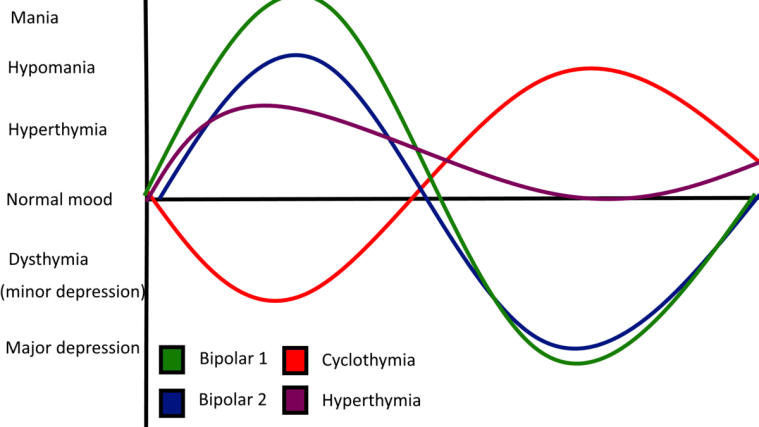
Graph showing showing hyperthymia in comparison to other bipolar spectrum disorders.

Background

It is generally defined by increased energy, vividness and enthusiasm for life activities, as opposed to dysthymia. Hyperthymia is similar to but more stable than hypomania.

Characteristics of the hyperthymic temperament include:

  • Increased energy and productivity.
  • Short sleep patterns.
  • Vividness, activity extroversion.
  • Self-assurance, self-confidence.
  • Strong will.
  • Extreme talkativeness.
  • Tendency to repeat oneself.
  • Risk-taking/sensation seeking.
  • Breaking social norms.
  • Very strong libido.
  • Love of attention.
  • Low threshold for boredom.
  • Generosity and tendency to overspend.
  • Emotion sensitivity.
  • Cheerfulness and joviality.
  • Unusual warmth.
  • Expansiveness.
  • Tirelessness.
  • Irrepressibility, irresistible, and infectious quality.

The clinical, psychiatric understanding of hyperthymia is evolving. Studies have shown that hyperthymic temperament promotes efficient performance of complex tasks under time pressure or extreme conditions. Despite this positive characterisation, hyperthymia can be complicated with depressive episodes manifesting as a softer form of bipolar illness, such as cyclothymia. Research also suggests a familial genetic connection of the temperament to bipolar I.

Aside from references in historical and more recent writings on the spectrum of mood disorders, further literature on the temperament is lacking. There is a lack of agreement on its definition, implications or whether it is pathological. It is not known where to place hyperthymia on the affective spectrum.

Hyperthymia manifesting intermittently or in an unusual way may mask hypomania or another psychiatric disorder. Hyperthymia can be most accurately diagnosed by a psychologist or psychiatrist with the help of a patient’s family and/or close friends.