
An Overview of Regulatory Focus Theory

Introduction

Regulatory focus theory (RFT) is a theory of goal pursuit  formulated by Columbia University psychology professor and researcher E. Tory Higgins regarding people’s motivations and perceptions in judgement and decision making processes. RFT examines the relationship between the motivation of a person and the way in which they go about achieving their goal. RFT posits two separate and independent self-regulatory orientations: prevention and promotion (Higgins, 1997).

This psychological theory, like many others, is applied in communication, specifically in the subfields of nonverbal communication and persuasion. Chronic regulatory focus is measured using the Regulatory Focus Questionnaire (Higgins et al., 2001) or the Regulatory Strength measure. Momentary regulatory focus can be primed or induced.

Background

Regulatory Fit Theory

To understand RFT, it is important to understand another of E. Tory Higgins’ theories: regulatory fit theory. When a person believes that there is “fit”, they will involve themselves more in what they are doing and “feel right” about it.  Regulatory fit should not directly affect the hedonic occurrence of a thing or occasion, but should influence a person’s assurance in their reaction to the object or event.

Regulatory fit theory suggests that a match between orientation to a goal and the means used to approach that goal produces a state of regulatory fit that both creates a feeling of rightness about the goal pursuit and increases task engagement (Higgins, 2001, 2005). Regulatory fit intensifies responses, such as the value of a chosen object, persuasion, and job satisfaction.

Regulatory fit does not increase the assessment of a decision; instead when someone feels “right” about their decision, the experience of “correctness and importance” is transferred to the ensuing assessment of the chosen object, increasing its superficial worth. Research suggests that the “feeling right” experience can then sway retrospective or prospective evaluations. Regulatory fit can be manipulated incidentally (outside the context of interest) or integrally (within the context of interest).

Definition

RFT refers to when a person pursues a goal in a way that maintains the person’s own personal values and beliefs, also known as regulatory orientation. This theory operates on the basic principle that people embrace pleasure but avoid pain, and they then maintain their regulatory fit based on this standard.

The regulatory focus is basically the way in which someone approaches pleasure but avoids pain. An individual’s regulatory focus concentrates on desired end-states, and the approach motivation used to go from the current state to the desired end-state. This theory differentiates between a promotion-focus on hopes and accomplishments, also known as gains. This focus is more concerned with higher level gains such as advancement and accomplishment.

Another focus is the prevention-focus based on safety and responsibilities, also known as non-losses. This focus emphasizes security and safety by following the guidelines and the rules.

These two regulatory focuses regulate the influences that a person would be exposed to in the decision-making process, and determine the different ways they achieve their goal, as discussed by RFT. An individual’s regulatory orientation is not necessarily fixed. While individuals have chronic tendencies towards either promotion or prevention, these preferences may not hold for all situations. Furthermore, a specific regulatory focus can be induced.

The value taken from interaction and goal attainment can be either positive or negative. The decision has positive value when people attempt to attain their goal in a way that fits their regulatory orientation and it will have negative value when people attempt to attain their goal in a way that does not fit their regulatory orientation. Regulatory fit allows value to be created by intensifying the commitment, based on one of the regulatory focus orientations. Making choices and fulfilling objectives are considered as activities, and with any activity, people can be more or less involved. When this involvement is strong, it can intensify the feelings and values about this activity, and the approach to the activity determines whether they are or are not satisfied with the outcome and method of achieving the outcome.

This theory has noteworthy implications for increasing the value of life. For example, in interpersonal conflict, if each person experiences “fit”, each one will be satisfied with and committed to the outcome. In the broad sense, for people to appreciate their own lives, they need to be satisfied and “feel right” about what they are doing, and the way they are doing it.  If it is not satisfying, it is known as “non-fit”, and they will not reach their desired goal.

Goal Attainment and Motivation

Regulatory focus theory, according to Higgins, views motivation in a way that allows an understanding of the foundational ways we approach a task or a goal. Different factors can motivate people during goal pursuit, and we self-regulate our methods and processes during our goal pursuit. RFT proposes that motivational strength is enhanced when the manner in which people work toward a goal sustains their regulatory orientation. Achieving a goal in a way that is consistent to a person’s regulatory orientation leads to an individual sense of importance to the event. The impact of motivation is considered calculated and this creates a greater sense of commitment to the goal. The more strongly an individual is engaged (i.e. involved, occupied, fully engrossed) in an activity, the more intense the motivational force experienced. Engagement is of great importance to attain and motivate in order to reach a goal. Engagement serves as intensifier of the directional component of the value experience. An individual who is strongly engaged in a goal pursuits will experience a positive target more positively and a negative target more negatively.

Individuals can pursue different goals with diverse regulatory orientations and in unlike ways. There are two different kinds of regulatory orientations that people use to obtain their goals: promotion-focus orientation and prevention-focus orientation. These terms are derived from E. Tory Higgins’s Theory of Regulatory Focus. In which, he adds to the notion that people regulate their goal-oriented behaviour in two very distinct ways, coined promotion-focus orientation and prevention-focus orientation

E. Tory Higgins uses this example: there is Student A and Student B, and they both have the shared goal to make an A in a class they are both taking in college. Student A uses a promotion-focus orientation which slants them towards achieving their goal and towards advancement, growth and life accomplishment. This would cause Student A to view the goal as an ideal that satisfies their need for accomplishment. Student B uses a prevention-focus orientation where the goal is something that should be realised because it fulfils their need for security, protection and prevention of negative outcomes. Student A uses an eager approach where they read extra materials to obtain their goal of an A. Student B uses a vigilant approach where they become more detail oriented and pay careful attention to completing all of the course requirements.
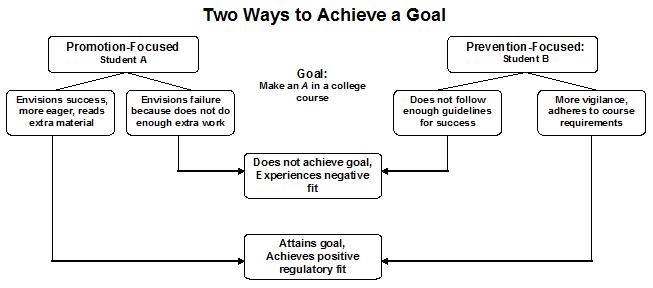
Both forms of regulatory orientation can work to fulfil goals, but the choice of orientation is based on individual preferences and style. When a person pursues their goal in the focus that fits their regulatory orientation, they are more likely to pursue their goal more eagerly and aggressively than if they were using the other focus. In this case each student has different styles. They both feel more comfortable in persuading their goal. The outcome in this experiment would have been different if the students were given an undesirable choice.

When people make decisions, they often envision the possible “pleasure or pain” of the possible outcomes that the focus orientation will produce.  A person imagining making a pleasing choice is more likely to engage in promotion-focus orientation because envisioning the possible outcome of success maintains eagerness about the outcome but does not place importance on vigilance. A person imagining the possible pain by making an undesirable choice maintains more vigilance but less eagerness.

A person with promotion-focus orientation is more likely to remember the occasions where the goal is pursued by using eagerness approaches and less likely to remember occasions where the goal is pursued by vigilance approaches. A person with prevention-focus orientation is more likely to remember events where the goal is pursued by means of vigilance than if it was pursued using eagerness approaches.

Application

Regulatory Focus Theory and Persuasion

When relating regulatory focus theory to persuasion, it is important to remember that RFT is a goal-attainment theory, and that RFT can spawn feelings of rightness/wrongness which in turn may produce formulations for judgements.

The feelings of rightness give an individual more commitment to the information coming in and therefore can avoid endangering their regulatory fit which in turn changes their regulatory focus and accepting a probable motive to change. If a person experiences feelings of wrongness they will suffer negative emotions and deem the experience and information as a threat to their regulatory fit and therefore a threat to their regulatory focus and their goal.

Studies have been done where fit and focus have been applied to show their applicability to consumer purchasing, health advisories, and social policy issues.  To be persuaded is to change your prior feelings, actions, and/or beliefs on a matter to where you agree with the persuader.

The “fit” involved in RFT plays a large role in such issues and stories because it can be a device to help an individual receive and review the experience during a particular message delivery. Positive reinforcement and feelings of rightness while decoding the message creates a stronger engagement and relationship with processing the message, and negative reinforcement and feelings of wrongness lessens the engagement and attachment.

Researchers found that targeting the two different regulatory focus orientations, and their coinciding types of fit, works as an effective process to aid in persuasive charm or pull when they introduced a manner of persuasion where the framing of the message was everything and the content was irrelevant to uphold or interrupt a person’s regulatory fit and follow the pattern of logic used in regulatory orientation.

Lee and Aaker (2004) conducted an experiment that involved whether or not to give their information in a prevention-focus- or promotion-focus-concerning way. The study involved an advertisement for a grape juice drink, which they split into two to create prevention-focus concerns (disease-preventing) and then promotion-focus concerns (energy enhancement).  In doing so, they demonstrated that rather than trying to know each individual recipient’s qualities, one needs only to start by nailing the focus (prevention/promotion) and then framing the message so that it creates that “rightness”.

Some may confuse RFT with regulatory fit, regulatory relevance, message matching, and source attractiveness in such an example. The extent of similarities between closely related theories of RFT, such as ones stated above, make it hard to clarify when this theory is applicable or apparent in respect to the persuasion process.

Regulatory Focus Theory and Nonverbal Communication

RFT can be a useful outline for a better understanding of the effects of nonverbal cues in persuasion and impression formation. Regulatory Fit Theory suggests that the effect of a cue cannot be understood without remembering what the cue means given a recipient’s focus orientation.

Nonverbal cues can be used by the message source to vary delivery style, more specifically to convey eagerness or vigilance, of a given message in a way that will produce regulatory fit in message recipients of different focus orientations.

Advancement implies eager movement forward, so eagerness is conveyed by gestures that involve animated, broad opening movements such as hand movements projecting outward, forward leaning body positions, fast body movement, and fast speech rate. Caution implies vigilant carefulness, so vigilance should be conveyed by gestures that show precision like slightly backward-leaning body positions, slower body movement, and slower speech rate.

An eager nonverbal delivery style will result in greater message effectiveness for promotion-focus recipients than for prevention-focus recipients, while the opposite is true for a vigilant nonverbal style.

There are various aspects, which may contribute to whether or not a message’s persuasive element is successful. One aspect is the effect of nonverbal cues and their association with persuasive appeals based on the message recipient’s motivational regulatory orientation. This determines the recipient’s impression of the source during impression formation.

Research has found that nonverbal cues are an essential element of most persuasive appeals. RFT creates the background that allows a prediction for when and for whom a nonverbal cue can have an effect on persuasion. When nonverbal cues and signals are used appropriately, they increase the effectiveness of persuasion.

Moral Judgement

RFT has also been applied within moral psychology to the topic of moral judgment, contrasting the notions of “oughts” and “ideals.”

References

  • Cesario, J: “Regulatory fit and persuasion: Basic principles and remaining questions”, Social and Personality Psychology Compass 2(1)
  • Higgins, E: “Making a Good Decision: Value From Fit”, American Psychologist 55(11):1217
  • Higgins, E. T. (2005). Value From Regulatory Fit. Current Directions in Psychological Science, 14(4), 209–213. doi:10.1111/j.0963-7214.2005.00366.x
  • Kruglanski, A. W., Pierro, A., & Higgins, E. T. (2007). Regulatory Mode and Preferred Leadership Styles: How Fit Increases Job Satisfaction. Basic and Applied Social Psychology, 29(2), 137–149. doi:10.1080/01973530701331700
  • Avnet, T: “Locomotion, assessment, and regulatory fit: Value transfer from ‘how’ to ‘what'”, Journal of Experimental Psychology 39(5):525
  • Manczak, Erika M.; Zapata-Gietl, Claudia; McAdams, Dan P. (January 2014). “Regulatory focus in the life story: prevention and promotion as expressed in three layers of personality”. Journal of Personality and Social Psychology. 106 (1): 169–181. doi:10.1037/a0034951. ISSN 1939-1315. PMID 24377362.
  • Higgins, E: “Achievement orientations from subjective histories of success: promotion pride versus prevention pride”, European Journal of Social Psychology. 31(1):4
  • Higgins, E. (1997, December) Beyond pleasure and pain. American Psychologist, 52(12):1281
  • Spiegel, S: “How regulatory fit enhances motivational strength during goal pursuit”, European Journal of Social Psychology. 34(1):40
  • Larsen, R., & Buss, D. (2009). Personality psychology: domains of knowledge about human nature. (4th ed., p. 388).
  • Vaughn, A: “‘This story is right on’: The impact of regulatory fit on narrative engagement and persuasion”, European Journal of Social Psychology. 39:448
  • Cesario, J., Higgins, E. (2008 May) Making Message Recipients “Feel Right”: How Nonverbal Cues Can Increase Persuasion. Psychological Science, 19(5)
  • Cornwell, James F. M.; Higgins, E. Tory (September 2015). “The “Ought” Premise of Moral Psychology and the Importance of the Ethical “Ideal””. Review of General Psychology. 19 (3): 311–328. doi:10.1037/gpr0000044. S2CID 146170745.
  • Cornwell, James F.M.; Higgins, E. Tory (November 2015). “Approach and avoidance in moral psychology: Evidence for three distinct motivational levels”. Personality and Individual Differences. 86: 139–149. doi:10.1016/j.paid.2015.06.012.
  • Cornwell, James F. M.; Higgins, E. Tory (March 2016). “Eager feelings and vigilant reasons: Regulatory focus differences in judging moral wrongs”. Journal of Experimental Psychology: General. 145 (3): 338–355. doi:10.1037/xge0000136. PMC 4755905. PMID 26726912. S2CID 20920447.

This page is based on the copyrighted Wikipedia article < https://en.wikipedia.org/wiki/Regulatory_focus_theory >; it is used under the Creative Commons Attribution-ShareAlike 3.0 Unported License (CC-BY-SA). You may redistribute it, verbatim or modified, providing that you comply with the terms of the CC-BY-SA.

What is Parataxic Distortion?

Introduction

Parataxic distortion is a psychiatric term first used by Harry S. Sullivan to describe the inclination to skew perceptions of others based on fantasy.

Refer to Parataxical Integration.

Background

The “distortion” is a faulty perception of others, based not on actual experience with the other individual, but on a projected fantasy personality attributed to the individual. For example, when one falls in love, an image of another person as the “perfect match” or “soul mate” can be created when in reality, the other person may not live up to these expectations or embody the imagined traits at all.

The fantasy personality is created in part from past experiences and from expectations as to how the person ‘should be’, and is formulated in response to emotional stress. This stress can originate from the formation of a new relationship, or from cognitive dissonance required to maintain an existing relationship. Parataxic distortion serves as an immature cognitive defence mechanism against this psychological stress and is similar to Transference.

Parataxic distortion is difficult to avoid because of the nature of human learning and interaction. Stereotyping of individuals based on social cues and the classification of people into groups is a commonplace cognitive function of the human mind. Such pigeonholing allows for a person to gain a quick, though possibly inaccurate, assessment of an interaction. The cognitive processes employed, however, can have a distorting effect on the clear understanding of individuals. In essence, one can lose the ability to ‘hear the other’ through one’s own projected beliefs of what the other person is saying.

Etymology

From the Greek παράταξις, “placement side by side”.

Para – A Greek prefix which came to designate objects or activities auxiliary to or derivative of that denoted by the base word ( parody; paronomasia, paranoia) and hence abnormal or defective.

Taxic – indicating movement towards or away from a specified stimulus.

In this sense, Parataxic distortion, is a shift in perception away from reality.

Interpersonal Relationships and Emotions

Distorting one’s perception of others can often interfere with interpersonal relationships. In many cases, however, it may be beneficial to do so. Humans are constantly and subconsciously stereotyping. According to Paul Martin Lester, “our brains naturally classify what we see, we can’t help but notice the differences in physical attributes between one person and another.” Parataxic distortion runs parallel to stereotyping while it remains in the subconscious. As we make quick judgements, we are drawing from previous experiences stored in our memory.

Parataxic distortion can be a beneficial defence mechanism for the individual, allowing the individual to maintain relationships with others with whom he or she would otherwise be unable to interact or allowing the individual to endure difficult periods in relationships. A self-imposed blindness to certain personality traits can keep a relationship healthy, or it can also prove destructive. For instance, parataxic distortion can keep one in denial of the abusive nature of a spouse.

Attachment Theory

Parataxic distortion can begin in the early stages of development in infants. A mother’s nurturing personality and emotional warmth might be projected onto a lover later in life. This could initially generate stronger feelings for the woman than are warranted by her behaviour and character alone. This example of attachment theory correlates with parataxic distortion.

Attachment theory would have it that the fantasy selves projected onto others in parataxic distortion are informed by our long-term attachment patterns. Not only are these imagined traits the resultant of our earliest bonds and unresolved emotional issues from past relationships, but they are recreated in these fantasy selves for the purpose of recreating that past attachment in the present.

Negative Effects

Dealing with current situations or people that relate to a past event, or remind someone of a person from the past, can have negative effects on a human from an emotional standpoint. If the person from the past was a negative figure or the past event had a negative influence on a person, the person may create a self-sense of identity for the new individual they met. The negative emotional response happens when the individual realises that they have been creating a fake identity for the new individual.

Parataxic distortion is most effective in the realm of interpersonal communication. Parataxic distortion is typically used to avoid coping with past events. For example, if a child is mistreated by his or her father, the child may not only attach the fear and anger towards the father but will also relate this fear and anger to other men that look, talk or act like the father. The human mind keeps track of situations that we have encountered in the past to help us deal with future situations. The unconscious memory, without our knowing, helps us understand and deal with situations in the present that we have dealt with in the past. Parataxic distortion and our unconscious mind make us act the same way in current situations as we did in the past, even without realising it.

Defence Mechanism

As a defence mechanism, parataxic distortion protects one from the emotional consequences of a past event. A person may not remember a certain event, or be acting on it consciously, but will act a certain way to protect themselves from an outcome with the use of parataxic distortion. This behaviour is a pathological attempt to cope with reality by using unreality.

Parataxic distortion is a commonly used psychological defence mechanism. It is not an illness or a disease, but a part of everyday, normal human psychology that can become maladaptive in certain situations. The cognitive abilities used to generate internal models of others are useful in interaction. As we can never truly internalise the full reality of another, we must interact with a shorthand version of them. It is only when we believe that the shorthand version is their reality that this ability can become maladaptive. One may also attempt to coerce or force another to ‘fit the mould’ and act more according to expectations, more like the idealised version they dream the other as being. This is also pathological.

However, all humans engage in parataxic distortion to one extent or another, in one realm or another. It may be to manage emotions within their family, to facilitate communication between them and their spouse, or to imagine a relationship between them and their nation-state.

The Nurse-Patient Relationship: Aggressive Behaviour in a Mental Health Setting

Research Paper Title

Aggressive Behaviour: Nurse-Patient Relationship in Mental Health Setting.

Background

Mental disorder is known to be as a loss of existential paradigm; individual’s functioning is lacking in all areas. Therefore, it is difficult to point out what the patients exactly need because their needs are set on a broad range of a difficult boundary.

The level of care that follows will be complex and multifactorial because nursing will challenge the interaction with the individual as a whole: behaviours and relations with family members.

At this stage exploring interpersonal conflicts, with past and present aggression behaviours will be crucial.

Methods

The aim of this paper is to investigate the professional experience in a work context where the patient’s clinical condition poses a daily challenge from a physical and emotional perspective.

Narrative investigation is performed here in order to explore the psychological load of the professional’s psychological experience and its implication in facing aggressive situations.

Moreover, this investigation highlights the importance of some professional and personal resources that can be made available to the operator.

Results

These tools could improve the understanding of the subjective experience of acute events guiding the individual through an exploration of the phenomenology of what happened decreasing the intimate stress load.

Conclusions

A constant updating, the knowledge of de-escalation techniques and sharing the experience in dedicated settings could be important allies in the management of risk events.

Reference

Moriconi, S., Balducci, P.M. & Tortorella, A. (2020) Aggressive Behavior: Nurse-Patient Relationship in Mental Health Setting. Pyschiatria Danubina. 32(Suppl 1), pp.207-209.

Is It Important that Health Promotion be a Focus that Permeates the Entire Organisation of Mental Health Care?

Research Paper Title

Mental health nurses’ experience of physical health care and health promotion initiatives for people with severe mental illness.

Background

Health care for people with severe mental illness is often divided into physical health care and mental health care despite the importance of a holistic approach to caring for the whole person.

Mental health nurses have an important role not only in preventing ill health, but also in promoting health, to improve the overall health among people with severe mental illness and to develop a more person-centred, integrated physical and mental health care.

Thus, the aim of this study was to describe mental health nurses’ experiences of facilitating aspects that promote physical health and support a healthy lifestyle for people with severe mental illness.

Methods

Interviews were conducted with mental health nurses (n = 15), and a qualitative content analysis was used to capture the nurse’s experiences.

Results

Analysis of the interviews generated three categories:

  • To have a health promotion focus in every encounter;
  • To support with each person’s unique prerequisites in mind; and
  • To take responsibility for health promotion in every level of the organisation.

Conclusions

The results show the importance of a health promotion focus that permeates the entire organisation of mental health care.

Shared responsibility for health and health promotion activities should exist at all levels:

  • In the person-centred care in the relation with the patient;
  • Embedded in a joint vision within the working unit; and
  • In decisions at management level.

Reference

Lundstrom, S., Jormfeldt, H., Ahlstrom, B.H. & Skarsater, I. (2020) Mental health nurses’ experience of physical health care and health promotion initiatives for people with severe mental illness. International Journal of Mental Health Nursing. 29(2), pp.244-253. doi: 10.1111/inm.12669. Epub 2019 Oct 29.

Should Service Users be Involved in Co-Designing Surveys they will Use?

Research Paper Title

Validation of a Comprehensive Patient Experience Survey for Addiction and Mental Health that was Co-designed with Service Users.

Background

A rigorous survey development process was undertaken to design and test a novel, comprehensive patient experience measure that can be used across the full continuum of addiction and mental health programs.

Service users were involved in all aspects of the measure’s development, including the selection of items, pre-testing, naming of the scales, and interpretation of the results.

Methods

Survey data was collected from 1222 patients in treatment in a variety of service settings across Alberta, Canada (89% outpatients; 60% female).

Results

An exploratory factor analysis identified five subscales-patient-centred care, treatment effectiveness, staff behaviour, availability and coordination of care, and communication.

The subscales had high internal reliability (Cronbach’s alpha = 0.77 to 0.85) and test-retest reliability ranged from 0.53 to 0.82 across the five scales.

Conclusions

Scores on the new instrument were correlated with treatment outcomes.

The assessment of patient experience should be integrated into a continuous, sustainable quality improvement process to be truly effective.

Reference

Currie, S.R., Liu, P., Adamyk-Simpson, J. & Stanich, J. (2020) Validation of a Comprehensive Patient Experience Survey for Addiction and Mental Health that was Co-designed with Service Users. Community Mental Health Journal. 56(4), pp.735-743. doi: 10.1007/s10597-019-00534-1. Epub 2020 Jan 1.

MedSupport: Patient Perceptions & Perceived Support

Research Paper Title

Enabling patients to cope with psychotropic medication in mental health care: Evaluation and reports of the new inventory MedSupport.

Background

This cross sectional study examined patients’ perceptions of professional support regarding use of psychotropic medication in a specialist mental health care setting.

The aims were to evaluate reliability and validity of the MedSupport inventory, and investigate possible associations between MedSupport scores and patient characteristics.

Methods

A cross-sectional study was performed. The patients completed the MedSupport, a newly developed self-reported 6 item questionnaire on a Likert scale ranged 1 to 5 (1 = strongly disagree to 5 = strongly agree), and the Beliefs about Medicines Questionnaire.

Diagnosis and treatment information were obtained at the clinical visits and from patient records.

Among the 992 patients recruited, 567 patients (57%) used psychotropic medications, and 514 (91%) of these completed the MedSupport and were included in the study.

Results

The MedSupport showed an adequate internal consistency (Cronbach alpha.87; 95% CI.86-89) and a convergent validity toward the available variables.

The MedSupport mean score was 3.8 (standard deviation.9, median 3.8).

Increasing age and the experience of stronger needs for psychotropic medication were associated with perception of more support to cope with medication, whereas higher concern toward use of psychotropic medication was associated with perception of less support.

Patients diagnosed with behavioural and emotional disorders, onset in childhood and adolescence perceived more support than patients with Mood disorders.

Conclusions

The MedSupport inventory was suitable for assessing the patients’ perceived support from health care service regarding their medication.

Awareness of differences in patients’ perceptions might enable the service to provide special measures for patients who perceive insufficient medication support.

Reference

Drivenes, K., Vederhus, J.K., Haaland, V.Ø., Ruud, T., Hauge, Y.L., Regevik, H., Falk, R.S. & Tanum, L. (2020) Enabling patients to cope with psychotropic medication in mental health care: Evaluation and reports of the new inventory MedSupport. Medicine (Baltimore). 99(1):e18635. doi: 10.1097/MD.0000000000018635.

Do We Need to be Aware of Differences in Patients’ Perceptions of Medication Support?

Research Paper Title

Enabling patients to cope with psychotropic medication in mental health care: Evaluation and reports of the new inventory MedSupport.

Background

This cross sectional study examined patients’ perceptions of professional support regarding use of psychotropic medication in a specialist mental health care setting.

The aims were to evaluate reliability and validity of the MedSupport inventory, and investigate possible associations between MedSupport scores and patient characteristics.

Methods

A cross-sectional study was performed.

The patients completed the MedSupport, a newly developed self-reported 6 item questionnaire on a Likert scale ranged 1 to 5 (1 = strongly disagree to 5 = strongly agree), and the Beliefs about Medicines Questionnaire.

Diagnosis and treatment information were obtained at the clinical visits and from patient records.

Among the 992 patients recruited, 567 patients (57%) used psychotropic medications, and 514 (91%) of these completed the MedSupport and were included in the study.

Results

The MedSupport showed an adequate internal consistency (Cronbach alpha.87; 95% CI.86-89) and a convergent validity toward the available variables.

The MedSupport mean score was 3.8 (standard deviation.9, median 3.8).

Increasing age and the experience of stronger needs for psychotropic medication were associated with perception of more support to cope with medication, whereas higher concern toward use of psychotropic medication was associated with perception of less support.

Patients diagnosed with behavioural and emotional disorders, onset in childhood and adolescence perceived more support than patients with Mood disorders.

Conclusions

The MedSupport inventory was suitable for assessing the patients’ perceived support from health care service regarding their medication.

Awareness of differences in patients’ perceptions might enable the service to provide special measures for patients who perceive insufficient medication support.

Reference

Drivenes, K., Vederhus, J.K., Haaland, V.Ø., Ruud, T., Hauge, Y.L., Regevik, H., Falk, R.S. & Tanum, L. (2020) Enabling patients to cope with psychotropic medication in mental health care: Evaluation and reports of the new inventory MedSupport. Medicine (Baltimore). 99(1):e18635. doi: 10.1097/MD.0000000000018635.