On This Day … 15 April

People (Births)

  • 1858 – Émile Durkheim, French sociologist, psychologist, and philosopher (d. 1917).
  • 1920 – Thomas Szasz, Hungarian-American psychiatrist and academic (d. 2012).
  • 1931 – Tomas Tranströmer, Swedish poet, translator, and psychologist Nobel Prize laureate (d. 2015).

Emile Durkheim

David Émile Durkheim (15 April 1858 to 15 November 1917) was a French sociologist. He formally established the academic discipline of sociology and, with Max Weber, is commonly cited as the principal architect of modern social science.

From his lifetime, much of Durkheim’s work would be concerned with how societies could maintain their integrity and coherence in modernity, an era in which traditional social and religious ties are no longer assumed, and in which new social institutions have come into being. His first major sociological work would be De la division du travail social (1893; The Division of Labour in Society), followed in 1895 by Les Règles de la Méthode Sociologique (The Rules of Sociological Method), the same year in which Durkheim would set up the first European department of sociology and become France’s first professor of sociology. Durkheim’s seminal monograph, Le Suicide (1897), a study of suicide rates in Catholic and Protestant populations, especially pioneered modern social research, serving to distinguish social science from psychology and political philosophy. The following year, in 1898, he established the journal L’Année Sociologique. Les formes élémentaires de la vie religieuse (1912; The Elementary Forms of the Religious Life) presented a theory of religion, comparing the social and cultural lives of aboriginal and modern societies.

Durkheim would also be deeply preoccupied with the acceptance of sociology as a legitimate science. He refined the positivism originally set forth by Auguste Comte, promoting what could be considered as a form of epistemological realism, as well as the use of the hypothetico-deductive model in social science. For Durkheim, sociology was the science of institutions, understanding the term in its broader meaning as the “beliefs and modes of behaviour instituted by the collectivity,” with its aim being to discover structural social facts. As such, Durkheim was a major proponent of structural functionalism, a foundational perspective in both sociology and anthropology. In his view, social science should be purely holistic, in that sociology should study phenomena attributed to society at large, rather than being limited to the specific actions of individuals.

He remained a dominant force in French intellectual life until his death in 1917, presenting numerous lectures and published works on a variety of topics, including the sociology of knowledge, morality, social stratification, religion, law, education, and deviance. Durkheimian terms such as “collective consciousness” have since entered the popular lexicon.

Thomas Szasz

Thomas Stephen Szasz (15 April 1920 to 08 September 2012) was a Hungarian-American academic, psychiatrist and psychoanalyst. He served for most of his career as professor of psychiatry at the State University of New York Upstate Medical University in Syracuse, New York. A distinguished lifetime fellow of the American Psychiatric Association and a life member of the American Psychoanalytic Association, he was best known as a social critic of the moral and scientific foundations of psychiatry, as what he saw as the social control aims of medicine in modern society, as well as scientism. His books The Myth of Mental Illness (1961) and The Manufacture of Madness (1970) set out some of the arguments most associated with him.

Szasz argued throughout his career that mental illness is a metaphor for human problems in living, and that mental illnesses are not “illnesses” in the sense that physical illnesses are; and that except for a few identifiable brain diseases, there are “neither biological or chemical tests nor biopsy or necropsy findings for verifying DSM diagnoses.”

Szasz maintained throughout his career that he was not anti-psychiatry but was rather that he opposed coercive psychiatry. He was a staunch opponent of civil commitment and involuntary psychiatric treatment, but he believed in and practiced psychiatry and psychotherapy between consenting adults.

His views on special treatment followed from libertarian roots, based on the principles that each person has the right to bodily and mental self-ownership and the right to be free from violence from others, and he criticised the use of psychiatry in the Western world as well as communist states.

Tomas Transtromer

Tomas Gösta Tranströmer (15 April 1931 to 26 March 2015) was a Swedish poet, psychologist and translator. His poems captured the long Swedish winters, the rhythm of the seasons and the palpable, atmospheric beauty of nature. Tranströmer’s work is also characterised by a sense of mystery and wonder underlying the routine of everyday life, a quality which often gives his poems a religious dimension. He has been described as a Christian poet.

Tranströmer is acclaimed as one of the most important Scandinavian writers since the Second World War. Critics praised his poetry for its accessibility, even in translation. His poetry has been translated into over 60 languages. He was the recipient of the 1990 Neustadt International Prize for Literature and the 2011 Nobel Prize in Literature.

On This Day … 13 April

People (Births)

Jacques Lacan

Jacques Marie Émile Lacan (13 April 1901 to 09 September 1981) was a French psychoanalyst and psychiatrist who has been called “the most controversial psycho-analyst since Freud”.

Giving yearly seminars in Paris from 1953 to 1981, Lacan’s work has marked the French and international intellectual landscape, having made a significant impact on continental philosophy and cultural theory in areas such as post-structuralism, critical theory, feminist theory and film theory as well as on psychoanalysis itself.

Lacan took up and discussed the whole range of Freudian concepts emphasising the philosophical dimension of Freud’s thought and applying concepts derived from structuralism in linguistics and anthropology to its development in his own work which he would further augment by employing formulae from mathematical logic and topology. Taking this new direction, and introducing controversial innovations in clinical practice, led to expulsion for Lacan and his followers from the International Psychoanalytic Association. In consequence Lacan went on to establish new psychoanalytic institutions to promote and develop his work which he declared to be a “return to Freud” in opposition to prevalent trends in psychoanalysis collusive of adaptation to social norms.

On This Day … 07 April

People (Deaths)

  • 1999 – Heinz Lehmann, German-Canadian psychiatrist and academic (b. 1911).

Heinz Lehmann

Heinz Edgar Lehmann, OC FRSC (17 July 17 1911 to 07 April 1999) was a German-born Canadian psychiatrist best known for his use of chlorpromazine for the treatment of schizophrenia in 1950s and “truly the father of modern psychopharmacology.”

Early Life

Born in Berlin, Germany, he was educated at the University of Freiburg, the University of Marburg, the University of Vienna, and the University of Berlin. He emigrated to Canada in 1937.

Hospital Work in Canada

In 1947, he was appointed the clinical director of Montreal’s Douglas Hospital. From 1971 to 1975, he was the chair of the McGill University Department of Psychiatry. He was also a humane lecturer in psychiatry in 1952, and was able to give empathetic lectures on the plight of people suffering from anxiety, depression obsessions, paranoia etc. No one to that time had been able to understand or help schizophrenic patients, who filled mental hospitals around the world, so when chlorpromazine showed some promise he helped to promote it in North America and start the drug revolution. He was ahead of his time in that he supported research in the use of the active ingredient psilocybin to alleviate anxiety.

Le Dain Commission

From 1969 to 1972, he was one of the five members of the Le Dain Commission, a royal commission appointed in Canada to study the non-medical use of drugs. He was an advocate for decriminalisation of marijuana.

DSM Work

In 1973, he was a member of the Nomenclature Committee of the American Psychiatric Association that decided to drop homosexuality from the Diagnostic and Statistical Manual of Mental Disorders, i.e. to depathologise it.

Honours and Awards

In 1970 he was made a Fellow of the Royal Society of Canada and, in 1976, he was made an Officer of the Order of Canada. He was inducted into the Canadian Medical Hall of Fame in 1998.

Heinz Lehmann Award

In 1999, the Canadian College of Neuropsychopharmacology established the Heinz Lehmann Award in his honour, given in recognition of outstanding contributions to research in neuropsychopharmacology in Canada.

On This Day … 03 April

People (Births)

  • 1860 – Frederik van Eeden, Dutch psychiatrist and author (d. 1932).

Frederik van Eeden

Frederik Willem van Eeden (03 April 1860 to 16 June 1932) was a late 19th-century and early 20th-century Dutch writer and psychiatrist. He was a leading member of the Tachtigers and the Significs Group, and had top billing among the editors of De Nieuwe Gids (The New Guide) during its celebrated first few years of publication, starting in 1885.

Biography

Van Eeden was the son of Frederik Willem Van Eeden, director of the Royal Tropical Institute in Haarlem.

In 1880 he studied Medicine in Amsterdam, where he pursued a bohemian lifestyle and wrote poetry. Whilst living in the city, he coined the term lucid dream in the sense of mental clarity, a term that nowadays is a classic term in the Dream literature and study, meaning dreaming while knowing that one is dreaming. In his early writings, he was strongly influenced by Hindu ideas of selfhood, by Boehme’s mysticism, and by Fechner’s panpsychism.

He went on to become a prolific writer, producing many critically acclaimed novels, poetry, plays, and essays. He was widely admired in the Netherlands in his own time for his writings, as well as his status as the first internationally prominent Dutch psychiatrist.

Van Eeden’s psychiatrist practice included treating his fellow Tachtiger Willem Kloos as a patient starting in 1888. His treatment of Kloos was of limited benefit, as Kloos deteriorated into alcoholism and increasing symptoms of mental illness. Van Eeden also incorporated his psychiatric insights into his later writings, such as in a deeply psychological novel called “Van de koele meren des doods” (translated in English as “The Deeps of Deliverance”). Published in 1900, the novel intimately traced the struggle of a woman addicted to morphine as she deteriorated physically and mentally.

His best known written work, “De Kleine Johannes” (“Little Johannes”), which first appeared in the premiere issue of De Nieuwe Gids, was a fantastical adventure of an everyman who grows up to face the harsh realities of the world around him and the emptiness of hopes for a better afterlife, but ultimately finding meaning in serving the good of those around him. This ethic is memorialized in the line “Waar de mensheid is, en haar weedom, daar is mijn weg.” (“Where mankind is, and her woe, there is my path.”).

Van Eeden sought not only to write about, but also to practice, such an ethic. He established a commune named Walden (commune) [nl], taking inspiration from Thoreau’s book Walden, in Bussum, North Holland, where the residents tried to produce as much of their needs as they could themselves and to share everything in common, and where he took up a standard of living far below what he was used to. This reflected a trend toward socialism among the Tachtigers; another Tachtiger, Herman Gorter, was a founding member of the world’s first Communist political party, the Dutch Social-Democratic Party, in 1909.

Van Eeden visited the US. He had contacts with William James and other psychologists. He met Freud in Vienna, whom he practically introduced in the Netherlands. He corresponded with Hermann Hesse, Charles Lloyd Tuckey (medical hypnotist), Harold Williams (linguist) and was a friend of Peter Kropotkin, the Russian anarchist living in London (UK).

Van Eeden also had a keen interest in Indian philosophy. He translated many of Tagore’s works, including Gitanjali and short stories.

In late years of his life, Van Eeden became a Roman Catholic.

On This Day … 31 March

People (Births)

  • 1930 – Yehuda Nir, Polish Jewish-American psychiatrist (d. 2014).

Yehuda Nir

Yehuda Nir (31 March 1930 to 19 July 2014) was a Polish-born American Holocaust survivor, psychiatrist and author of The Lost Childhood. Nir posed as a Roman Catholic and learned Latin to escape Nazi persecution in Poland during World War II. Nir’s ordeal led him to a career as a psychiatrist, specialising in the treatment of post-traumatic stress disorder and severely ill children. He immigrated to the United States in 1959 to complete medical residencies in New York City and Philadelphia. He served as the chief of child psychiatry of Memorial Sloan-Kettering Cancer Center from 1979 until 1986.

Nir was born Juliusz Gruenfeld in Lwów, Poland, (present-day Lviv, Ukraine) on 31 March 1930. He later changed his name to “Nir” after World War II since “Gruenfeld” has German origins. Nir means ‘plowed fields’ in Hebrew.

Nir released a memoir of his experience during the Holocaust, “The Lost Childhood”, in 1989. A second edition was reprinted by Scholastic Press in 2002. The Lost Childhood is now used as part of the high school curriculum throughout the United States. He also published four self-help books focusing on relationships, including “Not Quite Paradise: Making Marriage Work” and “Loving Men for All the Right Reasons.”

Yehuda Nir died at his home in Manhattan, New York City, on 19 July 2014, at the age of 84. His funeral was held at Riverside Memorial Chapel on the Upper West Side, with burial on the Mount of Olives in Jerusalem. He was survived by his wife Bonnie Maslin and their children: daughter Sarah, a reporter for The New York Times; and son David, the political director of Daily Kos; and two sons from a previous marriage: private investor Daniel and fashion executive Aaron.

Book: A Straight Talking Introduction to the Power Threat Meaning Framework: An Alternative to Psychiatric Diagnosis

Book Title:

A Straight Talking Introduction to the Power Threat Meaning Framework: An Alternative to Psychiatric Diagnosis (The Straight Talking Introduction Series).

Author(s): Mary Boyle and Lucy Johnstone.

Year: 2020.

Edition: First (1st).

Publisher: PCCS Books.

Type(s): Paperback and Kindle.

Synopsis:

The current mainstream way of describing psychological and emotional distress assumes it is the result of medical illnesses that need diagnosing and treating. This book summarises a powerful alternative to psychiatric diagnosis that asks not ‘What’s wrong with you?’ but ‘What’s happened to you?’ The Power Threat Meaning Framework (PTMF) was co-produced by a core group of psychologists and service users and launched in 2018, prompting considerable interest in the UK and worldwide. It argues that emotional distress, unusual experiences and many forms of troubled or troubling behaviour are understandable when viewed in the context of a person’s life and circumstances, the cultural and social norms we are expected to live up to and the degree to which we are exposed to trauma, abuse, injustice and inequality. The PTMF offers all of us the tools to create new, hopeful narratives about the reasons for our distress that are not based on psychiatric diagnosis and to find ways forward as individuals, families, social groups and whole societies.

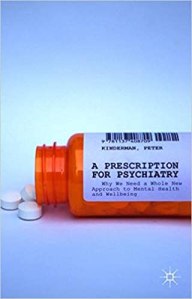
Book: A Prescription for Psychiatry: Why We Need a Whole New Approach to Mental Health and Wellbeing

Book Title:

A Prescription for Psychiatry: Why We Need a Whole New Approach to Mental Health and Wellbeing.

Author(s): Peter Kinderman.

Year: 2014.

Edition: First (1st).

Publisher: Palgrave Macmillan.

Type(s): Paperback and Kindle.

Synopsis:

A Prescription for Psychiatry lays bare the flaws and failings of traditional mental health care and offers a radical alternative. Exposing the old-fashioned biological ‘disease model’ of psychiatry as unscientific and unhelpful, it calls for a revolution in the way we plan and deliver care. Kinderman challenges the way we think about mental health problems, arguing that the origins of distress are largely social, and urges a change from a ‘disease model’ to a ‘psychosocial model’. The book persuasively argues that we should significantly reduce our use of psychiatric medication, and help should be tailored to each person’s unique needs. This is a manifesto for an entirely new approach to psychiatric care; one that truly offers care rather than coercion, therapy rather than medication, and a return to the common sense appreciation that distress is usually an understandable reaction to life’s challenges.

On This Day … 30 March

People (Births)

  • 1882 – Melanie Klein, Jewish Austrian-English psychologist and author (d. 1960).

People (Deaths)

  • 1873 – Bénédict Morel, Austrian-French psychiatrist and physician (b. 1809).

Melanie Klein

Melanie Klein (née Reizes; 30 March 1882 to 22 September 1960) was an Austrian-British author and psychoanalyst known for her work in child analysis. She was the primary figure in the development of object relations theory. Klein suggested that pre-verbal existential anxiety in infancy catalysed the formation of the unconscious, resulting in the unconscious splitting of the world into good and bad idealisations. In her theory, how the child resolves that split depends on the constitution of the child and the character of nurturing the child experiences; the quality of resolution can inform the presence, absence, and/or type of distresses a person experiences later in life.

Contributions to Psychoanalysis

Klein was one of the first to use traditional psychoanalysis with young children. She was innovative in both her techniques (such as working with children using toys) and her theories on infant development. Gaining the respect of those in the academic community, Klein established a highly influential training program in psychoanalysis.

By observing and analysing the play and interactions of children, Klein built onto the work of Freud’s unconscious mind. Her dive into the unconscious mind of the infant yielded the findings of the early Oedipus complex, as well as the developmental roots of the superego.

Klein’s theoretical work incorporates Freud’s belief in the existence of the death pulsation, reflecting the notion that all living organisms are inherently drawn toward an “inorganic” state, and therefore, somehow, towards death. In psychological terms, Eros (properly, the life pulsation), the postulated sustaining and uniting principle of life, is thereby presumed to have a companion force, Thanatos (death pulsation), which seeks to terminate and disintegrate life. Both Freud and Klein regarded these “biomental” forces as the foundations of the psyche. These primary unconscious forces, whose mental matrix is the id, spark the ego – the experiencing self – into activity. Id, ego and superego, to be sure, were merely shorthand terms (similar to the instincts) referring to highly complex and mostly uncharted psychodynamic operations.

Benedict Morel

Bénédict Augustin Morel (22 November 1809 to 30 March 1873) was a French psychiatrist born in Vienna, Austria. He was an influential figure in the field of degeneration theory during the mid-19th century.

Morel received his education in Paris, and while a student, supplemented his income by teaching English and German classes. In 1839 he earned his medical doctorate, and two years later became an assistant to psychiatrist Jean-Pierre Falret (1794-1870) at the Salpêtrière in Paris.

Morel’s interest in psychiatry was further enhanced in the mid-1840s when he visited several mental institutions throughout Europe. In 1848 he was appointed director of the Asile d’Aliénés de Maréville at Nancy. Here he introduced reforms towards the welfare of the mentally ill, in particular liberalisation of restraining practices. At the Maréville asylum he studied the mentally handicapped, researching their family histories and investigating aspects such as poverty and childhood physical illnesses. In 1856 he was appointed director of the mental asylum at Saint-Yon in Rouen.

Morel, influenced by various pre-Darwinian theories of evolution, particularly those that attributed a powerful role to acclimation, saw mental deficiency as the end stage of a process of mental deterioration. In the 1850s, he developed a theory of “degeneration” in regards to mental problems that take place from early life to adulthood. In 1857 he published Traité des dégénérescences physiques, intellectuelles et morales de l’espèce humaine et des causes qui produisent ces variétés maladives, a treatise in which he explains the nature, causes, and indications of human degeneration. Morel looked for answers to mental illness in heredity, although later on he believed that alcohol and drug usage could also be important factors in the course of mental decline.

On This Day … 28 March

People (Births)

  • 1955 – John Alderdice, Baron Alderdice, Northern Irish psychiatrist and politician, 1st Speaker of the Northern Ireland Assembly.

John Alderdice

John Thomas Alderdice, Baron Alderdice (born 28 March 1955 is a Northern Ireland politician.

He was Speaker of the Northern Ireland Assembly 1998–2004, leader of the Alliance Party of Northern Ireland 1987-1998, and since 1996 has sat in the House of Lords as a Liberal Democrat.

John was educated at Ballymena Academy and the Queen’s University Belfast (QUB) where he studied medicine and qualified in 1978. In 1977 he married Joan Hill, with whom he has two sons and one daughter. He worked part-time as a consultant psychiatrist in psychotherapy in the NHS from 1988 until he retired from psychiatric practice in 2010. He also lectured at Queen’s University’s Faculty of Medicine between 1991 and 1999.

Alderdice claims a distant relationship to John King, a 19th-century Australian explorer and the sole survivor of the Burke and Wills expedition.

On This Day … 26 March

People (Births)

  • 1905 – Viktor Frankl, Austrian neurologist and psychiatrist (d. 1997).

People (Deaths)

  • 2014 – Roger Birkman, American psychologist and author (b. 1919).
  • 2015 – Tomas Tranströmer, Swedish poet, translator, and psychologist Nobel Prize laureate (b. 1931).

Viktor Frankl

Viktor Emil Frankl (26 March 1905 to 02 September 1997) was an Austrian neurologist, psychiatrist, philosopher, author, and Holocaust survivor.

He was the founder of logotherapy, a school of psychotherapy which describes a search for a life meaning as the central human motivational force. Logotherapy is part of existential and humanistic psychology theories.

Frankl published 39 books. The autobiographical Man’s Search for Meaning, a best-selling book, is based on his experiences in various Nazi concentration camps.

Roger Birkman

Roger Winfred Birkman (01 February 1919 to 26 March 2014) was an American organisational psychologist. He was the creator of The Birkman Method, a workplace psychological assessment. Birkman received his Ph.D. in psychology in 1961 from the University of Texas at Austin. He was the founder and chairman of the board of Birkman International, Inc.

The Birkman Method

The Birkman Method is an online personality, social perception, and occupational interest assessment consisting of ten scales describing occupational preferences (Interests), 11 scales describing “effective behaviours” (Usual behaviours) and 11 scales describing interpersonal and environmental expectations (Needs or Expectations). A corresponding set of 11 scale values was derived to describe “less than effective” behaviours (Stress behaviours). Occupational profiling consists of 22 job families with more than 200 corresponding job titles all connected to O*Net.

The construction and comparative analysis of the Birkman Method is designed to provide insight into what specifically drives a person’s behaviour, with the goal of creating greater choice and more self-responsibility. It attempts to measure social behaviours, underlying expectations of interpersonal and task actions, potential stress reactions to unmet expectations, occupational preferences and organisational strengths. It is empirically supported by reliability and validity studies, including studies using classical test theory (CTT) and item response theory (IRT). The Birkman Method has 3 different types of assessments available.

Tomas Tranströmer

Tomas Gösta Tranströmer 15 April 1931 to 26 March 2015) was a Swedish poet, psychologist and translator. His poems captured the long Swedish winters, the rhythm of the seasons and the palpable, atmospheric beauty of nature. Tranströmer’s work is also characterised by a sense of mystery and wonder underlying the routine of everyday life, a quality which often gives his poems a religious dimension. He has been described as a Christian poet.

Tranströmer is acclaimed as one of the most important Scandinavian writers since the Second World War. Critics praised his poetry for its accessibility, even in translation. His poetry has been translated into over 60 languages. He was the recipient of the 1990 Neustadt International Prize for Literature and the 2011 Nobel Prize in Literature.