On This Day … 25 March

People (Deaths)

Milton H. Erickson

Milton Hyland Erickson (05 December 1901 to 25 March 1980) was an American psychiatrist and psychologist specialising in medical hypnosis and family therapy.

He was founding president of the American Society for Clinical Hypnosis and a fellow of the American Psychiatric Association, the American Psychological Association, and the American Psychopathological Association.

He is noted for his approach to the unconscious mind as creative and solution-generating. He is also noted for influencing brief therapy, strategic family therapy, family systems therapy, solution focused brief therapy, and neuro-linguistic programming.

On This Day … 23 March

People (Births)

  • 1900 – Erich Fromm, German psychologist and sociologist (d. 1980).
  • 1933 – Philip Zimbardo, American psychologist and academic.

People (Deaths)

  • 2008 – Vaino Vahing, Estonian psychiatrist, author, and playwright (b. 1940).

Erich Fromm

Erich Seligmann Fromm (23 March 1900 to 18 March 1980) was a German social psychologist, psychoanalyst, sociologist, humanistic philosopher, and democratic socialist. He was a German Jew who fled the Nazi regime and settled in the US. He was one of the founders of The William Alanson White Institute of Psychiatry, Psychoanalysis and Psychology in New York City and was associated with the Frankfurt School of critical theory.

Philip Zimbardo

Philip George Zimbardo (/zɪmˈbɑːrdoʊ/; born 23 March 1933) is an American psychologist and a professor emeritus at Stanford University. He became known for his 1971 Stanford prison experiment, which was later severely criticised for both ethical and scientific reasons. He has authored various introductory psychology textbooks for college students, and other notable works, including The Lucifer Effect, The Time Paradox, and The Time Cure. He is also the founder and president of the Heroic Imagination Project.

Stanford Prison Experiment

The Stanford prison experiment (SPE) was a social psychology experiment that attempted to investigate the psychological effects of perceived power, focusing on the struggle between prisoners and prison officers. It was conducted at Stanford University on the days of 15-21 August 1971, by a research group led by psychology professor Philip Zimbardo using college students. In the study, volunteers were assigned to be either “guards” or “prisoners” by the flip of a coin, in a mock prison, with Zimbardo himself serving as the superintendent. Several “prisoners” left mid-experiment, and the whole experiment was abandoned after six days. Early reports on experimental results claimed that students quickly embraced their assigned roles, with some guards enforcing authoritarian measures and ultimately subjecting some prisoners to psychological torture, while many prisoners passively accepted psychological abuse and, by the officers’ request, actively harassed other prisoners who tried to stop it. The experiment has been described in many introductory social psychology textbooks, although some have chosen to exclude it because its methodology is sometimes questioned.

The US Office of Naval Research funded the experiment as an investigation into the causes of difficulties between guards and prisoners in the United States Navy and United States Marine Corps. Certain portions of it were filmed, and excerpts of footage are publicly available.

The experiment’s findings have been called into question, and the experiment has been criticized for unscientific methodology. Although Zimbardo interpreted the experiment as having shown that the “prison guards” instinctively embraced sadistic and authoritarian behaviours, Zimbardo actually instructed the “guards” to exert psychological control over the “prisoners”. Critics also noted that some of the participants behaved in a way that would help the study, so that, as one “guard” later put it, “the researchers would have something to work with,” which is known as demand characteristics. Variants of the experiment have been performed by other researchers, but none of these attempts have replicated the results of the SPE.

Vaino Vahling

Vaino Vahing (15 February 1940 to 23 March 2008), was an Estonian writer, prosaist, psychiatrist and playwright. Starting from 1973, he was a member of Estonian Writers Union.

Vaino Vahing has written many articles about psychiatry, but also literature – novels, books and plays with psychiatric and autobiographical influence. He has played in several Estonian films.

What is the Goldberg Test?

Introduction

Goldberg test may refer to any of various psychiatric tests used to assess mental health in general or as screening tools for specific mental disorders e.g. depression or bipolar disorder.

Goldberg, after whom some psychiatric tests are named, might be one of two psychiatrists who share the same last name:

  • Ivan Goldberg, an American psychiatrist; and
  • Sir David Goldberg, a British psychiatrist.

Psychiatric screening tests generally do not substitute getting help from professionals.

Tests Developed by Ivan K. Goldberg

  • Goldberg Depression Test is an 18-question screening tool for depression.
  • Goldberg Mania Scale is an 18-question screening test for mania.

Tests developed by Sir David Goldberg

  • General Health Questionnaire or Goldberg Health Questionnaire (GHQ):
    • Developed in 1972 in its initial format as a 60-question test (GHQ-60) with a four-point scale for each question.
    • It is used to measure the risk of developing psychiatric disorders.
    • Other forms of GHQ are:
      • GHQ-30;
      • GHQ-28; and
      • GHQ-12.
  • Together with Simpson, they developed Personal Health Questionnaire (PHQ) in 1995.
    • It is a 10-question screening instrument for depression.
    • It should not be confused with the 9-question patient health questionnaire (PHQ-9) developed by Spitzer also to quantify the risk for depression.
    • Personal Health Questionnaire is sometimes abbreviated as PHQ-G to differentiate it from PHQ-9.

On This Day … 18 March

People (Births)

  • 1935 – Frances Cress Welsing, American psychiatrist and author (d. 2016).

People (Deaths)

  • 1980 – Erich Fromm, German psychologist and philosopher (b. 1900).

Frances Cress Welsing

Frances Luella Welsing (née Cress; 18 March 1935 to 02 January 2016) was an American psychiatrist. She has been described by critics as a black supremacist. Her 1970 essay, The Cress Theory of Colour-Confrontation and Racism (White Supremacy), offered her interpretation of what she described as the origins of white supremacy culture.

She was the author of The Isis Papers: The Keys to the Colours (1991).

Erich Fromm

Erich Seligmann Fromm (23 March 1900 to 18 March 1980) was a German social psychologist, psychoanalyst, sociologist, humanistic philosopher, and democratic socialist. He was a German Jew who fled the Nazi regime and settled in the US. He was one of the founders of The William Alanson White Institute of Psychiatry, Psychoanalysis and Psychology in New York City and was associated with the Frankfurt School of critical theory.

On This Day … 11 March

People (Births)

  • 1915 – J.C.R. Licklider, American computer scientist and psychologist (d. 1990).

People (Deaths)

  • 1999 – Herbert Jasper, Canadian psychologist, anatomist, and neurologist (b. 1906).
  • 1999 – Camille Laurin, Canadian psychiatrist and politician (b. 1922).

J.C.R. Licklider

Joseph Carl Robnett Licklider (11 March 1915 to 26 June 1990), known simply as J.C.R. or “Lick”, was an American psychologist and computer scientist who is considered among prominent figures in computer science development and general computing history.

He is particularly remembered for being one of the first to foresee modern-style interactive computing and its application to all manner of activities; and also as an Internet pioneer with an early vision of a worldwide computer network long before it was built. He did much to initiate this by funding research which led to much of it, including today’s canonical graphical user interface, and the ARPANET, the direct predecessor to the Internet.

He has been called “computing’s Johnny Appleseed”, for planting the seeds of computing in the digital age; Robert Taylor, founder of Xerox PARC’s Computer Science Laboratory and Digital Equipment Corporation’s Systems Research Center, noted that “most of the significant advances in computer technology—including the work that my group did at Xerox PARC—were simply extrapolations of Lick’s vision. They were not really new visions of their own. So he was really the father of it all”.

Herbert Jasper

Herbert Henri Jasper, OC GOQ FRSC (27 July 1906 to 11 March 1999) was a Canadian psychologist, physiologist, neurologist, and epileptologist.

Born in La Grande, Oregon, he attended Reed College in Portland, Oregon and received his PhD in psychology from the University of Iowa in 1931 and earned a Doctor of Science degree from the University of Paris for research in neurobiology.

From 1946 to 1964 he was Professor of Experimental Neurology at the Montreal Neurological Institute, McGill University and then from 1965 to 1976 he was Professor of Neurophysiology, Université de Montréal. He did his most important research with Wilder Penfield at McGill University. He was a member of the American Academy of Neurology and the American Association for the Advancement of Science. He was also a member of the Canadian Neurological Society and the Royal Society of Medicine. He wrote more than 350 scientific publications.

Camille Laurin

Camille Laurin (06 May 1922 to 11 March 1999) was a psychiatrist and Parti Québécois (PQ) politician in the province of Quebec, Canada. MNA member for the riding of Bourget, he is considered the father of Quebec’s language law known informally as “Bill 101”.

Born in Charlemagne, Quebec, Laurin obtained a degree in psychiatry from the Université de Montréal where he came under the influence of the Roman Catholic priest, Lionel Groulx. After earning his degree, Laurin went to Boston, Massachusetts, where he worked at the Boston State Hospital. Following a stint in Paris, France, in 1957, he returned to practice in Quebec. In 1961, he authored the preface of the book Les fous crient au secours, which described the conditions of psychiatric hospitals of the time.

He was one of the early founders of the Quebec sovereignty movement. As a senior cabinet minister in the first PQ government elected in the 1976 Quebec election, he was the guiding force behind Bill 101, the legislation that placed restrictions on the use of English on public signs and in the workplace of large companies, and strengthened the position of French as the only official language in Quebec.

Laurin resigned from his cabinet position on 26 November 1984 because of a disagreement with Lévesque on the future of the sovereignty movement. He resigned from his seat in the National Assembly on 25 January 1985. He was elected once again to the Assembly on 12 September 1994 but did not run in the 1998 election for health reasons.

He died after a long battle with cancer.

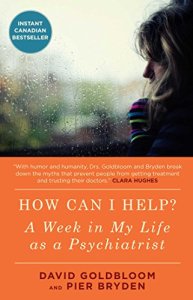
Book: How Can I Help?: A Week in My Life as a Psychiatrist

Book Title:

How Can I Help?: A Week in My Life as a Psychiatrist.

Author(s): David Goldbloom (MD) and Pier Bryden (MD).

Year: 2017.

Edition: First (1st), Canadian Origin Edition.

Publisher: Touchstone.

Type(s): Hardcover, Paperback, Audiobook, and Kindle.

Synopsis:

A humane behind-the-scenes account of a week in the life of a psychiatrist at one of Canada’s leading mental health hospitals. How Can I Help? takes us to the frontlines of modern psychiatric care.

How Can I Help? portrays a week in the life of Dr. David Goldbloom as he treats patients, communicates with families, and trains staff at CAMH, the largest psychiatric facility in Canada. This highly readable and touching behind-the-scenes account of his daily encounters with a wide range of psychiatric concerns – from his own patients and their families to Emergency Department arrivals – puts a human face on an often misunderstood area of medical expertise. From schizophrenia and borderline personality disorder to post-traumatic stress syndrome and autism, How Can I Help? investigates a range of mental issues.

What is it like to work as a psychiatrist now? What are the rewards and challenges? What is the impact of the suffering – and the recovery – of people with mental illness on families and the clinicians who treat them? What does the future hold for psychiatric care?

How Can I Help? demystifies a profession that has undergone profound change over the past twenty-five years, a profession that is often misunderstood by the public and the media, and even by doctors themselves. It offers a compassionate, realistic picture of a branch of medicine that is entering a new phase, as increasingly we are able to decode the mysteries of the brain and offer new hope for sufferers of mental illness.

Book: Into the Abyss: A Neuropsychiatrist’s Notes on Troubled Minds

Book Title:

Into the Abyss: A Neuropsychiatrist’s Notes on Troubled Minds.

Author(s): Anthony David.

Year: 2021.

Edition: First (1st), Reprint Edition.

Publisher: Oneworld Publications.

Type(s): Paperback, Audiobook, and Kindle.

Synopsis:

We cannot know how to fix a problem until we understand its causes. But even for some of the most common mental health problems, specialists argue over whether the answers lie in the person’s biology, their psychology or their circumstances.

As a cognitive neuropsychiatrist, Anthony David brings together many fields of enquiry, from social and cognitive psychology to neurology. The key for each patient might be anything from a traumatic memory to a chemical imbalance, an unhealthy way of thinking or a hidden tumour.

Patrick believes he is dead. Jennifer’s schizophrenia medication helped with her voices but did it cause Parkinson’s? Emma is in a coma – or is she just refusing to respond?

Drawing from Professor David’s career as a clinician and academic, these fascinating case studies reveal the unique complexity of the human mind, stretching the limits of our understanding.

Psychiatric Rehabilitation & Young Adults with Serious Mental Health Conditions

Research Paper Title

Factors that hinder or facilitate the continuous pursuit of education, training, and employment among young adults with serious mental health conditions.

Background

This study can inform psychiatric rehabilitation practice by describing the patterns of education, training, and employment activities among young adults with serious mental health conditions and identify potentially malleable factors that hinder or facilitate their ability to continuously pursue these activities.

Methods

One-time, in-person interviews were conducted with 55 young adults, ages 25-30, with serious mental health conditions in Massachusetts. The life story interview script asked participants about key life and mental health experiences and details about their education, training, and employment experiences.

Results

Young adult paths’ through post-secondary school, training, and work were often non-linear and included multiple starts and stops. Many young adults reported unsteady and inconsistent patterns of school and work engagement and only half were meaningfully engaged in education, employment, or training at the time of the interview. Employment often included service industry jobs with short tenures and most who had attempted post-secondary college had not obtained a degree. Barriers to continuous pursuit of school, training, or work included stress-induced anxiety or panic, increased symptomatology related to their mental health condition, and interpersonal conflicts. Flexible school, training, and work environments with supportive supervisors helped facilitate the continuous pursuit of these activities.

Conclusions

Psychiatric rehabilitation professionals need to help young adults with serious mental health conditions manage stress and anxiety and periods of increased symptomatology, navigate interpersonal challenges, and advocate for flexible and supportive accommodations. Early and blended education and employment supports would also be beneficial.

Reference

Sabella, K. (2021) Factors that hinder or facilitate the continuous pursuit of education, training, and employment among young adults with serious mental health conditions. Psychiatric Rehabilitation Journal. doi: 10.1037/prj0000470. Online ahead of print.

On This Day … 27 February

People (Births)

People (Deaths)

  • 2012 – Tina Strobos, Dutch physician and psychiatrist (b. 1920).

Roberto Assagioli

Roberto Assagioli (27 February 1888 to 23 August 1974) was an Italian psychiatrist and pioneer in the fields of humanistic and transpersonal psychology. Assagioli founded the psychological movement known as psychosynthesis, which is still being developed today by therapists and psychologists, who practice the psychological methods and techniques he developed. His work, expounded in two books and many monographs published as pamphlets, emphasized the possibility of progressive integration, or synthesis, of the personality.

Assagioli received his first degree in neurology and psychiatry at Istituto di Studii Superiori Pratici e di Perfezionamento, in Florence in 1910. It was during this time he began writing articles that criticised psychoanalysis in which Assagioli argued a more holistic approach.

Once he finished his studies in Italy, Assagioli went to Switzerland, where he was trained in psychiatry at the psychiatric hospital Burghölzli in Zürich. This led to him opening the first psychoanalytic practice in Italy, known as Istituto di Psicosintesi. However, his work in psychoanalysis left him unsatisfied with the field of psychiatry; as a whole, as he felt that psychoanalysis was incomplete.

Tina Strobos

Tina Strobos, née Tineke Buchter (19 May 1920 to 27 February 2012), was a Dutch physician and psychiatrist from Amsterdam, known for her resistance work during World War II. While a young medical student, she worked with her mother and grandmother to rescue more than 100 Jewish refugees as part of the Dutch resistance during the Nazi occupation of the Netherlands. Strobos provided her house as a hiding place for Jews on the run, using a secret attic compartment and warning bell system to keep them safe from sudden police raids. In addition, Strobos smuggled guns and radios for the resistance and forged passports to help refugees escape the country. Despite being arrested and interrogated nine times by the Gestapo, she never betrayed the whereabouts of a Jew.

After the war, Strobos completed her medical degree and became a psychiatrist. She studied under Anna Freud in England. Strobos later emigrated to the United States to study psychiatry under a Fulbright scholarship, and she subsequently settled in New York. She married twice and had three children. Strobos built a career as a family psychiatrist, receiving the Elizabeth Blackwell Medal in 1998 for her medical work, and finally retired from active practice in 2009.

In 1989, Strobos was honoured as Righteous Among the Nations by Yad Vashem for her rescue work. In 2009, she was recognised for her efforts by the Holocaust and Human Rights Education Centre of New York City.

On This Day … 26 February

People (Births)

People (Deaths)

  • 1930 – Mary Whiton Calkins, American philosopher and psychologist (b. 1863).
  • 1969 – Karl Jaspers, German-Swiss psychiatrist and philosopher (b. 1883).

Emile Coue

Émile Coué de la Châtaigneraie (26 February 1857 to 02 July 1926) was a French psychologist and pharmacist who introduced a popular method of psychotherapy and self-improvement based on optimistic autosuggestion.

Considered by Charles Baudouin to represent a second Nancy School, Coué treated many patients in groups and free of charge.

Sandie Shaw

Sandie Shaw, MBE (born Sandra Ann Goodrich; 26 February 1947) is an English singer. One of the most successful British female singers of the 1960s, she had three UK number one singles with “(There’s) Always Something There to Remind Me” (1964), “Long Live Love” (1965) and “Puppet on a String” (1967). With “Puppet on a String”, she became the first British entry to win the Eurovision Song Contest. She returned to the UK top 40, for the first time in 15 years, with her 1984 cover of the Smiths song “Hand in Glove”. Shaw announced her retirement from the music industry in 2013.

Mary Whiton Calkins

Mary Whiton Calkins (30 March 1863 to 26 February 1930) was an American philosopher and psychologist. As a psychologist, she taught at Wellesley College for many years and conducted research on dreams and memory. Calkins was the first woman to become president of the American Psychological Association and the American Philosophical Association.

Karl Jaspers

Karl Theodor Jaspers 23 February 1883 to 26 February 1969) was a German-Swiss psychiatrist and philosopher who had a strong influence on modern theology, psychiatry, and philosophy. After being trained in and practicing psychiatry, Jaspers turned to philosophical inquiry and attempted to discover an innovative philosophical system. He was often viewed as a major exponent of existentialism in Germany, though he did not accept the label.