Book: Case Study Research in Counselling and Psychotherapy

Book Title:

Case Study Research in Counselling and Psychotherapy.

Author(s): John Mcleod.

Year: 2010.

Edition: First (1st).

Publisher: SAGE Publications Ltd.

Type(s): Hardcover, Paperback, and Kindle.

Synopsis:

Case-based knowledge forms an essential element of the evidence base for counselling and psychotherapy practice. This book provides the reader with a unique introduction to the conceptual and practical tools required to conduct high quality case study research that is grounded in their own therapy practice or training. Drawing on real-life cases at the heart of counselling and psychotherapy practice, John McLeod makes complex debates and concepts engaging and accessible for the trainees and practitioners at all levels, and from all theoretical orientations. Key topics covered in the book include:

  • The role of case studies in the development of theory, practice and policy in counselling and psychotherapy.
  • Strategies for responding to moral and ethical issues in therapy case study research.
  • Practical tools for collecting case data.
  • ′How-to-do-it′ guides for carrying out different types of case study.
  • Team-based case study research for practitioners and students.
  • Questions, issues and challenges that may have been raised for readers through their study.

Concrete examples, points for reflection and discussion, and recommendations for further reading will enable readers to use the book as a basis for carrying out their own case investigation.

All trainees in counselling, psychotherapy and clinical psychology are required to complete case reports, and this is the only textbook to cover the topic in real depth. The book will also be valuable to people who intend to use existing case studies to inform their practice, and it will help experienced practitioners to generate publishable case reports.

What is Integrative Psychotherapy?

Introduction

Integrative psychotherapy is the integration of elements from different schools of psychotherapy in the treatment of a client.

Integrative psychotherapy may also refer to the psychotherapeutic process of integrating the personality: uniting the “affective, cognitive, behavioural, and physiological systems within a person”.

Background

Initially, Sigmund Freud developed a talking cure called psychoanalysis; then he wrote about his therapy and popularised psychoanalysis. After Freud, many different disciplines splintered off. Some of the more common therapies include: psychodynamic psychotherapy, transactional analysis, cognitive behavioural therapy, gestalt therapy, body psychotherapy, family systems therapy, person-centred psychotherapy, and existential therapy. Hundreds of different theories of psychotherapy are practiced (Norcross, 2005, p.5).

A new therapy is born in several stages. After being trained in an existing school of psychotherapy, the therapist begins to practice. Then, after follow up training in other schools, the therapist may combine the different theories as a basis of a new practice. Then, some practitioners write about their new approach and label this approach with a new name.

A pragmatic or a theoretical approach can be taken when fusing schools of psychotherapy. Pragmatic practitioners blend a few strands of theory from a few schools as well as various techniques; such practitioners are sometimes called eclectic psychotherapists and are primarily concerned with what works. Alternatively, other therapists consider themselves to be more theoretically grounded as they blend their theories; they are called integrative psychotherapists and are not only concerned with what works, but why it works (Norcross, 2005, p.8).

For example, an eclectic therapist might experience a change in their client after administering a particular technique and be satisfied with a positive result. In contrast, an integrative therapist is curious about the “why and how” of the change as well. A theoretical emphasis is important: for example, the client may only have been trying to please the therapist and was adapting to the therapist rather than becoming more fully empowered in themselves.

Different Routes to Integration

The most recent edition of the Handbook of Psychotherapy Integration (Norcross & Goldfried, 2005) recognized four general routes to integration: common factors, technical eclecticism, theoretical integration, and assimilative integration (Norcross, 2005).

Common Factors

The first route to integration is called common factors and “seeks to determine the core ingredients that different therapies share in common” (Norcross, 2005, p.9). The advantage of a common factors approach is the emphasis on therapeutic actions that have been demonstrated to be effective. The disadvantage is that common factors may overlook specific techniques that have been developed within particular theories. Common factors have been described by Jerome Frank (Frank & Frank, 1991), Bruce Wampold (Wampold & Imel, 2015), and Miller, Duncan and Hubble (2005). Common factors theory asserts it is precisely the factors common to the most psychotherapies that make any psychotherapy successful.

Some psychologists have converged on the conclusion that a wide variety of different psychotherapies can be integrated via their common ability to trigger the neurobiological mechanism of memory reconsolidation in such a way as to lead to deconsolidation (Ecker, Ticic & Hulley 2012; Lane et al. 2015; Welling 2012 – but for a more hesitant view of the role of memory reconsolidation in psychotherapy see the objections in some of the invited comments in: Lane et al. 2015).

Technical Eclecticism

The second route to integration is technical eclecticism which is designed “to improve our ability to select the best treatment for the person and the problem…guided primarily by data on what has worked best for others in the past” (Norcross, 2005, p.8). The advantage of technical eclecticism is that it encourages the use of diverse strategies without being hindered by theoretical differences. A disadvantage is that there may not be a clear conceptual framework describing how techniques drawn from divergent theories might fit together. The most well known model of technical eclectic psychotherapy is Arnold Lazarus’ (2005) multimodal therapy. Another model of technical eclecticism is Larry E. Beutler and colleagues’ systematic treatment selection (Beutler, Consoli, & Lane, 2005).

Theoretical Integration

The third route to integration commonly recognised in the literature is theoretical integration in which “two or more therapies are integrated in the hope that the result will be better than the constituent therapies alone” (Norcross, 2005, p.8). Some models of theoretical integration focus on combining and synthesizing a small number of theories at a deep level, whereas others describe the relationship between several systems of psychotherapy. One prominent example of theoretical synthesis is Paul Wachtel’s model of cyclical psychodynamics that integrates psychodynamic, behavioural, and family systems theories (Wachtel, Kruk, & McKinney, 2005). Another example of synthesis is Anthony Ryle’s model of cognitive analytic therapy, integrating ideas from psychoanalytic object relations theory and cognitive psychotherapy (Ryle, 2005). Another model of theoretical integration is specifically called integral psychotherapy (Forman, 2010; Ingersoll & Zeitler, 2010). The most notable model describing the relationship between several different theories is the transtheoretical model (Prochaska & DiClemente, 2005).

Assimilative Integration

Assimilative integration is the fourth route and acknowledges that most psychotherapists select a theoretical orientation that serves as their foundation but, with experience, incorporate ideas and strategies from other sources into their practice. “This mode of integration favours a firm grounding in any one system of psychotherapy, but with a willingness to incorporate or assimilate, in a considered fashion, perspectives or practices from other schools” (Messer, 1992, p.151). Some counsellors may prefer the security of one foundational theory as they begin the process of integrative exploration. Formal models of assimilative integration have been described based on a psychodynamic foundation (Frank, 1999; Stricker & Gold, 2005) and based on cognitive behavioural therapy (Castonguay, Newman, Borkovec, Holtforth, & Maramba, 2005).

Govrin (2015) pointed out a form of integration, which he called “integration by conversion”, whereby theorists import into their own system of psychotherapy a foreign and quite alien concept, but they give the concept a new meaning that allows them to claim that the newly imported concept was really an integral part of their original system of psychotherapy, even if the imported concept significantly changes the original system. Govrin gave as two examples Heinz Kohut’s novel emphasis on empathy in psychoanalysis in the 1970s and the novel emphasis on mindfulness and acceptance in “third-wave” cognitive behavioural therapy in the 1990s to 2000s.

Other Models that Combine Routes

In addition to well-established approaches that fit into the five routes mentioned above, there are newer models that combine aspects of the traditional routes.

Clara E. Hill’s (2014) three-stage model of helping skills encourages counsellors to emphasize skills from different theories during different stages of helping. Hill’s model might be considered a combination of theoretical integration and technical eclecticism. The first stage is the exploration stage. This is based on client-centred therapy. The second stage is entitled insight. Interventions used in this stage are based on psychoanalytic therapy. The last stage, the action stage, is based on behavioural therapy.

Good and Beitman (2006) described an integrative approach highlighting both core components of effective therapy and specific techniques designed to target clients’ particular areas of concern. This approach can be described as an integration of common factors and technical eclecticism.

Multitheoretical psychotherapy (Brooks-Harris, 2008) is an integrative model that combines elements of technical eclecticism and theoretical integration. Therapists are encouraged to make intentional choices about combining theories and intervention strategies.

An approach called integral psychotherapy (Forman, 2010; Ingersoll & Zeitler, 2010) is grounded in the work of theoretical psychologist and philosopher Ken Wilber (2000), who integrates insights from contemplative and meditative traditions. Integral theory is a meta-theory that recognises that reality can be organised from four major perspectives: subjective, intersubjective, objective, and interobjective. Various psychotherapies typically ground themselves in one these four foundational perspectives, often minimising the others. Integral psychotherapy includes all four. For example, psychotherapeutic integration using this model would include subjective approaches (cognitive, existential), intersubjective approaches (interpersonal, object relations, multicultural), objective approaches (behavioural, pharmacological), and interobjective approaches (systems science). By understanding that each of these four basic perspectives all simultaneously co-occur, each can be seen as essential to a comprehensive view of the life of the client. Integral theory also includes a stage model that suggests that various psychotherapies seek to address issues arising from different stages of psychological development (Wilber, 2000).

The generic term, integrative psychotherapy, can be used to describe any multi-modal approach which combines therapies. For example, an effective form of treatment for some clients is psychodynamic psychotherapy combined with hypnotherapy. Kraft & Kraft (2007) gave a detailed account of this treatment with a 54-year-old female client with refractory IBS in a setting of a phobic anxiety state. The client made a full recovery and this was maintained at the follow-up a year later.

Comparison with Eclecticism

In Integrative and Eclectic Counselling and Psychotherapy (Woolfe & Palmer, 2000, pp.55 & 256), the authors make clear the distinction between integrative and eclectic psychotherapy approaches: “Integration suggests that the elements are part of one combined approach to theory and practice, as opposed to eclecticism which draws ad hoc from several approaches in the approach to a particular case.” Psychotherapy’s eclectic practitioners are not bound by the theories, dogma, conventions or methodology of any one particular school. Instead, they may use what they believe or feel or experience tells them will work best, either in general or suiting the often immediate needs of individual clients; and working within their own preferences and capabilities as practitioners (Norcross & Goldfried, 2005, pp.3-23).

References

  • Beutler, L.E., Consoli, A.J. & Lane, G. (2005). Systematic treatment selection and prescriptive psychotherapy: an integrative eclectic approach. In J.C. Norcross & M.R. Goldfried (Eds.), Handbook of Psychotherapy Integration (2nd Ed, pp.121-143). New York: Oxford.
  • Brooks-Harris, J.E. (2008). Integrative Multitheoretical Psychotherapy. Boston: Houghton-Mifflin.
  • Castonguay, L.G., Newman, M.G., Borkovec, T.D., Holtforth, M.G. & Maramba, G.G. (2005). Cognitive-behavioral assimilative integration. In J.C. Norcross & M.R. Goldfried (Eds.), Handbook of Psychotherapy Integration (2nd Ed, pp.241-260). New York: Oxford.
  • Ecker, B., Ticic, R. & Hulley, L. (2012). Unlocking the Emotional Brain: Eliminating Symptoms at Their Roots Using Memory Reconsolidation. New York: Routledge.
  • Forman, M.D. (2010). A Guide to Integral Psychotherapy: Complexity, Integration, and Spirituality in Practice. Albany, NY: SUNY Press.
  • Frank, J.D. & Frank, J.B. (1991). Persuasion and Healing: A Comparative Study of Psychotherapy (3rd Ed). Baltimore, MD: Johns Hopkins University.
  • Frank, K.A. (1999). Psychoanalytic Participation: Action, Interaction, and Integration. Mahwah, NJ: Analytic Press.
  • Good, G.E. & Beitman, B.D. (2006). Counseling and Psychotherapy Essentials: Integrating Theories, Skills, and Practices. New York: W.W. Norton.
  • Govrin, A. (2015). Blurring the threat of ‘otherness’: integration by conversion in psychoanalysis and CBT. Journal of Psychotherapy Integration. 26(1), pp.78-90.
  • Hill, C.E. (2014). Helping Skills: Facilitating Exploration, Insight, and Action. 4th Ed. Washington, DC: American Psychological Association.
  • Ingersoll, E. & Zeitler, D. (2010). Integral Psychotherapy: Inside Out/Outside In. Albany, NY: SUNY Press.
  • Kraft T. & Kraft D. (2007). Irritable bowel syndrome: symptomatic treatment approaches versus integrative psychotherapy. Contemporary Hypnosis, 24(4), pp.161-177.
  • Lane, R.D., Ryan, L., Nadel, L. & Greenberg, L.S. (2015). Memory reconsolidation, emotional arousal and the process of change in psychotherapy: new insights from brain science. Behavioral and Brain Sciences, 38, pp.e1.
  • Lazarus, A.A. (2005). Multimodal therapy. In J.C. Norcross & M.R. Goldfried (Eds), Handbook of Psychotherapy Integration. 2nd Ed. pp.105-120). New York: Oxford.
  • Messer, S.B. (1992). A critical examination of belief structures in integrative and eclectic psychotherapy. In J.C. Norcross, & M. R. Goldfried, (Eds), Handbook of Psychotherapy Integration (pp.130-165). New York: Basic Books.
  • Miller, S.D., Duncan, B.L. & Hubble, M.A. (2005). Outcome-informed clinical work. In J.C. Norcross, & M.R. Goldfried (Eds.), Handbook of Psychotherapy Integration (2nd Ed, pp. 84-102). New York: Oxford.
  • Norcross, J.C. (2005). A primer on psychotherapy integration. In J.C. Norcross & M.R. Goldfried (Eds), Handbook of Psychotherapy Integration (2nd Ed, pp.3-23). New York: Oxford.
  • Norcross, J.C. & Goldfried, M.R. (Eds) (2005). Handbook of Psychotherapy Integration (2nd Ed). New York: Oxford.
  • Prochaska, J.O. & DiClemente, C.C. (2005). The transtheoretical approach. In J.C. Norcross & M.R. Goldfried (Eds), Handbook of Psychotherapy Integration (2nd Ed, pp.147-171). New York: Oxford.
  • Ryle, A. (2005). Cognitive analytic therapy. In J.C. Norcross & M.R. Goldfried (Eds), Handbook of Psychotherapy Integration (2nd Ed, pp.196-217). New York: Oxford.
  • Stricker, G. & Gold, J. (2005). Assimilative psychodynamic psychotherapy. In J.C. Norcross & M.R. Goldfried (Eds.), Handbook of Psychotherapy Integration (2nd Ed, pp.221-240). New York: Oxford.
  • Wachtel, P.L., Kruk, J.C. & McKinney, M.K. (2005). Cyclical psychodynamics and integrative relational psychotherapy. In J.C. Norcross & M.R. Goldfried (Eds), Handbook of Psychotherapy Integration (2nd Ed, pp.172-195). New York: Oxford.
  • Wampold, B.E. & Imel Z.E. (2015). The Great Psychotherapy Debate: The Evidence for What Makes Psychotherapy Work (2nd Ed). New York: Routledge.
  • Welling, H. (June 2012). Transformative emotional sequence: towards a common principle of change. Journal of Psychotherapy Integration, 22(2), pp.109-136.
  • Wilber, K. (2000). Integral Psychology: Consciousness, Spirit, Psychology, Therapy. Boston: Shambhala.
  • Woolfe, R. & Palmer, S. (2000). Integrative and Eclectic Counselling and Psychotherapy. London; Thousand Oaks, CA: Sage Publications.

What is Group Psychotherapy?

Introduction

Group psychotherapy, or group therapy, is a form of psychotherapy in which one or more therapists treat a small group of clients together as a group. The term can legitimately refer to any form of psychotherapy when delivered in a group format, including Art therapy, cognitive behavioural therapy or interpersonal therapy, but it is usually applied to psychodynamic group therapy where the group context and group process is explicitly utilised as a mechanism of change by developing, exploring and examining interpersonal relationships within the group.

The broader concept of group therapy can be taken to include any helping process that takes place in a group, including support groups, skills training groups (such as anger management, mindfulness, relaxation training or social skills training), and psychoeducation groups. The differences between psychodynamic groups, activity groups, support groups, problem-solving and psychoeducational groups have been discussed by psychiatrist Charles Montgomery. Other, more specialised forms of group therapy would include non-verbal expressive therapies such as art therapy, dance therapy, or music therapy.

Brief History

The founders of group psychotherapy in the USA were Joseph H. Pratt, Trigant Burrow and Paul Schilder. All three of them were active and working at the East Coast in the first half of the 20th century. In 1932 Jacob L. Moreno presented his work on group psychotherapy to the American Psychiatric Association, and co-authored a monograph on the subject. After World War II, group psychotherapy was further developed by Moreno, Samuel Slavson, Hyman Spotnitz, Irvin Yalom, and Lou Ormont. Yalom’s approach to group therapy has been very influential not only in the USA but across the world.

An early development in group therapy was the T-group or training group (sometimes also referred to as sensitivity-training group, human relations training group or encounter group), a form of group psychotherapy where participants (typically, between eight and 15 people) learn about themselves (and about small group processes in general) through their interaction with each other. They use feedback, problem solving, and role play to gain insights into themselves, others, and groups. It was pioneered in the mid-1940s by Kurt Lewin and Carl Rogers and his colleagues as a method of learning about human behaviour in what became the National Training Laboratories (also known as the NTL Institute) that was created by the Office of Naval Research and the National Education Association in Bethel, Maine, in 1947.

Moreno developed a specific and highly structured form of group therapy known as psychodrama (although the entry on psychodrama claims it is not a form of group therapy). Another recent development in the theory and method of group psychotherapy based on an integration of systems thinking is Yvonne Agazarian’s systems-centred therapy (SCT), which sees groups functioning within the principles of system dynamics. Her method of “functional subgrouping” introduces a method of organizing group communication so it is less likely to react counterproductively to differences. SCT also emphasizes the need to recognise the phases of group development and the defences related to each phase in order to best make sense and influence group dynamics.

In the United Kingdom group psychotherapy initially developed independently, with pioneers S. H. Foulkes and Wilfred Bion using group therapy as an approach to treating combat fatigue in the Second World War. Foulkes and Bion were psychoanalysts and incorporated psychoanalysis into group therapy by recognising that transference can arise not only between group members and the therapist but also among group members. Furthermore, the psychoanalytic concept of the unconscious was extended with a recognition of a group unconscious, in which the unconscious processes of group members could be acted out in the form of irrational processes in group sessions. Foulkes developed the model known as group analysis and the Institute of Group Analysis, while Bion was influential in the development of group therapy at the Tavistock Clinic.

Bion’s approach is comparable to social therapy, first developed in the United States in the late 1970s by Lois Holzman and Fred Newman, which is a group therapy in which practitioners relate to the group, not its individuals, as the fundamental unit of development. The task of the group is to “build the group” rather than focus on problem solving or “fixing” individuals.

In Argentina an independent school of group analysis stemmed from the work and teachings of Swiss-born Argentine psychoanalyst Enrique Pichon-Rivière. This thinker conceived of a group-centred approach which, although not directly influenced by Foulkes’ work, was fully compatible with it.

Therapeutic Principles

Irvin Yalom proposed a number of therapeutic factors (originally termed curative factors but renamed therapeutic factors in the 5th edition of The Theory and Practice of Group Psychotherapy).

  • Universality:
    • The recognition of shared experiences and feelings among group members and that these may be widespread or universal human concerns, serves to remove a group member’s sense of isolation, validate their experiences, and raise self-esteem
  • Altruism:
    • The group is a place where members can help each other, and the experience of being able to give something to another person can lift the member’s self esteem and help develop more adaptive coping styles and interpersonal skills.
  • Instillation of hope:
    • In a mixed group that has members at various stages of development or recovery, a member can be inspired and encouraged by another member who has overcome the problems with which they are still struggling.
  • Imparting information:
    • While this is not strictly speaking a psychotherapeutic process, members often report that it has been very helpful to learn factual information from other members in the group.
    • For example, about their treatment or about access to services.
  • Corrective recapitulation of the primary family experience:
    • Members often unconsciously identify the group therapist and other group members with their own parents and siblings in a process that is a form of transference specific to group psychotherapy.
    • The therapist’s interpretations can help group members gain understanding of the impact of childhood experiences on their personality, and they may learn to avoid unconsciously repeating unhelpful past interactive patterns in present-day relationships.
  • Development of socialising techniques:
    • The group setting provides a safe and supportive environment for members to take risks by extending their repertoire of interpersonal behaviour and improving their social skills
  • Imitative behaviour:
    • One way in which group members can develop social skills is through a modelling process, observing and imitating the therapist and other group members.
    • For example, sharing personal feelings, showing concern, and supporting others.
  • Cohesiveness:
    • It has been suggested that this is the primary therapeutic factor from which all others flow. Humans are herd animals with an instinctive need to belong to groups, and personal development can only take place in an interpersonal context.
    • A cohesive group is one in which all members feel a sense of belonging, acceptance, and validation.
  • Existential factors:
    • Learning that one has to take responsibility for one’s own life and the consequences of one’s decisions.
  • Catharsis:
    • Catharsis is the experience of relief from emotional distress through the free and uninhibited expression of emotion.
    • When members tell their story to a supportive audience, they can obtain relief from chronic feelings of shame and guilt.
  • Interpersonal learning:
    • Group members achieve a greater level of self-awareness through the process of interacting with others in the group, who give feedback on the member’s behaviour and impact on others.
  • Self-understanding:
    • This factor overlaps with interpersonal learning but refers to the achievement of greater levels of insight into the genesis of one’s problems and the unconscious motivations that underlie one’s behaviour.

Settings

Group therapy can form part of the therapeutic milieu of a psychiatric in-patient unit or ambulatory psychiatric partial hospitalisation (also known as day hospital treatment). In addition to classical “talking” therapy, group therapy in an institutional setting can also include group-based expressive therapies such as drama therapy, psychodrama, art therapy, and non-verbal types of therapy such as music therapy and dance/movement therapy.

Group psychotherapy is a key component of milieu therapy in a therapeutic community. The total environment or milieu is regarded as the medium of therapy, all interactions and activities regarded as potentially therapeutic and are subject to exploration and interpretation, and are explored in daily or weekly community meetings. However, interactions between the culture of group psychotherapeutic settings and the more managerial norms of external authorities may create ‘organisational turbulence’ which can critically undermine a group’s ability to maintain a safe yet challenging ‘formative space’. Academics at the University of Oxford studied the inter-organisational dynamics of a national democratic therapeutic community over a period of four years; they found external steering by authorities eroded the community’s therapeutic model, produced a crisis, and led to an intractable conflict which resulted in the community’s closure.

A form of group therapy has been reported to be effective in psychotic adolescents and recovering addicts. Projective psychotherapy uses an outside text such as a novel or motion picture to provide a “stable delusion” for the former cohort and a safe focus for repressed and suppressed emotions or thoughts in the latter. Patient groups read a novel or collectively view a film. They then participate collectively in the discussion of plot, character motivation and author motivation. In the case of films, sound track, cinematography and background are also discussed and processed. Under the guidance of the therapist, defence mechanisms are bypassed by the use of signifiers and semiotic processes. The focus remains on the text rather than on personal issues. It was popularised in the science fiction novel, Red Orc’s Rage.

Group therapy is now often utilised in private practice settings.

Group analysis has become widespread in Europe, and especially the United Kingdom, where it has become the most common form of group psychotherapy. Interest from Australia, the former Soviet Union and the African continent is also growing.

Research on Effectiveness

A 2008 meta-analysis found that individual therapy may be slightly more effective than group therapy initially, but this difference seems to disappears after 6 months. There is clear evidence for the effectiveness of group psychotherapy for depression: a meta-analysis of 48 studies showed an overall effect size of 1.03, which is clinically highly significant. Similarly, a meta-analysis of five studies of group psychotherapy for adult sexual abuse survivors showed moderate to strong effect sizes, and there is also good evidence for effectiveness with chronic traumatic stress in war veterans.

There is less robust evidence of good outcomes for patients with borderline personality disorder, with some studies showing only small to moderate effect sizes. The authors comment that these poor outcomes might reflect a need for additional support for some patients, in addition to the group therapy. This is borne out by the impressive results obtained using mentalisation-based treatment, a model that combines dynamic group psychotherapy with individual psychotherapy and case management.

Most outcome research is carried out using time-limited therapy with diagnostically homogenous groups. However, long-term intensive interactional group psychotherapy assumes diverse and diagnostically heterogeneous group membership, and an open-ended time scale for therapy. Good outcomes have also been demonstrated for this form of group therapy.

Computer-Supported Group Therapy

Research on computer-supported and computer-based interventions has increased significantly since the mid-1990s. For a comprehensive overview of current practices (refer to Computer-supported psychotherapy).

Several feasibility studies examined the impact of computer-, app- and media-support on group interventions. Most investigated interventions implemented short rationales, which usually were based on principles of cognitive behaviour therapy (CBT). Most research focussed on:

  • Anxiety disorders (e.g. social phobia, generalised anxiety disorder).
  • Depression (e.g. mild to moderate Major Depression).
  • Other disorders (e.g. hoarding).

While the evidence base for group therapy is very limited, preliminary research in individual therapy suggests possible increases of treatment efficiency or effectiveness. Further, the use of app- or computer-based monitoring has been investigated several times. Reported advantages of the modern format include improved between-session transfer and patient-therapist-communication, as well as increased treatment transparency and intensity. Negative effects may occur in terms of dissonance due to non-compliance with online tasks, or the constriction of in-session group interaction. Last but not least, group phenomena might influence the motivation to engage with online tasks.

What is the Karpman Drama Triangle?

Introduction

The drama triangle is a social model of human interaction – the triangle maps a type of destructive interaction that can occur among people in conflict.

The drama triangle model is a tool used in psychotherapy, specifically transactional analysis.

The triangle of actors in the drama are oppressors, victims and rescuers.

Refer to Triangulation (Psychology).

The Theory

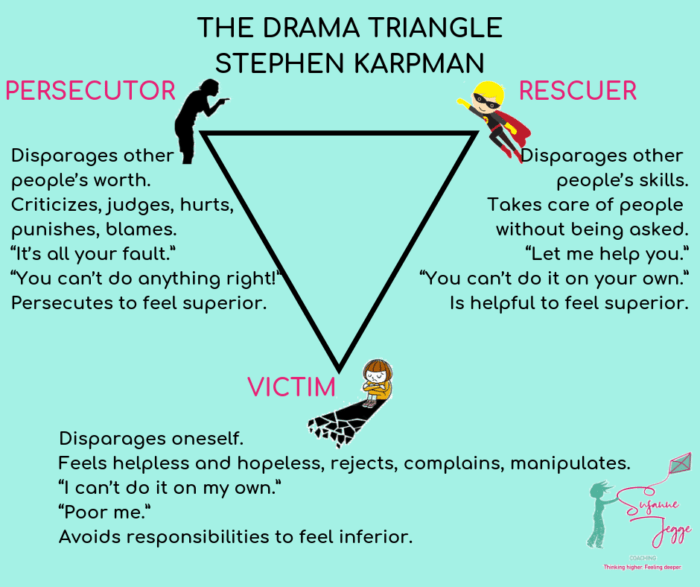
Stephen Karpman used triangles to map conflicted or drama-intense relationship transactions. The Karpman Drama Triangle models the connection between personal responsibility and power in conflicts, and the destructive and shifting roles people play. He defined three roles in the conflict; Persecutor, Rescuer (the one up positions) and Victim (one down position). Karpman placed these three roles on an inverted triangle and referred to them as being the three aspects, or faces of drama.

  • The Victim:
    • The Victim in this model is not intended to represent an actual victim, but rather someone feeling or acting like one.
    • The Victim’s stance is “Poor me!”
    • The Victim feels victimised, oppressed, helpless, hopeless, powerless, ashamed, and seems unable to make decisions, solve problems, take pleasure in life, or achieve insight.
    • The Victim, if not being persecuted, will seek out a Persecutor and also a Rescuer who will save the day but also perpetuate the Victim’s negative feelings.
  • The Rescuer:
    • The rescuer’s line is “Let me help you.”
    • A classic enabler, the Rescuer feels guilty if they do not go to the rescue.
    • Yet their rescuing has negative effects: It keeps the Victim dependent and does not allow the Victim permission to fail and experience the consequences of their choices.
    • The rewards derived from this rescue role are that the focus is taken off of the rescuer.
    • When they focus their energy on someone else, it enables them to ignore their own anxiety and issues.
    • This rescue role is also pivotal because their actual primary interest is really an avoidance of their own problems disguised as concern for the victim’s needs.
  • The Persecutor:
    • A.k.a. Villain.
    • The Persecutor insists, “It’s all your fault.”
    • The Persecutor is controlling, blaming, critical, oppressive, angry, authoritarian, rigid, and superior.

Initially, a drama triangle arises when a person takes on the role of a victim or persecutor. This person then feels the need to enlist other players into the conflict. As often happens, a rescuer is encouraged to enter the situation. These enlisted players take on roles of their own that are not static, and therefore various scenarios can occur. The victim might turn on the rescuer, for example, while the rescuer then switches to persecution.

The reason that the situation persist is that each participant has their (frequently unconscious) psychological wishes/needs met without having to acknowledge the broader dysfunction or harm done in the situation as a whole. Each participant is acting upon their own selfish needs, rather than acting in a genuinely responsible or altruistic manner. Any character might “ordinarily come on like a plaintive victim; it is now clear that the one can switch into the role of Persecutor providing it is ‘accidental’ and the one apologises for it”.

The motivations of the rescuer are the least obvious. In the terms of the triangle, the rescuer has a mixed or covert motive and benefits egoically in some way from being “the one who rescues”. The rescuer has a surface motive of resolving the problem and appears to make great efforts to solve it, but also has a hidden motive to not succeed, or to succeed in a way in which they benefit. They may get a self-esteem boost, for example, or receive respected rescue status, or derive enjoyment by having someone depend on them and trust them and act in a way that ostensibly seems to be trying to help, but at a deeper level plays upon the victim in order to continue getting a payoff.

The relationship between the victim and the rescuer may be one of co-dependency. The rescuer keeps the victim dependent by encouraging their victimhood. The victim gets their needs met by having the rescuer take care of them.

Participants generally tend to have a primary or habitual role (victim, rescuer, persecutor) when they enter into drama triangles. Participants first learn their habitual role in their family of origin. Even though participants each have a role with which they most identify, once on the triangle, participants rotate through all the three positions.

Each triangle has a “payoff” for those playing it. The “antithesis” of a drama triangle lies in discovering how to deprive the actors of their payoff.

Use

Through popular usage and the work of Karpman and others, Karpman’s triangle has been adapted for use in structural analysis and transactional analysis.

Historical Context

Family Therapy Movement

After World War II, therapists observed that while many battle-torn veteran patients readjusted well after returning to their families, some patients did not; some even regressed when they returned to their home environment. Researchers felt that they needed an explanation for this and began to explore the dynamics of family life – and thus began the family therapy movement. Prior to this time, psychiatrists and psychoanalysts focused on the patient’s already-developed psyche and downplayed outside detractors. Intrinsic factors were addressed and extrinsic reactions were considered as emanating from forces within the person.

Transaction Analysis

In the 1950s, Eric Berne developed transactional analysis, a method for studying interactions between individuals. This approach was profoundly different than that of Freud. While Freud relied on asking patients about themselves, Berne felt that a therapist could learn by observing what was communicated (words, body language, facial expressions) in a transaction. So instead of directly asking the patient questions, Berne would frequently observe the patient in a group setting, noting all of the transactions that occurred between the patient and other individuals.

Triangles/Triangulation

The theory of triangulation was originally published in 1966 by Murray Bowen as one of eight parts of Bowen’s family systems theory. Murray Bowen, a pioneer in family systems theory, began his early work with schizophrenics at the Menninger Clinic, from 1946 to 1954. Triangulation is the “process whereby a two-party relationship that is experiencing tension will naturally involve third parties to reduce tension”. Simply put, when people find themselves in conflict with another person, they will reach out to a third person. The resulting triangle is more comfortable as it can hold much more tension because the tension is being shifted around three people instead of two.

Bowen studied the dyad of the mother and her schizophrenic child while he had them both living in a research unit at the Menninger clinic. Bowen then moved to the National Institute of Mental Health (NIMH), where he resided from 1954 to 1959. At the NIMH Bowen extended his hypothesis to include the father-mother-child triad. Bowen considered differentiation and triangles the crux of his theory, Bowen Family Systems Theory. Bowen intentionally used the word triangle rather than triad. In Bowen Family Systems Theory, the triangle is an essential part of the relationship.

Couples left to their own resources oscillate between closeness and distance. Two people having this imbalance often have difficulty resolving it by themselves. To stabilise the relationship, the couple often seek the aid of a third party to help re-establish closeness. A triangle is the smallest possible relationship system that can restore balance in a time of stress. The third person assumes an outside position. In periods of stress, the outside position is the most comfortable and desired position. The inside position is plagued by anxiety, along with its emotional closeness. The outsider serves to preserve the inside couple’s relationship. Bowen noted that not all triangles are constructive – some are destructive.

Pathological/Perverse Triangles

In 1968, Nathan Ackerman conceptualised a destructive triangle. Ackerman stated “we observe certain constellations of family interactions which we have epitomised as the pattern of family interdependence, roles those of destroyer or persecutor, the victim of the scapegoating attack, and the family healer or the family doctor. Ackerman also recognise the pattern of attack, defence, and counterattack, as shifting roles.

Karpman Triangle and Eric Berne

In 1968, Stephen Karpman, who had an interest in acting and was a member of the Screen Actors Guild, chose “drama triangle” rather than “conflict triangle” as, here, the Victim in his model is not intended to represent an actual victim, but rather someone feeling or acting like one. He first published his theory in an article entitled “Fairy Tales and Script Drama Analysis”. His article, in part, examined the fairy tale “Little Red Riding Hood” to illustrate its points. Karpman was, at the time, a recent graduate of Duke University School of Medicine and was doing post post-graduate studies under Berne. Berne, who founded the field transactional analysis, encouraged Karpman to publish what Berne referred to as “Karpman’s triangle”. Karpman’s article was published in 1968. In 1972, Karpman received the Eric Berne Memorial Scientific Award for the work.

Transactional Analysis

Eric Berne, a Canadian-born psychiatrist, created the theory of transactional analysis, in the middle of the 20th century, as a way of explaining human behaviour. Berne’s theory of transactional analysis was based on the ideas of Freud but was distinctly different. Freudian psychotherapists focused on talk therapy as a way of gaining insight to their patients’ personalities. Berne believed that insight could be better discovered by analysing patients’ social transactions.

Games in transactional analysis refers to a series of transactions that is complementary (reciprocal), ulterior, and proceeds towards a predictable outcome. In this context, the Karpman Drama Triangle is a “game”.

Games are often characterised by a switch in roles of players towards the end. The number of players may vary. Games in this sense are devices used (often unconsciously) by people to create a circumstance where they can justifiably feel certain resulting feelings (such as anger or superiority) or justifiably take or avoid taking certain actions where their own inner wishes differ from societal expectations. They are always a substitute for a more genuine and full adult emotion and response which would be more appropriate. Three quantitative variables are often useful to consider for games:

  • Flexibility:
    • “The ability of the players to change the currency of the game (that is, the tools they use to play it).
    • “Some games…can be played properly with only one kind of currency, while others, such as exhibitionistic games, are more flexible”, so that players may shift from words, to money, to parts of the body.
  • Tenacity:
    • “Some people give up their games easily, others are more persistent”, referring to the way people stick to their games and their resistance to breaking with them.
  • Intensity:
    • “Some people play their games in a relaxed way, others are more tense and aggressive.
    • Games so played are known as easy and hard games, respectively”, the latter being played in a tense and aggressive way.

The consequences of games may vary from small paybacks to paybacks built up over a long period to a major level. Based on the degree of acceptability and potential harm, games are classified into three categories, representing first degree games, second degree games, and third degree games:

  • Socially acceptable.
  • Undesirable but not irreversibly damaging.
  • May result in drastic harm.

The Karpman triangle was an adaptation of a model that was originally conceived to analyse the play-action pass and the draw play in American football and later adapted as a way to analyse movie scripts. Karpman is reported to have doodled thirty or more diagram types before settling on the triangle. Karpman credits the movie Valley of the Dolls as being a testbed for refining the model into what Berne coined as the Karpman Drama Triangle.

Karpman now has many variables of the Karpman triangle in his fully developed theory, besides role switches. These include space switches (private-public, open-closed, near-far) which precede, cause, or follow role switches, and script velocity (number of role switches in a given unit of time). These include the Question Mark triangle, False Perception triangle, Double Bind triangle, The Indecision triangle, the Vicious Cycle triangle, Trapping triangle, Escape triangle, Triangles of Oppression, and Triangles of Liberation, Switching in the triangle, and the Alcoholic Family triangle.

While transactional analysis is the method for studying interactions between individuals, one researcher postulates that drama-based leaders can instil an organisational culture of drama. Persecutors are more likely to be in leadership positions and a persecutor culture goes hand in hand with cutthroat competition, fear, blaming, manipulation, high turnover and an increased risk of lawsuits. There are also victim cultures which can lead to low morale and low engagement as well as an avoidance of conflict, and rescuer cultures which can be characterised as having a high dependence on the leader, low initiative and low innovation.

Therapeutic Models

The Winner’s Triangle was published by Acey Choy in 1990 as a therapeutic model for showing patients how to alter social transactions when entering a triangle at any of the three entry points. Choy recommends that anyone feeling like a victim think more in terms of being vulnerable and caring, that anyone cast as a persecutor adopt an assertive posture, and anyone recruited to be a rescuer should react by being “caring”.

  • Vulnerable: A victim should be encouraged to accept their vulnerability, problem solve, and be more self-aware.
  • Assertive: A persecutor should be encouraged to ask for what they want, be assertive, but not be punishing.
  • Caring: A rescuer should be encouraged to show concern and be caring, but not over-reach and problem solve for others.

The Power of TED, first published in 2009, recommends that the “victim” adopt the alternative role of creator, view the persecutor as a challenger, and enlist a coach instead of a rescuer.

  • Creator:
    • Victims are encouraged to be outcome-oriented as opposed to problem-oriented and take responsibility for choosing their response to life challenges.
    • They should focus on resolving “dynamic tension” (the difference between current reality and the envisioned goal or outcome) by taking incremental steps toward the outcomes he or she is trying to achieve.
  • Challenger:
    • A victim is encouraged to see a persecutor as a person (or situation) that forces the creator to clarify his or her needs, and focus on their learning and growth.
  • Coach:
    • A rescuer should be encouraged to ask questions that are intended to help the individual to make informed choices.
    • The key difference between a rescuer and a coach is that the coach sees the creator as capable of making choices and of solving his or her own problems.
    • A coach asks questions that enable the creator to see the possibilities for positive action, and to focus on what he or she does want instead of what he or she does not want.

On This Day … 12 January

People (Births)

  • 1896 – David Wechsler, Romanian-American psychologist and author (d. 1981).
  • 1914 – Mieko Kamiya, Japanese psychiatrist and psychologist (d. 1979).
  • 1941 – Fiona Caldicott, English psychiatrist and psychotherapist.

David Wechsler

David Wechsler (12 January 1896 to 02 May 1981) was a Romanian-American psychologist. He developed well-known intelligence scales, such as the Wechsler Adult Intelligence Scale (WAIS) and the Wechsler Intelligence Scale for Children (WISC). A Review of General Psychology survey, published in 2002, ranked Wechsler as the 51st most cited psychologist of the 20th century.

Biography

Wechsler was born in a Jewish family in Lespezi, Romania, and emigrated with his parents to the United States as a child. He studied at the City College of New York and Columbia University, where he earned his master’s degree in 1917 and his Ph.D. in 1925 under the direction of Robert S. Woodworth. During World War I, he worked with the United States Army to develop psychological tests to screen new draftees while studying under Charles Spearman and Karl Pearson.

After short stints at various locations (including five years in private practice), Wechsler became chief psychologist at Bellevue Psychiatric Hospital in 1932, where he stayed until 1967. He died on 02 May 1981.

Intelligence Scales

Wechsler is best known for his intelligence tests. He was one of the most influential advocates of the role of non-intellective factors in testing. He emphasized that factors other than intellectual ability are involved in intelligent behaviour. Wechsler objected to the single score offered by the 1937 Binet scale. Although his test did not directly measure non-intellective factors, it took these factors into careful account in its underlying theory. The Wechsler Adult Intelligence Scale (WAIS) was developed first in 1939 and then called the Wechsler-Bellevue Intelligence Test. From these he derived the Wechsler Intelligence Scale for Children (WISC) in 1949 and the Wechsler Preschool and Primary Scale of Intelligence (WPPSI) in 1967. Wechsler originally created these tests to find out more about his patients at the Bellevue clinic and he found the then-current Binet IQ test unsatisfactory. The tests are still based on his philosophy that intelligence is “the global capacity to act purposefully, to think rationally, and to deal effectively with [one’s] environment” (cited in Kaplan & Saccuzzo, p. 256).

The Wechsler scales introduced many novel concepts and breakthroughs to the intelligence testing movement. First, he did away with the quotient scores of older intelligence tests (the Q in “I.Q.”). Instead, he assigned an arbitrary value of 100 to the mean intelligence and added or subtracted another 15 points for each standard deviation above or below the mean the subject was. While not rejecting the concept of general intelligence (as conceptualised by his teacher Charles Spearman), he divided the concept of intelligence into two main areas: verbal and performance (non-verbal) scales, each evaluated with different subtests.

Mieko Kamiya

Mieko Kamiya (神谷 美恵子, Kamiya Mieko, 12 January 1914 to 22 October 1979) was a Japanese psychiatrist who treated leprosy patients at Nagashima Aiseien Sanatorium. She was known for translating books on philosophy. She worked as a medical doctor in the Department of Psychiatry at Tokyo University following World War II. She was said to have greatly helped the Ministry of Education and the General Headquarters, where the Supreme Commander of the Allied Powers stayed, in her role as an English-speaking secretary, and served as an adviser to Empress Michiko. She wrote many books as a highly educated, multi-lingual person; one of her books, titled On the Meaning of Life (Ikigai Ni Tsuite in Japanese), based on her experiences with leprosy patients, attracted many readers.

Fiona Caldicott

Dame Fiona Caldicott, DBE, FMedSci (12 January 1941 to Present) is a psychiatrist and psychotherapist and, previously, Principal of Somerville College, Oxford. She is the present National Data Guardian for Health and Social Care in England.

Caldicott was born on 12 January 1941 in Troon, daughter of barrister Joseph Maurice Soesan and civil servant Elizabeth Jane (née Ransley). Her paternal grandparents were greengrocers who were unenthusiastic about education; her father left school in his mid-teens, but subsequently completed a chemistry degree at night school and a law degree by correspondence. Caldicott was educated at City of London School for Girls, then studied medicine at St Hilda’s College, Oxford, qualifying BM BCh in 1966.

Career

She was a Pro Vice-Chancellor, Personnel and Equal Opportunities, of the University of Oxford and chaired its Personnel Committee. She retired from her 10-year term as Chair at the Oxford University Hospitals NHS Trust in March 2019, and was a past President of the British Association for Counselling and Psychotherapy. She was the first woman to be President of the Royal College of Psychiatrists (1993–96) and its first woman Dean (1990-1993). From 2011 to 2013 she was Chair of the National Information Governance Board for Health and Social Care.

Caldicott Committee

A review was commissioned by the Chief Medical Officer of England and Wales owing to increasing concern about the ways in which patient information is used in the NHS of England and Wales and the need to ensure that confidentiality is not undermined. Such concern was largely due to the development of information technology in the service, and its capacity to disseminate information about patients rapidly and extensively. In 1996, guidance on “the protection and use of patient information” was promulgated and there was a need to promote awareness of it at all levels in the NHS. It did not affect Scotland originally but they have recently adopted it. A main committee was set up under Caldicott’s Chair and there were four separate working groups; the committee was known as the Caldicott Committee.

The Caldicott Committee … was [responsible] to review all patient-identifiable information, which passes from NHS organisations to other NHS or non-NHS bodies for purposes other than direct care, medical research, or where there is a statutory requirement for information. The committee was to consider each flow of patient-identifiable information and was to advise the NHS Executive whether patient identification was justified by the purpose and whether action to minimise risks of breach of confidentiality was desirable – for example, reduction, elimination, or separate storage of items of information.

The Caldicott Report was published in December 1997. Today, every NHS trust has a ‘Caldicott Guardian’, to make sure standards of patient confidentiality and the Caldicott principles are upheld.

National Data Guardian for Health and Social Care

Caldicott became the UK’s first National Data Guardian for Health and Social Care in November 2014. In December 2018 the Health and Social Care (National Data Guardian) Act 2018 passed into law, and in April 2019 she was appointed as the first statutory position holder by the Secretary of State for Health and Social Care.

Awards and Honours

  • Honorary fellow at Somerville College, Oxford.
  • Dame Commander of the Order of the British Empire, 15 June 1996..
  • Lifetime Achievement Award from the Royal College of Psychiatrists, November 2018.

What is Psychology?

Introduction

Psychology is the science of mind and behaviour. Psychology includes the study of conscious and unconscious phenomena, as well as feeling and thought. It is an academic discipline of immense scope. Psychologists seek an understanding of the emergent properties of brains, and all the variety of phenomena linked to those emergent properties, joining this way the broader neuro-scientific group of researchers. As a social science, it aims to understand individuals and groups by establishing general principles and researching specific cases. Not to be confused with psychiatry.

In this field, a professional practitioner or researcher is called a psychologist and can be classified as a social, behavioural, or cognitive scientist. Psychologists attempt to understand the role of mental functions in individual and social behaviour, while also exploring the physiological and biological processes that underlie cognitive functions and behaviours.

Psychologists explore behaviour and mental processes, including perception, cognition, attention, emotion, intelligence, subjective experiences, motivation, brain functioning, and personality. This extends to interaction between people, such as interpersonal relationships, including psychological resilience, family resilience, and other areas. Psychologists of diverse orientations also consider the unconscious mind. Psychologists employ empirical methods to infer causal and correlational relationships between psychosocial variables. In addition, or in opposition, to employing empirical and deductive methods, some – especially clinical psychologists and counselling psychologists – at times rely upon symbolic interpretation and other inductive techniques. Psychology has been described as a “hub science” in that medicine tends to draw psychological research via neurology and psychiatry, whereas social sciences most commonly draws directly from sub-disciplines within psychology.

While psychological knowledge is often applied to the assessment and treatment of mental health problems, it is also directed towards understanding and solving problems in several spheres of human activity. By many accounts, psychology ultimately aims to benefit society. The majority of psychologists are involved in some kind of therapeutic role, practicing in clinical, counselling, or school settings. Many do scientific research on a wide range of topics related to mental processes and behaviour, and typically work in university psychology departments or teach in other academic settings (e.g. medical schools, hospitals). Some are employed in industrial and organizational settings, or in other areas such as human development and aging, sports, health, and the media, as well as in forensic investigation and other aspects of law.

Etymology and Definitions

The word psychology derives from Greek roots meaning study of the psyche, or soul (ψυχή psychē, “breath, spirit, soul” and -λογία -logia, “study of” or “research”).The Latin word psychologia was first used by the Croatian humanist and Latinist Marko Marulić in his book, Psichiologia de ratione animae humanae in the late 15th century or early 16th century. The earliest known reference to the word psychology in English was by Steven Blankaart in 1694 in The Physical Dictionary which refers to “Anatomy, which treats the Body, and Psychology, which treats of the Soul.”

In 1890, William James defined psychology as “the science of mental life, both of its phenomena and their conditions”. This definition enjoyed widespread currency for decades. However, this meaning was contested, notably by radical behaviourists such as John B. Watson, who in his 1913 manifesto defined the discipline of psychology as the acquisition of information useful to the control of behaviour. Also since James defined it, the term more strongly connotes techniques of scientific experimentation. Folk psychology refers to the understanding of ordinary people, as contrasted with that of psychology professionals.

Brief History

The ancient civilizations of Egypt, Greece, China, India, and Persia all engaged in the philosophical study of psychology. In Ancient Egypt the Ebers Papyrus mentioned depression and thought disorders. Historians note that Greek philosophers, including Thales, Plato, and Aristotle (especially in his De Anima treatise), addressed the workings of the mind. As early as the 4th century BC, Greek physician Hippocrates theorised that mental disorders had physical rather than supernatural causes.

In China, psychological understanding grew from the philosophical works of Laozi and Confucius, and later from the doctrines of Buddhism. This body of knowledge involves insights drawn from introspection and observation, as well as techniques for focused thinking and acting. It frames the universe as a division of, and interaction between, physical reality and mental reality, with an emphasis on purifying the mind in order to increase virtue and power. An ancient text known as The Yellow Emperor’s Classic of Internal Medicine identifies the brain as the nexus of wisdom and sensation, includes theories of personality based on yin-yang balance, and analyses mental disorder in terms of physiological and social disequilibria. Chinese scholarship focused on the brain advanced in the Qing Dynasty with the work of Western-educated Fang Yizhi (1611-1671), Liu Zhi (1660-1730), and Wang Qingren (1768-1831). Wang Qingren emphasized the importance of the brain as the centre of the nervous system, linked mental disorder with brain diseases, investigated the causes of dreams and insomnia, and advanced a theory of hemispheric lateralisation in brain function.

Distinctions in types of awareness appear in the ancient thought of India, influenced by Hinduism. A central idea of the Upanishads is the distinction between a person’s transient mundane self and their eternal unchanging soul. Divergent Hindu doctrines, and Buddhism, have challenged this hierarchy of selves, but have all emphasized the importance of reaching higher awareness. Yoga is a range of techniques used in pursuit of this goal. Much of the Sanskrit corpus was suppressed under the British East India Company followed by the British Raj in the 1800s. However, Indian doctrines influenced Western thinking via the Theosophical Society, a New Age group which became popular among Euro-American intellectuals.

Psychology was a popular topic in Enlightenment Europe. In Germany, Gottfried Wilhelm Leibniz (1646-1716) applied his principles of calculus to the mind, arguing that mental activity took place on an indivisible continuum – most notably, that among an infinity of human perceptions and desires, the difference between conscious and unconscious awareness is only a matter of degree. Christian Wolff identified psychology as its own science, writing Psychologia empirica in 1732 and Psychologia rationalis in 1734. This notion advanced further under Immanuel Kant, who established the idea of anthropology, with psychology as an important subdivision. However, Kant explicitly and notoriously rejected the idea of experimental psychology, writing that “the empirical doctrine of the soul can also never approach chemistry even as a systematic art of analysis or experimental doctrine, for in it the manifold of inner observation can be separated only by mere division in thought, and cannot then be held separate and recombined at will (but still less does another thinking subject suffer himself to be experimented upon to suit our purpose), and even observation by itself already changes and displaces the state of the observed object.” In 1783, Ferdinand Ueberwasser (1752-1812) designated himself Professor of Empirical Psychology and Logic and gave lectures on scientific psychology, though these developments were soon overshadowed by the Napoleonic Wars, after which the Old University of Münster was discontinued by Prussian authorities. Having consulted philosophers Hegel and Herbart, however, in 1825 the Prussian state established psychology as a mandatory discipline in its rapidly expanding and highly influential educational system. However, this discipline did not yet embrace experimentation. In England, early psychology involved phrenology and the response to social problems including alcoholism, violence, and the country’s well-populated mental asylums.

The Beginning of Experimental Psychology

Gustav Fechner began conducting psychophysics research in Leipzig in the 1830s, articulating the principle (Weber-Fechner law) that human perception of a stimulus varies logarithmically according to its intensity. Fechner’s 1860 Elements of Psychophysics challenged Kant’s stricture against quantitative study of the mind. In Heidelberg, Hermann von Helmholtz conducted parallel research on sensory perception, and trained physiologist Wilhelm Wundt. Wundt, in turn, came to Leipzig University, establishing the psychological laboratory which brought experimental psychology to the world. Wundt focused on breaking down mental processes into the most basic components, motivated in part by an analogy to recent advances in chemistry, and its successful investigation of the elements and structure of material. Paul Flechsig and Emil Kraepelin soon created another influential psychology laboratory at Leipzig, this one focused on more on experimental psychiatry.

Psychologists in Germany, Denmark, Austria, England, and the United States soon followed Wundt in setting up laboratories. G. Stanley Hall who studied with Wundt, formed a psychology lab at Johns Hopkins University in Maryland, which became internationally influential. Hall, in turn, trained Yujiro Motora, who brought experimental psychology, emphasizing psychophysics, to the Imperial University of Tokyo. Wundt’s assistant, Hugo Münsterberg, taught psychology at Harvard to students such as Narendra Nath Sen Gupta – who, in 1905, founded a psychology department and laboratory at the University of Calcutta. Wundt students Walter Dill Scott, Lightner Witmer, and James McKeen Cattell worked on developing tests for mental ability. Catell, who also studied with eugenicist Francis Galton, went on to found the Psychological Corporation. Wittmer focused on mental testing of children; Scott, on selection of employees.

Another student of Wundt, Edward Titchener, created the psychology program at Cornell University and advanced a doctrine of “structuralist” psychology. Structuralism sought to analyse and classify different aspects of the mind, primarily through the method of introspection. William James, John Dewey and Harvey Carr advanced a more expansive doctrine called functionalism, attuned more to human-environment actions. In 1890, James wrote an influential book, The Principles of Psychology, which expanded on the realm of structuralism, memorably described the human “stream of consciousness”, and interested many American students in the emerging discipline. Dewey integrated psychology with social issues, most notably by promoting the cause progressive education to assimilate immigrants and inculcate moral values in children.

A different strain of experimentalism, with more connection to physiology, emerged in South America, under the leadership of Horacio G. Piñero at the University of Buenos Aires. Russia, too, placed greater emphasis on the biological basis for psychology, beginning with Ivan Sechenov’s 1873 essay, “Who Is to Develop Psychology and How?” Sechenov advanced the idea of brain reflexes and aggressively promoted a deterministic viewpoint on human behaviour.

Wolfgang Kohler, Max Wertheimer and Kurt Koffka co-founded the school of Gestalt psychology (not to be confused with the Gestalt therapy of Fritz Perls). This approach is based upon the idea that individuals experience things as unified wholes. Rather than breaking down thoughts and behaviour into smaller elements, as in structuralism, the Gestaltists maintained that whole of experience is important, and differs from the sum of its parts. Other 19th-century contributors to the field include the German psychologist Hermann Ebbinghaus, a pioneer in the experimental study of memory, who developed quantitative models of learning and forgetting at the University of Berlin, and the Russian-Soviet physiologist Ivan Pavlov, who discovered in dogs a learning process that was later termed “classical conditioning” and applied to human beings.

Consolidation and Funding

One of the earliest psychology societies was La Société de Psychologie Physiologique in France, which lasted 1885-1893. The first meeting of the International Congress of Psychology sponsored by the International Union of Psychological Science took place in Paris, in August 1889, amidst the World’s Fair celebrating the centennial of the French Revolution. William James was one of three Americans among the four hundred attendees. The American Psychological Association (APA) was founded soon after, in 1892. The International Congress continued to be held, at different locations in Europe, with wider international participation. The Sixth Congress, Geneva 1909, included presentations in Russian, Chinese, and Japanese, as well as Esperanto. After a hiatus for World War I, the Seventh Congress met in Oxford, with substantially greater participation from the war-victorious Anglo-Americans. In 1929, the Congress took place at Yale University in New Haven, Connecticut, attended by hundreds of members of the APA. Tokyo Imperial University led the way in bringing new psychology to the East, and from Japan these ideas diffused into China.

American psychology gained status during World War I, during which a standing committee headed by Robert Yerkes administered mental tests (“Army Alpha” and “Army Beta”) to almost 1.8 million soldiers. Subsequent funding for behavioural research came in large part from the Rockefeller family, via the Social Science Research Council. Rockefeller charities funded the National Committee on Mental Hygiene, which promoted the concept of mental illness and lobbied for psychological supervision of child development. Through the Bureau of Social Hygiene and later funding of Alfred Kinsey, Rockefeller foundations established sex research as a viable discipline in the U.S.[41] Under the influence of the Carnegie-funded Eugenics Record Office, the Draper-funded Pioneer Fund, and other institutions, the eugenics movement also had a significant impact on American psychology; in the 1910s and 1920s, eugenics became a standard topic in psychology classes.

During World War II and the Cold War, the US military and intelligence agencies established themselves as leading funders of psychology – through the armed forces and in the new Office of Strategic Services intelligence agency. University of Michigan psychologist Dorwin Cartwright reported that university researchers began large-scale propaganda research in 1939-1941, and “the last few months of the war saw a social psychologist become chiefly responsible for determining the week-by-week-propaganda policy for the United States Government.” Cartwright also wrote that psychologists had significant roles in managing the domestic economy. The Army rolled out its new General Classification Test and engaged in massive studies of troop morale. In the 1950s, the Rockefeller Foundation and Ford Foundation collaborated with the Central Intelligence Agency (CIA) to fund research on psychological warfare. In 1965, public controversy called attention to the Army’s Project Camelot – the “Manhattan Project” of social science – an effort which enlisted psychologists and anthropologists to analyse foreign countries for strategic purposes.

In Germany after World War I, psychology held institutional power through the military, and subsequently expanded along with the rest of the military under the Third Reich. Under the direction of Hermann Göring’s cousin Matthias Göring, the Berlin Psychoanalytic Institute was renamed the Göring Institute. Freudian psychoanalysts were expelled and persecuted under the anti-Jewish policies of the Nazi Party, and all psychologists had to distance themselves from Freud and Adler. The Göring Institute was well-financed throughout the war with a mandate to create a “New German Psychotherapy”. This psychotherapy aimed to align suitable Germans with the overall goals of the Reich; as described by one physician: “Despite the importance of analysis, spiritual guidance and the active cooperation of the patient represent the best way to overcome individual mental problems and to subordinate them to the requirements of the Volk and the Gemeinschaft.” Psychologists were to provide Seelenführung, leadership of the mind, to integrate people into the new vision of a German community. Harald Schultz-Hencke melded psychology with the Nazi theory of biology and racial origins, criticising psychoanalysis as a study of the weak and deformed. Johannes Heinrich Schultz, a German psychologist recognised for developing the technique of autogenic training, prominently advocated sterilisation and euthanasia of men considered genetically undesirable, and devised techniques for facilitating this process. After the war, some new institutions were created and some psychologists were discredited due to Nazi affiliation. Alexander Mitscherlich founded a prominent applied psychoanalysis journal called Psyche and with funding from the Rockefeller Foundation established the first clinical psychosomatic medicine division at Heidelberg University. In 1970, psychology was integrated into the required studies of medical students.

After the Russian Revolution, psychology was heavily promoted by the Bolsheviks as a way to engineer the “New Man” of socialism. Thus, university psychology departments trained large numbers of students, for whom positions were made available at schools, workplaces, cultural institutions, and in the military. An especial focus was paedology, the study of child development, regarding which Lev Vygotsky became a prominent writer. The Bolsheviks also promoted free love and embraced the doctrine of psychoanalysis as an antidote to sexual repression. Although paedology and intelligence testing fell out of favour in 1936, psychology maintained its privileged position as an instrument of the Soviet Union. Stalinist purges took a heavy toll and instilled a climate of fear in the profession, as elsewhere in Soviet society. Following World War II, Jewish psychologists past and present (including Lev Vygotsky, A.R. Luria, and Aron Zalkind) were denounced; Ivan Pavlov (posthumously) and Stalin himself were aggrandised as heroes of Soviet psychology. Soviet academics was speedily liberalised during the Khrushchev Thaw, and cybernetics, linguistics, genetics, and other topics became acceptable again. There emerged a new field called “engineering psychology” which studied mental aspects of complex jobs (such as pilot and cosmonaut). Interdisciplinary studies became popular and scholars such as Georgy Shchedrovitsky developed systems theory approaches to human behaviour.

Twentieth-century Chinese psychology originally modelled the US, with translations from American authors like William James, the establishment of university psychology departments and journals, and the establishment of groups including the Chinese Association of Psychological Testing (1930) and the Chinese Psychological Society (1937). Chinese psychologists were encouraged to focus on education and language learning, with the aspiration that education would enable modernisation and nationalisation. John Dewey, who lectured to Chinese audiences in 1918-1920, had a significant influence on this doctrine. Chancellor T’sai Yuan-p’ei introduced him at Peking University as a greater thinker than Confucius. Kuo Zing-yang who received a PhD at the University of California, Berkeley, became President of Zhejiang University and popularised behaviourism. After the Chinese Communist Party gained control of the country, the Stalinist Soviet Union became the leading influence, with Marxism-Leninism the leading social doctrine and Pavlovian conditioning the approved concept of behaviour change. Chinese psychologists elaborated on Lenin’s model of a “reflective” consciousness, envisioning an “active consciousness” (pinyin: tzu-chueh neng-tung-li) able to transcend material conditions through hard work and ideological struggle. They developed a concept of “recognition” (pinyin: jen-shih) which referred the interface between individual perceptions and the socially accepted worldview (failure to correspond with party doctrine was “incorrect recognition”). Psychology education was centralized under the Chinese Academy of Sciences, supervised by the State Council. In 1951, the Academy created a Psychology Research Office, which in 1956 became the Institute of Psychology. Most leading psychologists were educated in the United States, and the first concern of the Academy was re-education of these psychologists in the Soviet doctrines. Child psychology and pedagogy for nationally cohesive education remained a central goal of the discipline.

Disciplinary Organisation

Institutions

In 1920, Édouard Claparède and Pierre Bovet created a new applied psychology organisation called the International Congress of Psychotechnics Applied to Vocational Guidance, later called the International Congress of Psychotechnics and then the International Association of Applied Psychology. The IAAP is considered the oldest international psychology association. Today, at least 65 international groups deal with specialized aspects of psychology. In response to male predominance in the field, female psychologists in the US formed National Council of Women Psychologists in 1941. This organisation became the International Council of Women Psychologists after World War II, and the International Council of Psychologists in 1959. Several associations including the Association of Black Psychologists and the Asian American Psychological Association have arisen to promote non-European racial groups in the profession.

The world federation of national psychological societies is the International Union of Psychological Science (IUPsyS), founded in 1951 under the auspices of UNESCO, the United Nations cultural and scientific authority. Psychology departments have since proliferated around the world, based primarily on the Euro-American model. Since 1966, the Union has published the International Journal of Psychology. IAAP and IUPsyS agreed in 1976 each to hold a congress every four years, on a staggered basis.

The International Union recognises 66 national psychology associations and at least 15 others exist. The American Psychological Association is the oldest and largest. Its membership has increased from 5,000 in 1945 to 100,000 in the present day. The APA includes 54 divisions, which since 1960 have steadily proliferated to include more specialties. Some of these divisions, such as the Society for the Psychological Study of Social Issues and the American Psychology-Law Society, began as autonomous groups.

The Interamerican Society of Psychology, founded in 1951, aspires to promote psychology and coordinate psychologists across the Western Hemisphere. It holds the Interamerican Congress of Psychology and had 1,000 members in year 2000. The European Federation of Professional Psychology Associations, founded in 1981, represents 30 national associations with a total of 100,000 individual members. At least 30 other international groups organize psychologists in different regions.

In some places, governments legally regulate who can provide psychological services or represent themselves as a “psychologist”. The APA defines a psychologist as someone with a doctoral degree in psychology.

Boundaries

Early practitioners of experimental psychology distinguished themselves from parapsychology, which in the late nineteenth century enjoyed great popularity (including the interest of scholars such as William James), and indeed constituted the bulk of what people called “psychology”. Parapsychology, hypnotism, and psychism were major topics of the early International Congresses. But students of these fields were eventually ostracised, and more or less banished from the Congress in 1900-1905. Parapsychology persisted for a time at Imperial University, with publications such as Clairvoyance and Thoughtography by Tomokichi Fukurai, but here too it was mostly shunned by 1913.

As a discipline, psychology has long sought to fend off accusations that it is a “soft” science. Philosopher of science Thomas Kuhn’s 1962 critique implied psychology overall was in a pre-paradigm state, lacking the agreement on overarching theory found in mature sciences such as chemistry and physics. Because some areas of psychology rely on research methods such as surveys and questionnaires, critics asserted that psychology is not an objective science. Sceptics have suggested that personality, thinking, and emotion, cannot be directly measured and are often inferred from subjective self-reports, which may be problematic. Experimental psychologists have devised a variety of ways to indirectly measure these elusive phenomenological entities.

Divisions still exist within the field, with some psychologists more oriented towards the unique experiences of individual humans, which cannot be understood only as data points within a larger population. Critics inside and outside the field have argued that mainstream psychology has become increasingly dominated by a “cult of empiricism” which limits the scope of its study by using only methods derived from the physical sciences. Feminist critiques along these lines have argued that claims to scientific objectivity obscure the values and agenda of (historically mostly male) researchers. Jean Grimshaw, for example, argues that mainstream psychological research has advanced a patriarchal agenda through its efforts to control behaviour.

Major Schools of Thought

Biological

Psychologists generally consider the organism the basis of the mind, and therefore a vitally related area of study. Psychiatrists and neuropsychologists work at the interface of mind and body. Biological psychology, also known as physiological psychology, or neuropsychology is the study of the biological substrates of behaviour and mental processes. Key research topics in this field include comparative psychology, which studies humans in relation to other animals, and perception which involves the physical mechanics of sensation as well as neural and mental processing. For centuries, a leading question in biological psychology has been whether and how mental functions might be localised in the brain. From Phineas Gage to H.M. and Clive Wearing, individual people with mental issues traceable to physical damage have inspired new discoveries in this area. Modern neuropsychology could be said to originate in the 1870s, when in France Paul Broca traced production of speech to the left frontal gyrus, thereby also demonstrating hemispheric lateralisation of brain function. Soon after, Carl Wernicke identified a related area necessary for the understanding of speech.

The contemporary field of behavioural neuroscience focuses on physical causes underpinning behaviour. For example, physiological psychologists use animal models, typically rats, to study the neural, genetic, and cellular mechanisms that underlie specific behaviours such as learning and memory and fear responses. Cognitive neuroscientists investigate the neural correlates of psychological processes in humans using neural imaging tools, and neuropsychologists conduct psychological assessments to determine, for instance, specific aspects and extent of cognitive deficit caused by brain damage or disease. The biopsychosocial model is an integrated perspective toward understanding consciousness, behaviour, and social interaction. It assumes that any given behaviour or mental process affects and is affected by dynamically interrelated biological, psychological, and social factors.

Evolutionary psychology examines cognition and personality traits from an evolutionary perspective. This perspective suggests that psychological adaptations evolved to solve recurrent problems in human ancestral environments. Evolutionary psychology offers complementary explanations for the mostly proximate or developmental explanations developed by other areas of psychology: that is, it focuses mostly on ultimate or “why?” questions, rather than proximate or “how?” questions. “How?” questions are more directly tackled by behavioural genetics research, which aims to understand how genes and environment impact behaviour.

The search for biological origins of psychological phenomena has long involved debates about the importance of race, and especially the relationship between race and intelligence. The idea of white supremacy and indeed the modern concept of race itself arose during the process of world conquest by Europeans. Carl von Linnaeus’s four-fold classification of humans classifies Europeans as intelligent and severe, Americans as contented and free, Asians as ritualistic, and Africans as lazy and capricious. Race was also used to justify the construction of socially specific mental disorders such as drapetomania and dysaesthesia aethiopica – the behaviour of uncooperative African slaves. After the creation of experimental psychology, “ethnical psychology” emerged as a subdiscipline, based on the assumption that studying primitive races would provide an important link between animal behaviour and the psychology of more evolved humans.

Behavioural

Psychologists take human behaviour as a main area of study. Much of the research in this area began with tests on mammals, based on the idea that humans exhibit similar fundamental tendencies. Behavioural research ever aspires to improve the effectiveness of techniques for behaviour modification.

Early behavioural researchers studied stimulus-response pairings, now known as classical conditioning. They demonstrated that behaviours could be linked through repeated association with stimuli eliciting pain or pleasure. Ivan Pavlov – known best for inducing dogs to salivate in the presence of a stimulus previously linked with food – became a leading figure in the Soviet Union and inspired followers to use his methods on humans. In the United States, Edward Lee Thorndike initiated “connectionism” studies by trapping animals in “puzzle boxes” and rewarding them for escaping. Thorndike wrote in 1911: “There can be no moral warrant for studying man’s nature unless the study will enable us to control his acts.” From 1910-1913 the American Psychological Association went through a sea change of opinion, away from mentalism and towards “behaviouralism”, and in 1913 John B. Watson coined the term behaviourism for this school of thought. Watson’s famous Little Albert experiment in 1920 demonstrated that repeated use of upsetting loud noises could instil phobias (aversions to other stimuli) in an infant human. Karl Lashley, a close collaborator with Watson, examined biological manifestations of learning in the brain.

Embraced and extended by Clark L. Hull, Edwin Guthrie, and others, behaviourism became a widely used research paradigm. A new method of “instrumental” or “operant” conditioning added the concepts of reinforcement and punishment to the model of behaviour change. Radical behaviourists avoided discussing the inner workings of the mind, especially the unconscious mind, which they considered impossible to assess scientifically. Operant conditioning was first described by Miller and Kanorski and popularised in the US by B.F. Skinner, who emerged as a leading intellectual of the behaviourist movement.

Noam Chomsky delivered an influential critique of radical behaviourism on the grounds that it could not adequately explain the complex mental process of language acquisition. Martin Seligman and colleagues discovered that the conditioning of dogs led to outcomes (“learned helplessness”) that opposed the predictions of behaviourism. Skinner’s behaviourism did not die, perhaps in part because it generated successful practical applications. Edward C. Tolman advanced a hybrid “cognitive behavioural” model, most notably with his 1948 publication discussing the cognitive maps used by rats to guess at the location of food at the end of a modified maze.

The Association for Behaviour Analysis International was founded in 1974 and by 2003 had members from 42 countries. The field has been especially influential in Latin America, where it has a regional organization known as ALAMOC: La Asociación Latinoamericana de Análisis y Modificación del Comportamiento. Behaviourism also gained a strong foothold in Japan, where it gave rise to the Japanese Society of Animal Psychology (1933), the Japanese Association of Special Education (1963), the Japanese Society of Biofeedback Research (1973), the Japanese Association for Behaviour Therapy (1976), the Japanese Association for Behaviour Analysis (1979), and the Japanese Association for Behavioural Science Research (1994). Today the field of behaviourism is also commonly referred to as behaviour modification or behaviour analysis.

Cognitive

Cognitive psychology studies cognition, the mental processes underlying mental activity. Perception, attention, reasoning, thinking, problem solving, memory, learning, language, and emotion are areas of research. Classical cognitive psychology is associated with a school of thought known as cognitivism, whose adherents argue for an information processing model of mental function, informed by functionalism and experimental psychology.

Starting in the 1950s, the experimental techniques developed by Wundt, James, Ebbinghaus, and others re-emerged as experimental psychology became increasingly cognitivist – concerned with information and its processing – and, eventually, constituted a part of the wider cognitive science. Some called this development the cognitive revolution because it rejected the anti-mentalist dogma of behaviourism as well as the strictures of psychoanalysis.

Social learning theorists, such as Albert Bandura, argued that the child’s environment could make contributions of its own to the behaviours of an observant subject.

Technological advances also renewed interest in mental states and representations. English neuroscientist Charles Sherrington and Canadian psychologist Donald O. Hebb used experimental methods to link psychological phenomena with the structure and function of the brain. The rise of computer science, cybernetics and artificial intelligence suggested the value of comparatively studying information processing in humans and machines. Research in cognition had proven practical since World War II, when it aided in the understanding of weapons operation.

A popular and representative topic in this area is cognitive bias, or irrational thought. Psychologists (and economists) have classified and described a sizeable catalogue of biases which recur frequently in human thought. The availability heuristic, for example, is the tendency to overestimate the importance of something which happens to come readily to mind.

Elements of behaviourism and cognitive psychology were synthesized to form cognitive behavioural therapy, a form of psychotherapy modified from techniques developed by American psychologist Albert Ellis and American psychiatrist Aaron T. Beck.

On a broader level, cognitive science is an interdisciplinary enterprise of cognitive psychologists, cognitive neuroscientists, researchers in artificial intelligence, linguists, human-computer interaction, computational neuroscience, logicians and social scientists. The discipline of cognitive science covers cognitive psychology as well as philosophy of mind, computer science, and neuroscience.[citation needed] Computer simulations are sometimes used to model phenomena of interest.

Social

Social psychology is the study of how humans think about each other and how they relate to each other. Social psychologists study such topics as the influence of others on an individual’s behaviour (e.g. conformity, persuasion), and the formation of beliefs, attitudes, and stereotypes about other people. Social cognition fuses elements of social and cognitive psychology in order to understand how people process, remember, or distort social information. The study of group dynamics reveals information about the nature and potential optimisation of leadership, communication, and other phenomena that emerge at least at the microsocial level. In recent years, many social psychologists have become increasingly interested in implicit measures, mediational models, and the interaction of both person and social variables in accounting for behaviour. The study of human society is therefore a potentially valuable source of information about the causes of psychiatric disorder. Some sociological concepts applied to psychiatric disorders are the social role, sick role, social class, life event, culture, migration, social, and total institution.

Psychoanalysis

Psychoanalysis comprises a method of investigating the mind and interpreting experience; a systematised set of theories about human behaviour; and a form of psychotherapy to treat psychological or emotional distress, especially conflict originating in the unconscious mind. This school of thought originated in the 1890s with Austrian medical doctors including Josef Breuer (physician), Alfred Adler (physician), Otto Rank (psychoanalyst), and most prominently Sigmund Freud (neurologist). Freud’s psychoanalytic theory was largely based on interpretive methods, introspection and clinical observations. It became very well known, largely because it tackled subjects such as sexuality, repression, and the unconscious. These subjects were largely taboo at the time, and Freud provided a catalyst for their open discussion in polite society. Clinically, Freud helped to pioneer the method of free association and a therapeutic interest in dream interpretation.

Swiss psychiatrist Carl Jung, influenced by Freud, elaborated a theory of the collective unconscious – a primordial force present in all humans, featuring archetypes which exerted a profound influence on the mind. Jung’s competing vision formed the basis for analytical psychology, which later led to the archetypal and process-oriented schools. Other well-known psychoanalytic scholars of the mid-20th century include Erik Erikson, Melanie Klein, D.W. Winnicott, Karen Horney, Erich Fromm, John Bowlby, and Sigmund Freud’s daughter, Anna Freud. Throughout the 20th century, psychoanalysis evolved into diverse schools of thought which could be called Neo-Freudian. Among these schools are ego psychology, object relations, and interpersonal, Lacanian, and relational psychoanalysis.

Psychologists such as Hans Eysenck and philosophers including Karl Popper criticised psychoanalysis. Popper argued that psychoanalysis had been misrepresented as a scientific discipline, whereas Eysenck said that psychoanalytic tenets had been contradicted by experimental data. By the end of 20th century, psychology departments in American universities mostly marginalised Freudian theory, dismissing it as a “desiccated and dead” historical artefact. However, researchers in the emerging field of neuro-psychoanalysis today defend some of Freud’s ideas on scientific grounds, while scholars of the humanities maintain that Freud was not a “scientist at all, but … an interpreter”.

Existential-Humanistic Theories

Humanistic psychology developed in the 1950s as a movement within academic psychology, in reaction to both behaviourism and psychoanalysis. The humanistic approach sought to glimpse the whole person, not just fragmented parts of the personality or isolated cognitions. Humanism focused on uniquely human issues, such as free will, personal growth, self-actualisation, self-identity, death, aloneness, freedom, and meaning. It emphasized subjective meaning, rejection of determinism, and concern for positive growth rather than pathology. Some founders of the humanistic school of thought were American psychologists Abraham Maslow, who formulated a hierarchy of human needs, and Carl Rogers, who created and developed client-centred therapy. Later, positive psychology opened up humanistic themes to scientific modes of exploration.

The American Association for Humanistic Psychology, formed in 1963, declared:

Humanistic psychology is primarily an orientation toward the whole of psychology rather than a distinct area or school. It stands for respect for the worth of persons, respect for differences of approach, open-mindedness as to acceptable methods, and interest in exploration of new aspects of human behaviour. As a “third force” in contemporary psychology, it is concerned with topics having little place in existing theories and systems: e.g., love, creativity, self, growth, organism, basic need-gratification, self-actualization, higher values, being, becoming, spontaneity, play, humour, affection, naturalness, warmth, ego-transcendence, objectivity, autonomy, responsibility, meaning, fair-play, transcendental experience, peak experience, courage, and related concepts.

In the 1950s and 1960s, influenced by philosophers Søren Kierkegaard and Martin Heidegger and, psychoanalytically trained American psychologist Rollo May pioneered an existential branch of psychology, which included existential psychotherapy: a method based on the belief that inner conflict within a person is due to that individual’s confrontation with the givens of existence. Swiss psychoanalyst Ludwig Binswanger and American psychologist George Kelly may also be said to belong to the existential school. Existential psychologists differed from more “humanistic” psychologists in their relatively neutral view of human nature and their relatively positive assessment of anxiety. Existential psychologists emphasized the humanistic themes of death, free will, and meaning, suggesting that meaning can be shaped by myths, or narrative patterns, and that it can be encouraged by an acceptance of the free will requisite to an authentic, albeit often anxious, regard for death and other future prospects.

Austrian existential psychiatrist and Holocaust survivor Viktor Frankl drew evidence of meaning’s therapeutic power from reflections garnered from his own internment. He created a variation of existential psychotherapy called logotherapy, a type of existentialist analysis that focuses on a will to meaning (in one’s life), as opposed to Adler’s Nietzschean doctrine of will to power or Freud’s will to pleasure.

Themes

Personality

Personality psychology is concerned with enduring patterns of behaviour, thought, and emotion – commonly referred to as personality – in individuals. Theories of personality vary across different psychological schools and orientations. They carry different assumptions about such issues as the role of the unconscious and the importance of childhood experience. According to Freud, personality is based on the dynamic interactions of the id, ego, and super-ego. In order to develop a taxonomy of personality constructs, trait theorists, in contrast, attempt to describe the personality sphere in terms of a discrete number of key traits using the statistical data-reduction method of factor analysis. Although the number of proposed traits has varied widely, an early biologically-based model proposed by Hans Eysenck, the 3rd mostly highly cited psychologist of the 20th Century (after Freud, and Piaget respectively), suggested that at least three major trait constructs are necessary to describe human personality structure: extraversion–introversion, neuroticism-stability, and psychoticism-normality. Raymond Cattell, the 7th most highly cited psychologist of the 20th Century (based on the scientific peer-reviewed journal literature) empirically derived a theory of 16 personality factors at the primary-factor level, and up to 8 broader second-stratum factors (at the Eysenckian level of analysis), rather than the “Big Five” dimensions. Dimensional models of personality are receiving increasing support, and a version of dimensional assessment has been included in the DSM-V. However, despite a plethora of research into the various versions of the “Big Five” personality dimensions, it appears necessary to move on from static conceptualisations of personality structure to a more dynamic orientation, whereby it is acknowledged that personality constructs are subject to learning and change across the lifespan.

An early example of personality assessment was the Woodworth Personal Data Sheet, constructed during World War I. The popular, although psychometrically inadequate Myers-Briggs Type Indicator sought to assess individuals’ “personality types” according to the personality theories of Carl Jung. Behaviourist resistance to introspection led to the development of the Strong Vocational Interest Blank and Minnesota Multiphasic Personality Inventory (MMPI), in an attempt to ask empirical questions that focused less on the psychodynamics of the respondent. However, the MMPI has been subjected to critical scrutiny, given that it adhered to archaic psychiatric nosology, and since it required individuals to provide subjective, introspective responses to the hundreds of items pertaining to psychopathology.

Unconscious Mind

Study of the unconscious mind, a part of the psyche outside the awareness of the individual which nevertheless influenced thoughts and behaviour was a hallmark of early psychology. In one of the first psychology experiments conducted in the United States, C.S. Peirce and Joseph Jastrow found in 1884 that subjects could choose the minutely heavier of two weights even if consciously uncertain of the difference. Freud popularised this concept, with terms like Freudian slip entering popular culture, to mean an uncensored intrusion of unconscious thought into one’s speech and action. His 1901 text The Psychopathology of Everyday Life catalogues hundreds of everyday events which Freud explains in terms of unconscious influence. Pierre Janet advanced the idea of a subconscious mind, which could contain autonomous mental elements unavailable to the scrutiny of the subject.

Behaviourism notwithstanding, the unconscious mind has maintained its importance in psychology. Cognitive psychologists have used a “filter” model of attention, according to which much information processing takes place below the threshold of consciousness, and only certain processes, limited by nature and by simultaneous quantity, make their way through the filter. Copious research has shown that subconscious priming of certain ideas can covertly influence thoughts and behaviour. A significant hurdle in this research is proving that a subject’s conscious mind has not grasped a certain stimulus, due to the unreliability of self-reporting. For this reason, some psychologists prefer to distinguish between implicit and explicit memory. In another approach, one can also describe a subliminal stimulus as meeting an objective but not a subjective threshold.

The automaticity model, which became widespread following exposition by John Bargh and others in the 1980s, describes sophisticated processes for executing goals which can be selected and performed over an extended duration without conscious awareness. Some experimental data suggests that the brain begins to consider taking actions before the mind becomes aware of them. This influence of unconscious forces on people’s choices naturally bears on philosophical questions free will. John Bargh, Daniel Wegner, and Ellen Langer are some prominent contemporary psychologists who describe free will as an illusion.

Motivation

Psychologists such as William James initially used the term motivation to refer to intention, in a sense similar to the concept of will in European philosophy. With the steady rise of Darwinian and Freudian thinking, instinct also came to be seen as a primary source of motivation. According to drive theory, the forces of instinct combine into a single source of energy which exerts a constant influence. Psychoanalysis, like biology, regarded these forces as physical demands made by the organism on the nervous system. However, they believed that these forces, especially the sexual instincts, could become entangled and transmuted within the psyche. Classical psychoanalysis conceives of a struggle between the pleasure principle and the reality principle, roughly corresponding to id and ego. Later, in Beyond the Pleasure Principle, Freud introduced the concept of the death drive, a compulsion towards aggression, destruction, and psychic repetition of traumatic events. Meanwhile, behaviourist researchers used simple dichotomous models (pleasure/pain, reward/punishment) and well-established principles such as the idea that a thirsty creature will take pleasure in drinking. Clark Hull formalised the latter idea with his drive reduction model.

Hunger, thirst, fear, sexual desire, and thermoregulation all seem to constitute fundamental motivations for animals. Humans also seem to exhibit a more complex set of motivations – though theoretically these could be explained as resulting from primordial instincts – including desires for belonging, self-image, self-consistency, truth, love, and control.

Motivation can be modulated or manipulated in many different ways. Researchers have found that eating, for example, depends not only on the organism’s fundamental need for homeostasis – an important factor causing the experience of hunger – but also on circadian rhythms, food availability, food palatability, and cost. Abstract motivations are also malleable, as evidenced by such phenomena as goal contagion: the adoption of goals, sometimes unconsciously, based on inferences about the goals of others. Vohs and Baumeister suggest that contrary to the need-desire-fulfilment cycle of animal instincts, human motivations sometimes obey a “getting begets wanting” rule: the more you get a reward such as self-esteem, love, drugs, or money, the more you want it. They suggest that this principle can even apply to food, drink, sex, and sleep.

Development

Mainly focusing on the development of the human mind through the life span, developmental psychology seeks to understand how people come to perceive, understand, and act within the world and how these processes change as they age. This may focus on cognitive, affective, moral, social, or neural development. Researchers who study children use a number of unique research methods to make observations in natural settings or to engage them in experimental tasks. Such tasks often resemble specially designed games and activities that are both enjoyable for the child and scientifically useful, and researchers have even devised clever methods to study the mental processes of infants. In addition to studying children, developmental psychologists also study aging and processes throughout the life span, especially at other times of rapid change (such as adolescence and old age). Developmental psychologists draw on the full range of psychological theories to inform their research.

Genes and Environment

All researched psychological traits are influenced by both genes and environment, to varying degrees. These two sources of influence are often confounded in observational research of individuals or families. An example is the transmission of depression from a depressed mother to her offspring. Theory may hold that the offspring, by virtue of having a depressed mother in his or her (the offspring’s) environment, is at risk for developing depression. However, risk for depression is also influenced to some extent by genes. The mother may both carry genes that contribute to her depression but will also have passed those genes on to her offspring thus increasing the offspring’s risk for depression. Genes and environment in this simple transmission model are completely confounded.

Experimental and quasi-experimental behavioural genetic research uses genetic methodologies to disentangle this confound and understand the nature and origins of individual differences in behaviour. Traditionally this research has been conducted using twin studies and adoption studies, two designs where genetic and environmental influences can be partially un-confounded. More recently, the availability of microarray molecular genetic or genome sequencing technologies allows researchers to measure participant DNA variation directly, and test whether individual genetic variants within genes are associated with psychological traits and psychopathology through methods including genome-wide association studies.

One goal of such research is similar to that in positional cloning and its success in Huntington’s: once a causal gene is discovered biological research can be conducted to understand how that gene influences the phenotype. One major result of genetic association studies is the general finding that psychological traits and psychopathology, as well as complex medical diseases, are highly polygenic, where a large number (on the order of hundreds to thousands) of genetic variants, each of small effect, contribute to individual differences in the behavioural trait or propensity to the disorder. Active research continues to understand the genetic and environmental bases of behaviour and their interaction.

Applications

Psychology encompasses many subfields and includes different approaches to the study of mental processes and behavior:

Mental Testing

Psychological testing has ancient origins, such as examinations for the Chinese civil service dating back to 2200 BC. Written exams began during the Han dynasty (202 BC-AD 200). By 1370, the Chinese system required a stratified series of tests, involving essay writing and knowledge of diverse topics. The system was ended in 1906. In Europe, mental assessment took a more physiological approach, with theories of physiognomy – judgement of character based on the face – described by Aristotle in 4th century BC Greece. Physiognomy remained current through the Enlightenment, and added the doctrine of phrenology: a study of mind and intelligence based on simple assessment of neuroanatomy.

When experimental psychology came to Britain, Francis Galton was a leading practitioner, and, with his procedures for measuring reaction time and sensation, is considered an inventor of modern mental testing (also known as psychometrics). James McKeen Cattell, a student of Wundt and Galton, brought the concept to the United States, and in fact coined the term “mental test”. In 1901, Cattell’s student Clark Wissler published discouraging results, suggesting that mental testing of Columbia and Barnard students failed to predict their academic performance. In response to 1904 orders from the Minister of Public Instruction, French psychologists Alfred Binet and Théodore Simon elaborated a new test of intelligence in 1905-1911, using a range of questions diverse in their nature and difficulty. Binet and Simon introduced the concept of mental age and referred to the lowest scorers on their test as idiots. Henry H. Goddard put the Binet-Simon scale to work and introduced classifications of mental level such as imbecile and feebleminded. In 1916 (after Binet’s death), Stanford professor Lewis M. Terman modified the Binet-Simon scale (renamed the Stanford–Binet scale) and introduced the intelligence quotient as a score report. From this test, Terman concluded that mental retardation “represents the level of intelligence which is very, very common among Spanish-Indians and Mexican families of the Southwest and also among negroes. Their dullness seems to be racial.”

Following the Army Alpha and Army Beta tests for soldiers in World War I, mental testing became popular in the US, where it was soon applied to school children. The federally created National Intelligence Test was administered to 7 million children in the 1920s, and in 1926 the College Entrance Examination Board created the Scholastic Aptitude Test to standardise college admissions. The results of intelligence tests were used to argue for segregated schools and economic functions – i.e. the preferential training of Black Americans for manual labour. These practices were criticised by black intellectuals such a Horace Mann Bond and Allison Davis. Eugenicists used mental testing to justify and organise compulsory sterilisation of individuals classified as mentally retarded. In the United States, tens of thousands of men and women were sterilised. Setting a precedent which has never been overturned, the US Supreme Court affirmed the constitutionality of this practice in the 1907 case Buck v. Bell.

Today mental testing is a routine phenomenon for people of all ages in Western societies. Modern testing aspires to criteria including standardisation of procedure, consistency of results, output of an interpretable score, statistical norms describing population outcomes, and, ideally, effective prediction of behaviour and life outcomes outside of testing situations.

Mental Health Care

The provision of psychological health services is generally called clinical psychology in the US The definitions of this term are various and may include school psychology and counselling psychology. Practitioners typically includes people who have graduated from doctoral programs in clinical psychology but may also include others. In Canada, the above groups usually fall within the larger category of professional psychology. In Canada and the US, practitioners get bachelor’s degrees and doctorates, then spend one year in an internship and one year in postdoctoral education. In Mexico and most other Latin American and European countries, psychologists do not get bachelor’s and doctorate degrees; instead, they take a three-year professional course following high school. Clinical psychology is at present the largest specialisation within psychology. It includes the study and application of psychology for the purpose of understanding, preventing, and relieving psychologically based distress, dysfunction or mental illness and to promote subjective well-being and personal development. Central to its practice are psychological assessment and psychotherapy although clinical psychologists may also engage in research, teaching, consultation, forensic testimony, and program development and administration.

Credit for the first psychology clinic in the United States typically goes to Lightner Witmer, who established his practice in Philadelphia in 1896. Another modern psychotherapist was Morton Prince. For the most part, in the first part of the twentieth century, most mental health care in the United States was performed by specialised medical doctors called psychiatrists. Psychology entered the field with its refinements of mental testing, which promised to improve diagnosis of mental problems. For their part, some psychiatrists became interested in using psychoanalysis and other forms of psychodynamic psychotherapy to understand and treat the mentally ill. In this type of treatment, a specially trained therapist develops a close relationship with the patient, who discusses wishes, dreams, social relationships, and other aspects of mental life. The therapist seeks to uncover repressed material and to understand why the patient creates defences against certain thoughts and feelings. An important aspect of the therapeutic relationship is transference, in which deep unconscious feelings in a patient reorient themselves and become manifest in relation to the therapist.

Psychiatric psychotherapy blurred the distinction between psychiatry and psychology, and this trend continued with the rise of community mental health facilities and behavioural therapy, a thoroughly non-psychodynamic model which used behaviourist learning theory to change the actions of patients. A key aspect of behaviour therapy is empirical evaluation of the treatment’s effectiveness. In the 1970s, cognitive-behaviour therapy arose, using similar methods and now including the cognitive constructs which had gained popularity in theoretical psychology. A key practice in behavioural and cognitive-behavioural therapy is exposing patients to things they fear, based on the premise that their responses (fear, panic, anxiety) can be deconditioned.

Mental health care today involves psychologists and social workers in increasing numbers. In 1977, National Institute of Mental Health director Bertram Brown described this shift as a source of “intense competition and role confusion”. Graduate programmes issuing doctorates in psychology (PhD or PsyD) emerged in the 1950s and underwent rapid increase through the 1980s. This degree is intended to train practitioners who might conduct scientific research.

Some clinical psychologists may focus on the clinical management of patients with brain injury – this area is known as clinical neuropsychology. In many countries, clinical psychology is a regulated mental health profession. The emerging field of disaster psychology (see crisis intervention) involves professionals who respond to large-scale traumatic events.

The work performed by clinical psychologists tends to be influenced by various therapeutic approaches, all of which involve a formal relationship between professional and client (usually an individual, couple, family, or small group). Typically, these approaches encourage new ways of thinking, feeling, or behaving. Four major theoretical perspectives are psychodynamic, cognitive behavioural, existential-humanistic, and systems or family therapy. There has been a growing movement to integrate the various therapeutic approaches, especially with an increased understanding of issues regarding culture, gender, spirituality, and sexual orientation. With the advent of more robust research findings regarding psychotherapy, there is evidence that most of the major therapies have equal effectiveness, with the key common element being a strong therapeutic alliance. Because of this, more training programmes and psychologists are now adopting an eclectic therapeutic orientation.

Diagnosis in clinical psychology usually follows the Diagnostic and Statistical Manual of Mental Disorders (DSM), a handbook first published by the American Psychiatric Association in 1952. New editions over time have increased in size and focused more on medical language. The study of mental illnesses is called abnormal psychology.

Education

Educational psychology is the study of how humans learn in educational settings, the effectiveness of educational interventions, the psychology of teaching, and the social psychology of schools as organizations. The work of child psychologists such as Lev Vygotsky, Jean Piaget, and Jerome Bruner has been influential in creating teaching methods and educational practices. Educational psychology is often included in teacher education programmes in places such as North America, Australia, and New Zealand.

School psychology combines principles from educational psychology and clinical psychology to understand and treat students with learning disabilities; to foster the intellectual growth of gifted students; to facilitate prosocial behaviours in adolescents; and otherwise to promote safe, supportive, and effective learning environments. School psychologists are trained in educational and behavioural assessment, intervention, prevention, and consultation, and many have extensive training in research.

Work

Industrialists soon brought the nascent field of psychology to bear on the study of scientific management techniques for improving workplace efficiency. This field was at first called economic psychology or business psychology; later, industrial psychology, employment psychology, or psychotechnology. An important early study examined workers at Western Electric’s Hawthorne plant in Cicero, Illinois from 1924-1932. With funding from the Laura Spelman Rockefeller Fund and guidance from Australian psychologist Elton Mayo, Western Electric experimented on thousands of factory workers to assess their responses to illumination, breaks, food, and wages. The researchers came to focus on workers’ responses to observation itself, and the term Hawthorne effect is now used to describe the fact that people work harder when they think they are being watched.

The name industrial and organisational psychology (I-O) arose in the 1960s and became enshrined as the Society for Industrial and Organisational Psychology, Division 14 of the American Psychological Association, in 1973. The goal is to optimise human potential in the workplace. Personnel psychology, a subfield of I-O psychology, applies the methods and principles of psychology in selecting and evaluating workers. I-O psychology’s other subfield, organisational psychology, examines the effects of work environments and management styles on worker motivation, job satisfaction, and productivity. The majority of I-O psychologists work outside of academia, for private and public organisations and as consultants. A psychology consultant working in business today might expect to provide executives with information and ideas about their industry, their target markets, and the organisation of their company.

Military and Intelligence

One role for psychologists in the military is to evaluate and counsel soldiers and other personnel. In the US, this function began during World War I, when Robert Yerkes established the School of Military Psychology at Fort Oglethorpe in Georgia, to provide psychological training for military staff military. Today, US Army psychology includes psychological screening, clinical psychotherapy, suicide prevention, and treatment for post-traumatic stress, as well as other aspects of health and workplace psychology such as smoking cessation.

Psychologists may also work on a diverse set of campaigns known broadly as psychological warfare. Psychological warfare chiefly involves the use of propaganda to influence enemy soldiers and civilians. In the case of so-called black propaganda the propaganda is designed to seem like it originates from a different source. The CIA’s MKULTRA programme involved more individualised efforts at mind control, involving techniques such as hypnosis, torture, and covert involuntary administration of LSD. The US military used the name Psychological Operations (PSYOP) until 2010, when these were reclassified as Military Information Support Operations (MISO), part of Information Operations (IO). Psychologists are sometimes involved in assisting the interrogation and torture of suspects, though this has sometimes been denied by those involved and sometimes opposed by others.

Health, Well-Being, and Social Change

Medical facilities increasingly employ psychologists to perform various roles. A prominent aspect of health psychology is the psychoeducation of patients: instructing them in how to follow a medical regimen. Health psychologists can also educate doctors and conduct research on patient compliance.

Psychologists in the field of public health use a wide variety of interventions to influence human behaviour. These range from public relations campaigns and outreach to governmental laws and policies. Psychologists study the composite influence of all these different tools in an effort to influence whole populations of people.

Black American psychologists Kenneth and Mamie Clark studied the psychological impact of segregation and testified with their findings in the desegregation case Brown v. Board of Education (1954).

Positive psychology is the study of factors which contribute to human happiness and well-being, focusing more on people who are currently healthy. In 2010, Clinical Psychological Review published a special issue devoted to positive psychological interventions, such as gratitude journaling and the physical expression of gratitude. Positive psychological interventions have been limited in scope, but their effects are thought to be superior to that of placebos, especially with regard to helping people with body image problems.

Research Methods

Quantitative psychological research lends itself to the statistical testing of hypotheses. Although the field makes abundant use of randomised and controlled experiments in laboratory settings, such research can only assess a limited range of short-term phenomena. Thus, psychologists also rely on creative statistical methods to glean knowledge from clinical trials and population data. These include the Pearson product-moment correlation coefficient, the analysis of variance, multiple linear regression, logistic regression, structural equation modelling, and hierarchical linear modelling. The measurement and operationalisation of important constructs is an essential part of these research designs.

Controlled Experiments

A true experiment with random allocation of subjects to conditions allows researchers to make strong inferences about causal relationships. In an experiment, the researcher alters parameters of influence, called independent variables, and measures resulting changes of interest, called dependent variables. Prototypical experimental research is conducted in a laboratory with a carefully controlled environment.

Repeated-measures experiments are those which take place through intervention on multiple occasions. In research on the effectiveness of psychotherapy, experimenters often compare a given treatment with placebo treatments, or compare different treatments against each other. Treatment type is the independent variable. The dependent variables are outcomes, ideally assessed in several ways by different professionals. Using crossover design, researchers can further increase the strength of their results by testing both of two treatments on two groups of subjects.

Quasi-experimental design refers especially to situations precluding random assignment to different conditions. Researchers can use common sense to consider how much the non-random assignment threatens the study’s validity. For example, in research on the best way to affect reading achievement in the first three grades of school, school administrators may not permit educational psychologists to randomly assign children to phonics and whole language classrooms, in which case the psychologists must work with pre-existing classroom assignments. Psychologists will compare the achievement of children attending phonics and whole language classes.

Experimental researchers typically use a statistical hypothesis testing model which involves making predictions before conducting the experiment, then assessing how well the data supports the predictions. (These predictions may originate from a more abstract scientific hypothesis about how the phenomenon under study actually works.) Analysis of variance (ANOVA) statistical techniques are used to distinguish unique results of the experiment from the null hypothesis that variations result from random fluctuations in data. In psychology, the widely used standard ascribes statistical significance to results which have less than 5% probability of being explained by random variation.

Other Forms of Statistical Inference

Statistical surveys are used in psychology for measuring attitudes and traits, monitoring changes in mood, checking the validity of experimental manipulations, and for other psychological topics. Most commonly, psychologists use paper-and-pencil surveys. However, surveys are also conducted over the phone or through e-mail. Web-based surveys are increasingly used to conveniently reach many subjects.

Neuropsychological tests, such as the Wechsler scales and Wisconsin Card Sorting Test, are mostly questionnaires or simple tasks used which assess a specific type of mental function in the respondent. These can be used in experiments, as in the case of lesion experiments evaluating the results of damage to a specific part of the brain.

Observational studies analyse uncontrolled data in search of correlations; multivariate statistics are typically used to interpret the more complex situation. Cross-sectional observational studies use data from a single point in time, whereas longitudinal studies are used to study trends across the life span. Longitudinal studies track the same people, and therefore detect more individual, rather than cultural, differences. However, they suffer from lack of controls and from confounding factors such as selective attrition (the bias introduced when a certain type of subject disproportionately leaves a study).

Exploratory data analysis refers to a variety of practices which researchers can use to visualize and analyse existing sets of data. In Peirce’s three modes of inference, exploratory data analysis corresponds to abduction, or hypothesis formation. Meta-analysis is the technique of integrating the results from multiple studies and interpreting the statistical properties of the pooled dataset.

Technological Assays

A classic and popular tool used to relate mental and neural activity is the electroencephalogram (EEG), a technique using amplified electrodes on a person’s scalp to measure voltage changes in different parts of the brain. Hans Berger, the first researcher to use EEG on an unopened skull, quickly found that brains exhibit signature “brain waves”: electric oscillations which correspond to different states of consciousness. Researchers subsequently refined statistical methods for synthesizing the electrode data, and identified unique brain wave patterns such as the delta wave observed during non-REM sleep.

Newer functional neuroimaging techniques include functional magnetic resonance imaging and positron emission tomography, both of which track the flow of blood through the brain. These technologies provide more localised information about activity in the brain and create representations of the brain with widespread appeal. They also provide insight which avoids the classic problems of subjective self-reporting. It remains challenging to draw hard conclusions about where in the brain specific thoughts originate – or even how usefully such localisation corresponds with reality. However, neuroimaging has delivered unmistakable results showing the existence of correlations between mind and brain. Some of these draw on a systemic neural network model rather than a localized function model.

Psychiatric interventions such as transcranial magnetic stimulation and drugs also provide information about brain-mind interactions. Psychopharmacology is the study of drug-induced mental effects.

Computer Simulation

Computational modelling is a tool used in mathematical psychology and cognitive psychology to simulate behaviour. This method has several advantages. Since modern computers process information quickly, simulations can be run in a short time, allowing for high statistical power. Modelling also allows psychologists to visualise hypotheses about the functional organisation of mental events that could not be directly observed in a human. Computational neuroscience uses mathematical models to simulate the brain. Another method is symbolic modelling, which represents many mental objects using variables and rules. Other types of modelling include dynamic systems and stochastic modelling.

Animal Studies

Animal experiments aid in investigating many aspects of human psychology, including perception, emotion, learning, memory, and thought, to name a few. In the 1890s, Russian physiologist Ivan Pavlov famously used dogs to demonstrate classical conditioning. Non-human primates, cats, dogs, pigeons, rats, and other rodents are often used in psychological experiments. Ideally, controlled experiments introduce only one independent variable at a time, in order to ascertain its unique effects upon dependent variables. These conditions are approximated best in laboratory settings. In contrast, human environments and genetic backgrounds vary so widely, and depend upon so many factors, that it is difficult to control important variables for human subjects. There are pitfalls in generalizing findings from animal studies to humans through animal models.

Comparative psychology refers to the scientific study of the behaviour and mental processes of non-human animals, especially as these relate to the phylogenetic history, adaptive significance, and development of behaviour. Research in this area explores the behaviour of many species, from insects to primates. It is closely related to other disciplines that study animal behaviour such as ethology.[198] Research in comparative psychology sometimes appears to shed light on human behaviour, but some attempts to connect the two have been quite controversial, for example the Sociobiology of E.O. Wilson. Animal models are often used to study neural processes related to human behaviour, e.g. in cognitive neuroscience.

Qualitative and Descriptive Research

Research designed to answer questions about the current state of affairs such as the thoughts, feelings, and behaviours of individuals is known as descriptive research. Descriptive research can be qualitative or quantitative in orientation. Qualitative research is descriptive research that is focused on observing and describing events as they occur, with the goal of capturing all of the richness of everyday behaviour and with the hope of discovering and understanding phenomena that might have been missed if only more cursory examinations have been made.

Qualitative psychological research methods include interviews, first-hand observation, and participant observation. Creswell (2003) identifies five main possibilities for qualitative research, including narrative, phenomenology, ethnography, case study, and grounded theory. Qualitative researchers sometimes aim to enrich interpretations or critiques of symbols, subjective experiences, or social structures. Sometimes hermeneutic and critical aims can give rise to quantitative research, as in Erich Fromm’s study of Nazi voting or Stanley Milgram’s studies of obedience to authority.

Just as Jane Goodall studied chimpanzee social and family life by careful observation of chimpanzee behaviour in the field, psychologists conduct naturalistic observation of ongoing human social, professional, and family life. Sometimes the participants are aware they are being observed, and other times the participants do not know they are being observed. Strict ethical guidelines must be followed when covert observation is being carried out.

Program Evaluation

Program Evaluation is a systematic method for collecting, analysing, and using information to answer questions about projects, policies and programmes, particularly about their effectiveness and efficiency. In both the public and private sectors, stakeholders often want to know whether the programmes they are funding, implementing, voting for, receiving or objecting to are producing the intended effect. While programme evaluation first focuses around this definition, important considerations often include how much the programme costs per participant, how the programme could be improved, whether the programme is worthwhile, whether there are better alternatives, if there are unintended outcomes, and whether the programme goals are appropriate and useful.

Contemporary Issues in Methodology and Practice

Metascience

The field of metascience has revealed significant problems with the methodology of psychological research. Psychological research suffers from high bias, low reproducibility, and widespread misuse of statistics. These finding have led to calls for reform from within and from outside the scientific community.

Confirmation Bias

In 1959, statistician Theodore Sterling examined the results of psychological studies and discovered that 97% of them supported their initial hypotheses, implying a possible publication bias. Similarly, Fanelli (2010) found that 91.5% of psychiatry/psychology studies confirmed the effects they were looking for, and concluded that the odds of this happening (a positive result) was around five times higher than in fields such as space- or geosciences. Fanelli argues that this is because researchers in “softer” sciences have fewer constraints to their conscious and unconscious biases.

Replication

Over the subsequent few years, a replication crisis in psychology was identified, where it was publicly noted that many notable findings in the field had not been replicated and with some researchers being accused of outright fraud in their results. More systematic efforts to assess the extent of the problem, such as the Reproducibility Project of the Centre for Open Science, found that as many as two-thirds of highly publicised findings in psychology had failed to be replicated, with reproducibility being generally stronger in studies and journals representing cognitive psychology than social psychology topics, and the subfields of differential psychology (including general intelligence and Big Five personality traits research), behavioural genetics (except for candidate gene and candidate gene-by-environment interaction research on behaviour and mental illness), and the related field of behavioural economics being largely unaffected by the replication crisis. Other subfields of psychology that have been implicated by the replication crisis are clinical psychology, developmental psychology (particularly cognitive and personality development), and a field closely related to psychology that has also been implicated is educational research.

Focus on the replication crisis has led to other renewed efforts in the discipline to re-test important findings, and in response to concerns about publication bias and p-hacking, more than 140 psychology journals have adopted result-blind peer review where studies are accepted not on the basis of their findings and after the studies are completed, but before the studies are conducted and upon the basis of the methodological rigor of their experimental designs and the theoretical justifications for their statistical analysis techniques before data collection or analysis is done. In addition, large-scale collaborations between researchers working in multiple labs in different countries and that regularly make their data openly available for different researchers to assess have become much more common in the field. Early analysis of such reforms has estimated that 61% of result-blind studies have led to null results, in contrast to an estimated 5% to 20% in earlier research.

Misuse of Statistics

Some critics view statistical hypothesis testing as misplaced. Psychologist and statistician Jacob Cohen wrote in 1994 that psychologists routinely confuse statistical significance with practical importance, enthusiastically reporting great certainty in unimportant facts. Some psychologists have responded with an increased use of effect size statistics, rather than sole reliance on p-values.

WEIRD Bias

In 2008, Arnett pointed out that most articles in American Psychological Association journals were about US populations when US citizens are only 5% of the world’s population. He complained that psychologists had no basis for assuming psychological processes to be universal and generalizing research findings to the rest of the global population. In 2010, Henrich, Heine, and Norenzayan reported a systemic bias in conducting psychology studies with participants from “WEIRD” (western, educated, industrialized, rich and democratic) societies. Although only 1/8 people worldwide live in regions that fall into the WEIRD classification, the researchers claimed that 60-90% of psychology studies are performed on participants from these areas. The article gave examples of results that differ significantly between people from WEIRD and tribal cultures, including the Müller-Lyer illusion. Arnett (2008), Altmaier and Hall (2008), and Morgan-Consoli et al. (2018) saw the Western bias in research and theory as a serious problem considering psychologists are increasingly applying psychological principles developed in WEIRD regions in their research, clinical work, and consultation with populations around the world. In 2018, Rad, Martingano & Ginges showed that nearly a decade after Henrich et al.’s paper, over 80% of the samples used in studies published in the journal, Psychological Science, were from the WEIRD population. Moreover, their analysis showed that several studies did not fully disclose the origin of their samples, and the authors offer a set of recommendations to editors and reviewers to reduce the WEIRD bias.

From an anthropological perspective, scholars applied the WEIRD model to European history, arguing that a powerful Christian Church forced a radical change away from incest and cousin marriages that undermined the role of clans and created individualism in Europe by 1500 CE. They argue that a distinctive Western psychology thus emerged that valued agency, autonomy, and kindness towards strangers. Historians were not involved in that study, and have stated that it contains historical fallacies regarding an all-powerful Church at too early a point in time and a rejection of cousin marriage that did not happen.

Unscientific Mental Health Training

Some observers perceive a gap between scientific theory and its application – in particular, the application of unsupported or unsound clinical practices. Critics say there has been an increase in the number of mental health training programs that do not instil scientific competence. Practices such as “facilitated communication for infantile autism”; memory-recovery techniques including body work; and other therapies, such as rebirthing and reparenting, may be dubious or even dangerous, despite their popularity. In 1984, Allen Neuringer made a similar point[vague] regarding the experimental analysis of behaviour. Psychologists, sometimes divided along the lines of laboratory vs. clinic, continue to debate these issues.

Ethics

Ethical standards in the discipline have changed over time. Some famous past studies are today considered unethical and in violation of established codes (the Canadian Code of Conduct for Research Involving Humans, and the Belmont Report).

The most important contemporary standards are informed and voluntary consent. After World War II, the Nuremberg Code was established because of Nazi abuses of experimental subjects. Later, most countries (and scientific journals) adopted the Declaration of Helsinki. In the US, the National Institutes of Health established the Institutional Review Board in 1966, and in 1974 adopted the National Research Act (HR 7724). All of these measures encouraged researchers to obtain informed consent from human participants in experimental studies. A number of influential studies led to the establishment of this rule; such studies included the MIT and Fernald School radioisotope studies, the Thalidomide tragedy, the Willowbrook hepatitis study, and Stanley Milgram’s studies of obedience to authority.

Humans

University psychology departments have ethics committees dedicated to the rights and well-being of research subjects. Researchers in psychology must gain approval of their research projects before conducting any experiment to protect the interests of human participants and laboratory animals.

The ethics code of the American Psychological Association originated in 1951 as “Ethical Standards of Psychologists”. This code has guided the formation of licensing laws in most American states. It has changed multiple times over the decades since its adoption. In 1989, the APA revised its policies on advertising and referral fees to negotiate the end of an investigation by the Federal Trade Commission. The 1992 incarnation was the first to distinguish between “aspirational” ethical standards and “enforceable” ones. Members of the public have a five-year window to file ethics complaints about APA members with the APA ethics committee; members of the APA have a three-year window.

Some of the ethical issues considered most important are the requirement to practice only within the area of competence, to maintain confidentiality with the patients, and to avoid sexual relations with them. Another important principle is informed consent, the idea that a patient or research subject must understand and freely choose a procedure they are undergoing. Some of the most common complaints against clinical psychologists include sexual misconduct, and involvement in child custody evaluations.

Other Animals

Current ethical guidelines state that using non-human animals for scientific purposes is only acceptable when the harm (physical or psychological) done to animals is outweighed by the benefits of the research. Keeping this in mind, psychologists can use certain research techniques on animals that could not be used on humans.

  • An experiment by Stanley Milgram raised questions about the ethics of scientific experimentation because of the extreme emotional stress suffered by the participants.
    • It measured the willingness of study participants to obey an authority figure who instructed them to perform acts that conflicted with their personal conscience.
  • Comparative psychologist Harry Harlow drew moral condemnation for isolation experiments on rhesus macaque monkeys at the University of Wisconsin-Madison in the 1970s.
    • The aim of the research was to produce an animal model of clinical depression.
    • Harlow also devised what he called a “rape rack”, to which the female isolates were tied in normal monkey mating posture.
    • In 1974, American literary critic Wayne C. Booth wrote that, “Harry Harlow and his colleagues go on torturing their nonhuman primates decade after decade, invariably proving what we all knew in advance – that social creatures can be destroyed by destroying their social ties.”
    • He writes that Harlow made no mention of the criticism of the morality of his work.

What is Clinical Psychology?

Introduction

Clinical psychology is an integration of science, theory, and clinical knowledge for the purpose of understanding, preventing, and relieving psychologically-based distress or dysfunction and to promote subjective well-being and personal development. Central to its practice are psychological assessment, clinical formulation, and psychotherapy, although clinical psychologists also engage in research, teaching, consultation, forensic testimony, and program development and administration. In many countries, clinical psychology is a regulated mental health profession.

The field is generally considered to have begun in 1896 with the opening of the first psychological clinic at the University of Pennsylvania by Lightner Witmer. In the first half of the 20th century, clinical psychology was focused on psychological assessment, with little attention given to treatment. This changed after the 1940s when World War II resulted in the need for a large increase in the number of trained clinicians. Since that time, three main educational models have developed in the USA – the Ph.D. Clinical Science model (heavily focused on research), the Ph.D. science-practitioner model (integrating scientific research and practice), and the Psy.D. practitioner-scholar model (focusing on clinical theory and practice). In the UK and the Republic of Ireland, the Clinical Psychology Doctorate falls between the latter two of these models, whilst in much of mainland Europe, the training is at the masters level and predominantly psychotherapeutic. Clinical psychologists are expert in providing psychotherapy, and generally train within four primary theoretical orientations – psychodynamic, humanistic, cognitive behavioural therapy (CBT), and systems or family therapy.

Brief History

The earliest recorded approaches to assess and treat mental distress were a combination of religious, magical, and/or medical perspectives. Early examples of such physicians included Patañjali, Padmasambhava, Rhazes, Avicenna, and Rumi. In the early 19th century, one approach to study mental conditions and behaviour was using phrenology, the study of personality by examining the shape of the skull. Other popular treatments at that time included the study of the shape of the face (physiognomy) and Mesmer’s treatment for mental conditions using magnets (mesmerism). Spiritualism and Phineas Quimby’s “mental healing” were also popular.

While the scientific community eventually came to reject all of these methods for treating mental illness, academic psychologists also were not concerned with serious forms of mental illness. The study of mental illness was already being done in the developing fields of psychiatry and neurology within the asylum movement. It was not until the end of the 19th century, around the time when Sigmund Freud was first developing his “talking cure” in Vienna, that the first scientific application of clinical psychology began.

Early Clinical Psychology

By the second half of the 1800s, the scientific study of psychology was becoming well established in university laboratories. Although there were a few scattered voices calling for applied psychology, the general field looked down upon this idea and insisted on “pure” science as the only respectable practice. This changed when Lightner Witmer (1867-1956), a past student of Wundt and head of the psychology department at the University of Pennsylvania, agreed to treat a young boy who had trouble with spelling. His successful treatment was soon to lead to Witmer’s opening of the first psychological clinic at Penn in 1896, dedicated to helping children with learning disabilities. Ten years later in 1907, Witmer was to found the first journal of this new field, The Psychological Clinic, where he coined the term “clinical psychology”, defined as “the study of individuals, by observation or experimentation, with the intention of promoting change”. The field was slow to follow Witmer’s example, but by 1914, there were 26 similar clinics in the US.

Even as clinical psychology was growing, working with issues of serious mental distress remained the domain of psychiatrists and neurologists. However, clinical psychologists continued to make inroads into this area due to their increasing skill at psychological assessment. Psychologists’ reputation as assessment experts became solidified during World War I with the development of two intelligence tests, Army Alpha and Army Beta (testing verbal and nonverbal skills, respectively), which could be used with large groups of recruits. Due in large part to the success of these tests, assessment was to become the core discipline of clinical psychology for the next quarter-century, when another war would propel the field into treatment.

Early Professional Organisations

The field began to organise under the name “clinical psychology” in 1917 with the founding of the American Association of Clinical Psychology. This only lasted until 1919, after which the American Psychological Association (founded by G. Stanley Hall in 1892) developed a section on Clinical Psychology, which offered certification until 1927. Growth in the field was slow for the next few years when various unconnected psychological organisations came together as the American Association of Applied Psychology in 1930, which would act as the primary forum for psychologists until after World War II when the APA reorganised. In 1945, the APA created what is now called Division 12, its division of clinical psychology, which remains a leading organisation in the field. Psychological societies and associations in other English-speaking countries developed similar divisions, including in Britain, Canada, Australia, and New Zealand.

World War II and the Integration of Treatment

When World War II broke out, the military once again called upon clinical psychologists. As soldiers began to return from combat, psychologists started to notice symptoms of psychological trauma labelled “shell shock” (eventually to be termed posttraumatic stress disorder) that were best treated as soon as possible. Because physicians (including psychiatrists) were over-extended in treating bodily injuries, psychologists were called to help treat this condition. At the same time, female psychologists (who were excluded from the war effort) formed the National Council of Women Psychologists with the purpose of helping communities deal with the stresses of war and giving young mothers advice on child rearing. After the war, the Veterans Administration (VA) in the US made an enormous investment to set up programmes to train doctoral-level clinical psychologists to help treat the thousands of veterans needing care. As a consequence, the US went from having no formal university programmes in clinical psychology in 1946 to over half of all Ph.D.s in psychology in 1950 being awarded in clinical psychology.

WWII helped bring dramatic changes to clinical psychology, not just in America but internationally as well. Graduate education in psychology began adding psychotherapy to the science and research focus based on the 1947 scientist-practitioner model, known today as the Boulder Model, for Ph.D. programmes in clinical psychology. Clinical psychology in Britain developed much like in the US after WWII, specifically within the context of the National Health Service with qualifications, standards, and salaries managed by the British Psychological Society.

Development of the Doctor of Psychology Degree

By the 1960s, psychotherapy had become embedded within clinical psychology, but for many, the Ph.D. educational model did not offer the necessary training for those interested in practice rather than research. There was a growing argument that said the field of psychology in the US had developed to a degree warranting explicit training in clinical practice. The concept of a practice-oriented degree was debated in 1965 and narrowly gained approval for a pilot programme at the University of Illinois starting in 1968. Several other similar programmes were instituted soon after, and in 1973, at the Vail Conference on Professional Training in Psychology, the practitioner-scholar model of clinical psychology – or Vail Model – resulting in the Doctor of Psychology (Psy.D.) degree was recognised. Although training would continue to include research skills and a scientific understanding of psychology, the intent would be to produce highly trained professionals, similar to programmes in medicine, dentistry, and law. The first programme explicitly based on the Psy.D. model was instituted at Rutgers University. Today, about half of all American graduate students in clinical psychology are enrolled in Psy.D. programmes.

A Changing Profession

Since the 1970s, clinical psychology has continued growing into a robust profession and academic field of study. Although the exact number of practicing clinical psychologists is unknown, it is estimated that between 1974 and 1990, the number in the US grew from 20,000 to 63,000. Clinical psychologists continue to be experts in assessment and psychotherapy while expanding their focus to address issues of gerontology, sports, and the criminal justice system to name a few. One important field is health psychology, the fastest-growing employment setting for clinical psychologists in the past decade. Other major changes include the impact of managed care on mental health care; an increasing realisation of the importance of knowledge relating to multicultural and diverse populations; and emerging privileges to prescribe psychotropic medication.

Professional Practice

Clinical psychologists engage in a wide range of activities. Some focus solely on research into the assessment, treatment, or cause of mental illness and related conditions. Some teach, whether in a medical school or hospital setting, or in an academic department (e.g., psychology department) at an institution of higher education. The majority of clinical psychologists engage in some form of clinical practice, with professional services including psychological assessment, provision of psychotherapy, development and administration of clinical programmes, and forensics (e.g., providing expert testimony in a legal proceeding).

In clinical practice, clinical psychologists may work with individuals, couples, families, or groups in a variety of settings, including private practices, hospitals, mental health organisations, schools, businesses, and non-profit agencies. Clinical psychologists who provide clinical services may also choose to specialise. Some specialisations are codified and credentialed by regulatory agencies within the country of practice. In the United States such specialisations are credentialed by the American Board of Professional Psychology (ABPP).

Training and Certification to Practice

Clinical psychologists study a generalist programme in psychology plus postgraduate training and/or clinical placement and supervision. The length of training differs across the world, ranging from four years plus post-Bachelors supervised practice to a doctorate of three to six years which combines clinical placement. In the US, about half of all clinical psychology graduate students are being trained in Ph.D. programmes – a model that emphasizes research – with the other half in Psy.D. programmes, which has more focus on practice (similar to professional degrees for medicine and law). Both models are accredited by the American Psychological Association and many other English-speaking psychological societies. A smaller number of schools offer accredited programmes in clinical psychology resulting in a Masters degree, which usually take two to three years post-Bachelors.

In the UK, clinical psychologists undertake a Doctor of Clinical Psychology (D.Clin.Psych.), which is a practitioner doctorate with both clinical and research components. This is a three-year full-time salaried programme sponsored by the National Health Service (NHS) and based in universities and the NHS. Entry into these programmes is highly competitive and requires at least a three-year undergraduate degree in psychology plus some form of experience, usually in either the NHS as an Assistant Psychologist or in academia as a Research Assistant. It is not unusual for applicants to apply several times before being accepted onto a training course as only about one-fifth of applicants are accepted each year. These clinical psychology doctoral degrees are accredited by the British Psychological Society and the Health Professions Council (HPC). The HPC is the statutory regulator for practitioner psychologists in the UK. Those who successfully complete clinical psychology doctoral degrees are eligible to apply for registration with the HPC as a clinical psychologist.

The practice of clinical psychology requires a license in the United States, Canada, the United Kingdom, and many other countries. Although each of the US states is somewhat different in terms of requirements and licenses, there are three common elements:

  • Graduation from an accredited school with the appropriate degree.
  • Completion of supervised clinical experience or internship.
  • Passing a written examination and, in some states, an oral examination.

All US state and Canadian province licensing boards are members of the Association of State and Provincial Psychology Boards (ASPPB) which created and maintains the Examination for Professional Practice in Psychology (EPPP). Many states require other examinations in addition to the EPPP, such as a jurisprudence (i.e. mental health law) examination and/or an oral examination. Most states also require a certain number of continuing education credits per year in order to renew a license, which can be obtained through various means, such as taking audited classes and attending approved workshops. Clinical psychologists require the Psychologist license to practice, although licenses can be obtained with a masters-level degree, such as Marriage and Family Therapist (MFT), Licensed Professional Counsellor (LPC), and Licensed Psychological Associate (LPA).

In the UK registration as a clinical psychologist with the Health Professions Council (HPC) is necessary. The HPC is the statutory regulator for practitioner psychologists in the UK. In the UK the following titles are restricted by law “registered psychologist” and “practitioner psychologist”; in addition, the specialist title “clinical psychologist” is also restricted by law.

Assessment

An important area of expertise for many clinical psychologists is psychological assessment, and there are indications that as many as 91% of psychologists engage in this core clinical practice. Such evaluation is usually done in service to gaining insight into and forming hypotheses about psychological or behavioural problems. As such, the results of such assessments are usually used to create generalized impressions (rather than diagnoses) in service to informing treatment planning. Methods include formal testing measures, interviews, reviewing past records, clinical observation, and physical examination.

Measurement Domains

There exist hundreds of various assessment tools, although only a few have been shown to have both high validity (i.e., test actually measures what it claims to measure) and reliability (i.e., consistency). Many psychological assessment measures are restricted for use by those with advanced training in mental health. For instance, Pearson(one of the many companies with rights and protection of psychological assessment tools separates who can administer, interpret, and report on certain tests.) Anybody is able to access Qualification Level A tests. Those who intend to use assessment tools at Qualification Level B must hold a master’s degree in psychology, education, speech language pathology, occupational therapy, social work, counseling, or in a field closely related to the intended use of the assessment, and formal training in the ethical administration, scoring, and interpretation of clinical assessments. Those with access to Qualification C (highest level) assessment measures must hold a doctorate degree in psychology, education, or a closely related field with formal training in the ethical administration, scoring, and interpretation of clinical assessments related to the intended use of the assessment.

Psychological measures generally fall within one of several categories, including the following:

  • Intelligence & achievement tests:
    • These tests are designed to measure certain specific kinds of cognitive functioning (often referred to as IQ) in comparison to a norming group.
    • These tests, such as the WISC-IV and the WAIS, attempt to measure such traits as general knowledge, verbal skill, memory, attention span, logical reasoning, and visual/spatial perception.
    • Several tests have been shown to predict accurately certain kinds of performance, especially scholastic.
    • Other tests in this category include the WRAML and the WIAT.
  • Personality tests:
    • Tests of personality aim to describe patterns of behaviour, thoughts, and feelings.
    • They generally fall within two categories: objective and projective.
    • Objective measures, such as the MMPI, are based on restricted answers – such as yes/no, true/false, or a rating scale – which allow for the computation of scores that can be compared to a normative group.
    • Projective tests, such as the Rorschach inkblot test, allow for open-ended answers, often based on ambiguous stimuli.
    • Other commonly used personality assessment measures include the PAI and the NEO.
  • Neuropsychological tests:
    • Neuropsychological tests consist of specifically designed tasks used to measure psychological functions known to be linked to a particular brain structure or pathway.
    • They are typically used to assess impairment after an injury or illness known to affect neurocognitive functioning, or when used in research, to contrast neuropsychological abilities across experimental groups.
  • Diagnostic Measurement Tools:
    • Clinical psychologists are able to diagnose psychological disorders and related disorders found in the DSM-5 and ICD-10.
    • Many assessment tests have been developed to complement the clinicians clinical observation and other assessment activities.
    • Some of these include the SCID-IV, the MINI, as well as some specific to certain psychological disorders such as the CAPS-5 for trauma, the ASEBA, and the K-SADS for affective and Schizophrenia in children.
  • Clinical observation:
    • Clinical psychologists are also trained to gather data by observing behaviour.
    • The clinical interview is a vital part of the assessment, even when using other formalised tools, which can employ either a structured or unstructured format.
    • Such assessment looks at certain areas, such as general appearance and behaviour, mood and affects, perception, comprehension, orientation, insight, memory, and content of the communication.
    • One psychiatric example of a formal interview is the mental status examination, which is often used in psychiatry as a screening tool for treatment or further testing.

Diagnostic Impressions

After assessment, clinical psychologists may provide a diagnostic impression. Many countries use the International Statistical Classification of Diseases and Related Health Problems (ICD-10) while the US most often uses the Diagnostic and Statistical Manual of Mental Disorders. Both are nosological systems that largely assume categorical disorders diagnosed through the application of sets of criteria including symptoms and signs.

Several new models are being discussed, including a “dimensional model” based on empirically validated models of human differences (such as the five factor model of personality) and a “psychosocial model”, which would take changing, intersubjective states into greater account. The proponents of these models claim that they would offer greater diagnostic flexibility and clinical utility without depending on the medical concept of illness. However, they also admit that these models are not yet robust enough to gain widespread use, and should continue to be developed.

Clinical psychologists do not tend to diagnose, but rather use formulation – an individualised map of the difficulties that the patient or client faces, encompassing predisposing, precipitating and perpetuating (maintaining) factors.

Clinical vs Mechanical Prediction

Clinical assessment can be characterised as a prediction problem where the purpose of assessment is to make inferences (predictions) about past, present, or future behaviour. For example, many therapy decisions are made on the basis of what a clinician expects will help a patient make therapeutic gains. Once observations have been collected (e.g. psychological test results, diagnostic impressions, clinical history, X-ray, etc.), there are two mutually exclusive ways to combine those sources of information to arrive at a decision, diagnosis, or prediction. One way is to combine the data in an algorithmic, or “mechanical” fashion. Mechanical prediction methods are simply a mode of combination of data to arrive at a decision/prediction of behaviour (e.g. treatment response). The mechanical prediction does not preclude any type of data from being combined; it can incorporate clinical judgments, properly coded, in the algorithm. The defining characteristic is that, once the data to be combined is given, the mechanical approach will make a prediction that is 100% reliable. That is, it will make exactly the same prediction for exactly the same data every time. Clinical prediction, on the other hand, does not guarantee this, as it depends on the decision-making processes of the clinician making the judgment, their current state of mind, and knowledge base.

What has come to be called the “clinical versus statistical prediction” debate was first described in detail in 1954 by Paul Meehl, where he explored the claim that mechanical (formal, algorithmic) methods of data combination could outperform clinical (e.g. subjective, informal, “in the clinician’s head”) methods when such combinations are used to arrive at a prediction of behaviour. Meehl concluded that mechanical modes of combination performed as well or better than clinical modes. Subsequent meta-analyses of studies that directly compare mechanical and clinical predictions have born out Meehl’s 1954 conclusions. A 2009 survey of practicing clinical psychologists found that clinicians almost exclusively use their clinical judgment to make behavioural predictions for their patients, including diagnosis and prognosis.

Intervention

Refer to Psychotherapy.

Psychotherapy involves a formal relationship between professional and client – usually an individual, couple, family, or small group – that employs a set of procedures intended to form a therapeutic alliance, explore the nature of psychological problems, and encourage new ways of thinking, feeling, or behaving.

Clinicians have a wide range of individual interventions to draw from, often guided by their training – for example, a cognitive behavioural therapy (CBT) clinician might use worksheets to record distressing cognitions, a psychoanalyst might encourage free association, while a psychologist trained in Gestalt techniques might focus on immediate interactions between client and therapist. Clinical psychologists generally seek to base their work on research evidence and outcome studies as well as on trained clinical judgment. Although there are literally dozens of recognised therapeutic orientations, their differences can often be categorised on two dimensions: insight vs. action and in-session vs. out-session.

  • Insight: Emphasis is on gaining a greater understanding of the motivations underlying one’s thoughts and feelings (e.g. psychodynamic therapy).
  • Action: Focus is on making changes in how one thinks and acts (e.g. solution focused therapy, cognitive behavioural therapy).
  • In-session: Interventions centre on the here-and-now interaction between client and therapist (e.g. humanistic therapy, Gestalt therapy).
  • Out-session: A large portion of therapeutic work is intended to happen outside of session (e.g. bibliotherapy, rational emotive behaviour therapy).

The methods used are also different in regards to the population being served as well as the context and nature of the problem. Therapy will look very different between, say, a traumatized child, a depressed but high-functioning adult, a group of people recovering from substance dependence, and a ward of the state suffering from terrifying delusions. Other elements that play a critical role in the process of psychotherapy include the environment, culture, age, cognitive functioning, motivation, and duration (i.e. brief or long-term therapy).

Four Main Schools

Many clinical psychologists are integrative or eclectic and draw from the evidence base across different models of therapy in an integrative way, rather than using a single specific model.

In the UK, clinical psychologists have to show competence in at least two models of therapy, including CBT, to gain their doctorate. The British Psychological Society Division of Clinical Psychology has been vocal about the need to follow the evidence base rather than being wedded to a single model of therapy.

In the US, intervention applications and research are dominated in training and practice by essentially four major schools of practice: psychodynamic, humanistic, behavioural/cognitive behavioural, and systems or family therapy.

1. Psychodynamic

The psychodynamic perspective developed out of the psychoanalysis of Sigmund Freud. The core object of psychoanalysis is to make the unconscious conscious – to make the client aware of his or her own primal drives (namely those relating to sex and aggression) and the various defences used to keep them in check. The essential tools of the psychoanalytic process are the use of free association and an examination of the client’s transference towards the therapist, defined as the tendency to take unconscious thoughts or emotions about a significant person (e.g. a parent) and “transfer” them onto another person. Major variations on Freudian psychoanalysis practiced today include self psychology, ego psychology, and object relations theory. These general orientations now fall under the umbrella term psychodynamic psychology, with common themes including examination of transference and defences, an appreciation of the power of the unconscious, and a focus on how early developments in childhood have shaped the client’s current psychological state.

2. Humanistic/Experiential

Humanistic psychology was developed in the 1950s in reaction to both behaviourism and psychoanalysis, largely due to the person-centred therapy of Carl Rogers (often referred to as Rogerian Therapy) and existential psychology developed by Viktor Frankl and Rollo May. Rogers believed that a client needed only three things from a clinician to experience therapeutic improvement – congruence, unconditional positive regard, and empathetic understanding. By using phenomenology, intersubjectivity and first-person categories, the humanistic approach seeks to get a glimpse of the whole person and not just the fragmented parts of the personality. This aspect of holism links up with another common aim of humanistic practice in clinical psychology, which is to seek an integration of the whole person, also called self-actualisation. From 1980, Hans-Werner Gessmann integrated the ideas of humanistic psychology into group psychotherapy as humanistic psychodrama. According to humanistic thinking, each individual person already has inbuilt potentials and resources that might help them to build a stronger personality and self-concept. The mission of the humanistic psychologist is to help the individual employ these resources via the therapeutic relationship.

Emotion focused therapy/Emotionally focused therapy (EFT), not to be confused with Emotional Freedom Techniques, was initially informed by humanistic-phenomenological and Gestalt theories of therapy. “Emotion Focused Therapy can be defined as the practice of therapy informed by an understanding of the role of emotion in psychotherapeutic change. EFT is founded on a close and careful analysis of the meanings and contributions of emotion to human experience and change in psychotherapy. This focus leads therapist and client toward strategies that promotes the awareness, acceptance, expression, utilisation, regulation, and transformation of emotion as well as corrective emotional experience with the therapist. The goals of EFT are strengthening the self, regulating affect, and creating new meaning”. Similarly to some Psychodynamic therapy approaches, EFT pulls heavily from Attachment theory. Pioneers of EFT are Les Greenberg and Sue Johnson. EFT is often used in therapy with individuals, and may be especially useful for couples therapy. Founded in 1998, Dr. Sue Johnson and others lead the International Centre for Excellence in Emotion Focused Therapy (ICEEFT) where clinicians can find EFT training internationally. EFT is also a commonly chosen modality to treat clinically diagnosable trauma.

3. Behavioural and Cognitive Behavioural

Cognitive behavioural therapy (CBT) developed from the combination of cognitive therapy and rational emotive behaviour therapy, both of which grew out of cognitive psychology and behaviourism. CBT is based on the theory that how we think (cognition), how we feel (emotion), and how we act (behaviour) are related and interact together in complex ways. In this perspective, certain dysfunctional ways of interpreting and appraising the world (often through schemas or beliefs) can contribute to emotional distress or result in behavioural problems. The object of many cognitive behavioural therapies is to discover and identify the biased, dysfunctional ways of relating or reacting and through different methodologies help clients transcend these in ways that will lead to increased well-being. There are many techniques used, such as systematic desensitisation, socratic questioning, and keeping a cognition observation log. Modified approaches that fall into the category of CBT have also developed, including dialectic behaviour therapy and mindfulness-based cognitive therapy.

Behaviour therapy is a rich tradition. It is well researched with a strong evidence base. Its roots are in behaviourism. In behaviour therapy, environmental events predict the way we think and feel. Our behaviour sets up conditions for the environment to feedback back on it. Sometimes the feedback leads the behaviour to increase – reinforcement and sometimes the behaviour decreases – punishment. Oftentimes behaviour therapists are called applied behaviour analysts or behavioural health counsellors. They have studied many areas from developmental disabilities to depression and anxiety disorders. In the area of mental health and addictions a recent article looked at APA’s list for well established and promising practices and found a considerable number of them based on the principles of operant and respondent conditioning. Multiple assessment techniques have come from this approach including functional analysis (psychology), which has found a strong focus in the school system. In addition, multiple intervention programmes have come from this tradition including community reinforcement approach for treating addictions, acceptance and commitment therapy, functional analytic psychotherapy, including dialectic behaviour therapy and behavioural activation. In addition, specific techniques such as contingency management and exposure therapy have come from this tradition.

4. Systems or Family Therapy

Systems or family therapy works with couples and families, and emphasizes family relationships as an important factor in psychological health. The central focus tends to be on interpersonal dynamics, especially in terms of how change in one person will affect the entire system. Therapy is therefore conducted with as many significant members of the “system” as possible. Goals can include improving communication, establishing healthy roles, creating alternative narratives, and addressing problematic behaviours.

Other Therapeutic Perspectives

There exist dozens of recognised schools or orientations of psychotherapy – the list below represents a few influential orientations not given above. Although they all have some typical set of techniques practitioners employ, they are generally better known for providing a framework of theory and philosophy that guides a therapist in his or her working with a client.

  • Existential:
    • Existential psychotherapy postulates that people are largely free to choose who we are and how we interpret and interact with the world.
    • It intends to help the client find deeper meaning in life and to accept responsibility for living.
    • As such, it addresses fundamental issues of life, such as death, aloneness, and freedom.
    • The therapist emphasizes the client’s ability to be self-aware, freely make choices in the present, establish personal identity and social relationships, create meaning, and cope with the natural anxiety of living.
  • Gestalt:
    • Gestalt therapy was primarily founded by Fritz Perls in the 1950s.
    • This therapy is perhaps best known for using techniques designed to increase self-awareness, the best-known perhaps being the “empty chair technique.”
    • Such techniques are intended to explore resistance to “authentic contact”, resolve internal conflicts, and help the client complete “unfinished business”.
  • Postmodern:
    • Postmodern psychology says that the experience of reality is a subjective construction built upon language, social context, and history, with no essential truths.
    • Since “mental illness” and “mental health” are not recognised as objective, definable realities, the postmodern psychologist instead sees the goal of therapy strictly as something constructed by the client and therapist.
    • Forms of postmodern psychotherapy include narrative therapy, solution-focused therapy, and coherence therapy.
  • Transpersonal:
    • The transpersonal perspective places a stronger focus on the spiritual facet of human experience.
    • It is not a set of techniques so much as a willingness to help a client explore spirituality and/or transcendent states of consciousness.
    • It also is concerned with helping clients achieve their highest potential.
  • Multiculturalism:
    • Although the theoretical foundations of psychology are rooted in European culture, there is a growing recognition that there exist profound differences between various ethnic and social groups and that systems of psychotherapy need to take those differences into greater consideration.
    • Further, the generations following immigrant migration will have some combination of two or more cultures – with aspects coming from the parents and from the surrounding society – and this process of acculturation can play a strong role in therapy (and might itself be the presenting problem).
    • Culture influences ideas about change, help-seeking, locus of control, authority, and the importance of the individual versus the group, all of which can potentially clash with certain givens in mainstream psychotherapeutic theory and practice.
    • As such, there is a growing movement to integrate knowledge of various cultural groups in order to inform therapeutic practice in a more culturally sensitive and effective way.
  • Feminism:
    • Feminist therapy is an orientation arising from the disparity between the origin of most psychological theories (which have male authors) and the majority of people seeking counselling being female.
    • It focuses on societal, cultural, and political causes and solutions to issues faced in the counselling process.
    • It openly encourages the client to participate in the world in a more social and political way.
  • Positive psychology:
    • Positive psychology is the scientific study of human happiness and well-being, which started to gain momentum in 1998 due to the call of Martin Seligman, then president of the APA.
    • The history of psychology shows that the field has been primarily dedicated to addressing mental illness rather than mental wellness.
    • Applied positive psychology’s main focus, therefore, is to increase one’s positive experience of life and ability to flourish by promoting such things as optimism about the future, a sense of flow in the present, and personal traits like courage, perseverance, and altruism.
    • There is now preliminary empirical evidence to show that by promoting Seligman’s three components of happiness – positive emotion (the pleasant life), engagement (the engaged life), and meaning (the meaningful life) – positive therapy can decrease clinical depression.

Community psychology approaches are often used for psychological prevention of harm and clinical intervention.

Integration

In the last couple of decades, there has been a growing movement to integrate the various therapeutic approaches, especially with an increased understanding of cultural, gender, spiritual, and sexual-orientation issues. Clinical psychologists are beginning to look at the various strengths and weaknesses of each orientation while also working with related fields, such as neuroscience, behavioural genetics, evolutionary biology, and psychopharmacology. The result is a growing practice of eclecticism, with psychologists learning various systems and the most efficacious methods of therapy with the intent to provide the best solution for any given problem.

Professional Ethics

The field of clinical psychology in most countries is strongly regulated by a code of ethics. In the US, professional ethics are largely defined by the APA Code of Conduct, which is often used by states to define licensing requirements. The APA Code generally sets a higher standard than that which is required by law as it is designed to guide responsible behaviour, the protection of clients, and the improvement of individuals, organisations, and society. The Code is applicable to all psychologists in both research and applied fields.

The APA Code is based on five principles: Beneficence and Nonmaleficence, Fidelity and Responsibility, Integrity, Justice, and Respect for People’s Rights and Dignity. Detailed elements address how to resolve ethical issues, competence, human relations, privacy and confidentiality, advertising, record keeping, fees, training, research, publication, assessment, and therapy.

In the UK the British Psychological Society has published a Code of Conduct and Ethics for clinical psychologists. This has four key areas: Respect, Competence, Responsibility and Integrity. Other European professional organisations have similar codes of conduct and ethics.

Comparison with other Mental Health Professions

Psychiatry

Although clinical psychologists and psychiatrists can be said to share a same fundamental aim – the alleviation of mental distress – their training, outlook, and methodologies are often quite different. Perhaps the most significant difference is that psychiatrists are licensed physicians. As such, psychiatrists often use the medical model to assess psychological problems (i.e. those they treat are seen as patients with an illness) and can use psychotropic medications as a method of addressing the illness although many also employ psychotherapy as well. Psychiatrists are able to conduct physical examinations, order and interpret laboratory tests and EEGs, and may order brain imaging studies such as CT or CAT, MRI, and PET scanning.

Clinical psychologists generally do not prescribe medication, although there is a movement for psychologists to have prescribing privileges. These medical privileges require additional training and education. To date, medical psychologists may prescribe psychotropic medications in Guam, Iowa, Idaho, Illinois, New Mexico, Louisiana, the Public Health Service, the Indian Health Service, and the United States Military.

Counselling Psychology

Counselling psychologists undergo the same level of rigor in study and use many of the same interventions and tools as clinical psychologists, including psychotherapy and assessment. Traditionally, counselling psychologists helped people with what might be considered normal or moderate psychological problems – such as the feelings of anxiety or sadness resulting from major life changes or events. However, that distinction has faded over time, and of the counselling psychologists who do not go into academia (which does not involve treatment or diagnosis), the majority of counselling psychologists treat mental illness alongside clinical psychologists. Many counselling psychologists also receive specialised training in career assessment, group therapy, and relationship counselling.

Counselling psychology as a field values multiculturalism and social advocacy, often stimulating research in multicultural issues. There are fewer counselling psychology graduate programmes than those for clinical psychology and they are more often housed in departments of education rather than psychology. Counselling psychologists tend to be more frequently employed in university counselling centres compared to hospitals and private practice for clinical psychologists. However, counselling and clinical psychologists can be employed in a variety of settings, with a large degree of overlap (prisons, colleges, community mental health, non-profits, corporations, private practice, hospitals and Veterans Affairs).

School psychologists are primarily concerned with the academic, social, and emotional well-being of children and adolescents within a scholastic environment. In the UK, they are known as “educational psychologists”. Like clinical (and counselling) psychologists, school psychologists with doctoral degrees are eligible for licensure as health service psychologists, and many work in private practice. Unlike clinical psychologists, they receive much more training in education, child development and behaviour, and the psychology of learning. Common degrees include the Educational Specialist Degree (Ed.S.), Doctor of Philosophy (Ph.D.), and Doctor of Education (Ed.D.).

Traditional job roles for school psychologists employed in school settings have focused mainly on assessment of students to determine their eligibility for special education services in schools, and on consultation with teachers and other school professionals to design and carry out interventions on behalf of students. Other major roles also include offering individual and group therapy with children and their families, designing prevention programs (e.g. for reducing dropout), evaluating school programs, and working with teachers and administrators to help maximise teaching efficacy, both in the classroom and systemically.

Clinical Social Work

Social workers provide a variety of services, generally concerned with social problems, their causes, and their solutions. With specific training, clinical social workers may also provide psychological counselling (in the US and Canada), in addition to more traditional social work. The Masters in Social Work in the US is a two-year, sixty credit programme that includes at least a one-year practicum (two years for clinicians).

Occupational Therapy

Occupational therapy – often abbreviated OT – is the “use of productive or creative activity in the treatment or rehabilitation of physically, cognitively, or emotionally disabled people.” Most commonly, occupational therapists work with people with disabilities to enable them to maximise their skills and abilities. Occupational therapy practitioners are skilled professionals whose education includes the study of human growth and development with specific emphasis on the physical, emotional, psychological, sociocultural, cognitive and environmental components of illness and injury. They commonly work alongside clinical psychologists in settings such as inpatient and outpatient mental health, pain management clinics, eating disorder clinics, and child development services. OT’s use support groups, individual counselling sessions, and activity-based approaches to address psychiatric symptoms and maximise functioning in life activities.

Criticisms and Controversies

Clinical psychology is a diverse field and there have been recurring tensions over the degree to which clinical practice should be limited to treatments supported by empirical research. Despite some evidence showing that all the major therapeutic orientations are about of equal effectiveness, there remains much debate about the efficacy of various forms treatment in use in clinical psychology.

It has been reported that clinical psychology has rarely allied itself with client groups and tends to individualise problems to the neglect of wider economic, political and social inequality issues that may not be the responsibility of the client/service user. It has been argued that therapeutic practices are inevitably bound up with power inequalities, which can be used for good and bad. A critical psychology movement has argued that clinical psychology, and other professions making up a “psy complex”, often fail to consider or address inequalities and power differences and can play a part in the social and moral control of disadvantage, deviance and unrest.

An October 2009 editorial in the journal Nature suggests that a large number of clinical psychology practitioners in the United States consider scientific evidence to be “less important than their personal – that is, subjective – clinical experience.”

What is Art Therapy?

Introduction

Art therapy (not to be confused with arts therapy, which includes other creative therapies such as drama therapy and music therapy) is a distinct discipline that incorporates creative methods of expression through visual art media. Art therapy, as a creative arts therapy profession, originated in the fields of art and psychotherapy and may vary in definition.

There are three main ways that art therapy is employed:

  • The first one is called analytic art therapy. Analytic art therapy is based on the theories that come from analytical psychology, and in more cases, psychoanalysis.
    • Analytic art therapy focuses on the client, the therapist, and the ideas that are transferred between the both of them through art.
  • Another way that art therapy is utilised is art psychotherapy.
    • This approach focuses more on the psychotherapist and their analysis of their clients artwork verbally.
  • The last way art therapy is looked at is through the lens of art as therapy.
    • Some art therapists practicing art as therapy believe that analysing the client’s artwork verbally is not essential, therefore they stress the creation process of the art instead.

In all of these different approaches to art therapy, the art therapist’s client/service user goes on the journey to delve into their inner thoughts and emotions by the use of paint, paper and pen, or even clay.

Art therapy can be used to help people improve cognitive and sensory motor function, self-esteem, self awareness, emotional resilience. It may also aide in resolving conflicts and reduce distress.

Current art therapy includes a vast number of other approaches such as person-centred, cognitive, behaviour, Gestalt, narrative, Adlerian, and family. The tenets of art therapy involve humanism, creativity, reconciling emotional conflicts, fostering self-awareness, and personal growth.

Brief History

In the history of mental health treatment, art therapy (combining studies of psychology and art) emerged much later as a new field. This type of unconventional therapy is used to cultivate self-esteem and awareness, improve cognitive and motor abilities, resolve conflicts or stress, and inspire resilience in patients. It invites sensory, kinaesthetic, perceptual, and sensory symbolisation to address issues that verbal psychotherapy cannot reach. Although art therapy is a relatively young therapeutic discipline, its roots lie in the use of the arts in the ‘moral treatment’ of psychiatric patients in the late 18th century.

Art therapy as a profession began in the mid-20th century, arising independently in English-speaking and European countries. Art had been used at the time for various reasons: communication, inducing creativity in children, and in religious contexts. The early art therapists who published accounts of their work acknowledged the influence of aesthetics, psychiatry, psychoanalysis, rehabilitation, early childhood education, and art education, to varying degrees, on their practices.

The British artist Adrian Hill coined the term art therapy in 1942. Hill, recovering from tuberculosis in a sanatorium, discovered the therapeutic benefits of drawing and painting while convalescing. He wrote that the value of art therapy lay in “completely engrossing the mind (as well as the fingers)…releasing the creative energy of the frequently inhibited patient”, which enabled the patient to “build up a strong defence against his misfortunes”. He suggested artistic work to his fellow patients. That began his art therapy work, which was documented in 1945 in his book, Art Versus Illness.

The artist Edward Adamson, demobilised after WW2, joined Adrian Hill to extend Hill’s work to the British long stay mental hospitals. Other early proponents of art therapy in Britain include E.M. Lyddiatt, Michael Edwards, Diana Raphael-Halliday and Rita Simon. The British Association of Art Therapists was founded in 1964.

U.S. art therapy pioneers Margaret Naumburg and Edith Kramer began practicing at around the same time as Hill. Naumburg, an educator, asserted that “art therapy is psychoanalytically oriented” and that free art expression “becomes a form of symbolic speech which…leads to an increase in verbalisation in the course of therapy.” Edith Kramer, an artist, pointed out the importance of the creative process, psychological defences, and artistic quality, writing that “sublimation is attained when forms are created that successfully contain…anger, anxiety, or pain.” Other early proponents of art therapy in the United States include Elinor Ulman, Robert “Bob” Ault, and Judith Rubin. The American Art Therapy Association was founded in 1969.

National professional associations of art therapy exist in many countries, including Brazil, Canada, Finland, Lebanon, Israel, Japan, the Netherlands, Romania, South Korea, and Sweden. International networking contributes to the establishment of standards for education and practice.

Diverse perspectives exist on history of art therapy, which complement those that focus on the institutionalisation of art therapy as a profession in Britain and the United States.

Definitions

There are various definitions of the term art therapy.

The British Association of Art Therapists defines art therapy as “a form of psychotherapy that uses art media as its primary mode of expression and communication.”

The American Art Therapy Association defines art therapy as: “an integrative mental health and human services profession that enriches the lives of individuals, families, and communities through active art-making, creative process, applied psychological theory, and human experience within a psychotherapeutic relationship.”

What is Art Therapy Used For?

As a regulated mental health profession, art therapy is employed in many clinical and other settings with diverse populations. It is increasingly recognised as a valid form of therapy. Art therapy can also be found in non-clinical settings, as well as in art studios and in creativity development workshops. Licensing for art therapists can vary from state to state with some recognising art therapy as a separate license and some licensing under a related field such a professional counselling, mental health counsellor. Art therapists must have a master’s degree that includes training on the creative process, psychological development, group therapy, and must complete a clinical internship. Art therapists may also pursue additional credentialing through the Art Therapy Credentials Board. Art therapists work with populations of all ages and with a wide variety of disorders and diseases. Art therapists provide services to children, adolescents, and adults, whether as individuals, couples, families, or groups.

Using their evaluative and psychotherapy skills, art therapists choose materials and interventions appropriate to their clients’ needs and design sessions to achieve therapeutic goals and objectives. They use the creative process to help their clients increase insight, cope with stress, work through traumatic experiences, increase cognitive, memory and neurosensory abilities, improve interpersonal relationships and achieve greater self-fulfilment. The activities an art therapist chooses to do with clients depend on a variety of factors such as their mental state or age. Art therapists may draw upon images from resources such as ARAS (Archive for Research in Archetypal Symbolism) to incorporate historical art and symbols into their work with patients. Depending on the state, province, or country, the term “art therapist” may be reserved for those who are professionals trained in both art and therapy and hold a master or doctoral degree in art therapy or certification in art therapy obtained after a graduate degree in a related field. Other professionals, such as mental health counsellors, social workers, psychologists, and play therapists optionally combine art-making with basic psychotherapeutic modalities in their treatment. Therapists may better understand a client’s absorption of information after assessing elements of their artwork.

A systemic literature review compiled and evaluated different research studies, some of which are listed below. Overall, this survey publication revealed that both the high level of variability (such as incorporating talk therapy) and limited number of studies done with certified art therapists made it difficult to generalise over findings. Despite these limitations, art therapy has, to an extent, proved its efficacy in relieving symptoms and improving quality of life.

General Illness

Art-making is a common activity used by many people to cope with illness. Art and the creative process can alleviate many illnesses (cancer, heart disease, influenza, etc.). This form of therapy helps benefit those who suffer from mental illnesses as well (chronic depression, anxiety disorders, bipolar disorders, etc.). It is difficult to measure the efficacy of art therapy as it treats various mental illnesses to different degrees; although, people can escape the emotional effects of various illness through art making and many creative methods. Sometimes people cannot express the way they feel, as it can be difficult to put into words, and art can help people express their experiences. “During art therapy, people can explore past, present and future experiences using art as a form of coping”. Art can be a refuge for the intense emotions associated with illness; there are no limits to the imagination in finding creative ways to express emotions.

Hospitals have started studying the influence of arts on patient care and found that participants in art programs have better vitals and fewer complications sleeping. Artistic influence does not need to be participation in a programme, but studies have found that a landscape picture in a hospital room had reduced need for narcotic pain killers and less time in recovery at the hospital. In addition, either looking at or creating art in hospitals helped stabilise vital signs, speed up the healing process, and in general, bring a sense of hope and soul to the patient. Family, care workers, doctors and nurses are also positively affected.

Cancer Diagnosis

Many studies have been conducted on the benefits of art therapy on cancer patients. Art therapy has been found to be useful to support patients during the stress of such things as chemotherapy treatment.

Art therapists have conducted studies to understand why some cancer patients turned to art making as a coping mechanism and a tool to creating a positive identity outside of being a cancer patient. Women in the study participated in different art programs ranging from pottery and card making to drawing and painting. The programmes helped them regain an identity outside of having cancer, lessened emotional pain of their on-going fight with cancer, and also giving them hope for the future.

In a study involving women facing cancer-related difficulties such as fear, pain, altered social relationships, etc., it was found that:

Engaging in different types of visual art (textiles, card making, collage, pottery, watercolour, acrylics) helped these women in 4 major ways. First, it helped them focus on positive life experiences, relieving their ongoing preoccupation with cancer. Second, it enhanced their self-worth and identity by providing them with opportunities to demonstrate continuity, challenge, and achievement. Third, it enabled them to maintain a social identity that resisted being defined by cancer. Finally, it allowed them to express their feelings in a symbolic manner, especially during chemotherapy.

Another study showed those who participated in these types of activities were discharged earlier than those who did not participate.

Furthermore, another study revealed the healing effects of art therapy on female breast cancer patients. Studies revealed that relatively short-term art therapy interventions significantly improved patients’ emotional states and perceived symptoms.

Studies have also shown how the emotional distress of cancer patients has been reduced when utilising the creative process. The women made drawings of themselves throughout the treatment process while also doing yoga and meditating; these actions combined helped to alleviate some symptoms.

Another study looked at the efficacy of mindfulness-based art therapy, combining meditation with art, on a large study with 111 participants. The study used measurements such as quality of life, physical symptoms, depression, and anxiety to evaluate the efficacy of the intervention. This yielded optimistic results that there was a significant decrease in distress and significant improvement in quality of life.

A review of 12 studies investigating the use of art therapy in cancer patients by Wood, Molassiotis, and Payne (2010) investigated the symptoms of emotional, social, physical, global functioning, and spiritual controls of cancer patients. They found that art therapy can improve the process of psychological readjustment to the change, loss, and uncertainty associated with surviving cancer. It was also suggested that art therapy can provide a sense of “meaning-making” because of the physical act of creating the art. When given five individual sessions of art therapy once per week, art therapy was shown to be useful for personal empowerment by helping the cancer patients understand their own boundaries in relation to the needs of other people. In turn, those who had art therapy treatment felt more connected to others and found social interaction more enjoyable than individuals who did not receive art therapy treatment. Furthermore, art therapy improved motivation levels, abilities to discuss emotional and physical health, general well-being, and increased global quality of life in cancer patients.

In sum, relatively short-term intervention of art therapy that is individualised to various patients has the potential to significantly improve emotional state and quality of life, while reducing perceived symptoms relating to the cancer diagnosis.

Disaster Relief

Art therapy has been used in a variety of traumatic experiences, including disaster relief and crisis intervention. Art therapists have worked with children, adolescents and adults after natural and manmade disasters, encouraging them to make art in response to their experiences. Some suggested strategies for working with victims of disaster include: assessing for distress or posttraumatic stress disorder (PTSD), normalising feelings, modelling coping skills, promoting relaxation skills, establishing a social support network, and increasing a sense of security and stability.

Dementia

While art therapy helps with behavioural issues, it does not appear to affect worsening mental abilities. Tentative evidence supports benefits with respect to quality of life. Art therapy had no clear results on affecting memory or emotional well being scales. However, Alzheimer’s association states art and music can enrich people’s lives and allow for self expression.

Autism

Art therapy is increasingly recognised to help address challenges of people with autism, as evidenced through these sources. Art therapy may address core symptoms of the autism spectrum disorder by promoting sensory regulation, supporting psychomotor development and facilitating communication. Art therapy is also thought to promote emotional and mental growth by allowing self expression, visual communication, and creativity.

Schizophrenia

A 2005 systematic review of art therapy as an add on treatment for schizophrenia found unclear effects. Studies reveal that cognitive behavioural therapy has proven to be most effective for this disorder.

Geriatric Patients

Studies conducted by Regev reveal that geriatric art therapy has been significantly useful in helping depression for the elderly, although not particularly successful among dementia patients. Group therapy versus individual sessions proved to be more effective.

Trauma and Children

Art therapy may alleviate trauma-induced emotions, such as shame and anger. It is also likely to increase trauma survivors’ sense of empowerment and control by encouraging children to make choices in their artwork. Art therapy in addition to psychotherapy offered more reduction in trauma symptoms than just psychotherapy alone.

Because traumatic memories are encoded visually, creating art may be the most effective way to access them. Through art therapy, children may be able to make more sense of their traumatic experiences and form accurate trauma narratives. Gradual exposure to these narratives may reduce trauma-induced symptoms, such as flashbacks and nightmares. Repetition of directives reduces anxiety, and visually creating narratives help clients build coping skills and balanced nervous system responses. This only works in long-term art therapy interventions.

Children who have experienced trauma may benefit from group art therapy. The group format is effective in helping survivors develop relationships with others who have experienced similar situations. Group art therapy may also be beneficial in helping children with trauma regain trust and social self-esteem. Usually, participants who undergo art therapy through group interventions have positive experiences and give their internal feelings validation.

Veterans and Post-Traumatic Stress Disorder

Art therapy has an established history of being used to treat veterans, with the American Art Therapy Association documenting its use as early as 1945. As with other sources of trauma, combat veterans may benefit from art therapy to access memories and to engage with treatment. A 2016 randomised control trial found that art therapy in conjunction with cognitive processing therapy (CPT) was more beneficial than CPT alone. Walter Reed Army Medical Centre, the National Intrepid Centre of Excellence and other Veteran Association institutions use art therapy to help veterans with PTSD.

Eating Disorders

Art therapy may help people with anorexia with weight improvements and may help with depression level. Traumatic or negative childhood experiences can result in unintentionally harmful coping mechanisms, such as eating disorders. As a result, clients may be cut off from their emotions, self-rejecting, and detached from their strengths. Art therapy may provide an outlet for exploring these inaccessible strengths and emotions; this is important because persons with eating disorders may not know how to vocalise their emotions.

Art therapy may be beneficial for clients with eating disorders because clients can create visual representations with art material of progress made, represent alterations to the body, and provide a nonthreatening method of acting out impulses. Individuals with eating disorders tend to rely heavily on defence mechanisms to feel a sense of control; it is important that clients feel a sense of authority over their art products through freedom of expression and controllable art materials. Through controllable media, such as pencils, markers, and coloured pencils, along with freedom of choice with the media, clients with eating disorders can create boundaries around unsettling themes.

Another systematic literature review found conclusive evidence that art therapy resulted in significant weight loss in patients with obesity, as well as helping with a range of psychological symptoms.

Ongoing Daily Challenges

Those who do not suffer from a mental illness or physical disease were also tested, these patients have ongoing daily challenges such as high-intensity jobs, financial constraints, and other personal issues. Findings revealed that art therapy reduces levels of stress and burnout related to patients’ professions.

Containment

The term containment, within art therapy and other therapeutic settings, has been used to describe what the client/service user can experience within the safety and privacy of a trusting relationship between client and counsellor. This term has also been equated, within art therapy research, with the holding or confining of an issue within the boundaries of visual expression, like a border or the circumference of a mandala. The creation of mandalas for symptom regulation is not a new approach within the field of art therapy, and numerous studies have been conducted in order to assess their efficacy.[

What is the Purpose of Art Therapy?

The purpose of art therapy is essentially one of healing. Art therapy can be successfully applied to clients with physical, mental or emotional problems, diseases and disorders. Any type of visual art and art medium can be employed within the therapeutic process, including painting, drawing, sculpting, photography, and digital art. Art therapy may include creative exercises such as drawing or painting a certain emotion, creative journaling, or freestyle creation.

One proposed learning mechanism is through the increased excitation, and as a consequence, strengthening of neuronal connections.

Outline of a Typical Session

Art therapy can take place in a variety of different settings. Art therapists may vary the goals of art therapy and the way they provide art therapy, depending upon the institution’s or client’s/service user’s needs. After an assessment of the client’s strengths and needs, art therapy may be offered in either an individual or group format, according to which is better suited to the person. Art therapist Dr. Ellen G. Horovitz wrote, “My responsibilities vary from job to job. It is wholly different when one works as a consultant or in an agency as opposed to private practice. In private practice, it becomes more complex and far reaching. If you are the primary therapist then your responsibilities can swing from the spectrum of social work to the primary care of the patient. This includes dovetailing with physicians, judges, family members, and sometimes even community members that might be important in the caretaking of the individual.” Like other psychotherapists in private practice, some art therapists find it important to ensure, for the therapeutic relationship, that the sessions occur each week in the same space and at the same time.

Art therapy is often offered in schools as a form of therapy for children because of their creativity and interest in art as a means of expression. Art therapy can benefit children with a variety of issues, such as learning disabilities, speech and language disorders, behavioural disorders, and other emotional disturbances that might be hindering a child’s learning. Similar to other psychologists that work in schools, art therapists should be able to diagnose the problems facing their student clients, and individualize treatment and interventions. Art therapists work closely with teachers and parents in order to implement their therapy strategies.

Art-Based Assessments

Art therapists and other professionals use art-based assessments to evaluate emotional, cognitive, and developmental conditions. There are also many psychological assessments that utilise artmaking to analyse various types of mental functioning (Betts, 2005). Art therapists and other professionals are educated to administer and interpret these assessments, most of which rely on simple directives and a standardised array of art materials (Malchiodi 1998, 2003; Betts, 2005). The first drawing assessment for psychological purposes was created in 1906 by German psychiatrist Fritz Mohr (Malchiodi 1998). In 1926, researcher Florence Goodenough created a drawing test to measure the intelligence in children called the Draw-A-Man Test (Malchiodi 1998). The key to interpreting the Draw-A-Man Test was that the more details a child incorporated into the drawing, the MORE intelligent they were (Malchiodi, 1998). Goodenough and other researchers realised the test had just as much to do with personality as it did intelligence (Malchiodi, 1998). Several other psychiatric art assessments were created in the 1940s, and have been used ever since (Malchiodi 1998).

Notwithstanding, many art therapists eschew diagnostic testing and indeed some writers (Hogan 1997) question the validity of therapists making interpretative assumptions. More recent literature, however, highlights the utility of standardised approaches to treatment planning and clinical decision-making, such as is evidenced through this source. Below are some examples of art therapy assessments:

  • Mandala Assessment Research Instrument:
    • In this assessment, a person is asked to select a card from a deck with different mandalas (designs enclosed in a geometric shape) and then must choose a colour from a set of coloured cards.
    • The person is then asked to draw the mandala from the card they choose with an oil pastel of the colour of their choice.
    • The artist is then asked to explain if there were any meanings, experiences, or related information related to the mandala they drew.
    • This test is based on the beliefs of Joan Kellogg, who sees a recurring correlation between the images, pattern and shapes in the mandalas that people draw and the personalities of the artists.
    • This test assesses and gives clues to a person’s psychological progressions and their current psychological condition (Malchiodi 1998).
    • The mandala originates in Buddhism; its connections with spirituality help us to see links with transpersonal art.
  • House-Tree-Person:
    • In the house-tree-person test, the client/service user is asked to first draw a house, then a tree, then a person, and is asked several questions about each.
    • As of 2014, this test had not been well-validated.

Outsider Art

The relation between the fields of art therapy and outsider art has been widely debated. The term ‘art brut’ was first coined by French artist Jean Dubuffet to describe art created outside the boundaries of official culture. Dubuffet used the term ‘art brut’ to focus on artistic practice by insane-asylum patients. The English translation “outsider art” was first used by art critic Roger Cardinal in 1972.

Both terms have been criticized because of their social and personal impact on both patients and artists. Art therapy professionals have been accused of not putting enough emphasis on the artistic value and meaning of the artist’s works, considering them only from a medical perspective. This led to the misconception of the whole outsider art practice, while addressing therapeutical issues within the field of aesthetical discussion. Outsider Art, on the contrary, has been negatively judged because of the labelling of the artists’ work, i.e. the equation artist = genius = insane. Moreover, the business-related issues on the term outsider art carry some misunderstandings. While the outsider artist is part of a specific art system, which can add a positive value to both the artist’s work as well as his personal development, it can also imprison him within the boundaries of the system itself.

What is Therapy?

Introduction

A therapy or medical treatment (often abbreviated tx, Tx, or Tx) is the attempted remediation of a health problem, usually following a medical diagnosis.

As a rule, each therapy has indications and contraindications. There are many different types of therapy. Not all therapies are effective. Many therapies can produce unwanted adverse effects.

Treatment and therapy are generally considered synonyms. However, in the context of mental health, the term therapy may refer specifically to psychotherapy.

Semantic Field

The words care, therapy, treatment, and intervention overlap in a semantic field, and thus they can be synonymous depending on context. Moving rightward through that order, the connotative level of holism decreases and the level of specificity (to concrete instances) increases. Thus, in health care contexts (where its senses are always noncount), the word care tends to imply a broad idea of everything done to protect or improve someone’s health (for example, as in the terms preventive care and primary care, which connote ongoing action), although it sometimes implies a narrower idea (for example, in the simplest cases of wound care or post-anaesthesia care, a few particular steps are sufficient, and the patient’s interaction with that provider is soon finished).

In contrast, the word intervention tends to be specific and concrete, and thus the word is often countable; for example, one instance of cardiac catheterisation is one intervention performed, and coronary care (noncount) can require a series of interventions (count). At the extreme, the piling on of such countable interventions amounts to interventionism, a flawed model of care lacking holistic circumspection – merely treating discrete problems (in billable increments) rather than maintaining health. Therapy and treatment, in the middle of the semantic field, can connote either the holism of care or the discreteness of intervention, with context conveying the intent in each use. Accordingly, they can be used in both noncount and count senses (for example, therapy for chronic kidney disease can involve several dialysis treatments per week).

The words aceology and iamatology are obscure and obsolete synonyms referring to the study of therapies.

The English word therapy comes via Latin therapīa from Greek: θεραπεία and literally means “curing” or “healing”.

Types of Therapies

By Chronology, Priority, or Intensity

Levels of Care

Levels of care classify health care into categories of chronology, priority, or intensity, as follows:

  • Emergency care handles medical emergencies and is a first point of contact or intake for less serious problems, which can be referred to other levels of care as appropriate.
  • Intensive care, also called critical care, is care for extremely ill or injured patients.
    • It thus requires high resource intensity, knowledge, and skill, as well as quick decision making.
  • Ambulatory care is care provided on an outpatient basis.
    • Typically patients can walk into and out of the clinic under their own power (hence “ambulatory”), usually on the same day.
  • Home care is care at home, including care from providers (such as physicians, nurses, and home health aides) making house calls, care from caregivers such as family members, and patient self-care.
  • Primary care is meant to be the main kind of care in general, and ideally a medical home that unifies care across referred providers.
  • Secondary care is care provided by medical specialists and other health professionals who generally do not have first contact with patients, for example, cardiologists, urologists and dermatologists.
    • A patient reaches secondary care as a next step from primary care, typically by provider referral although sometimes by patient self-initiative.
  • Tertiary care is specialised consultative care, usually for inpatients and on referral from a primary or secondary health professional, in a facility that has personnel and facilities for advanced medical investigation and treatment, such as a tertiary referral hospital.
  • Follow-up care is additional care during or after convalescence.
    • Aftercare is generally synonymous with follow-up care.
  • End-of-life care is care near the end of one’s life. It often includes the following:
    • Palliative care is supportive care, most especially (but not necessarily) near the end of life.
    • Hospice care is palliative care very near the end of life when cure is very unlikely.
      • Its main goal is comfort, both physical and mental.

Lines of Therapy

Treatment decisions often follow formal or informal algorithmic guidelines. Treatment options can often be ranked or prioritised into lines of therapy: first-line therapy, second-line therapy, third-line therapy, and so on.

First-line therapy (sometimes called induction therapy, primary therapy, or front-line therapy) is the first therapy that will be tried. Its priority over other options is usually either:

  • Formally recommended on the basis of clinical trial evidence for its best-available combination of efficacy, safety, and tolerability; or
  • Chosen based on the clinical experience of the physician.

If a first-line therapy either fails to resolve the issue or produces intolerable side effects, additional (second-line) therapies may be substituted or added to the treatment regimen, followed by third-line therapies, and so on.

An example of a context in which the formalisation of treatment algorithms and the ranking of lines of therapy is very extensive is chemotherapy regimens. Because of the great difficulty in successfully treating some forms of cancer, one line after another may be tried. In oncology the count of therapy lines may reach 10 or even 20.

Often multiple therapies may be tried simultaneously (combination therapy or polytherapy). Thus combination chemotherapy is also called polychemotherapy, whereas chemotherapy with one agent at a time is called single-agent therapy or monotherapy.

Adjuvant therapy is therapy given in addition to the primary, main, or initial treatment, but simultaneously (as opposed to second-line therapy). Neoadjuvant therapy is therapy that is begun before the main therapy. Thus one can consider surgical excision of a tumour as the first-line therapy for a certain type and stage of cancer even though radiotherapy is used before it; the radiotherapy is neoadjuvant (chronologically first but not primary in the sense of the main event). Premedication is conceptually not far from this, but the words are not interchangeable; cytotoxic drugs to put a tumour “on the ropes” before surgery delivers the “knockout punch” are called neoadjuvant chemotherapy, not premedication, whereas things like anaesthetics or prophylactic antibiotics before dental surgery are called premedication.

Step therapy or stepladder therapy is a specific type of prioritisation by lines of therapy. It is controversial in American health care because unlike conventional decision-making about what constitutes first-line, second-line, and third-line therapy, which in the US reflects safety and efficacy first and cost only according to the patient’s wishes, step therapy attempts to mix cost containment by someone other than the patient (third-party payers) into the algorithm. Therapy freedom and the negotiation between individual and group rights are involved.

By Intent

Therapy TypeDescription
Abortive Therapy1. A therapy that is intended to stop a medical condition from progressing any further.
2. A medication taken at the earliest signs of a disease, such as an analgesic taken at the very first symptoms of a migraine headache to prevent it from getting worse, is an abortive therapy.
3. Compare abortifacients, which abort a pregnancy.
Bridge Therapy1. A therapy that figuratively provides a bridge to another step or phase, crossing over some immediate chasm (challenge).
2. In contrast with destination therapy (see below), which is the final therapy in cases where clinically appropriate.
Consolidation Therapy1. A therapy given to consolidate the gains from induction therapy. In cancer, this means chasing after any malignant cells that may be left.
Curative Therapy1. A therapy with curative intent, that is, one that seeks to cure the root cause of a disorder.
2. Also known as etiotropic therapy.
Definitive Therapy1. A therapy that may be final, superior to others, curative, or all of those.
Destination Therapy1. A therapy that is the final destination rather than a bridge to another therapy.
2. Usually refers to ventricular assist devices to keep the existing heart going, not just until a heart transplant can occur, but for the rest of the patient’s life expectancy.
Empiric Therapy1. A therapy given on an empiric basis; that is, one given according to a clinician’s educated guess despite uncertainty about the illness’s causative factors.
2. For example, empiric antibiotic therapy administers a broad-spectrum antibiotic immediately on the basis of a good chance (given the history, physical examination findings, and risk factors present) that the illness is bacterial and will respond to that drug (even though the bacterial species or variant is not yet known).
Gold Standard Therapy1. A therapy that is definitive, just as a gold standard diagnostic test is a definitive test.
Investigational Therapy1. An experimental therapy. Use of experimental therapies must be ethically justified, because by definition they raise the question of standard of care.
2. Physicians have autonomy to provide empirical care (such as off-label care) according to their experience and clinical judgment, but the autonomy has limits that preclude quackery.
3. Thus it may be necessary to design a clinical trial around the new therapy and to use the therapy only per a formal protocol.
4. Sometimes shorthand phrases such as “treated on protocol” imply not just “treated according to a plan” but specifically “treated with investigational therapy”.
Maintenance Therapy1. A therapy taken during disease remission to prevent relapse.
Palliative TherapySee supportive therapy (below) for connotative distinctions.
Preventive Therapy (Prophylactic Therapy)1. A therapy that is intended to prevent a medical condition from occurring (also known as prophylaxis).
2. For example, many vaccines prevent infectious diseases.
Salvage Therapy (Rescue Therapy)1. A therapy tried after others have failed; it may be a “last-line” therapy.
Stepdown Therapy1. Therapy that tapers the dosage gradually rather than abruptly cutting it off.
2. For example, a switch from intravenous to oral antibiotics as an infection is brought under control steps down the intensity of therapy.
Supportive Therapy1. A therapy that does not treat or improve the underlying condition, but instead increases the patient’s comfort, also called symptomatic treatment (see there for more information).
2. For example, supportive care for flu, colds, or gastrointestinal upset can include rest, fluids, and over the counter pain relievers; those things do not treat the cause, but they treat the symptoms and thus provide relief.
3. Supportive therapy may be palliative therapy (palliative care).
4. The two terms are sometimes synonymous, but palliative care often specifically refers to serious illness and end-of-life care.
5. Therapy may be categorised as having curative intent (when it is possible to eliminate the disease) or palliative intent (when eliminating the disease is impossible and the focus shifts to minimizing the distress that it causes).
6. The two are often contradistinguished (mutually exclusive) in some contexts (such as the management of some cancers), but they are not inherently mutually exclusive; often a therapy can be both curative and palliative simultaneously.
7. Supportive psychotherapy aims to support the patient by alleviating the worst of the symptoms, with the expectation that definitive therapy can follow later if possible.
Systemic Therapy1. A therapy that is systemic.
2. In the physiological sense, this means affecting the whole body (rather than being local or locoregional), whether via systemic administration, systemic effect, or both.
3. Systemic therapy in the psychotherapeutic sense seeks to address people not only on the individual level but also as people in relationships, dealing with the interactions of groups.

By Therapy Composition

Treatments can be classified according to the method of treatment:

  • By Matter:
    • By drugs: pharmacotherapy, chemotherapy (also, medical therapy often means specifically pharmacotherapy).
    • By medical devices: implantation.
      • Cardiac resynchronisation therapy.
    • By specific molecules: molecular therapy (although most drugs are specific molecules, molecular medicine refers in particular to medicine relying on molecular biology).
      • By specific biomolecular targets: targeted therapy.
        • Molecular chaperone therapy.
      • By chelation: chelation therapy
    • By specific chemical elements:
      • By metals:
        • By heavy metals:
        • By gold: chrysotherapy (aurotherapy).
        • By platinum-containing drugs: platin therapy.
        • By biometals:
          • By lithium: lithium therapy.
          • By potassium: potassium supplementation.
          • By magnesium: magnesium supplementation.
          • By chromium: chromium supplementation; phonemic neurological hypochromium therapy.
          • By copper: copper supplementation.
      • By non-metals:
        • By diatomic oxygen: oxygen therapy, hyperbaric oxygen therapy (hyperbaric medicine).
        • Transdermal continuous oxygen therapy.
        • By triatomic oxygen (ozone): ozone therapy.
        • By fluoride: fluoride therapy.
        • By other gases: medical gas therapy.
    • By water:
      • Hydrotherapy.
      • Aquatic therapy.
      • Rehydration therapy.
        • Oral rehydration therapy.
      • Water cure (therapy).
    • By biological materials (biogenic substances, biomolecules, biotic materials, natural products), including their synthetic equivalents: biotherapy.
      • By whole organisms.
        • By viruses: virotherapy.
        • By bacteriophages: phage therapy.
        • By animal interaction: see animal interaction section.
      • By constituents or products of organisms.
        • By plant parts or extracts (but many drugs are derived from plants, even when the term phytotherapy is not used).
          • Scientific type: phytotherapy.
          • Traditional (prescientific) type: herbalism.
        • By animal parts: quackery involving shark fins, tiger parts, and so on, often driving threat or endangerment of species.
        • By genes: gene therapy.
          • Gene therapy for epilepsy.
          • Gene therapy for osteoarthritis.
          • Gene therapy for colour blindness.
          • Gene therapy of the human retina.
          • Gene therapy in Parkinson’s disease.
        • By epigenetics: epigenetic therapy.
        • By proteins: protein therapy (but many drugs are proteins despite not being called protein therapy).
        • By enzymes: enzyme replacement therapy.
        • By hormones: hormone therapy.
          • Hormonal therapy (oncology).
          • Hormone replacement therapy.
            • Oestrogen replacement therapy.
            • Androgen replacement therapy.
            • Hormone replacement therapy (menopause).
            • Hormone replacement therapy (transgender).
              • Hormone replacement therapy (male-to-female).
              • Hormone replacement therapy (female-to-male).
          • Antihormone therapy.
            • Androgen deprivation therapy.
        • By whole cells: cell therapy (cytotherapy).
          • By stem cells: stem cell therapy.
          • By immune cells: see immune system products below.
        • By immune system products: immunotherapy, host modulatory therapy.
          • By immune cells:
            • T-cell vaccination.
            • Cell transfer therapy.
            • Autologous immune enhancement therapy.
            • TK cell therapy.
          • By humoral immune factors: antibody therapy.
            • By whole serum: serotherapy, including antiserum therapy.
            • By immunoglobulins: immunoglobulin therapy.
              • By monoclonal antibodies: monoclonal antibody therapy.
      • By urine: urine therapy (some scientific forms; many prescientific or pseudoscientific forms).
      • By food and dietary choices:
        • Medical nutrition therapy.
        • Grape therapy (quackery).
    • By salts (but many drugs are the salts of organic acids, even when drug therapy is not called by names reflecting that).
      • By salts in the air.
        • By natural dry salt air: “taking the cure” in desert locales (especially common in prescientific medicine; for example, one 19th-century way to treat tuberculosis).
        • By artificial dry salt air:
          • Low-humidity forms of speleotherapy.
          • Negative air ionisation therapy.
        • By moist salt air:
          • By natural moist salt air: seaside cure (especially common in prescientific medicine).
          • By artificial moist salt air: water vapor forms of speleotherapy.
        • By salts in the water.
          • By mineral water: spa cure (“taking the waters”) (especially common in prescientific medicine).
          • By seawater: seaside cure (especially common in prescientific medicine).
    • By aroma: aromatherapy.
    • By other materials with mechanism of action unknown.
      • By occlusion with duct tape: duct tape occlusion therapy.
  • By Energy:
    • By electric energy as electric current: electrotherapy, electroconvulsive therapy:
      • Transcranial magnetic stimulation.
    • By magnetic energy:
      • Magnet therapy.
      • Pulsed electromagnetic field therapy.
      • Magnetic resonance therapy.
    • By electromagnetic radiation (EMR):
      • By light: light therapy (phototherapy).
        • Ultraviolet light therapy.
          • PUVA therapy.
        • Photodynamic therapy.
          • Photothermal therapy.
          • Cytoluminescent therapy.
        • Blood irradiation therapy.
        • By darkness: dark therapy.
        • By lasers: laser therapy.
          • Low level laser therapy.
      • By gamma rays: radiosurgery.
        • Gamma Knife radiosurgery.
        • Stereotactic radiation therapy.
        • Cobalt therapy.
      • By radiation generally: radiation therapy (radiotherapy).
        • Intraoperative radiation therapy.
        • By EMR particles:
          • Particle therapy.
            • Proton therapy.
            • Electron therapy.
              • Intraoperative electron radiation therapy.
              • Auger therapy.
            • Neutron therapy.
              • Fast neutron therapy.
              • Neutron capture therapy of cancer.
        • By radioisotopes emitting EMR:
          • By nuclear medicine.
          • By brachytherapy.
      • Quackery type: electromagnetic therapy (alternative medicine).
    • By mechanical: manual therapy as massotherapy and therapy by exercise as in physiotherapy and exercise therapy.
      • Inversion therapy.
    • By sound:
      • By ultrasound:
        • Ultrasonic lithotripsy.
          • Extracorporeal shock wave lithotripsy.
          • Extracorporeal shockwave therapy.
        • Sonodynamic therapy.
      • By music: music therapy.
        • Neurologic music therapy.
    • By temperature.
      • By heat: heat therapy (thermotherapy).
        • By moderately elevated ambient temperatures: hyperthermia therapy.
          • By dry warm surroundings: Waon therapy.
          • By dry or humid warm surroundings: sauna, including infrared sauna, for sweat therapy
      • By cold:
        • By extreme cold to specific tissue volumes: cryotherapy.
        • By ice and compression: cold compression therapy.
        • By ambient cold: hypothermia therapy for neonatal encephalopathy.
      • By hot and cold alternation: contrast bath therapy.
  • By Procedure and Human Interaction:
    • Surgery.
    • By counselling, such as psychotherapy (refer to list of psychotherapies).
      • Systemic therapy.
      • By group psychotherapy.
    • By cognitive behavioural therapy.
      • By cognitive therapy.
      • By behaviour therapy.
        • By dialectical behaviour therapy.
      • By cognitive emotional behavioural therapy.
    • By cognitive rehabilitation therapy.
    • By family therapy.
    • By education.
      • By psychoeducation.
      • By information therapy.
    • By physical therapy/occupational therapy, vision therapy, massage therapy, chiropractic or acupuncture.
    • By lifestyle modifications, such as avoiding unhealthy food or maintaining a predictable sleep schedule.
    • By coaching.
  • By Animal Interaction:
    • By pets, assistance animals, or working animals: animal-assisted therapy.
      • By horses: equine therapy, hippotherapy.
      • By dogs: pet therapy with therapy dogs, including grief therapy dogs.
      • By cats: pet therapy with therapy cats.
    • By fish: ichthyotherapy (wading with fish), aquarium therapy (watching fish).
    • By maggots: maggot therapy.
    • By worms:
      • By internal worms: helminthic therapy.
      • By leeches: leech therapy.
    • By immersion: animal bath.
  • By Meditation:
    • By mindfulness: mindfulness-based cognitive therapy.
  • By Reading:
    • By bibliotherapy.
  • By Creativity:
    • By expression: expressive therapy.
      • By writing: writing therapy.
        • Journal therapy.
    • By play: play therapy.
    • By art: art therapy.
      • Sensory art therapy.
      • Comic book therapy.
    • By gardening: horticultural therapy.
    • By dance: dance therapy.
    • By drama: drama therapy.
    • By recreation: recreational therapy.
    • By music: music therapy.
  • By Sleeping and Waking:
    • By deep sleep: deep sleep therapy.
    • By waking: wake therapy.