Suicide Screening and Prevention

Reseach Paper Title

Suicide Screening and Prevention.

Background

Suicide is a major public health problem not only in the United States (US) but in many western nations as well.

In the US, it is the 10th leading cause of death, accounting for nearly 44,000 deaths each year. Suicide is also the seventh leading cause of years of potential loss of life, surpassing liver disease, diabetes, and HIV.

Each year, nearly half a million individuals present to the emergency departments in the US following attempted suicide.

Data indicate that nearly 1 out of every 7 young adults admits to having some type of suicidal ideation at some point in their lives and at least 5% have made a suicide attempt.

Suicide has repercussions way beyond the affected individual. It costs the US healthcare system over $70 billion, and untold billions of dollars are lost by the families who are affected, in terms of loss of earning.

Suicides are at an all-time high and affect both genders. Men are nearly 3.5 times more likely than women to commit suicide, and on average 123 people kill themselves every day.

The World Health Organisation (WHO) has predicted that in the next 2 years, depression will be the leading cause of disability globally. Depression is not only a North American phenomenon but is now being diagnosed in almost every nation. The annual prevalence of major depressive disorders in North America is 4.5%, but this is a gross underestimate because many individuals do not seek medical help. Depression is a serious medical disorder and associated with a high risk of suicide. Data reveals that more than 90% of individuals with a major depressive disorder do see a healthcare provider within the first 12 months of the episode and at least 45% of suicide victims have had some contact with a primary health care provider within the 4 weeks of suicide.

This indicates that if their healthcare providers are more vigilant and alert, suicide could be prevented in these individuals. These grim statistics have led to a National Strategy for Suicide Prevention in the US.

Considering that many individuals who commit suicide have a mental health disorder and have visited their primary caregiver, the focus now is on health care providers to become aware of the factors that increase the risk of suicide and to refer these individuals to mental health professionals for some type of intervention.

The current United States Preventive Services Task Force (USPSTF) recommendations are that primary caregivers should screen adolescents and adults for depression only when there are appropriate systems in place to ensure adequate diagnosis, treatment, and follow-up.

Aetiology

Many factors have been identified in individuals who commit suicides or have attempted suicide. These factors include the following:

  • Advanced age.
  • Availability of a firearm.
  • Chronic illness.
  • A family history of suicides.
  • Financial difficulties.
  • Negative life experiences.
  • Loss of job.
  • Marital status divorced.
  • Medications.
  • Mental illnesses such as depression, anxiety, post-traumatic stress disorder (PTSD).
  • Pain that is continuous.
  • A physical illness that has led to disability.
  • Race: white.
  • Gender: Male.
  • Social media.
  • Stress.
  • A sense of no purpose in life.

Other Risk Factors for Suicide

Over the years, several other factors have been identified that increases the risk of suicide and they include:

  • Major childhood adverse events, for example, sexual abuse.
  • Discriminated for being gay, lesbian, transgender or bisexual.
  • Having access to lethal means.
  • A long history of being bullied.
  • Chronic sleep problems.

In Males and Older Individuals

  • Loss of job or unemployment.
  • Low income.
  • Neurosis.
  • Social isolation.
  • Spousal loss, bereavement.
  • Affective disease.
  • Functional impairment.
  • Physical illness.

Military Personnel

  • Traumatic brain injury.
  • PTSD.
  • Other mental health issues.

The most important thing to understand is that having just one risk factor has very limited predictive value. Millions of Americans have one of these factors at any one point in time, but very few attempt suicide and even fewer die as a result. One has to look at the entire clinical picture to increase the predictive values of these risk factors.

Function

Which type of mental health disorder is associated with an increased risk of suicide?

Accumulated data reveal that many types of mental health disorders have been associated with an increased risk of suicide and they include the following:

  • Major depression.
  • Schizophrenia.
  • Substance abuse.
  • Alcoholism.
  • Post-traumatic stress disorder.
  • Bipolar disorder.
  • Personality disorders.
  • Emotional stress.
  • Medications and Suicides.

You can read further @ https://www.ncbi.nlm.nih.gov/books/NBK531453/.

Reference

O’Rourke, M.C., Jamil, R.T. & Siddiqui, W. (2020) Suicide Screening and Prevention. Treasure Islan, Florida: StatPearls Publishing.

A Leader Suicide Risk Assessment Tool for Mitigating Risk Factors

Research Paper Title

Development of a Leader Tool for Assessing and Mitigating Suicide Risk Factors.

Background

Despite efforts in prevention, suicide rates in the US military remain unchanged. This article describes the development of a tool for leaders to identify and mitigate suicide risk factors.

Methods

A seven-item measure, the Leader Suicide Risk Assessment Tool (LSRAT), was constructed to allow leaders to assess and mitigate suicide drivers. During a 6-month pilot, unit leaders completed the LSRAT for 161 at-risk soldiers. The LSRAT data were compared to clinical data from a subset of these soldiers.

Results

The LSRAT showed good test-retest reliability. The LSRAT scores showed significant correlations with both clinical and screening measures of suicidality. Command actions mitigated or partially mitigated 89% of risk factors identified on the LSRAT.

Conclusions

This study provides initial psychometric data on a tool that prescribes concrete responses to mitigate risk. The LSRAT may be a valid and feasible tool to assist front-line commanders in identifying potential area’s risk mitigation. Synchronisation efforts between commanders, clinicians, and support services are crucial to ensure effective intervention to prevent suicide behaviour.

Reference

Hoyt, T., Repke, D., Barry, D., Baisley, M., Jervis, S., Black, R., McCreight, S., Prendergast, D., Brinton, C. & Amin, R. (2020) Development of a Leader Tool for Assessing and Mitigating Suicide Risk Factors. Military Medicine. 185(Suppl 1), pp.334-341. doi: 10.1093/milmed/usz194.

Is there an Association between Firearm Ownership & Capability for Suicide in Post-Deployment National Guard Service Members?

Research Paper Title

Firearm Ownership and Capability for Suicide in Post-Deployment National Guard Service Members.

Background

National Guard service members demonstrate increased suicide risk relative to the civilian population.

One potential mechanism for this increased risk may be familiarity with and access to firearms following deployment.

This study examined the association between firearm ownership, reasons for ownership, and firearm familiarity with a widely studied suicide risk factor-capability for suicide-among National Guard service members.

Methods

Data were drawn from a cross-sectional survey of National Guard service members conducted immediately post-deployment in 2010. Service members (n = 2,292) completed measures of firearm ownership, firearm familiarity, and capability for suicide.

Results

Firearm ownership and increased firearm familiarity were associated with capability for suicide (d = 0.47 and r = .25, for firearm ownership and familiarity, respectively).

When examined separately based on reason for ownership, owning a firearm for self-protection (d = 0.33) or owning a military weapon (d = 0.27) remained significantly associated with capability for suicide.

In contrast, owning a firearm for hobby purposes did not (d = -0.07).

Conclusions

Our findings support theories emphasising practical aspects of suicide (e.g., three-step theory) and suggest that owning firearms, in particular for self-protection, along with familiarity using firearms may be associated with greater capability for suicide.

Reference

Goldberg, S.B., Tucker, R.P., Abbas, M., Schultz, M.E., Hiserodt, M., Thomas, K.A., Anestis, M.D. & Wyman, M.F. (2019) Firearm Ownership and Capability for Suicide in Post-Deployment National Guard Service Members. Suicide & Life-Threatening Behavior. 49(6), pp.1668-1679. doi: 10.1111/sltb.12551. Epub 2019 Apr 19.

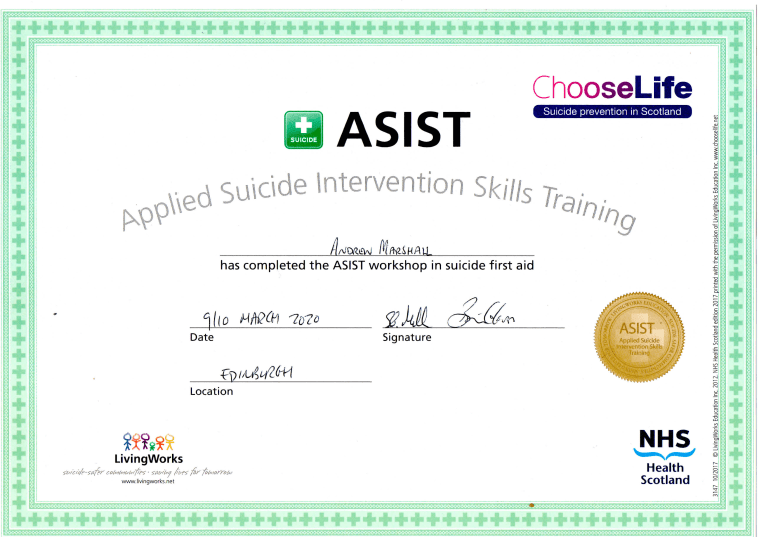
Course: Applied Suicide Intervention Skills Training (ASIST)

Just completed the 2-day Applied Suicide Intervention Skills Training (ASIST) course.

ASIST is intended as ‘suicide first-aid’ training.

It aims to enable helpers (anyone in a position of trust) to become more willing, ready, and able to recognise and intervene effectively to help persons at risk of suicide.

You can find out more about the ASIST course here.

Linking Risk of Suicidal Behaviour with Mental Disorders & Work Disability

Research Paper Title

Mental disorders and suicidal behavior in refugees and Swedish-born individuals: is the association affected by work disability?

Background

Among potential pathways to suicidal behavior in individuals with mental disorders (MD), work disability (WD) may play an important role.

The Researchers examined the role of WD in the relationship between MD and suicidal behaviour in Swedish-born individuals and refugees.

Methods

The study cohort consisted of 4,195,058 individuals aged 16-64, residing in Sweden in 2004-2005, whereof 163,160 refugees were followed during 2006-2013 with respect to suicidal behaviour.

Risk estimates were calculated as hazard ratios (HR) with 95% confidence intervals (CI).

The reference groups comprised individuals with neither MD nor WD.

WD factors (sickness absence (SA) and disability pension (DP)) were explored as potential modifiers and mediators.

Results

In both Swedish-born and refugees, SA and DP were associated with an elevated risk of suicide attempt regardless of MD. In refugees, HRs for suicide attempt in long-term SA ranged from 2.96 (95% CI: 2.14-4.09) (no MD) to 6.23 (95% CI: 3.21-12.08) (MD).

Similar associations were observed in Swedish-born. Elevated suicide attempt risks were also observed in DP.

In Swedish-born individuals, there was a synergy effect between MD, and SA and DP regarding suicidal behaviour.

Both SA and DP were found to mediate the studied associations in Swedish-born, but not in refugees.

Conclusions

There is an effect modification and a mediating effect between mental disorders and WD for subsequent suicidal behaviour in Swedish-born individuals.

Also for refugees without MD, WD is a risk factor for subsequent suicidal behaviour.

Particularly for Swedish-born individuals with MD, information on WD is vital in a clinical suicide risk assessment.

Reference

Björkenstam, E., Helgesson, M., Amin, R., Lange, T. & Mittendorfer-Rutz, E. (2020) Mental disorders and suicidal behavior in refugees and Swedish-born individuals: is the association affected by work disability? Social Psychiatry and Psychiatric Epidemiology. doi: 10.1007/s00127-019-01824-5. [Epub ahead of print].

Do Individuals who are Suicidal have Unusual Patterns of Brain Activity?

Individuals who are suicidal seem to have unusual patterns of brain activity.

The differences are not big enough to identify those who may try to kill themselves, however, the researchers hope it will provide them with more information about what may be happening in terms of brain mechanisms (Schmaal et al., 2019).

The finding comes from a review of 131 brain-scan studies, comprising more than 12,000 people. The study looked to see whether there are distinctive patterns of brain activity in those who had made suicide attempts or had been thinking about suicide.

Most of these studies compared individuals with a certain mental health condition, such as depression, who had a history of suicidal behaviour, with a similar group with that condition who had not become suicidal, or with individuals without mental health problems.

The researchers found that two brain networks appear to function differently:

  • The first of these involves areas at the front of the head known as the medial and lateral ventral prefrontal cortex and their connections to regions involved in emotion. This may lead to difficulties regulating emotions.
  • A second involves regions known as the dorsal prefrontal cortex and inferior frontal gyrus system, which play a role in decision making.

However, the differences in these networks may just reflect that individuals who are suicidal are in more distress, rather than indicating specific thoughts of suicide.

Reference

Wilson, C. (2019) Suicidal Behaviour Linked to Two Brain Networks. New Scientist. 07 December 2019, pp.16.

Schmaal, L>, van Harmelen, A-L., Chatzi, V., Lippard, E.T.C., Toenders, Y.J., Averill, L.A., Mazure, C.M. & Plumberg, H.P. (2019) Imaging suicidal thoughts and behaviors: a comprehensive review of 2 decades of neuroimaging studies. Molecular Psychiatry. 25, pp.408-427. https://www.nature.com/articles/s41380-019-0587-x

Suicide in Older Adults: A Critical Problem

Research Paper Title

Suicide in Older Adults.

Abstract

Suicide in older adults is a critical problem that nurses and other health professionals need to address. Evidence-based interventions for prevention of late-life suicide are urgently needed, as well as increased availability of health care professionals with knowledge and skills to recognise suicide risks and intervene to provide effective care for this vulnerable population.

Reference

Sorrell, J.M. (2020) Suicide in Older Adults. Journal of Psychosocial Nursing and Mental Health Services. 58(1), pp.17-20. doi: 10.3928/02793695-20191218-04.

Veterans: We’re Afraid to Say Suicide

Research Paper Title

“We’re Afraid to Say Suicide”: Stigma as a Barrier to Implementing a Community-Based Suicide Prevention Program for Rural Veterans.

Background

Suicide is a significant public health concern for veterans residing in rural communities.

Although various initiatives have been implemented to prevent suicide among veterans, efforts specific to rural veterans remain limited.

Methods

To aid such efforts, the researchers examined stigma as a potential barrier to community readiness in the implementation of a community-based suicide prevention program for rural veterans.

In this qualitative study, community readiness interviews were conducted with 13 participants in a rural community.

Themes included lack of awareness regarding veteran suicide, rare discussions of veteran suicide, and suicide-related stigma within the community.

Results

Results suggest that prioritising destigmatisation may be particularly important to implementing community-based suicide prevention programming in rural communities.

Conclusions

In particular, addressing community misconceptions regarding veteran suicide, while increasing knowledge of the extent to which veteran suicide occurs locally may facilitate increased awareness and thus community readiness to prevent suicide among rural veterans.

Reference

Monteith, L.L., Smith, N.B., Holliday, R., Dorsey Holliman, B.A., LoFaro, C.T. & Mohatt, N.V. (2019) “We’re Afraid to Say Suicide”: Stigma as a Barrier to Implementing a Community-Based Suicide Prevention Program for Rural Veterans. The Journal of Nervous and Mental Disease. doi: 10.1097/NMD.0000000000001139. [Epub ahead of print].