
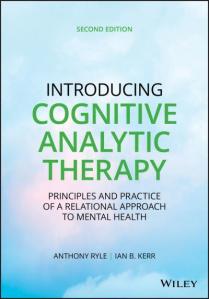
Book: Introducing Cognitive Analytic Therapy

Book Title:

Introducing Cognitive Analytic Therapy: Principles and Practice of a Relational Approach to Mental Health.

Author(s): Anthony Ryle and Ian B. Kerr.

Year: 2020.

Edition: Second (2nd).

Publisher: Wiley.

Type(s): Paperback and Kindle.

Synopsis:

Cognitive Analytic Therapy (CAT) is an increasingly popular approach to therapy that is now widely recognised as a genuinely integrative and fundamentally relational model of psychotherapy. This new edition of the definitive text to CAT offers a systematic and comprehensive introduction to its origins, development, and practice. It also provides a fully updated overview of developments in the theory, research, and applications of CAT, including clarification and re-statement of basic concepts, such as reciprocal roles and reciprocal role procedures, as well as extensions into new areas of expertise.

Introducing Cognitive Analytic Therapy: Principles and Practice of a Relational Approach to Mental Health, 2nd Edition starts with a brief account of the scope and focus of CAT and how it evolved and explains the main features of its practice. It next offers a brief account of a relatively straightforward therapy to give readers a sense of the unfolding structure and style of a time-limited CAT. Following that are chapters that consider the normal and abnormal development of the Self and that introduce influential concepts from Vygotskian, Bakhtinian and developmental psychology. Subsequent chapters describe selection and assessment; reformulation; the course of therapy; the ‘ideal model’ of therapist activity and its relation to the supervision of therapists; applications of CAT in various patient groups and settings and in treating personality type disorders; use in ‘reflective practice’; a CAT perspective on the ‘difficult’ patient; and systemic and ‘contextual’ approaches.

  • Presents an updated introduction and overview of the principles and practice of cognitive analytic therapy (CAT).
  • Updates the first edition with developments from the last decade, in which CAT theory has deepened and the approach has been applied to new patient groups and extended far beyond its roots.
  • Includes detailed, applicable ‘how to’ descriptions of CAT in practice.
  • Includes references to CAT published works and suggestions for further reading within each chapter.
  • Includes a glossary of terms and several appendices containing the CAT Psychotherapy File; a summary of CAT competences extracted from Roth and Pilling; the Personality Structure Questionnaire; and a description of repertory grid basics and their use in CAT.
  • Co-written by the creator of the CAT model, Anthony Ryle, in collaboration with leading CAT practitioner, trainer, and researcher, Ian B. Kerr.

Introducing Cognitive Analytic Therapy is the definitive book for CAT practitioners and CAT trainees at skills, practitioner, and psychotherapy levels. It should also be of considerable interest and relevance to mental health professionals of all orientations, including clinical psychologists, psychiatrists, counselors, mental health nurses, to those working in forensic and various institutional settings, and to a range of other health care and social work professionals.

Book: Essential Art Therapy Exercises

Book Title:

Essential Art Therapy Exercises: Effective Techniques to Manage Anxiety, Depression, and PTSD.

Author(s): Leah Guzman.

Year: 2020.

Edition: First (1st).

Publisher: Rockridge Press.

Type(s): Paperback and Kindle.

Synopsis:

Process difficult thoughts and feelings with art therapy

Essential Art Therapy Exercises shows you how creating art can help ease depression, anxiety, PTSD, and life’s other challenges. Art therapy activities like drawing, painting, and sculpting will help you better understand your state of mind in order to gain control over your emotions and improve your self-esteem.

From drawing a representation of your favourite song, to writing affirmations and taking photos to match, these therapeutic exercises will help you overcome the mindsets that are holding you back and lead you toward inner peace. Some take only five minutes, others up to an hour, but all of them explore a range of artistic mediums, so you can choose exactly what works for you.

Essential Art Therapy Exercises offers:

  • The art of getting better – These sophisticated exercises are a springboard for insight, self-expression, mindfulness, acceptance, and self-compassion.
  • Insights and questions – Every activity describes its benefits and offers thoughtful prompts to help you get the most out of each experience.
  • No experience required – You do not need to be an artist to use art therapy. It is about the experience of creating-without worry or judgement.

Book: Minding Closely – The Four Applications of Mindfulness

Book Title:

Minding Closely – The Four Applications of Mindfulness.

Author(s): B. Alan Wallace.

Year: 2012.

Edition: First (1st), Illustrated Edition.

Publisher: Snow Lion Publications.

Type(s): Paperback and Kindle.

Synopsis:

Bringing his experience as a monk, scientist, and contemplative, Alan Wallace offers a rich synthesis of Eastern and Western traditions along with a comprehensive range of meditation practices interwoven throughout the text.

The guided meditations are systematically presented, beginning with very basic instructions, which are then gradually built upon as one gains increasing familiarity with the practice.

Book: Mindfulness Meditation in Psychotherapy

Book Title:

Mindfulness Meditation In Psychotherapy – An Integrated Model For Clinicians.

Author(s): Steven A. Alper, MSW LCSW.

Year: 2016.

Edition: First (1st), Illustrated Edition.

Publisher: Context Press.

Type(s): Hardcover, Paperback, and Kindle.

Synopsis:

Embodying mindfulness allows both therapists and clients to make the most of treatment sessions. More than just a guide to techniques and benefits, this book provides a comprehensive understanding of mindfulness meditation, and shows how to effectively incorporate mindfulness into every aspect of the therapeutic process.

Mindfulness is not simply a therapeutic tool that can be used at a specific time. If you are a psychotherapist interested in implementing mindfulness practices into your therapy sessions, you must first embody a mindful presence yourself. In Mindfulness Meditation in Psychotherapy, psychotherapist Steven Alper presents the mindfulness pyramid model, an easy-to-use reference approach for integrating mindfulness into the very fabric of your therapy sessions – in every action you take.

A therapist’s mindfulness practice and the mindful activity during sessions forms the foundation of clients’ mindfulness practice. This practical guide will help demystify mindfulness meditation; elaborate on the psychotherapeutic benefits of practices such as body scan, breath awareness, sitting meditation, and lovingkindness; and offer helpful strategies for teaching formal and informal mindfulness skills to clients. This book conceptualises and explores the applicability of mindfulness and delves into the many ways in which mindfulness can manifest in psychotherapy.

This is a must-have resource for any therapist interested in honing their own mindfulness practice and incorporating mindfulness in treatment sessions.