
What is the Behavioural Despair Test?

Introduction

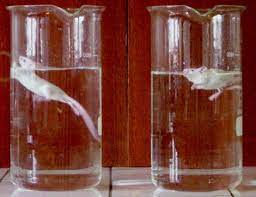
The behavioural despair test (or Porsolt forced swimming test) is a test, centred on a rodent’s response to the threat of drowning, whose result has been interpreted as measuring susceptibility to negative mood. It is commonly used to measure the effectiveness of antidepressants, although significant criticisms of its interpretation have been made.
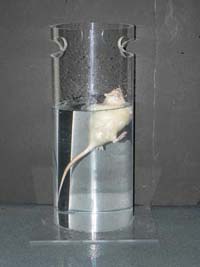
An ‘interesting’ way to test the effectiveness of antidepressants!

Method

Animals are subjected to two trials during which they are forced to swim in an acrylic glass cylinder filled with water, and from which they cannot escape. The first trial lasts 15 minutes. Then, after 24-hours, a second trial is performed that lasts 5 minutes. The time that the test animal spends in the second trial without making any movements beyond those required to keep its head above water is measured. This immobility time is decreased by various types of antidepressants and also by electroconvulsive shock. Another common variant of this behavioural test specifically used for mice is conducted only for one trial and lasts six minutes. Modern implementations of the test score swimming and climbing behaviours separately, because swimming behaviour has been shown to be increased by selective serotonin reuptake inhibitors, while climbing behaviour is increased by selective norepinephrine reuptake inhibitors such as desipramine and maprotiline.

Controversy in Interpretation

Classically, immobility in the second test has been interpreted as a behavioural correlate of negative mood, representing a kind of hopelessness in the animal. Rodents given antidepressants swim harder and longer than controls (which forms the basis for claims of the test’s validity). However, there is some debate between scientists whether increased immobility instead demonstrates learning or habituation, and would therefore be a positive behavioural adaptation: the animal is less fearful because it is now familiar with the environment of the test. This interpretation is supported by the fact that even rats who are first put into a container from which they can escape (and therefore do not experience despair) show reduced mobility in the second test.

Some pharmacological compounds that influence motor movement, like stimulants and sedatives, may cause animals to swim for different amounts of time that are unrelated to the antidepressant properties of the compound. Researchers need to assess locomotor activity in the animal’s homecage or by a locomotor test. If locomotion is altered compared to controls then other animal antidepressant models should be used.

The term “behavioural despair test” bears an anthropomorphic connotation and is a somewhat subjective description as it is uncertain whether the test reliably gauges mood or despair. Strictly speaking, the descriptive term “forced swimming test” is preferred by researchers. The use of forced swimming tests is criticised by animal rights groups, notably PETA.

My Comments

  • I cannot believe some of the shi**y things researchers will do to animals.
  • Can you imagine being arbitrarily thrown into a container full of water, not knowing what is going on, not being able to touch the bottom, and no means of getting out of the container? Would you have a low mood or be in despair at your situation?
  • I see why they changed the name of the ‘test’, to sooth their conscience rather than that of the mice.

This page is based on the copyrighted Wikipedia article < https://en.wikipedia.org/wiki/Behavioural_despair_test >; it is used under the Creative Commons Attribution-ShareAlike 3.0 Unported License (CC-BY-SA). You may redistribute it, verbatim or modified, providing that you comply with the terms of the CC-BY-SA.

What is Eptapirone?

Introduction

Eptapirone (F-11,440) is a very potent and highly selective 5-HT1A receptor full agonist of the azapirone family. Its affinity for the 5-HT1A receptor was reported to be 4.8 nM (Ki) (or 8.33 (pKi)), and its intrinsic activity approximately equal to that of serotonin (i.e. 100%).

Eptapirone and related high-efficacy 5-HT1A full and super agonists such as befiradol and F-15,599 were developed under the hypothesis that the maximum exploitable therapeutic benefits of 5-HT1A receptor agonists might not be able to be seen without the drugs employed possessing sufficiently high intrinsic activity at the receptor. As 5-HT1A receptor agonism, based on animal and other research, looked extremely promising for the treatment of depression from a theoretical perspective, this idea was developed as a potential explanation for the relatively modest clinical effectiveness seen with already available 5-HT1A receptor agonists like buspirone and tandospirone, which act merely as weak-to-moderate partial agonists of the receptor.

Animal Studies

In the Porsolt forced swimming test, eptapirone was found to suppress immobility more robustly than buspirone, ipsapirone, flesinoxan, paroxetine, and imipramine, which was suggestive of strong antidepressant-like effects. In this assay, unlike the other drugs screened, buspirone actually increased the immobility time with a single administration, while repeated administration decreased it, an effect that may have been related to buspirone’s relatively weak intrinsic activity (~30%) at the 5-HT1A receptor and/or its preferential activation of 5-HT1A somatodendritic autoreceptors over postsynaptic receptors.

After repeated administration, high dose paroxetine was able to rival the reduction in immobility seen with eptapirone. However, efficacy was seen on the first treatment with eptapirone, which suggested that eptapirone may have the potential for a more rapid onset of antidepressant effectiveness in comparison. Imipramine was unable to match the efficacy of eptapirone or high dose paroxetine, which was probably the result of the fact that higher doses were fatal.

In the conflict procedure, eptapirone produced substantial increases in punished responding without affecting unpunished responding, which was suggestive of marked anxiolytic-like effects. In addition, the efficacy of eptapirone in this assay was more evident than that of buspirone, ipsapirone, and flesinoxan.

Human Studies

Eptapirone has been assayed in humans in preclinical trials at an oral dose of 1.5 mg. In these studies, eptapirone reduced body temperature, prolonged REM sleep, increased cortisol and growth hormone levels, and produced side effects such as dizziness and drowsiness while being overall well tolerated. It peaked rapidly within 30–60 minutes and had an estimated half-life of two hours, with a total duration of approximately three hours.

This page is based on the copyrighted Wikipedia article < https://en.wikipedia.org/wiki/Eptapirone >; it is used under the Creative Commons Attribution-ShareAlike 3.0 Unported License (CC-BY-SA). You may redistribute it, verbatim or modified, providing that you comply with the terms of the CC-BY-SA.

What is Enilospirone?

Introduction

Enilospirone (CERM-3,726) is a selective 5-HT1A receptor agonist of the azapirone class.

This page is based on the copyrighted Wikipedia article < https://en.wikipedia.org/wiki/Enilospirone >; it is used under the Creative Commons Attribution-ShareAlike 3.0 Unported License (CC-BY-SA). You may redistribute it, verbatim or modified, providing that you comply with the terms of the CC-BY-SA.

What is BMY-7,378?

Introduction

BMY-7,378 is a 5-HT1A receptor weak partial agonist/antagonist and α1D-adrenergic receptor antagonist.

Refer to Azapirone.

This page is based on the copyrighted Wikipedia article < https://en.wikipedia.org/wiki/BMY-7378 >; it is used under the Creative Commons Attribution-ShareAlike 3.0 Unported License (CC-BY-SA). You may redistribute it, verbatim or modified, providing that you comply with the terms of the CC-BY-SA.

What is Binospirone?

Introduction

Binospirone (MDL-73,005-EF) is a drug which acts as a partial agonist at 5-HT1A somatodendritic autoreceptors but as an antagonist at postsynaptic 5-HT1A receptors.

It has anxiolytic effects.

Refer to Azapirone.

This page is based on the copyrighted Wikipedia article < https://en.wikipedia.org/wiki/Binospirone >; it is used under the Creative Commons Attribution-ShareAlike 3.0 Unported License (CC-BY-SA). You may redistribute it, verbatim or modified, providing that you comply with the terms of the CC-BY-SA.

What is Alnespirone?

Introduction

Alnespirone (S-20,499) is a selective 5-HT1A receptor full agonist of the azapirone chemical class.

It has antidepressant and anxiolytic effects.

This page is based on the copyrighted Wikipedia article < https://en.wikipedia.org/wiki/Alnespirone >; it is used under the Creative Commons Attribution-ShareAlike 3.0 Unported License (CC-BY-SA). You may redistribute it, verbatim or modified, providing that you comply with the terms of the CC-BY-SA.

What is Azapirone?

Introduction

Azapirones are a class of drugs used as anxiolytics, antidepressants, and antipsychotics.

They are commonly used as add-ons to other antidepressants, such as selective serotonin reuptake inhibitors (SSRIs).

List of Azapirones

The azapirones include the following agents:

  • Others:
    • SNAP-8719 (CAS number: 255893-38-0 )

Medical Uses

Azapirones have shown benefit in general anxiety and augmenting SSRIs in social anxiety and depression. Evidence is not clear for panic disorder and functional gastrointestinal disorders.

Tandospirone has also been used to augment antipsychotics in Japan as it improves cognitive and negative symptoms of schizophrenia. Buspirone is being investigated for this purpose as well.

Side Effects

Side effects of azapirones may include dizziness, headaches, restlessness, nausea, and diarrhoea.

Azapirones have more tolerable adverse effects than many other available anxiolytics, such as benzodiazepines or SSRIs. Unlike benzodiazepines, azapirones lack abuse potential and are not addictive, do not cause cognitive/memory impairment or sedation, and do not appear to induce appreciable tolerance or physical dependence. However, azapirones are considered less effective with slow onset in controlling symptoms.

Chemistry

Buspirone was originally classified as an azaspirodecanedione, shortened to azapirone or azaspirone due to the fact that its chemical structure contained this moiety, and other drugs with similar structures were labelled as such as well. However, despite all being called azapirones, not all of them actually contain the azapirodecanedione component, and most in fact do not or contain a variation of it. Additionally, many azapirones are also pyrimidinylpiperazines, though again this does not apply to them all.

Drugs classed as azapirones can be identified by their -spirone or -pirone suffix.

Pharmacology

Pharmacodynamics

On a pharmacological level, azapirones varyingly possess activity at the following receptors:

  • 5-HT1A receptor (as partial or full agonists)
  • 5-HT2A receptor (as inverse agonists)
  • D2 receptor (as antagonists or partial agonists)
  • α1-adrenergic receptor (as antagonists)
  • α2-adrenergic receptor (as antagonists)

Actions at D4, 5-HT2C, 5-HT7, and sigma receptors have also been shown for some azapirones.

While some of the listed properties such as 5-HT2A and D2 blockade may be useful in certain indications such as in the treatment of schizophrenia (as with perospirone and tiospirone), all of them except 5-HT1A agonism are generally undesirable in anxiolytics and only contribute to side effects. As a result, further development has commenced to bring more selective of anxiolytic agents to the market. An example of this initiative is gepirone, which was recently approved after completing clinical trials in the United States for the treatment of major depression and generalized anxiety disorder. Another example is tandospirone which has been licensed in Japan for the treatment of anxiety and as an augmentation to antidepressants for depression.

5-HT1A receptor partial agonists have demonstrated efficacy against depression in rodent studies and human clinical trials. Unfortunately, however, their efficacy is limited and they are only relatively mild antidepressants. Instead of being used as monotherapy treatments, they are more commonly employed as augmentations to serotonergic antidepressants like the SSRIs. It has been proposed that high intrinsic activity at 5-HT1A postsynaptic receptors is necessary for maximal therapeutic benefits to come to prominence, and as a result, investigation has commenced in azapirones which act as 5-HT1A receptor full agonists such as alnespirone and eptapirone. Indeed, in preclinical studies, eptapirone produces robust antidepressant effects which surpass those of even high doses of imipramine and paroxetine.

Pharmacokinetics

Azapirones are poorly but nonetheless appreciably absorbed and have a rapid onset of action, but have only very short half-lives ranging from 1–3 hours. As a result, they must be administered 2-3 times a day. The only exception to this rule is umespirone, which has a very long duration with a single dose lasting as long as 23 hours. Unfortunately, umespirone has not been commercialized. Although never commercially produced, Bristol-Myers Squibb applied for a patent on 28 October 1993, and received the patent on 11 July 1995, for an extended release formulation of buspirone. An extended release formulation of gepirone is currently under development and if approved, should help to improve this issue.

Metabolism of azapirones occurs in the liver and they are excreted in urine and faeces. A common metabolite of several azapirones including buspirone, gepirone, ipsapirone, revospirone, and tandospirone is 1-(2-pyrimidinyl)piperazine (1-PP). 1-PP possesses 5-HT1A partial agonist and α2-adrenergic antagonist actions and likely contributes overall mostly to side effects.

This page is based on the copyrighted Wikipedia article < https://en.wikipedia.org/wiki/Azapirone >; it is used under the Creative Commons Attribution-ShareAlike 3.0 Unported License (CC-BY-SA). You may redistribute it, verbatim or modified, providing that you comply with the terms of the CC-BY-SA.

What is Azaperone?

Introduction

Azaperone is a pyridinylpiperazine and butyrophenone neuroleptic drug with sedative and antiemetic effects, which is used mainly as a tranquiliser in veterinary medicine. It is uncommonly used in humans as an antipsychotic drug.

Azaperone acts primarily as a dopamine antagonist but also has some antihistaminic and anticholinergic properties as seen with similar drugs such as haloperidol. Azaperone may cause hypotension and while it has minimal effects on respiration in pigs, high doses in humans can cause respiratory depression.

Veterinary Use

The most common use for azaperone is in relatively small doses as a “serenic” (to reduce aggression) in farmed pigs, either to stop them fighting or to encourage sows to accept piglets. Higher doses are used for anaesthesia in combination with other drugs such as xylazine, tiletamine and zolazepam. Azaperone is also used in combination with strong narcotics such as etorphine or carfentanil for tranquilising large animals such as elephants. Use in horses is avoided as adverse reactions may occur.

The European Medicines Agency has established a maximum residue limit for azaperone when administered to pigs.

Azaperone (under the brand name Stresnil) was approved for use in pigs in the USA in 1983, under NADA 115-732.

Synthesis

The alkylation of 2-chloropyridine with piperazine gives 1-(pyridin-2-yl)piperazine 67980-77-2. The attachment of the sidechain by reaction with 4-chloro-4′-fluorobutyrophenone 3874-54-2 completed the synthesis of azaperone.

This page is based on the copyrighted Wikipedia article < https://en.wikipedia.org/wiki/Azaperone >; it is used under the Creative Commons Attribution-ShareAlike 3.0 Unported License (CC-BY-SA). You may redistribute it, verbatim or modified, providing that you comply with the terms of the CC-BY-SA.

What is Enciprazine?

Introduction

Enciprazine (INN, BAN; enciprazine hydrochloride (USAN); developmental code names WY-48624, D-3112) is an anxiolytic and antipsychotic of the phenylpiperazine class which was never marketed.

Outline

It shows high affinity for the α1-adrenergic receptor and 5-HT1A receptor, among other sites.

The drug was initially anticipated to produce ortho-methoxyphenylpiperazine (oMeOPP), a serotonin receptor agonist with high affinity for the 5-HT1A receptor, as a significant active metabolite, but subsequent research found this not to be the case.

Synthesis

3,4,5-trimethoxyphenol (aka Antiarol) [642-71-7] is alkylated with epichlorohydrin to give [(3,4,5-Trimethoxyphenoxy)methyl]oxirane [74760-14-8]. Opening of the epoxide with o-anisyl-piperazine [35386-24-4] completes the synthesis of enciprazine.

This page is based on the copyrighted Wikipedia article < https://en.wikipedia.org/wiki/Enciprazine >; it is used under the Creative Commons Attribution-ShareAlike 3.0 Unported License (CC-BY-SA). You may redistribute it, verbatim or modified, providing that you comply with the terms of the CC-BY-SA.