What is the Trevor Project?

Introduction

The Trevor Project is an American non-profit organisation founded in 1998 focused on suicide prevention efforts among lesbian, gay, bisexual, transgender, queer, and questioning (LGBTQ) youth.

Through a toll-free telephone number, it operates The Trevor Lifeline, a confidential service that offers trained counsellors. The stated goals of the project are to provide crisis intervention and suicide prevention services for the aforementioned youths (defined by the organisation as people under 25), as well as to offer guidance and resources to parents and educators in order to foster safe, accepting, and inclusive environments for all youth, at home and at school.

Brief History

The project was founded in 1998 in West Hollywood, California, by Celeste Lecesne, Peggy Rajski, and Randy Stone. They are the creators of the 1994 Academy Award-winning short film Trevor, a dramedy about Trevor, a gay thirteen-year-old boy who, when rejected by friends because of his sexuality, makes an attempt to take his life. When the film was scheduled to air on HBO television in 1998, the filmmakers realised that some of the programme’s young viewers might be facing the same kind of crisis as Trevor, and began to search for a support line to be broadcast during the airing. They discovered that no such helpline existed, and decided to dedicate themselves to forming the resource: an organisation to promote acceptance of LGBTQ youth, and to aid in crisis and suicide prevention among that group.

The Trevor Lifeline was established with seed funds provided by The Colin Higgins Foundation and HBO’s license fee. As a result, it became the first nationwide, around-the-clock crisis and suicide prevention helpline for LGBTQ youth. The project also provides online support to young people through the project’s website, as well as guidance and resources to educators and parents.

In November 2009, the project was contracted by the Tulare County Suicide Prevention Task Force, located in Tulare County, California. With this agreement, the project received public funds for the first time. In June 2009, seven Tulare County volunteers completed The Trevor Project Lifeguard Workshop Facilitator training. Lifeguard workshops have been done in schools in Tulare County municipalities, including Dinuba, Lindsay, Porterville and Visalia, as well as in Hanford in adjacent Kings County.

The Trevor Project has been supported by various celebrities, including Melanie Martinez, Ellen DeGeneres, Troye Sivan, Kathy Griffin, Shay Mitchell, Daniel Radcliffe, Neil Patrick Harris, James Marsden, Chris Colfer, Kim Kardashian, Darren Criss, Dianna Agron, George Takei, Anderson Cooper, John Oliver and Tyler Oakley. In 2021, the first openly gay active NFL player, Carl Nassib used his coming out to also announce a $100,000 donation to The Trevor Project.

Projects

The Trevor Lifeline

The Trevor Lifeline is the only nationwide, around-the-clock crisis and suicide prevention helpline for LGBTQ youth in the United States. The lifeline is a free and confidential service from counsellors trained to listen without judging, and can refer callers to supportive local organisations and groups; this information is also available on the project’s website. The number for the line in the United States is 1-866-488-7386.

TrevorText

TrevorText is a confidential text messaging service provided by The Trevor Project 24 hours a day 7 days a week.

TrevorChat

TrevorChat is a free, confidential, live and secure online messaging service provided by The Trevor Project 24 hours a day 7 days a week.

TrevorSpace

TrevorSpace is an online social networking community for LGBTQ+ youth ages 13 through 24, along with their friends and allies. Youth can create personal profiles, which are verified by the administrators before they are allowed to interact with other profiles, and connect with other young people internationally, as well as find resources within their communities. TrevorSpace is commonly used to receive or give advice and make friends who have shared similar experiences as the user. TrevorSpace is carefully monitored by administrators designated by the project to ensure all content is age-appropriate, youth-friendly and factual. Members over the age of 18 cannot privately message members under the age of 18. TrevorSpace links members to The Trevor Project’s home page, where information about The Trevor Lifeline, “Dear Trevor,” and other resources are available. The software used to create TrevorSpace was donated to the project by Tim Gill, an American software entrepreneur and philanthropist.

Palette Fund Internship Programme

Through the Palette Fund Internship Programme, the project provides for five internships in both its Los Angeles and New York City offices. Interns are placed among the programme, communication, and development departments. The programme provides an opportunity for young people to learn about working in the non-profit sector. Palette Fund internships are specifically designed to introduce young leaders to the LGBTQ movement.

Youth Advisory Council

The Youth Advisory Council serves as a liaison between youth nationwide and the project on issues surrounding suicide, sexuality and gender identity. The council submits recommendations to the project in an effort to increase project visibility and best serve the LGBTQ youth population.

School Workshops

The project’s Lifeguard Workshop Programme uses a structured, age-appropriate curriculum to address topics around sexuality, gender identity, the impacts of language and behaviour, and what it means for young people to feel different. The programme also teaches young people to recognise depression and suicide amongst their peers, the impacts of language and behaviour on LGBTQ youth, and suicide prevention skills in schools.

Fundraisers and Annual Awards Ceremonies

Tyler Oakley’s Fundraiser

On 10 February 2014, YouTube personality Tyler Oakley started a fundraiser to collect $150,000 for the Trevor Project. Oakley set the deadline for the money to be collected by the time of his birthday, 22 March, but the goal was reached after only six days. Oakley later extended the fundraiser and more than $462,000 had been raised as of 29 March. On 31 March the fundraiser ended, with a total of $525,754 raised.

Annual Award Ceremony Fundraisers

The Trevor Project uses annual events to honour individuals and businesses that have been leaders in supporting LGBT rights and advocated against bullying and hate crimes. In 1998, it held the first Cracked Xmas fundraiser in Los Angeles, changing its name to TrevorLIVE Los Angeles in 2010. In 2001, a New York City-based annual event was added, using entertainers to raise financial resources for the organisation. This NYC-based event has had three names, beginning as “A Very Funny Whatever”, changing to TrevorNY in 2007 and then to TrevorLIVE New York in 2011. In the 2018 financial year (August 2017 to July 2018), these special events raised over $3,030,000.

The New York City event is typically held in June each year, and the Los Angeles event is typically held in late November or early December each year.

A variety of awards have been given over time and not all awards are given each year.

What is Sensory Processing Sensitivity?

Introduction

Sensory processing sensitivity (SPS) is a temperamental or personality trait involving “an increased sensitivity of the central nervous system and a deeper cognitive processing of physical, social and emotional stimuli”.

The trait is characterised by “a tendency to ‘pause to check’ in novel situations, greater sensitivity to subtle stimuli, and the engagement of deeper cognitive processing strategies for employing coping actions, all of which is driven by heightened emotional reactivity, both positive and negative”.

A human with a particularly high measure of SPS is considered to have “hypersensitivity”, or be a highly sensitive person (HSP). The terms SPS and HSP were coined in the mid-1990s by psychologists Elaine Aron and her husband Arthur Aron, who developed the Highly Sensitive Person Scale (HSPS) questionnaire by which SPS is measured. Other researchers have applied various other terms to denote this responsiveness to stimuli that is seen in humans and other species.

According to the Arons and colleagues, people with high SPS make up about 15-20% of the population. Although some researchers consistently related high SPS to negative outcomes, other researchers have associated it with increased responsiveness to both positive and negative influences. Aron and colleagues state that the high-SPS personality trait is not a disorder.

Origin and Development of the Terms

Elaine Aron’s book The Highly Sensitive Person was published in 1996. In 1997 Elaine and Arthur Aron formally identified sensory processing sensitivity (SPS) as the defining trait of highly sensitive persons (HSPs). The popular terms hypersensitivity (not to be confused with the medical term hypersensitivity) or highly sensitive are popular synonyms for the scientific concept of SPS. By way of definition, Aron and Aron (1997) wrote that sensory processing here refers not to the sense organs themselves, but to what occurs as sensory information is transmitted to or processed in the brain. They assert that the trait is not a disorder but an innate survival strategy that has both advantages and disadvantages.

Elaine Aron’s academic journal articles as well as self-help publications for the lay reader have focused on distinguishing high SPS from socially reticent behaviour and disorders with which high SPS can be confused; overcoming the social unacceptability that can cause low self-esteem; and emphasizing the advantages of high SPS to balance the disadvantages emphasized by others.

In 2015, sociologist Elizabeth Bernstein wrote in The Wall Street Journal that HSPs were “having a moment,” noting that several hundred research studies had been conducted on topics related to HSPs’ high sensitivity. The First International Scientific Conference on High Sensitivity or Sensory Processing Sensitivity was held at the Vrije Universiteit Brussel. By 2015, more than a million copies of The Highly Sensitive Person had been sold.

Earlier Research

Research pre-dating the Arons’ coining of the term “high sensitivity” includes that of German medicine professor Wolfgang Klages, who argued in the 1970s that the phenomenon of sensitive and highly sensitive humans is “biologically anchored” and that the “stimulus threshold of the thalamus” is much lower in these persons. As a result, said Klages, there is a higher permeability for incoming signals from afferent nerve fibres so that they pass “unfiltered” to the cerebral cortex.

The Arons (1997) recognised psychologist Albert Mehrabian’s (1976, 1980, 1991) concept of filtering the “irrelevant”, but wrote that the concept implied that the inability of HSPs’ (Mehrabian’s “low screeners”) to filter out what is irrelevant would imply that what is relevant is determined from the perspective of non-HSPs (“high screeners”).

Attributes, Characteristics and Prevalence

Boterberg et al. (2016) describe high SPS as a “temperamental or personality trait which is present in some individuals and reflects an increased sensitivity of the central nervous system and a deeper cognitive processing of physical, social and emotional stimuli”.

People with high SPS report having a heightened response to stimuli such as pain, caffeine, hunger, and loud noises. According to Boterberg et al., these individuals are “believed to be easily overstimulated by external stimuli because they have a lower perceptual threshold and process stimuli cognitively deeper than most other people.” This deeper processing may result in increased reaction time as more time is spent responding to cues in the environment, and might also contribute to cautious behaviour and low risk-taking.

The HSP Scale, initially (1997) a questionnaire designed to measure SPS on a unidimensional scale, was subsequently decomposed into two, three, or four factors or sub-scales. Most components have been associated with traditionally accepted negative psychological outcomes including high stress levels, being easily overwhelmed, increased rates of depression, anxiety, and sleep problems, as well as symptoms of autism; the diathesis-stress model focused on increased vulnerability to negative influences. However, the differential susceptibility theory (DST) and biological sensitivity to context theory (BSCT) and sensory processing sensitivity (SPS) suggest increased plasticity in terms of responsiveness to both positive and negative influences; and the vantage sensitivity (VS) concept emphasizes increased responsiveness to positive experiences. Researchers such as Smolewska et al. (2006) said positive outcomes were more common in individuals with high aesthetic sensitivity, who tend to experience heightened positive emotions in response to rewarding stimuli and more likely to score high on “openness” on the Big Five factors model.

Research in evolutionary biology provides evidence that the trait of SPS can be observed, under various terms, in over 100 nonhuman species, Aron writing that the SPS trait is meant to encompass what personality psychologists have described under various other names. Conversely, Aron has distinguished SPS from what she considers it is not, explicitly distinguishing high SPS from possibly similar-appearing traits or disorders (such as shyness, sensation-seeking, sensory processing disorder, and autism), and further, that SPS may be a basic variable that may underlie multiple other trait differences (such as introversion versus extraversion). Contrary to common misconception, according to Aron HSPs include both introverts and extroverts, and may be simultaneously high-sensation seeking and cautious.

In humans and other species, responsive and unresponsive individuals coexist and consistently display different levels of responsiveness to environmental stimuli, the different levels of responsiveness having corresponding evolutionary costs and benefits. This observation parallels Aron’s assertion that high SPS is not a disorder, but rather a personality trait with attendant advantages and disadvantages. Accordingly, Aron cautions medical professionals against prescribing psychoactive medications to “cure” the trait, which may or may not coexist with an actual disorder.

By 2015 the trait had been documented at various levels of study, including temperament and behaviour psychology, brain function and neuronal sensitization, and genetics. For example, genetic studies provide evidence that higher levels of SPS are linked to the serotonin transporter 5-HTTLPR short/short genotype, polymorphisms in dopamine neurotransmitter genes,[37] and the ADRA2b norepinephrine-related gene variant.

HSP Scale score patterns in adults were thought to be distributed as a dichotomous categorical variable with a break point between 10% and 35%, with Aron choosing a cut-off of the highest-scoring 20% of individuals to define the HSP category. A 2019 review article stated that findings suggest people fall into three sensitivity groups along a normal distribution sensitivity continuum.

What is the Differential Susceptibility Hypothesis?

Introduction

The differential susceptibility hypothesis proposed by Jay Belsky is another interpretation of psychological findings that are usually discussed according to the diathesis-stress model.

Both models suggest that people’s development and emotional affect are differentially susceptible to experiences or qualities of the environment. Where the Diathesis-stress model suggests a distinct and mostly negativity-sensitive group, Belsky describes a group that is sensitive to negative experiences but also to positive experiences. These models may be complementary, if some individuals are dually or uniquely positivity-sensitive, while other people are uniquely negativity-sensitive.

Differential Susceptibility versus Diathesis-Stress

The idea that individuals vary in their responsivity to negative qualities of the environment is generally framed in diathesis-stress or dual-risk terms. That is, some individuals, due to their biological, temperamental and/or behavioural characteristics (i.e. “diathesis” or “risk 1”), are more vulnerable to the adverse effects of negative experiences (i.e., “stress” or “risk 2”), whereas others are relatively resilient with respect to them (see Figure 1, an adaptation of Bakermans-Kranenburg and van IJzendoorn’s (2007) Figure 1). A fundamentally different, even if not competing view, of the very same phenomenon is central to Belsky’s differential susceptibility hypothesis and Boyce and Ellis’ (2005) related notion of biological sensitivity to context: Individuals do not simply vary in the degree to which they are vulnerable to the negative effects of adverse experience but, more generally, in their developmental plasticity.

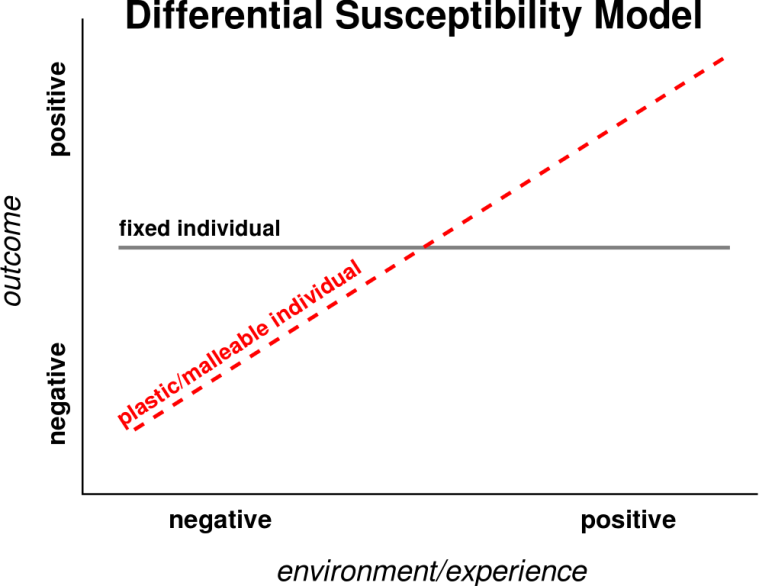
On this hypothesis, more “plastic” or malleable individuals are more susceptible than others to environmental influences in a for-better-and-for-worse manner. That is, susceptible to both the adverse developmental sequelae associated with negative environments and the positive developmental consequences of supportive ones. Less susceptible individuals, in contrast, are less affected by rearing conditions, be they presumptively supportive or undermining of well being (see Figure 2, an adaptation of Bakermans-Kranenburg and Van IJzendoorn’s (2007) Figure 1).

Figure 1. The diathesis-stress/dual-risk model. Developmental outcome as it relates to environmental quality. A “vulnerable” group experiences negative outcome when exposed to a negative environment, although this group is identical to the other, “resilient” group in a positive environment.
Figure 2. The differential susceptibility model. The lines depict two categorical groups that differ in their responsiveness to the environment: the “plastic” group is disproportionately more affected by both negative and positive environments compared to the “fixed” group.

Theoretical Background

Belsky suggests that evolution might select for some children who are more plastic, and others who are more fixed in the face of, for example, parenting styles.

Belsky offers that ancestral parents, just like parents today, could not have known (consciously or unconsciously) which childrearing practices would prove most successful in promoting the reproductive fitness of offspring – and thus their own inclusive fitness. As a result, and as a fitness optimising strategy involving bet hedging, natural selection might have shaped parents to bear children varying in plasticity. This way, if an effect of parenting had proven counterproductive in fitness terms, those children not affected by parenting would not have incurred the cost of developing in ways that ultimately proved “misguided”.

Importantly, natural selection might favour genetic lines with both plastic and fixed developmental and affective patterns. In other words, there is value to having both kinds at once. In light of inclusive-fitness considerations, children who were less malleable (and more fixed) would have “resistance” to parental influence. This could be adaptable some times, and maladaptive other times. Their fixedness would not only have benefited themselves directly, but even their more malleable siblings indirectly. This is because siblings, like parents and children, have 50% of their genes in common. By the same token, had parenting influenced children in ways that enhanced fitness, then not only would more plastic offspring have benefited directly by following parental leads, but so, too, would their parents and even their less malleable siblings who did not benefit from the parenting they received, again for inclusive-fitness reasons. The overall effect may be to temper some of the variability in parenting. That is, to make more conservative bets.

This line of evolutionary argument leads to the prediction that children should vary in their susceptibility to parental rearing and perhaps to environmental influences more generally. As it turns out, a long line of developmental inquiry, informed by a “transactional” perspective, has more or less been based on this unstated assumption.

Criteria for the Testing of Differential Susceptibility

Belsky, Bakermans-Kranenburg, & Van IJzendoorn, (2007) delineated a series of empirical requirements – or steps – for evidencing the differential susceptibility hypothesis. Particularly they identify tests that distinguish differential susceptibility from other interaction effects including diathesis-stress/dual-risk.

While diathesis-stress/dual-risk arises when the most vulnerable are disproportionately affected in an adverse manner by a negative environment but do not also benefit disproportionately from positive environmental conditions, differential susceptibility is characterised by a cross-over interaction: the susceptible individuals are disproportionately affected by both negative and positive experiences. A further criterion that needs to be fulfilled to distinguish differential susceptibility from diathesis-stress/dual-risk is the independence of the outcome measure from the susceptibility factor: if the susceptibility factor and the outcome are related, diathesis-stress/dual-risk is suggested rather than differential susceptibility. Further, environment and susceptibility factor must also be unrelated to exclude the alternative explanation that susceptibility merely represents a function of the environment. The specificity of the differential-susceptibility effect is demonstrated if the model is not replicated when other susceptibility factors (i.e. moderators) and outcomes are used. Finally, the slope for the susceptible subgroup should be significantly different from zero and at the same time significantly steeper than the slope for the non- (or less-) susceptible subgroup.

Susceptibility Markers and Empirical Evidence

Characteristics of individuals that have been shown to moderate environmental effects in a manner consistent with the differential susceptibility hypothesis can be subdivided into three categories:

  • Genetic factors;
  • Endophenotypic factors; and
  • Phenotypic factors.

Bakermans-Kranenburg and Van IJzendoorn (2006) were the first to test the differential susceptibility hypothesis as a function of Genetic Factors regarding the moderating effect of the dopamine receptor D4 7-repeat polymorphism (DRD4-7R) on the association between maternal sensitivity and externalising behaviour problems in 47 families. Children with the DRD4-7R allele and insensitive mothers displayed significantly more externalising behaviours than children with the same allele but with sensitive mothers. Children with the DRD4-7R allele and sensitive mothers had the least externalising behaviours of all whereas maternal sensitivity had no effect on children without the DRD4-7R allele.

Endophenotypic Factors have been examined by Obradovic, Bush, Stamperdahl, Adler and Boyce’s (2010). They investigated associations between childhood adversity and child adjustment in 338 5-year-olds. Children with high cortisol reactivity were rated by teachers as least prosocial when living under adverse conditions, but most prosocial when living under more benign conditions (and in comparison to children scoring low on cortisol reactivity).

Regarding characteristics of the category of Phenotypic Factors, Pluess and Belsky (2009) reported that the effect of child care quality on teacher-rated socioemotional adjustment varied as a function of infant temperament in the case of 761 4.5-year-olds participating in the NICHD Study of Early Child Care and Youth Development (NICHD Early Child Care Research Network, 2005). Children with difficult temperaments as infants manifest the most and least behaviour problems depending on whether they experienced, respectively, poor or good quality care (and in comparison to children with easier temperaments).

Table 1: List of Proposed Susceptibility Factors that emerge across studies, according to Belsky and colleagues.

What is Scopophobia?

Introduction

Scopophobia, scoptophobia, or ophthalmophobia is an anxiety disorder characterised by a morbid fear of being seen in public or stared at by others.

Similar phobias include erythrophobia, the fear of blushing, and an epileptic’s fear of being looked at, which may itself precipitate such an attack. Scopophobia is also commonly associated with schizophrenia and other psychiatric disorders. Often scopophobia will result in symptoms common with other anxiety disorders. Scopophobia is unique among phobias in that the fear of being looked at is considered both a social phobia and a specific phobia.

Refer to Scopophilia.

Origin of the Term

The term scopophobia comes from the Greek σκοπέω skopeō, “look to, examine”, and φόβος phobos, “fear”. Ophthalmophobia comes from the Greek ὀφθαλμός ophthalmos, “eye”.

Brief History

Phobias have a long history. The concept of social phobias was referred to as long ago as 400 B.C. One of the first references to scopophobia was by Hippocrates who commented on an overly-shy individual, explaining that such a person “loves darkness as light” and “thinks every man observes him.”

The term “social phobia” (phobie sociale) was first coined in 1903 by French psychiatrist Pierre Janet. He used this term to describe patients of his who exhibited a fear of being observed as they were participating in daily activities such as talking, playing the piano or writing.

In 1906 the psychiatric journal The Alienist and Neurologist, described scopophobia:

Then, there is a fear of being seen and a shamefacedness, which one sees in asylums. […] We called it scopophobia — a morbid dread of being seen. In minor degree, it is morbid shamefacedness, and the patient covers the face with his or her hands. In greater degree, the patient will shun the visitor and escape from his or her sight where this is possible. Scopophobia is more often manifest among women than among men.

Later in the same paper (p.285) scopophobia is defined as “a fear of seeing people or being seen, especially of strange faces”.

Signs and Symptoms

Individuals with scopophobia generally exhibit symptoms in social situations when attention is brought upon them like public speaking. Several other triggers exist to cause social anxiety. Some examples include: Being introduced to new people, being teased and/or criticised, embarrassing easily, and even answering a cell phone call in public.

Often scopophobia will result in symptoms common with other anxiety disorders. The symptoms of scopophobia include an irrational feelings of panic, feelings of terror, feelings of dread, rapid heartbeat, shortness of breath, nausea, dry mouth, trembling, anxiety and avoidance. Other symptoms related to scopophobia may be hyperventilation, muscle tension, dizziness, uncontrollable shaking or trembling, excessive eye watering and redness of the eyes.

Related Syndromes

Though scopophobia is a solitary disorder, many individuals with scopophobia also commonly experience other anxiety disorders. Scopophobia has been related to many other irrational fears and phobias. Specific phobias and syndromes that are similar to scopophobia include erythrophobia, the fear of blushing (which is found especially in young people), and an epileptic’s fear of being looked at, which may itself precipitate such an attack. Scopophobia is also commonly associated with schizophrenia and other psychiatric disorders. It is not considered indicative of other disorders, but is rather considered as a psychological problem that may be treated independently.

Sociologist Erving Goffman suggested that shying away from casual glances in the street remained one of the characteristic symptoms of psychosis in public. Many scopophobia patients develop habits of voyeurism or exhibitionism. Another related, yet very different syndrome, scopophilia, is the excessive enjoyment of looking at erotic items.

Causes

Scopophobia is unique among phobias in that the fear of being looked at is considered both a social phobia and a specific phobia, because it is a specific occurrence which takes place in a social setting. Most phobias typically fall in either one category or the other but scopophobia can be placed in both. On the other hand, as with most phobias, scopophobia generally arises from a traumatic event in the person’s life. With scopophobia, it is likely that the person was subjected to public ridicule as a child. Additionally, a person with scopophobia may often be the subject to public staring, possibly due to a physical disability.

According to the Social Phobia/Social Anxiety Association, US government data for 2012 suggests that social anxiety affects over 7% of the population at any given time. Stretched over a lifetime, the percentage increases to 13%.

Psychoanalytic Views

Building on Freud’s concept of the eye as an erogenous zone, psychoanalysts have linked scopophobia to a (repressed) fear of looking, as well as to an inhibition of exhibitionism. Freud also referred to scopophobia as a “dread of the evil eye” and “the function of observing and criticizing the self” during his research into the “eye” and “transformed I’s.”

In some explanations, the equation of being looked at with a feeling of being criticized or despised reveals shame as a motivating force behind scopophobia. In the self-consciousness of adolescence, with its increasing awareness of the Other as constitutive of the looking glass self, shame may exacerbate feelings of erythrophobia and scopophobia.

Treatment

There are several options for treatment of scopophobia. With one option, desensitisation, the patient is stared at for a prolonged period and then describes their feelings. The hope is that the individual will either be desensitised to being stared at or will discover the root of their scopophobia.

Exposure therapy, another treatment commonly prescribed, has five steps:

  • Evaluation.
  • Feedback.
  • Developing a fear hierarchy.
  • Exposure.
  • Building.

In the evaluation stage, the scopophobic individual would describe their fear to the therapist and try to find out when and why this fear developed. The feedback stage is when the therapist offers a way of treating the phobia. A fear hierarchy is then developed, where the individual creates a list of scenarios involving their fear, with each one becoming worse and worse. Exposure involves the individual being exposed to the scenarios and situations in their fear hierarchy. Finally, building is when the patient, comfortable with one step, moves on to the next.

As with many human health problems support groups exist for scopophobic individuals. Being around other people who face the same issues can often create a more comfortable environment.

Other suggested treatments for scopophobia include hypnotherapy, neuro-linguistic programming (NLP), and energy psychology. In extreme cases of scopophobia, it is possible for the subject to be prescribed anti-anxiety medications. Medications may include benzodiazepines, antidepressants, or beta-blockers.

In Popular Culture

  • In The Neverending Story, the Acharis are a race of beings so ashamed of their ugliness that they never appear in daylight.
  • The character Ryōshi Morino in Ōkami-san has the condition, wearing his hair long to avoid eye contact, and breaking down crying when he notices people staring at him.
  • The character Marimo Kaburagi in the second season of the anime series Active Raid has scopophobia, but her symptoms are alleviated by her wearing special glasses which digitally censor the eyes of whomever she looks at.
  • The SCP Foundation character SCP-096 is a humanoid monster that reacts violently whenever its face is seen through any medium, hunting down whoever saw it; this is typically avoided via showing an artistic depiction to prevent direct viewing.

Reference

“The Alienist and Neurologist”, edited by Charles Hamilton Hughes, 1906, p.165p.285 (digitised by Google).

What is Scopophilia?

Introduction

In psychology and psychiatry, scopophilia or scoptophilia (Ancient Greek: σκοπέω skopeō, “look to”, “to examine” + φῐλῐ́ᾱ philíā, “the tendency towards”) is an aesthetic pleasure drawn from looking at an object or a person.

In human sexuality, the term scoptophilia describes the sexual pleasure that a person derives from looking at prurient objects of eroticism, such as pornography, the nude body, and fetishes, as a substitute for actual participation in a sexual relationship.

Refer to Scopophobia.

Psychoanalysis

Sigmund Freud used the term scopophilia to describe, analyse, and explain the concept of Schaulust, the pleasure in looking, a curiosity which he considered a partial-instinct innate to the childhood process of forming a personality; and that such a pleasure-instinct might be sublimated, either into Aesthetics, looking at objets d’art or sublimated into an obsessional neurosis “a burning and tormenting curiosity to see the female body”, which afflicted the Rat Man patient of the psychoanalyst Freud. From that initial interpretation of Schaulust arose the psycho-medical belief that the inhibition of the scopic drive might lead to actual, physical illness, such as physiologic disturbances of vision and eyesight. In contrast to Freud’s interpretation of the scopic drive, other psychoanalytic theories proposed that the practices of scopophilia might lead to madness – either insanity or a mental disorder – which is the scopophilic person’s retreat from the concrete world of reality into an abstract world of fantasy.

The theoretic bases of scopophilia were developed by the psychoanalyst Otto Fenichel, in special reference to the process and stages of psychological identification. That in developing a personal identity, “a child, who is looking for libidinous purposes … wants to look at an object in order [for it] to ‘feel along with him’.” That the impersonal interaction of scopophilia (between the looker and the looked-at) sometimes replaced personal interactions in the psychological life of a person who is socially anxious, and seeks to avoid feelings of guilt.

Lacan’s conceptual development of the gaze linked the pleasure of scopophilia to the person’s apprehension of the Other (person) who is not the Self; that is: “The gaze is this object lost, and suddenly re-found, in the conflagration of shame, by the introduction of the Other.” The practice of scopophilia is how a person’s desire is captured by the imaginary representation of the Other. Theories alternative to Lacan’s interpretations of scopophilia and the gaze proposed that a child’s discovery of genital difference, and the accompanying anxiety about not knowing the difference of the Other sex, is the experience that subsequently impels the child’s scopic drive to fulfil the desire to look and to look at.

Literary Examples

  • The Satyricon (The Book of Satyr-like Adventures, AD 1st c.), by Gaius Petronius Arbiter, presents the scopophilic description of a priestess of Priapus as the woman who was “the first to put an inquisitive eye to a crack she had naughtily opened, and spy on their play with prurient eagerness.”
  • Secret Sexualities: A Sourcebook of 17th and 18th Century Writing (2003), by Ian McCormick, shows that transgressive sexuality is composed of the inter-relationships between the public and the private spheres and between the open and the secret aspects of a person’s life.
    • The example is Memoirs of a Woman of Pleasure (1749), in which the protagonist Fanny Hill gives her scoptophilic observations of two sodomites, which include descriptions of the furnishings and the décor of the room in which they are copulating: ” .. . at length I observed a paper patch of the same colour as the wainscot, which I took to conceal some flaw; but then it was so high that I was obliged to stand upon a chair to reach it, which I did, as soft as possible, and, with a point of a bodkin, soon pierced it, and opened myself espial room sufficient. And now, applying my eye close, I commanded the room perfectly, and could see my two young sparks romping and pulling one another about, entirely, to my imagination, in frolic and innocent play.”

Race

Critical race theorists, such as bell hooks, in “Eating Each Other” (2006),[15] Shannon Winnubst in “Is the Mirror Racist?: Interrogating the Space of Whiteness” (2006), and David Marriott in “Bordering On: The Black Penis” (1996), present and describe scopophilia and the scopic drive as the psychological and social mechanisms that realise the practices of Other-ing a person to exclude them from society. (c.f. scopophobia) That the social practice of scopophilia is meant to definitively fix the appearance and the identity of the Other (person) who is not the Self, by way of the gaze that objectifies and dehumanises a person as “not I” and thus “not one of us.” In that philosophic vein, the practices of cultural scopophilia restrict the number and type of visible representations of “outsiders” people in a society.

Cinema

In Psycho (1960), directed by Alfred Hitchcock, the protagonist Norman Bates is a voyeur whose motel rooms feature peepholes. In the course of the story, the motel manager Norman spies upon the anti-heroine as she undresses in her ostensibly private room. In Peeping Tom (1960), directed by Michael Powell, Scopophilia is mentioned as a psychological affliction of the protagonist, Mark Lewis. As narrative cinema, Peeping Tom is a deliberate exercise in voyeurism for the protagonist and for the spectator, which demonstrates how readily the protagonist and the spectator are mentally willing and morally capable of watching atrocities (torture, mutilation, death) that should not be gazed upon as narrative movies. The mentally ill protagonist acted as he acted consequent to severe mental mistreatment in boyhood, by his film-maker father; the paternal abuse mentally malformed Mark into a reclusive, introverted man comfortable with torturing and killing people.

In the 1970s, parting from Lacan’s propositions, psychoanalysts of the cinema used the term scopophilia to identify and to describe the aesthetic and emotional pleasures (often pathological), and other unconscious mental processes that occur in the minds spectators gazing at a film. Yet voyeurism and the male gaze are psychological practices basic to the spectators’ emotional experience of viewing mainstream, commercial cinema; notably, the male gaze is fully presented, described, and explained, and contrasted with the female gaze, in the essay “Visual Pleasure and Narrative Cinema” (1975), by Laura Mulvey. Subsequent scholars have challenged Mulvey’s influential reading of scopophilia as a “gross reduction of the erotic and the aesthetic to the politics of representation.”

What is Psychical Inertia?

Introduction

Psychical inertia is a term introduced by Carl Jung to describe the psyche’s resistance to development and change.

He considered it one of the main reason for the neurotic opposing, or shrinking from, his or her age-appropriate tasks in life.

Refer to Repetition Compulsion.

Freudian and Other Developments

Freud argued that such psychic inertia played a part in the lives of the normal, as well as of the neurotic, and saw its origins in fixation between early instincts and their first impressions of significant objects. As late as Civilization and its Discontents (his 1930 book), he considered as a major obstacle to cultural development “the inertia of the libido, its disinclination to give up an old position for a new one”.

Later Jungians have seen psychic inertia as a force of nature reflecting both internal and outer determinants; while others have seen it as a product of social pressures, especially in relation to ageing.

What is Repetition Compulsion?

Introduction

Repetition compulsion is a psychological phenomenon in which a person repeats an event or its circumstances over and over again.

This includes re-enacting the event or putting oneself in situations where the event is likely to happen again. This “re-living” can also take the form of dreams in which memories and feelings of what happened are repeated, and even hallucinated.

Repetition compulsion can also be used to cover the repetition of behaviour or life patterns more broadly: a “key component in Freud’s understanding of mental life, ‘repetition compulsion’ … describes the pattern whereby people endlessly repeat patterns of behaviour which were difficult or distressing in earlier life”.

Refer to Psychical Inertia.

Freud

Sigmund Freud‘s use of the concept of “repetition compulsion” (German: Wiederholungszwang) was first defined in the article of 1914, Erinnern, Wiederholen und Durcharbeiten (“Remembering, Repeating and Working-Through”). Here he noted how “the patient does not remember anything of what he has forgotten and repressed, he acts it out, without, of course, knowing that he is repeating it … For instance, the patient does not say that he remembers that he used to be defiant and critical toward his parents’ authority; instead, he behaves in that way to the doctor”.

He explored the repetition compulsion further in his 1920 essay Beyond the Pleasure Principle, describing four aspects of repetitive behaviour, all of which seemed odd to him from the point of view of the mind’s quest for pleasure/avoidance of unpleasure.

The first was the way “dreams occurring in traumatic neuroses have the characteristic of repeatedly bringing the patient back into the situation of his accident” rather than, for example, “show[ing] the patient pictures from his healthy past”.

The second came from children’s play. Freud reported observing a child throw his favourite toy from his crib, become upset at the loss, then reel the toy back in, only to repeat this action. Freud theorised that the child was attempting to master the sensation of loss “in allowing his mother to go away without protesting”, but asked in puzzlement “How then does his repetition of this distressing experience as a game fit in with the pleasure principle?”.

The third was the way (noted in 1914) that the patient, exploring in therapy a repressed past, “is obliged to repeat the repressed material as a contemporary experience instead of … remembering it as something belonging to the past … the compulsion to repeat the events of his childhood in the transference evidently disregards the pleasure principle in every way”.

The fourth was the so-called “destiny neurosis”, manifested in “the life-histories of men and women … [as] an essential character-trait which remains always the same and which is compelled to find expression in a repetition of the same experience”.

All such activities appeared to Freud to contradict the organism’s search for pleasure, and therefore “to justify the hypothesis of a compulsion to repeat—something that seems more primitive, more elementary, more instinctual than the pleasure principle which it over-rides”: “a daemonic current/trait”, “a daemonic character”, a “daemonic compulsion”, likely alluding to the Latin motto errare humanum est, perseverare autem diabolicum (“to err is human, to persist [in committing such errors] is of the devil”). Following this line of thought, he would come to stress that “an instinct is an urge inherent in organic life to restore an earlier state of things” (an explanation that some scholars have labelled as “metaphysical biology”), so to arrive eventually at his concept of the death drive.

Along the way, however, Freud had in addition considered a variety of more purely psychological explanations for the phenomena of the repetition compulsion which he had observed. Traumatic repetitions could be seen as the result of an attempt to retrospectively “master” the original trauma, a child’s play as an attempt to turn passivity into activity: “At the outset he was in a passive situation … but by repeating it, unpleasurable though it was, as a game, he took on an active part”.

At the same time, the repetition of unpleasant experiences in analysis could be considered “unpleasure for one system [the ego] and simultaneously satisfaction for the other [the id]. In the second edition of 1921, he extended the point, stating explicitly that transference repetitions “are of course the activities of instincts intended to lead to satisfaction; but no lesson has been learnt from the old experience of these activities having led only to unpleasure”.

Five years later, in Inhibition, Symptom and Anxiety, he would quietly revise his earlier definition – “There is no need to be discouraged by these emendations … so long as they enrich rather than invalidate our earlier views” – in his new formula on “the power of the compulsion to repeat—the attraction exerted by the unconscious prototypes upon the repressed instinctual process”.

Later Psychoanalytic Developments

It was in the later, psychological form that the concept of the repetition compulsion passed into the psychoanalytic mainstream. Otto Fenichel in his “second generation” compendium The Psychoanalytic Theory of Neurosis stressed two main kinds of neurotic repetition.

On the one hand, there were “Repetitions of traumatic events for the purpose of achieving a belated mastery … seen first and most clearly in children’s games”, although the “same pattern occurs in the repetitive dreams and symptoms of traumatic neurotics and in many similar little actions of normal persons who … repeat upsetting experiences a number of times before these experiences are mastered”. Such traumatic repetitions could themselves appear in active or passive forms. In a passive form, one chooses his or her most familiar experiences consistently as a means to deal with problems of the past, believing that new experiences will be more painful than their present situation or too new and untested to imagine. In the active, participatory form, a person actively engages in behaviour that mimics an earlier stressor, either deliberately or unconsciously, so that in particular events that are terrifying in childhood become sources of attraction in adulthood. For instance, a person who was spanked as a child may incorporate this into their adult sexual practices; or a victim of sexual abuse may attempt to seduce another person of authority in his or her life (such as their boss or therapist): an attempt at mastery of their feelings and experience, in the sense that they unconsciously want to go through the same situation but that it not result negatively as it did in the past.

On the other hand, there were “Repetitions due to the tendency of the repressed to find an outlet”. Here the drive of the repressed impulse to find gratification brought with it a renewal of the original defence: “the anxiety that first brought about the repression is mobilized again and creates, together with the repetition of the impulse, a repetition of the anti-instinctual measures”. Fenichel considered that “Neurotic repetitions of this kind contain no metaphysical element”, and “even the repetition of the most painful failure of the Oedipus complex in the transference during a psychoanalytic cure is not ‘beyond the pleasure principle'”.

Later writers would take very similar views. Eric Berne saw as central to his work “the repetition compulsion which drives men to their doom, the power of death, according to Freud … [who] places it in some mysterious biological sphere, when after all it is only the voice of seduction” – the seduction of the repressed and unconscious id.

Erik Erikson saw the destiny neurosis – the way “that some people make the same mistakes over and over” – in the same light: “the individual unconsciously arranges for variations of an original theme which he has not learned either to overcome or to live with”. Ego psychology would subsequently take for granted “how rigidly determined our lives are—how predictable and repetitive … the same mistake over and over again”.

Object relations theory, stressing the way “the transference is a live relationship … in the here-and-now of the analysis, repeating the way that the patient has used his objects from early in life” considered that “this newer conception reveals a purpose … [in] the repetition compulsion”: thus “unconscious hope may be found in repetition compulsion, when unresolved conflicts continue to generate attempts at solutions which do not really work … [until] a genuine solution is found”.

Later Formulations

By the close of the twentieth century, the psychoanalytic view of repetition compulsion had come into increasing dialogue with a variety of other discourses, ranging from attachment theory through brief psychodynamic therapy to cognitive behavioural therapy.

Attachment theory saw early developmental experiences leading to “schemas or mental representations of relationship … [which] become organized, encoded experiential and cognitive data … that led to self-confirmation”.

The core conflictual relationship theme – “core wishes that the individual has in relation to others” – was seen in brief psychodynamic therapy as linked to the way in “a repetition compulsion, the client will behave in ways that engender particular responses from others that conform with previous experiences in interpersonal relationships”.

Psychological schemas – described in cognitive psychology, social psychology, and schema therapy – are “an enduring symbolic framework that organises constellations of thought, feeling, memory, and expectation about self and others”. In some cases psychological schemas may be seen as analogous to the role in psychoanalytic theory of early unconscious fixations in fuelling the repetition compulsion.

What is Outpatient Commitment?

Introduction

Outpatient commitment – also termed assisted outpatient treatment (AOT) or community treatment orders (CTO) – refers to a civil court procedure wherein a legal process orders an individual diagnosed with a severe mental disorder to adhere to an outpatient treatment plan designed to prevent further deterioration or recurrence that is harmful to themselves or others.

This form of involuntary treatment is distinct from involuntary commitment in that the individual subject to the order continues to live in their home community rather than being detained in hospital or incarcerated. The individual may be subject to rapid recall to hospital, including medication over objections, if the conditions of the order are broken, and the person’s mental health deteriorates. This generally means taking psychiatric medication as directed and may also include attending appointments with a mental health professional, and sometimes even not to take non-prescribed illicit drugs and not associate with certain people or in certain places deemed to have been linked to a deterioration in mental health in that individual.

The criteria and process for outpatient commitment are established by law, which vary among nations and, in the US and Canada, among states or provinces. Some jurisdictions require court hearings, where a judge will make a court order, and others require that treating psychiatrists comply with a set of requirements before compulsory treatment is instituted. When a court process is not required, there is usually a form of appeal to the courts or appeal to or scrutiny by tribunals set up for that purpose. Community treatment laws have generally followed the worldwide trend of community treatment. See mental health law for details of countries which do not have laws that regulate compulsory treatment.

Terminology

In the United States the term “assisted outpatient treatment” (AOT) is often used and refers to a process whereby a judge orders a qualifying person with symptoms of severe untreated mental illness to adhere to a mental health treatment plan while living in the community. The plan typically includes medication and may include other forms of treatment as well. Patients are often monitored and assigned to case managers or a community dedicated to treating mental health known as assertive community treatment (ACT).

Australia, Canada, England, and New Zealand use the term “community treatment order” (CTO).

Comparison to Inpatient Commitment

The terminology, “outpatient commitment”, and legal construction often equate outpatient commitment with inpatient commitment but providing the patient more freedom. In practice, outpatient commitment may be used in situations where commitment would not be used because it is cheaper than inpatient commitment; seen as less draconian; and protects mental health professionals from moral, civil or criminal liability.

Preventive Use

Outpatient commitment is used in some countries to prevent relapse of mental disorders, as many mental disorders are episodic in natural (for example bipolar disorder or schizophrenia) and it can be difficult to predict whether a mental disorder with reoccur.

Some countries use outpatient commitment for first episode psychosis (FEP).

Implementation

Discussions of “outpatient commitment” began in the psychiatry community in the 1980s following deinstitutionalisation, a trend that led to the widespread closure of public psychiatric hospitals and resulted in the discharge of large numbers of people with mental illness to the community.

Europe

Denmark

Denmark introduced outpatient commitment in 2010 with the Mental Health Act (Danish: Lov om anvendelse af tvang i psykiatrien).

Germany

In Germany, as of 2014, only former forensic psychiatry patients may be placed under community treatment orders. Legislation to allow for wider use of CTOs was considered in 2003-2004, but it was ultimately rejected by the Bundestag.

The Netherlands

As of 2014, Dutch law provides for community treatment orders, and an individual who does not comply with the terms of their CTO may be subject to immediate involuntary commitment.

Norway

When Norway introduced outpatient commitment in the 1961 Mental Health Act, it could only be mandated for individuals who had previously been admitted for inpatient treatment. Revisions in 1999 and 2006 provided for outpatient commitment without previous inpatient treatment, but this provision is seldom used.

Sweden

In Sweden, the Compulsory Psychiatric Care Act (Swedish: Lag om psykiatrisk tvångsvård) provides for an administrative court to mandate psychiatric treatment to prevent harm to the individual or others. The law was created in 1991 and revised in 2008.

England and Wales

Changes in service provision and amendments to the Mental Health Act in England and Wales have increased the scope for compulsion in the community. The Mental Health Act 2007 introduced community treatment orders (CTOs). CTOs are legally defined as a form of outpatient leave for individuals detained under section 3 of the Mental Health Act. As such, only members of the medical community are involved in issuing a CTO, though both the section 3 detention underlying the CTO and the CTO itself can be appealed to the Mental Health Tribunal where a panel consisting of medical doctors and a judge will make a decision.

A review of patient data in London found that the average duration of a CTO in the UK was 3 years. Black people in the UK are more than ten times as likely to be under a CTO as white people. 

The legislation in the UK specifically allows CTOs to be issued after a single admission to hospital for treatment. However, the Royal College of Psychiatrists suggested limiting CTOs to patients with a history of noncompliance and hospitalization, when it reviewed the current mental health legislation.

John Mayer Chamberlain argues that this legislation was triggered by the Killing of Jonathan Zito by an individual who had interactions with mental health services prior this event, which led the then conservative government to argue for CTOs.

In a 2021 paper reviewing the mental health act, the UK government proposed a new form of indefinite outpatient commitment allowing for deprivation of liberties an continuous supervision termed supervised discharge. This discharge would be reviewed yearly, and only apply to individuals who would not benefit from treatment in a hospital setting and would be based on risk.  Further, this legislation would only apply to restricted patients who have been diverted to the mental health care system from courts.

Scotland

Scotland has a different community commitment regime from England and Wales introduced in the 2003 Mental Health Act. There is ongoing debate in the UK on the place of coercion and compulsion in community mental health care.

North America

In the last decade of the 20th century and the first of the 21st, “outpatient commitment” laws were passed in a number of US states and jurisdictions in Canada.

Canada

In the mid-1990s, Saskatchewan became the first Canadian province to implement community treatment orders, and Ontario followed in 2000. As of January 2016, New Brunswick was the only province without legislation that provided for either CTOs or extended leave.

United States

By the end of 2010, 44 US states had enacted some version of an outpatient commitment law. In some cases, passage of the laws followed widely publicised tragedies, such as the murders of Laura Wilcox and Kendra Webdale.

Oceania

Australia and New Zealand introduced community treatment orders in the 1980s and 1990s.

Australia

In Australia, community treatment orders last for a maximum of twelve months but can be renewed after review by a tribunal.

Evidence

A systematic review in 2016 that looked at around 200 papers investigating effectiveness of CTOs for patient outcomes. It found that non-randomised trials had dramatically varying results and found that no randomised controlled trials showed any benefits to the patient for outpatient commitment apart from a reduction in the risk of being the victim of crime.

The same interventions can have different effects in different countries due to legal, bureaucratic and social factors.

Cost

Research published in 2013 showed that Kendra’s Law in New York, which served about 2,500 patients at a cost of $32 million, had positive results in terms of net cost, reduced arrests. About $125 million is also spent annually on improved outpatient treatment for patients who are not subject to the law. In contrast to New York, despite wide adoption of outpatient commitment, the programs were generally not adequately funded.

“Although numerous AOT programs currently operate across the United States, it is clear that the intervention is vastly underutilized.”

Arrests, Danger, and Violence

The National Institute of Justice considers assisted outpatient treatment an effective crime prevention programme. Some studies in the US have found that AOT programmes have reduced the chances of arrest. Kendra’s Law has lowered risk of violent behaviours, reduced thoughts about suicide.

Outcomes and hospital admissions

AOT “programs improve adherence with outpatient treatment and have been shown to lead to significantly fewer emergency commitments, hospital admissions, and hospital days as well as a reduction in arrests and violent behavior.”

“The likelihood of psychiatric hospital admission was significantly reduced by approximately 25% during the initial six-month court order…and by over one-third during a subsequent six-month renewal of the order…. Similar significant reductions in days of hospitalization were evident during initial court orders and subsequent renewals…. Improvements were also evident in receipt of psychotropic medications and intensive case management services. Analysis of data from case manager reports showed similar reductions in hospital admissions and improved engagement in services.”

74% fewer participants experienced homelessness. 77% fewer experienced psychiatric hospitalization. 56% reduction in length of hospitalisation. 83% fewer experienced arrest. 87% fewer experienced incarceration. 49% fewer abused alcohol. 48% fewer abused drugs. Consumer participation and medication compliance improved. The number of individuals exhibiting good adherence to meds increased 51%. The number of individuals exhibiting good service engagement increased 103%. Consumer perceptions were positive. 75% reported that AOT helped them gain control over their lives. 81% said AOT helped them get and stay well. 90% said AOT made them more likely to keep appointments and take meds. 87% of participants said they were confident in their case manager’s ability. 88% said they and their case manager agreed on what was important to work on.

In Nevada County, CA, AOT (“Laura’s Law“) decreased the number of psychiatric hospital days 46.7%, the number of incarceration days 65.1%, the number of homeless days 61.9%, and the number of emergency interventions 44.1%. Laura’s Law implementation saved $1.81-$2.52 for every dollar spent, and receiving services under Laura’s Law caused a “reduction in actual hospital costs of $213,300” and a “reduction in actual incarceration costs of $75,600.”

In New Jersey, Kim Veith, director of clinical services at Ocean Mental Health Services, noted the AOT pilot programme performed “beyond wildest dreams.” AOT reduced hospitalisations, shortened inpatient stays, reduced crime and incarceration, stabilised housing, and reduced homelessness. Of clients who were homeless, 20% are now in supportive housing, 40% are in boarding homes, and 20% are living successfully with family members.

Writing in the British Journal of Psychiatry in 2013, Jorun Rugkåsa and John Dawson stated:

“The current evidence from RCTs suggests that CTOs do not reduce readmission rates over 12 months.”

“We find that New York State’s AOT Program improves a range of important outcomes for its recipients, apparently without feared negative consequences to recipients.”

“The increased services available under AOT clearly improve recipient outcomes, however, the AOT court order, itself, and its monitoring do appear to offer additional benefits in improving outcomes.”

Effect on Mental Illness System

Access to Services

“AOT has been instrumental in increasing accountability at all system levels regarding delivery of services to high need individuals. Community awareness of AOT has resulted in increased outreach to individuals who had previously presented engagement challenges to mental health service providers.”

“Improved treatment plan development, discharge planning, and coordination of service planning. Processes and structures developed for AOT have resulted in improvements to treatment plans that more appropriately match the needs of individuals who have had difficulties using mental health services in the past.”

“Improved collaboration between mental health and court systems. As AOT processes have matured, professionals from the two systems have improved their working relationships, resulting in greater efficiencies, and ultimately, the conservation of judicial, clinical, and administrative resources. There is now an organized process to prioritize and monitor individuals with the greatest need; AOT ensures greater access to services for individuals whom providers have previously been reluctant to serve; There is now increased collaboration between inpatient and community-based providers.”

In New York City net costs declined 50% in the first year after assisted outpatient treatment began and an additional 13% in the second year. In non-NYC counties, costs declined 62% in the first year and an additional 27% in the second year. This was in spite of the fact that psychotropic drug costs increased during the first year after initiation of assisted outpatient treatment, by 40% and 44% in the city and five-county samples, respectively. The increased community-based mental health costs were more than offset by the reduction in inpatient and incarceration costs. Cost declines associated with assisted outpatient treatment were about twice as large as those seen for voluntary services.

“In all three regions, for all three groups, the predicted probability of an MPR ≥80% improved over time (AOT improved by 31–40 percentage points, followed by enhanced services, which improved by 15–22 points, and ‘neither treatment,’ improving 8–19 points). Some regional differences in MPR trajectories were observed.”

“In tandem with New York’s AOT program, enhanced services increased among involuntary recipients, whereas no corresponding increase was initially seen for voluntary recipients. In the long run, however, overall service capacity was increased, and the focus on enhanced services for AOT participants appears to have led to greater access to enhanced services for both voluntary and involuntary recipients.”

“It is also important to recognize that the AOT order exerts a critical effect on service providers stimulating their efforts to prioritize care for AOT recipients.”

Race

“We find no evidence that the AOT Program is disproportionately selecting African Americans for court orders, nor is there evidence of a disproportionate effect on other minority populations. Our interviews with key stakeholders across the state corroborate these findings.”

“We found no evidence of racial bias. Defining the target population as public-system clients with multiple hospitalizations, the rate of application to white and black clients approaches parity.”

Service Engagement

“After 12 months or more on AOT, service engagement increased such that AOT recipients were judged to be more engaged than voluntary patients. This suggests that after 12 months or more, when combined with intensive services, AOT increases service engagement compared to voluntary treatment alone.”

Consumers approve. Despite being under a court order to participate in treatment, current AOT recipients feel neither more positive nor more negative about their treatment experiences than comparable individuals who are not under AOT.

“When the court order was for seven months or more, improved medication possession rates and reduced hospitalization outcomes were sustained even when the former AOT recipients were no longer receiving intensive case coordination services.”

In Los Angeles, CA, the AOT pilot programme reduced incarceration 78%, hospitalisation 86%, hospitalisation after discharge from the programme 77%, and cut taxpayer costs 40%.

In North Carolina, AOT reduced the percentage of persons refusing medications to 30%, compared to 66% of patients not under AOT.

In Ohio, AOT increased attendance at outpatient psychiatric appointments from 5.7 to 13.0 per year. It increased attendance at day treatment sessions from 23 to 60 per year. “During the first 12 months of outpatient commitment, patients experienced significant reductions in visits to the psychiatric emergency service, hospital admissions, and lengths of stay compared with the 12 months before commitment.”

In Arizona, “71% [of AOT patients] … voluntarily maintained treatment contacts six months after their orders expired” compared with “almost no patients” who were not court-ordered to outpatient treatment.

In Iowa, “it appears as though outpatient commitment promotes treatment compliance in about 80% of patients… After commitment is terminated, about ¾ of that group remain in treatment on a voluntary basis.”

Controversy

Proponents have argued that outpatient commitment improves mental health, increases the effectiveness of treatment, lowers incidence of homelessness, arrest, incarceration and hospitalisation and reduces costs. Opponents of outpatient commitment laws argue that they unnecessarily limit freedom, force people to ingest dangerous medications, or are applied with racial and socioeconomic biases.

Proponents

While many outpatient commitment laws have been passed in response to violent acts committed by people with mental illness, most proponents involved in the outpatient commitment debate also make arguments based on the quality of life and cost associated with untreated mental illness and “revolving door patients” who experience a cycle of hospitalisation, treatment and stabilisation, release, and decompensation. While the cost of repeated hospitalisations is indisputable, quality-of-life arguments rest on an understanding of mental illness as an undesirable and dangerous state of being. Outpatient commitment proponents point to studies performed in North Carolina and New York that have found some positive impact of court-ordered outpatient treatment. Proponents include: Substance Abuse and Mental Health Services Administration (SAMHSA), US Department of Justice, Agency for Healthcare Research and Quality (AHRQ), US Department of Health and Human Services, American Psychiatric Association, National Alliance on Mental Illness, International Association of Chiefs of Police. SAMHSA included Assisted Outpatient Treatment in their National Registry of Evidence Based Program and Practices. Crime Solutions: Management Strategies to Reduce Psychiatric Readmissions. The Treatment Advocacy Centre are an advocacy group that campaign for the use of outpatient commitment.

Opponents

Outpatient commitment opponents make several varied arguments. Some dispute the positive effects of compulsory treatment, questioning the methodology of studies that show effectiveness. Others highlight negative effects of treatment. Still others point to disparities in the way these laws are applied.

The opponents claim they are giving medication to the patient, but there are no brain chemical imbalances to correct in “mental illness”. Our ability to control ourselves and reason comes from the mind, and the brain is being reduced in size from the psychiatric medications.

The slippery slope argument of “If government bodies are given power, they will use it in excess.” was proven when 350–450 CTOs were expected to be issued in 2008 and more than five times that number were issued in the first few months. Every year there are increasing numbers of people subject to CTO’s.

The psychiatric survivors movement opposes compulsory treatment on the basis that the ordered drugs often have serious or unpleasant side-effects such as tardive dyskinesia, neuroleptic malignant syndrome, excessive weight gain leading to diabetes, addiction, sexual side effects, and increased risk of suicide. The New York Civil Liberties Union has denounced what they see as racial and socioeconomic biases in the issuing of outpatient commitment orders. The main opponents to any kind of coercion, including the outpatient commitment and any other form of involuntary commitment, are Giorgio Antonucci and Thomas Szasz.

What is Mental Health Law?

Introduction

Mental health law includes a wide variety of legal topics and pertain to people with a diagnosis or possible diagnosis of a mental health condition, and to those involved in managing or treating such people. Laws that relate to mental health include:

  • Employment laws, including laws that prohibit employment discrimination on the basis of a mental health condition, require reasonable accommodations in the workplace, and provide mental health-related leave;
  • Insurance laws, including laws governing mental health coverage by medical insurance plans, disability insurance, workers compensation, and Social Security Disability Insurance;
  • Housing laws, including housing discrimination and zoning;
  • Education laws, including laws that prohibit discrimination, and laws that require reasonable accommodations, equal access to programmes and services, and free appropriate public education;
  • Laws that provide a right to treatment;
  • Involuntary commitment and guardianship laws;
  • Laws governing treatment professionals, including licensing laws, confidentiality, informed consent, and medical malpractice;
  • Laws governing admission of expert testimony or other psychiatric evidence in court; and
  • Criminal laws, including laws governing fitness for trial or execution, and the insanity defence.

Mental health law has received relatively little attention in scholarly legal forums. The University of Memphis Cecil C. Humphreys School of Law in 2011 announced the formation of a student-edited law journal entitled “Mental Health Law & Policy Journal.”

United States

Employment

Title I of the Americans with Disabilities Act of 1990 (“ADA”) is a civil rights law that protects individuals with depression, posttraumatic stress disorder (“PTSD”), and other mental health conditions in the workplace. It prohibits employers with 15 or more employees from firing, refusing to hire, or taking other adverse actions against a job applicant or employee based on real or perceived mental health conditions. It also strictly limits the circumstances under which an employer can ask for information about medical conditions, including mental health conditions, and imposes confidentiality requirements on any medical information that the employer does have.

The ADA also requires employers to provide reasonable accommodations to job applicants or employees with mental health conditions under some circumstances. A reasonable accommodation is a special arrangement or piece of equipment that a person needs because of a medical condition to apply for a job, do a job, or enjoy the benefits and privileges of employment. Examples include a flexible schedule, changes in the method of supervision, and permission to work from home. To have the right to a reasonable accommodation, the worker’s mental health condition must meet the ADA’s definition of a “current disability.” Conditions that should easily qualify include major depression, PTSD, bipolar disorder, obsessive-compulsive disorder (“OCD”), and schizophrenia. Other conditions may also qualify, depending on what the symptoms would be if the condition were left untreated, during an active episode (if the condition involves active episodes). The symptoms do not need to be severe or permanent for the condition to be a disability under the ADA.

Under the Family and Medical Leave Act of 1993 (FMLA), certain employees are entitled to up to twelve weeks of job-protected and unpaid leave to recover from a serious illness or to care for a family member with a serious illness, among other reasons. To be eligible, the employer must have had 50 or more employees in 20 or more workweeks in the current or preceding calendar year, or else must be a public agency, elementary school, or secondary school, and the employee must have worked for the employer for at least 12 months, must have at least 1,250 hours of service for the employer during the 12-month period immediately preceding the leave, and must work at a location where the employer has at least 50 employees within 75 miles.

United Kingdom

Various pieces of legislation including Mental Health Act 1983 and the Mental Capacity Act 2005 govern mental health law giving mental health professionals the ability to commit individuals, treat them without consent and place restrictions on them while in public through outpatient commitment, according to the rules of this legislation. These decisions can be challenged through the mental health tribunals which contain members of the judiciary, though the initial decisions are made by mental health professionals alone.

Around the World

Civil Commitment

Mental health legislation is largely used in the management of psychiatric disorders, such as dementia or psychosis, and developmental disabilities where a person does not possess the ability to act in a legally competent manner and requires treatment and/or another person to act in his or her best interests. The laws generally cover the requirements and procedures for involuntary commitment and compulsory treatment in a psychiatric hospital or other facility.

In some jurisdictions, court orders are required for compulsory treatment; in others, psychiatrists may treat compulsorily by following set procedures, usually with means of appeal or regular scrutiny to ensure compliance with the law.

Sources of Law

Mental health law includes areas of both civil and criminal common and statutory law.

Common law is based on long-standing English legal principles, as interpreted through case law. Mental health-related legal concepts include mens rea, insanity defences; legal definitions of “sane,” “insane,” and “incompetent;” informed consent; and automatism, amongst many others.

Statutory law usually takes the form of a mental health statute. An example is the Mental Health Act 1983 in England and Wales. These acts codify aspects of the treatment of mental illness and provides rules and procedures to be followed and penalties for breaches.

Not all countries have mental health acts. The World Health Report (2001) lists the following percentages, by region, for countries with and without mental health legislation.

What is the National Suicide Prevention Lifeline?

Introduction

The National Suicide Prevention Lifeline is a United States-based suicide prevention network of over 160 crisis centres that provides 24/7 service via a toll-free hotline with the number 1-800-273-8255 (TALK).

It is available to anyone in suicidal crisis or emotional distress. The caller is routed to their nearest crisis centre to receive immediate counselling and local mental health referrals. The lifeline supports people who call for themselves or someone they care about. In July 2020, the US Federal Communication Commission (FCC) finalised an order to direct telecommunication carriers to implement 9-8-8 as the new toll-free nationwide telephone number for the hotline by 16 July 2022.

Logo of the National Suicide Prevention Lifeline.

Brief History

The National Suicide Prevention Lifeline grant is one component of the National Suicide Prevention Initiative (NSPI), a multi-project effort to reduce suicide, led by the Substance Abuse and Mental Health Services Administration’s (SAMHSA) Centre for Mental Health Services.

In July 2004, SAMHSA released a notice of funding availability (NOFA) as part of its National Suicide Prevention Initiative (NSPI). In keeping with SAMHSA’s duty to advance the goals of the National Strategy for Suicide Prevention, the NOFA called for proposals from non-profit organisations to expand, enhance, and sustain a network of certified crisis centres providing suicide prevention and intervention services to those in need using a toll-free number and website.

In September 2004, the Mental Health Association of New York City (MHA-NYC) was selected to administer the federally funded network of crisis centres named the National Suicide Prevention Lifeline.

In December 2004, the National Suicide Prevention Lifeline was founded by the Substance Abuse and Mental Health Services Administration, a division of the Department of Health and Human Services.

Google, Bing, Yahoo and Ask.com all place the phone number and website details of the National Suicide Prevention Lifeline as the reserved first result for when one enters keywords related to suicide, such as “How to tie a noose” and “I want to die.”

In April 2017, Logic, an American musician and rapper released a song featuring Alessia Cara and Khalid for his third album Everybody titled “1-800-273-8255”, the number used for The National Suicide Prevention Hotline. On the day of the song release, the lifeline received one of its highest daily call volumes. It was made to bring awareness to the hotline and to the problems associated with suicide. After being featured on the 2017 MTV Video Music Awards, it increased the calls to the hotline by 50% that night. On the day of the song release, “Lifeline’s Facebook page saw 3 times its usual traffic” and Lifeline’s “website saw a 17% increase in users in May 2017 over the previous month.” Many of the callers to several crisis centres have mentioned Logic’s song, and a third of those callers were struggling with suicidal thoughts. The song was performed at the 60th Annual Grammy Awards as a tribute to Linkin Park vocalist Chester Bennington, who committed suicide in the previous year.

The National Suicide Hotline Improvement Act of 2018 required the Federal Communications Commission and other agencies to consider a three-digit number for the hotline. On 15 August 2019, FCC staff recommended that the Commission designate the number 988 for the hotline. On 12 December 2019, the Commission approved a proposed rule starting the process for public commenting and final rule making. The rule was adopted on 16 July 2020 in final form in a 5-0 vote by the FCC. The rule requires telecommunication carriers to implement the telephone number 988 to route calls to the existing service number by 16 July 2022. This provides sufficient time to expand staff and training to handle the anticipated call volume. As 988 is already assigned as a central office prefix in many area codes, the dialling procedures for these areas must prescribe ten-digit dialling, or the central office prefix 988 must be retired. Where necessary, ten-digit dialling will become mandatory on 24 October 2021.

On 17 October 2020, the National Suicide Hotline Designation Act (S.2661) was signed into law to support the implementation of the hotline. Disability advocates, calling for equity, petitioned the FCC to implement text-to-988 service for hard-of-hearing and speech-disabled people. The following month, on 20 November 2020, T-Mobile became the first wireless carrier to implement the 9-8-8 number for voice calls.

The Canadian Radio-television and Telecommunications Commission has recommended using a three-digit number, most likely 988, for a similar program in Canada. Should 988 be used, it would require the last four areas without ten-digit dialling currently in place or with a planned overlay, those being area codes 506, 709, 807 and 867, to convert to ten-digit dialling to implement, as 988 is an active prefix in all areas above.

Veterans Hotline

In June 2007, the Department of Veterans Affairs (VA) partnered with SAMHSA and the National Suicide Prevention Lifeline to provide a veterans hotline to help veterans in emotional crisis. Callers who identify themselves as a US military veteran are routed to a special veterans hotline. This service caters to VA-specific mental health care needs, and helps connect vets to the VA Healthcare system. In addition to the hotline, the veterans hotline also offers text messaging support by texting to 838255, as well as an online chat service for those who want to use the hotline.