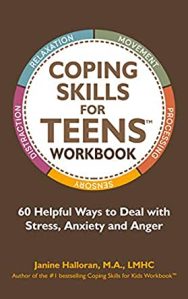
Book: Coping Skills for Teens Workbook

Book Title:

Coping Skills for Teens Workbook – 60 Helpful Ways to Deal with Stress, Anxiety and Anger.

Author(s): Janine Halloran (Author), Amy Maranville (Editor), and Meg Garcia (Illustrator).

Year: 2020.

Edition: First (1st).

Publisher: Encourage Play, LLC.

Type(s): Paperback and Kindle.

Synopsis:

A teen version of the #1 Bestselling Coping Skills for Kids Workbook, this version is written specifically with a tween/teen audience (age 11+) in mind.

There are 60 coping strategies included in the book, and it is divided into Coping Styles to make searching for a coping skill easier.

This book also includes several pages to support teens as they work on their coping skills, including: Feelings Tracker Worksheet Identifying Triggers and Making a Plan Positive to Negative Thoughts Worksheet Journal Pages Wellness Worksheets, including a Self-Care PlanThere’s also a rich resource section full of apps, books, card decks, and other resources to help teens deal with stress, anxiety and anger.

What are the Psychological Factors Associated with Financial Hardship & Mental Health?

Research Paper Title

Psychological factors associated with financial hardship and mental health: A systematic review.

Background

A review of the literature investigating the role of psychological factors in the relationship between financial hardship and mental health was completed.

Methods

The review sought to identify which factors have been most consistently and reliably indicated, and the mechanisms by which these factors are proposed to contribute to the association between hardship and mental health.

Results

Although the review identified that a broad variety of factors have been investigated, skills related to personal agency, self-esteem and coping were most frequently and reliably associated with the relationship between financial hardship and mental health outcomes.

Just over half of the studies reviewed concluded that the psychological factor investigated was either eroded by financial hardship, increasing vulnerability to mental health difficulties, or protected mental health by remaining intact despite the effects of financial hardship.

The remaining studies found no such effect or did not analyse their data in a manner in which a mechanism of action could be identified.

Conclusions

The methodological quality of the research included in the review was variable.

The valid and reliable measurement of financial hardship, and conclusions regarding causation due to the use of predominantly cross-sectional design were areas of particular weakness.

Reference

Frankham, C., Richardson, T. & Maguire, N. (2020) Psychological factors associated with financial hardship and mental health: A systematic review. Clinical Psychology Review. doi: 10.1016/j.cpr.2020.101832. Epub 2020 Feb 11.

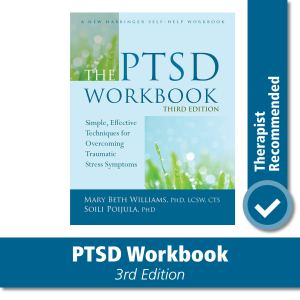
Book: The PTSD Workbook

Book Title:

The PTSD Workbook, 3rd Edition: Simple, Effective Techniques for Overcoming Traumatic Stress Symptoms.

Author(s): Mary Beth Williams and Soili Poijula.

Year: 2016.

Edition: Third (3rd).

Publisher: New Harbinger.

Type(s): Paperback and Kindle.

Synopsis:

Post-traumatic stress disorder (PTSD) is an extremely debilitating condition that can occur after exposure to a terrifying event.

But whether you are a veteran of war, a victim of domestic violence or sexual violence, or have been involved in a natural disaster, crime, car accident, or accident in the workplace, your symptoms may be getting in the way of you living your life.

PTSD can often cause you to relive your traumatic experience in the form of flashbacks, memories, nightmares, and frightening thoughts. This is especially true when you are exposed to events or objects that remind you of your trauma.

Left untreated, PTSD can lead to emotional numbness, insomnia, addiction, anxiety, depression, and even suicide. So, how can you start to heal and get your life back?

In The PTSD Workbook, Third Edition, psychologists and trauma experts Mary Beth Williams and Soili Poijula outline techniques and interventions used by PTSD experts from around the world to conquer distressing trauma-related symptoms.

In this fully revised and updated workbook, you will learn how to move past the trauma you have experienced and manage symptoms such as insomnia, anxiety, and flashbacks.

Based in cognitive behavioural therapy (CBT), this book is extremely accessible and easy-to-use, offering evidence-based therapy at a low cost.

This new edition features chapters focusing on veterans with PTSD, the link between cortisol and adrenaline and its role in PTSD and overall mental health, and the mind-body component of PTSD.

Clinicians will also find important updates reflecting the new DSM-V definition of PTSD.

This book is designed to give you the emotional resilience you need to get your life back together after a traumatic event.

Book: The PTSD Behavioural Activation Workbook

Book Title:

The PTSD Behavioral Activation Workbook: Activities to Help You Rebuild Your Life from Post-Traumatic Stress Disorder (A New Harbinger Self-Help Workbook).

Author(s): Matthew Jakupcak (PhD), Amy W Wagner (PhD), Christopher R. Martell (PhD), and Matthew T Tull (PhD).

Year: 2020.

Edition: First (1st).

Publisher: New Harbinger Publications; Workbook Edition.

Type(s): Paperback and Kindle.

Synopsis:

If you suffer from post-traumatic stress disorder (PTSD), reliving the past through trauma-focused treatments may be too painful a place to start. Behavioural activation – the powerful treatment method outlined in this workbook – provides an essential foundation for recovery by shifting the focus of your trauma to the things in life that give you true fulfilment, joy, and value. This way, you can envision the kind of future you want to have, and move forward in your treatment to pursue that future.

With this breakthrough workbook, you will learn to replace unproductive coping strategies – such as avoidance – with activities that you find pleasant and meaningful. You’ll find an overview of behavioural activation: what it is, why it works, and how you can implement it into your life to begin healing the wounds of your past and paving the way for a bright future full of possibility.

If you have experienced trauma, you need real tools to help you manage your pain and jumpstart your recovery. With this compassionate and evidence-based workbook, you will find actionable solutions to help you begin healing and take that next needed step toward wellness, wholeness, and peace.

Book: The Oxford Handbook of Emotion, Social Cognition, and Problem Solving in Adulthood

Book Title:

The Oxford Handbook of Emotion, Social Cognition, and Problem Solving in Adulthood.

Part of the Oxford Library of Psychology.

Author(s): Paul Verhaegen and Christopher Hertzog (Editors).

Year: 2014.

Edition: First.

Publisher: Oxford University Press.

Type(s): Hardcover and Kindle.

Synopsis:

Over the last decade, the field of socio-emotional development and ageing has rapidly expanded, with many new theories and empirical findings emerging. This trend is consistent with the broader movement in psychology to consider social, motivational, and emotional influences on cognition and behaviour.

The Oxford Handbook of Emotion, Social Cognition, and Problem Solving in Adulthood provides the first overview of a new field of adult development that has emerged out of conceptualisations and research at the intersections between socio-emotional development, social cognition, emotion, coping, and everyday problem solving.

This field roundly rejects a universal deficit model of ageing, highlighting instead the dynamic nature of socio-emotional development and the differentiation of individual trajectories of development as a function of variation in contextual and experiential influences.

It emphasises the need for a cross-level examination (from biology and neuroscience to cognitive and social psychology) of the determinants of emotional and socio-emotional behaviour.

This volume also serves as a tribute to the late Fredda Blanchard-Fields, whose thinking and empirical research contributed extensively to a life-span developmental view of emotion, problem solving, and social cognition.

Its chapters cover multiple aspects of adulthood and ageing, presenting developmental perspectives on emotion; antecedents and consequences of emotion in context; everyday problem solving; social cognition; goals and goal-related behaviours; and wisdom.

The landmark volume in this new field, The Oxford Handbook of Emotion, Social Cognition, and Problem Solving in Adulthood is an important resource for cognitive, developmental, and social psychologists, as well as researchers and graduate students in the field of ageing, emotion studies, and social psychology.

Strategies used by Families to Cope with Chronic Mental Illnesses

Research Paper Title

Strategies used by families to cope with chronic mental illnesses: Psychometric properties of the family crisis oriented personal evaluation scale.

Background

This study was aimed at investigating the psychometric properties of the Family Crisis Oriented Personal Evaluation Scale (F-COPES) for Turkish society, which assesses the coping skills of caregivers of individuals with chronic mental illnesses.

Methods

The study was conducted with 153 family caregivers of patients with a chronic mental illness admitted to the inpatient and outpatient units of two university hospitals and İzmir Schizophrenia Solidarity Association.

For the language validity, the translation-back translation method was performed, for the content validity, expert opinions were obtained, for the construct validity, exploratory and confirmatory factor analysis was performed.

For the reliability analysis, Cronbach α reliability coefficient was calculated and the test-retest reliability analysis was performed.

Results

The content validity index of the scale was 0.96.

The Cronbach’s α reliability coefficient for the overall scale was .80. Factor loadings of the subscales ranged between 0.56 and 0.69 for the Acquiring Social Support subscale, between 0.43 and 0.74 for the Reframing subscale, between 0.53 and 0.74 for the Seeking Spiritual Support subscale.

The model fit indexes were as follows: χ2  = 176.369, df = 116, χ2 /df = 1.52, RMSEA = 0.059, CFI = 0.90, IFI = 0.91, GFI = 0.88.

Conclusions

The results of the present study show that the levels of psychometric properties of F-COPES in Turkish society are acceptable.

It is thought that it would be useful to use the F-COPES in the assessment of coping behaviours of individuals who give care to patients with a chronic mental illness and that it can be used as measurement tool in studies to be conducted with caregivers of patients with a chronic mental illness to assess their coping skills.

Reference

Sari, A. & Çetinkaya Duman, Z. (2019) Strategies used by families to cope with chronic mental illnesses: Psychometric properties of the family crisis oriented personal evaluation scale. Perspectives in Psychiatric Care. doi: 10.1111/ppc.12457. [Epub ahead of print].