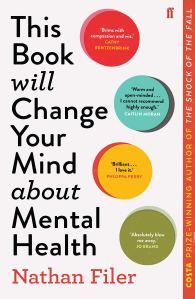
Book: This Book Will Change Your Mind About Mental Health

Book Title:

This Book Will Change Your Mind About Mental Health: A Journey into the Heartland of Psychiatry.

Author(s): Nathan Filer.

Year: 2019.

Edition: First (1st).

Publisher: Faber and Faber.

Type(s): Hardcover, Paperback, Audiobook, and Kindle.

Synopsis:

A journey into the heartland of psychiatry.

This book debunks myths, challenges assumptions and offers fresh insight into what it means to be mentally ill.

And what it means to be human.

This Book Will Change Your Mind About Mental Health was previously published in 2019 in hardback under the title The Heartland.

Some Common Myths about Mental Health Problems

Myth:

Only a few people get mental illnesses and they are unusual or odd, so it is obvious who they are.

Fact:

Mental health problems are common and we are often unaware of the person’s diagnosis.

Myth:

People with a diagnosis of mental illness are going to struggle for the rest of their lives.

Fact:

Most people recover from mental illness and go on to live fulfilling lives. Recovery is a unique and personal journey and often the person feels that they experienced personal growth and a new way of being through the process of recovery.

Myth:

People who attempt suicide or self-harm are doing it to get attention and are not really serious.

Fact:

All suicidal thoughts and self-harm, as well as all other forms and expressions of distress, are serious. Dismissing another person’s feelings as attention seeking only makes them withdraw from asking for help and may result in death or serious injury.

Myth:

People who have mental illnesses have brought it upon themselves, or their parents are to blame.

Fact:

Anyone can experience mental illness or experience mental distress regardless of their background or upbringing. Some people are more at risk through circumstances beyond their own control.

Some Important Facts about Mental Health Problems

Mental health problems are common and can affect anyone.

People with mental health problems do not lose their personality or intelligence, although the symptoms can sometimes change the way a person behaves when they are unwell.

People with mental health problems usually recover – there is a better chance of recovery from mental health problems than from some physical illnesses.

People with mental health problems want to work and to contribute to society, but it is often other people’s attitudes that prevent them from doing so.

Two thirds of employers, when asked, said that they did not feel comfortable employing a person with a mental health problem.

Many people with mental health problems continue to live life to the full, working and enjoying positive relationships and activities.

Sometimes, having a severe and enduring mental illness has a devastating effect on people’s live. With the right treatment and support, the person has a better chance of improvement and recovery.

People with schizophrenia do not have a split personality.

People with severe and enduring mental health problems are not usually dangerous – in fact, they are more likely to be victims of crime.

People with mental health problems are not weak and they do not bring the problems on themselves.

A growing body of evidence suggests that mental health problems cannot be separated from physical health, as the mind and body are closely interrelated.

Sometimes people dismiss others’ mental health problems or distress by judging them as weak. This is no more helpful or appropriate than judging someone for having a physical illness or disability.

Ordinary members of the public can help people experiencing mental health problems and make a real difference to their recovery.

Mental Health: Stigma & Myth

Most people know that it is not appropriate to deliberately treat someone with mental health problems badly.

This awareness means that stigma is often expressed in less obvious ways, such as unkind jokes or ignoring a person.

Stigma and the fear of stigma is a serious issue that has an effect on people’s ability to cope with and recover from a mental health problem.

There is a lot of evidence to show that people are treated differently when they experience a mental health problem.

Stigma is based on myths and false assumptions about mental health problems.

Therefore, it is best addressed by gaining knowledge and an understanding of the facts.

Research has found that attitudes towards people with mental health problems have improved significantly in the United Kingdom (UK) since anti-stigma campaigns like ‘See Me’ were introduced.

We can make a difference to people’s mental health by gaining understanding and knowledge, and sharing it with others.

We can also make a difference by treating people with mental health problems as equals, and offering kindness and support when they are unwell.