1921 – Reuven Feuerstein, Romanian-Israeli psychologist and academic (d. 2014).
People (Deaths)
2014 – Helen Bamber, English psychotherapist and academic (b. 1925).
Reuven Feuerstein
Reuven Feuerstein (21 August 1921 to 29 April 2014) was an Israeli clinical, developmental, and cognitive psychologist, known for his theory of intelligence which states “it is not ‘fixed’, but rather modifiable”. Feuerstein is recognised for his work in developing the theories and applied systems of structural cognitive modifiability, mediated learning experience, cognitive map, deficient cognitive functions, learning propensity assessment device, instrumental enrichment programmes, and shaping modifying environments. These interlocked practices provide educators with the skills and tools to systematically develop students’ cognitive functions and operations to build meta-cognition.
Feuerstein was the founder and director of the International Centre for the Enhancement of Learning Potential (ICELP) in Jerusalem, Israel. For more than 50 years, Feuerstein’s theories and applied systems have been implemented in both clinical and classroom settings internationally, with more than 80 countries applying his work. Feuerstein’s theory on the malleability of intelligence has led to more than 2,000 scientific research studies and countless case studies with various learning populations.
Helen Bamber
Helen Rae Bamber OBE, née Helen Balmuth (01 May 1925 to 21 August 2014), was a British psychotherapist and human rights activist. She worked with Holocaust survivors in Germany after the concentration camps were liberated in 1945. In 1947, she returned to Britain and continued her work, helping to establish Amnesty International and later co-founding the Medical Foundation for the Care of Victims of Torture. In 2005, she created the Helen Bamber Foundation to help survivors of human rights violations.
Throughout her life, Bamber worked with those who were the most marginalised: Holocaust survivors, asylum-seekers, refugees, victims of the conflict in Northern Ireland, trafficked men, women and children, survivors of genocide, torture, rape, female genital mutilation, British former Far East prisoners of war, former hostages and other people who suffered torture abroad. She worked in many countries including Gaza, Kosovo, Uganda, Turkey and Northern Ireland.
1913 – Roger Wolcott Sperry, American neuropsychologist and neurobiologist, Nobel Prize laureate (d. 1994).
People (Deaths)
1985 – Donald O. Hebb, Canadian psychologist and academic (b. 1904).
Roger Wolcott Sperry
Roger Wolcott Sperry (20 August 1913 to 17 April 1994) was an American neuropsychologist, neurobiologist and Nobel laureate who, together with David Hunter Hubel and Torsten Nils Wiesel, won the 1981 Nobel Prize in Physiology and Medicine for his work with split-brain research. A Review of General Psychology survey, published in 2002, ranked Sperry as the 44th most cited psychologist of the 20th century.
Education
Sperry went to Hall High School in West Hartford, Connecticut, where he was a star athlete in several sports, and did well enough academically to win a scholarship to Oberlin College. At Oberlin, he was captain of the basketball team, and he also took part in varsity baseball, football, and track. He also worked at a café on campus to help support himself. Sperry was an English major, but he took an Intro to Psychology class taught by a Professor named R.H. Stetson who had worked with William James, the father of American Psychology. This class sparked Sperry’s interest in the brain and how it can change. Stetson was disabled and had trouble getting around so Sperry would help him out by driving him to and from wherever he needed to go. This included taking Stetson to lunch with his colleagues. Sperry would just sit at the end of the table and listen to Stetson and his colleagues discuss their research and other psychological interests. This increased Sperry’s interest in Psychology even more and after he received his undergraduate degree in English from Oberlin he decided to stay and get his master’s degree in Psychology. He received his bachelor’s degree in English in 1935 and a master’s degree in psychology in 1937. He received his Ph.D. in zoology from the University of Chicago in 1941, supervised by Paul A. Weiss. Sperry then did postdoctoral research with Karl Lashley at Harvard University though most of his time was spent with Lashley at the Yerkes Primate Research Centre in Orange Park, Florida.
Career
In 1942, Sperry began work at the Yerkes Laboratories of Primate Biology, then a part of Harvard University. There he focused on experiments involving the rearranging of motor and sensory nerves. He left in 1946 to become an assistant professor, and later associate professor, at the University of Chicago. In 1949, during a routine chest x-ray, there was evidence of tuberculosis. He was sent to Saranac Lake in the Adironack Mountains in New York for treatment. It was during this time when he began writing his concepts of the mind and brain, and was first published in the American Scientist in 1952. In 1952, he became the Section Chief of Neurological Diseases and Blindness at the National Institutes of Health and finished out the year at the Marine Biology Laboratory in Coral Gables, Florida. Sperry went back to The University of Chicago in 1952 and became an Associate Professor of Psychology. He was not offered tenure at Chicago and planned to move to Bethesda, Maryland but was held up by a delay in construction at the National Institutes of Health. During this time Sperry’s friend Victor Hepburn invited him to lecture about his research at a symposium. There were professors from the California Institute of Technology in the audience of the symposium who, after listening to Sperry’s lecture, were so impressed with him they offered him a job as the Hixson Professor of Psychobiology. In 1954, he accepted the position as a professor at the California Institute of Technology (Caltech as Hixson Professor of Psychobiology) where he performed his most famous experiments with Joseph Bogen, MD and many students including Michael Gazzaniga.
Under the supervision of Paul Weiss while earning his Ph.D. at the University of Chicago, Sperry became interested in neuronal specificity and brain circuitry and began questioning the existing concepts about these two topics. He asked the simple question first asked in his Introduction to Psychology class at Oberlin: Nature or nurture? He began a series of experiments in an attempt to answer this question. Sperry crosswired the motor nerves of rats’ legs so the left nerve controlled the right leg and vice versa. He would then place the rats in a cage that had an electric grid on the bottom separated into four sections. Each leg of the rat was placed into one of the four sections of the electric grid. A shock was administered to a specific section of the grid, for example the grid where the rat’s left back leg was located would receive a shock. Every time the left paw was shocked the rat would lift his right paw and vice versa. Sperry wanted to know how long it would take the rat to realize he was lifting the wrong paw. After repeated tests Sperry found that the rats never learned to lift up the correct paw, leading him to the conclusion that some things are just hardwired and cannot be relearned. In Sperry’s words, “no adaptive functioning of the nervous system took place.” During Sperry’s postdoctoral years with Karl Lashley at Harvard and at the Yerkes Laboratories of Primate Biology in Orange Park, Florida, he continued his work on neuronal specificity that he had begun as a doctoral student and initiated a new series of studies involving salamanders. The optic nerves were sectioned and the eyes rotated 180 degrees. The question was whether vision would be normal after regeneration or would the animal forever view the world as “upside down” and right-left reversed. Should the latter prove to be the case, it would mean that the nerves were somehow “guided” back to their original sites of termination. Restoration of normal vision (i.e. “seeing” the world in a “right-side-up” orientation) would mean that the regenerating nerves had terminated in new sites, quite different from the original ones. The animals reacted as though the world was upside down and reversed from right to left. Furthermore, no amount of training could change the response. These studies, which provided strong evidence for nerve guidance by “intricate chemical codes under genetic control” (1963) culminated in Sperry’s chemoaffinity hypothesis (1951).
Sperry later served on the Board of Trustees and as Professor of Psychobiology Emeritus at California Institute of Technology. The Sperry Neuroscience Building at Oberlin College was named in his honour in 1990.
Donald O. Hebb
Donald Olding Hebb FRS (22 July 1904 to 20 August 1985) was a Canadian psychologist who was influential in the area of neuropsychology, where he sought to understand how the function of neurons contributed to psychological processes such as learning. He is best known for his theory of Hebbian learning, which he introduced in his classic 1949 work The Organisation of Behaviour. He has been described as the father of neuropsychology and neural networks. A Review of General Psychology survey, published in 2002, ranked Hebb as the 19th most cited psychologist of the 20th century. His views on learning described behaviour and thought in terms of brain function, explaining cognitive processes in terms of connections between neuron assemblies.
1990 – B.F. Skinner, American psychologist and philosopher, invented the Skinner box (b. 1904).
B.F. Skinner
Burrhus Frederic Skinner (20 March 1904 to 08 August 1990) was an American psychologist, behaviourist, author, inventor, and social philosopher. He was a professor of psychology at Harvard University from 1958 until his retirement in 1974.
Considering free will to be an illusion, Skinner saw human action as dependent on consequences of previous actions, a theory he would articulate as the principle of reinforcement: If the consequences to an action are bad, there is a high chance the action will not be repeated; if the consequences are good, the probability of the action being repeated becomes stronger.
Skinner developed behaviour analysis, especially the philosophy of radical behaviourism, and founded the experimental analysis of behaviour, a school of experimental research psychology. He also used operant conditioning to strengthen behaviour, considering the rate of response to be the most effective measure of response strength. To study operant conditioning, he invented the operant conditioning chamber (aka the Skinner box), and to measure rate he invented the cumulative recorder. Using these tools, he and Charles Ferster produced Skinner’s most influential experimental work, outlined in their 1957 book Schedules of Reinforcement.
Skinner was a prolific author, publishing 21 books and 180 articles. He imagined the application of his ideas to the design of a human community in his 1948 utopian novel, Walden Two, while his analysis of human behaviour culminated in his 1958 work, Verbal Behaviour.
Skinner, John B. Watson and Ivan Pavlov, are considered to be the pioneers of modern behaviourism. Accordingly, a June 2002 survey listed Skinner as the most influential psychologist of the 20th century.
Education and Later Life
Skinner attended Hamilton College in New York with the intention of becoming a writer. He wrote for the school paper, but, as an atheist, he was critical of the traditional mores of his college. After receiving his Bachelor of Arts in English literature in 1926, he attended Harvard University, where he would later research and teach. While attending Harvard, a fellow student, Fred S. Keller, convinced Skinner that he could make an experimental science of the study of behaviour. This led Skinner to invent a prototype for the Skinner box and to join Keller in the creation of other tools for small experiments.
After graduation, Skinner unsuccessfully tried to write a novel while he lived with his parents, a period that he later called the “Dark Years”. He became disillusioned with his literary skills despite encouragement from the renowned poet Robert Frost, concluding that he had little world experience and no strong personal perspective from which to write. His encounter with John B. Watson’s behaviourism led him into graduate study in psychology and to the development of his own version of behaviourism.
Skinner received a PhD from Harvard in 1931, and remained there as a researcher for some years. In 1936, he went to the University of Minnesota in Minneapolis to teach. In 1945, he moved to Indiana University, where he was chair of the psychology department from 1946 to 1947, before returning to Harvard as a tenured professor in 1948. He remained at Harvard for the rest of his life. In 1973, Skinner was one of the signers of the Humanist Manifesto II.
Contributions to Psychology
Behaviourism
Skinner referred to his approach to the study of behaviour as radical behaviourism, which originated in the early 1900s as a reaction to depth psychology and other traditional forms of psychology, which often had difficulty making predictions that could be tested experimentally. This philosophy of behavioural science assumes that behaviour is a consequence of environmental histories of reinforcement (refer to applied behaviour analysis). In his words:
The position can be stated as follows: what is felt or introspectively observed is not some nonphysical world of consciousness, mind, or mental life but the observer’s own body. This does not mean, as I shall show later, that introspection is a kind of psychological research, nor does it mean (and this is the heart of the argument) that what are felt or introspectively observed are the causes of the behavior. An organism behaves as it does because of its current structure, but most of this is out of reach of introspection. At the moment we must content ourselves, as the methodological behaviorist insists, with a person’s genetic and environment histories. What are introspectively observed are certain collateral products of those histories.… In this way we repair the major damage wrought by mentalism. When what a person does [is] attributed to what is going on inside him, investigation is brought to an end. Why explain the explanation? For twenty-five hundred years people have been preoccupied with feelings and mental life, but only recently has any interest been shown in a more precise analysis of the role of the environment. Ignorance of that role led in the first place to mental fictions, and it has been perpetuated by the explanatory practices to which they gave rise.[25]
Foundations of Skinner’s Behaviourism
Skinner’s ideas about behaviourism were largely set forth in his first book, The Behaviour of Organisms (1938). Here, he gives a systematic description of the manner in which environmental variables control behaviour. He distinguished two sorts of behaviour which are controlled in different ways:
Respondent behaviours are elicited by stimuli, and may be modified through respondent conditioning, often called classical (or pavlovian) conditioning, in which a neutral stimulus is paired with an eliciting stimulus. Such behaviours may be measured by their latency or strength.
Operant behaviours are ’emitted’, meaning that initially they are not induced by any particular stimulus. They are strengthened through operant conditioning (aka instrumental conditioning), in which the occurrence of a response yields a reinforcer. Such behaviours may be measured by their rate.
Both of these sorts of behaviour had already been studied experimentally, most notably: respondents, by Ivan Pavlov; and operants, by Edward Thorndike. Skinner’s account differed in some ways from earlier ones, and was one of the first accounts to bring them under one roof.
The idea that behaviour is strengthened or weakened by its consequences raises several questions. Among the most commonly asked are these:
Operant responses are strengthened by reinforcement, but where do they come from in the first place?
Once it is in the organism’s repertoire, how is a response directed or controlled?
How can very complex and seemingly novel behaviours be explained?
Origin of Operant Behaviour
Skinner’s answer to the first question was very much like Darwin’s answer to the question of the origin of a ‘new’ bodily structure, namely, variation and selection. Similarly, the behaviour of an individual varies from moment to moment; a variation that is followed by reinforcement is strengthened and becomes prominent in that individual’s behavioural repertoire. Shaping was Skinner’s term for the gradual modification of behaviour by the reinforcement of desired variations. Skinner believed that ‘superstitious’ behaviour can arise when a response happens to be followed by reinforcement to which it is actually unrelated. This can be seen, for example, with lucky socks that athletes wear. If they wear a pair of socks once and they win, but do not wear them for the next game and they lose, this reinforces the wearing of the lucky socks during games. The more it happens, the stronger the superstition will become.
Control of Operant Behaviour
The second question, “how is operant behaviour controlled?” arises because, to begin with, the behaviour is “emitted” without reference to any particular stimulus. Skinner answered this question by saying that a stimulus comes to control an operant if it is present when the response is reinforced and absent when it is not. For example, if lever-pressing only brings food when a light is on, a rat, or a child, will learn to press the lever only when the light is on. Skinner summarized this relationship by saying that a discriminative stimulus (e.g. light or sound) sets the occasion for the reinforcement (food) of the operant (lever-press). This three-term contingency (stimulus-response-reinforcer) is one of Skinner’s most important concepts, and sets his theory apart from theories that use only pair-wise associations.
Explaining Complex Behaviour
Most behaviour of humans cannot easily be described in terms of individual responses reinforced one by one, and Skinner devoted a great deal of effort to the problem of behavioural complexity. Some complex behaviour can be seen as a sequence of relatively simple responses, and here Skinner invoked the idea of “chaining”. Chaining is based on the fact, experimentally demonstrated, that a discriminative stimulus not only sets the occasion for subsequent behaviour, but it can also reinforce a behaviour that precedes it. That is, a discriminative stimulus is also a “conditioned reinforcer”. For example, the light that sets the occasion for lever pressing may also be used to reinforce “turning around” in the presence of a noise. This results in the sequence “noise – turn-around – light – press lever – food.” Much longer chains can be built by adding more stimuli and responses.
However, Skinner recognised that a great deal of behaviour, especially human behaviour, cannot be accounted for by gradual shaping or the construction of response sequences. Complex behaviour often appears suddenly in its final form, as when a person first finds his way to the elevator by following instructions given at the front desk. To account for such behaviour, Skinner introduced the concept of rule-governed behaviour. First, relatively simple behaviours come under the control of verbal stimuli: the child learns to “jump,” “open the book,” and so on. After a large number of responses come under such verbal control, a sequence of verbal stimuli can evoke an almost unlimited variety of complex responses.
Operant Conditioning Chamber
An operant conditioning chamber (also known as a “Skinner box”) is a laboratory apparatus used in the experimental analysis of animal behaviour. It was invented by Skinner while he was a graduate student at Harvard University. As used by Skinner, the box had a lever (for rats), or a disk in one wall (for pigeons). A press on this “manipulandum” could deliver food to the animal through an opening in the wall, and responses reinforced in this way increased in frequency. By controlling this reinforcement together with discriminative stimuli such as lights and tones, or punishments such as electric shocks, experimenters have used the operant box to study a wide variety of topics, including schedules of reinforcement, discriminative control, delayed response (“memory”), punishment, and so on. By channelling research in these directions, the operant conditioning chamber has had a huge influence on course of research in animal learning and its applications. It enabled great progress on problems that could be studied by measuring the rate, probability, or force of a simple, repeatable response. However, it discouraged the study of behavioural processes not easily conceptualized in such terms – spatial learning, in particular, which is now studied in quite different ways, for example, by the use of the water maze.
1832 – Wilhelm Wundt, German physician, psychologist, and physiologist (d. 1920).
Wilhelm Wundt
Wilhelm Maximilian Wundt (16 August 1832 to 31 August 1920) was a German physiologist, philosopher, and professor, known today as one of the founders of modern psychology. Wundt, who distinguished psychology as a science from philosophy and biology, was the first person ever to call himself a psychologist.
He is widely regarded as the “father of experimental psychology”. In 1879, at University of Leipzig, Wundt founded the first formal laboratory for psychological research. This marked psychology as an independent field of study. By creating this laboratory he was able to establish psychology as a separate science from other disciplines. He also formed the first academic journal for psychological research, Philosophische Studien (from 1881 to 1902), set up to publish the Institute’s research.
A survey published in American Psychologist in 1991 ranked Wundt’s reputation as first for “all-time eminence” based on ratings provided by 29 American historians of psychology. William James and Sigmund Freud were ranked a distant second and third.
1933 – Stanley Milgram, American social psychologist (d. 1984).
1958 – Simon Baron-Cohen, English-Canadian psychiatrist and author.
Stanley Milgram
Stanley Milgram (15 August 1933 20 December 1984) was an American social psychologist, best known for his controversial experiments on obedience conducted in the 1960s during his professorship at Yale.
Milgram was influenced by the events of the Holocaust, especially the trial of Adolf Eichmann, in developing the experiment. After earning a PhD in social psychology from Harvard University, he taught at Yale, Harvard, and then for most of his career as a professor at the City University of New York Graduate Centre, until his death in 1984.
His small-world experiment, while at Harvard, led researchers to analyse the degree of connectedness, including the six degrees of separation concept. Later in his career, Milgram developed a technique for creating interactive hybrid social agents (called cyranoids), which has since been used to explore aspects of social- and self-perception.
He is widely regarded as one of the most important figures in the history of social psychology. A Review of General Psychology survey, published in 2002, ranked Milgram as the 46th-most-cited psychologist of the 20th century.
Simon Baron-Cohen
Sir Simon Philip Baron-Cohen FBA FBPsS FMedSci (born 15 August 1958) is a British clinical psychologist and professor of developmental psychopathology at the University of Cambridge. He is the director of the university’s Autism Research Centre and a Fellow of Trinity College. In 1985, Baron-Cohen formulated the mind-blindness theory of autism, the evidence for which he collated and published in 1995. In 1997, he formulated the foetal sex steroid theory of autism, the key test of which was published in 2015.
He has also made major contributions to the fields of typical cognitive sex differences, autism prevalence and screening, autism genetics, autism neuroimaging, autism and technical ability, and synaesthesia. Baron-Cohen was knighted in the 2021 New Year Honours for services to autistic people.
1840 – Richard von Krafft-Ebing, German-Austrian psychologist and author (d. 1902).
Richard von Krafft-Ebing
Richard Freiherr von Krafft-Ebing (full name Richard Fridolin Joseph Freiherr Krafft von Festenberg auf Frohnberg, genannt von Ebing; 1840-1902) was an Austro-German psychiatrist and author of the foundational work Psychopathia Sexualis (1886).
Life
Krafft-Ebing was born in 1840 in Mannheim, Germany, studied medicine at the University of Heidelberg, where he specialized in psychiatry. He later practiced in psychiatric asylums. After leaving his work in asylums, he pursued a career in psychiatry, forensics, and hypnosis.
He died in Graz in 1902. He was recognized as an authority on deviant sexual behaviour and its medicolegal aspects.
Principal Work
Krafft-Ebing’s principal work is Psychopathia Sexualis: eine Klinisch-Forensische Studie (Sexual Psychopathy: A Clinical-Forensic Study), which was first published in 1886 and expanded in subsequent editions. The last edition from the hand of the author (the twelfth) contained a total of 238 case histories of human sexual behaviour.
Translations of various editions of this book introduced to English such terms as “sadist” (derived from the brutal sexual practices depicted in the novels of the Marquis de Sade), “masochist”, (derived from the name of Leopold von Sacher-Masoch), “homosexuality”, “bisexuality”, “necrophilia”, and “anilingus”.
Psychopathia Sexualis is a forensic reference book for psychiatrists, physicians, and judges. Written in an academic style, its introduction noted that, to discourage lay readers, the author had deliberately chosen a scientific term for the title of the book and that he had written parts of it in Latin for the same purpose.
Psychopathia Sexualis was one of the first books about sexual practices that studied homosexuality/bisexuality. It proposed consideration of the mental state of sex criminals in legal judgements of their crimes. During its time, it became the leading medico-legal textual authority on sexual pathology.
The twelfth and final edition of Psychopathia Sexualis presented four categories of what Krafft-Ebing called “cerebral neuroses”:
Paradoxia, sexual excitement occurring independently of the period of the physiological processes in the generative organs.
Anaesthesia, absence of sexual instinct.
Hyperaesthesia, increased desire, satyriasis.
Paraesthesia, perversion of the sexual instinct, i.e., excitability of the sexual functions to inadequate stimuli.
The term “hetero-sexual” is used, but not in chapter or section headings. The term “bi-sexuality” appears twice in the 7th edition, and more frequently in the 12th.
There is no mention of sexual activity with children in Chapter III, General Pathology, where the “cerebral neuroses” (including sexuality the paraesthesias) are covered. Various sexual acts with children are mentioned in Chapter IV, Special Pathology, but always in the context of specific mental disorders, such as dementia, epilepsy, and paranoia, never as resulting from its own disorder. However, Chapter V on sexual crimes has a section on sexual crimes with children. This section is brief in the 7th edition, but is expanded in the 12th to cover Non-Psychopathological Cases and Psychopathological Cases, in which latter subsection the term paedophilia erotica is used.
Krafft-Ebing considered procreation the purpose of sexual desire and that any form of recreational sex was a perversion of the sex drive. “With opportunity for the natural satisfaction of the sexual instinct, every expression of it that does not correspond with the purpose of nature—i.e., propagation,—must be regarded as perverse.” Hence, he concluded that homosexuals suffered a degree of sexual perversion because homosexual practices could not result in procreation. In some cases, homosexual libido was classified as a moral vice induced by the early practice of masturbation. Krafft-Ebing proposed a theory of homosexuality as biologically anomalous and originating in the embryonic and fetal stages of gestation, which evolved into a “sexual inversion” of the brain. In 1901, in an article in the Jahrbuch für sexuelle Zwischenstufen (Yearbook for Intermediate Sexual Types), he changed the biological term from anomaly to differentiation.
Although the primary focus is on sexual behaviour in men, there are sections on Sadism in Woman, Masochism in Woman, and Lesbian Love. Several of the cases of sexual activity with children were committed by women.
Krafft-Ebing’s conclusions about homosexuality are now largely forgotten, partly because Sigmund Freud’s theories were more interesting to physicians (who considered homosexuality to be a psychological problem) and partly because he incurred the enmity of the Austrian Catholic Church when he psychologically associated martyrdom (a desire for sanctity) with hysteria and masochism.
Works
A bibliography of von Krafft-Ebing’s writings can be found in A. Kreuter, Deutschsprachige Neurologen und Psychiater, München 1996, Band 2, pp.767-774.
Die Melancholie: Eine klinische Studie (1874) OCLC 180728044.
Grundzüge der Kriminalpsychologie für Juristen (second edition, 1882) OCLC 27460358.
Psychopathia Sexualis: eine Klinisch-Forensische Studie (first edition, 1886).
Die progressive allgemeine Paralyse (1894) OCLC 65980497.
Nervosität und neurasthenische Zustände (1895) OCLC 9633149.
Translations
Domino Falls translated and edited Psychopathia Sexualis:The Case Histories (1997) ISBN 978-0-9820464-7-0.
Charles Gilbert Chaddock translated four of Krafft-Ebing’s books into English:
An Experimental Study in the Domain of Hypnotism (New York and London, 1889).
1995 – Jan Křesadlo, Czech-English psychologist and author (b. 1926).
Jan Kresadlo
Václav Jaroslav Karel Pinkava (09 December 1926 to 13 August 1995), better known by his pen name Jan Křesadlo, was a Czech psychologist who was also a prizewinning novelist and poet.
An anti-communist, Pinkava emigrated to Britain with his wife and four children following the 1968 invasion of Czechoslovakia by the Soviet-led armies of the Warsaw pact. He worked as a clinical psychologist until his early retirement in 1982, when he turned to full-time writing. His first novel “Mrchopěvci” (GraveLarks) was published by Josef Škvorecký’s emigre publishing house 68 Publishers, and earned the 1984 Egon Hostovský prize.
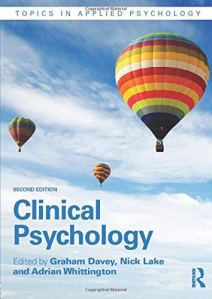
Clinical Psychology is for students studying clinical psychology as part of an undergraduate programme in psychology, nursing, sociology or social and behavioural sciences. Undergraduate students who wish to know if postgraduate study in clinical psychology would be of interest to them will find this book particularly useful.
The book will inform students about:
The profession of clinical psychology.
How to get onto a clinical psychology postgraduate training programme.
The way clinical psychologists work with children, adolescents and adults with common psychological problems.
The main models of practice used by clinical psychologists, and.
The scientific evidence for the effectiveness of psychological interventions.
There is a focus on both clinical case studies and relevant research, and the book includes summaries, revision questions, advice on further reading and a glossary of key terms, all of which make it an excellent student-friendly introduction to an exceptionally interesting subject.
Clinical Psychology (Topics in Applied Psychology).
Author(s): Graham Davey, Nick Lake, and Adrian Whittington (Editors).
Year: 2015.
Edition: Second (2nd).
Publisher: Routledge.
Type(s): Hardcover, Paperback and Kindle.
Synopsis:
Clinical Psychology, Second Edition offers a comprehensive and an up-to-date introduction to the field. Written by clinical practitioners and researchers, as well as service users who add their personal stories, the book provides a broad and balanced view of contemporary clinical psychology.
This new edition has been extensively revised throughout and includes a new section on working with people with disabilities and physical health problems. It also includes a new chapter on career choices, and help and advice on how to move forward into clinical psychology training.
The book starts by explaining the core elements of what a clinical psychologist does and the principles of clinical practice, as well as outlining the role of the clinical psychologist within a healthcare team. It goes on to cover issues involved with working with children and families, adult mental health problems, working with people with disabilities and physical health problems, and the use of neuropsychology. The final part of the book explores current professional issues in clinical psychology, the history and future of clinical psychology, and career options.
The integrated and interactive approach, combined with the comprehensive coverage, make this book the ideal companion for undergraduate courses in clinical psychology, and anyone interested in a career in this field. It will also be of interest to anyone who wants to learn more about the work of a clinical psychologist, including other healthcare professionals.
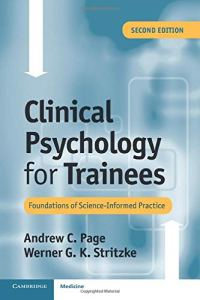
Clinical Psychology for Trainees: Foundations of Science-Informed Practice.
Author(s): Andrew C. Page and Werner G.K. Stritzke.
Year: 2014.
Edition: Second (2nd).
Publisher: Cambridge University Press.
Type(s): Paperback and Kindle.
Synopsis:
Thoroughly revised, and fully updated for DSM-5, the new edition of this practice-focused book guides clinical psychology trainees through a field which is rapidly evolving. Through real-world exploration of the scientist-practitioner model, the book helps readers to develop the core competencies required in an increasingly interdisciplinary healthcare environment. New chapters cover brief interventions, routine monitoring of treatment progress, and managing alliance ruptures. Practical skills such as interviewing, diagnosis, assessment, treatment and case management are discussed with emphasis on the question ‘how would a scientist-practitioner think and act?’ By demonstrating how an evidence-base can influence every decision that a clinical psychologist makes, the book equips trainees to deliver the accountable, efficient, effective client-centred service which is demanded of professionals in the modern integrated care setting. Essential reading for all those enrolled in, or contemplating, postgraduate studies in clinical psychology.




 Mental Health Matters
You must be logged in to post a comment.