On This Day … 16 April

People (Deaths)

  • 1961 – Carl Hovland, American psychologist and academic (b. 1912).

Carl Hovland

Carl Iver Hovland (12 June 1912 to 16 April 1961) was a psychologist working primarily at Yale University and for the US Army during World War II who studied attitude change and persuasion. He first reported the sleeper effect after studying the effects of the Frank Capra’s propaganda film Why We Fight on soldiers in the Army. In later studies on this subject, Hovland collaborated with Irving Janis who would later become famous for his theory of groupthink. Hovland also developed social judgment theory of attitude change. Carl Hovland thought that the ability of someone to resist persuasion by a certain group depended on your degree of belonging to the group.

With the advent of government propaganda in support of the United States’ participation in World War II, the artefacts worth investigating helped with increase of persuasive communication with intent to affect behaviour, attitude, and values. These artefacts had a remarkable amount of money invested into them, however, were they effective? This concept of effectiveness and affecting change within individuals, interpersonal relations, and persuasion are exactly what Hovland was interested in. Carl Hovland’s contributions to the field of communications were three-fold. First, he emphasized micro-level analysis, next he was interested in all facets of interpersonal communication, and finally he revolutionised persuasive research.

On This Day … 15 April

People (Births)

  • 1858 – Émile Durkheim, French sociologist, psychologist, and philosopher (d. 1917).
  • 1920 – Thomas Szasz, Hungarian-American psychiatrist and academic (d. 2012).
  • 1931 – Tomas Tranströmer, Swedish poet, translator, and psychologist Nobel Prize laureate (d. 2015).

Emile Durkheim

David Émile Durkheim (15 April 1858 to 15 November 1917) was a French sociologist. He formally established the academic discipline of sociology and, with Max Weber, is commonly cited as the principal architect of modern social science.

From his lifetime, much of Durkheim’s work would be concerned with how societies could maintain their integrity and coherence in modernity, an era in which traditional social and religious ties are no longer assumed, and in which new social institutions have come into being. His first major sociological work would be De la division du travail social (1893; The Division of Labour in Society), followed in 1895 by Les Règles de la Méthode Sociologique (The Rules of Sociological Method), the same year in which Durkheim would set up the first European department of sociology and become France’s first professor of sociology. Durkheim’s seminal monograph, Le Suicide (1897), a study of suicide rates in Catholic and Protestant populations, especially pioneered modern social research, serving to distinguish social science from psychology and political philosophy. The following year, in 1898, he established the journal L’Année Sociologique. Les formes élémentaires de la vie religieuse (1912; The Elementary Forms of the Religious Life) presented a theory of religion, comparing the social and cultural lives of aboriginal and modern societies.

Durkheim would also be deeply preoccupied with the acceptance of sociology as a legitimate science. He refined the positivism originally set forth by Auguste Comte, promoting what could be considered as a form of epistemological realism, as well as the use of the hypothetico-deductive model in social science. For Durkheim, sociology was the science of institutions, understanding the term in its broader meaning as the “beliefs and modes of behaviour instituted by the collectivity,” with its aim being to discover structural social facts. As such, Durkheim was a major proponent of structural functionalism, a foundational perspective in both sociology and anthropology. In his view, social science should be purely holistic, in that sociology should study phenomena attributed to society at large, rather than being limited to the specific actions of individuals.

He remained a dominant force in French intellectual life until his death in 1917, presenting numerous lectures and published works on a variety of topics, including the sociology of knowledge, morality, social stratification, religion, law, education, and deviance. Durkheimian terms such as “collective consciousness” have since entered the popular lexicon.

Thomas Szasz

Thomas Stephen Szasz (15 April 1920 to 08 September 2012) was a Hungarian-American academic, psychiatrist and psychoanalyst. He served for most of his career as professor of psychiatry at the State University of New York Upstate Medical University in Syracuse, New York. A distinguished lifetime fellow of the American Psychiatric Association and a life member of the American Psychoanalytic Association, he was best known as a social critic of the moral and scientific foundations of psychiatry, as what he saw as the social control aims of medicine in modern society, as well as scientism. His books The Myth of Mental Illness (1961) and The Manufacture of Madness (1970) set out some of the arguments most associated with him.

Szasz argued throughout his career that mental illness is a metaphor for human problems in living, and that mental illnesses are not “illnesses” in the sense that physical illnesses are; and that except for a few identifiable brain diseases, there are “neither biological or chemical tests nor biopsy or necropsy findings for verifying DSM diagnoses.”

Szasz maintained throughout his career that he was not anti-psychiatry but was rather that he opposed coercive psychiatry. He was a staunch opponent of civil commitment and involuntary psychiatric treatment, but he believed in and practiced psychiatry and psychotherapy between consenting adults.

His views on special treatment followed from libertarian roots, based on the principles that each person has the right to bodily and mental self-ownership and the right to be free from violence from others, and he criticised the use of psychiatry in the Western world as well as communist states.

Tomas Transtromer

Tomas Gösta Tranströmer (15 April 1931 to 26 March 2015) was a Swedish poet, psychologist and translator. His poems captured the long Swedish winters, the rhythm of the seasons and the palpable, atmospheric beauty of nature. Tranströmer’s work is also characterised by a sense of mystery and wonder underlying the routine of everyday life, a quality which often gives his poems a religious dimension. He has been described as a Christian poet.

Tranströmer is acclaimed as one of the most important Scandinavian writers since the Second World War. Critics praised his poetry for its accessibility, even in translation. His poetry has been translated into over 60 languages. He was the recipient of the 1990 Neustadt International Prize for Literature and the 2011 Nobel Prize in Literature.

On This Day … 14 April

People (Deaths)

  • 2010 – Alice Miller, Polish-French psychologist and author (b. 1923).

Alice Miller

Alice Miller, born as Alicija Englard (12 January 1923 to 14 April 2010), was a Polish-Swiss psychologist, psychoanalyst and philosopher of Jewish origin, who is noted for her books on parental child abuse, translated into several languages. She was also a noted public intellectual.

Her book The Drama of the Gifted Child caused a sensation and became an international bestseller upon the English publication in 1981. Her views on the consequences of child abuse became highly influential. In her books she departed from psychoanalysis, charging it with being similar to the poisonous pedagogies.

Life

Miller was born in Piotrków Trybunalski, Poland into a Jewish family. She was the oldest daughter of Gutta and Meylech Englard and had a sister, Irena, who was five years younger. From 1931 to 1933 the family lived in Berlin, where nine-year-old Alicija learned the German language. Due to the National Socialists’ seizure of power in Germany in 1933 the family turned back to Piotrków Trybunalski. As a young woman, Miller managed to escape the Jewish Ghetto in Piotrków Trybunalski, where all Jewish inhabitants were interned since October 1939, and survived World War II in Warsaw under the assumed name of Alicja Rostowska. While she was able to smuggle her mother and sister out, in 1941, her father died in the ghetto.

She retained her assumed name Alice Rostovska when she moved to Switzerland in 1946, where she had won a scholarship to the University of Basel.

In 1949 she married Swiss sociologist Andreas Miller, originally a Polish Catholic, with whom she had moved from Poland to Switzerland as students. They divorced in 1973. They had two children, Martin (born 1950) and Julika (born 1956). Shortly after his mother’s death Martin Miller stated in an interview with Der Spiegel that he had been beaten by his authoritarian father during his childhood – in the presence of his mother. Miller first stated that his mother intervened, but later that she did not intervene. These events happened decades before Alice Miller’s awakening about the dangers of such childrearing methods. Martin also mentioned that his mother was unable to talk with him, despite numerous lengthy conversations, about her wartime experiences, as she was severely burdened by them.

In 1953 Miller gained her doctorate in philosophy, psychology and sociology. Between 1953 and 1960, Miller studied psychoanalysis and practiced it between 1960 and 1980 in Zürich.

In 1980, after having worked as a psychoanalyst and an analyst trainer for 20 years, Miller “stopped practicing and teaching psychoanalysis in order to explore childhood systematically.” She became critical of both Sigmund Freud and Carl Jung. Her first three books originated from research she took upon herself as a response to what she felt were major blind spots in her field. However, by the time her fourth book was published, she no longer believed that psychoanalysis was viable in any respect.

In 1985 Miller wrote about the research from her time as a psychoanalyst: “For twenty years I observed people denying their childhood traumas, idealising their parents and resisting the truth about their childhood by any means.” In 1985 she left Switzerland and moved to Saint-Rémy-de-Provence in Southern France.

In 1986, she was awarded the Janusz Korczak Literary Award for her book Thou Shalt Not Be Aware: Society’s Betrayal of the Child.

In April 1987 Miller announced in an interview with the German magazine Psychologie Heute (Psychology Today) her rejection of psychoanalysis. The following year she cancelled her memberships in both the Swiss Psychoanalytic Society and the International Psychoanalytic Association, because she felt that psychoanalytic theory and practice made it impossible for former victims of child abuse to recognise the violations inflicted on them and to resolve the consequences of the abuse, as they “remained in the old tradition of blaming the child and protecting the parents”.

One of Miller’s last books, Bilder meines Lebens (“Pictures of My Life”), was published in 2006. It is an informal autobiography in which the writer explores her emotional process from painful childhood, through the development of her theories and later insights, told via the display and discussion of 66 of her original paintings, painted in the years 1973-2005.

Between 2005 and her death in 2010, she answered hundreds of readers’ letters on her website, where there are also published articles, flyers and interviews in three languages. Days before her death Alice Miller wrote: “These letters will stay as an important witness also after my death under my copyright”.

Miller died on 14 April 2010, at the age of 87, at her home in Saint-Rémy-de-Provence by suicide after severe illness and diagnosis of advanced stage of pancreatic cancer.

Work

Miller extended the trauma model to include all forms of child abuse, including those that were commonly accepted (such as spanking), which she called poisonous pedagogy, a non-literal translation of Katharina Rutschky’s Schwarze Pädagogik (black or dark pedagogy/imprinting).

Drawing upon the work of psychohistory, Miller analysed writers Virginia Woolf, Franz Kafka and others to find links between their childhood traumas and the course and outcome of their lives.

The introduction of Miller’s first book, The Drama of the Gifted Child, first published in 1979, contains a line that summarises her core views:

Experience has taught us that we have only one enduring weapon in our struggle against mental illness: the emotional discovery and emotional acceptance of the truth in the individual and unique history of our childhood.

In the 1990s, Miller strongly supported a new method developed by Konrad Stettbacher, who himself was later charged with incidents of sexual abuse. Miller came to know about Stettbacher and his method from a book by Mariella Mehr titled Steinzeit (Stone Age). Having been strongly impressed by the book, Miller contacted Mehr in order to get the name of the therapist. From that time forward, Miller refused to make therapist or method recommendations. In open letters, Miller explained her decision and how she originally became Stettbacher’s disciple, but in the end she distanced herself from him and his regressive therapies.

In her writings, Miller is careful to clarify that by “abuse” she does not only mean physical violence or sexual abuse, she is also concerned with psychological abuse perpetrated by one or both parents on their child; this is difficult to identify and deal with because the abused person is likely to conceal it from themselves and may not be aware of it until some event, or the onset of depression, requires it to be treated. Miller blamed psychologically abusive parents for the majority of neuroses and psychoses. She maintained that all instances of mental illness, addiction, crime and cultism were ultimately caused by suppressed rage and pain as a result of subconscious childhood trauma that was not resolved emotionally, assisted by a helper, which she came to term an “enlightened witness.” In all cultures, “sparing the parents is our supreme law,” wrote Miller. Even psychiatrists, psychoanalysts and clinical psychologists were unconsciously afraid to blame parents for the mental disorders of their clients, she contended. According to Miller, mental health professionals were also creatures of the poisonous pedagogy internalised in their own childhood. This explained why the Commandment “Honour thy parents” was one of the main targets in Miller’s school of psychology.

Miller called electroconvulsive therapy “a campaign against the act of remembering”. In her book Abbruch der Schweigemauer (The Demolition of Silence), she also criticised psychotherapists’ advice to clients to forgive their abusive parents, arguing that this could only hinder recovery through remembering and feeling childhood pain. It was her contention that the majority of therapists fear this truth and that they work under the influence of interpretations culled from both Western and Oriental religions, which preach forgiveness by the once-mistreated child. She believed that forgiveness did not resolve hatred, but covered it in a dangerous way in the grown adult: displacement on scapegoats, as she discussed in her psycho-biographies of Adolf Hitler and Jürgen Bartsch, both of whom she described as having suffered severe parental abuse.

A common denominator in Miller’s writings is her explanation of why human beings prefer not to know about their own victimisation during childhood: to avoid unbearable pain. She believed that the unconscious command of the individual, not to be aware of how he or she was treated in childhood, led to displacement: the irresistible drive to repeat abusive parenting in the next generation of children or direct unconsciously the unresolved trauma against others (war, terrorism, delinquency), or against him or herself (eating disorders, drug addiction, depression).

The Roots of Violence

According to Alice Miller, worldwide violence has its roots in the fact that children are beaten all over the world, especially during their first years of life, when their brains become structured. She said that the damage caused by this practice is devastating, but unfortunately hardly noticed by society. She argued that as children are forbidden to defend themselves against the violence inflicted on them, they must suppress the natural reactions like rage and fear, and they discharge these strong emotions later as adults against their own children or whole peoples: “child abuse like beating and humiliating not only produces unhappy and confused children, not only destructive teenagers and abusive parents, but thus also a confused, irrationally functioning society”. Miller stated that only through becoming aware of this dynamic can we break the chain of violence.

On This Day … 12 April

People (Births)

Benjamin Libet

Benjamin Libet (12 April 1916 to 23 July 2007) was a pioneering scientist in the field of human consciousness. Libet was a researcher in the physiology department of the University of California, San Francisco. In 2003, he was the first recipient of the Virtual Nobel Prize in Psychology from the University of Klagenfurt, “for his pioneering achievements in the experimental investigation of consciousness, initiation of action, and free will”.

On This Day … 11 April

People (Births)

David Perrett

David Ian Perrett FBA FRSE (born 11 April 1954) is a professor of psychology at the University of St Andrews in Scotland, where he leads the Perception Lab. The main focus in his team’s research is on face perception, including facial cues to health, effects of physiological conditions on facial appearance, and facial preferences in social settings such as trust games and mate choice. He has published over 400 peer-reviewed articles, many of which appearing in leading scientific journals such as the Proceedings of the Royal Society of London Series B – Biological Sciences, Psychological Science, and Nature.

Perrett received the British Psychological Society President’s Award for Distinguished Contributions to Psychological Knowledge in 2000, the Golden Brain Award of Minerva Foundation in 2002, the Experimental Psychology Society Mid-Career prize (2008), and a British Academy Wolfson Research Professorship (2009-2012).

Book: A Dictionary of Psychology 4/e

Book Title:

A Dictionary of Psychology 4/e (Oxford Quick Reference).

Author(s): Andrew M. Colman.

Year: 2015.

Edition: Fourth (4th).

Publisher: Oxford OUP.

Type(s): Paperback and Kindle.

Synopsis:

Including more than 11,000 definitions, this authoritative and up-to-date dictionary covers all branches of psychology. Clear, concise descriptions for each entry offer extensive coverage of key areas including cognition, sensation and perception, emotion and motivation, learning and skills, language, mental disorder, and research methods. The range of entries extends to related disciplines including psychoanalysis, psychiatry, the neurosciences, and statistics. Entries are extensively cross-referenced for ease of use, and cover word origins and derivations as well as definitions. More than 100 illustrations complement the text.

This fourth edition has incorporated a large number of significant revisions and additions, many in response to the 2013 publication of the American Psychiatric Association’s latest edition of Diagnostic and Statistical Manual of Mental Disorders, bringing the Dictionary fully up to date with the most recent literature of the subject.

In addition to the alphabetical entries, the dictionary also includes appendices covering over 800 commonly used abbreviations and symbols, as well as a list of phobias and phobic stimuli, with definitions.

Comprehensive and clearly written, this dictionary is an invaluable work of reference for students, lecturers, and the general reader with an interest in psychology.

On This Day … 06 April

People (Births)

Tanya Byron

Tanya Byron (born 06 April 1967) is a British psychologist, writer, and media personality, best known for her work as a child therapist on television shows Little Angels and The House of Tiny Tearaways. She also co-created the BBC Two sitcom The Life and Times of Vivienne Vyle with Jennifer Saunders, and still contributes articles to various newspapers.

In 2008, she became Professor of the Public Understanding of Science at Edge Hill University and is the first and current Chancellor of the same institution.

Early Life

When Byron was 15 years old, her German-born paternal grandmother was murdered by being battered to death by a woman who abused illicit drugs. Her grandmother knew the woman, who was in pursuit of money. Byron was perplexed by this cruelty, and at about that time she began to try to understand how anyone could do such a terrible thing and began to be interested in psychology.

Education

Byron was educated at North London Collegiate School, University of York (BSc Psychology, 1989), University College London (MSc Clinical Psychology, 1992), and University of Surrey (PhD, 1995). Her PhD thesis was entitled “The evaluation of an outpatient treatment programme for stimulant drug misuse”, and was completed at University College Hospital.

Career

Prior to training in Clinical Psychology, Byron worked as a researcher on the BBC’s Video Diaries documentary series. Once she qualified, Byron worked in the NHS for 18 years in a number of public health areas such as drug addiction, STDs, and mental disorders.

In 2005, Byron was featured on French and Saunders’ Christmas Special as herself, who came in to sort out Dawn and Jennifer’s childish behaviour on the show. Subsequently, she co-wrote the series The Life and Times of Vivienne Vyle with Jennifer Saunders. Byron has also co-authored a book on parenting based on the Little Angels show and two other books on child development and parenting, as well as writing weekly articles for The Times and contributing to several women’s magazines. She has also worked with the Home Office on the current changes to the Homicide Act as it relates to children and young people, and she also works with the National Family and Parenting Institute advising government and ministers on related policy.

In September 2007, it was announced that she would head an independent review in England – supported by the Department for Children, Schools, and Families, as well as the Department for Culture, Media, and Sport – into the potentially harmful effects of both the Internet and video games on children. This was published in March 2008 as “Safer Children in a Digital World”, but is commonly called the Byron Review.

In April 2008, Byron fronted a four-part show called Am I Normal? exploring the boundaries of acceptable behaviour.

In May 2008, she was elected as the first Chancellor of Edge Hill University, in Lancashire and installed at a ceremony in December 2008.[10] Edge Hill University also appointed her to the post of Professor of the Public Understanding of Science, and she delivered her inaugural lecture, “The Trouble With Kids”, in March the following year.

In 2009, Byron was awarded an honorary doctorate by the University of York.

Byron is the patron of Prospex, a charity which works with young people in North London. She is also a partner in a media company, Doris Partnership.

She has published The Skeleton Cupboard: The Making of a Clinical Psychologist in 2015.

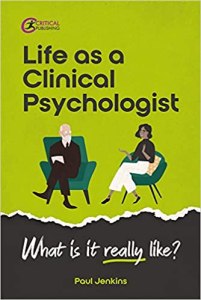
Book: Life as a Clinical Psychologist: What is it Really Like?

Book Title:

Life as a Clinical Psychologist: What is it Really Like?

Author(s): Paul Jenkins.

Year: 2020.

Edition: First (1st).

Publisher: Critical Publishing.

Type(s): Paperback and Kindle.

Synopsis:

Considering a career as a Clinical Psychologist? This book is an ideal, jargon-free introduction for those wishing to find out more about working in this demanding but rewarding mental health profession.

An accessible text that invites you to think critically about whether becoming a Clinical Psychologist is right for you, questioning and challenging your views and providing an honest perspective of life as a clinical psychologist.

Written from personal experience of over 10 years working in applied psychology, with a unique knowledge of the practice, theory, and application of Clinical Psychology, Paul Jenkins provides a first-hand perspective, blending anecdotes with factual advice on the clinical academic culture. It is also packed with case studies which highlight a range of different career pathways (including in other mental health fields) and includes coverage of post-qualification life to gives the reader a sense of the career you can have after training.

On This Day … 04 April

People (Deaths)

  • 2012 – A. Dean Byrd, American psychologist and academic (b. 1948).

A. Dean Byrd

Albert Dean Byrd (1948 to 4 April 2012) was a former president of the National Association for Research & Therapy of Homosexuality (NARTH), a research organisation that advocates sexual orientation change efforts (SOCE).

He was a psychologist who focused on SOCE, and wrote on the topic. Although raised by a Buddhist mother and a Baptist father, Byrd converted to The Church of Jesus Christ of Latter-day Saints (LDS Church) and was very active in the debate within the church on issues involving homosexuality.

Professional Life

Byrd was a well known supporter of conversion therapy, and authored more than 100 publications, including books, peer-reviewed scientific journals, law journals, book chapters, invited commentaries and opinion editorials, many of which addressed issues of human sexuality. In 2002, he presented a paper which describes a technique called gender-affirmative therapy. He stated: “The basic premise of gender-affirmative therapy is that social and emotional variables affect gender identity which, in turn, determines sexual orientation. The work of the therapist is to help people understand their gender development. Subsequently, such individuals are able to make choices that are consistent with their value system. The focus of therapy is to help clients fully develop their masculine or feminine identity”. He wrote several papers with Joseph Nicolosi. One of the largest was a survey of 882 people who were undergoing therapy, attending ex-gay groups or ex-gay conferences: 22.9% reported they had not undergone any changes, 42.7% reported some changes, and 34.3% reported much change in sexual orientation. As a group, they reported large reductions in homosexual thoughts and fantasies and improvements in their psychological, interpersonal, and spiritual well-being. He promoted his ideas on college campuses, in newspapers, and in several books. He was called as a professional witness to testify on behalf of Andrew McClintock, a Christian magistrate who was forced to resign due to his beliefs on homosexual parents. In 2007, he was asked to chair a symposium at the APA Convention in San Francisco.

Byrd received a Ph.D. in psychology from Brigham Young University (BYU), a post-doctoral degree in Child and Family Psychology from Virginia Commonwealth University and Medical College of Virginia, and a post-doctoral degree in Behavioral Medicine from Loyola University, Chicago. He also received both an M.P.H. from the University of Utah (U of U), School of Medicine, and an M.B.A. also from the U of U. He was a diplomate in forensic medicine.

Byrd served as the Director of Clinical Training for LDS Social Services, was a Clinical Professor at BYU, and was, at the time of his death, a Clinical Professor at the University of Utah, School of Medicine, with appointments in the Department of Family and Preventive Medicine and in Department of Psychiatry, with an adjunct clinical appointment in the Department of Family Studies, also at the University of Utah. As member of the faculty at the U of U, he lectured training medical students about disparities in health care in the population. He was also a member of the American Psychological Association, the Utah Psychological Association where he served on the governing board, with professional affiliations in the American Orthopsychiatric Association, where he was a fellow, the American Public Health Association, the American Board of Forensic Examiners and the Prescribing Psychologist Register, a training and credentialing organization for psychologists in psychopharmacology. He was also a former member of the Evergreen Board of Trustees. He was also the president of Thrasher Research Fund, a paediatric research granting institution. In 2007, he was elected as president of NARTH for 2008. Byrd had visiting professor appointments in Israel and Poland. He also had training in genetics, biochemistry and neurochemistry from the University of California at Berkeley.

Death

Byrd died of cancer on 04 April 2012.

On This Day … 03 April

People (Births)

  • 1860 – Frederik van Eeden, Dutch psychiatrist and author (d. 1932).

Frederik van Eeden

Frederik Willem van Eeden (03 April 1860 to 16 June 1932) was a late 19th-century and early 20th-century Dutch writer and psychiatrist. He was a leading member of the Tachtigers and the Significs Group, and had top billing among the editors of De Nieuwe Gids (The New Guide) during its celebrated first few years of publication, starting in 1885.

Biography

Van Eeden was the son of Frederik Willem Van Eeden, director of the Royal Tropical Institute in Haarlem.

In 1880 he studied Medicine in Amsterdam, where he pursued a bohemian lifestyle and wrote poetry. Whilst living in the city, he coined the term lucid dream in the sense of mental clarity, a term that nowadays is a classic term in the Dream literature and study, meaning dreaming while knowing that one is dreaming. In his early writings, he was strongly influenced by Hindu ideas of selfhood, by Boehme’s mysticism, and by Fechner’s panpsychism.

He went on to become a prolific writer, producing many critically acclaimed novels, poetry, plays, and essays. He was widely admired in the Netherlands in his own time for his writings, as well as his status as the first internationally prominent Dutch psychiatrist.

Van Eeden’s psychiatrist practice included treating his fellow Tachtiger Willem Kloos as a patient starting in 1888. His treatment of Kloos was of limited benefit, as Kloos deteriorated into alcoholism and increasing symptoms of mental illness. Van Eeden also incorporated his psychiatric insights into his later writings, such as in a deeply psychological novel called “Van de koele meren des doods” (translated in English as “The Deeps of Deliverance”). Published in 1900, the novel intimately traced the struggle of a woman addicted to morphine as she deteriorated physically and mentally.

His best known written work, “De Kleine Johannes” (“Little Johannes”), which first appeared in the premiere issue of De Nieuwe Gids, was a fantastical adventure of an everyman who grows up to face the harsh realities of the world around him and the emptiness of hopes for a better afterlife, but ultimately finding meaning in serving the good of those around him. This ethic is memorialized in the line “Waar de mensheid is, en haar weedom, daar is mijn weg.” (“Where mankind is, and her woe, there is my path.”).

Van Eeden sought not only to write about, but also to practice, such an ethic. He established a commune named Walden (commune) [nl], taking inspiration from Thoreau’s book Walden, in Bussum, North Holland, where the residents tried to produce as much of their needs as they could themselves and to share everything in common, and where he took up a standard of living far below what he was used to. This reflected a trend toward socialism among the Tachtigers; another Tachtiger, Herman Gorter, was a founding member of the world’s first Communist political party, the Dutch Social-Democratic Party, in 1909.

Van Eeden visited the US. He had contacts with William James and other psychologists. He met Freud in Vienna, whom he practically introduced in the Netherlands. He corresponded with Hermann Hesse, Charles Lloyd Tuckey (medical hypnotist), Harold Williams (linguist) and was a friend of Peter Kropotkin, the Russian anarchist living in London (UK).

Van Eeden also had a keen interest in Indian philosophy. He translated many of Tagore’s works, including Gitanjali and short stories.

In late years of his life, Van Eeden became a Roman Catholic.