Book: New Handbook of Mathematical Psychology – Volume 01

Book Title:

New Handbook of Mathematical Psychology – Volume 01: Foundation and Methodology.

Author(s): William H. Batchelder, Hans Colonius, Ehtibar N. Dzhafarov, and Jay Myung (Editors).

Year: 2016.

Edition: First (1st), Illustrated Edition.

Publisher: Cambridge University Press.

Type(s): Hardcover, Paperback and Kindle.

Synopsis:

The field of mathematical psychology began in the 1950s and includes both psychological theorising, in which mathematics plays a key role, and applied mathematics, motivated by substantive problems in psychology.

Central to its success was the publication of the first Handbook of Mathematical Psychology in the 1960s. The psychological sciences have since expanded to include new areas of research, and significant advances have been made in both traditional psychological domains and in the applications of the computational sciences to psychology.

Upholding the rigor of the first title in this field to be published, the New Handbook of Mathematical Psychology reflects the current state of the field by exploring the mathematical and computational foundations of new developments over the last half-century.

This first volume focuses on select mathematical ideas, theories, and modeling approaches to form a foundational treatment of mathematical psychology.
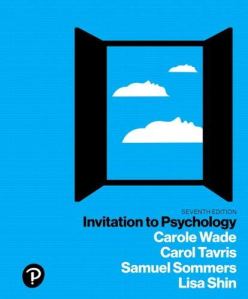
Book: Invitation to Psychology

Book Title:

Invitation to Psychology.

Author(s): Carole Wade, Carol Tavris, Samuel Sommers, and Lisa Shin.

Year: 2017.

Edition: Seventh (7th).

Publisher: Pearson.

Type(s): Paperback.

Synopsis:

Invitation to Psychology, 7th Edition weaves scientific thinking and critical thinking into the fabric of psychological science.

Joining longtime authors Carole Wade and Carol Tavris, new co-authors Samuel Sommers and Lisa Shin (of Tufts University) call upon their research and teaching expertise to speak to today’s students. Their contributions include expanded gender coverage as well as engaging new cultural and pop-cultural examples.

By prompting students to separate fact from fiction and to distinguish wishful thinking from thinking wisely, the authors inspire students to ask questions and be willing to wonder – and help them become 21st-century thinkers.

Book: How Emotions Are Made

Book Title:

How Emotions Are Made – The Secret Life Of The Brain.

Author(s): Lisa Feldman Barrett.

Year: 2017.

Edition: First (1st); Main Market Edition.

Publisher: Macmillan.

Type(s): Hardcover, Paperback, Audiobook, and Kindle.

Synopsis:

When you feel anxious, angry, happy, or surprised, what is really going on inside you? Most scientists would agree that emotions come from specific parts of the brain, and that we feel them whenever they are triggered by the world around us. The thrill of seeing an old friend, the sadness of a tear-jerker movie, the fear of losing someone you love – each of these sensations arises automatically and uncontrollably within us, finding expression on our faces and in our behaviour, and carrying us away with the experience.

This understanding of emotion has been around since Aristotle. But what if it is wrong? In How Your Emotions Are Made, pioneering psychologist Lisa Feldman Barrett draws on the latest scientific evidence to reveal that our ideas about emotion are dramatically, even dangerously, out of date – and that we have been paying the price. Emotions do not exist objectively in nature, Barrett explains, and they are not pre-programmed in our brains and bodies; rather, they are psychological experiences that each of us constructs based on our unique personal history, physiology and environment.

This new view of emotions has serious implications: when judges issue lesser sentences for crimes of passion, when police officers fire at threatening suspects, or when doctors choose between one diagnosis and another, they are all, in some way, relying on the ancient assumption that emotions are hardwired into our brains and bodies. Revising that conception of emotion is not just good science, Barrett shows; it is vital to our wellbeing and the health of society itself.

On This Day … 13 September

Events

  • 1848 – Vermont railroad worker Phineas Gage survives an iron rod 1 1⁄4 inches (3.2 cm) in diameter being driven through his brain; the reported effects on his behaviour and personality stimulate discussion of the nature of the brain and its functions.

People (Deaths)

  • 1999 – Benjamin Bloom, American psychologist and academic (b. 1913).

Book: The Routledge Handbook of Philosophy of Well-Being

Book Title:

The Routledge Handbook of Philosophy of Well-Being.

Author(s): Guy Fletcher (editor).

Year: 2015.

Edition: First (1st).

Publisher: Routledge.

Type(s): Hardcover, Paperback, and Kindle.

Synopsis:

The concept of well-being is one of the oldest and most important topics in philosophy and ethics, going back to ancient Greek philosophy. Following the boom in happiness studies in the last few years it has moved to centre stage, grabbing media headlines and the attention of scientists, psychologists and economists. Yet little is actually known about well-being and it is an idea that is often poorly articulated.

The Routledge Handbook of Philosophy of Well-Being provides a comprehensive, outstanding guide and reference source to the key topics and debates in this exciting subject.

Comprising over 40 chapters by a team of international contributors, the Handbook is divided into six parts:

  • Well-being in the history of philosophy.
  • Current theories of well-being, including hedonism and perfectionism.
  • Examples of well-being and its opposites, including friendship and virtue and pain and death.
  • Theoretical issues, such as well-being and value, harm, identity and well-being and children.
  • Well-being in moral and political philosophy.
  • Well-being and related subjects, including law, economics and medicine..

Essential reading for students and researchers in ethics and political philosophy, it is also an invaluable resource for those in related disciplines such as psychology, politics and sociology.

Book: The Rough Guide to Psychology

Book Title:

The Rough Guide to Psychology: An Introduction to Human Behaviour and the Mind.

Author(s): Dr. Christian Jarrett.

Year: 2011.

Edition: First (1st).

Publisher: Rough Guides.

Type(s): Paperback and Kindle.

Synopsis:

The Rough Guide to Psychology looks at the question psychologists have been asking for over a hundred years – why are we the way we are? It starts with you, your mind and brain, broadening out to look at your friends and other relationships, then finally on to crowds, mobs and religion.

It explores the latest research relevant to crime, schooling, sport, politics, shopping and health, and what happens when the mind goes wrong, including depression, anxiety, schizophrenia, and more unusual conditions.

The Rough Guide to Psychology includes fascinating information on real-life psychology, testing your memory, intelligence, personality and much more, with advice on everything from chat-up lines to developing your creativity.

The Rough Guide to Psychology is your ultimate guide to this fascinating subject.

Book: Psychology in Black and White

Book Title:

Psychology in Black and White – The Project Of A Theory-Driven Science.

Author(s): Sergio Salvatore.

Year: 2015.

Edition: Reprint Edition.

Publisher: Information Age Publishing.

Type(s): Hardcover, Paperback, and Kindle.

Synopsis:

This book is long awaited within the contemporarily creative field of cultural psychologies.

It is a theoretical synthesis that is at the level of innovations that Sigmund Freud, James Mark Baldwin, William Stern, Kurt Lewin, Jean Piaget, Lev Vygotsky and Jan Smedslund have brought into psychology over the past century.

Here we can observe a creative solution to integrating cultural psychology with the rich traditions of psychodynamic perspectives, without repeating the conceptual impasses in which many psychoanalytic perspectives have become caught.

Book: Psychology and the Conduct of Everyday Life

Book Title:

Psychology and the Conduct of Everyday Life.

Author(s): Ernst Schraube (editor) and Charlotte Hojholt (contributor).

Year: 2015.

Edition: First (1st).

Publisher: Routledge.

Type(s): Hardcover, Paperback, and Kindle.

Synopsis:

Psychology and the Conduct of Everyday Life moves psychological theory and research practice out of the laboratory and into the everyday world. Drawing on recent developments across the social and human sciences, it examines how people live as active subjects within the contexts of their everyday lives, using this as an analytical basis for understanding the dilemmas and contradictions people face in contemporary society.

Early chapters gather the latest empirical research to explore the significance of context as a cross-disciplinary critical tool; they include a study of homeless Māori men reaffirming their cultural identity via gardening, and a look at how the dilemmas faced by children in difficult situations can provide insights into social conflict at school. Later chapters examine the interplay between everyday life around the world and contemporary global phenomena such as the rise of the debt economy, the hegemony of the labour market, and the increased reliance on digital technology in educational settings. The book concludes with a consideration of how social psychology can deepen our understanding of how we conduct our lives, and offer possibilities for collective work on the resolution of social conflict.

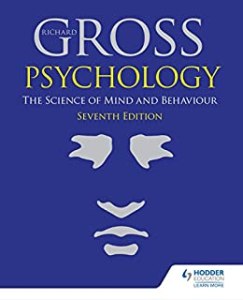
Book: Psychology: The Science of Mind and Behaviour

Book Title:

Psychology: The Science of Mind and Behaviour.

Author(s): Richard Gross.

Year: 2015.

Edition: Eighth (8th).

Publisher: Hodder Education, UK Edition.

Type(s): Paperback and Kindle.

Synopsis:

Provides the essential foundation for psychology students, this is a revised and updated version of the most trusted introduction written by the bestselling psychology author Richard Gross.

Psychology: The Science of Mind and Behaviour has helped over half a million students worldwide.

It is the essential introduction to psychology, covering all students need to know to understand and evaluate classic and contemporary topics.

  • Enables students to easily access psychological theories and research with colourful, user-friendly content and useful features including summaries, critical discussion and research updates.
  • Helps students to understand the research process with contributions from leading psychologists including Elizabeth Loftus, Alex Haslam and David Canter.
  • Ensures students are up to date with the latest issues and debates with this fully updated edition.

Book: Mental Health Atlas 2017

Book Title:

Mental Health Atlas 2017.

Author(s): World Health Organisation (WHO).

Year: 2017.

Edition: Denoted by year.

Publisher: WHO.

Type(s): Paperback and digital.

Synopsis:

The Mental Health Atlas series is considered the most comprehensive resource on global information on mental health and an important tool for developing and planning mental health services within countries and regions.

The Mental Health Atlas 2017 acquires new importance as it includes information and data on the progress towards the achievement of objectives and targets of the Comprehensive Mental Health Action Plan 2013–2020.

You can a download a free copy of the Mental Health Atlas 2017 here.