
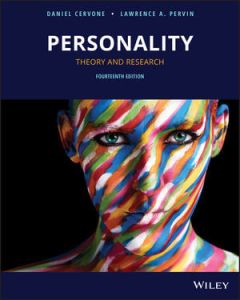
Book: Personality: Theory and Research

Book Title:

Personality: Theory and Research.

Author(s): Daniel Cervone and Lawrence A. Pervin.

Year: 2019.

Edition: Fourteenth (14th).

Publisher: Wiley.

Type(s): Hardcover and ebook (from Wiley).

Synopsis:

An invaluable resource for over four decades, Personality examines the fundamental theories and concepts of personality psychology while exploring contemporary research, new methodologies, and the latest technological advancements.

Through a well-rounded blend of theory, case studies, and the latest research, this text identifies the structures and processes of personality, traces personality development, and highlights the value of therapeutic change.

An effective pedagogical structure enhances student interest while strengthening objectivity and critical-thinking skills.

Psychodynamic, social-cognitive, phenomenological, and trait-theoretic perspectives are presented in an unbiased – yet critical – fashion that encourages students to compare theories, evaluate evidence, analyse data, and form their own conclusions.

Thorough historical coverage is balanced with discussions of the current state of the field, providing a solid understanding of theory and methods as relevant to practice today.

Suitable for introductory coursework, this text also serves as a valuable resource for advanced studies and as a reference for professionals in psychology and related fields.

Book: The Oxford Handbook of Emotion, Social Cognition, and Problem Solving in Adulthood

Book Title:

The Oxford Handbook of Emotion, Social Cognition, and Problem Solving in Adulthood.

Part of the Oxford Library of Psychology.

Author(s): Paul Verhaegen and Christopher Hertzog (Editors).

Year: 2014.

Edition: First.

Publisher: Oxford University Press.

Type(s): Hardcover and Kindle.

Synopsis:

Over the last decade, the field of socio-emotional development and ageing has rapidly expanded, with many new theories and empirical findings emerging. This trend is consistent with the broader movement in psychology to consider social, motivational, and emotional influences on cognition and behaviour.

The Oxford Handbook of Emotion, Social Cognition, and Problem Solving in Adulthood provides the first overview of a new field of adult development that has emerged out of conceptualisations and research at the intersections between socio-emotional development, social cognition, emotion, coping, and everyday problem solving.

This field roundly rejects a universal deficit model of ageing, highlighting instead the dynamic nature of socio-emotional development and the differentiation of individual trajectories of development as a function of variation in contextual and experiential influences.

It emphasises the need for a cross-level examination (from biology and neuroscience to cognitive and social psychology) of the determinants of emotional and socio-emotional behaviour.

This volume also serves as a tribute to the late Fredda Blanchard-Fields, whose thinking and empirical research contributed extensively to a life-span developmental view of emotion, problem solving, and social cognition.

Its chapters cover multiple aspects of adulthood and ageing, presenting developmental perspectives on emotion; antecedents and consequences of emotion in context; everyday problem solving; social cognition; goals and goal-related behaviours; and wisdom.

The landmark volume in this new field, The Oxford Handbook of Emotion, Social Cognition, and Problem Solving in Adulthood is an important resource for cognitive, developmental, and social psychologists, as well as researchers and graduate students in the field of ageing, emotion studies, and social psychology.

Book: Abnormal Psychology in a Changing World

Book Title: Abnormal Psychology in a Changing World.

Author(s): Jeffery S. Nevid, Spencer A. Rathus, and Beverly Greene.

Year: 2018.

Edition: Tenth.

Publisher: Pearson Education.

Synopsis:

Abnormal Psychology in a Changing World makes complex abnormal psychology concepts accessible and stimulating to students.

Authors Jeffrey Nevid, Spencer Rathus, and Beverly Greene present illustrative case examples drawn from their own clinical and teaching experiences, leading students to recognise the human dimension of the study of abnormal psychology.

Updated to reflect the latest advancements in the field, the Tenth Edition highlights the ways in which personal technology is changing the study of abnormal psychology via the new Abnormal Psychology in the Digital Age feature.