Book: Meeting the Mental Health Needs of Young Children 0-5 Years

Book Title:

Meeting the Mental Health Needs of Young Children 0-5 Years.

Author(s): Samuel Jones and Marie Potter.

Year: 2019.

Edition: First (1st).

Publisher: Critical Publishing Ltd.

Type(s): Paperback and Kindle.

Synopsis:

The mental health of children is a current concern, and this applies even to the earliest years of a child’s life. This book supports trainees and practitioners working in early years contexts to understand the risk factors which can result in the development of mental health needs in children from birth to 5. It argues that high quality early years provision can mitigate against some of these risk factors and provides clear, evidence-informed guidance around government policy, transitions, attachment and working with parents or carers.

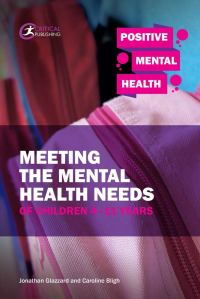
Book: Meeting the Mental Health Needs of Children 4-11 Years

Brain Changer eBook

Book Title:

Meeting the Mental Health Needs of Children 4-11 Years.

Author(s): Jonathan Glazzard and Caroline Bligh.

Year: 2018.

Edition: First (1st).

Publisher: Critical Publishing Ltd.

Type(s): Paperback and Kindle.

Synopsis:

The mental health of children in primary schools is a current concern.

  • Do you feel equipped to identify mental health needs in your pupils?
  • Do you have the knowledge and understanding to adequately support them?
  • Do you understand where your responsibilities start and stop?

This book helps you address these questions and more, providing a range of evidence-based strategies and tools. It introduces the various risk factors involved, shows how you can build resilience in children, and focuses on identifying and supporting both specific mental health needs and particular groups of pupils.

Book: Meeting the Mental Health Needs of Learners 11-18 Years

Brain Changer eBook

Book Title:

Meeting the Mental Health Needs of Learners 11-18 Years.

Author(s): Jonathan Glazzard and Kate Bancroft.

Year: 2018.

Edition: First (1st).

Publisher: Critical Publishing Ltd.

Type(s): Paperback and Kindle.

Synopsis:

The mental health of young people in secondary schools is a current concern.

  • Do you feel equipped to identify mental health needs in your learners?
  • Do you have the knowledge and understanding to adequately support them?
  • Do you understand where your responsibilities start and stop?

This book helps you address these questions and more, providing a range of evidence-based strategies and tools. It introduces the various risk factors involved, shows how you can build resilience in your students, and focuses on identifying and supporting both specific mental health needs and particular groups of learners.

Book: Supporting Student Mental Health in Higher Education

Brain Changer eBook

Book Title:

Supporting Student Mental Health in Higher Education.

Author(s): Samuel Stones and Jonathan Glazzard.

Year: 2019.

Edition: First (1st).

Publisher: Critical Publishing Ltd.

Type(s): Paperback and Kindle.

Synopsis:

Student mental health is a key consideration in higher education at the moment with recent reports identifying a major gap in provision by universities and how ill-equipped academics feel to support students. This book addresses these concerns, providing comprehensive guidance and workable evidence-informed strategies and interventions to help those working with students to support them effectively. It is suitable for lecturers, personal tutors, student counsellors, course leaders, heads of department and administration staff with responsibility for student support.

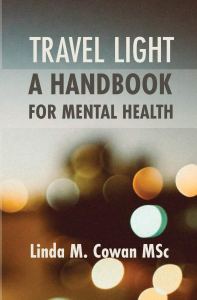
Book: Travel Light: A Handbook for Mental Health

Brain Changer eBook

Book Title:

Travel Light: A Handbook for Mental Health.

Author(s): Linda Margaret.

Year: 2019.

Edition: First (1st).

Publisher: CCS.

Type(s): Paperback and Kindle.

Synopsis:

Linda Cowan is a counsellor/therapist; she has worked at her Private Practice for many years.

Linda has drawn on the experience she has learnt over the years to inspire her to write her new book, ‘Travel Light a Handbook for Mental Health’.

Linda acknowledges that not everyone has access to private therapy (this book is not a substitute for personal therapy) however, it will go a long way to help people understand themselves in a way they have never before. If you are: tormented by anxiety- doubts and self-critical thoughts- stressed and overwhelmed by unhealthy addictive behaviours – weighed down by the mental clutter of unforgiveness, anger and shame.

This book is for you; Whether you have a strong faith or no faith, this book will transform and revolutionise your life. You will learn to find peace in a frantic world.

Book: Brain Changer

Brain Changer eBook

Book Title:

Brain Changer: How diet can save your mental health – cutting-edge science from an expert.

Author(s): Felice Jacka.

Year: 2019.

Edition: First (1st).

Publisher: Yellow Kite.

Type(s): Paperback, Audiobook, and Kindle.

Synopsis:

A combination of Professor Felice Jacka’s love of food and her own experience of depression and anxiety as a young woman led her to question whether what we put in our mouths everyday affects more than our waistline. Felice set out on a journey of discovery to change the status quo and uncover the truth through rigorous science. Beginning her PhD in 2005, she examined the association between women’s diets and their mental health, focusing on depression and anxiety. She soon discovered – you feel how you eat. It is Professor Jacka’s ground-breaking research that has now changed the way we think about mental and brain health in relation to diet.

Brain Changer explains how and why we should consider our food as the basis of our mental and brain health throughout our lives. It includes a selection of recipes and meal plans featuring ingredients beneficial to mental health. It also includes the simple, practical solutions we can use to help prevent mental health problems in the first place and offers strategies for treating these problems if they do arise.

This is not a diet book to help you on the weight scales. This is a guide to good habits to save your brain and to optimise your mental health through what you eat at every stage of life.

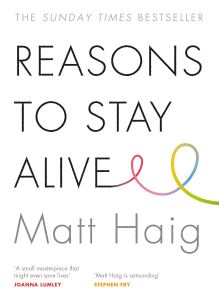
Book: Reasons to Stay Alive

Book Title:

Reasons to Stay Alive.

Author(s): Matt Haig.

Year: 2015.

Edition: First (1st).

Publisher: Canongate Books Ltd.

Type(s): Hardcover, Paperback, Audiobook, and Kindle.

Synopsis:

Aged 24, Matt Haig’s world caved in. He could see no way to go on living. This is the true story of how he came through crisis, triumphed over an illness that almost destroyed him and learned to live again.

A moving, funny and joyous exploration of how to live better, love better and feel more alive, Reasons to Stay Alive is more than a memoir. It is a book about making the most of your time on earth.

“I wrote this book because the oldest clichés remain the truest. Time heals. The bottom of the valley never provides the clearest view. The tunnel does have light at the end of it, even if we haven’t been able to see it . . . Words, just sometimes, really can set you free.”

Book: Suicide Prevention Handbook

Book Title:

Suicide Prevention Handbook: A Mental Health Guide For Saving Lives.

Author(s): Ben Oakley.

Year: 2020.

Edition: First (1st).

Publisher: Independently Published.

Type(s): Paperback and Kindle.

Synopsis:

The book includes our detailed four-step guide for suicide prevention:

  • Warning Signs include social signs, personal signs and planning signs.
  • Risk Factors include isolation and social inequality, violence or abuse, self-harm and mental health disorders.
  • Intervention includes social intervention, personal intervention including exactly what to say to start a mental health conversation and how to seek help.
  • Coping Strategies include distraction, grounding and relaxation.

With real-world examples and concrete ways of how to help yourself or another.

Many mental health advocates and organisations recommend you talk about mental health but they don’t tell you how to get the conversation started. This book provides you with Conversation Starters, Direct Questions, Indirect Questions, Example Lists, Guidance and ways to move a conversation from negative emotions to positive ones.

Along with the extensive four-step suicide prevention handbook, there is a guide to writing your own suicide prevention life plan with tips on creating priorities, goals, action plans and how to write it.

You’ll also find a list of UK mental health organisations, what not to say, myths debunked and a series of essays about the misconception of man.

Supreme Movement is a mental health awareness social enterprise in the United Kingdom whose mission is to raise awareness of mental health issues, specifically suicide and self-harm among males.

Ben Oakley is an established non-fiction author, researcher, mental health advocate and founder of Supreme Movement.

Book: Developing Resilience: A Cognitive-Behavioural Approach

Book Title:

Developing Resilience: A Cognitive-Behavioural Approach.

Author(s): Michael Neenan.

Year: 2017.

Edition: Second (2nd).

Publisher: Routledge.

Type(s): Hardcover and Kindle.

Synopsis:

Some individuals emerge from grim experiences stronger in mind and spirit than others who suffered the same ordeal. In this updated and revised edition, Michael Neenan focuses on the meanings we attach to life’s adversities in order to understand how we respond to them. This is why different people can react to the same adverse event in a variety of ways such as fighting back or crumbling. Different meanings of what constitutes resilience are also discussed and the author takes issue with the simplistic view of it as bouncing back from adversity which suggests the absence of struggle and emotional pain as well as underestimating how long the process of self-righting can sometimes take.

Developing Resilience shows how people can find constructive ways of dealing with hard times by using the ideas and techniques of cognitive behavioural therapy as well as drawing on the viewpoints and experiences of other writers presented here. This book provides useful guidance and advice on topics including:

  • Managing negative emotions in difficult times.
  • Using an assets and liabilities model to understand resilient behaviour.
  • Distinguishing between what’s within and outside of your control.
  • Identifying and changing attitudes that undermine resilience building.
  • Developing self-belief.
  • Increasing your level of frustration tolerance.
  • Maintaining a resilient outlook.

This book will be essential reading for anyone interested in learning more about resilience as well as for mental health professionals, coaches and therapists looking for guidance in helping their clients to cope better with adversity.

Book: Mental and behavioural state examination: Theory into Practice – A Nurse’s Perspective on Psychiatric Assessment

Book Title:

Mental and behavioural state examination: Theory into Practice – A Nurse’s Perspective on Psychiatric Assessment.

Author(s): Tim Whittard.

Year: 2020.

Edition: First (1st), Illustrated Edition.

Publisher: The Choir Press.

Type(s): Paperback.

Synopsis:

The ability to carry out assessments of mental and behavioural state is a useful and required skill for those who work within the healthcare industry, as well as in other professions where there is a routine requirement to work with vulnerable members of the public; this includes nurses and therapists of all specialties and backgrounds, midwives, care assistants, doctors, social workers, school teachers and emergency services, including paramedics and police officers (among numerous other professional groups).

This book attempts to break down each aspect of the assessment using psychiatric terminology, definitions and examples in order to provide the reader with a comprehensive guide in how to carry out mental and behavioural state examinations (MBSEs) which is both detailed and concise.

It is an essential handbook for those novices and more experienced clinicians alike, who wish to have a concise directory of some of the basic and core theoretical principles which underpin the process of non-medical psychiatric assessment in the 21st century.