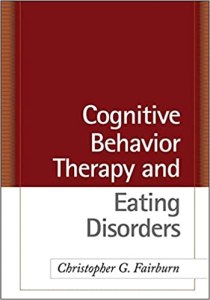
Book: Cognitive Behaviour Therapy and Eating Disorders

Book Title:

Cognitive Behaviour Therapy and Eating Disorders.

Author(s): Christopher G. Fairburn.

Year: 2008.

Edition: First (1st).

Publisher: Guildford Press.

Type(s): Hardcover and Kindle.

Synopsis:

This book provides the first comprehensive guide to enhanced cognitive behaviour therapy (CBT-E), the leading empirically supported treatment for eating disorders in adults.

Written with the practitioner in mind, the book demonstrates how this transdiagnostic approach can be used with the full range of eating disorders seen in clinical practice.

Christopher Fairburn and colleagues describe in detail how to tailor CBT-E to the needs of individual patients, and how to adapt it for patients who require hospitalisation.

Also addressed are frequently encountered co-occurring disorders and how to manage them.

Reproducible appendices feature the Eating Disorder Examination interview and questionnaire.

Book: Mental Health Workbook

Book Title:

Mental Health Workbook: 4 Books In 1: How to Use Neuroscience and Cognitive Behavioural Therapy to Declutter Your Mind, Stop Overthinking and Quickly Overcome Anxiety, Worry and Panic Attacks.

Author(s): Edward Scott.

Year: 2020.

Edition: First (1st).

Publisher: Saturno Lecca.

Type(s): Hardcover, Paperback, and Kindle.

Synopsis:

Want to learn more about neuroscience paired with cognitive behavioural therapy? Would you like to figure out how to clear your mind by stopping stress, stopping overthinking, overcoming anxiety, worries and panic attacks? If so, read on!

The Cognitive behavioural therapy has been shown to be effective in relieving symptoms in a wide range of mental health problems, ranging from addiction to schizophrenia, along with almost everything in between. It has been shown to be useful for longer than drugs and other forms of therapy.

Excessive thinking can be a side effect of some nervousness problems; however, it can also be an indication of simply being overwhelmed.

One of the most important reasons you want to clear your mind is because it is already playing a negative role in your life. Living with constant negative thoughts and intense fears can cause someone to crave a way to relieve pain or develop unhealthy habits that could get worse.

Anxiety is linked to many other mental illnesses, especially depression!

The main focus of this book is to follow the steps which will improve your thinking

This book covers the following topics

  • What is cognitive behavioural therapy?
  • Stages of cognitive behavioural therapy
  • Definition of excessive thinking.
  • How to identify if you are an excessive thinker.
  • The relationship between excessive thinking, anxiety and stress.
  • Health Benefits of Decluttering.
  • Usual remedy in localised deep breathing.
  • Believe in your self-esteem.
  • And many more.

Before learning the exercises that eliminate negative thinking, you should understand why you have these thoughts.

In fact, the stress caused by information overload, endless options and physical clutter can trigger various mental health problems, including depression, anxiety, and panic attacks. Do you want to know how to prevent them?

Book: Cognitive Analytic Therapy and the Politics of Mental Health

Book Title:

Cognitive Analytic Therapy and the Politics of Mental Health.

Author(s): Rachel Pollard and Julie Lloyd (Editors).

Year: 2018.

Edition: First (1st).

Publisher: Routledge.

Type(s): Hardcover, Paperback, and Kindle.

Synopsis:

Cognitive Analytic Therapy and the Politics of Mental Health provides an overview of the development of cognitive analytic therapy (CAT), and illuminates how the political context affects the way in which therapists consider their work and facilitates their practice.

This book examines how CAT contributes to wider debates over ‘the politics of mental health’. With contributions from those working in services – including adult mental health, learning disabilities and child and adolescent therapists – the writers consider how contemporary politics devolves responsibility for mental illness onto those suffering distress. The evolving political and social attitudes clients bring to therapy are also addressed in several chapters, and there is a focus on groups in society who have been marginalized and neglected in mental and physical health services.

Cognitive Analytic Therapy and the Politics of Mental Health offers a fresh understanding of the contemporary politics of mental health that will be of interest to all therapists and mental health professionals.

Book: Cognitive Analytic Supervision

Book Title:

Cognitive Analytic Supervision: A Relational Approach.

Author(s): Deborah Pickvance (Editor).

Year: 2016.

Edition: First (1st).

Publisher: Routledge.

Type(s): Hardcover, Paperback, and Kindle.

Synopsis:

Cognitive Analytic Supervision: A relational approach is the first book to present a cognitive analytic perspective on psychotherapy supervision. This edited collection of original chapters reflects the ways in which CAT therapists and supervisors have developed the model and used it in diverse settings. It is a significant contribution to the literature on relational psychotherapy supervision, written by established CAT supervisors, trainers and therapists who, together, have an enormous amount of professional and clinical experience.
The book covers important areas such as:

  • The relational theory and practice of CAT supervision.
  • A cognitive analytic conceptualisation of narcissistic difficulties.
  • Intercultural issues in supervision (based on CAT training experience in India).
  • Ethical and clinical dilemmas in supervision.
  • Supervision of consultancy work.

Cognitive Analytic Supervision will be of interest to CAT supervisors, therapists and trainee supervisors, as well as supervisors and therapists working in other therapeutic models, in particular those with a relational approach. This book may be a useful bridge into relationally informed supervision for therapists who do not have an explicitly relational focus.

Book: Cognitive Analytic Therapy

Book Title:

Cognitive Analytic Therapy: Distinctive Features (Psychotherapy and Counselling Distinctive Features).

Author(s): Claire Corbridge, Laura Brummer, and Philippa Coid.

Year: 2017.

Edition: First (1st).

Publisher: Routledge.

Type(s): Hardcover, Paperback, and Kindle.

Synopsis:

Cognitive Analytic Therapy: Distinctive Features offers an introduction to what is distinctive about this increasingly popular method. Written by three Cognitive Analytic Therapists, with many years’ experience, it provides an accessible, bitesize overview of this increasingly used psychological therapy. Using the popular Distinctive Features format, this book describes 15 theoretical features and 15 practical techniques of Cognitive Analytic Therapy.

Cognitive Analytic Therapy will be a valuable source for students, professionals in training and practising therapists, as well as other psychotherapists, counsellors and mental health professionals wishing to learn more about the distinctive features of this important therapy.

Book: Cognitive Analytic Therapy and Borderline Personality Disorder

Book Title:

Cognitive Analytic Therapy and Borderline Personality Disorder : The Model and the Method

Author(s): Anthony Ryle.

Year: 1997.

Edition: First (1st).

Publisher: John Wiley & Sons.

Type(s): Paperback and Kindle.

Synopsis:

Borderline Personality Disorder patients are impulsive, unstable and destructive, hurting themselves and those around them, including those who seek to help them. This has resulted in a widespread reluctance to treat them and a pessimism about treatment.

In the experience of the authors this pessimism is unjustified, because for many patients a relatively brief intervention can be effective in cost-benefit terms as well as human terms. The interventions illustrated here have been used to treat outpatients for 15 years.

The results indicate that treatments can achieve clinically significant changes in the course of 16 24 sessions, in a substantial proportion of patients. While CAT shares some ideas and methods with other approaches, it introduces many new features and is uniquely integrated at both the theoretical and practical level. The early joint reformulation of patients problems serves to contain destructiveness and to create a working alliance. Also, the use of reformulation to teach self-reflection and avoid collusive responses from the therapist, throughout the therapy, represents a powerful new technique.

The book offers a critical appraisal of current ideas and practices, contrasting with these the ways in which CAT mobilises the patient s own resources. The authors argue that CAT should have a place in any service seeking to help these difficult patients.

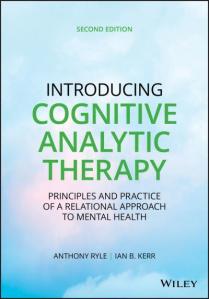
Book: Introducing Cognitive Analytic Therapy

Book Title:

Introducing Cognitive Analytic Therapy: Principles and Practice of a Relational Approach to Mental Health.

Author(s): Anthony Ryle and Ian B. Kerr.

Year: 2020.

Edition: Second (2nd).

Publisher: Wiley.

Type(s): Paperback and Kindle.

Synopsis:

Cognitive Analytic Therapy (CAT) is an increasingly popular approach to therapy that is now widely recognised as a genuinely integrative and fundamentally relational model of psychotherapy. This new edition of the definitive text to CAT offers a systematic and comprehensive introduction to its origins, development, and practice. It also provides a fully updated overview of developments in the theory, research, and applications of CAT, including clarification and re-statement of basic concepts, such as reciprocal roles and reciprocal role procedures, as well as extensions into new areas of expertise.

Introducing Cognitive Analytic Therapy: Principles and Practice of a Relational Approach to Mental Health, 2nd Edition starts with a brief account of the scope and focus of CAT and how it evolved and explains the main features of its practice. It next offers a brief account of a relatively straightforward therapy to give readers a sense of the unfolding structure and style of a time-limited CAT. Following that are chapters that consider the normal and abnormal development of the Self and that introduce influential concepts from Vygotskian, Bakhtinian and developmental psychology. Subsequent chapters describe selection and assessment; reformulation; the course of therapy; the ‘ideal model’ of therapist activity and its relation to the supervision of therapists; applications of CAT in various patient groups and settings and in treating personality type disorders; use in ‘reflective practice’; a CAT perspective on the ‘difficult’ patient; and systemic and ‘contextual’ approaches.

  • Presents an updated introduction and overview of the principles and practice of cognitive analytic therapy (CAT).
  • Updates the first edition with developments from the last decade, in which CAT theory has deepened and the approach has been applied to new patient groups and extended far beyond its roots.
  • Includes detailed, applicable ‘how to’ descriptions of CAT in practice.
  • Includes references to CAT published works and suggestions for further reading within each chapter.
  • Includes a glossary of terms and several appendices containing the CAT Psychotherapy File; a summary of CAT competences extracted from Roth and Pilling; the Personality Structure Questionnaire; and a description of repertory grid basics and their use in CAT.
  • Co-written by the creator of the CAT model, Anthony Ryle, in collaboration with leading CAT practitioner, trainer, and researcher, Ian B. Kerr.

Introducing Cognitive Analytic Therapy is the definitive book for CAT practitioners and CAT trainees at skills, practitioner, and psychotherapy levels. It should also be of considerable interest and relevance to mental health professionals of all orientations, including clinical psychologists, psychiatrists, counselors, mental health nurses, to those working in forensic and various institutional settings, and to a range of other health care and social work professionals.

Book: The Good News About Depression

Book Title:

The Good News About Depression: Cures And Treatments In The New Age Of Psychiatry.

Author(s): Mark S. Gold.

Year: 1995.

Edition: First (1st).

Publisher: Infobase Publishing.

Type(s): Paperback and Kindle.

Synopsis:

Ten years ago pioneering biopsychiatrist Mark S. Gold, M.D. wrote a visionary guide to the effective new medical therapies emerging for the treatment of depression. Now, in this newly revised edition of his classic book, Dr. Gold does it again. The new Good News reveals how, in just a decade, sophisticated new research and drug therapies have revolutionised the care of all types of depression.

This essential resource includes:

  • New treatments for depression and manic depression for 1995 and on the horizon for approval.
  • New diagnostic guidelines for different types of depression, including crucial tests many physicians omit.
  • The most common illnesses that mimic depression.
  • New tools to treat depression, such as light therapy and hormone therapy.
  • An all-new chapter on Prozac and other state-of-the-art medications.
  • New information on depression in women, children, and seniors.
  • Vital new approaches to relapse prevention.

Plus a complete guide to self-help, and in depth advice on getting and evaluating the proper treatment.

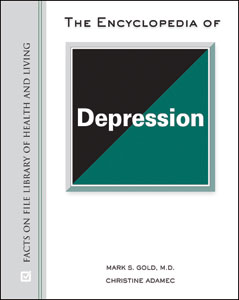
Book: The Encyclopaedia Of Depression

Book Title:

The Encyclopaedia Of Depression (part of the series Library of Health and Living).

Author(s): Mark S. Gold and Christine Adamec.

Year: 2016.

Edition: First (1st).

Publisher: Infobase Publishing.

Type(s): eBook.

Synopsis:

Mental health professionals estimate that approximately 1 in 10 Americans suffer from depression at some point in their lives. Depression is a disease that disrupts one’s mood and sense of well-being. It can interfere with one’s enjoyment of life, interactions with friends and family members, and ability to work. Severe depression can leave one despondent to the point of paralysis and hopelessness or even contribute to suicide. The disease takes an economic toll, as well, in costs for treatment and lost wages and productivity. Fortunately, most cases of depression can be successfully treated with medication and therapy.

The Encyclopaedia of Depression is a concise, A-to-Z guide to covering everything readers need to understand the nature of this disease, recognise its signs and symptoms, and seek out treatment for themselves or a loved one. More than 80 in-depth articles examine all aspects of depression, including its causes, current research into the disease, treatment options, and related social issues.

Topics covered include:

  • Antidepressants.
  • Bipolar disorder.
  • Children and depression.
  • Demographics of depression.
  • Generalised anxiety disorder.
  • Holiday depression.
  • Myths and inaccuracies about depression.
  • Refractory depression.
  • Risk factors for depression.
  • Substance abuse.

Book: The International Encyclopaedia Of Depression

Book Title:

The International Encyclopaedia Of Depression.

Author(s): Rick E. Ingram (Editor).

Year: 2019.

Edition: First (1st).

Publisher: Springer Publishing.

Type(s): Hardcover and Kindle.

Synopsis:

There is no more central topic to mental health professionals than depression.

In the last 20 years, theory and research in depression has grown rapidly.

The wealth of information now available on depression is enormous, but has not been summarised into a comprehensive encyclopaedia until now.

The entries in this book include: behavioural treatment, cognitive theories, cognitive therapy, epidemiology, heredity, personality disorders, double depression, and prevention.

In summarising the vast amount of information on depression, “The International Encyclopaedia of Depression” serves as an important resource for researchers, patients, students, and educated laypeople.

This book presents holistic, interdisciplinary coverage of an important but misunderstood medical disorder.