Posts

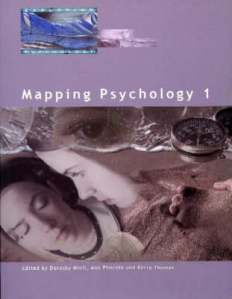
Book: Mapping Psychology 1

Book Title:

Mapping Psychology 1.

Author(s): Dorothy Miell, Ann Phoenix, and Kerry Thomas (Editors).

Year: 2002.

Edition: First (1st).

Publisher: Open University.

Type(s): Paperback.

Synopsis:

This book (which is in two bindings) provides students with a conceptual ‘bag of tools’ – the basic equipment needed to start mapping psychology in the 21st Century. The aim of this book is to introduce you to the diversity of psychology by presenting the findings and established knowledge on a variety of topics central to psychological enquiry. The topics covered include: Identities and diversities – Evolutionary psychology – Three approaches to learning – Biological processes and psychological explanation – The individual differences approach to personality, perception and attention – Perceiving and understanding the social world – Memory – structures, process and skills – Person psychology – psychoanalytic and humanistic perspectives. Editorial commentaries within each chapter help to highlight theoretical debate, discuss wider issues and explore themes.

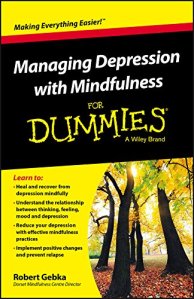
Book: Managing Depression with Mindfulness for Dummies

Book Title:

Managing Depression with Mindfulness for Dummies.

Author(s): Robert Gebka.

Year: 2016.

Edition: First (1st).

Publisher: Wiley.

Type(s): Paperback and Kindle.

Synopsis:

Rise above depression and build a positive future using mindfulness

If you suffer from depression, you know that it is not something you can simply snap yourself out of. Depression is a potentially debilitating condition that must be treated and managed with care, but not knowing where to turn for help can make an already difficult time feel even more harrowing. Thankfully, Managing Depression with Mindfulness For Dummies offers authoritative and sensitive guidance on using evidence based and NHS approved Mindfulness Based Interventions similar to Cognitive Behavioural Therapy (CBT) to help empower you to rise above depression and discover a renewed sense of emotional wellbeing and happiness. The book offers cutting edge self-management mindfulness techniques which will help you make sense of your condition and teach you how to relate differently to negative thought patterns which so often contribute to low mood and depression.

The World Health Organisation predicts that more people will be affected by depression than any other health problem by the year 2030. While the statistics are staggering, they offer a small glimmer of hope: you are not alone. As we continue to learn more about how depression works and how it can be treated, the practice of mindfulness proves to be an effective tool for alleviating stress, anxiety, depression, low self-esteem, and insomnia. With the tips and guidance offered inside, you′ll learn how to apply the practice of mindfulness to ease your symptoms of depression and get your life back.

  • Heal and recover from depression mindfully.
  • Understand the relationship between thinking, feeling, mood, and depression.
  • Reduce your depression with effective mindfulness practices.
  • Implement positive changes and prevent relapse.

Whether you are struggling with low mood or simply wish to learn mindfulness as a way of enriching your life, Managing Depression with Mindfulness For Dummies serves as a beacon of light and hope on your journey to rediscovering your sense of wellbeing, joy and happiness.

Age at First Drink & Severity of Alcohol Dependence in Military Personnel

Research Paper Title

Age at first drink and severity of alcohol dependence.

Background

Early age at first drink (AFD) has been linked to early onset and increased severity of alcohol dependence in various studies. Few Indian studies on AFD have shown a negative correlation between AFD and severity of alcohol dependence. The study aimed to explore this relationship in patients with alcohol dependence syndrome (ADS) diagnosed using ICD-10 criteria.

Methods

One hundred fifty-one consecutive patients freshly diagnosed with ADS were included in the study, which was conducted at the psychiatry unit of a tertiary care, multispecialty hospital. The Addiction Severity Index (ASI) was used to assess severity of alcohol dependence.

Results

Mean AFD was 24.85 years (range = 13-40 years). Median ASI score was 36 (range = 21 to 57). The study yielded a weak negative correlation (ρ = -.105) between AFD and ASI, which was statistically not significant.

Conclusions

The researchers found no correlation between AFD and severity of alcohol dependence at detection in Indian Armed Forces personnel, which is contrary to what has been reported worldwide and in previous Indian studies. Delayed initiation of alcohol use among those enrolling in the Indian Armed Forces and early detection of alcohol dependence within the military environment are possible explanations.

Reference

Chatterjee, K., Dwivedi, A.K. & Singh, R. (2021) Age at first drink and severity of alcohol dependence. Medical Journal, Armed Forces India. 77(1), pp.70-74. doi: 10.1016/j.mjafi.2019.05.003. Epub 2019 Oct 16.

What is the Taylor Manifest Anxiety Scale?

Introduction

The Taylor Manifest Anxiety Scale, often shortened to TMAS, is a test of anxiety as a personality trait, and was created by Janet Taylor in 1953 to identify subjects who would be useful in the study of anxiety disorders. The TMAS originally consisted of 50 true or false questions a person answers by reflecting on themselves, in order to determine their anxiety level. Janet Taylor spent her career in the field of psychology studying anxiety and gender development.

Her scale has often been used to separate normal participants from those who would be considered to have pathological anxiety levels. The TMAS has been shown to have high test-retest reliability. The test is for adults but in 1956 a children’s form was developed. The test was very popular for many years after its development but is now used infrequently.

Refer to Zung Self-Rating Anxiety Scale.

Development and Validation

The TMAS has been proven reliable using test-retest reliability. O’Connor, Lorr, and Stafford found there were five general factors in the scale: chronic anxiety or worry, increased physiological reactivity, sleep disturbances associated with inner strain, sense of personal inadequacy, and motor tension. This study showed that persons administered the test could be display different anxiety levels across these areas. O’Connor, Lorr, and Stafford’s realisation allows patients and their doctors to better understand which dimension of anxiety needs to be addressed.

Childhood and Adolescence

The Children’s Manifest Anxiety Scale, sometimes shortened to the CMAS, was created in 1956.

This scale was closely modelled after the Taylor Manifest Anxiety Scale. It was developed so that the TMAS could be applied to a broader range of people, specifically children.

Kitano tested the validity of the CMAS by comparing students who were placed in special education classes versus those placed in regular classrooms. Kitano proposed the idea that children who were in special education classes were more likely to have higher anxiety than those in regular classrooms. Using the CMAS, Kitano found boys tested in the special education classes had higher anxiety scores than their regular classroom counterparts.

Hafner tested the reliability of the CMAS with the knowledge that the TMAS had a feminine bias. Hafner found that the CMAS did not have a female bias. He only found two questions that females always scored higher on than their male counterparts.

As the test stands now, the suggestion is to compare the female and male participants separately. Castaneda found significant differences across different grade levels, indicating that as students develop they are affected differentially by various stressors.

Gender Differences

Although the CMAS proved to not have a feminine bias, Quarter and Laxer found that females tend to score higher on the TMAS than their male counterparts. An example of these questions endorsed more frequently by females is, “I cry easily”. Similarly, Goodstein and Goldberger found that 17 of the 38 questions were more likely to be endorsed by females than males. Gall found that when she tested the femininity versus masculinity qualities of men and women, then compared them to the TMAS score, the people that were more feminine, either male or female, were more likely to have a positive correlation with their anxiety level score. Based on this, Gall agreed with previous research that stated the TMAS is more strongly female based. Hafner, however, found that the CMAS does not reflect the gender difference as the girls that took the children’s test only scored higher than the boys consistently on two of the questions.

Cultural Differences

Since the TMAS was introduced in 1953, comprehensive research has been done regarding the validity of the scale. across different cultures. In 1967, a study of cross-cultural differences in the scale was done between 9 year-old Japanese, French, and American students. The data concluded that Japanese and French students tested significantly lower on anxiety scores compared to the American students. Thus, there are strong cross-cultural differences related to the scores on the TMAS. Additional studies of the validity of the TMAS include a study between South African Natives and South African Europeans in 1979. Both groups included individuals with varying levels of education. This study found that the TMAS is sensitive to certain cross-cultural differences, but precautions should be taken when interpreting scores from the scale in non-Western cultures, regardless of the individual’s education level.

The Adult Manifest Anxiety Scale

In 2003, the Adult Manifest Anxiety Scale (AMAS) was introduced. It was made for three different age groups. The AMAS takes into account age-related situations that affect an individual’s anxiety. The divisions include:

  • One scale for adults (AMA-A);
  • One scale for college students (AMAS-C), and
  • The other for the elderly population (AMAS-E).

Each scale is geared towards examining situations specific to that age group. For example, the AMAS-C has items pertaining specifically to college students, such as questions about anxiety of the future.

The AMAS-A is geared more toward mid-life issues, and the AMAS-E has specific anxieties the older population deals with, such as fear of aging and dying. The AMAS-A contains 36 items. It has 14 questions relating to worry/oversensitivity, nine questions about physiological anxiety, seven questions about social concerns/stress, and six questions about lies. An example of an age appropriate item for this scale is, “I am worried about my job performance”. The AMAS-C contains 49 items about the same topics, but incorporates 15 items related specifically to test anxiety. Questions relating to the items on this scale include, “I worry too much about tests and exams”. This scale is similar in structure to the CMAS discussed above. The AMAS-E contains 44 items related to worry/oversensitivity, physiological anxiety, lying, and the fear of aging. Twenty-three of the questions on the AMAS-E are related to worry/oversensitivity, but The Fear of Aging category of this scale includes items such as, “I worry about becoming senile”. Similar to the TMAS, the AMAS can be given in a group or individual setting, and the person responds either yes or no to each item listed according to if it pertains to themselves or not. The more items that are answered yes, suggest a higher level of anxiety. The scale has been said to be easy to complete and practical, because it takes only about 10 minutes to complete and just a few minutes to score.

Applications and Limitations of AMAS

The AMAS has a broad range of applications, but also a number of limitations. The AMAS can be used in clinical settings, career counselling centres on campuses, hospices, nursing homes, and to monitor the progress and effectiveness of psychotherapy and drug treatment. Effective psychotherapy is indicated by a decrease in AMAS. Almost all college students will experience some type of stress in their academic career. Examples of their stress range from text anxiety to worry of the future after graduation. The AMAS-C items can provide psychologists with a statistical reference point to judge the student’s level of anxiety compared to other college students. A limitation of the AMAS-C is that it does not lend insight into the factors that are influencing the students anxiety, such as lack of studying and social factors. A more formal and extensive level of testing is necessary to resolve this limitation.

Utility

The utility of the TMAS is that it is a way to relate anxiety directly to performance in a certain area. The scale is able to measure anxiety levels and use the scores to determine performance on certain tasks. In some studies, researchers found that high anxiety (high drive) participants would make a greater number of mistakes, therefore taking longer for the participants to reach the learned criterion, whereas participants with low anxiety (low drive) would reach the learned criterion quicker. The TMAS was able to measure that anxiety, so the researchers could make inclusions or exclusions of the participants for their specific studies. This would allow them to achieve the results they want. The TMAS was also a way to relate intelligence to anxiety. Studies have shown there is a possible correlation between anxiety and academic achievement, but they do not recommend it be the sole predictor of achievement. It should be paired with other tests in order to make an accurate prediction.

Decline

The TMAS scale was frequently used in the past, however, its use has declined over the years due to problems with the validity of this self-report measure. Participants use their own judgement when answering questions, which causes internal and construct validity issues, which makes the interpretation of results difficult. Another possible reason this scale has declined in its use over the years is that researchers seemed to only get results of anxiety from participants under threat conditions and not under non-threat conditions, which again questioned the scale’s validity.

Awards

The Association for Psychological Science established an award in honour of Janet Taylor Spence for her contributions to psychology. Receiving this award means that the psychologist made honourable, new, creative, and cutting edge contributions to research and impact in the early years of their career, as Janet Taylor did during her career. The award is named the Janet Taylor Spence Award for Transformative Early Career Contributions.

Reference

Taylor, J. (1953). A Personality Scale of Manifest Anxiety. The Journal of Abnormal and Social Psychology. 48(2), pp.285-290. doi:10.1037/h0056264.

What is the Zung Self-Rating Anxiety Scale?

Introduction

The Zung Self-Rating Anxiety Scale (SAS) was designed by William W. K. Zung M.D, (1929-1992) a professor of psychiatry from Duke University, to quantify a patient’s level of anxiety.

Background

The SAS is a 20-item self-report assessment device built to measure anxiety levels, based on scoring in 4 groups of manifestations: cognitive, autonomic, motor and central nervous system symptoms. Answering the statements a person should indicate how much each statement applies to him or her within a period of one or two weeks prior to taking the test. Each question is scored on a Likert-type scale of 1-4 (based on these replies: “a little of the time,” “some of the time,” “good part of the time,” “most of the time”). Some questions are negatively worded to avoid the problem of set response. Overall assessment is done by total score.

The Anxiety Index

The total raw scores range from 20-80. The raw score then needs to be converted to an “Anxiety Index” score using the chart on the paper version of the test that can be found on the link below. The “Anxiety Index” score can then be used on this scale below to determine the clinical interpretation of one’s level of anxiety:

  • 20-44: Normal Range.
  • 45-59: Mild to Moderate Anxiety Levels.
  • 60-74: Marked to Severe Anxiety Levels.
  • 75 and above: Extreme Anxiety Levels.

You can find an online version of the SAS here.

Refer to Zung Self-Rating Depression Scale and Taylor Manifest Anxiety Scale (TMAS).

PDF version of test with Raw Score-Index Score Conversion Table.

References

Zung, W.A.K. (1974). The Measurement of Affects: Depression and Anxiety. Modern Problems of Pharmacopsychiatry. 7(0), pp.170-188. doi: 10.1159/000395075.

Zung, W.A.K. (1971) A Rating Instrument for Anxiety Disorders. Psychosomatics. 12(6), pp.371-379. doi: 10.1016/S0033-3182(71)71479-0.

What is the Zung Self-Rating Depression Scale?

Introduction

The Zung Self-Rating Depression Scale (SDS) was designed by Duke University psychiatrist William W.K. Zung MD (1929-1992) to assess the level of depression for patients diagnosed with depressive disorder.

The Levels

  • 20-44: Normal Range.
  • 45-59: Mildly Depressed.
  • 60-69: Moderately Depressed.
  • 70 and above Severely Depressed.

The SDS has been translated into many languages, including Arabic, Azerbaijani, Dutch, German, Portuguese, and Spanish.

You can find an online version of the SDS here.

Refer to Zung Self-Rating Anxiety Scale.

Reference

Zung, W.A.K. (1965) A Self-Rating Depression Scale. Archives of General Psychiatry. 12(1), pp63-70.

Is It Useful to Screen for Anxiety using the GAD-7 in Pregnant Women?

Research Paper Title

Validation of the Generalised Anxiety Disorder Screener (GAD-7) in Spanish Pregnant Women.

Background

Anxiety during pregnancy is one of the most common mental health problems and a significant risk factor for postpartum depression. The Generalised Anxiety Disorder-7 (GAD-7) is one of the most widely used self-report measures of anxiety symptoms available in multiple languages. This study evaluates the psychometric properties and underlying factor structures of the Spanish GAD-7 among pregnant women in Spain.

Methods

Spanish-speaking pregnant women (N = 385) were recruited from an urban obstetrics setting in Northern Spain. Women completed the GAD-7 and the anxiety subscale of the Symptom Checklist (SCL90-R) at three time points, once per trimester. The reliability, concurrent validity, and factor analyses were conducted to evaluate the psychometric properties and factor structure, respectively.

Results

In the first trimester, the GAD-7 demonstrated good internal consistency (a = 0.89). GAD-7 is positively correlated with SCL90-R (anxiety subscale; r=0.75; p < 0.001). The proposed one-factor structure is found using exploratory factor analysis -FACTOR programme – with Unweighted Least Squares procedure and optimal implementation of parallel analysis (GFI = 0.99).

Conclusions

Health providers should screen for anxiety using the GAD-7 during pregnancy among urban Spanish-speaking samples to provide appropriate follow-up care.

Reference

Soto-Balbuena, C. Rodriguez-Munoz, M.F. & Le, H-N. (2021) Validation of the Generalized Anxiety Disorder Screener (GAD-7) in Spanish Pregnant Women. Psicothema. 33(1), pp.164-170. doi: 10.7334/psicothema2020.167.

Book: Essentials of Child Psychopathology

Book Title:

Essentials of Child Psychopathology (Part of Essentials of Behavioural Science).

Author(s): Linda Wilmhurst.

Year: 2005.

Edition: First (1st).

Publisher: Wiley.

Type(s): Paperback.

Synopsis:

The only concise, comprehensive overview of child psychopathology covering theory, assessment, and treatment as well as issues and trends

Essentials of Child Psychopathology provides students and professionals with a comprehensive overview of critical conceptual issues in child and adolescent psychopathology. The text covers the major theories, assessment practices, issues, and trends in this important field. Author Linda Wilmshurst also includes chapters on specific disorders prevalent among this age group and covers special topics such as diversity, abuse, and divorce.

As part of the Essentials of Behavioral Science series, this book provides information mental health professionals need in order to practice knowledgeably, efficiently, and ethically in today’s behavioral healthcare environment. Each concise chapter features numerous callout boxes highlighting key concepts, bulleted points, and extensive illustrative material, as well as “Test Yourself” questions that help you gauge and reinforce your grasp of the information covered.

Essentials of Child Psychopathology is the only available resource to condense the wide-ranging topics of the field into a concise, accessible format for handy and quick reference. An excellent review guide, Essentials of Child Psychopathology is an invaluable tool for learning as well as a convenient reference for established mental health professionals.

Other titles in the Essentials of Behavioral Science series:

  • Essentials of Statistics for the Social and Behavioural Sciences.
  • Essentials of Psychological Testing.
  • Essentials of Research Design and Methodology.

Book: Encyclopaedia of Counselling

Book Title:

Encyclopaedia of Counselling: Master Review and Tutorial for the National Counsellor Examination, State Counselling Exams, and the Counsellor Preparation Comprehensive Examination.

Author(s): Howard Rosenthal.

Year: 2017.

Edition: Fourth (4th).

Publisher: Routledge.

Type(s): Hardcover, Paperback, and Kindle.

Synopsis:

With more questions and answers than any other edition, the Encyclopaedia of Counselling, Fourth Edition, is still the only book you need to pass the NCE, CPCE, and other counselling exams. Every chapter has new and updated material and is still written in Dr. Rosenthal’s lively, user-friendly style counsellors know and love. The book’s new and improved coverage incorporates a range of vital topics, including social media, group work in career counselling, private practice and non-profit work, addictions, neurocounselling, research trends, the DSM-5, the new ACA and NBCC codes of ethics, and much, much more.

Book: Encyclopaedia of Counselling

Book Title:

Encyclopaedia of Counselling: Master Review and Tutorial for the National Counsellor Examination, State Counselling Exams, and the Counsellor Preparation Comprehensive Examination.

Author(s): Howard Rosenthal.

Year: 2008.

Edition: Third (3rd).

Publisher: Routledge.

Type(s): Paperback.

Synopsis:

In the third edition of Howard Rosenthal’s best-selling test preparation guide for the National Counsellor Examination (NCE), students get more help than ever with an expanded section on marriage and family counselling, new material on web counselling, and updated material throughout. This resource now includes over 1,050 tutorial questions/answers and a new “Final Review and Last Minute Super Review Boot Camp” section. This guide is an ideal review tool for state licensing, the NCC credential, and preparation for written and oral boards. And because the new Counsellor Preparation Comprehensive Examination (CPCE), draws from the same subject areas, the Encyclopaedia is a perfect study guide for the CPCE as well. Written in a unique question/answer format, with a quick reference index, this is also an essential student reference volume for use in any counselling, social work, or human services course.