Posts

Book: Psychoanalysis And The Cinema – The Imaginary Signifier

Book Title:

Psychoanalysis And The Cinema – The Imaginary Signifier.

Author(s): Christian Metz.

Year: 1984.

Edition: First (1st).

Publisher: Palgrave Macmillan.

Type(s): Hardcover and Paperback.

Synopsis:

In the first half of the book Metz explores a number of aspects of the psychological anchoring of cinema as a social institution…In the second half, he shifts his approach…to look at the operations of meaning in the film text, at the figures of image and sound concatenation. Thus he is led to consideration of metaphor and metonymy in film, this involving a detailed account of these two figures as they appear in psychoanalysis and linguistics.

Book: On Attachment – The View From Developmental Psychology

Book Title:

On Attachment – The View From Developmental Psychology.

Author(s): Ian Rory Owen.

Year: 2017.

Edition: First (1st).

Publisher: Routledge.

Type(s): Hardcover, Paperback, and Kindle.

Synopsis:

Attachment theory occupies an integrative position between psychodynamic therapy and various perspectives within empirical psychology.

Since therapy began, its way of thinking has been to interpret mental processes in relation to meaningful psychological objects between children and parents, partners, friends, and within individual therapy.

This volume summarises the research literature relating to attachment theory in developmental psychology in order to clarify conclusions that support practice.

  • Part 1 considers the received wisdom about attachment, and summarises the literature and what it means for understanding relationships and defences as part of development.
  • Part 2 considers attachment in relation to emotional regulations.
  • Part 3 applies the clarified understanding of attachment processes to inform assessment and therapy, and more broadly, mental health work in general.

The ideas of Sigmund Freud and John Bowlby are used to reinvigorate psychodynamic practice.

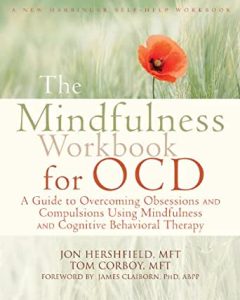
Book: The Mindfulness Workbook For OCD

Book Title:

The Mindfulness Workbook For OCD.

Author(s): Jon Hershfield (MFT) and Tom Corboy (MFT).

Year: 2014.

Edition: First (1st).

Publisher: New Harbinger.

Type(s): Paperback and Kindle.

Synopsis:

If you have obsessive-compulsive disorder (OCD), you might have an irrational fear of being contaminated by germs, or obsessively double-check things. You may even feel like a prisoner, trapped with your intrusive thoughts. Despite the fact that OCD can have a devastating impact on a person’s life, getting real help can be a challenge.

If you have tried medications without success, it might be time to explore further treatment options. You should know that mindfulness-based approaches have been proven-effective in treating OCD and anxiety disorders.

They involve developing an awareness and acceptance of the unwanted thoughts, feelings, and urges that are at the heart of OCD. Combining mindfulness practices with cognitive behavioral therapy (CBT), The Mindfulness Workbook for OCD offers practical and accessible tools for managing the unwanted thoughts and compulsive urges that are associated with OCD.

Research: Real-Time Data Collection to Examine Relations Between Physical Activity and Affect in Adults With Mental Illness

Research Paper Title:

Real-Time Data Collection to Examine Relations Between Physical Activity and Affect in Adults With Mental Illness.

Author(s): Danielle R. Madden, Chun Nok Lam, Brian Redline, Eldin Dzubur, Harmony Rhoades, Stephen S. Intille, Genevieve F. Dunton, and Benjamin Henwood.

Year: 2020.

Journal: Journ of Sport and Exercise Psychology, 6, pp.1-8.

DOI: doi: 10.1123/jsep.2019-0035. Online ahead of print.

Abstract:

Adults with serious mental illness engage in limited physical activity, which contributes to significant health disparities. This study explored the use of both ecological momentary assessments (EMAs) and activity trackers in adults with serious mental illness to examine the bidirectional relationship between activity and affect with multilevel modelling.

Affective states were assessed up to seven times per day using EMA across 4 days. The participants (n = 20) were equipped with a waist-worn accelerometer to measure moderate to vigorous physical activity.

The participants had a mean EMA compliance rate of 88.3%, and over 90% of completed EMAs were matched with 30-min windows of accelerometer wear. The participants who reported more positive affect than others had a higher probability of engaging in moderate to vigorous physical activity.

Engaging in more moderate to vigorous physical activity than one’s usual was associated with more negative affect. This study begins to address the effect of momentary mood on physical activity in a population of adults that is typically difficult to reach.

On This Day … 12 October

Events

  • 1773 – America’s first insane asylum opens.

People (Births)

  • 1925 – Denis Lazure, Canadian psychiatrist and politician (d. 2008).
  • 1929 – Robert Coles, American psychologist, author, and academic.

People (Deaths)

  • 1948 – Susan Sutherland Isaacs, English psychologist and psychoanalyst (b. 1885).

Eastern State Hospital (Virginia)

Eastern State Hospital is a psychiatric hospital in Williamsburg, Virginia. Built in 1773, it was the first public facility in the present-day United States constructed solely for the care and treatment of the mentally ill. The original building had burned but was reconstructed in 1985.

Denis Lazure

Denis Lazure (12 October 1925 to 23 February 2008) was a Canadian psychiatrist and politician. Lazure was a Member of the National Assembly of Quebec (MNA) from 1976 to 1984 and from 1989 to 1996. He is the father of actress Gabrielle Lazure.

Robert Coles

Robert Coles (born 12 October 1929) is an American author, child psychiatrist, and professor emeritus at Harvard University.

Knowing that he was to be called into the US Armed Forces under the ‘doctors’ draft’, Coles joined the Air Force in 1958 and was assigned the rank of captain. His field of specialisation was psychiatry, his intention eventually to sub-specialise in child psychiatry. He served as chief of neuropsychiatric services at Keesler Air Force base in Biloxi, Mississippi.

Susan Isaacs

Susan Sutherland Isaacs, CBE (née Fairhurst; 24 May 1885 to 12 October 1948; also known as Ursula Wise) was a Lancashire-born educational psychologist and psychoanalyst.

She published studies on the intellectual and social development of children and promoted the nursery school movement. For Isaacs, the best way for children to learn was by developing their independence. She believed that the most effective way to achieve this was through play, and that the role of adults and early educators was to guide children’s play.

Research: Age-specific prevalence and determinants of depression in long-term breast cancer survivors compared to female population controls

Research Paper Title:

Age-specific prevalence and determinants of depression in long-term breast cancer survivors compared to female population controls.

Author(s): Daniela Doege, Melissa S.Y. Thong, Lena Koch-Gallenkamp, Lina Jansen, Heike Bertram, Andrea Eberle, Bernd Holleczek, Ron Pritzkuleit, Annika Waldmann, Sylke R. Zeissig, Hermann Brenner, and Volker Arndt.

Year: 2020.

Journal: Cancer Medicine.

DOI: doi: 10.1002/cam4.3476. Online ahead of print.

Abstract:

Depression is more prevalent in breast cancer (BC) survivors than in the general population. However, little is known about depression in long-term survivors. Study objectives were: (1) to compare the age-specific prevalence of depressive symptoms (a) in BC survivors vs female population controls, (b) in disease-free BC survivors vs BC survivors with self-reported recurrence vs controls, and (2) to explore determinants of depression in BC survivors.

Methods

About 3010 BC survivors (stage I-III, 5-16 years post-diagnosis), and 1005 population controls were recruited in German multi-regional population-based studies. Depression was assessed by the Geriatric Depression Scale-15. Prevalence of mild/severe and severe depression only were estimated via logistic regression, controlling for age and education. Multinomial logistic regression was used to explore determinants of mild and severe depression.

Results

Compared with population controls, BC survivors were more likely to report mild/severe depression (30.4% vs 23.8%, p = .0003), adjusted for age and education. At all age groups <80 years, prevalence of both mild/severe and severe depression only was significantly higher in BC survivors, while BC survivors ≥80 years reported severe depression less frequently than controls. BC survivors with recurrence reported significantly higher prevalence of mild/severe depression than disease-free survivors and controls, but prevalence in disease-free survivors and controls was comparable. Age, income, living independently, recurrence, and BMI were significant determinants of mild depression in BC survivors. Age, education, employment, income, recurrence, and BMI were significant determinants of severe depression.

Conclusions

Long-term BC survivors <80 years report significantly higher prevalence of depressive symptoms than controls, which might be explained by recurrence and individual factors. The findings suggest that depression in BC survivors is common, and even more after BC recurrence. Clinicians should routinise screening and normalise referral to psychological care.

On This Day … 10 October

People (Deaths)

  • 1979 – Christopher Evans, English psychologist, computer scientist, and author (b. 1931).

Christopher Evans

Born on 23 May 1931 in Aberdyfi, Christopher Evans spent his childhood in Wales and was educated at Christ College, Brecon on (1941-1949).

He spent two years in the RAF (1950-1952), and worked as a science journalist and writer until 1957, when he began a B.A. course in Psychology at University College, London, graduating with honours in 1960.

After a summer fellowship at Duke University in the United States, where he first met his American wife, Nancy Fullmer, he took up a Research Assistant post in the Physics Laboratory, University of Reading, working on eye movements under Professor R. W. Ditchburn.

Upon receiving his PhD (the title of his thesis was “Pattern Perception and the Stabilised Retinal Image”), he went to the Division of Computer Science, National Physical Laboratory, Teddington, in 1964, where he remained until his death from cancer on 10 October 1979.

He had two children, Christopher Samuel Evans and Victoria Evans-Theiler.

He also edited two anthologies of psychological science fiction/horror stories, Mind at Bay and Mind in Chains, a collection of science writings, Cybernetics: Key Papers, a reference book Psychology: A Dictionary of Mind, Brain and Behaviour, and was a contributing editor to the science magazine Omni.

National Day Without Stigma 2020

Introduction

The National Day Without Stigma is a day dedicated to eliminating the discrimination and shame that surrounds mental illness.

Created by Active Minds, a student mental health advocacy organisation, their mission is to eliminate the stigma surrounding mental health disorders. The put on events which seek to reduce stigmas associated with seeking help with mental health. Their statistics, from 2017, include:

  • 48% of college students feel overwhelmed by all they have to do
  • 51% of college students experienced overwhelming anxiety within the past year
  • But only 2% of college students said they would seek help from a mental help professional in time of need.

Similar Campaigns in Early Ocotber

Links

National Depression Screening Day 2020

Introduction

Whether for heart disease, high blood pressure, diabetes or depression, health screenings provide a quick and easy way to spot the first signs of serious illness and can reach people who might not otherwise seek professional medical advice.

Major depression is one of the most common mental illnesses, affecting 6.7% (more than 16 million) of American adults each year.

Like screenings for other illnesses, depression screenings should be a routine part of healthcare.

Why Screen for Depression?

  • Clinical depression is a serious medical illness.
  • Clinical depression can lead to suicide.
  • Sometimes people with depression mistakenly believe that the symptoms of depression are a “normal part of life.”
  • Clinical depression affects men and women of all ages, races and socioeconomic groups.
  • Only about a third (35.3%) of those suffering from severe depression seek treatment from a mental health professional.
  • Depression can co-occur and complicate other medical conditions.
  • Screenings are often the first step in getting help.

Who Should Get Screened?

People suffering from depression often experience some of these key symptoms:

  1. A persistent sad, anxious or ’empty’ mood.
  2. Sleeping too little, early morning awakening, or sleeping too much.
  3. Reduced appetite and weight loss, or increased appetite and weight gain.
  4. Loss of interest or pleasure in activities once enjoyed.
  5. Restlessness or irritability.
  6. Difficulty concentrating, remembering or making decisions.
  7. Fatigue or loss of energy.
  8. Thoughts of death or suicide.

Screenings are not a Professional Diagnosis

Screenings point out the presence or absence of depressive symptoms and provide a referral for further evaluation if needed.

You should see a medical professional or a qualified mental health professional if you experience five or more of the above symptoms for longer than two weeks or if the symptoms are severe enough to interfere with your daily routine.

Similar Campaigns in Early Ocotber

Links

Mental Illness Awareness Week 2020

Introduction

Mental Illness Awareness Week (MIAW) was established in 1990 in recognition of efforts by the National Alliance on Mental Illness (NAMI) to educate and increase awareness about mental illness.

It takes place every year during the first full week of October.

During this week, mental health advocates and organisations across the US join to sponsor events to promote community outreach and public education concerning mental illnesses such as major depressive disorder, bipolar disorder, and schizophrenia.

Examples of activities held during the week include art/music events, educational sessions provided by healthcare professionals and individuals with lived experience and/or familial lived experience, advertising campaigns, health fairs, prayer services, movie nights, candlelight vigils, and benefit runs.

An estimated 26.2% of Americans ages 18 and older – about one in four adults – are believed to be diagnosable with a mental illness in any given year. The numbers may be larger because stigma reduces reporting.

Not only are these adults affected by one mental illness; 45% of these adults meet criteria for two or more disorders. These range from fairly common mood disorders to the much more serious anxiety and schizophrenia disorders. Among these, anxiety disorders were the most common, as some 40 million American adultages 18 and older experience some form of anxiety disorder.

Despite the large number of Americans affected by such disorders, stigma surrounding mental illness is a major barrier that prevents people from seeking the mental health treatment that they need.

Programmes during Mental Illness Awareness Week are designed to create community awareness and discussion in an effort to put an end to stigma and advocate for treatment and recovery.

Similar Campaigns in Early Ocotber

Links