Posts

Qualified Withdrawal Treatment (QWT) & Alcohol Use Disorders (AUD)

Research Paper Title

The potential effects of an extended alcohol withdrawal treatment programme on morbidity and mortality among inpatients in the German city of Bremen: a simulation study.

Background

According to the German guidelines, people with severe alcohol use disorders (AUDs) should receive withdrawal treatment.

Compared to somatic withdrawal treatment (SWT), extended duration and psychosocial elements of so-called “qualified withdrawal treatment” (QWT) aim to reduce relapse rates.

Despite promising results of prospective studies on QWT, only few German inpatients seeking withdrawal treatment receive QWT.

The researchers estimated the potential effects on mortality and morbidity for higher proportions of treatment-seeking patients receiving QWT rather than SWT in the German city of Bremen.

Methods

In 2016 and 2017, 2051 inpatients were admitted to two specialised hospitals for withdrawal treatment.

The potential beneficial effects of QWT over SWT were estimated by simulating treatment outcomes taken from two prospective studies.

Outcomes comprised number and length of all-cause hospitalisations within 5 years, as well as abstinence and all-cause mortality rates within 28 months.

Outcomes were estimated for actual and increased rates of QWT (25, 50%) among inpatients seeking alcohol treatment.

Results

In the selected hospitals, 170 patients (8%) received QWT. If 25% of AUD inpatients were to receive QWT, benefits in abstinence rates (+ 18%), the total number of hospitalisations (- 9%) and hospital days (- 10%) could be expected.

If 50% of AUD inpatients were to receive QWT, benefits in abstinence rates (+ 45%), the total number of hospitalisations (- 23%) and hospital days (- 26%) were more pronounced, in addition to reductions in mortality (- 20%).

Conclusions

Increasing the proportion of people with severe AUD enrolled in extended withdrawal treatment programmes (such as QWT) may contribute to reduce overall alcohol-attributable burden of disease.

Randomised controlled trials or other prospective studies controlling for confounding factors are needed to determine the potential at the population level.

Reference

Manthey, J., Lindemann, C., Kraus, L., Reimer, J., Verthein, U., Schulte, B. & Rehm, J. (2020) The potential effects of an extended alcohol withdrawal treatment programme on morbidity and mortality among inpatients in the German city of Bremen: a simulation study. Substance Abuse Treatment, Prevention, and Policy. 15(1):1. doi: 10.1186/s13011-019-0249-7.

An Examination of Environmental Influences on Genomic Variations, Neurodevelopmental Trajectories & Vulnerability to Psychopathology, with a Focus on Externalising Disorders

Research Paper Title

Consortium on Vulnerability to Externalizing Disorders and Addictions (cVEDA): A developmental cohort study protocol.

Background

Low and middle-income countries like India with a large youth population experience a different environment from that of high-income countries.

The Consortium on Vulnerability to Externalising Disorders and Addictions (cVEDA), based in India, aims to examine environmental influences on genomic variations, neurodevelopmental trajectories and vulnerability to psychopathology, with a focus on externalising disorders.

Methods

cVEDA is a longitudinal cohort study, with planned missingness design for yearly follow-up.

Participants have been recruited from multi-site tertiary care mental health settings, local communities, schools and colleges.

10,000 individuals between 6 and 23 years of age, of all genders, representing five geographically, ethnically, and socio-culturally distinct regions in India, and exposures to variations in early life adversity (psychosocial, nutritional, toxic exposures, slum-habitats, socio-political conflicts, urban/rural living, mental illness in the family) have been assessed using age-appropriate instruments to capture socio-demographic information, temperament, environmental exposures, parenting, psychiatric morbidity, and neuropsychological functioning.

Blood/saliva and urine samples have been collected for genetic, epigenetic and toxicological (heavy metals, volatile organic compounds) studies.

Structural (T1, T2, DTI) and functional (resting state fMRI) MRI brain scans have been performed on approximately 15% of the individuals.

All data and biological samples are maintained in a databank and biobank, respectively.

Discussion

The cVEDA has established the largest neurodevelopmental database in India, comparable to global datasets, with detailed environmental characterisation.

This should permit identification of environmental and genetic vulnerabilities to psychopathology within a developmental framework.

Neuroimaging and neuropsychological data from this study are already yielding insights on brain growth and maturation patterns.

Reference

Sharma, E., Vaidya, N., Iyengar, U., Zhang, Y., Holla, B., Purushottam, M., Chakrabarti, A., Fernandes, G.S., Heron, J., Hickman, M., Desrivieres, S., Kartik, K., Jacob, P., Rangaswamy, M., Bharath, R.D., Barker, G., Orfanos, D.P., Ahuja, C., Murthy, P., Jain, S., Varghese, M., Jayarajan, D., Kumar, K., Thennarasu, K., Basu, D., Subodh, B.N., Kuriyan, R., Kurpad, S.S., Kalyanram, K., Krishnaveni, G., Krishna, M., Singh, R.L., Singh, L.R., Kalyanram, K., Toledano, M., Schumann, G., Benegal, V. & cVEDA Consortium. (2020) Consortium on Vulnerability to Externalizing Disorders and Addictions (cVEDA): A developmental cohort study protocol. BMC Psychiatry. 20(1):2. doi: 10.1186/s12888-019-2373-3.


Testing the Effectiveness of Smartphone Apps Delivered to School Students to Prevent Depression at Scale.

Research Paper Title

A trial protocol for the effectiveness of digital interventions for preventing depression in adolescents: The Future Proofing Study.

Background

Depression frequently first emerges during adolescence, and one in five young people will experience an episode of depression by the age of 18 years.

Despite advances in treatment, there has been limited progress in addressing the burden at a population level.

Accordingly, there has been growing interest in prevention approaches as an additional pathway to address depression.

Depression can be prevented using evidence-based psychological programmes. However, barriers to implementing and accessing these programmes remain, typically reflecting a requirement for delivery by clinical experts and high associated delivery costs.

Digital technologies, specifically smartphones, are now considered a key strategy to overcome the barriers inhibiting access to mental health programmes.

The Future Proofing Study is a large-scale school-based trial investigating whether cognitive behaviour therapies (CBT) delivered by smartphone application can prevent depression.

Methods

A randomised controlled trial targeting up to 10,000 Year 8 Australian secondary school students will be conducted.

In Stage I, schools will be randomised at the cluster level either to receive the CBT intervention app (SPARX) or to a non-active control group comparator.

The primary outcome will be symptoms of depression, and secondary outcomes include psychological distress, anxiety and insomnia.

At the 12-month follow-up, participants in the intervention arm with elevated depressive symptoms will participate in an individual-level randomised controlled trial (Stage II) and be randomised to receive a second CBT app which targets sleep difficulties (Sleep Ninja) or a control condition.

Assessments will occur post intervention (both trial stages) and at 6, 12, 24, 36, 48 and 60 months post baseline.

Primary analyses will use an intention-to-treat approach and compare changes in symptoms from baseline to follow-up relative to the control group using mixed-effect models.

Results & Conclusions

This is the first trial testing the effectiveness of smartphone apps delivered to school students to prevent depression at scale.

Results from this trial will provide much-needed insight into the feasibility of this approach.

They stand to inform policy and commission decisions concerning if and how such programmes should be deployed in school-based settings in Australia and beyond.

Reference

Werner-Seidler, A., Huckvale, K., Larsen, M.E., Calear, A.L., Maston, K., Johnston, L., Torok, M., O’Dea, B., Batterham, P.J., Schweizer, S., Skinner, S.R., Steinbeck, K., Ratcliffe, J., Oei, J.L., Patton, G., Wong, I., Beames, J., Wong, Q.J.J., Lingam, R., Boydell, K., Salmon, A.M., Cockayne, N., Mackinnon, A. & Christensen, H. (2020) A trial protocol for the effectiveness of digital interventions for preventing depression in adolescents: The Future Proofing Study. Trials. 21(1), pp.2. doi: 10.1186/s13063-019-3901-7.

What is the Prevalence & Associated Factors of Depression among Patients with Schizophrenia?

Research Paper Title

The prevalence and associated factors of depression among patients with schizophrenia in Addis Ababa, Ethiopia, cross-sectional study.

Background

Depression is common among people with schizophrenia and associated with severe positive and negative symptoms, higher rates of disability, treatment resistance and mortality related to suicide, physical and drug-related causes.

However, to the researchers knowledge, no study has been conducted to report the magnitude of depression among people with schizophrenia in Ethiopia.

Therefore, this study aimed to determine the prevalence and associated factors of depression among people with schizophrenia.

Methods

A hospital-based cross-sectional study was conducted among 418 patients with schizophrenia selected by systematic sampling technique.

Patient Health Questionnaire 9 (PHQ-9) was used to measure depression among the study participants.

To identify the potential contributing factors, we performed binary and multi-variable logistic regression analysis adjusting the model for the potential confounding factors.

Odds ratios (OR) with the corresponding 95% confidence interval (95%CI)) was determined to evaluate the strength of association.

Results

The prevalence estimate of depression among people with schizophrenia was found to be 18.0% [95% confidence interval: 14.50-22.30].

The multi-variable analysis revealed that current substance use (AOR 2.28, 95%CI (1.27, 4.09), suicide attempt (AOR 5.24, 95%CI (2.56, 10.72), duration of illness between 6 and 10 years (AOR 2.09, 95%CI (1.08, 4.04) and poor quality of life (AOR 3.13, 95%CI (1.79, 5.76) were found to be the factors associated with depression among people with schizophrenia.

Conclusions

The current study revealed that co-morbid depression was high among people with schizophrenia and associated with current substance use, suicide attempt, and long duration of the illness as well as poor quality of life.

Attention needs to be given to address co-morbid depression among people with schizophrenia.

Reference

Fanta, T., Bekel, D. & Ayano, G. (2020) The prevalence and associated factors of depression among patients with schizophrenia in Addis Ababa, Ethiopia, cross-sectional study. BMC Pyschiatry. 20(1):3. doi: 10.1186/s12888-019-2419-6.

Is There a link between Cosmetic Facial Injection & Emotional Disorder Syndrome?

Research Paper Title

Emotional disorder syndrome after cosmetic facial injection.

Background

There are a number of patients who develop severe anxiety or depression after receiving facial cosmetic injections.

The researchers presented a 32-year-old woman who developed frequent panic, tension headache, tachycardia, shortness of breath, and sleep disorder for a year after the injection of hyaluronic acid on her forehead and glabella.

Brain magnetic resonance imaging (MRI) showed multiple flaky and slightly longer T1, slightly longer T2 signals on the anterior frontal white matter. However, the patient’s brain MRI scan 5 months before the injection showed no such performance.

The patient was asked to consult the psychiatrist and was diagnosed with anxiety disorder.

The researchers name such phenomenon by Emotional disorder syndrome after cosmetic facial injection and assume that there are three major reasons for the emergence of this syndrome:

  • One reason may be that emotional disorder is caused by the mental state of the patient.
  • The second reason to explain the emotional disorder might be the frontal lobe syndrome caused by the frontal embolism during the filler injection.
  • Another reason may be leukoaraiosis, a brain white matter change which may cause depression and anxiety.

Reference

Wang, C., Sun, T., Zhu, L., Zhang, Y. & Wang, X. (2020) Emotional disorder syndrome after cosmetic facial injection.

Psychiatric Nurses & Personal Initiative: What are the Factors to Consider?

Research Paper Title

Personal and organisational factors related to initiative behaviour among psychiatric nurses.

Background

To identify the degree of personal initiative (PI) among psychiatric nurses and to examine the influence of personal and organisational characteristics on their PI.

Methods

Ninety-seven nurses completed a questionnaire on PI, work climate, self-efficacy toward initiatives and innovations, nursing work environment, and actual initiative at work.

Results

Differences in actual initiative at work according to the level of education, and negative association between PI and age were found.

Self-efficacy and work climate explained 56% of PI; self-efficacy, work climate, and age explained 30% of initiative behaviour.

Conclusions

Investing in young nurses, fostering higher education, and creating a supportive work environment can help in conversion of innovative vision into actual initiatives.

Reference

Hendel, T., Chor, R., Kigli-Shemesh, R. & Kagan, I. (2020) Personal and organizational factors related to initiative behavior among psychiatric nurses. Perspectives in Psychiatric Care. doi: 10.1111/ppc.12471. [Epub ahead of print].

Quality of Life: Psychosocial Intervention in Men with Advanced Prostate Cancer

Research Paper Title

Technology-Based Psychosocial Intervention to Improve Quality of Life and Reduce Symptom Burden in Men with Advanced Prostate Cancer: Results from a Randomized Controlled Trial.

Background

Men with advanced prostate cancer (APC) face multiple challenges including poor prognosis, poor health-related quality of life (HRQOL), and elevated symptom burden.

This study sought to establish the efficacy of a tablet-delivered, group-based psychosocial intervention for improving HRQOL and reducing symptom burden in men with APC.

The researchers hypothesised that men randomised to cognitive-behavioural stress management (CBSM) would report improved HRQOL and reduced symptom burden relative to men randomised to an active control health promotion (HP) condition.

Condition effects on intervention targets and moderators of these effects were explored.

Methods

Men with APC (N = 192) were randomised (1:1) to 10-week tablet-delivered CBSM or HP, and followed for 1 year.

Multilevel modelling was used to evaluate condition effects over time.

Results

Changes in HRQOL and symptom burden did not differ between groups.

Men in both groups improved across several intervention targets; men in the CBSM condition reported greater increases in self-reported ability to relax, and both conditions showed improvements in cancer-related anxiety, cancer-related distress, and feelings of cohesiveness with other patients over time.

Moderating factors included baseline interpersonal disruption, fatigue, and sexual functioning.

Conclusions

Tablet-delivered CBSM and HP were well received by men with APC.

The hypothesised effects of CBSM on HRQOL and symptom burden were not supported, though improvements in intervention targets were observed across conditions.

Participants reported high-baseline HRQOL relative to cancer and general population norms, possibly limiting intervention effects.

The identified moderating factors should be considered in the development and implementation of interventions targeting HRQOL and symptom burden.

Reference

Penedo, F.J., Fox, R.S., Oswald, L.B., Moreno, P.I., Boland, C.L., Estabrook, R., McGinty, H.L., Mohr, D.C., Begale, M.J., Dahn, J.R., Flury, S.C., Perry, K.T., Kundu, S.D. & Yanez, B. (2020) Technology-Based Psychosocial Intervention to Improve Quality of Life and Reduce Symptom Burden in Men with Advanced Prostate Cancer: Results from a Randomized Controlled Trial. International Journal of Behavioral Medicine. doi: 10.1007/s12529-019-09839-7. [Epub ahead of print].

E-Therapy & Training Future Psychiatrists

Research Paper Title

Therapy and E-therapy – Preparing Future Psychiatrists in the Era of Apps and Chatbots.

Background

In both Canada and the USA, residency includes learning about psychotherapy.

The Royal College of Physicians and Surgeons of Canada mentions several psychotherapies in its training objectives and states that residents must “demonstrate proficiency in assessing suitability for and prescribing and delivering” such treatments, including cognitive behavioural therapy.

The Accreditation Council for Graduate Medical Education (ACGME) in the USA sets out competency frameworks and assessments for psychotherapy in psychiatry post-graduate education.

Yet on neither side of the 49th parallel is there mention of e-therapies in training requirements.

Read the full article using the link below.

Reference

Gratzer, D. & Goldbloom, D. (2020) Therapy and E-therapy – Preparing Future Psychiatrists in the Era of Apps and Chatbots. Academic Psychiatry. https://link.springer.com/article/10.1007%2Fs40596-019-01170-3.

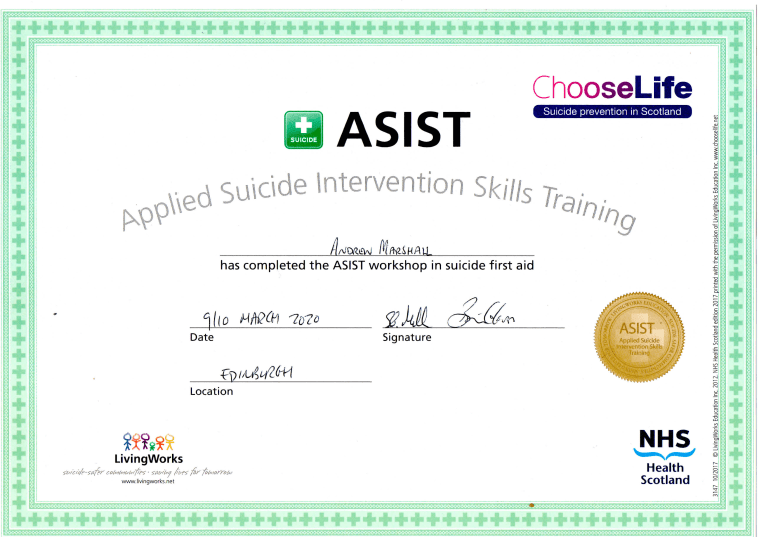
Course: Applied Suicide Intervention Skills Training (ASIST)

Just completed the 2-day Applied Suicide Intervention Skills Training (ASIST) course.

ASIST is intended as ‘suicide first-aid’ training.

It aims to enable helpers (anyone in a position of trust) to become more willing, ready, and able to recognise and intervene effectively to help persons at risk of suicide.

You can find out more about the ASIST course here.

Considering Drug-Associated Contexts in Substance Use Disorders and Treatment Development.

Research Paper Title

Considering Drug-Associated Contexts in Substance Use Disorders and Treatment Development.

Background

Environmental contexts that are reliably associated with the use of pharmacologically active substances are hypothesized to contribute to substance use disorders.

In this review, the researchers provide an updated summary of parallel pre-clinical and human studies that support this hypothesis.

Methods

Research conducted in rats shows that environmental contexts that are reliably paired with drug use can renew extinguished drug-seeking behaviour and amplify responding elicited by discrete, drug-predictive cues.

Akin to drug-associated contexts, interoceptive drug stimuli produced by the psychopharmacological effects of drugs can also influence learning and memory processes that play a role in substance use disorders.

Results

Findings from human laboratory studies show that drug-associated contexts, including social stimuli, can have profound effects on cue reactivity, drug use, and drug-related cognitive expectancies.

This translationally relevant research supports the idea that treatments for substance use disorders could be improved by considering drug-associated contexts as a factor in treatment interventions.

The researchers conclude this review with ideas for how to integrate drug-associated contexts into treatment-oriented research based on 4 approaches:

  • Pharmacology;
  • Brain stimulation;
  • Mindfulness-based relapse prevention; and
  • Cognitive behavioural group therapy.

Throughout, the researchers focus on alcohol- and tobacco-related research, which are two of the most prevalent and commonly misused drugs worldwide for which there are known treatments.

Reference

LeCocq, M.R., Randall, P.A., Besheer, J. & Chaudhri, N. (2020) Considering Drug-Associated Contexts in Substance Use Disorders and Treatment Development. Neurotherapeutics. 17(1), pp.43-54. doi: 10.1007/s13311-019-00824-2.