Posts

10 Strategies for Evoking ‘Change Talk’

1. Ask Evocative Questions

Ask evocative, open-ended questions, to which the answers are likely to be change talk:

  • “Why would you want to make this change?”
  • “What makes you willing to stop / start _____?”
  • “What are the three best reasons for you to do this?”
  • “Why is it important for you to make these changes?”
  • “So, what do you think that you will do from here?”

2. Explore the Decisional Balance

Help the person to explore the advantages and disadvantages of making changes:

  • “What are the good things about ________?”
  • “What are the not-so-good things about ________?”
  • “What are the benefits of stopping / changing ___?”

3. Ask for Elaboration

When a change talk theme emerges, ask for more detail:

  • “How has this impacted on your health/relationships/family?”
  • “In what ways?”
  • “Tell me more about …”

4. Ask for Examples

When a ‘change talk’ theme emerges, ask for specific examples:

  • “When was the last time that happened?”
  • “Can you give me an example?”
  • “What else?”

5. Look Back

Ask about a time before the current concern emerged:

  • “How were things different or better then?”

6. Look Forward

Ask:

  • “What might happen if things continue as they are?” or
  • “How would you like your life to be in five years’ time?”

Try the ‘Miracle Question’:

  • “If you were 100% successful in making the changes you want to make, what would be different?”

7. Query Extremes

  • Ask “What are the best things that might happen if you do make this change?” or
  • “What are the worst things that might happen if you do not make this change?”

8. Use Change Rulers

Ask

  • “On a scale of nought to ten, how important is it for you to make this change – where nought is not at all important and ten is extremely important?”

Follow up with:

  • “Why are you at _ and not at _ [lower number than they stated]? What might need to happen so that you could move from _ to _ [higher number]?”

Instead of:

  • “How important is …?” you could ask “How much do you want to …?” or
  • “How confident are you that you can …?” or
  • “How committed are you to …?”

Avoid asking:

  • “How ready are you to …?”

It can be confusing because it combines the competing components of:

  • Desire;
  • Ability;
  • Reason(s); and
  • Need.

9. Explore Goals and Values

Explore what a person’s guiding values are.

What do they want in life?

How does the person’s behaviour fit with their goals and values?

Does it help to achieve goals, interfere with them or is it irrelevant?

10. Come Alongside

Try explicitly siding with the negative (continuing and not changing) side of ambivalence:

  • “Perhaps smoking weed is so important to you that you will not give it up, no matter what the cost.”

11 Tips for Encouraging Motivation to Change

  • Do I listen more than I talk? Or am I talking more than I am listening?
  • Do I keep myself sensitive and open to a person’s issues, whatever they may be? Or am I talking about what I think the problem is?
  • Do I invite a person to talk about and explore their own feelings for change? Or am I jumping to conclusions and possible solutions?
  • Do I encourage a person to talk about their reasons for not changing? Or am I forcing them to talk only about change?
  • Do I ask permission to give my feedback? Or am I presuming that my ideas are what they want to hear?
  • Do I reassure a person that ambivalence to change is normal? Or am I telling them to take action and push ahead for a solution?
  • Do I help a person identify successes and challenges from their past and relate them to present change effects? Or am I encouraging them to ignore or get stuck on old stories?
  • Do I seek to understand a person? Or am I spending a lot of time trying to convince them to understand me and my ideas?
  • Do I summarise for a person what I am hearing? Or am I just summarising what I think?
  • Do I value a person’s opinion more than my own? Or am I giving more value to my viewpoint?
  • Do I remind myself that a person is capable of making their own choices? Or am I assuming that they are not capable of making good choices?

Somatic Symptom Disorder & Social Stigma

Research Paper Title

Social Stigma Towards People with Medically Unexplained Symptoms: the Somatic Symptom Disorder.

Background

The majority of previous studies on mental health stigma have focused on medically explained symptoms and the studies on medically unexplained symptoms (MUS) have only assessed the consequences of internalised stigma.

A new category in DSM 5, named as somatic symptom disorder (SSD), includes multiple somatic disorders with medically-explained or -unexplained somatic symptoms.

This study aimed to test the effects of social stigma on people with SSD with MUS depending on the attribution model.

Methods

In a class environment, 348 college students from different regions in Turkey were presented with a vignette on a person with SSD with MUS and asked to complete a survey including demographics and attitudes towards that person.

Results

Along the same lines with previous findings for other mental disorders, the path analysis using AMOS revealed that stigma-related cognitions (i.e., dependency, dangerousness and responsibility) shaped people’s affective (i.e., anger and pity) and behavioural responses (i.e., social distance) to these people.

The most important predictor of social distance was pity and the level of contact was not related to social distance.

Conclusions

In conclusion, anti-stigma interventions towards SSD with MUS should involve building empathy towards these patients and educating people about this disorder contrary to the recommended interventions for other mental health disorders stressing the importance of contact.

Reference

Eger Aydogmus, M. (2020) Social Stigma Towards People with Medically Unexplained Symptoms: the Somatic Symptom Disorder.

Stacey Dooley: On the Psych Ward (2020)

Introduction

Every year thousands of young people are brought to mental health units across the UK to seek treatments.

Latest estimates put the number of people who suffer from a mental condition at 1 in 3 and most first experience mental health problems when they are young.

Refer to Stacey Dooley: Back on the Psych Ward (2021).

Outline

Stacey is going to work in Springfield Hospital, one of the oldest mental health units in the UK, to see what life is really like on the front line of mental health services. More than just observing, she will be working directly with staff, dealing with patients, and taking part in making incredibly tough decisions on what is best for patients.

Stacey meets Rachelle who has been diagnosed with EUPD (Emotionally Unstable Personality Disorder). Still in her 20s, she’s had a troubled life already – full of suicide attempts and self-harm. She opens up to Stacey about her struggles with her illness, and her hope that she will soon get the talking therapy that she believes could be the solution to her problems. The doctors here agree that this is not the best place for Rachelle to be, and they are hoping she will get a place at a specialist unit in Cambridge where she can make real progress in coping with her condition.

Stacey also spends time in a special acute assessment unit where patients can self-refer. She meets 19-year-old Kyle, who has come to Springfield in the midst of a severe depression and incident of self-harm. As Stacey takes part in a discussion with staff about whether to admit him to the hospital or support him in the community, Stacey experiences for herself just how difficult the decisions and the judgement calls are that the team have to make.

Police have brought Laura to the 136 unit, so called because it is the local designated place of safety as defined under section 136 of the Mental Health Act. She has been sectioned after being found on a motorway bridge, threatening to jump. She opens up to Stacey as they talk, trying to explain her thinking and her ongoing struggles with depression and her eating disorder – all stemming from traumas earlier in her short life.

Production & Filming Details

Losing It – Our Mental Health Emergency (2020): S01E04 – Street Triage

Introduction

As attitudes to mental health change during a surge in the number of people asking for help or harming themselves, this series joins the frontline care services in Nottinghamshire.

Nottinghamshire Healthcare NHS Foundation Trust opens its doors to TV cameras to reveal what it means to be in crisis.

Going to the heart of front line services as staff struggle to tackle an unprecedented rise in demand.

Outline

A look at the work of Street Triage, a blue-light rapid response team in Nottinghamshire, where the number of attempted suicides is staggering and ward beds are in short supply.

Losing It: Our Mental Health Emergency Series

Production & Filming Details

  • Release Date: 2020.
  • Original Network: Channel 4.

Losing It – Our Mental Health Emergency (2020): S01E03 – Josh, Christopher & Zoe

Introduction

As attitudes to mental health change during a surge in the number of people asking for help or harming themselves, this series joins the frontline care services in Nottinghamshire.

Nottinghamshire Healthcare NHS Foundation Trust opens its doors to TV cameras to reveal what it means to be in crisis.

Going to the heart of front line services as staff struggle to tackle an unprecedented rise in demand.

Outline

Josh is brought to A&E after trying to kill himself.

Is it safe to send the 15-year-old home?

After 11 years and multiple issues, Christopher faces being discharged from the service.

Losing It: Our Mental Health Emergency Series

Production & Filming Details

  • Release Date: 2020.
  • Original Network: Channel 4.

Losing It – Our Mental Health Emergency (2020): S01E02 – Three Teenage Girls

Introduction

As attitudes to mental health change during a surge in the number of people asking for help or harming themselves, this series joins the frontline care services in Nottinghamshire.

Nottinghamshire Healthcare NHS Foundation Trust opens its doors to TV cameras to reveal what it means to be in crisis.

Going to the heart of front line services as staff struggle to tackle an unprecedented rise in demand.

Outline

A young teen comes to A&E having self-harmed.

A 16-year-old is on the psychiatric ward.

And a 14-year-old’s eating disorder risks permanent harm to her body.

Losing It: Our Mental Health Emergency Series

Production & Filming Details

  • Release Date: 2020.
  • Original Network: Channel 4.

Losing It – Our Mental Health Emergency (2020): S01E01 – Laura & Briena

Introduction

As attitudes to mental health change during a surge in the number of people asking for help or harming themselves, this series joins the frontline care services in Nottinghamshire.

Nottinghamshire Healthcare NHS Foundation Trust opens its doors to TV cameras to reveal what it means to be in crisis.

Going to the heart of front line services as staff struggle to tackle an unprecedented rise in demand.

Outline

Two weeks after becoming a mum, Laura is sectioned having tried to drive into a brick wall.

And is 11-year-old Briena really suicidal, or is the underlying diagnosis more complicated?

Losing It: Our Mental Health Emergency Series

Production & Filming Details

  • Release Date:
  • Original Network: Channel 4.

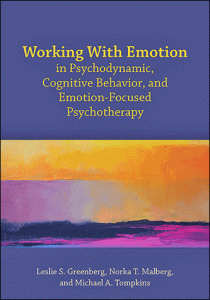
Book: Working with Emotion

Book Title:

Working With Emotion in Psychodynamic, Cognitive Behaviour, and Emotion-Focused Psychotherapy.

Author(s): Leslie S. Greenberg, Norka T. Malberg, and Michael A. Tompkins.

Year: 2019.

Edition: First (1st).

Publisher: American Psychological Assocation.

Type(s): Paperback and Kindle.

Synopsis:

The authors of this volume investigate the role of emotion in the development and maintenance of psychological problems, and in effecting psychological change.

They examine emotion as it is conceptualised and used in three of the most widely practised approaches today–psychodynamic, cognitive behaviour, and emotion-focused psychotherapy.

In each chapter, the authors discuss the impact of emotion on child development and learning, the relationship between emotion and motivation, and the ways in which emotion can be harnessed in treatment to improve psychological functioning and strengthen interpersonal relationships.

Clinical vignettes show readers how to arouse, identify, and channel emotions in therapy, while also utilising emotion to develop and maintain an effective therapeutic alliance.

Book: Understanding Depression

Book Title:

Understanding Depression: 9 Techniques To Change YOUR Life!

Author(s): Amy McMiller.

Year: 2019.

Edition: First (1st).

Publisher: Independently Published.

Type(s): Kindle.

Synopsis:

I have written this book because I have helped many people with depression and feel that there is a need to clear a few things up.

The current medical and pharmaceutical industry are not doing much to improve the symptoms. I want people to feel like themselves again and finally get the symptom relieve that they are looking for.


Luckily I am not the only one recognising that someone has to wake up in order to educate people of what can really aid in fighting depression.

I have been a former nurse working with mentally ill patients for more than a decade therefore I am speaking from experience and also in the name of many of my former patients for whom I cared deeply.

Depending on where you are living in the world antidepressants can be very expensive, the medical system might have written you off already or you have simply lost hope that there will ever be a cure for your condition. Do not give up. Take the courage and read this book, fight another day to get out of the cycle of depression and medication.

I want you to try my suggestions in this book because I know that they will work! Together we can cure your depression and potentially with the help of your current physician get off the medication for good. Sounds good? Let’s get started!