Book: Internet Addiction

Book Title:

Internet Addiction: Prevalence, Risk Factors and Health Effects.

Author(s): Margaret Adams (Editor).

Year: 2016.

Edition: First (1st).

Publisher: Nova Science Publishers.

Type(s): Hardcover and Kindle.

Synopsis:

According to the World Health Organisation, pathological addiction is the psychic, and sometimes even physical, condition arising from the interaction between a living organism and an exogenous substance, characterised by behavioural responses and other reactions that always include a compulsive need to take the substance continuously or periodically, in order to get its psychic effects and/or to avoid the distress related to its withdrawal.

This book presents a review on Internet addiction, which is considered an emergent problem especially amongst adolescents, and examines the risk factors and health effects of this addiction.

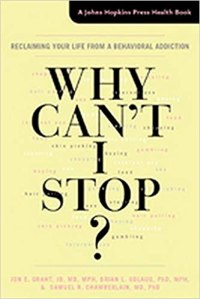
Book: Why Can’t I Stop?

Book Title:

Why Can’t I Stop?: Reclaiming Your Life from a Behavioral Addiction (A Johns Hopkins Press Health Book).

Author(s): Jon E. Grant, Brian L. Odlaug, and Samuel R. Chamberlain.

Year: 2016.

Edition: First (1st).

Publisher: John Hopkins University Press.

Type(s): Hardcover, Paperback, and Kindle.

Synopsis:

At some point in our lives, we all engage in behaviours that are risky, irrational, or unwise. We might find it exciting and temporarily rewarding to gamble on the lottery or impulsively buy an expensive gadget. But just as substances like alcohol and narcotics have the potential to become addictive, so do certain behaviours. A person addicted to gambling, shopping, the internet, food, or picking at their skin may suffer shame in the shadows while their behaviour consumes time and energy and disrupts their life. Some people with behavioural addictions lose their family, job, savings, and home. With a physical basis in the brain, behavioural addictions are serious illnesses – but simply willing yourself to stop is usually not enough.

Why Can’t I Stop? is for anyone who has a behavioural addiction, as well as their supportive families and friends. Examining seven of the most common and serious addictions – gambling, sex, stealing, internet use, shopping and buying, hair pulling and skin picking, and food – the authors bring together cutting-edge research to describe behavioural addiction, its causes, and how it can be diagnosed and treated.

Featuring patient stories of behavioural addiction and recovery, as well as information about treatment centres, this compassionate guide will help readers better understand the complicated issues surrounding these addictions and teach family members how to help the addicted person while helping themselves.

Book: Molecular Neurobiology of Addiction Recovery

Book Title:

Molecular Neurobiology of Addiction Recovery: The 12 Steps Program and Fellowship (SpringerBriefs in Neuroscience).

Author(s): Kenneth Blum, John Femino, Scott Teitelbaum, John Giordano, Marlene Oscar-Berman, and Mark Gold.

Year: 2013.

Edition: First (1st).

Publisher: Springer.

Type(s): Paperback and Kindle.

Synopsis:

Since Alcoholics Anonymous was founded in 1935, its 12 step programme of spiritual and character development has helped individuals overcome addiction.

This book takes a systematic look at the molecular neurobiology associated with each of the 12 steps.

Book: The Economics Of Addictive Behaviours – Volume IV

Book Title:

The Economics Of Addictive Behaviours – Volume IV: The Private and Social Costs of Overeating and Their Remedies.

Author(s): John Joshua.

Year: 2017.

Edition: First (1ed).

Publisher: Palgrave Macmillan.

Type(s): Hardcover, Paperback, and Kindle.

Synopsis:

This title offers an in-depth analysis of the psychological causes and consequences of, and proposed interventions for over-eating. The author examines the history of obesity and its distribution by social class and geography, the environmental effects of overconsumption and economic remedies such as the introduction of a sugar tax to reduce obesity. Joshua also considers the politics of corporate social responsibility of food and beverage corporations and how this could prevent poor health decisions.

This is the final title in a four volume series ‘The Economics of Addictive Behaviours’, consisting of three additional volumes on smoking, alcohol abuse and illicit drug abuse.

Book: The Economics Of Addictive Behaviours – Volume III

Book Title:

The Economics Of Addictive Behaviours – Volume III: The Private and Social Costs of the Abuse of Illicit Drugs and Their Remedies.

Author(s): John Joshua.

Year: 2017.

Edition: First (1ed).

Publisher: Palgrave Macmillan.

Type(s): Hardcover, Paperback, and Kindle.

Synopsis:

This title offers an in-depth analysis of the causes, consequences and treatments of illicit drug abuse. The author examines the effects of existing drug policies and proposes drug use legalisation within a regulated market as a viable alternative. Joshua assesses the factors that make individuals vulnerable to drug abuse and the pathways they may follow. As well as exploring the physical and psychological effects on the individual, Joshua examines the social and economic consequences for society. He highlights the pitfalls of a purely legal approach to drug abuse, which is primarily a health matter, and questions whether special drugs courts could be used as an alternative to the present criminal justice system. This book adds to the debate on whether most drugs could be sold in a regulated market in the same way as other drugs are, such as alcohol or nicotine.

This is the third title in a four volume series ‘The Economics of Addictive Behaviours’, consisting of three additional volumes on smoking, alcohol abuse and overeating.

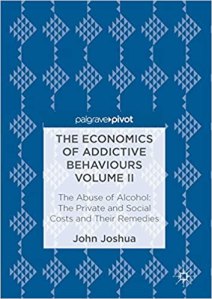
Book: The Economics Of Addictive Behaviours – Volume II

Book Title:

The Economics Of Addictive Behaviours – Volume II: The Private and Social Costs of Alcohol and Their Remedies.

Author(s): John Joshua.

Year: 2017.

Edition: First (1ed).

Publisher: Palgrave Macmillan.

Type(s): Hardcover, Paperback, and Kindle.

Synopsis:

This title discusses the phenomenon of alcohol abuse as a behavioural disease and the associated costs. The author details alcohol’s status as a psychoactive drug; he notes, however, that in contrast to other psychoactive drugs, alcohol has been widely culturally accepted in Western countries and legally available, except in isolated incidents for a short period of time. Joshua considers which policies are being correctly utilised so as to reduce the abuse of alcohol, and how these policies may operate on a supply and demand model. Whereas programs of prevention and treatment operate on the demand side of alcohol abuse, legislation is directed at the supply side of alcohol; that is, dealing with marketing – product, promotion, point of sales and price.

This is the second title in a four volume series ‘The Economics of Addictive Behaviours’, consisting of three additional volumes on smoking, illicit drug abuse and overeating.

Book: The Economics Of Addictive Behaviours – Volume I

Book Title:

The Economics Of Addictive Behaviours – Volume I: The Private and Social Costs of Smoking and Their Remedies.

Author(s): John Joshua.

Year: 2017.

Edition: First (1ed).

Publisher: Palgrave Macmillan.

Type(s): Hardcover, Paperback, and Kindle.

Synopsis:

This title discusses the phenomenon of smoking as a behavioural disease and the associated costs. The author details the consequences of smoking, in addition to the detrimental effects caused by second-hand tobacco smoke exposure as a health risk to children as well as to the general public. The central contribution of Joshua’s work is to address these concerns in terms of the issues of free choice and the market. Considering the various restrictive policies designed to reduce smoking’s prevalence, including the banning of smoking in public places, and the inclusion of warning labels on cigarette packets, Joshua carefully analyses potential economic remedies to the problem of smoking, notably the Pigovian tax. Finally, the book concludes with a highly relevant discussion of corporate social responsibility, and the role that this might play in anti-smoking projects.

This is the first title in a four volume series ‘The Economics of Addictive Behaviours’, which consists of three further volumes on alcohol abuse, illicit drug abuse and overeating.

Addictions: Broken Brain Model vs Systems-Level Perspective

Research Paper Title

Curing the broken brain model of addiction: Neurorehabilitation from a systems perspective.

Background

The dominant biomedical perspective on addictions has been that they are chronic brain diseases.

While the authors acknowledge that the brains of people with addictions differ from those without, they argue that the “broken brain” model of addiction has important limitations. They propose that a systems-level perspective more effectively captures the integrated architecture of the embodied and situated human mind and brain in relation to the development of addictions. This more dynamic conceptualisation places addiction in the broader context of the addicted brain that drives behaviour, where the addicted brain is the substrate of the addicted mind, that in turn is situated in a physical and socio-cultural environment.

From this perspective, neurorehabilitation should shift from a “broken-brain” to a systems theoretical framework, which includes high-level concepts related to the physical and social environment, motivation, self-image, and the meaning of alternative activities, which in turn will dynamically influence subsequent brain adaptations. The authors call this integrated approach system-oriented neurorehabilitation.

They illustrate their proposal by showing the link between addiction and the architecture of the embodied brain, including a systems-level perspective on classical conditioning, which has been successfully translated into neurorehabilitation. Central to this example is the notion that the human brain makes predictions on future states as well as expected (or counterfactual) errors, in the context of its goals.

The authors advocate system-oriented neurorehabilitation of addiction where the patients’ goals are central in targeted, personalised assessment and intervention.

Reference

Wiers, R.W. & Verschure, P. (2020) Curing the broken brain model of addiction: Neurorehabilitation from a systems perspective. Addictive Behaviors. doi: 10.1016/j.addbeh.2020.106602. Online ahead of print.

Book: The Age of Addiction – How Bad Habits Became Big Business

300300

Book Title:

The Age of Addiction – How Bad Habits Became Big Business.

Author(s): David T. Courtwright.

Year: 2019.

Edition: First (1st).

Publisher: Harvard University Press..

Type(s): Hardcover, Paperback, Audiobook, and Kindle.

Synopsis:

We live in an age of addiction, from compulsive gaming and shopping to binge eating and opioid abuse.

Sugar can be as habit-forming as cocaine, researchers tell us, and social media apps are deliberately hooking our kids.

But what can we do to resist temptations that insidiously rewire our brains? A renowned expert on addiction, David Courtwright reveals how global enterprises have both created and catered to our addictions.

The Age of Addiction chronicles the triumph of what he calls “limbic capitalism,” the growing network of competitive businesses targeting the brain pathways responsible for feeling, motivation, and long-term memory.

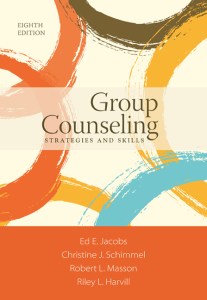
Book: Group Counseling – Strategies and Skills

Book Title:

Group Counseling – Strategies and Skills.

Author(s): Ed E. Jacobs, Christine J. Schimmel, Robert L. Mason, and Riley L. Harvill.

Year: 2016.

Edition: Eighth (8th).

Publisher: Brooks/Cole.

Type(s): Paperback.

Synopsis:

Group Counseling: Strategies and Skills, Eighth Edition, provides an in-depth look at group counselling with an emphasis on practical knowledge and techniques for effective group leadership.

The authors discuss the many facets of group counselling and provide examples of how each skill can be applied in a wide range of group settings to produce effective and efficient group sessions.

The book focuses on the skills necessary for starting and ending a session, as well as on how to make the middle phase productive and meaningful.

Its practical, active approach is supported by nearly 50 video segments-including several new ones-that demonstrate specific skills as well as the integration of multiple skills and techniques.

Through its integration of traditional theories and concepts of group process with thoughtful strategies and specific skills, this reader-friendly book and video clips meet the needs of practising or future counsellors, social workers, psychologists, and others who are leading or preparing to lead groups in a variety of settings.