Book: Self-Esteem for Dummies

Book Title:

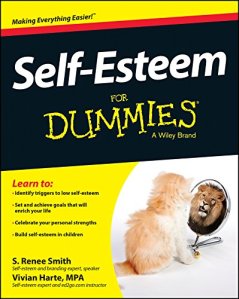
Self-Esteem for Dummies.

Author(s): S. Renee Smith and Vivian Harte.

Year: 2015.

Edition: Fourth (4th), Revised Edition.

Publisher: John Wiley and Sons.

Type(s): Paperback and Kindle.

Synopsis:

Boost your self-esteem and truly believe that you are perfectly awesome Looking to get your hands on some more self-esteem? You’re not alone.

Thankfully, Self-Esteem For Dummies presents clear, innovative, and compassionate methods that help you identify the causes of low self-esteem as well the lowdown on the consequences.

Packed with trusted, hands-on advice to help you improve your overall self-worth, Self-Esteem For Dummies arms you with the proven tools and techniques for learning how to think and behave with more self-assurance at work, in social situations, and even in relationships.

Self-esteem is shaped by your thoughts, relationships, and experiences. When you were growing up, your successes, failures, and how you were treated by your family, teachers, coaches, religious authorities, and peers determined how you feel about yourself.

But you can shift your thinking and reclaim your self-worth with the help of Self-Esteem For Dummies.

  • Helps you understand the ranges of self-esteem and the benefits of promoting self-esteem.
  • Arms you with the tools to learn how to think and behave with more self-assurance.
  • Covers the importance of mental well-being, assertiveness, resilience, and more.
  • Shows you how to improve your self-image, increase personal power, and feel better about yourself.

If you are looking to boost your sense of self-worth, Self-Esteem For Dummies sets you on the path to a more confident, awesome you.

Book: The Science of Positivity

Book Title:

The Science of Positivity: Stop Negative Thought Patterns by Changing Your Brain Chemistry.

Author(s): Loretta Graziano Breuning.

Year: 2016.

Edition: First (1st).

Publisher: Adams Media Corporation.

Type(s): Paperback, Audiobook, and Kindle.

Synopsis:

Sometimes it is easiest to look for the worst in every situation – our brains have evolved to scan for problems in order to help avoid them. But you can transcend this natural negativity – if you know how.

The Science of Positivity teaches you how cynical thought habits are formed, and how you can rewire yourself to go beyond them. Neurochemical expert Loretta Graziano Breuning, PhD, empowers you to transcend negativity by creating new thought habits.

You will learn simple, practical actions you can take to shift your thinking to a way that causes your brain to reward optimism with the release of happy chemicals. You can even permanently replace cynical thought patterns with realistic and optimistic thoughts.

In just minutes a day for six weeks, you will build new pathways to see the world in new ways. Frustration is an inevitable part of life, but rather than using cynicism to manage frustration, you can rewire your brain to get beyond it.

Book: The Routledge Handbook of Philosophy of Well-Being

Book Title:

The Routledge Handbook of Philosophy of Well-Being.

Author(s): Guy Fletcher (editor).

Year: 2015.

Edition: First (1st).

Publisher: Routledge.

Type(s): Hardcover, Paperback, and Kindle.

Synopsis:

The concept of well-being is one of the oldest and most important topics in philosophy and ethics, going back to ancient Greek philosophy. Following the boom in happiness studies in the last few years it has moved to centre stage, grabbing media headlines and the attention of scientists, psychologists and economists. Yet little is actually known about well-being and it is an idea that is often poorly articulated.

The Routledge Handbook of Philosophy of Well-Being provides a comprehensive, outstanding guide and reference source to the key topics and debates in this exciting subject.

Comprising over 40 chapters by a team of international contributors, the Handbook is divided into six parts:

  • Well-being in the history of philosophy.
  • Current theories of well-being, including hedonism and perfectionism.
  • Examples of well-being and its opposites, including friendship and virtue and pain and death.
  • Theoretical issues, such as well-being and value, harm, identity and well-being and children.
  • Well-being in moral and political philosophy.
  • Well-being and related subjects, including law, economics and medicine..

Essential reading for students and researchers in ethics and political philosophy, it is also an invaluable resource for those in related disciplines such as psychology, politics and sociology.

Book: The Rough Guide to Psychology

Book Title:

The Rough Guide to Psychology: An Introduction to Human Behaviour and the Mind.

Author(s): Dr. Christian Jarrett.

Year: 2011.

Edition: First (1st).

Publisher: Rough Guides.

Type(s): Paperback and Kindle.

Synopsis:

The Rough Guide to Psychology looks at the question psychologists have been asking for over a hundred years – why are we the way we are? It starts with you, your mind and brain, broadening out to look at your friends and other relationships, then finally on to crowds, mobs and religion.

It explores the latest research relevant to crime, schooling, sport, politics, shopping and health, and what happens when the mind goes wrong, including depression, anxiety, schizophrenia, and more unusual conditions.

The Rough Guide to Psychology includes fascinating information on real-life psychology, testing your memory, intelligence, personality and much more, with advice on everything from chat-up lines to developing your creativity.

The Rough Guide to Psychology is your ultimate guide to this fascinating subject.

Book: Psychology in Black and White

Book Title:

Psychology in Black and White – The Project Of A Theory-Driven Science.

Author(s): Sergio Salvatore.

Year: 2015.

Edition: Reprint Edition.

Publisher: Information Age Publishing.

Type(s): Hardcover, Paperback, and Kindle.

Synopsis:

This book is long awaited within the contemporarily creative field of cultural psychologies.

It is a theoretical synthesis that is at the level of innovations that Sigmund Freud, James Mark Baldwin, William Stern, Kurt Lewin, Jean Piaget, Lev Vygotsky and Jan Smedslund have brought into psychology over the past century.

Here we can observe a creative solution to integrating cultural psychology with the rich traditions of psychodynamic perspectives, without repeating the conceptual impasses in which many psychoanalytic perspectives have become caught.

Book: Psychology and the Conduct of Everyday Life

Book Title:

Psychology and the Conduct of Everyday Life.

Author(s): Ernst Schraube (editor) and Charlotte Hojholt (contributor).

Year: 2015.

Edition: First (1st).

Publisher: Routledge.

Type(s): Hardcover, Paperback, and Kindle.

Synopsis:

Psychology and the Conduct of Everyday Life moves psychological theory and research practice out of the laboratory and into the everyday world. Drawing on recent developments across the social and human sciences, it examines how people live as active subjects within the contexts of their everyday lives, using this as an analytical basis for understanding the dilemmas and contradictions people face in contemporary society.

Early chapters gather the latest empirical research to explore the significance of context as a cross-disciplinary critical tool; they include a study of homeless Māori men reaffirming their cultural identity via gardening, and a look at how the dilemmas faced by children in difficult situations can provide insights into social conflict at school. Later chapters examine the interplay between everyday life around the world and contemporary global phenomena such as the rise of the debt economy, the hegemony of the labour market, and the increased reliance on digital technology in educational settings. The book concludes with a consideration of how social psychology can deepen our understanding of how we conduct our lives, and offer possibilities for collective work on the resolution of social conflict.

Book: Psychology: The Science of Mind and Behaviour

Book Title:

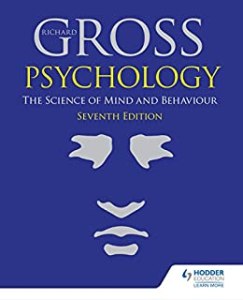
Psychology: The Science of Mind and Behaviour.

Author(s): Richard Gross.

Year: 2015.

Edition: Eighth (8th).

Publisher: Hodder Education, UK Edition.

Type(s): Paperback and Kindle.

Synopsis:

Provides the essential foundation for psychology students, this is a revised and updated version of the most trusted introduction written by the bestselling psychology author Richard Gross.

Psychology: The Science of Mind and Behaviour has helped over half a million students worldwide.

It is the essential introduction to psychology, covering all students need to know to understand and evaluate classic and contemporary topics.

  • Enables students to easily access psychological theories and research with colourful, user-friendly content and useful features including summaries, critical discussion and research updates.
  • Helps students to understand the research process with contributions from leading psychologists including Elizabeth Loftus, Alex Haslam and David Canter.
  • Ensures students are up to date with the latest issues and debates with this fully updated edition.

Book: The Manipulative Man: Identify His Behaviour, Counter the Abuse, Regain Control

Book Title:

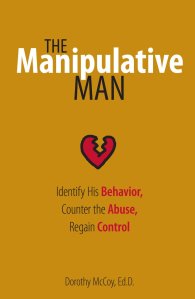
The Manipulative Man: Identify His Behaviour, Counter the Abuse, Regain Control.

Author(s): Dorothy McCoy.

Year: 2006.

Edition: First (1st).

Publisher: Adams Media.

Type(s): Paperback and Kindle.

Synopsis:

Conventional wisdom says that women are the manipulative ones – but tell that to the thousands of desperate women suffering at the hands of a manipulative man. Men can be just as sneaky, passive-aggressive, needy, underhanded, whiny, guilt-inducing, and emotionally demanding as women are accused of being – and more so!

As any woman in love with a manipulative man can tell you, it is not easy to get past his charm and your guilt to a place where you can see your relationship for what it is – out of balance, extraordinarily stressful, emotionally exhausting, and potentially dangerous. The Manipulative Man is a groundbreaking prescription for dealing with the manipulative men in your life by using:

  • Tests to help you determine if you are involved with a mama’s boy, narcissist, sociopath, or even a psychopath.
  • Techniques for defining and setting boundaries with your man;.
  • Tools to help you improve their relationship.
  • And more!

In The Manipulative Man, acclaimed psychotherapist Dr. Dorothy McCoy shows you how to identify the type of manipulative man you are involved with, deal with the issues his behaviour provokes, and, ultimately, salvage the relationship – or move on.

Can We Model Essential Connections in Obsessive-Compulsive Disorder Patients using Functional MRI?

Research Paper Title

Modeling essential connections in obsessive-compulsive disorder patients using functional MRI.

Background

Obsessive-compulsive disorder (OCD) is a mental disease in which people experience uncontrollable and repetitive thoughts or behaviours.

Clinical diagnosis of OCD is achieved by using neuropsychological assessment metrics, which are often subjectively affected by psychologists and patients.

In this study, the researchers propose a classification model for OCD diagnosis using functional MR images.

Methods

Using functional connectivity (FC) matrices calculated from brain region of interest (ROI) pairs, a novel Riemann Kernel principal component analysis (PCA) model is employed for feature extraction, which preserves the topological information in the FC matrices.

Hierarchical features are then fed into an ensemble classifier based on the XGBoost algorithm.

Finally, decisive features extracted during classification are used to investigate the brain FC variations between patients with OCD and healthy controls.

Results

The proposed algorithm yielded a classification accuracy of 91.8%.

Additionally, the well-known cortico-striatal-thalamic-cortical (CSTC) circuit and cerebellum were found as highly related regions with OCD.

To further analyse the cerebellar-related function in OCD, the researchers demarcated cerebellum into three sub-regions according to their anatomical and functional property.

Using these three functional cerebellum regions as seeds for brain connectivity computation, statistical results showed that patients with OCD have decreased posterior cerebellar connections.

Conclusions

This study provides a new and efficient method to characterise patients with OCD using resting-state functional MRI.

The researchers also provide a new perspective to analyse disease-related features.

Despite of CSTC circuit, their model-driven feature analysis reported cerebellum as an OCD-related region.

This paper may provide novel insight to the understanding of genetic aetiology of OCD.

Reference

Xing, X., Jin, L., Li, Q., Yang, Q., Han, H., Xu, C., Wei, Z., Zhan, Y., Zhou, X.S., Xue, Z., Chu, X., Peng, Z. & Shi, F. (2020) Modeling essential connections in obsessive-compulsive disorder patients using functional MRI. Brain and Behavior. 10(2):e01499. doi: 10.1002/brb3.1499. Epub 2020 Jan 1.

Are Pre-service Military-related & Mental Disorder Factors Associated with Leaving the UK Armed Forces?

Research Paper Title

Pre-service Military-related and Mental Disorder Factors Associated with Leaving the UK Armed Forces.

Background

The UK Armed Forces (UKAF) have a substantial manning deficit as more personnel leave than join.

This article identified pre-service, military, and mental health factors giving rise to leaving the UKAF and estimated the contributions to leaving of those factors which are potentially amenable to modification.

Methods

This study utilised data from a three-phase cohort study (2004-2006, 2007-2009 and 2014-2016), commencing while respondents were serving in the UKAF (n = 10,836; 6,046 (55.8%) had left service).

Associations between leaving the services and socio-demographics, military career and experiences, and mental health were determined using Cox regression.

Contribution to leaving was based on population attributable fractions (PAF) from Cox regression.

Analyses were stratified by rank due to the different career structures of Commissioned Officers and enlisted personnel.

Results

Leaving the UKAF was associated with joining when older, being a woman with a child/children, Army service, combat role, lower education level, and poor mental health.

Factors contributing a significant proportion of leaving among enlisted personnel were joining over the age of 17, history of externalising behaviour, being female, common mental disorders, and alcohol misuse.

Among Commissioned Officers only age at joining and sex contributed significant proportions to leaving.

Conclusions

The key factors for leaving are education and higher age at recruitment.

These are not amenable to intervention, for policy, equity, and legal reasons.

Heavy drinking and common mental disorder symptoms may be more amenable to modification and hence reduce rates of leaving the UKAF.

Women are more likely to leave due to childbearing.

Reference

Burdett, H., Stevelink, S.A.M., Jones, N., Hull, L., Wessely, S. & Rona, R. (2020) Pre-service Military-related and Mental Disorder Factors Associated with Leaving the UK Armed Forces. Psychiatry. 1-16. doi: 10.1080/00332747.2020.1729063. [Epub ahead of print].