Book: Overcoming Addiction

Book Title:

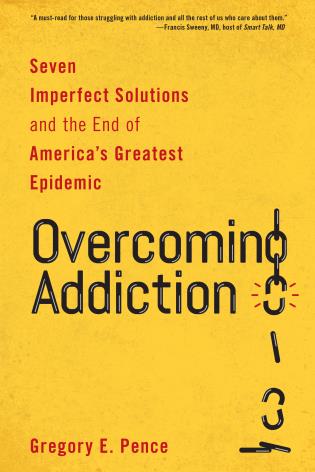
Overcoming Addiction: Seven Imperfect Solutions and the End of America’s Greatest Epidemic.

Author(s): Gregory E. Pence.

Year: 2020.

Edition: First (1ed).

Publisher: Rowman & Littlefield Publishers.

Type(s): Hardcover and Kindle.

Synopsis:

With an estimated 20 million people addicted to drugs or alcohol, North America is in the grip of an unrivalled epidemic. Overcoming Addiction reveals how seemingly contradictory treatment theories must come together to understand and end dangerous substance abuse.

Addiction treatment has become a billion-dollar industry based on innumerable clinical and psychological perspectives. Zealous clinicians and researchers have gathered around the theories, proclaiming each as the sole truth and excluding alternate views. In this book, leading bioethicist Gregory Pence demystifies seven foundational theories of addiction and addiction treatment. From Alcoholics and Narcotics Anonymous to methadone clinics and brain chemistry studies, each method holds foundation beliefs about human nature, free will, and biology. Understanding the diversity of these theories allows us to build a framework for more effective treatment for all addiction types.

For individuals suffering from addiction, their families, and those who devote their lives to ending addiction’s grasp on our society, this book offers a fresh perspective and a framework for long-term solutions.


Book: The Mindful Child

Book Title:

Mindful Child, The – How to Help Your Kid Manage Stress and Become Happier, Kinder, and More Compassionate.

Author(s): Susan Kaiser Greenland.

Year: 2010.

Edition: First (1ed).

Publisher: Atria Books.

Type(s):Paperback, audiobook and Kindle.

Synopsis:

The techniques of mindful awareness have helped millions of adults reduce stress in their lives. Now, children -who are under more pressure than ever before – can learn to protect themselves with these well-established methods adapted for their ages. Based on a programme affiliated with UCLA, The Mindful Child is a groundbreaking book, the first to show parents how to teach these transformative practices to their children.

Mindful awareness works by enabling you to pay closer attention to what is happening within you – your thoughts, feelings, and emotions – so you can better understand what is happening to you.

The Mindful Child extends the vast benefits of mindfulness training to children from four to eighteen years old with age-appropriate exercises, songs, games, and fables that Susan Kaiser Greenland has developed over more than a decade of teaching mindful awareness to kids.

These fun and friendly techniques build kids’ inner and outer awareness and attention, which positively affects their academic performance as well as their social and emotional skills, such as making friends, being compassionate and kind to others, and playing sports, while also providing tools to manage stress and to overcome specific challenges like insomnia, overeating, ADHD, hyper-perfectionism, anxiety, and chronic pain.

When children take a few moments before responding to stressful situations, they allow their own healthy inner compasses to click in and guide them to become more thoughtful, resilient, and empathetic.

The step-by-step process of mental training presented in The Mindful Child provides tools from which all children – and all families – will benefit.

Preparation for Life…

“How has your field of study changed in the time you have been working in it?

We understand a lot more about how many mental health problems originate in early life. Experience in pregnancy sends a kind of weather report to the fetus to give it indicators of how life might be and to begin the process of preparation for that life. That is extraordinary and there is still a huge amount to learn.”

Reference

Ramchandani, P. (2020) The Back Pages: Q&A. New Scientist. 11 January 2020, pp.56.

Is There a link between Separation Anxiety Trajectory in Early Childhood & Risk for Sleep Bruxism?

Research Paper Title

High separation anxiety trajectory in early childhood is a risk factor for sleep bruxism at age 7.

Background

The evolution of sleep bruxism manifestations and their co-occurrence with separation anxiety in early childhood remain unclear.

The researchers threefold aim was to:

  1. Describe developmental sleep bruxism trajectories in early childhood;
  2. Investigate co-occurrences between trajectories of sleep bruxism and separation anxiety; and
  3. Determine whether distinct trajectories of separation anxiety increase the risk of presenting sleep bruxism during the first year of elementary school.

Methods

This study is part of the Québec Longitudinal Study of Child Development.

Sleep bruxism scores were assessed from age 1.5 to 7 years with the Self-Administered Questionnaire for Mother (n=1,946).

Separation anxiety scores were measured from age 1.5 to 6 years with the Interviewer-Completed Computerised Questionnaire (n=2,045).

Results

The researchers identified:

  • Four sleep bruxism trajectories from age 1.5 to 6 years:
    • High-Increasing sleep bruxism at age 1.5 (14.1%);
    • High-Increasing sleep bruxism at age 4 (18.3%);
    • Low-Persistent sleep bruxism (12.1%); and
    • Never-Persistent sleep bruxism (55.5%).
  • Four separation anxiety trajectories from age 1.5 to 6 years:
    • Low-Persistent separation anxiety (60.2%);
    • High-Increasing separation anxiety (6.9%);
    • High-Decreasing separation anxiety (10.8%); and
    • Low-Increasing separation anxiety (22.1%).

Sleep bruxism and separation anxiety trajectories were weakly associated (X2=37.84, P<0.001).

Compared with preschoolers belonging to the Low-Persistent separation anxiety trajectory, preschoolers in the High-Increasing separation anxiety trajectory had almost double the risk of presenting sleep bruxism at age 7 (95% CI=1.25-3.22, P=.04).

Conclusions

When separation anxiety issues are detected in early childhood, it would be useful to target sleep bruxism during the first year of elementary school.

Reference

Rostami, E.G., Touchette, É., Huynh, N., Montplaisir, J., Tremblay, R.E., Battaglia, M. & Boivin, M. (2020) High separation anxiety trajectory in early childhood is a risk factor for sleep bruxism at age 7.

What is the Intergenerational Transmission of Risk for PTSD Symptoms & the Roles of Maternal and Child Emotion Dysregulation?

Research Paper Title

Intergenerational transmission of risk for PTSD symptoms in African American children: The roles of maternal and child emotion dysregulation.

Background

Emotion dysregulation is a transdiagnostic risk factor for many mental health disorders and develops in the context of early trauma exposure.

Research suggests inter-generational risk associated with trauma exposure and post-traumatic stress disorder (PTSD), such that maternal trauma experiences and related symptoms can negatively impact child outcomes across development.

The goals of the present study were to examine child and mother correlates of child PTSD symptoms and the unique roles of child and maternal emotion dysregulation in understanding child PTSD symptoms.

Methods

Subjects included 105 African American mother-child dyads from an urban hospital serving primarily low-income minority individuals.

Results

Correlational results showed that child trauma exposure, child emotion dysregulation, maternal depressive symptoms, maternal emotion dysregulation, and potential for maternal child abuse all were significantly associated with child PTSD symptoms (ps < 0.05).

Hierarchical linear regression models revealed that child trauma exposure, maternal depression, and maternal abuse potential accounted for 29% of the variance in child PTSD symptoms (p < 0.001).

Both child emotion dysregulation (Rchange² = 0.14, p < .001) and maternal emotion dysregulation (Rchange² = 0.04, p < .05) were significantly associated with child PTSD symptoms independent of other risk factors and potential for maternal abuse was no longer a significant predictor.

Conclusions

These results suggest that maternal emotion dysregulation may be an important factor in influencing their child’s PTSD symptoms above and beyond child-specific variables.

Both maternal and child emotion dysregulation could be valuable treatment targets for improving maternal mental health and parenting behaviours and bolstering child health outcomes, thus reducing inter-generational transmission of risk associated with trauma.

Reference

Powers, A., Stevens, J.S., O’Banion, D., Stenson, A.F., Kaslow, N., Jovanovic, T. & Bradley, B. (2020) Intergenerational transmission of risk for PTSD symptoms in African American children: The roles of maternal and child emotion dysregulation. Psychological Trauma: Theory, Research, Practice and Policy. doi: 10.1037/tra0000543. [Epub ahead of print].

Book: Parenting the New Teen in the Age of Anxiety

Book Title:

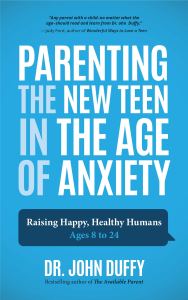
Parenting the New Teen in the Age of Anxiety: A Complete Guide to Your Child’s Stressed, Depressed, Expanded, Amazing Adolescence.

Author(s): Dr. John Duffy.

Year: 2019.

Edition: First.

Publisher: Mango.

Type(s): Paperback, Kindle, and Audiobook.

Synopsis:

Learn about the “New Teen” and how to adjust your parenting approach. Kids are growing up with nearly unlimited access to social media and the internet, and unprecedented academic, social, and familial stressors. Starting as early as eight years old, children are exposed to information, thought, and emotion that they are developmentally unprepared to process. As a result, saving the typical “teen parenting” strategies for thirteen-year-olds is now years too late.

Urgent advice for parents of teens. Dr. John Duffy’s parenting book is a new and necessary guide that addresses this hidden phenomenon of the changing teenage brain. Dr. Duffy, a nationally recognised expert in parenting for nearly twenty-five years, offers this book as a guide for parents raising children who are growing up quickly and dealing with unresolved adolescent issues that can lead to anxiety and depression.

Unprecedented psychological suffering among our young and why it is occurring. A shift has taken place in how and when children develop. Because of the exposure they face, kids are emotionally overwhelmed at a young age, often continuing to search for a sense of self well into their twenties. Paradoxically, Dr. Duffy recognises the good that comes with these challenges, such as the sense of justice instilled in teenagers starting at a young age.

Readers of this book will:

  • Sort through the overwhelming circumstances of today’s teens and better understand the changing landscape of adolescence.
  • Come away with a revised, conscious parenting plan more suited to addressing the current needs of the New Teen.
  • Discover the joy in parenting again by reclaiming the role of your teen’s ally, guide, and consultant.

Book: Child Psychology & Development for Dummies

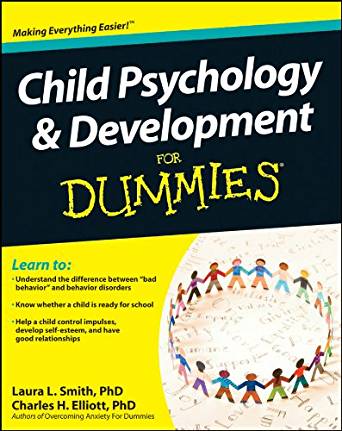
Book Title: Child Psychology & Development for Dummies

Author(s): Laura L. Smith, PhD and Charles H. Elliott, PhD.

Year: 2011.

Edition: First.

Publisher: Wiley Publishing, Inc.

Synopsis:

Grasp a child’s cognitive development, detect abnormalities, and learn what to do next.

An essential guide for parents, teachers, and caregivers, Child Psychology & Development For Dummies provides an informational guide to cognitive development at every stage of a child’s life, as well as expert tips and guidance on how to diagnose, treat, and overcome the cognitive barriers that impede learning and development.

  • The nuts and bolts – delve into the soup of kids’ development, including biology, psychology, learning, environment, and culture.
  • What makes kids tick? – discover how heredity, environment, experience, and culture interact to determine a child’s physical and emotional development.
  • Watch them grow – get an understanding of what a “normal” childhood should look like from conception through adolescence, and the types of behaviours to anticipate throughout.
  • Learn to spot trouble – find out what can go wrong during a child’s development, from physical problems like chronic illness to psychological problems like autism.
  • Ask for help – get expert guidance on the therapies and interventions that work, and how you can collaborate with professionals for an even better outcome.