On This Day … 24 November

People (Births)

  • 1932 – Claudio Naranjo, Chilean psychiatrist.
  • 1954 – Margaret Wetherell, English psychologist and academic.

Claudio Naranjo

Claudio Benjamín Naranjo Cohen (24 November 1932 to 12 July 2019) was a Chilean-born psychiatrist of Arabic/Moorish, Spanish and Jewish descent who is considered a pioneer in integrating psychotherapy and the spiritual traditions.

He was one of the three successors named by Fritz Perls (founder of Gestalt Therapy), a principal developer of Enneagram of Personality theories and a founder of the Seekers After Truth Institute.

He was also an elder statesman of the US and global human potential movement and the spiritual renaissance of the late 20th century.

He was the author of various books.

Margaret Wetherell

Margaret Wetherell (born 24 November 1954), is a prominent academic in the area of discourse analysis.

Her 1987 book, Discourse and Social Psychology: Beyond Attitudes and Behaviour, cowritten with Jonathan Potter, was very influential, particularly in social psychology, though also in other fields (e.g. Wood & Kroger, 2000).

While discourse analysis has many different meanings, Wetherell’s approach has been quite catholic in line with other anglophone discourse analysts like Gilbert & Mulkay (1984).

Wetherell is currently Professor of Social Psychology at the Open University in the United Kingdom, and in 2010/11 led a collaboration on identity funded by the UK Economic and Social Research Council (ESRC).

On This Day … 22 November

People (Births)

  • 1927 – Robert E. Valett, American psychologist, teacher, and author (d. 2008).

Robert Valett

Robert E. Valett (22 November 1927 to 14 November 2008) was an American psychology professor who wrote more than 20 books primarily focused on educational psychology.

He earned the distinguished psychologist award from the San Joaquin Psychological Association and was a president of the California Association of School Psychologists.

Early Life and Education

Robert Edward Valett was born in Clinton, Iowa on 22 November 1927. His father, Edward John Valett, worked for the railroad as a pipe fitter and his mother, Myrtle (née Peterson), was a saleswoman. Valett attended Clinton High School while also achieving the rank of Eagle Scout in the Boy Scouts of America. During World War Two, he served in the US Navy Medical Corps. He then did his undergraduate work at the University of Iowa and George Williams College. Valett went on to earn an MA from the University of Chicago (1951) and an (Ed.D.) in educational psychology from the University of California in Los Angeles.

Career

Valett was a professor of psychology at Orange Coast College in Costa Mesa, Ca., and the University of Canterbury in New Zealand and taught psychology from 1970 to 1992 at California State University, Fresno where he was named Professor Emeritus. He authored several books on learning disabilities, child development, dyslexia and attention disorders/hyperactivity. He received the distinguished psychologist award from the San Joaquin Psychological Association in 1982 and served as president of the California Association of School Psychologists from 1971 to 1972.

Personal Life

In 1950, Valett married Shirley Bellman with whom he had 5 children. He died on 14 November 2008, in Fresno, California.

On This Day … 20 November

People (Births)

  • 1916 – Charles E. Osgood, American psychologist (d. 1991).
  • 1920 – Douglas Dick, American actor and psychologist (d. 2015).

Charles Osgood

Charles Egerton Osgood (20 November 1916 to 15 September 1991) was an American psychologist and professor at the University of Illinois.

He was known for his research on behaviourism versus cognitivism, semantics (he introduced the term “semantic differential), cross-culturalism, psycholinguistic theory, and peace studies.

He is credited with helping in the early development of psycholinguistics.

Charles Osgood was recognised distinguished and highly honoured psychologist throughout his career.

Douglas Dick

Douglas Harvey Dick (20 November 1920 to 19 December 2015) was an American actor and occasional screenwriter.

His most famous role came in the 1948 film Rope.

In 1971, Dick left the entertainment industry to work as a psychologist.

Military Service

Dick did patrol duty with the United States Coast Guard and served as an aviator in the United States Navy, receiving a medical discharge from the latter.

Film

Dick’s film debut was in The Searching Wind (1946). Producer Hal B. Wallis met Dick in a Broadway agent’s office as Dick was waiting for an interview. Wallis had Dick make a screen test in New York City. The test, along with those of five other prospects, was shown to 300 women employees of Wallis’ studio. Dick was the clear favourite when the women were polled, and his role in The Searching Wind was the result. His best known film role is Kenneth Lawrence in the Alfred Hitchcock film classic Rope (1948). Among his other notable films are The Red Badge of Courage (1951) and Something to Live For (1952).

On This Day … 19 November

People (Births)

  • 1833 – Wilhelm Dilthey, German psychologist, sociologist, and historian (d. 1911).
  • 1937 – Penelope Leach, English psychologist and author.

Wilhelm Dilthey

Wilhelm Dilthey (19 November 1833 to 01 October 1911) was a German historian, psychologist, sociologist, and hermeneutic philosopher, who held G. W. F. Hegel’s Chair in Philosophy at the University of Berlin.

As a polymathic philosopher, working in a modern research university, Dilthey’s research interests revolved around questions of scientific methodology, historical evidence and history’s status as a science.

He could be considered an empiricist, in contrast to the idealism prevalent in Germany at the time, but his account of what constitutes the empirical and experiential differs from British empiricism and positivism in its central epistemological and ontological assumptions, which are drawn from German literary and philosophical traditions.

Psychology

Dilthey was interested in psychology. In his work Ideas Concerning a Descriptive and Analytic Psychology (Ideen über eine beschreibende und zergliedernde Psychologie, 1894), he introduced a distinction between explanatory psychology (erklärende Psychologie; also explanative psychology) and descriptive psychology (beschreibende Psychologie; also analytic psychology, zergliedernde Psychologie): in his terminology, explanatory psychology is the study of psychological phenomena from a third-person point of view, which involves their subordination to a system of causality, while descriptive psychology is a discipline that attempts to explicate how different mental processes converge in the “structural nexus of consciousness.”

The distinction is based on the more general distinction between explanatory/explanative sciences (erklärende Wissenschaften), on the one hand, and interpretive sciences (beschreibende Wissenschaften or verstehende Wissenschaften, that is, the sciences which are based on the Verstehen method), on the other.

In his later work (Der Aufbau der geschichtlichen Welt in den Geisteswissenschaften, 1910), he used the alternative term structural psychology (Strukturpsychologie) for descriptive psychology.

Penelope Leach

Penelope Jane Leach (née Balchin; born 19 November 1937), is a British psychologist who researches and writes extensively on parenting issues from a child development perspective.

Leach is best known for her book Your Baby and Child: From Birth to Age Five, published in 1977, which has sold over two million copies to date and won the BMA award for “best medical book for general audiences” in 1998. Leach notes in the introduction to that book: “Whatever you are doing, however you are coping, if you listen to your child and to your own feelings, there will be something you can actually do to put things right or make the best of those that are wrong.”

Early Life and Education

Born in Hampstead, London, she is the daughter of the novelists Nigel Balchin and Elizabeth Ayrton. She graduated from Newnham College, Cambridge, with honours in 1959. After Cambridge, she attended the London School of Economics, where she received her PhD in psychology (1964) and lectured on child development.

On This Day … 18 November

People (Births)

  • 1924 – Anna Elisabeth (Lise) Østergaard, Danish psychologist and politician (d. 1996).

Anna Østergaard

Anna Elisabeth “Lise” Østergaard (18 November 1924 to 19 March 1996) was a Danish psychologist and a politician in the social-democratic party. Under Anker Jørgensen’s leadership, she was Minister without Portfolio (1977-1980) and Minister of Culture (February 1980 to September 1982).

As a psychologist, she was head of psychology in Copenhagen’s Rigshospitalet (1958) as well as the first woman to become professor of clinical psychology at Copenhagen University (1963), a position she resumed after her political career ended in the mid-1980s.

Biography

Born on 18 November 1924 in Odense, Østergarrd was the daughter of Alfred Østergaard (1890-1962) and his wife Martha Kirstine Nielsen (1885-1944). She spent her first 12 years in Odense before moving with her parents to Gentofte. Although she encountered difficulties at school, she finally embarked on psychology studies at Copenhagen University. On leaving home against her father’s wishes, she paid her own way by working as a doctor’s secretary.

Psychology

After graduating in 1947, Østergaard worked as a psychologist in Norrtulls sjukhus, a children’s hospital in Stockholm. In 1949, she returned to Denmark, first spending a year in Dronning Louises Børnehospital (Queen Louise’s Children’s Hospital) before moving to the newly established children’s psychology clinic at Copenhagen University where she remained until 1954. She then entered the Rigshospitalet’s psychology department where she was appointed head psychologist in 1958, expanding her experience in clinical psychology. As a result, from 1955 to 1960 she headed a course in clinical psychology for the Dansk Psychologforening (Danish Psychologists Association) while teaching as the first woman psychologist at the university. She also took up assignments as a guest lecturer in Lund, Sweden, and Bergen, Norway.

Published in 1961, her Den psykologiske testmetode og dens relation til klinisk psykiatri (The Psychological Test Method and its Relationship to Clinical Psychiatry) raised considerable interest among psychiatrists. While working at Rigshospitalet, Østergaard treated a number of schizophrenic patients. In 1962, this led to her En psykologisk analyse af de formelle schizofrene tankeforstyrrelser (A Psychological Analysis of Formal Schizophrenic Thought Disorders), paving the way for research on the borderline between psychology and psychiatry in collaboration with the National Institute of Mental Health in the United States.

In 1963, Østergaard became the first female professor of psychology at Copenhagen University. After heading the Studenterrådgivningsklinikken (Student Advisory Clinic, 1964-1968), she established the Institut for Klinisk Psykologi (Clinical Psychology Institute) in 1968. From 1970 to 1973, she was a member of Denmark’s Unesco committee and from 1973 a member of Akademiet for de Tekniske Videnskaber (The Danish Academy of Technical Sciences).

Political Career

In the early 1970s, Østergaard became involved in the Danish Refugee Council, acting as spokesman from 1974 to 1977. She also increasingly became active in children’s affairs, becoming spokesman for the Danish Children’s Commission where she promoted the need for paternity leave. Her life underwent a significant change in 1977 when Anker Jørgensen offered her an appointment as Minister without Portfolio with special responsibilities for foreign affairs.

Although she had no political background, Østergaard was not afraid to criticize the West for fighting for its status as a ruling class rather than helping the poor. She drew considerable attention in 1980 when she opposed Denmark’s support for NATO’s decision to modernise Western Europe’s rocket defences. After gaining increasing popularity, she was elected to the Folketing with a considerable majority in 1979 as representative for Gladsaxe. In 1980, she was appointed Minister of Culture and Minister for Nordic Affairs until the socialist government was defeated in 1982. In 1980, she chaired the UN World Conference on Women in Copenhagen and in 1982 she was deputy chair of the Unesco World Cultural Conference in Mexico. She remained a member of parliament until 1984 but did not seek re-election.

Later Life

On leaving the Folketing, Østergaard returned to Copenhagen University, concentrating on the need for women to contribute to international development. She held her post as professor until 1994.

Lise Østergaard died on 19 March 1996 in Copenhagen and is buried in Holmens Cemetery. She shares a grave with Gunnar P. Rosendahl (1919-1996) whom she married in 1974.

On This Day … 17 November

People (Births)

  • 1896 – Lev Vygotsky, Belarusian-Russian psychologist and philosopher (d. 1934).

People (Deaths)

  • 2014 – Patrick Suppes, American psychologist and philosopher (b. 1922).

Lev Vygotsky

Lev Semyonovich Vygotsky (Russian: Лев Семёнович Выго́тский; Belarusian: Леў Сямёнавіч Выго́цкі; 17 November 17 (05 November (O.S.) 1896 to 11 June 1934) was a Soviet psychologist, known for his work on psychological development in children. He published on a diverse range of subjects, and from multiple views as his perspective changed over the years. Among his students was Alexander Luria.

He is known for his concept of the zone of proximal development (ZPD): the distance between what a student (apprentice, new employee, etc.) can do on their own, and what they can accomplish with the support of someone more knowledgeable about the activity. Vygotsky saw the ZPD as a measure of skills that are in the process of maturing, as supplement to measures of development that only look at a learner’s independent ability.

Also influential are his works on the relationship between language and thought, the development of language, and a general theory of development through actions and relationships in a socio-cultural environment.

Vygotsky is the subject of great scholarly dispute. There is a group of scholars who see parts of Vygotsky’s current legacy as distortions and who are going back to Vygotsky’s manuscripts in an attempt to make Vygotsky’s legacy more true to his actual ideas.

Patrick Suppes

Patrick Colonel Suppes (17 March 1922 to 17 November 2014) was an American philosopher who made significant contributions to philosophy of science, the theory of measurement, the foundations of quantum mechanics, decision theory, psychology and educational technology.

He was the Lucie Stern Professor of Philosophy Emeritus at Stanford University and until January 2010, and was the Director of the Education Program for Gifted Youth also at Stanford.

On This Day … 14 November

People (Births)

  • 1895 – Walter Jackson Freeman II, American physician and psychiatrist (d. 1972).

People (Deaths)

  • 2008 – Robert E. Valett, American psychologist, teacher, and author (b. 1927).

Walter Jackson Freeman II

Walter Jackson Freeman II (14 November 1895 to 31 May 1972) was an American physician who specialized in lobotomy.

Biography and Early Years

Walter J. Freeman was born on 14 November 1895, and raised in Philadelphia, Pennsylvania, by his parents. Freeman’s grandfather, William Williams Keen, was well known as a surgeon in the Civil War. His father was also a very successful doctor. Freeman attended Yale University beginning in 1912, and graduated in 1916. He then moved on to study neurology at the University of Pennsylvania Medical School. While attending medical school, he studied the work of William Spiller and idolized his groundbreaking work in the new field of the neurological sciences. Spiller also worked in Philadelphia and was credited by many in the world of psychology as being the founder of neurology. Freeman applied for a coveted position working alongside Spiller in his home town of Philadelphia, but was rejected.

Shortly afterward, in 1924, Freeman relocated to Washington, D.C., and started practicing as the first neurologist in the city. Upon his arrival in Washington, Freeman began work directing laboratories at St. Elizabeth’s Hospital. Working at the hospital and witnessing the pain and distress suffered by the patients encouraged him to continue his education in the field. Freeman earned his PhD in neuropathology within the following few years and secured a position at George Washington University in Washington, D.C., as head of the neurology department.

In 1932, his mother died at the Philadelphia Orthopaedic Hospital in Philadelphia, Pennsylvania.

Lobotomy

The first systematic attempt at human psychosurgery – performed in the 1880s-1890s – is commonly attributed to the Swiss psychiatrist Gottlieb Burckhardt. Burckhardt’s experimental surgical forays were largely condemned at the time and in the subsequent decades psychosurgery was attempted only intermittently. On 12 November 1935, a new psychosurgery procedure was performed in Portugal under the direction of the neurologist and physician Egas Moniz. His new “leucotomy” procedure, intended to treat mental illness, took small corings of the patient’s frontal lobes. Moniz became a mentor and idol for Freeman who modified the procedure and renamed it the “lobotomy”. Instead of taking coring’s from the frontal lobes, Freeman’s procedure severed the connection between the frontal lobes and the thalamus. Because Freeman lost his license to perform surgery himself after his last patient died on the operating table, he enlisted neurosurgeon James Watts as a research partner. One year after the first leucotomy, on 14 September 1936, Freeman directed Watts through the very first prefrontal lobotomy in the United States on housewife Alice Hood Hammatt of Topeka, Kansas. By November, only two months after performing their first lobotomy surgery, Freeman and Watts had already worked on 20 cases including several follow-up operations. By 1942, the duo had performed over 200 lobotomy procedures and had published results claiming 63% of patients had improved, 24% were reported to be unchanged and 14% were worse after surgery.

After almost ten years of performing lobotomies, Freeman heard of a doctor in Italy named Amarro Fiamberti who operated on the brain through his patients’ eye sockets, allowing him to access the brain without drilling through the skull. After experimenting with novel ways of performing these brain surgeries, Freeman formulated a new procedure called the transorbital lobotomy. This new procedure became known as the “icepick” lobotomy and was performed by inserting a metal pick into the corner of each eye-socket, hammering it through the thin bone there with a mallet, and moving it back and forth, severing the connections to the prefrontal cortex in the frontal lobes of the brain. He performed the transorbital lobotomy surgery for the first time in Washington, D.C., on a housewife named Sallie Ellen Ionesco. This transorbital lobotomy method did not require a neurosurgeon and could be performed outside of an operating room without the use of anaesthesia by using electroconvulsive therapy to induce seizure. The modifications to his lobotomy allowed Freeman to broaden the use of the surgery, which could be performed in psychiatric hospitals throughout the United States that were overpopulated and understaffed. In 1950, Walter Freeman’s long-time partner James Watts left their practice and split from Freeman due to his opposition to the cruelty and overuse of the transorbital lobotomy.

Following his development of the transorbital lobotomy, Freeman travelled across the country visiting mental institutions, performing lobotomies and spreading his views and methods to institution staff (Contrary to myth, there is no evidence that he referred to the van that he travelled in as a “lobotomobile”). Freeman’s name gained popularity despite the widespread criticism of his methods following a lobotomy on President John F. Kennedy’s sister Rosemary Kennedy, which left her with severe mental and physical disability. A memoir written by former patient Howard Dully, called My Lobotomy documented his experiences with Freeman and his long recovery after undergoing a lobotomy surgery at 12 years of age. Walter Freeman charged just $25 for each procedure that he performed. After four decades Freeman had personally performed possibly as many as 4,000 lobotomy surgeries in 23 states, of which 2,500 used his ice-pick procedure, despite the fact that he had no formal surgical training. In February 1967, Freeman performed his final surgery on Helen Mortensen. Mortensen was a long-term patient and was receiving her third lobotomy from Freeman. She died of a cerebral haemorrhage, as did as many as 100 of his other patients, and he was finally banned from performing surgery. His patients often had to be retaught how to eat and use the bathroom. Relapses were common, some never recovered, and about 15% died from the procedure. In 1951, one patient at Iowa’s Cherokee Mental Health Institute died when Freeman suddenly stopped for a photo during the procedure, and the surgical instrument accidentally penetrated too far into the patient’s brain. Freeman wore neither gloves nor mask during these procedures. He lobotomised nineteen minors, including a four-year-old child.

At fifty-seven years old, Freeman retired from his position at George Washington University and opened up a modest practice in California.

An extensive collection of Freeman’s papers were donated to The George Washington University in 1980. The collection largely deals with the work that Freeman and James W. Watts did on psychosurgery over the course of their medical careers. The collection is currently under the care of GWU’s Special Collections Research Centre, located in the Estelle and Melvin Gelman Library.

Freeman was known for his eccentricities and he complemented his theatrical approach to demonstrating surgery by sporting a cane, goatee, and a narrow-brimmed hat.

Death

Freeman died, of complications arising from an operation for cancer, on 31 May 1972.

He was survived by four children – Walter, Frank, Paul and Lorne – who became defenders of their father’s legacy. Paul became a psychiatrist in San Francisco and the eldest, Walter Jr., became a professor emeritus of neurobiology at University of California, Berkeley.

Contributions to Psychiatry

Walter Freeman nominated his mentor António Egas Moniz for a Nobel prize, and in 1949 Moniz won the Nobel prize in physiology and medicine. He pioneered and helped open up the psychiatric world to the idea of what would become psychosurgery. At the time, it was seen as a possible treatment for severe mental illness, but “within a few years, lobotomy was labelled one of the most barbaric mistakes of modern medicine.” He also helped to demonstrate the idea that mental events have a physiological basis. Despite his interest in the mind, Freeman was “uninterested in animal experiments or understanding what was happening in the brain”. Freeman was also co-founder and president of the American Board of Psychiatry and Neurology from 1946 to 1947 and a contributor and member of the American Psychiatric Association.

Publications

Freeman, W. & Watts, J.W. (1942) Psychosurgery: Intelligence, Emotion and Social Behaviour Following Prefrontal Lobotomy for Mental Disorders. Springfield, Illinois: Charles C. Thomas Publisher.

Robert E. Valett

Robert E. Valett (22 November 1927 to 14 November 2008) was an American psychology professor who wrote more than 20 books primarily focused on educational psychology. He earned the distinguished psychologist award from the San Joaquin Psychological Association and was a president of the California Association of School Psychologists.

Early Life and Education

Robert Edward Valett was born in Clinton, Iowa on 22 November 1927. His father, Edward John Valett, worked for the railroad as a pipe fitter and his mother, Myrtle (née Peterson), was a saleswoman. Valett attended Clinton High School while also achieving the rank of Eagle Scout in the Boy Scouts of America. During World War 2, he served in the US Navy Medical Corps. He then did his undergraduate work at the University of Iowa and George Williams College. Valett went on to earn an MA from the University of Chicago (1951 ) and an (Ed.D.) in educational psychology from the University of California in Los Angeles.

Career

Valett was a professor of psychology at Orange Coast College in Costa Mesa, Ca., and the University of Canterbury in New Zealand and taught psychology from 1970 to 1992 at California State University, Fresno where he was named Professor Emeritus. He authored several books on learning disabilities, child development, dyslexia and attention disorders/hyperactivity. He received the distinguished psychologist award from the San Joaquin Psychological Association in 1982 and served as president of the California Association of School Psychologists from 1971 to 1972.

Personal Life

In 1950, Valett married Shirley Bellman with whom he had 5 children. He died on 14 November 2008, in Fresno, California.

Publications

  • The Remediation of Learning Disabilities – Fearon Publishers 1967.
  • A Psychoeducational Inventory of Basic Learning Abilities – Fearon Publishers 1968.
  • Developmental Task Analysis – 1969.
  • Programming Learning Disabilities – Fearon 1969.
  • Modifying Children’s Behaviour: A Guide for Parents and Professionals – Fearon 1969.
  • Determining Individual Learning Objectives – Lear Siegler/Fearon 1972.
  • A Basic Screening and Referral Form for Children with Suspected Learning and Behavioural Disabilities – Fearon 1972.
  • Learning Disabilities: Diagnostic-Prescriptive Instruments – Lake Pub Co 1973.
  • Self-actualisation: A Guide to Happiness and Self-Determination – Argus Communications 1974.
  • The Psychoeducational Treatment of Hyperactive Children – Fearon 1974.
  • Affective-Humanistic Education; Goals, Programs & Learning Activities – L. Siegler/Fearon Publishers 1974.
  • Humanistic Education: Developing the Total Person – Mosby 1977.
  • Developing Cognitive Abilities: Teaching Children to Think – Mosby 1978.
  • The Dyslexia Screening Survey: A Checklist of Basic Neuropsychological Skills – Lake 1980.
  • Dyslexia, a Neuropsychological Approach to Educating Children With Severe Reading Disorders – Fearon Pitman, Costello Education 1980/
  • Valett Inventory of Critical Thinking Abilities (VICTA) – Wiley 1981.
  • How to Write an I.E. – with John Arena 1989.
  • The Valett Perceptual-Motor Transitions to Reading Programme – with Shirley Bellamn Valett, Academic Therapy Publications 1990.
  • Spiritual Guide to Holistic Health and Happiness – Authors Choice Press 1997.

On This Day .. 12 November

People (Births)

  • 1894 – Thorleif Schjelderup-Ebbe, Norwegian zoologist and comparative psychologist (d. 1976).

People (Deaths)

  • 2012 – Daniel Stern, American psychologist and theorist (b. 1934).

Thorleif Schjelderup-Ebbe

Thorleif Schjelderup-Ebbe (12 November 1894 to 08 June 1976) was a Norwegian zoologist and comparative psychologist.

Thorleif Schjelderup-Ebbe described the pecking order of hens in his PhD dissertation of 1921. The work in his dissertation was partly based on his observations of his own chickens that he had recorded since the age of 10.

The dominance hierarchy of chickens and other birds that he studied led him to the observation that these birds had established the order in which individuals would be allowed to get to food while others would have to wait for their turn.

Daniel Stern

Daniel N. Stern (16 August 1934 to 12 November 2012) was a prominent American psychiatrist and psychoanalytic theorist, specialising in infant development, on which he had written a number of books – most notably The Interpersonal World of the Infant (1985).

Stern’s 1985 and 1995 research and conceptualisation created a bridge between psychoanalysis and research-based developmental models.

Stern was born in New York City. He went to Harvard University as an undergraduate, from 1952 to 1956. He then attended Albert Einstein College of Medicine, completing his M.D. in 1960. In 1961, Stern was member of the Freedom Riders, a group of black and white activists challenging racial segregation in the south by travelling together on bus rides.

He continued his educational career doing research at the NIH in psychopharmacology from 1962-1964. In 1964, Stern decided to specialise in psychiatric care, completing his residency at Columbia University College of Physicians and Surgeons. In 1972 he started a psychoanalytic education at Columbia University Centre for Psychoanalytic Training and Research.

For more than 30 years, he worked in research and practice as well in developmental psychology and psychodynamic psychotherapy.

In his research, he dedicated his time to the observation of infants and to clinical reconstruction of early experiences. His efforts continue to contribute to currently existing developmental theories.

He was well known as an expert researcher of early affective mother-child bonding. Research and discoveries on the field of affective bonding was one of his leading activities.

Before his death, Stern was an honorary professor in Psychology at the University of Geneva, adjunct professor in the department of Psychiatry at the Cornell University Medical School and a lecturer at the Columbia University Centre for Psychoanalytic Training and Research.

He received Honorary Doctorates from the Universities of Copenhagen (2002), Dk; Palermo, It; Mons Hainaut, Be; Alborg, Dk; Padua, It, and Stockholm University.

He died, aged 78, in Geneva, Switzerland, following a heart failure. He actively contributed to the ongoing work of the Boston Process of Change Study Group only a few months prior.

Book: Cold War Freud

Book Title:

Cold War Freud – Psychoanalysis in an Age of Catastrophes.

Author(s): Dagmar Herzog.

Year: 2016.

Edition: First (1st).

Publisher: Cambridge University Press.

Type(s): Hardcover, Paperback, and Kindle.

Synopsis:

In Cold War Freud Dagmar Herzog uncovers the astonishing array of concepts of human selfhood which circulated across the globe in the aftermath of World War II.

Against the backdrop of Nazism and the Holocaust, the sexual revolution, feminism, gay rights, and anticolonial and antiwar activism, she charts the heated battles which raged over Freud’s legacy.

From the postwar US to Europe and Latin America, she reveals how competing theories of desire, anxiety, aggression, guilt, trauma and pleasure emerged and were then transformed to serve both conservative and subversive ends in a fundamental rethinking of the very nature of the human self and its motivations.

Her findings shed new light on psychoanalysis’ enduring contribution to the enigma of the relationship between nature and culture, and the ways in which social contexts enter into and shape the innermost recesses of individual psyches.

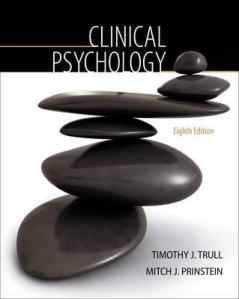
Book: Clinical Psychology

Book Title:

Clinical Pschology.

Author(s): Timothy J. Trull and Mitchell J. Prinstein.

Year: 2012.

Edition: Eighth (8th).

Publisher: Wadsworth Publishing Co Inc.

Type(s): Hardcover and Paperback.

Synopsis:

In language your students will understand and enjoy reading, Timothy Trull’s Clinical Psychology offers a concrete and well-rounded introduction to clinical psychology.

A highly respected clinician and researcher, Dr. Trull examines the rigorous research training that clinicians receive, along with the empirically supported assessment methods and interventions that clinical psychologists must understand to be successful in the field.

This new edition of Trull’s bestselling text covers cutting-edge trends, as well as offers enhanced coverage of culture, gender and diversity, and contemporary issues of health care.

Written to inspire students thinking of pursuing careers in the field of clinical psychology, this text is a complete introduction.