
Book: Approaches to Drug Abuse Counselling

Book Title:

Approaches to Drug Abuse Counselling.

Author(s): National Institute on Drug Abuse (NIDA).

Year: 2000.

Edition: First (1st).

Publisher: US Government Printing Office.

Type(s): eBook.

Synopsis:

Dual disorders recovery counselling (DDRC) is an integrated approach to treatment of patients with drug use disorders and comorbid psychiatric disorders.

The DDRC model, which integrates individual and group addiction counselling approaches with psychiatric interventions, attempts to balance the focus of treatment so that both the patient’s addiction and psychiatric issues are addressed.

The DDRC model is based on the assumption that there are several treatment phases that patients may go through.

You can access the book, for free, here.
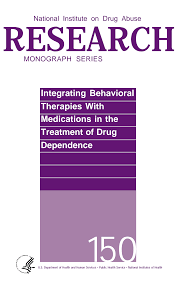
Book: Integrating Behavioural Therapies with Medications in the Treatment of Drug Dependence

Book Title:

Integrating Behavioural Therapies With Medications in the Treatment of Drug Dependence (National Institute on Drug Abuse Research Monograph Series).

Author(s): Lisa Simon Onken (PhD), Jack D. Blaine (MD), and John J. Boren (PhD.

Year: 1995.

Edition: First (1st).

Publisher: US Government Printing Office.

Type(s): eBook.

Synopsis:

It is no revelation that drug dependence is a complex problem with behavioural, cognitive, psychosocial, and biological dimensions and may be treated with behavioural therapy (including behaviour therapy, psychotherapy, and counselling), and, where available, pharmacotherapy.

Drug use can be reduced behaviourally with appropriate manipulation of reinforcements within the environment (Higgins et al. 1993). Continued improvements over time in drug use can be initiated by cognitive behavioural psychotherapies to modify cognitions that perpetuate drug use (Carroll et al., submitted for publication), and a reduced likelihood of
relapse has been engendered by specialised training approaches (Rohsenow et al., in press).

Methadone, of course, has long been recognised as an effective pharmacotherapy to reduce opiate use, and its biological mechanism of action is well understood.

You can access the book, for free, here.
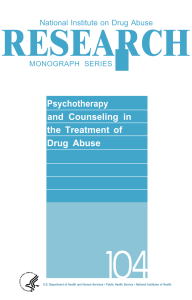
Book: Psychotherapy And Counselling In The Treatment Of Drug Abuse

Book Title:

Psychotherapy And Counselling In The Treatment Of Drug Abuse (National Institute on Drug Abuse Research Monograph Series).

Author(s): Lisa Simon Onken (PhD) and Jack D. Blaine (MD).

Year: 1990.

Edition: First (1st).

Publisher: US Government Printing Office.

Type(s): eBook.

Synopsis:

Drug abuse treatment occurs in a multitude of forms. It may be provided in outpatient or inpatient settings, be publicly or privately funded, and mayor may not involve the administration of medication. The differences among the philosophies of, and the services provided in, various drug abuse treatment programmes may be enormous. What is remarkable is that some form of drug abuse counselling or psychotherapy is almost invariably a part of every type of comprehensive drug abuse treatment. Individual therapy or counselling is available in about 99% of the drug-free, methadone-maintenance, and multiple-modality drug abuse treatment units in this country (National Drug and Alcoholism Treatment Unit Survey 1982). It is also available in approximately 97% of the detoxification units.

You can access the book, for free, here.
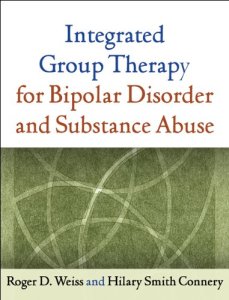
Book: Integrated Group Therapy for Bipolar Disorder and Substance Abuse

Book Title:

Integrated Group Therapy for Bipolar Disorder and Substance Abuse.

Author(s): Roger D. Weiss and Hilary S. Connery.

Year: 2011.

Edition: First (1st).

Publisher: Guildford Press.

Type(s): Paperback and Kindle.

Synopsis:

Packed with practical clinical tools, this book presents an empirically supported treatment expressly designed for clients with both bipolar disorder and substance use disorders. Integrated group therapy teaches essential recovery behaviours and relapse prevention skills that apply to both illnesses.

The volume provides a complete session-by-session overview of the approach, including clear guidelines for setting up and running groups, implementing the cognitive-behavioral treatment techniques, and troubleshooting frequently encountered problems.

In a large-size format for easy reference and photocopying, the book features more than 30 reproducible handouts, forms, and bulletin board materials.