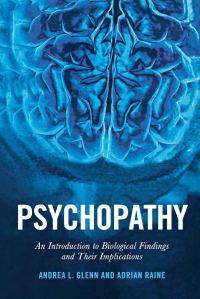
Book: Psychopathy: An Introduction to Biological Findings and Their Implications

Book Title:

Psychopathy: An Introduction to Biological Findings and Their Implications.

Author(s): Andrea L. Glenn and Adrian Raine.

Year: 2014.

Edition: First (1st).

Publisher: NYU Press.

Type(s): Hardcover, Paperback, and Kindle.

Synopsis:

The last two decades have seen tremendous growth in biological research on psychopathy, a mental disorder distinguished by traits including a lack of empathy or emotional response, egocentricity, impulsivity, and stimulation seeking. But how does a psychopath’s brain work? What makes a psychopath?

Psychopathy provides a concise, non-technical overview of the research in the areas of genetics, hormones, brain imaging, neuropsychology, environmental influences, and more, focusing on explaining what we currently know about the biological foundations for this disorder and offering insights into prediction, intervention, and prevention. It also offers a nuanced discussion of the ethical and legal implications associated with biological research on psychopathy. How much of this disorder is biologically based? Should offenders with psychopathic traits be punished for their crimes if we can show that biological factors contribute? The text clearly assesses the conclusions that can and cannot be drawn from existing biological research, and highlights the pressing considerations this research demands.
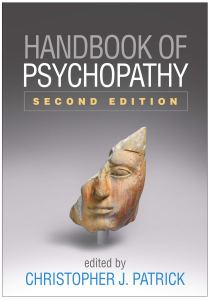
Book: Handbook of Psychopathy

Book Title:

Handbook of Psychopathy.

Author(s): Christopher J. Patrick (Editor).

Year: 2018.

Edition: Second (2nd).

Publisher: Guildford Press.

Type(s): Hardcover, Paperback, and Kindle.

Synopsis:

Widely considered the go-to reference – and now extensively revised with over 65% new material – this authoritative handbook surveys the landscape of current knowledge on psychopathy and addresses essential clinical and applied topics. Leading researchers explore major theoretical models; symptomatology and diagnostic subtypes; assessment methods; developmental pathways; and causal influences, from genes and neurobiology to environmental factors. The volume examines manifestations of psychopathy in specific populations as well as connections to antisocial behaviour and recidivism. It presents contemporary perspectives on prevention and treatment and discusses special considerations in clinical and forensic practice.

New to This Edition

  • Extensively revised with more than a decade’s theoretical, empirical, and clinical advances.
  • Many new authors and topics.
  • Expanded coverage of phenotypic facets, with chapters on behavioural disinhibition, callous–unemotional traits, and boldness.
  • Chapters on DSM-5, clinical interviewing, cognitive and emotional processing, and serial murder.
  • Significantly updated coverage of aetiology, assessment methods, neuroimaging research, and adult and juvenile treatment approaches.

Book: Psychopathy – A Very Short Introduction

Book Title:

Psychopathy – A Very Short Introduction.

Author(s): Essi Viding.

Year: 2019.

Edition: First (1st).

Publisher: OUP Oxford.

Type(s): Paperback, Audiobook, and Kindle.

Synopsis:

Psychopathy is a personality disorder that has long captured the public imagination. Newspaper column inches have been devoted to murderers with psychopathic features, and we also encounter psychopaths in films and books. Individuals with psychopathy are characterised in particular by lack of empathy and guilt, manipulation of other people and, in the case of criminal psychopathy, premeditated violent behaviour. They are dangerous and can incur immeasurable emotional, psychological, physical, and financial costs to their victims and their families. Despite the public fascination with psychopathy, there is often a very limited understanding of the condition, and several myths about psychopathy abound. For example, people commonly assume that all psychopaths are sadistic serial killers or that all violent and antisocial individuals are psychopaths. Yet, research shows that most psychopaths are not serial killers, and, equally, there are plenty of antisocial and violent offenders who are not psychopaths. This Very Short Introduction gives an overview of how we can identify individuals with or at risk of developing psychopathy, and how they differ from other people who display antisocial behaviour. Essi Viding also explores the latest genetic, neuroscience, and psychology evidence in order to illuminate why psychopaths behave and develop the way they do, and considers whether it is possible to prevent or even treat psychopathy.

Book: Psychology at Work

Book Title:

Psychology at Work.

Author(s): Peter Warr (Editor).

Year: 2002.

Edition: Fifth (5th), Revised Edition.

Publisher: Penguin.

Type(s): Paperback and Kindle.

Synopsis:

Applied psychology in work settings has made considerable progress in the 30 years since the original version of this book was published.

This new collection of essays aims to illustrate both the empirical and practical richness of the field as wellas its theoretical development.

The chapters cover psychological processes, the study of groups and workteams, and the nature of complex organisations as a whole.

Reflecting recent developments in psychology as well as society generally, topics range from skill and workload, shiftwork, personnel selection, training and careers, and the effects of new technology, leadership and management, to job stress and well-being, women in employment, corporate culture and processes of organisational change.

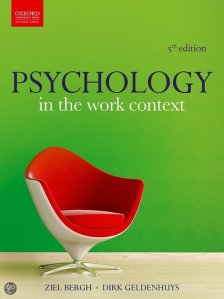
Book: Psychology in the Work Context

Book Title:

Psychology in the Work Context.

Author(s): Ziel Bergh and Dirk Geldenhuys.

Year: 2017.

Edition: Fifth (5th).

Publisher: Oxford University Press.

Type(s): Paperback.

Synopsis:

Psychology in the work context 5e is an introductory text for students of industrial and organizational psychology.

The book provides a comprehensive conceptual framework for understanding work behaviour and relationships at work and equips the student with a theoretical framework form which to analyse issues in the work place.

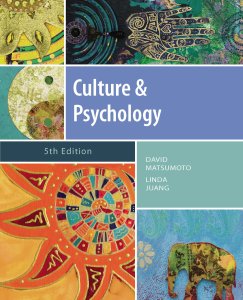
Book: Culture and Psychology

Book Title:

Culture and Psychology.

Author(s): David Matsumoto and Linda Juang.

Year: 2012.

Edition: Fifth (5th).

Publisher: Cengage Learning.

Type(s): Paperback and Kindle.

Synopsis:

This field-leading book puts psychological theories and concepts into a cross-cultural framework that invites readers to discover, question, and ultimately, understand the relationship between culture and psychology through exploration of topics like changing gender roles, sexuality, self-esteem, aggression, personality, and mate selection.

It all adds up to a book that will leave readers with a deeper, more complex understanding of the nature of culture, its relationship to psychological processes, and the differences and similarities between cultures in the increasingly globalized world.

Book: Health Psychology: A Textbook

Book Title:

Health Psychology: A Textbook.

Author(s): Jane Ogden.

Year: 2012.

Edition: Fifth (5th).

Publisher: Open University Press.

Type(s): Paperback and Kindle.

Synopsis:

Thoroughly revised to reflect recent research, theory and practice in health psychology, this market bestseller includes new coverage of topical issues such as behaviour change strategies, health inequalities, exercise dependence, caffeine use and men’s health.

Now organized into five sections, the book follows a health-illness continuum model, covering theory and research related to the context of health, health beliefs and behaviours, becoming ill and being ill, with the final section describing how students can learn to think more critically about all aspects of health psychology. The new edition also includes five new chapters:

  • Health inequalities: Depicts health variation by gender, social class and geography and describes possible explanations for this
  • Health promotion: Describes a wide range of theories and strategies used to change behaviour including CBT, motivational interviewing, relapse prevention, fear appeals and the use of technology
  • Health access: Examines patient contact with health professionals, with a focus on help seeking behaviour (and delay), screening, communication and adherence
  • Men’s health: Explores gender differences in life expectancy and causes of mortality, men’s health related behaviours, their health beliefs, social norms of masculinity and emotional expression
  • Being critical: Offers a detailed analysis of how to be more critical, with a focus on thinking about theory, constructs, methodology and measurement

Many brand new examples are introduced, covering: post traumatic stress symptoms, exercise and Chronic Fatigue Syndrome, post traumatic growth and benefit finding, measurement issues for adherence, eating, exercise, social support and coping, visualization and illness cognitions and the response shift.

Health Psychology, 5th edition is essential reading for all students and researchers of health psychology. It will also be invaluable to students of medicine, nursing and allied health.

Book: Foundations of Sport and Exercise Psychology

Book Title:

Foundations of Sport and Exercise Psychology.

Author(s): Robert Weinberg and Daniel Gould.

Year: 2018.

Edition: Seventh (7th).

Publisher: Human Kinetic, Inc.

Type(s): Hardcover, Paperback, and Kindle.

Synopsis:

Introductory textbook for sport and exercise psychology courses; ideal for students pursuing a career as a sport psychologist, coach, physical educator, fitness instructor, athletic trainer, physical therapist, or sports medicine professional.

Also a reference for libraries and sport psychologists.

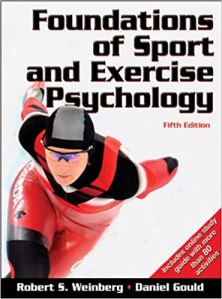
Book: Foundations of Sport and Exercise Psychology

Book Title:

Foundations of Sport and Exercise Psychology.

Author(s): Robert Weinberg and Daniel Gould.

Year: 2010.

Edition: Fifth (5th).

Publisher: Human Kinetics Publishers.

Type(s): Hardcover and Paperback.

Synopsis:

Weinberg and Gould are back! Nearly 200,000 sold across 5 editions worldwide, this is the sport psychology textbook. This bestseller provides a thorough introduction to the key concepts of sport and exercise psychology, taking students on a unique journey through the origins and goals, key concepts and career options available in this field. A new edition brings enhanced design, artwork and photos and written by internationally respected authors, it provides students with a comprehensive view of sport and exercise psychology, bridging the gap between research and practice. Capture the excitement of the world of sport and exercise psychology.

  • Chapter 1. Welcome to Sport and Exercise Psychology.
  • Chapter 2. Personality and Sport.
  • Chapter 3. Motivation.
  • Chapter 4. Arousal, Stress, and Anxiety.
  • Chapter 5. Competition and Cooperation.
  • Chapter 6. Feedback, Reinforcement, and Intrinsic Motivation.
  • Chapter 7. Group and Team Dynamics.
  • Chapter 8. Group Cohesion.
  • Chapter 9. Leadership.
  • Chapter 10. Communication.

Book: Research Methods and Statistics in Psychology

Book Title:

Research Methods and Statistics in Psychology.

Author(s): Hugh Coolican.

Year: 2009.

Edition: Fifth (5th).

Publisher: Routledge.

Type(s): Paperback.

Synopsis:

This fifth edition of Research Methods and Statistics in Psychology has been revised and updated, providing students with the most readable and comprehensive survey of research methods, statistical concepts and procedures in psychology today.

The book assumes no prior knowledge, taking you through every stage of your research project in manageable steps. Advice on planning and conducting studies, analysing data and writing up practical reports is given, and examples provided, as well as advice on how to report results in conventional (APA) style.

Unlike other introductory texts, there is discussion of commonly misunderstood concepts such as ecological validity, the null hypothesis and the role of cross-cultural psychology studies. Qualitative research is included in the central research methods chapters as well as being highlighted in specialist chapters which cover content analysis, grounded theory, interpretative phenomenological analysis (IPA), narrative analysis, discourse analysis and how to tackle a qualitative research project.

The book provides clear coverage of statistical procedures, and includes everything needed at undergraduate level from nominal level tests to multi-factorial ANOVA designs, multiple regression and log linear analysis. In addition, the book provides detailed and illustrated SPSS instructions (updated to version 16) for all statistical procedures, including data entry and interpreting output, thus eliminating the need for an extra SPSS textbook.

Each chapter contains a glossary, key terms and newly integrated exercises, ensuring that key concepts are understood. A companion website (www.routledge.com/cw/coolican) provides additional exercises, revision flash cards, links to further reading and data for use with SPSS.

The bestselling research methods text for almost two decades, Research Methods and Statistics in Psychology remains an invaluable resource for students of psychology throughout their studies.