Symptoms of Anxiety Disorders

Anxiety can arise suddenly, as in panic, or gradually over minutes, hours, or days.

Anxiety can last for any length of time, from a few seconds to years.

It ranges in intensity from barely noticeable qualms to a full-blown panic attack, which may cause shortness of breath, dizziness, an increased heart rate, and trembling (tremor).

Anxiety disorders can be so distressing and interfere so much with an individual’s life that they can lead to depression.

Individuals may develop a substance use disorder.

Individuals who have an anxiety disorder (except for certain very specific phobias, such as fear of spiders) are at least twice as likely to have depression as those without an anxiety disorder.

Sometimes individuals with depression develop an anxiety disorder.

Causes of Anxiety Disorders (Physical Disorder or Drug)

Anxiety can also be caused by a general medical disorder or the use or discontinuation (withdrawal) of a drug.

General medical disorders that can cause anxiety include the following:

  • Heart disorders, such as:
    • Heart failure; and
    • Abnormal heart rhythms (arrhythmias)
  • Hormonal (endocrine) disorders, such as:
    • An overactive adrenal gland (hyperadrenocorticism); or
    • Thyroid gland (hyperthyroidism); or
    • A hormone-secreting tumour called a pheochromocytoma.
  • Lung (respiratory) disorders, such as:
    • Asthma; and
    • Chronic obstructive pulmonary disease (COPD).

Even fever can cause anxiety.

Anxiety may occur in dying people as a result of fear of death, pain, and difficulty breathing.

Drugs that can trigger anxiety include the following:

  • Alcohol;
  • Stimulants (such as amphetamines);
  • Caffeine;
  • Cocaine;
  • Many prescription drugs, such as corticosteroids; and
  • Some over-the-counter weight-loss products, such as those containing:
    • The herbal product guarana;
    • Caffeine; or
    • Both.

Withdrawal from alcohol or sedatives, such as benzodiazepines (used to treat anxiety disorders), can cause anxiety and other symptoms, such as insomnia and restlessness.

Causes of Anxiety Disorders

The causes of anxiety disorders are not fully known, but the following may be involved:

  • Genetic factors (including a family history of an anxiety disorder);
  • Environment (such as experiencing a traumatic event or stress);
  • Psychologic makeup; and/or
  • A physical condition.

An anxiety disorder can be triggered by environmental stresses, such as the breakup of a significant relationship or exposure to a life-threatening disaster.

When an individual’s response to stresses is inappropriate or an individual is overwhelmed by events, an anxiety disorder can arise. For example, some individuals find speaking before a group exhilarating. But others dread it, becoming anxious with symptoms such as sweating, fear, a rapid heart rate, and tremor. Such individuals may avoid speaking even in a small group.

Anxiety tends to run in families. Doctors think some of this tendency may be inherited, but some is probably learned by living with anxious individuals.

Did You Know?

  • Anxiety disorders are the most common type of mental health disorder.
  • Individuals with an anxiety disorder are more likely than other individuals to have depression.

How Does Anxiety Affect Performance?

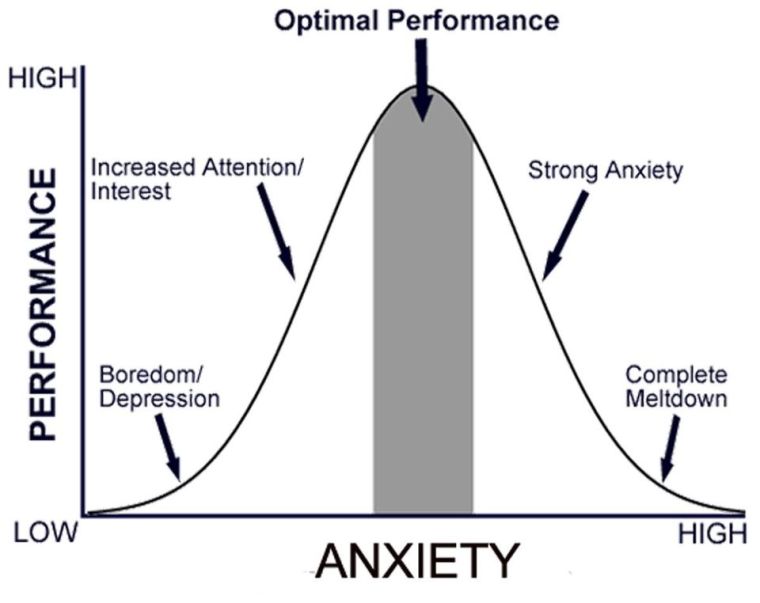
The effects of anxiety on performance can be shown on a curve.

As the level of anxiety increases, performance efficiency increases proportionately, but only up to a point.

As anxiety increases further, performance efficiency decreases.

Before the peak of the curve, anxiety is considered adaptive because it helps people prepare for a crisis and improve their functioning.

Beyond the peak of the curve, anxiety is considered maladaptive because it produces distress and impairs functioning.

The Yerkes-Dodson Law

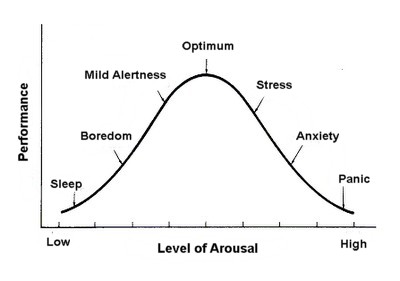
The Yerkes–Dodson law is an empirical relationship between arousal and performance, originally developed by psychologists Robert M. Yerkes and John Dillingham Dodson in 1908.

The law dictates that performance increases with physiological or mental arousal, but only up to a point.

Levels of Arousal (or Anxiety)

Research suggests that different tasks require different levels of arousal for optimal performance. For example:

  • Difficult or intellectually demanding tasks may require a lower level of arousal (to facilitate concentration); whereas
  • Tasks demanding stamina or persistence may be performed better with higher levels of arousal (to increase motivation).

Because of task differences, the shape of the curve can be highly variable (Diamond et al., 2007).

  • For simple or well-learned tasks, the relationship is monotonic, and performance improves as arousal increases.
  • For complex, unfamiliar, or difficult tasks, the relationship between arousal and performance reverses after a point, and performance thereafter declines as arousal increases.

What is the Relationship to Glucocorticoids?

A 2007 review of the effects of stress hormones (glucocorticoids, GC) and human cognition revealed that memory performance versus circulating levels of glucocorticoids does manifest an upside down U shaped curve and the authors noted the resemblance to the Yerkes-Dodson curve.

For example, long-term potentiation (LTP) (the process of forming long-term memories) is optimal when glucocorticoid levels are mildly elevated whereas significant decreases of LTP are observed after adrenalectomy (low GC state) or after exogenous glucocorticoid administration (high GC state).

This review also revealed that in order for a situation to induce a stress response, it has to be interpreted as one or more of the following:

  • Novel;
  • Unpredictable;
  • Not controllable by the individual; and/or
  • A social evaluative threat (negative social evaluation possibly leading to social rejection).

It has also been shown that elevated levels of glucocorticoids enhance memory for emotionally arousing events but lead more often than not to poor memory for material unrelated to the source of stress/emotional arousal (Lupien et al, 2007).

References

Diamond, D.M., Campbell, A.M., Park, C.P., Halonen, J. & Zoladz, P.R. (2007). The Temporal Dynamics Model of Emotional Memory Processing: A Synthesis on the Neurobiological Basis of Stress-Induced Amnesia, Flashbulb and Traumatic Memories, and the Yerkes–Dodson Law. Neural Plasticity. 2007: 60803. http://dx.doi.org/10.1155/2007/60803.

Lupien, S.J., Maheu, F., Tu, M., Fioco, A. & Schramek, T.E. (2007) The effects of stress and stress hormones on human cognition: Implications for the field of brain and cognition. Brain and Cognition. 65(3), pp.209-237. https://doi.org/10.1016/j.bandc.2007.02.007.

Yerkes, R.M. & Dodson, J.D. (1908) The Relation of Strength of Stimulus to Rapidity of Habit-Formation. Journal of Comparative Neurology and Psychology. 18, pp.459-482.


Identifying Mental Illness

Mental illness cannot always be clearly differentiated from normal behaviour.

For example, distinguishing normal bereavement from depression may be difficult in people who have had a significant loss, such as the death of a spouse or child, because both involve sadness and a depressed mood.

In the same manner, deciding whether a diagnosis of anxiety disorder applies to people who are worried and stressed about work can be challenging because most people experience these feelings at some time.

The line between having certain personality traits and having a personality disorder can be blurry.

Thus, mental illness and mental health are best thought of as being on a continuum.

Any dividing line is usually based on the following:

  • How severe the symptoms are;
  • How long symptoms last; and
  • How much symptoms affect the ability to function in daily life.

Resilience Training: Guided Self-reflection as an Alternative to Coping Skills in Military Officer Cadets

Research Paper Title

Strengthening resilience in military officer cadets: A group-randomized controlled trial of coping and emotion regulatory self-reflection training.

Background

This group-randomised control trial examined the efficacy of guided coping and emotion regulatory self-reflection as a means to strengthen resilience by testing the effects of the training on anxiety and depression symptoms and perceived stressor frequency after an intensive stressor period.

Methods

The sample was 226 officer cadets training at the Royal Military College, Australia. Cadets were randomised by platoon to the self-reflection (n = 130) or coping skills training (n = 96). Surveys occurred at 3 time points: baseline, immediately following the final reflective session (4-weeks post-baseline), and longer-term follow-up (3-months post-initial follow-up).

Results

There were no significant baseline differences in demographic or outcome variables between the intervention groups. On average, cadets commenced the resilience training with mild depression and anxiety symptoms. Analyses were conducted at the individual-level after exploring group-level effects.

No between-groups differences were observed at initial follow-up. At longer-term follow-up, improvements in mental health outcomes were observed for the self-reflection group, compared with the coping skills group, on depression (Cohen’s d = 0.55; 95% CI [0.24, 0.86]), anxiety symptoms (Cohen’s d = 0.69; 95% CI [0.37, 1.00]), and perceived stressor frequency (Cohen’s d = 0.46; 95% CI [0.15, 0.77]).

Longitudinal models demonstrated a time by condition interaction for depression and anxiety, but there was only an effect of condition for perceived stressor frequency. Mediation analyses supported an indirect effect of the intervention on both anxiety and depression via perceived stressor frequency.

Conclusions

Findings provide initial support for the use of guided self-reflection as an alternative to coping skills approaches to resilience training.

Reference

Crane, M.F., Boga, D., Karin, E., Gucciardi, D.F., Rapport, F., Callen, J. & Sinclair, L. (2019) Strengthening resilience in military officer cadets: A group-randomized controlled trial of coping and emotion regulatory self-reflection training. Journal of Consulting and Clinical Psychology. 87(2), pp.125-140. doi: 10.1037/ccp0000356. Epub 2018 Nov 29.

What are the Factors Associated with Anxiety Disorders among Patients with Substance Use Disorders

Research Paper Title

Factors associated with anxiety disorders among patients with substance use disorders in Lebanon: Results of a cross-sectional study.

Background

Estimate the rate of anxiety disorders (AD) and associated factors among patients with substance use disorder (SUD) in Lebanon.

Methods

A cross-sectional study, conducted between April and September 2017, enrolled 57 inpatients with SUD.

Results

The rate of AD in patients with SUD was 61.4%. The university level of education compared to the primary level of education (ORa = 0.221) was significantly associated with lower anxiety among patients with SUD. Being sexually abused and having a family history of depression tended to significance.

Conclusions

AD is widespread in Lebanon and high rates of anxiety in patients with SUD were found, warranting the implementation of strategic interventions and establishing national policies and legislation for mental health services to provide optimal care.

Reference

Haddad, C., Darwich, M.J., Obeid, S., Sacre, H., Zakhour, M., Kazour, F., Nabout, R., Hallit, S. & Tahan, F.E. (2019) Factors associated with anxiety disorders among patients with substance use disorders in Lebanon: Results of a cross-sectional study. Perspectives in Psychiatric Care. doi: 10.1111/ppc.12462. [Epub ahead of print].

Would a Clinical Staging Tool be useful in Clinical Practice to Predict Disease Course in Anxiety Disorders?

Research Paper Title

A clinical staging approach to improving diagnostics in anxiety disorders: Is it the way to go?

Background

Clinical staging is a paradigm in which stages of disease progression are identified; these, in turn, have prognostic value.

A staging model that enables the prediction of long-term course in anxiety disorders is currently unavailable but much needed as course trajectories are highly heterogenic.

This study therefore tailored a heuristic staging model to anxiety disorders and assessed its validity.

Methods

A clinical staging model was tailored to anxiety disorders, distinguishing nine stages of disease progression varying from subclinical stages (0, 1A, 1B) to clinical stages (2A-4B).

At-risk subjects and subjects with anxiety disorders (n = 2352) from the longitudinal Netherlands Study of Depression and Anxiety were assigned to these nine stages.

The model’s validity was assessed by comparing baseline (construct validity) and 2-year, 4-year and 6-year follow-up (predictive validity) differences in anxiety severity measures across stages.

Differences in depression severity and disability were assessed as secondary outcome measures.

Results

Results showed that the anxiety disorder staging model has construct and predictive validity.

At baseline, differences in anxiety severity, social avoidance behaviours, agoraphobic avoidance behaviours, worrying, depressive symptoms and levels of disability existed across all stages (all p-values < 0.001).

Over time, these differences between stages remained present until the 6-year follow-up.

Differences across stages followed a linear trend in all analyses: higher stages were characterised by the worst outcomes.

Regarding the stages, subjects with psychiatric comorbidity (stages 2B, 3B, 4B) showed a deteriorated course compared with those without comorbidity (stages 2A, 3A, 4A).

Conclusions

A clinical staging tool would be useful in clinical practice to predict disease course in anxiety disorders.

Reference

Bokma, W.A., Batelaan, N.M., Hoogendoorn, A.W., Penninx, B.W. & van Balkom, A.J. (2019) A clinical staging approach to improving diagnostics in anxiety disorders: Is it the way to go? The Australian & New Zealand Journal of Psychiatry. doi: 10.1177/0004867419887804. [Epub ahead of print].