Causes of Anxiety Disorders

The causes of anxiety disorders are not fully known, but the following may be involved:

  • Genetic factors (including a family history of an anxiety disorder);
  • Environment (such as experiencing a traumatic event or stress);
  • Psychologic makeup; and/or
  • A physical condition.

An anxiety disorder can be triggered by environmental stresses, such as the breakup of a significant relationship or exposure to a life-threatening disaster.

When an individual’s response to stresses is inappropriate or an individual is overwhelmed by events, an anxiety disorder can arise. For example, some individuals find speaking before a group exhilarating. But others dread it, becoming anxious with symptoms such as sweating, fear, a rapid heart rate, and tremor. Such individuals may avoid speaking even in a small group.

Anxiety tends to run in families. Doctors think some of this tendency may be inherited, but some is probably learned by living with anxious individuals.

Did You Know?

  • Anxiety disorders are the most common type of mental health disorder.
  • Individuals with an anxiety disorder are more likely than other individuals to have depression.

How Does Anxiety Affect Performance?

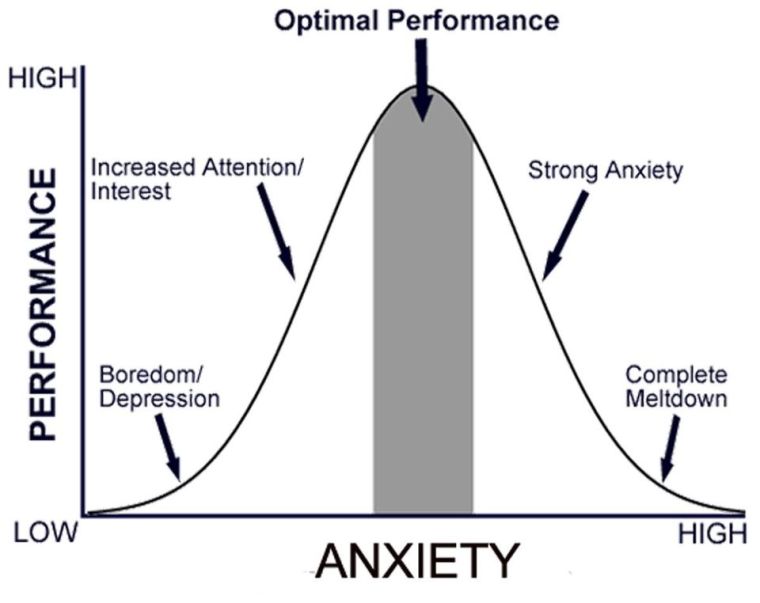
The effects of anxiety on performance can be shown on a curve.

As the level of anxiety increases, performance efficiency increases proportionately, but only up to a point.

As anxiety increases further, performance efficiency decreases.

Before the peak of the curve, anxiety is considered adaptive because it helps people prepare for a crisis and improve their functioning.

Beyond the peak of the curve, anxiety is considered maladaptive because it produces distress and impairs functioning.

The Yerkes-Dodson Law

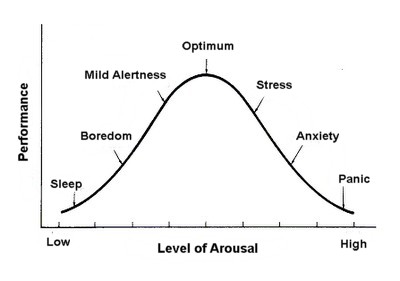
The Yerkes–Dodson law is an empirical relationship between arousal and performance, originally developed by psychologists Robert M. Yerkes and John Dillingham Dodson in 1908.

The law dictates that performance increases with physiological or mental arousal, but only up to a point.

Levels of Arousal (or Anxiety)

Research suggests that different tasks require different levels of arousal for optimal performance. For example:

  • Difficult or intellectually demanding tasks may require a lower level of arousal (to facilitate concentration); whereas
  • Tasks demanding stamina or persistence may be performed better with higher levels of arousal (to increase motivation).

Because of task differences, the shape of the curve can be highly variable (Diamond et al., 2007).

  • For simple or well-learned tasks, the relationship is monotonic, and performance improves as arousal increases.
  • For complex, unfamiliar, or difficult tasks, the relationship between arousal and performance reverses after a point, and performance thereafter declines as arousal increases.

What is the Relationship to Glucocorticoids?

A 2007 review of the effects of stress hormones (glucocorticoids, GC) and human cognition revealed that memory performance versus circulating levels of glucocorticoids does manifest an upside down U shaped curve and the authors noted the resemblance to the Yerkes-Dodson curve.

For example, long-term potentiation (LTP) (the process of forming long-term memories) is optimal when glucocorticoid levels are mildly elevated whereas significant decreases of LTP are observed after adrenalectomy (low GC state) or after exogenous glucocorticoid administration (high GC state).

This review also revealed that in order for a situation to induce a stress response, it has to be interpreted as one or more of the following:

  • Novel;
  • Unpredictable;
  • Not controllable by the individual; and/or
  • A social evaluative threat (negative social evaluation possibly leading to social rejection).

It has also been shown that elevated levels of glucocorticoids enhance memory for emotionally arousing events but lead more often than not to poor memory for material unrelated to the source of stress/emotional arousal (Lupien et al, 2007).

References

Diamond, D.M., Campbell, A.M., Park, C.P., Halonen, J. & Zoladz, P.R. (2007). The Temporal Dynamics Model of Emotional Memory Processing: A Synthesis on the Neurobiological Basis of Stress-Induced Amnesia, Flashbulb and Traumatic Memories, and the Yerkes–Dodson Law. Neural Plasticity. 2007: 60803. http://dx.doi.org/10.1155/2007/60803.

Lupien, S.J., Maheu, F., Tu, M., Fioco, A. & Schramek, T.E. (2007) The effects of stress and stress hormones on human cognition: Implications for the field of brain and cognition. Brain and Cognition. 65(3), pp.209-237. https://doi.org/10.1016/j.bandc.2007.02.007.

Yerkes, R.M. & Dodson, J.D. (1908) The Relation of Strength of Stimulus to Rapidity of Habit-Formation. Journal of Comparative Neurology and Psychology. 18, pp.459-482.

Resilience Training: Guided Self-reflection as an Alternative to Coping Skills in Military Officer Cadets

Research Paper Title

Strengthening resilience in military officer cadets: A group-randomized controlled trial of coping and emotion regulatory self-reflection training.

Background

This group-randomised control trial examined the efficacy of guided coping and emotion regulatory self-reflection as a means to strengthen resilience by testing the effects of the training on anxiety and depression symptoms and perceived stressor frequency after an intensive stressor period.

Methods

The sample was 226 officer cadets training at the Royal Military College, Australia. Cadets were randomised by platoon to the self-reflection (n = 130) or coping skills training (n = 96). Surveys occurred at 3 time points: baseline, immediately following the final reflective session (4-weeks post-baseline), and longer-term follow-up (3-months post-initial follow-up).

Results

There were no significant baseline differences in demographic or outcome variables between the intervention groups. On average, cadets commenced the resilience training with mild depression and anxiety symptoms. Analyses were conducted at the individual-level after exploring group-level effects.

No between-groups differences were observed at initial follow-up. At longer-term follow-up, improvements in mental health outcomes were observed for the self-reflection group, compared with the coping skills group, on depression (Cohen’s d = 0.55; 95% CI [0.24, 0.86]), anxiety symptoms (Cohen’s d = 0.69; 95% CI [0.37, 1.00]), and perceived stressor frequency (Cohen’s d = 0.46; 95% CI [0.15, 0.77]).

Longitudinal models demonstrated a time by condition interaction for depression and anxiety, but there was only an effect of condition for perceived stressor frequency. Mediation analyses supported an indirect effect of the intervention on both anxiety and depression via perceived stressor frequency.

Conclusions

Findings provide initial support for the use of guided self-reflection as an alternative to coping skills approaches to resilience training.

Reference

Crane, M.F., Boga, D., Karin, E., Gucciardi, D.F., Rapport, F., Callen, J. & Sinclair, L. (2019) Strengthening resilience in military officer cadets: A group-randomized controlled trial of coping and emotion regulatory self-reflection training. Journal of Consulting and Clinical Psychology. 87(2), pp.125-140. doi: 10.1037/ccp0000356. Epub 2018 Nov 29.

What are the Factors Associated with Anxiety Disorders among Patients with Substance Use Disorders

Research Paper Title

Factors associated with anxiety disorders among patients with substance use disorders in Lebanon: Results of a cross-sectional study.

Background

Estimate the rate of anxiety disorders (AD) and associated factors among patients with substance use disorder (SUD) in Lebanon.

Methods

A cross-sectional study, conducted between April and September 2017, enrolled 57 inpatients with SUD.

Results

The rate of AD in patients with SUD was 61.4%. The university level of education compared to the primary level of education (ORa = 0.221) was significantly associated with lower anxiety among patients with SUD. Being sexually abused and having a family history of depression tended to significance.

Conclusions

AD is widespread in Lebanon and high rates of anxiety in patients with SUD were found, warranting the implementation of strategic interventions and establishing national policies and legislation for mental health services to provide optimal care.

Reference

Haddad, C., Darwich, M.J., Obeid, S., Sacre, H., Zakhour, M., Kazour, F., Nabout, R., Hallit, S. & Tahan, F.E. (2019) Factors associated with anxiety disorders among patients with substance use disorders in Lebanon: Results of a cross-sectional study. Perspectives in Psychiatric Care. doi: 10.1111/ppc.12462. [Epub ahead of print].

Would a Clinical Staging Tool be useful in Clinical Practice to Predict Disease Course in Anxiety Disorders?

Research Paper Title

A clinical staging approach to improving diagnostics in anxiety disorders: Is it the way to go?

Background

Clinical staging is a paradigm in which stages of disease progression are identified; these, in turn, have prognostic value.

A staging model that enables the prediction of long-term course in anxiety disorders is currently unavailable but much needed as course trajectories are highly heterogenic.

This study therefore tailored a heuristic staging model to anxiety disorders and assessed its validity.

Methods

A clinical staging model was tailored to anxiety disorders, distinguishing nine stages of disease progression varying from subclinical stages (0, 1A, 1B) to clinical stages (2A-4B).

At-risk subjects and subjects with anxiety disorders (n = 2352) from the longitudinal Netherlands Study of Depression and Anxiety were assigned to these nine stages.

The model’s validity was assessed by comparing baseline (construct validity) and 2-year, 4-year and 6-year follow-up (predictive validity) differences in anxiety severity measures across stages.

Differences in depression severity and disability were assessed as secondary outcome measures.

Results

Results showed that the anxiety disorder staging model has construct and predictive validity.

At baseline, differences in anxiety severity, social avoidance behaviours, agoraphobic avoidance behaviours, worrying, depressive symptoms and levels of disability existed across all stages (all p-values < 0.001).

Over time, these differences between stages remained present until the 6-year follow-up.

Differences across stages followed a linear trend in all analyses: higher stages were characterised by the worst outcomes.

Regarding the stages, subjects with psychiatric comorbidity (stages 2B, 3B, 4B) showed a deteriorated course compared with those without comorbidity (stages 2A, 3A, 4A).

Conclusions

A clinical staging tool would be useful in clinical practice to predict disease course in anxiety disorders.

Reference

Bokma, W.A., Batelaan, N.M., Hoogendoorn, A.W., Penninx, B.W. & van Balkom, A.J. (2019) A clinical staging approach to improving diagnostics in anxiety disorders: Is it the way to go? The Australian & New Zealand Journal of Psychiatry. doi: 10.1177/0004867419887804. [Epub ahead of print].

Sickness: In the Mind or Gut?

“Remember the last time you had a stomach bug and just wanted to crawl into bed and pull up the covers?

That is called “sickness behaviour” and it is a kind of short-term depression.

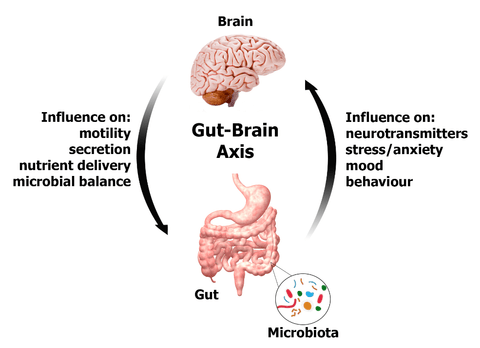
The bacteria infecting you aren’t just making you feel nauseous, they are controlling your mood too.

It sounds absurd: they are in your gut and your feelings are generated in your brain.

In fact, this is just an inkling of the power that microbes have over our emotions.

In recent years, such organisms in the gut have been implicated in a range of conditions that affect mood, especially depression and anxiety.

The good news is that bacteria don’t just make you feel low; the right ones can also improve your mood.

That has an intriguing implication: one day we may be able to manipulate the microbes living within our gut to change our mood and feelings.

It is early days, but the promise is astounding.

The World Health Organization rates depression and anxiety as the number one cause of disability, affecting at least 300 million people worldwide.

The new findings challenge the whole paradigm of mental illness being caused by a chemical imbalance in the brain, and offer an alternative to drug treatment.

You’ve probably heard of probiotics, but these are their new incarnation – psychobiotics. They could be about to change the mood of the planet.” (Anderson, 2019, p.34).

Reference

Anderson, S. (2019) The Pyschobiotic Revolution. New Scientist. 07 September 2019.

Comparing the Effectiveness of Prompt Mental Health Care to Treatment as Usual

Research Paper Title

Effectiveness of Prompt Mental Health Care, the Norwegian Version of Improving Access to Psychological Therapies: A Randomized Controlled Trial.

Background

The innovative treatment model Improving Access to Psychological Therapies (IAPT) and its Norwegian adaptation, Prompt Mental Health Care (PMHC), have been evaluated by cohort studies only. Albeit yielding promising results, the extent to which these are attributable to the treatment thus remains unsettled.

Therefore the objective of this research was to investigate the effectiveness of the PMHC treatment compared to treatment as usual (TAU) at 6-month follow-up.

Methods

A randomised controlled trial with parallel assignment was performed in two PMHC sites (Sandnes and Kristiansand) and enrolled clients between November 9, 2015 and August 31, 2017. Participants were 681 adults (aged ≥18 years) considered for admission to PMHC due to anxiety and/or mild to moderate depression (Patient Health Questionnaire [PHQ-9]/Generalised Anxiety Disorder scale [GAD-7] scores above cutoff). These were randomly assigned (70:30 ratio; n = 463 to PMHC, n = 218 to TAU) with simple randomisation within each site with no further constraints. The main outcomes were recovery rates and changes in symptoms of depression (PHQ-9) and anxiety (GAD-7) between baseline and follow-up. Primary outcome data were available for 73/67% in PMHC/TAU. Sensitivity analyses based on observed patterns of missingness were also conducted. Secondary outcomes were work participation, functional status, health-related quality of life, and mental well-being.

Results

A reliable recovery rate of 58.5% was observed in the PMHC group and of 31.9% in the TAU group, equalling a between-group effect size of 0.61 (95% CI 0.37 to 0.85, p < 0.001). The differences in degree of improvement between PMHC and TAU yielded an effect size of -0.88 (95% CI -1.23 to -0.43, p < 0.001) for PHQ-9 and -0.60 (95% CI -0.90 to -0.30, p < 0.001) for GAD-7 in favour of PMHC. All sensitivity analyses pointed in the same direction, with small variations in point estimates. Findings were slightly more robust for depressive than anxiety symptoms. PMHC was also more effective than TAU in improving all secondary outcomes, except for work participation (z = 0.415, p = 0.69).

Conclusions

The PMHC treatment was substantially more effective than TAU in alleviating the burden of anxiety and depression. This adaptation of IAPT is considered a viable supplement to existing health services to increase access to effective treatment for adults who suffer from anxiety and mild to moderate depression. A potential effect on work participation needs further examination.

Reference

Knapstad, M., Lervik, L.V., Sæther, S.M.M., Aarø, L.E. & Smith, O.R.F. (2019) Effectiveness of Prompt Mental Health Care, the Norwegian Version of Improving Access to Psychological Therapies: A Randomized Controlled Trial. Psychotherapy and Psychosomatics. 1-16. doi: 10.1159/000504453. [Epub ahead of print].

The Workplace & Common Mental Health Problems

1.0 Pre-2010

Common mental health problems are widespread and debilitating. Surveys carried out in Great Britain and internationally indicate that at any one time about one adult in six in the general population has a condition such as anxiety or depression. Incidence is higher among women and in people aged 45-54 years and there appears to be an upward trend in their rates over the last 15 years (Deverill & King, 2009). About three-quarters of adults with a common mental health problem are not in receipt of medication or counselling, including two thirds of those assessed as having a level of symptoms sufficient to warrant treatment (Deverill & King, 2009).

These levels of prevalence are mirrored among working age adults. At any one time nearly one worker in six will be experiencing depression, anxiety or problems related to stress. This increases to one in five when drug or alcohol dependence are included (Sainsbury Centre, 2007).

Although most of these mental health problems are unrelated to issues at work (HSE, 2007), there may be associations with workplace conditions such as long work hours, work overload, lack of control over work, lack of participation in decision making, poor social support and unclear management and work role, with some correlation with poor management style (Michie & Williams, 2003; Stansfeld, 2002; Berkels et al., 2004; Sanderson & Andrews, 2006). High demands and low support at work have been shown to be predictive of depressive symptoms worsening, independent of individual personality traits (Paterniti et al., 2002). Women are at risk of increased depression and anxiety if the management style at their workplace is not inclusive or considerate; and male employees are more at risk if they feel excluded from decision making (Kivimaki et al., 2003a; Ylippaavalniemi et al., 2005; Kivimaki et al., 2003b).

Against the backdrop of an economic recession and a labour market under pressure, people may increasingly be underemployed – that is involuntarily working part-time or for a wage at or below the poverty level because they have lost their former employment. Underemployment is an independent risk factor for worsening mental health and such suboptimal jobs may contribute to depression (Dooly et al., 2000; Friedland & Price, 2003).

The changing nature of work itself adds another layer of risk to mental health. For example atypical work, such as seasonal or casual work or fixed-term or subsidised jobs for people moving off benefits linked to unemployment support, is associated with significantly worse mental health (Sanderson & Andrews; 2006).

In summary, common mental health problems are the dominant health problem in the working age population (HWWB, 2009). Despite high rates of mental ill health, there are indications that almost half of employers think between none and one in twenty of their employees will ever experience a mental health problem during their working lives (Shaw Trust, 2006).

Low awareness among employers about the extent mental ill health, coupled with inadequate levels of treatment for those with these conditions and pervasive stigmatising public attitudes towards mental health problems (TNS Social, 2009), result in the perpetuation of a set of circumstances that are personally and financially costly to individuals, their families and their workplaces. An effective approach to the management of common mental health problems in the workplace could minimise or avert many of the related problems and costs associated with staff turnover, absenteeism and presenteeism (Sainsbury Centre, 2007; Sanderson & Andrews, 2006; Hilton, 2007).

2.0 Post-2010

Moving past 2010, the last decade has witnessed progress from employers regarding mental health. For example, many large employers now offer mental health-related services as part of their employee assistance programmes (EAP).

There are also many more opportunities outside of the workplace – such as charities and NHS services – that both employers and employees can turn to; many just need to be aware of them and be signposted.

Although there have been improvements, there is still much to be done.

3.0 References

Berkels, H., Henderson, J., Henke, N., Kuhn, K., Lavikainen, J., Lehtinen, V., Ozamiz, A., van den Heede, P. & Zenzinger, K. (2004) Mental Health Promotion and Prevention Strategies for Coping with Anxiety, Depression and Stress-Related Disorders in Europe. Final Report 2001-2003. Dortmund/Dresden/Berlin: WHO.

Deverill, C. & King, M. (2009) Common Mental Disorders. In: McManus, S., Meltzer, H., Brugha, T., Bebbington, P. & Jenkins, R. (eds) Adult Psychiatric Morbidity in England: Results of a household survey. The NHS Information Centre. (www.ic.nhs.uk/pubs/psychiatricmorbidity07).

Dooley, D., Prause, J. & Ham-Rowbottom, K.A. (2000) Underemployment and depression: longitudinal relationships. Journal of Health and Social Behaviour. 41, pp.421-436.

Friedland, D.S. & Price, R.H. (2003) Underemployment consequences for the health and wellbeing of workers. American Journal of Community Psychology. 32, pp.33-45.

Hilton, M. (2007) Getting upstream of psychological disability in the workforce – who are we not seeing and at what cost? Presentation available from: http://www.mrc.ac.uk/Utilities/Documentrecord/index.htm?d=MRC003869.

HSE (Health and Safety Executive). (2007) Self-Reported Work-Related Illness 2005/06. Available from World Wide Web: http://hse.gov.uk/statistics/tables/0506/swit1.htm. [Accessed: 20 November, 2019].

HWWB (Health, Work and Wellbeing). (2009) Working our Way to Better Mental Health: A framework for action. Available from World Wide Web: http://www.workingforhealth.gov.uk/Initiatives/Mental-health-and-employmentstrategy/Default.aspx. [Accessed: 20 November, 2019].

Kivimaki , M., Vahtera, E.J., Virtanen, M. & Stansfeld, S.A. (2003b) Association between organizational inequity and incidence of psychiatric disorders in female employees. Psychological Medicine. 33, pp.319-326.

Kivimaki, M., Elovainio, M., Vahtera, J. & Ferrie, J.E. (2003a) Organisational justice and health of employees: prospective cohort study. Occupational Environmental Medicine. 60, pp.27-34.

Michie, S. & Williams, S. (2003) Reducing workrelated psychological ill health and sickness
absence: a systematic literature review. Occupational and Environmental Medicine. 60, pp.3-9.

Paterniti, S., Niedhammer, I., Lang, T., & Consoli, S.M. (2002) Psychosocial factors at work, personality traits and depressive symptoms: Longitudinal results from the GAZEL study. British Journal of Psychiatry. 181(2), pp.111-117.

Sainsbury Centre. (2007) Mental Health at Work: Developing the Business Case. London: Sainsbury Centre for Mental Health.

Sanderson, K. & Andrews, G. (2006) Common mental disorders in the workforce: Recent findings from descriptive and social epidemiology. Canadian Journal of Psychiatry. 51(2), pp.63-75.

Shaw Trust (2006) The Last Workplace Taboo. Available from World Wide Web: http://www.tacklementalhealth.org.uk. [Accessed: 20 November, 2019].

Stansfeld, S. (2002) Work, personality and mental health. British Journal of Psychiatry. 181, pp.96-98.

TNS Social (2009) Attitudes to Mental Illness 2009. Research Report. JN189997. Available from World Wide Web: http://www.library.nhs.uk/mentalHealth/ViewResource.aspx?resID=319335. [Accessed: 20 November, 2019].

Ylippaavalniemi, J., Kivimaki, M., Elovainio, M., Virtanen, M., Keltikangas-Jarvinen, L. & Vahtera, J. (2005) Psychosocial work characteristics and incidence of newly diagnosed depression: a prospective cohort study of three different models. Social Science Medicine. 61, pp.111-112.

Why Mental Health First Aid?

There are many reasons for people to train in mental health first aid (MHFA).

Mental health problems are very common. As many as 1 in 4 people will experience mental health problems in any year. This means that most people know someone who has personal experience of mental health problems.

Currently, 1 in 20 people have depression. Around 80% of mental health problems are anxiety and depression. General practitioners (GP’s) are likely to diagnose 60% of mental health problems, and 90% of those will be treated by their GP’s. Almost 40% of absences from work are caused by mental health problems. Of all GP appointments, 70% will be patients with depression and anxiety.

Mental illness and distress has been a taboo subject in our society. This taboo is due to the stigma that surrounds mental health issues. In Western countries, people with mental health problems have been ridiculed or treated differently. For this reason, there is often a fear of speaking about such experiences.

Most people know very little about mental health. Good information and understanding about where to get effective help and treatment for mental health problems is invaluable when a crisis occurs, regardless of the setting. Receiving help or treatment early gives people the best possible chance of recovery.

Having people in the community who are comfortable talking about mental health issues, and who offer kindness, support and appropriate information, helps to reduce distress and promote recovery.

Many people are fearful of a diagnosis of a mental health problem, believing that receiving such a diagnosis will ruin their lives. This fear may cause people to hold back from asking for help when they most need it. Fears are kept alive by ignorance and a lack of understanding. Gaining more knowledge about mental health helps to ease fears and encourage recovery.

People from other countries and cultures who live and work in the United Kingdom (UK) may have very different ideas about mental health and find the National Health Service (NHS) and system confusing or difficult to access. For instance, Chinese medicine does not recognise the division between the mind and the body that is common in Western medicine. Therefore, a system that has separate care for mental and physical health may be difficult for a Chinese person to accept or feel confident using. Support that recognises and respects difference can help to bridge cultural differences and encourage understanding.

Professional help is not always immediately available. A ‘mental health first-aider’ can offer comfort and support in a crisis until help arrives.

In some instances, the person experiencing a mental health problem is not aware of the problem. Some illnesses cause the person’s thinking to be affected. In other cases, the person is so distressed that they do not know how to ask for help. Others may be aware that something is wrong, but may feel afraid of judgement or rejection. A mental health first-aider is trained to approach the person, offer assistance and to listen without judgement, enabling the person to say how they feel. The first-aider can then encourage the person to get appropriate help.

Knowing how to respond in a crisis is a key part of MHFA. It gives the first-aider confidence to know that they are offering effective help and not making things worse. MHFA is based on a five-step action plan that can be applied in any situation in which a person is experiencing mental health problems or distress.