
Is there a Link between Exercise Addiction & Eating Disorders?

Research Paper Title

A comparative meta-analysis of the prevalence of exercise addiction in adults with and without indicated eating disorders.

Background

Exercise addiction is associated with multiple adverse outcomes and can be classified as co-occurring with an eating disorder, or a primary condition with no indication of eating disorders.

The researchers conducted a meta-analysis exploring the prevalence of exercise addiction in adults with and without indicated eating disorders.

Methods

A systematic review of major databases and grey literature was undertaken from inception to 30/04/2019.

Studies reporting prevalence of exercise addiction with and without indicated eating disorders in adults were identified.

A random effect meta-analysis was undertaken, calculating odds ratios for exercise addiction with versus without indicated eating disorders.

Results

Nine studies with a total sample of 2140 participants (mean age = 25.06; 70.6% female) were included.

Within these, 1732 participants did not show indicated eating disorders (mean age = 26.4; 63.0% female) and 408 had indicated eating disorders (mean age = 23.46; 79.2% female).

The odds ratio for exercise addiction in populations with versus without indicated eating disorders was 3.71 (95% CI 2.00-6.89; I2 = 81; p  ≤ 0.001).

Exercise addiction prevalence in both populations differed according to the measurement instrument used.

Conclusions

Exercise addiction occurs more than three and a half times as often as a comorbidity to an eating disorder than in people without an indicated eating disorder.

The creation of a measurement tool able to identify exercise addiction risk in both populations would benefit researchers and practitioners by easily classifying samples.

Reference

Trott, M., Jackson, S.E., Firth, J., Jacob, L., Grabovac, I., Mistry, A., Stubbs, B. & Smith, L. (2020) A comparative meta-analysis of the prevalence of exercise addiction in adults with and without indicated eating disorders. Eating and Weight Disorders: EWD. doi: 10.1007/s40519-019-00842-1. [Epub ahead of print].

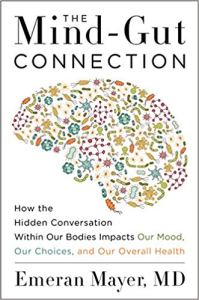
Book: The Mind-Gut Connection

Book Title:

The Mind-Gut Connection – How the Hidden Conversation Within Our Bodies Impacts Our Mood, Our Choices, and Our Overall Health.

Author(s): Emeran Mayer (MD).

Year: 2016.

Edition: First.

Publisher: HarperWave.

Type(s): Hardcover and Kindle.

Synopsis:

Combining cutting-edge neuroscience with the latest discoveries on the human microbiome, a practical guide in the tradition of The Second Brain, and The Good Gut that conclusively demonstrates the inextricable, biological link between mind and the digestive system.

We have all experienced the connection between our mind and our gut – the decision we made because it “felt right”; the butterflies in our stomach before a big meeting; the anxious stomach rumbling we get when we are stressed out.

While the dialogue between the gut and the brain has been recognised by ancient healing traditions, including Ayurvedic and Chinese medicine, Western medicine has by and large failed to appreciate the complexity of how the brain, gut, and more recently, the gut microbiota – the microorganisms that live inside our digestive tract – communicate with one another.

In The Mind-Gut Connection, Dr. Emeran Mayer, professor of medicine and executive director of the UCLA Centre for Neurobiology of Stress, offers a revolutionary and provocative look at this developing science, teaching us how to harness the power of the mind-gut connection to take charge of our health and listen to the innate wisdom of our bodies.

Fitness Trackers & Apps: Be Careful When Monitoring Your Goals

Fitness trackers and apps can give us guidance on everything we do, from how well we are eating to sleeping, and therefore can be a useful aid to help us to meet our health and fitness goals.

However, new research highlights the importance of using such fitness trackers and apps wisely.

A small-scale study by researchers at Loughborough University suggests that these trackers and apps could be linked to obsessive behaviour regarding food and exercise – a term known as ‘disordered eating’.

In the study, individuals who tracked their activity or food intake (primarily to manage their weight or shape) showed the highest levels of disordered eating and exercise.