Workplace Injury: Musculoskeletal Conditions & Mental Illness

Research Paper Title

Prevalence of serious mental illness and mental health service use after a workplace injury: a longitudinal study of workers’ compensation claimants in Victoria, Australia.

Background

Serious mental illness is common among those who have experienced a physical workplace injury, yet little is known about mental health service use in this population.

This study aims to estimate the proportion of the workplace musculoskeletal injury population experiencing a mental illness, the proportion who access mental health services through the workers’ compensation system and the factors associated with likelihood of accessing services.

Methods

A longitudinal cohort study was conducted with a random sample of 615 workers’ compensation claimants followed over three survey waves between June 2014 and July 2015.

The primary outcome was receiving any type of mental health service use during this period, as determined by linking survey responses to administrative compensation system records for the 18 months after initial interview.

Results

Of 181 (29.4%) participants who met the case definition for a serious mental illness at one or more of the three interviews, 75 (41.4%) accessed a mental health service during the 18-month observation period.

Older age (OR=0.96, 95% CI 0.93 to 0.99) and achieving sustained return to work (OR=0.27, 95% CI 0.11 to 0.69) were associated with reduced odds of mental health service use.

Although not significant, being born in Australia was associated with an increased odds of service use (OR=2.23, 95% CI 0.97 to 5.10).

Conclusions

The proportion of injured workers with musculoskeletal conditions experiencing mental illness is high, yet the proportion receiving mental health services is low.

More work is needed to explore factors associated with mental health service use in this population, including the effect of returning to work.

Reference

Orchard, C., Carnide, N., Mustard, C. & Smith, P.M. (2020) Prevalence of serious mental illness and mental health service use after a workplace injury: a longitudinal study of workers’ compensation claimants in Victoria, Australia. Occupational and Environmental Medicine. pii: oemed-2019-105995. doi: 10.1136/oemed-2019-105995. [Epub ahead of print].

Strategies used by Families to Cope with Chronic Mental Illnesses

Research Paper Title

Strategies used by families to cope with chronic mental illnesses: Psychometric properties of the family crisis oriented personal evaluation scale.

Background

This study was aimed at investigating the psychometric properties of the Family Crisis Oriented Personal Evaluation Scale (F-COPES) for Turkish society, which assesses the coping skills of caregivers of individuals with chronic mental illnesses.

Methods

The study was conducted with 153 family caregivers of patients with a chronic mental illness admitted to the inpatient and outpatient units of two university hospitals and İzmir Schizophrenia Solidarity Association.

For the language validity, the translation-back translation method was performed, for the content validity, expert opinions were obtained, for the construct validity, exploratory and confirmatory factor analysis was performed.

For the reliability analysis, Cronbach α reliability coefficient was calculated and the test-retest reliability analysis was performed.

Results

The content validity index of the scale was 0.96.

The Cronbach’s α reliability coefficient for the overall scale was .80. Factor loadings of the subscales ranged between 0.56 and 0.69 for the Acquiring Social Support subscale, between 0.43 and 0.74 for the Reframing subscale, between 0.53 and 0.74 for the Seeking Spiritual Support subscale.

The model fit indexes were as follows: χ2  = 176.369, df = 116, χ2 /df = 1.52, RMSEA = 0.059, CFI = 0.90, IFI = 0.91, GFI = 0.88.

Conclusions

The results of the present study show that the levels of psychometric properties of F-COPES in Turkish society are acceptable.

It is thought that it would be useful to use the F-COPES in the assessment of coping behaviours of individuals who give care to patients with a chronic mental illness and that it can be used as measurement tool in studies to be conducted with caregivers of patients with a chronic mental illness to assess their coping skills.

Reference

Sari, A. & Çetinkaya Duman, Z. (2019) Strategies used by families to cope with chronic mental illnesses: Psychometric properties of the family crisis oriented personal evaluation scale. Perspectives in Psychiatric Care. doi: 10.1111/ppc.12457. [Epub ahead of print].

Providing a Starting Point for Discussions, Dialogue, and Further Study Regarding Mental Health Research for Indigenous Peoples around the World

Research Paper Title

The mental health of Indigenous peoples in Canada: A critical review of research.

Background

Many scholars assert that Indigenous peoples across the globe suffer a disproportionate burden of mental illness.

Research indicates that colonialism and its associated processes are important determinants of Indigenous peoples’ health internationally.

In Canada, despite an abundance of health research documenting inequalities in morbidity and mortality rates for Indigenous peoples, relatively little research has focused on mental health.

This paper provides a critical scoping review of the literature related to Indigenous mental health in Canada.

Methods

searched eleven databases and two Indigenous health-focused journals for research related to mental health, Indigenous peoples, and Canada, for the years 2006-2016.

Over two hundred papers are included in the review and coded according to research theme, population group, and geography.

Results

Results demonstrate that the literature is overwhelmingly concerned with issues related to colonialism in mental health services and the prevalence and causes of mental illness among Indigenous peoples in Canada, but with several significant gaps.

Mental health research related to Indigenous peoples in Canada overemphasises suicide and problematic substance use; a more critical use of the concepts of colonialism and historical trauma is advised; and several population groups are underrepresented in research, including Métis peoples and urban or off-reserve Indigenous peoples.

Conclusions

The findings are useful in an international context by providing a starting point for discussions, dialogue, and further study regarding mental health research for Indigenous peoples around the world.

Reference

Nelson, S.E. & Wilson, K. (2017) The mental health of Indigenous peoples in Canada: A critical review of research. Social Science & Medicine (1982). 176, pp.93-112. doi: 10.1016/j.socscimed.2017.01.021. Epub 2017 Jan 18.

What is the Evidence for the Use of Nutrient Supplements in the Treatment of Mental Disorders?

Research Paper Title

The efficacy and safety of nutrient supplements in the treatment of mental disorders: a meta-review of meta-analyses of randomized controlled trials.

Background

The role of nutrition in mental health is becoming increasingly acknowledged. Along with dietary intake, nutrition can also be obtained from “nutrient supplements”, such as polyunsaturated fatty acids (PUFAs), vitamins, minerals, antioxidants, amino acids and pre/probiotic supplements.

Recently, a large number of meta-analyses have emerged examining nutrient supplements in the treatment of mental disorders.

Methods

To produce a meta-review of this top-tier evidence, the researchers identified, synthesised and appraised all meta-analyses of randomised controlled trials (RCTs) reporting on the efficacy and safety of nutrient supplements in common and severe mental disorders.

Results

Their systematic search identified 33 meta-analyses of placebo-controlled RCTs, with primary analyses including outcome data from 10,951 individuals. The strongest evidence was found for PUFAs (particularly as eicosapentaenoic acid) as an adjunctive treatment for depression.

More nascent evidence suggested that PUFAs may also be beneficial for attention-deficit/hyperactivity disorder, whereas there was no evidence for schizophrenia.

Folate-based supplements were widely researched as adjunctive treatments for depression and schizophrenia, with positive effects from RCTs of high dose methylfolate in major depressive disorder.

There was emergent evidence for N-acetylcysteine as a useful adjunctive treatment in mood disorders and schizophrenia.

All nutrient supplements had good safety profiles, with no evidence of serious adverse effects or contraindications with psychiatric medications.

Conclusions

In conclusion, clinicians should be informed of the nutrient supplements with established efficacy for certain conditions (such as eicosapentaenoic acid in depression), but also made aware of those currently lacking evidentiary support.

Future research should aim to determine which individuals may benefit most from evidence-based supplements, to further elucidate the underlying mechanisms.

Reference

Firth, J., Teasdale, S.B., Allott, K., Siskind, D., Marz, W., Cotter, J., Veronese, N., Schuch, F., Smith, L., Solmi, M., Carvalho, A.F., Vancampfort, D., Berk, M., Stubbs, B> & Sarris, J. (2019) The efficacy and safety of nutrient supplements in the treatment of mental disorders: a meta-review of meta-analyses of randomized controlled trials. World Psychiatry. 18, pp.308-324.

When Does a Mental Health Condition Become a Disability?

1.0 Introduction

A mental health condition is considered a disability if it has a long-term effect on your normal day to-day activity, and this is defined under the Equality Act 2010.

The condition is ‘long term’ if it lasts, or is likely to last, 12 months.

‘Normal day-to-day activity’ is defined as something the individual does regularly in a normal day. This includes things like using a computer, working set times or interacting with people.

Currently, the law considers the effects of an impairment on the individual. For example, someone with a mild form of depression with minor effects may not be covered. However, someone with severe depression with significant effects on their daily life is likely to be considered as having a disability.

2.0 Where Does the Equality Act 2010 Apply?

The Equality Act 2010 applies in England, Wales, and Scotland.

It does not apply in Northern Ireland, where individuals are protected by the Disability Discrimination Act 1995.

3.0 Definition of Disability under the Equality Act 2010

An individual is classed as disabled under the Equality Act 2010 if they have a physical or mental impairment that has a ‘substantial’ and ‘long-term’ negative effect on their ability to do normal daily activities.

In order to be protected by the Act, a person must have an impairment that meets the Act’s definition of disability, or be able to establish that any less favourable treatment or harassment is because of another person’s disability or because of a perceived disability.

4.0 Factors to Consider in Determining Disability

Factors to consider include:

  • The individual must have an impairment that is either physical or mental;
  • The impairment must have adverse effects which are substantial;
  • The substantial adverse effects must be long-term; and
  • The long-term substantial adverse effects must be effects on normal day-to-day activities.

4.1 What Does Substantial and Long-term Mean?

  • ‘Substantial’ is more than minor or trivial, for example, it takes much longer than it usually would to complete a daily task like getting dressed.
  • ‘Long-term’ means 12 months or more, for example, a breathing condition that develops as a result of a lung infection.

4.2 What is an Impairment?

With regards to disability, an impairment refers to an individual’s ability to carry out normal day-to-day activities and, importantly, the effect that an impairment has on this ability.

A disability can arise from a wide range of impairments which can be:

  • Sensory impairments, such as those affecting sight or hearing.
  • Impairments with fluctuating or recurring effects such as rheumatoid arthritis, myalgic encephalitis (ME), chronic fatigue syndrome (CFS), fibromyalgia, depression and epilepsy.
  • Progressive, such as motor neurone disease, muscular dystrophy, and forms of dementia;
  • Auto-immune conditions such as systemic lupus erythematosis (SLE).
  • Organ specific, including respiratory conditions, such as asthma, and cardiovascular diseases, including thrombosis, stroke and heart disease.
  • Developmental, such as autistic spectrum disorders (ASD), dyslexia and dyspraxia;
  • Learning disabilities.
  • Mental health conditions:
    • With symptoms such as anxiety, low mood, panic attacks, phobias, or unshared perceptions;
    • Eating disorders;
    • Bipolar affective disorders;
    • Obsessive compulsive disorders (OCD);
    • Personality disorders;
    • Post-traumatic stress disorder (PTSD); and
    • Some self-harming behaviour.
  • Mental illnesses, such as depression and schizophrenia.
  • Produced by injury to the body, including to the brain.

What it is important to consider is the effect of an impairment, not its cause – provided that it is not an excluded condition. For example, addiction to, or dependency on, alcohol, nicotine, or any other substance (other than in consequence of the substance being medically prescribed) are specifically excluded from the Equality Act 2010 – although any accompanying impairments maybe protected.

5.0 What about Recurring or Fluctuating Conditions?

There are special rules about recurring or fluctuating conditions (ODI, 2011, p.29), for example “…mental health conditions such as schizophrenia, bipolar affective disorder, and certain types of depression, though this is not an exhaustive list.”

Some impairments with recurring or fluctuating effects may be less obvious in their impact on the individual concerned than is the case with other impairments where the effects are more constant.

6.0 What about Progressive Conditions?

A progressive condition is one that gets worse over time, and individuals with progressive conditions can be classed as disabled.

Examples of progressive conditions include various types of dementia.

Medical prognosis of the likely impact of the condition is the normal route to establishing protection under this provision. Although the effect need not be continuous and need not be substantial, the individual will still need to demonstrate that the impairment meets the long-term condition of the definition.

7.0 Employers & Disability

If an individual’s mental health condition means they are disabled they can get support at work from their employer. Two things to note:

  • The individual’s employer cannot discriminate against them because of their disability – they are protected by the Equality Act 2010; and
  • The employer must also keep the individual’s job open for them, and cannot put pressure on the individual to resign just because they have become disabled.

7.1 Reasonable Adjustments

The individual’s employer must make ‘reasonable adjustments’ for them so that they are not disadvantaged compared to non-disabled people, with examples including:

  • A phased return to work, for example working flexible hours or part-time;
  • Time off for medical treatment or counselling;
  • Giving another employee tasks the individual cannot easily do; and/or
  • Providing practical aids and technical equipment for the individual.

7.2 Time off from Work

If the individual is an employee and cannot work because of their disability, they may be able to get Statutory Sick Pay (SSP), although some employers have their own sick pay scheme.

If the individual still cannot work after 28 weeks, or they cannot get SSP, they can apply for Universal Credit (UC) or Employment and Support Allowance (ESA).

It is important to note that time off from work should not be recorded as an ‘absence from work’ if the individual is waiting for their employer to put reasonable adjustments in place.

7.3 Dismissals and Redundancy

The individual’s employer cannot dismiss them just because they have become disabled.

However, the individual can be dismissed if their disability means they cannot do their job even with reasonable adjustments.

An individual cannot be selected for redundancy just because they are disabled.

8.0 Disability Benefits

As well as having rights to protection from discrimination if the individual becomes disabled, they may also be entitled to certain benefits. The main disability and sickness benefits include:

  • Disability Living Allowance (DLA) or Personal Independence Payment (PIP);
  • Attendance Allowance; and/or
  • Employment and Support Allowance (ESA).

DLA is paid on top of income support, ESA, and other benefits. DLA does not reduce an individual’s other benefits and, in some cases getting DLA, can actually increase the amount the individual receives in other benefits. An individual can receive DLA if they are in or out of work.

What the individual is entitled to will depend on their circumstances. The individual might also be able to get:

  • Certain types of equipment or have adaptations made to their home without paying VAT;
  • Council Tax discounts;
  • A TV licence discount; and/or
  • Free vehicle tax.

9.0 Useful Links

10.0 References

ODI (Office for Disability Issues). (2011) Equality Act 2010: Guidance. Available from World Wide Web: https://assets.publishing.service.gov.uk/government/uploads/system/uploads/attachment_data/file/570382/Equality_Act_2010-disability_definition.pdf. [Accessed: 25 November, 2019].

The Mental Health Continuum

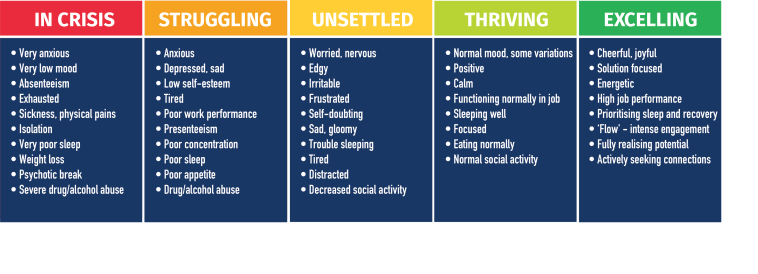
Mental health and illness has sometime been described as a spectrum.

People at one end of the line or spectrum are very well, and those at the other end are very unwell with a serious mental illness.

In the middle might be people who have minor mental health problems.

This idea is not a very helpful method to understand mental health, as it can lead us to make false assumptions.

For example, one may falsely assume that most people are ‘well’ and that a few people, who are a long way removed at the other end of the spectrum, are ‘ill’ or ‘mad’.

This assumption creates a distance between people and causes fear. Another assumption is that once you know your place on the spectrum, it is where you will stay unless something dramatic happens to change it.

This denies the fact that we can make a big difference to our own mental health, both positively and negatively.

It also does not take account of the fact that our mental health changes a lot over relatively short periods of time.

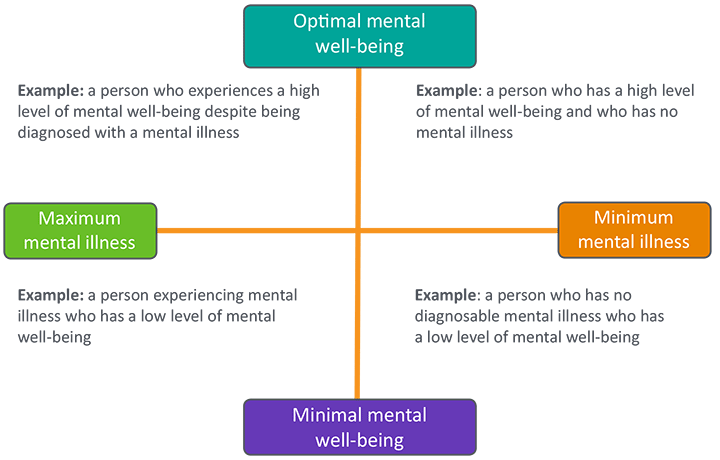
A different and more helpful way of thinking about mental health is the continuum (Figure 1).

The four quadrants of the mental health continuum represent different possible times and situations in a person’s life.

On the right hand side of the diagram, two possible situations are described. Even if a person has no diagnosable illness, they can have either positive or negative mental well-being. Usually the person’s mental health will be affected by life events. If faced with redundancy or the break up of a long-term relationship, the person may find themselves at the lower end of the continuum, experiencing poor mental well-being. If things are going well and the person is looking after their emotional, mental, and physical health they may be higher up the continuum.

Similarly, on the left hand side of the diagram we see that a person with a diagnosed illness can also be experiencing either positive or negative mental well-being.

With the right treatment and proper supports in place, the person can live a happy and fulfilled life whether or not they are experiencing symptoms. Living life to the full may involve having meaningful things to do, having good relationships, a satisfying social life, and good self esteem. On the other hand, without the right treatment and support the person may experience negative mental health.

Being at the lower end of the mental health continuum puts people at greater risk of suicide, whether they have a mental illness or not.

Given that 1 in 4 adults will experience mental health problems at some time in their lives, we can see that it is possible for us to move into all four corners of the continuum at different times.

Knowing that mental health changes over time can help us to look after our own well-being. It can also help us to be more understanding and supportive of others when they are experiencing poor mental health.

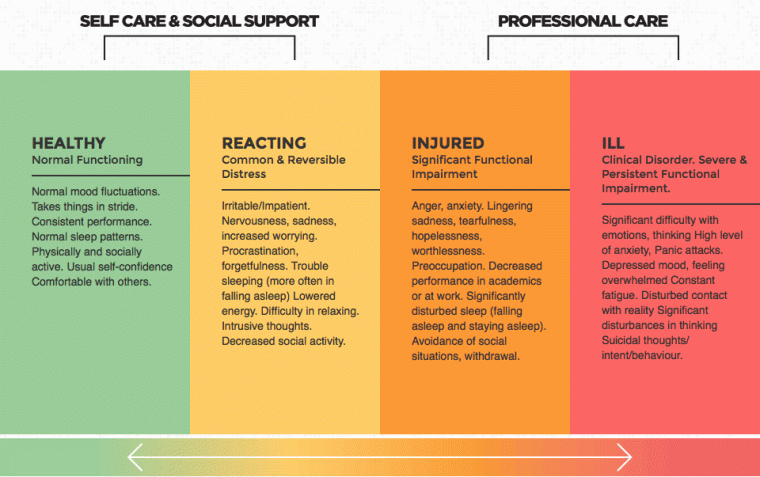
There are other ways to look at the mental health continuum.

An Overview of Insurance & Mental Health

1.0 Introduction

This article provides an overview of things that one might wish to consider regarding mental health and insurance.

Mental health conditions might not be as easy to pin down as physical health conditions, but insurers are increasingly recognising the need to provide cover and support to those suffering with a mental health condition.

One in four people in the United Kingdom (UK) will be affected by a mental health problem in any given year and, of these, around four million will also struggle with their financial wellbeing.

The insurance industry is aware of the importance and value of insurance in protecting individuals when life does not go to plan. And, with this in mind, the insurance industry continues to demonstrate increasing commitment to aiding those suffering from a mental health problem. In 2017, mental health was the most common cause of claim on income protection policies in the UK.

The insurance industry continues to engage with the third sector (aka charities) and healthcare industries to promote greater access to insurance for individuals with mental health conditions and has repeatedly emphasised its commitment to aiding people suffering from mental ill health.

There is no difference in any of the insurance decision making processes for mental health to those for physical health. The process by which decisions are made and guidelines are written is consistent for every medical condition whether physical or mental health (or, as is often the case, a combination of the two).

Whether an individual has a mental health condition or not, if they are considering buying insurance, or just looking for more information, this article outlines some of the things individuals should think about.

As with any other form of insurance, check the small print for what is and is not covered, such as exemptions and exclusions.

2.0 Should You Bother Buying Insurance to Cover Mental Health Care?

When it comes to protecting and supporting individuals who have been diagnosed with a mental health condition, insurers will not only pay claims, they may also provide additional support.

Support services (generally) come at no extra cost and start from the day the cover begins. It is always there to help the individual, which means they can feel confident that help is always at hand. This help can include:

  1. Preventative Measures;
  2. Accessing Support Services; and
  3. Rehabilitation Services.

2.1 Preventative Measures

Many insurers provide specialist mental health service support, which enables employees of company schemes or individual policy holders to receive rapid access to assessment, often within 48 hours.

Individuals will often have a dedicated case manager/case management team assigned to them to take them through the whole process.

This can include a tailored treatment plan and access to a wide range of specialists including:

  • Psychologists;
  • Counsellors; and
  • Psychiatrists.

2.2 Accessing Support Services

Most insurers have what are known as dedicated Employee Assistance Programmes (EAP) which provide access to support services 24 hours a day.

These can offer support on a range of topics which may trigger stress or anxiety, such as finances, relationships and legal issues, as well as dedicated mental health counsellors.

These services can be accessed through dedicated helplines as well as through interactive online services.

2.3 Rehabilitation Services

Rehabilitation services are at the heart of most protection insurance products, and consequently many insurers offer access to rehabilitation teams who help manage an employee’s or individual policy holder’s sickness absence.

They often offer access to counselling and a wide range of other services, including assistance with HR issues and legal assistance.

Many income protection policies have specific mental health pathways for individuals to get the tailored assistance they need it.

3.0 What Things Should I Consider before Buying?

There are a range of insurance products that provide cover for a wide range of situations.

Although many people find that buying insurance provides financial security and peace of mind, which can help them on the road to recovery when the unexpected happens, it is important to understand the different products on offer and what they cover.

3.1 Types of Insurance

Some of the different types of insurance that an individual might like to consider buying that can provide financial peace of mind include:

  • Private Medical Insurance:
    • This enables faster access to treatment by enabling a speedy diagnosis and reduced waiting times.
    • It also helps to pay for some, or all, of the treatment that an individual may need.
    • This can help the individual get back on their feet, and return to employment, quicker.
  • Income Protection Insurance (Section 8.0):
    • This will pay a tax-free monthly income while an individual is unable to work due to illness, injury and/or suffering a reduction in salary for a prolonged period.
    • This insurance covers mental health issues and provides key support services.
  • Travel Insurance:
    • This covers the cost of any medical treatment an individual may need in an emergency when travelling abroad.
    • Individuals can also obtain travel insurance which covers the cost of their holiday if they are unable to travel and need to cancel their holiday due to illness.
  • Life Insurance:
    • This is a type of policy that can be potentially affected by disclosure of mental health conditions.
    • Find out more about the importance of disclosure below.
  • Critical Illness Insurance (Section 9.0):
    • Also known as critical illness cover, is a long-term insurance policy which covers serious illnesses listed within a policy.
    • If an individual get one of these illnesses, a critical illness policy will pay out a tax-free, one-off payment.

3.2 Why is Disclosure Important?

For many insurance products, disclosing pre-existing mental health conditions is very important (A pre-existing medical condition is any condition an individual has at the time they apply for insurance).

Some insurance policies do not cover pre-existing conditions, meaning that they will not pay out on a claim related to a pre-existing condition (which can sometimes include mental health problems). For those who have been denied insurance cover due to a pre-existing mental health condition, look here for a list of specialist advisers on the Mind website (a mental health charity).

Insurers need to know about existing conditions as it allows them to understand the type of mental health condition, and the associated risk based on scientific evidence. As noted by research, mental health conditions can have a direct impact on a sufferer’s risk of premature death or disability and there are also links to greater risk of abuse of medication, drugs or alcohol, which increases the risk of a serious accident.

For most insurers, mental health will include all aspects such as:

  • Stress;
  • Post-natal depression;
  • Attention deficit hyperactivity disorder (ADHD);
  • Eating disorders;
  • Addictions;
  • Myalgic encephalomyelitis (ME), also known as chronic fatigue syndrome (CFS);
  • Fatigue;
  • Depression; and
  • Anxiety.

Individuals will, generally, be asked to provide their diagnosis, symptoms, and treatment.

Regardless of an individual’s age or health status, they will need to provide information on their mental health and whether they have been diagnosed with or treated for a mental health condition.

Some insurers want individuals to disclose all mental health episodes regardless of when they occurred.

It is important that individuals disclose complete and accurate information because it affects the:

  • Risk assessment;
  • Premiums charged; and
  • Terms and conditions of their insurance policy.

It is a legal requirement that individuals answer honestly, as failure to do so may result in the policy being void.

4.0 What Information Might I Need?

As noted above, insurance policies may or may not cover pre-existing medical conditions depending on the severity of the condition.

If an individual has been diagnosed, or has received treatment for a mental health condition, the insurer may want to know the following:

  • Date of diagnosis;
  • Method of treatment;
  • Past methods of treatment;
  • Doctor’s details;
  • Symptoms and dates of last symptoms;
  • Details of any previous hospitalisations;
  • Specifics of time taken off work because of the condition

Some underwriters may split a question about an individual’s medical history into two asking:

  1. “Have you ever had…” for the more serious incidents such as in-patient treatment or suicide attempts; and
  2. Just ask about the last five years for other mental health issues, meaning if episodes happened before then, they may not need to be disclosed at all.

5.0 What Challenges Might I Face?

There are a number of challenges an individual may need to consider, including:

  • Lack of Disclosure:
    • Advisers and insurers are used to dealing with medical conditions, both physical and mental, so there’s no need for an individual to feel embarrassed about their medical history.
    • As with all insurance applications, when an individual is applying for insurance it is vital they are open and honest.
    • A tiny percentage of insurance claims are declined each year, but the main reason is due to issues of non-disclosure at the application stage, for example individuals omitting to say they are taking medication.
  • High Risk Customer:
    • Individuals could be assessed as a ‘high risk’ customer which means that the insurance provider believes that they are more likely to claim.
    • As a result, they may be charged a higher premium, or have a specific exclusion added to their policy.
  • Over the Phone rather than Online:
    • Individuals may be declined insurance if they try to apply for insurance directly online and disclose that they have experienced a mental health condition or have an existing mental health condition.
    • It is therefore recommended that individuals speak to a specialist adviser who will be able to support their specific needs.
  • Symptoms Change:
    • If the individual’s policy does not cover a specific mental health condition because of a recent history of mental illness, yet they go on to be symptom-free for a few years, it is worth reviewing the policy.
    • Future cover could be accepted at standard terms, which could save the individual money.
    • The insurance company’s adviser will be able to advise when will be the best time to do this.

6.0 Where Can I Get Help? What Help is Available?

6.1 Who Can I Speak To?

There are a number of things that an individual can do to make sure they get the right cover for their needs. 

Some companies provide cover specifically for people with pre-existing medical conditions, including mental health conditions. In order for an individuals to gain support that is specific to their needs, they may want to look into getting an insurance quote from a specialist provider (which can be found in Section 3.2 above).

Mental health support is of growing importance for UK businesses. Employers increasingly provide support which may include giving employees access to counselling services such as:

  • EAP;
  • General practitioner (GP) services;
  • On-site medical support; and
  • Health tracking apps.

EAP services are confidential and can be accessed free without disclosure required to an individual’s line manager. Individuals may also be able to access occupational health support through their line manager or human resources service.

6.2 What Questions Should I Ask Before Buying a Policy?

There are a vast range of questions an individual can ask, including:

  • Does the plan cover mental health out-patient therapies or consultant sessions?
    • How many per year does the insurance cover?
    • This could include out-patient cognitive behavioural therapy (CBT) or a counselling plan.
  • At what rate will the sessions be covered?
    • Is there a cost limit per therapy session?
  • Is approval required from the individual’s GP to access consultant or out-patient therapies?
  • Does the individual need any pre-approval from the insurance company before they see a mental health professional?
  • Can the individual get a list of providers in their area?
  • Can the individual meet with more than one provider for a consultation or second opinion and still have it paid for?
  • Does the individual pay the provider or does the insurance company pay them?
  • Are psychiatric medications covered under the plan?
  • Does the policy cover substance abuse services?
    • Inpatient mental health services?
    • Psychiatry?
    • ADHD evaluations?
  • Does the policy also include self-help and guided online therapy?
  • How many days does the individual receive for in-patient/day-case mental health treatment per year?
  • Does the insurance policy come with a counselling support service or specialist support services? Examples include:
    • EAP for employer-based insurance products; or
    • Individual support from foundations such as RedArc – an organisation that includes a team of highly trained and experienced Personal Nurse Advisers who provide practice advice and emotional support.

7.0 What is a Deferred Period?

The deferred period is the period of time from when a person has become unable to work until the time that the benefit begins to be paid. For example, an individual selected a deferred period of six months because they knew they would receive sick pay from their company for that period and would not need the insurance benefits.

7.1 What is a Deferred Period on Income Protection Insurance?

The deferred period on income protection insurance is the period between going off work and the income payments commencing.

For example, income protection insurance with a 4 week deferred period will commence income payments once the policyholder has been off work for a period of 4 weeks.

7.2 What is the Length of a Deferred Period?

The length of the deferred period is selected when the individual commences the income protection insurance, and this can be between 4 weeks and 12 months.

Generally, the longer the chosen deferred period the lower the monthly premiums on commencement of the policy.

7.3 How Do I Choose a Deferred Period?

Choosing a deferred period will be based on individual circumstances, taking into account the following two factors:

  1. Cover Provided by the Employer:
    • If the individual’s employer pays them full sick pay for a period of time then it will make sense to set the deferred period from the date the sick pay ceases.
    • This is because there is no point in setting the deferred period for less than the full sick pay period as the insurance company will not pay out until the individual ceases receiving income from their employer.
    • If an individual requires cover for redundancy in their income protection policy, then they will need to take into consideration the amount of redundancy payment they will receive.
    • For example, if the individual is likely to receive a redundancy payment equal to six month’s salary, then it would make sense to set the deferred period at six months.
  2. Personal Savings:
    • If an individual has access to personal savings then it would make sense to factor this in.
    • For example, if – in the event of sickness, accident or redundancy – the individual has enough personal savings to replace their income for three months, then set a deferred period of three months.

8.0 Income Protection Insurance

There is often confusion between the various types of insurance available on the market, particularly between income protection insurance and critical illness insurance (Section 9.0).

8.1 What is Income Protection Insurance?

Income protection insurance is designed to provide an income if the individual is unable to work due to sickness, or as a result of an accident:

  • Benefits will be paid until:
    • The individual returns to work;
    • Retires; or
    • The end of the policy (whichever comes first).
  • Benefits will only commence once a pre-agreed deferred period has passed.
    • This would generally be between one and twelve months.
    • The longer the deferred period the lower the premium.
  • Income protection insurance is a long term policy with premiums paid monthly.
  • The amount of income covered is typically 60-65% of the individual’s monthly income.
    • Normally enough to cover the mortgage and basic living expenses.
  • Cover may continue until retirement or prior cancellation.
  • Any benefits received are tax free.
    • Unless cover is provided free by an employer, in which case they may be taxed.
  • Pre-existing conditions are (normally) not covered under income protection insurance.

8.2 Why Would I Need Income Protection Insurance?

An individual may want income protection insurance:

  • If they receive only statutory sick pay when off work;
  • If they only receive their full pay for a limited period of time when off work; and/or
  • To make sure their basic living expenses are covered whilst off work.

8.3 Rehabilitation Support Services

Rehabilitation support services are typically bundled as part of income protection insurance and, although provision varies between insurers, example services include:

  • Rehabilitation Support:
    • Early intervention rehabilitation support services help individuals from the moment they are unable to work due to illness or injury.
    • The insurer will provide assistance during the deferred period, and will source specialist providers to suit the individual’s needs.
  • Recuperation Benefit:
    • The insurer will pay for services requested by the individual that could improve or maintain their health and help them return to work.
    • This could could range from physiotherapy or counselling through to help travelling to work.
    • The individual could receive an additional payment of up to three times their monthly income protection benefit with no deferred period.
  • Hospitalisation Benefit:
    • To help individuals cope with long, expensive hospital stays, the insurer may pay individuals a per night fee after a set number of nights (subject to a maximum number of nights).
  • Proportionate Benefit:
    • Returning to work sometimes means a lower salary or fewer hours.
    • The insurer may top up the individuals benefit to match their usual monthly earnings.

9.0 Critical Illness Insurance

9.1 What is Critical Illness Insurance?

Critical illness insurance is a long term policy that will pay a lump sum if an individual is diagnosed with one or more of the critical illness detailed in the policy.

  • If paid out the lump sum can also be used to provide a regular income.
  • It is designed to provide the money to pay off bills or make alterations to the individual’s home, for example, wheelchair access.
  • A typical critical illness policy will cover conditions including:
    • Heart attack;
    • Stroke;
    • Certain cancers; and
    • Conditions like multiple sclerosis.
  • All illnesses have to be judged serious enough for the individual to qualify for a pay-out.
  • The amount of cover is selected by the individual and not linked to income.

9.2 Why Do I Need Critical Illness Insurance?

Reasons for taking out critical illness cover include:

  • Providing the finances to support the individual’s family if diagnosed with a critical illness.
  • Whilst life insurance will provide cover in the event of death (and can include cover which pays out if the individual is terminally ill with less than 12 months to live), critical illness insurance will provide the cover when the individual is critically ill.
  • Providing peace of mind to the individual and their family.

Some Common Myths about Mental Health Problems

Myth:

Only a few people get mental illnesses and they are unusual or odd, so it is obvious who they are.

Fact:

Mental health problems are common and we are often unaware of the person’s diagnosis.

Myth:

People with a diagnosis of mental illness are going to struggle for the rest of their lives.

Fact:

Most people recover from mental illness and go on to live fulfilling lives. Recovery is a unique and personal journey and often the person feels that they experienced personal growth and a new way of being through the process of recovery.

Myth:

People who attempt suicide or self-harm are doing it to get attention and are not really serious.

Fact:

All suicidal thoughts and self-harm, as well as all other forms and expressions of distress, are serious. Dismissing another person’s feelings as attention seeking only makes them withdraw from asking for help and may result in death or serious injury.

Myth:

People who have mental illnesses have brought it upon themselves, or their parents are to blame.

Fact:

Anyone can experience mental illness or experience mental distress regardless of their background or upbringing. Some people are more at risk through circumstances beyond their own control.

Some Important Facts about Mental Health Problems

Mental health problems are common and can affect anyone.

People with mental health problems do not lose their personality or intelligence, although the symptoms can sometimes change the way a person behaves when they are unwell.

People with mental health problems usually recover – there is a better chance of recovery from mental health problems than from some physical illnesses.

People with mental health problems want to work and to contribute to society, but it is often other people’s attitudes that prevent them from doing so.

Two thirds of employers, when asked, said that they did not feel comfortable employing a person with a mental health problem.

Many people with mental health problems continue to live life to the full, working and enjoying positive relationships and activities.

Sometimes, having a severe and enduring mental illness has a devastating effect on people’s live. With the right treatment and support, the person has a better chance of improvement and recovery.

People with schizophrenia do not have a split personality.

People with severe and enduring mental health problems are not usually dangerous – in fact, they are more likely to be victims of crime.

People with mental health problems are not weak and they do not bring the problems on themselves.

A growing body of evidence suggests that mental health problems cannot be separated from physical health, as the mind and body are closely interrelated.

Sometimes people dismiss others’ mental health problems or distress by judging them as weak. This is no more helpful or appropriate than judging someone for having a physical illness or disability.

Ordinary members of the public can help people experiencing mental health problems and make a real difference to their recovery.

Mental Health: Stigma & Myth

Most people know that it is not appropriate to deliberately treat someone with mental health problems badly.

This awareness means that stigma is often expressed in less obvious ways, such as unkind jokes or ignoring a person.

Stigma and the fear of stigma is a serious issue that has an effect on people’s ability to cope with and recover from a mental health problem.

There is a lot of evidence to show that people are treated differently when they experience a mental health problem.

Stigma is based on myths and false assumptions about mental health problems.

Therefore, it is best addressed by gaining knowledge and an understanding of the facts.

Research has found that attitudes towards people with mental health problems have improved significantly in the United Kingdom (UK) since anti-stigma campaigns like ‘See Me’ were introduced.

We can make a difference to people’s mental health by gaining understanding and knowledge, and sharing it with others.

We can also make a difference by treating people with mental health problems as equals, and offering kindness and support when they are unwell.