Book: Resilience – How We Find New Strength at Times of Stress

Book Title:

Resilience – How We Find New Strength at Times of Stress.

Author(s): Fredric Flach (MD).

Year: 2020.

Edition: First (1st).

Publisher: Hatherleigh Press.

Type(s): Paperback.

Synopsis:

Make stress your ally in the pursuit of happiness and personal fulfillment.

There’s no escaping stress. It appears on our doorstep uninvited in the shattering forms of death, divorce, or job loss. Stress even comes in the pleasant experiences of promotion, marriage, or a long-held wish fulfilled.

So why do some people come out of a crisis feeling better than ever, and others never seem to bounce back?

You will discover:

  • How to develop the 14 traits that will make you more resilient.
  • Why “falling apart” is often the smartest step to take on the road to resilience.
  • When the five-step plan for creative problem solving can help.
  • What essential steps you can take to strengthen your body’s resilience.
  • How to redefine your problem and restructure your pain to create a life you can handle, a life you can learn from and enjoy!

Drawing on more than thirty years of case studies from his own psychiatric practice, Dr. Frederic Flach reveals the remarkable antidote to the destructive qualities of stress – physical, mental, and emotional resilience.

Book: Emotion Efficacy Therapy

Book Title:

Emotion Efficacy Therapy: A Brief, Exposure-Based Treatment for Emotion Regulation Integrating ACT and DBT.

Author(s): Matthew McKay (PhD) and Aprilia West (PSyD, MT).

Year: 2016.

Edition: First (1st).

Publisher: New Harbinger.

Type(s): Paperback and Kindle.

Synopsis:

If you treat clients with emotion regulation disorders – including depression, anxiety, post-traumatic stress disorder (PTSD), bipolar disorder, and borderline personality disorder (BPD) – you know how important it is for these clients to take control of their emotions and choose their actions in accordance with their values. To help, emotion efficacy therapy (EET) provides a new, theoretically-driven, contextually-based treatment that integrates components from acceptance and commitment therapy (ACT) and dialectical behaviour therapy (DBT) into an exposure-based protocol. In doing so, EET targets the transdiagnostic drivers of experiential avoidance and distress intolerance to increase emotional efficacy.

This step-by-step manual will show you how to help your clients confront and accept their pain, and learn to apply new adaptive responses to emotional triggers. Using a brief treatment that lasts as little as eight weeks, you will be able to help your clients understand and develop a new relationship with their emotions, learn how to have mastery over their emotional experience, practice values-based action in the midst of being emotionally triggered, and stop intense emotions from getting in the way of creating the life they want.

Using the transdiagnostic, exposure-based approach in this book, you can help your clients manage difficult emotions, curb negative reactions, and start living a better life. This book is a game changer for emotion exposure treatment!

Book: Relaxation and Stress Reduction Workbook

Book Title:

Relaxation and Stress Reduction Workbook.

Author(s): Matthew McKay (PhD).

Year: 2019.

Edition: Seventh (7th).

Publisher: New Harbinger.

Type(s): Paperback and Kindle.

Synopsis:

The Relaxation and Stress Reduction Workbook broke new ground when it was first published in 1980, detailing easy, step-by-step techniques for calming the body and mind in an increasingly overstimulated world. Now in its seventh edition, this fully revised and updated workbook-highly regarded by therapists and their clients-offers the latest stress reduction techniques to combat the effects of stress and integrate healthy relaxation habits into every aspect of daily life.

This new edition also includes powerful self-compassion practices, fully updated chapters on the most effective tools for coping with anxiety, fear, and panic-such as worry delay and diffusion, two techniques grounded in acceptance and commitment therapy (ACT)-as well as a new section focused on body scan.

In the workbook, you will explore your own stress triggers and symptoms, and learn how to create a personal action plan for stress reduction. Each chapter features a different method for relaxation, explains why the method works, and provides on-the-spot exercises you can do when you feel stressed out. The result is a comprehensive yet accessible workbook that will help you to curb stress and cultivate a more peaceful life.

Book: Psychotherapy in Later Life

Book Title:

Psychotherapy in Later Life.

Author(s): Rajesh R. Tampi, Brandon Yarns, Kristina F. Zdanys, and Deena J. Tampi (Editors).

Year: 2020.

Edition: First (1st).

Publisher: Cambridge University Press.

Type(s): Paperback and Kindle.

Synopsis:

Psychotherapy in Later Life is a practical how-to-guide for psychiatrists, psychologists and mental health workers on choosing and delivering evidence-based psychological therapies to older adults.

It covers all the main evidence-based psychological therapies such as cognitive behavioural therapy (CBT) and interpersonal psychotherapy (IPT), as well as specialist topics such as combining psychotherapy with pharmacological treatments, working with diverse populations and individual versus group therapy.

The World Health Organisation estimates that over the next four decades, the proportion of the world’s older adults will nearly double, from 12% to 22%, and that one in five older adults has a diagnosable mental health disorder.

Given the increasing number of older adults requiring mental health treatment, incorporating talking therapies into treatment plans is key to tackling issues related to polypharmacy, medication interactions and side effects. Written by experts in geriatric mental health, this book provides the most authoritative information on the use of psychotherapy in older adults.

Book: Best Practices and Barriers to Engaging People with Substance Use Disorders in Treatment

Book Title:

Best Practices and Barriers to Engaging People with Substance Use Disorders in Treatment.

Author(s): Peggy O’Brien, Erika Crable, Catherine Fullerton, and Lauren Hughey.

Year: March 2019.

Edition: First (1st).

Publisher: US Department of Health and Human Services.

Type(s): eBook.

Synopsis:

In 2015, 20.8 million people aged 12 years or older (7.8% of the United States population) had a substance use disorder (SUD) in the previous year. Approximately 75% of this group, or 15.7 million Americans, had an alcohol use disorder,
2.0 million had a prescription opioid use disorder (OUD), and about 0.6 million had a heroin use disorder.

Since 1999, opioid-related overdose deaths in the United States have quadrupled, with more than 15,000 individuals experiencing prescription drug-related overdose deaths in 2015. Even though evidence-based SUD treatments are effective, rates of treatment receipt are quite low. In 2015, only 18% of the population with SUDs, or 3.7 million people, received SUD treatment – a number that has not increased significantly since 2002.

Only about 48% of patients who enter SUD treatment actually complete it.

You can access the book, for free, here.

Book: Approaches to Drug Abuse Counselling

Book Title:

Approaches to Drug Abuse Counselling.

Author(s): National Institute on Drug Abuse (NIDA).

Year: 2000.

Edition: First (1st).

Publisher: US Government Printing Office.

Type(s): eBook.

Synopsis:

Dual disorders recovery counselling (DDRC) is an integrated approach to treatment of patients with drug use disorders and comorbid psychiatric disorders.

The DDRC model, which integrates individual and group addiction counselling approaches with psychiatric interventions, attempts to balance the focus of treatment so that both the patient’s addiction and psychiatric issues are addressed.

The DDRC model is based on the assumption that there are several treatment phases that patients may go through.

You can access the book, for free, here.

Book: Integrating Behavioural Therapies with Medications in the Treatment of Drug Dependence

Book Title:

Integrating Behavioural Therapies With Medications in the Treatment of Drug Dependence (National Institute on Drug Abuse Research Monograph Series).

Author(s): Lisa Simon Onken (PhD), Jack D. Blaine (MD), and John J. Boren (PhD.

Year: 1995.

Edition: First (1st).

Publisher: US Government Printing Office.

Type(s): eBook.

Synopsis:

It is no revelation that drug dependence is a complex problem with behavioural, cognitive, psychosocial, and biological dimensions and may be treated with behavioural therapy (including behaviour therapy, psychotherapy, and counselling), and, where available, pharmacotherapy.

Drug use can be reduced behaviourally with appropriate manipulation of reinforcements within the environment (Higgins et al. 1993). Continued improvements over time in drug use can be initiated by cognitive behavioural psychotherapies to modify cognitions that perpetuate drug use (Carroll et al., submitted for publication), and a reduced likelihood of
relapse has been engendered by specialised training approaches (Rohsenow et al., in press).

Methadone, of course, has long been recognised as an effective pharmacotherapy to reduce opiate use, and its biological mechanism of action is well understood.

You can access the book, for free, here.

Book: Psychotherapy And Counselling In The Treatment Of Drug Abuse

Book Title:

Psychotherapy And Counselling In The Treatment Of Drug Abuse (National Institute on Drug Abuse Research Monograph Series).

Author(s): Lisa Simon Onken (PhD) and Jack D. Blaine (MD).

Year: 1990.

Edition: First (1st).

Publisher: US Government Printing Office.

Type(s): eBook.

Synopsis:

Drug abuse treatment occurs in a multitude of forms. It may be provided in outpatient or inpatient settings, be publicly or privately funded, and mayor may not involve the administration of medication. The differences among the philosophies of, and the services provided in, various drug abuse treatment programmes may be enormous. What is remarkable is that some form of drug abuse counselling or psychotherapy is almost invariably a part of every type of comprehensive drug abuse treatment. Individual therapy or counselling is available in about 99% of the drug-free, methadone-maintenance, and multiple-modality drug abuse treatment units in this country (National Drug and Alcoholism Treatment Unit Survey 1982). It is also available in approximately 97% of the detoxification units.

You can access the book, for free, here.

Book: Therapy with a Map: A Cognitive Analytic Approach to Helping Relationships

Book Title:

Therapy with a Map: A Cognitive Analytic Approach to Helping Relationships.

Author(s): Steve Potter.

Year: 2020.

Edition: First (1st).

Publisher: Luminate.

Type(s): Paperback and Kindle.

Synopsis:

A therapeutic relationship is a web of interactions, tasks and processes in space and time. It is not easy to stay aware of the relationship in the thick of talking and trying to help someone; but doing so boosts flexibility and enables deeper formulation. A therapist who can attend not only to a specific therapeutic model, but also to relational factors underlying all therapy, has a far greater chance of enabling change.

Therapy with a Map sets out a therapeutic process of talking accompanied by visual conversation maps set down in real time on paper. Like all maps, these help us to find our way, notice when we are lost, track our route and survey the wider landscape. The book uses mapping to introduce the tools and concepts of Cognitive Analytic Therapy (CAT), along with other relational, conversational and narrative approaches. By mapping patterns of thinking and relating, therapists can help clients to develop self-understanding, solve problems, and take away a freer, more self-aware relationship with themselves in the world.

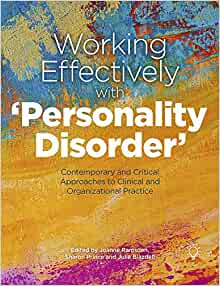
Book: Working Effectively with ‘Personality Disorder’

Book Title:

Working Effectively with ‘Personality Disorder’: Contemporary and Critical Approaches to Clinical and Organisational Practice.

Author(s): Joanne Ramsden (Author and Editor), Sharon Prince (Editor), and Julia Blazdell (Editor).

Year: 2020.

Edition: First (1st).

Publisher: Luminate.

Type(s): Paperback and Kindle.

Synopsis:

The history of personality disorder services is problematic to say the least. The very concept is under heavy fire, services are often expensive and ineffective, and many service users report feeling that they have been deceived, stigmatised or excluded. Yet while there are inevitably serious (and often destructive) relational challenges involved in the work, creative networks of learning do exist – professionals who are striving to provide progressive, compassionate services for and with this client group.

Working Effectively with Personality Disorder shares this knowledge, articulating an alternative way of working that acknowledges the contemporary debate around diagnosis, reveals flawed assumptions underlying current approaches, and argues for services that work more positively, more holistically and with a wider and more socially focused agenda.

Table of Contents

  • Foreword by John Livesley.
  • Introduction (Jo Ramsden, Sharon Prince and Julia Blazdell).
  • PART 1: CONTEMPORARY AND CRITICAL PERSPECTIVES ON PERSONALITY DISORDER:
    • Chapter 1: Life and Labels: Some Personal Thoughts about Personality Disorder (Sue Sibbald).
    • Chapter 2: Personality Disorder: Breakdown in the Relational Field (Nick Benefield & Rex Haigh).
    • Chapter 3: The Scale of the Problem (Sarah Skett & Kimberley Barlow).
    • Chapter 4: The Politics of Personality Disorder A Critical Realist Account (David Pilgrim).
    • Chapter 5: The Importance of Personal Meaning (Sharon Prince & Sue Ellis).
    • Chapter 6: The Organisation and Its Discontents: In Search of the Fallible and Good Enough Care Enterprise (Jina Barrett).
  • PART 2: GOVERNANCE PRINCIPLES SUPPORTING SERVICES TO ENACT CONTEMPORARY AND CRITICAL PERSPECTIVES:
    • Chapter 7: Access to Services – Moving beyond Specialist Provision while Applying the Learning (Jo Ramsden).
    • Chapter 8: Reimagining Interventions (Alan Hirons & Ruth Sutherland).
    • Chapter 9: Service User Involvement and Co-production in Personality Disorder Services An Invitation to Transcend Re Traumatising Power Politics (Melanie Ann Ball).
    • Chapter 10: Partnership Working (David Harvey & Bernie Tuohy).
    • Chapter 11: Outcomes (Mary McMurran).
    • Chapter 12: Contained and Containing Teams (Jo Ramsden).
    • Chapter 13: Co-Produced Practice Near Learning: Developing Critically Reflective Relational Systems (Neil Gordon).