Book: Mastering the World of Psychology

Book Title:

Mastering the World of Psychology.

Author(s): Samuel E. Wood, Ellen Green Wood, and Denise Boyd.

Year: 2013.

Edition: Fifth (6th).

Publisher: Pearson.

Type(s): Paperback.

Synopsis:

Mastering the World of Psychology, fifth edition, provides students with more support than ever before, thanks to the Survey, Question, Read, Recite, and Review Learning Method, or SQ3R, which is integrated throughout the text. SQ3R shows students the relationship between psychological theory and learning. It is the strongest and most comprehensive program for measuring progress and attaining successful outcomes in Introductory Psychology.

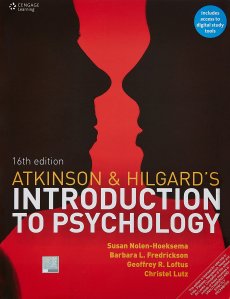
Book: Atkinson And Hilgards Introduction To Psychology

Book Title:

Atkinson And Hilgards Introduction To Psychology.

Author(s): Susan Nolen-Hoeksema, Barbara L. Fredrickson, Geoffrey R. Loftus, and Christel Lutz..

Year: 2015.

Edition: Sixteenth (16th).

Publisher: Cengage India.

Type(s): Hardcover and Paperback.

Synopsis:

Now in its 16th edition, Atkinson & Hilgard’s Introduction to Psychology has been fully revised and updated to reflect all recent research developments, theories and ideas, whilst also retaining all of the qualities which have established it as a leading undergraduate psychology textbook over the past five decades, including its highly accessible and engaging student-centred approach.

The established author team of Susan Nolen-Hoeksema, Barbara Fredrickson and Geoffrey R. Loftus has been joined by Christel Lutz (University of Utrecht), who has helped to add a fresh European influence, and thereby create a truly international introductory textbook.

The ‘Cutting Edge Research’ box features and ‘Seeing Both Sides’ essays which conclude each chapter have been fully updated and replaced throughout, using contributions from a range of experts across the globe, and really help to bring the text to life for students.

Book: Psychology

Book Title:

Psychology.

Author(s): G. Neil martin, Neil R. Carlson, and William Buskist.

Year: 2013.

Edition: Fifth (5th).

Publisher: Pearson.

Type(s): Paperback.

Synopsis:

Now in its fifth edition, Psychology is a comprehensive, lively and accessible introduction to the fascinating study of the subject.

It describes and explores every major area of psychology and present the latest findings, along with clear evaluation of controversial theories and models, to give a thorough and critical grounding in the subject.

Book: Psychology in Black and White

Book Title:

Psychology in Black and White – The Project of a Theory-Driven Science.

Author(s): Sergio Salvatore (Author) and Jaan Valsiner (Series Editor).

Year: 2015.

Edition: First (1st).

Publisher: Information Age Publishing, Illustrated Edition.

Type(s): Hardcover, Paperback, and Kindle.

Synopsis:

This book is long awaited within the contemporarily creative field of cultural psychologies. It is a theoretical synthesis that is at the level of innovations that Sigmund Freud, James Mark Baldwin, William Stern, Kurt Lewin, Jean Piaget, Lev Vygotsky and Jan Smedslund have brought into psychology over the past century. Here we can observe a creative solution to integrating cultural psychology with the rich traditions of psychodynamic perspectives, without repeating the conceptual impasses in which many psychoanalytic perspectives have become caught.

CONTENTS

  • Series Editor’s Preface.
  • New Synthesis: A dynamic theory of Sense-Making Introduction.
  • Psychology as the science of the explanandum.
  • PART I – MICRO-PHYSICS OF SENSEMAKING:
    • Chapter 1. The meaning of our discontent.
    • Chapter 2. The Semio-Dynamic Model of Sensemaking (SDMS).
    • Chapter 3. Micro-dynamic of sensemaking.
    • Chapter 4. The semiotic Big Bang.
  • PART II. THEORETICAL EXPLORATIONS:
    • Chapter 5. The contextuality of mind.
    • Chapter 6. Beyond subject and object.
    • Chapter 7. Affect and desire as semiotic processes.
    • Chapter 8. Exercises of semiotic reframing.
  • PART III. A NEW METHODOLOGICAL APPROACH:
    • Chapter 9. Field dependency and abduction.
    • Chapter 10. The modelling of sensemaking.
    • Chapter 11. Models and strategies of empirical investigation.
    • Chapter 12. Studies of sensemaking.
  • Epilogue.
  • References.

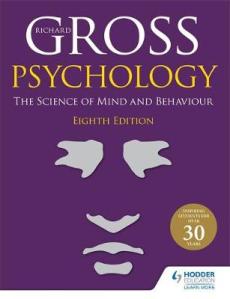
Book: Psychology – The Science of Mind and Behaviour

Book Title:

Psychology – The Science of Mind and Behaviour.

Author(s): Richard Gross.

Year: 2020.

Edition: Eighth (8th).

Publisher: Hodder Education.

Type(s): Paperback and Kindle.

Synopsis:

Build a solid foundation for students to develop the skills and knowledge they need to progress with the updated edition of Richard Gross’s best-selling introduction to Psychology.

This 8th edition of Psychology: The Science of Mind and Behaviour is the essential guide to studying Psychology, helping over half a million students during its 30 years of publication.

  • Easily access psychological theories and research with user-friendly content and useful features including summaries, critical discussion and research updates.
  • Develop evaluative skills, with new evaluation boxes, encouraging students to put classic and contemporary studies into context.
  • Consolidate understanding by identifying common misconceptions.
  • Stay up to date with revised content and the latest psychological research.
  • Understand the research process with updated contributions from leading Psychologists including Elizabeth Loftus, Alex Haslam and David Canter.

Book: Psychoanalysis and the Cinema- The Imaginary Signifier

Book Title:

Psychoanalysis and the Cinema- The Imaginary Signifier.

Author(s): Christian Metz.

Year: 1984.

Edition: First (1st).

Publisher: Palgrave Macmillan.

Type(s): Hardcover and Paperback.

Synopsis:

In the first half of the book Metz explores a number of aspects of the psychological anchoring of cinema as a social institution.

In the second half, he shifts his approach…to look at the operations of meaning in the film text, at the figures of image and sound concatenation. Thus he is led to consideration of metaphor and metonymy in film, this involving a detailed account of these two figures as they appear in psychoanalysis and linguistics.

Book: Psychiatric Diagnosis and Classification

Book Title:

Psychiatric Diagnosis and Classification.

Author(s): Mario Maj, Wolfgang Gaebel, Juan Jose Lopez-Ibor, and Norman Sartorius (Editors).

Year: 2002.

Edition: First (1st).

Publisher: Wiley-Blackwell.

Type(s): Hardcover and Kindle.

Synopsis:

This book provides an overview of the strengths and limitations of the currently available systems for the diagnosis and classification of mental disorders, in particular the DSM-IV and the ICD-10, and of the prospects for future developments. Among the covered issues are: The impact of biological research The diagnosis of mental disorders in primary care The usefulness and limitations of the concept of comorbidity in psychiatry The role of understanding and empathy in the diagnostic process The ethical, legal and social aspects of psychiatric classification Psychiatric Diagnosis & Classification provides a comprehensive picture of the current state of available diagnostic and classificatory systems in psychiatry and the improvements that are needed.

Book: Principles and Practice of Grief Counselling

Book Title:

Principles and Practice of Grief Counselling.

Author(s): Darcy L. Harris and Howard R. Winokuer.

Year: 2019.

Edition: Third (3rd).

Publisher: Springer Publishing Company.

Type(s): Paperback and Kindle.

Synopsis:

This core introductory text, with a focus on clinical application, combines the knowledge and skills of counselling psychology with current theory and research in grief and bereavement. The third edition is updated to address issues related to the developmental aspects of grief, including grief in children and young people, grief as a lifespan concept, and grief in an increasingly aging demographic. It describes new therapeutic approaches and examines the neurological basis of grief as well as trauma from disruption and loss.

Also emphasized is the role of diversity, along with cultural considerations in grief counselling. Instructor’s resources include a Test Bank, Instructor’s Manual, and PowerPoint slides. User-friendly, while grounded in the latest research and theoretical constructs, the text offers such pedagogical aids as learning objectives, practice examples, glossary terms, and questions for reflection in each chapter. Above all, the book addresses grief counselling and support in a way that is informed and practical. The content explores concepts relevant to complicated grief, while differentiating the normal human experience of grief from mental disorders. Purchase includes digital access for use on mobile devices and computers.

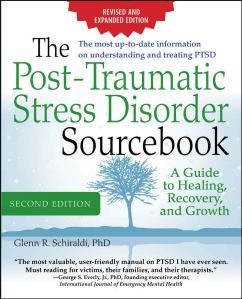
Book: The Post-Traumatic Stress Disorder Sourcebook

Book Title:

The Post-Traumatic Stress Disorder Sourcebook, Revised and Expanded Second Edition: A Guide to Healing, Recovery, and Growth.

Author(s): Glenn R. Schiraldi (PhD).

Year: 2016.

Edition: Second (2nd).

Publisher: McGraw-Hill Education.

Type(s): Paperback and Kindle.

Synopsis:

The Post-Traumatic Stress Disorder Sourcebook, Revised and Expanded Second Edition introduces survivors, loved ones, and helpers to the remarkable range of treatment alternatives and self-management techniques available today to break through the pain and realise recovery and growth.

This updated edition incorporates all-new diagnostics from the DSM-5 and covers the latest treatment techniques and research findings surrounding the optimisation of brain health and function, sleep disturbance, new USDA dietary guidelines and the importance of antioxidants, early childhood trauma, treating PTSD and alcoholism, the relationship between PTSD and brain injury, suicide and PTSD, somatic complaints associated with PTSD, and more.

Book: Pocket Therapy for Emotional Balance

Book Title:

Pocket Therapy for Emotional Balance: Quick DBT Skills to Manage Intense Emotions (New Harbinger Pocket Therapy).

Author(s): Matthew McKay (PhD), Jeffrey C. Wood (PSyd), and Jeffrey Brantley (MD).

Year: 2020.

Edition: First (1st).

Publisher: New Harbinger.

Type(s): Paperback and Kindle.

Synopsis:

In Pocket Therapy for Emotional Balance, three clinical psychologists and authors of The Dialectical Behaviour Therapy Skills Workbook offer quick, evidence-based tips and tools for managing intense emotions in the moment. Using this handy, take-anywhere guide, readers will find freedom from overwhelming thoughts and feelings, find a sense of calm, and live a more balanced life.

Bite-sized, evidence based tips and tools for managing intense emotions in the moment-from the authors of The Dialectical Behaviour Therapy Skills Workbook! Sometimes emotions can feel like a big, powerful tidal wave that will sweep you away. And the more you try to suppress or put a lid on these emotions, the more overwhelming they get. So, how can you feel better when difficult emotions threaten to wash over you?

In this take-anywhere pocket guide, clinical psychologists and authors Matt McKay, Jeffrey Wood, and Jeffrey Brantley offer quick and simple strategies based in dialectical behaviour therapy (DBT) to help you take charge of your emotions and start living the life you want. Using this handy little book, you’ll find freedom from overwhelming thoughts and feelings, discover a sense of lasting calm, improve your relationships, and feel more at peace with the world and yourself. If you are looking for small, easy ways to manage your emotions on the go, put this compact guide in your coat pocket, your purse, on your nightstand, or anywhere for quick and soothing relief.