Posts

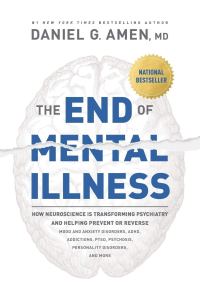
Book: The End of Mental Illness

Book Title:

The End of Mental Illness: How Neuroscience Is Transforming Psychiatry and Helping Prevent or Reverse Mood and Anxiety Disorders, ADHD, Addictions, PTSD, Psychosis, Personality Disorders, and More.

Author(s): Daniel G. Amen.

Year: 2020.

Edition: First (1st).

Publisher: Tyndale House Publishers.

Type(s): Hardcover, Paperback, Audiobook, and Kindle.

Synopsis:

Though incidence of these conditions is skyrocketing, for the past four decades standard treatment has not much changed, and success rates in treating them have barely improved, either. Meanwhile, the stigma of the “mental illness” label – damaging and devastating on its own – can often prevent sufferers from getting the help they need.

Brain specialist and bestselling author Dr. Daniel Amen is on the forefront of a new movement within medicine and related disciplines that aims to change all that. In The End of Mental Illness, Dr. Amen draws on the latest findings of neuroscience to challenge an outdated psychiatric paradigm and help readers take control and improve the health of their own brain, minimising or reversing conditions that may be preventing them from living a full and emotionally healthy life.

The End of Mental Illness will help you discover:

  • Why labelling someone as having a “mental illness” is not only inaccurate but harmful.
  • Why standard treatment may not have helped you or a loved one – and why diagnosing and treating you based on your symptoms alone so often misses the true cause of those symptoms and results in poor outcomes.
  • At least 100 simple things you can do yourself to heal your brain and prevent or reverse the problems that are making you feel sad, mad, or bad.
  • How to identify your “brain type” and what you can do to optimise your particular type.
  • Where to find the kind of health provider who understands and uses the new paradigm of brain health.

What is Person-Centred Therapy?

Introduction

Person-centred therapy, also known as person-centred psychotherapy, person-centred counselling, client-centred therapy and Rogerian psychotherapy, is a form of psychotherapy developed by psychologist Carl Rogers beginning in the 1940s and extending into the 1980s. Person-centred therapy seeks to facilitate a client’s self-actualising tendency, “an inbuilt proclivity toward growth and fulfilment”, via acceptance (unconditional positive regard), therapist congruence (genuineness), and empathic understanding.

It is one of the most influential and fundamental modalities of treatment in modern psychological practice, and is applied almost universally in modern psychotherapy. However, it is rarely used on its own; typically it is combined with other forms of therapy.

Background

Person-centred therapy, now considered a founding work in the humanistic school of psychotherapies, began with Carl Rogers, and is recognised as one of the major psychotherapy “schools” (theoretical orientations),[clarification needed] along with psychodynamic psychotherapy, psychoanalysis, classical Adlerian psychology, cognitive behavioural therapy, existential therapy, and others.

Rogers affirmed individual personal experience as the basis and standard for living and therapeutic effect. This emphasis contrasts with the dispassionate position which may be intended in other therapies, particularly the behavioural therapies. Living in the present rather than the past or future, with organismic trust, naturalistic faith in one’s own thoughts and the accuracy in one’s feelings, and a responsible acknowledgment of one’s freedom, with a view toward participating fully in our world, contributing to other peoples’ lives, are hallmarks of Rogers’ person-centred therapy. Rogers also claimed that the therapeutic process is essentially the accomplishments made by the client. The client having already progressed further along in their growth and maturation development, only progresses further with the aid of a psychologically favoured environment.

Although client-centred therapy has been criticised by behaviourists for lacking structure and by psychoanalysts for actually providing a conditional relationship, it has been shown to be an effective treatment.

What is Required for Therapeutic Change?

Rogers (1957; 1959) stated that there are six necessary and sufficient conditions required for therapeutic change:

  1. Therapist-client psychological contact: a relationship between client and therapist must exist, and it must be a relationship in which each person’s perception of the other is important.
  2. Client incongruence: that in-congruence exists between the client’s experience and awareness.
  3. Therapist congruence, or genuineness: the therapist is congruent within the therapeutic relationship. The therapist is deeply involved – they are not ‘acting’ – and they can draw on their own experiences (self-disclosure) to facilitate the relationship.
  4. Therapist unconditional positive regard: the therapist accepts the client unconditionally, without judgment, disapproval or approval. This facilitates increased self-regard in the client, as they can begin to become aware of experiences in which their view of self-worth was distorted or denied.
  5. Therapist empathic understanding: the therapist experiences an empathic understanding of the client’s internal frame of reference. Accurate empathy on the part of the therapist helps the client believe the therapist’s unconditional regard for them.
  6. Client perception: that the client perceives, to at least a minimal degree, the therapist’s unconditional positive regard and empathic understanding.

Core Conditions

It is believed that the most important factor in successful therapy is the relational climate created by the therapist’s attitude to their client. The therapist’s attitude is defined by the three conditions focused on the therapist, which are often called the core conditions (3, 4, and 5 of the above six conditions):

  1. Congruence: the willingness to transparently relate to clients without hiding behind a professional or personal façade.
  2. Unconditional positive regard: the therapist offers an acceptance and prizing for their client for who he or she is without conveying disapproving feelings, actions or characteristics and demonstrating a willingness to attentively listen without interruption, judgement or giving advice.
  3. Empathy: the therapist communicates their desire to understand and appreciate their client’s perspective.

Processes

Rogers believed that a therapist who embodies the three critical and reflexive attitudes (the three core conditions) will help liberate their client to more confidently express their true feelings without fear of judgement. To achieve this, the client-centred therapist carefully avoids directly challenging their client’s way of communicating themselves in the session in order to enable a deeper exploration of the issues most intimate to them and free from external referencing. Rogers was not prescriptive in telling his clients what to do, but believed that the answers to the clients’ questions were within the client and not the therapist. Accordingly, the therapists’ role was to create a facilitative, empathic environment wherein the client could discover the answers for him or herself.

Can We Link Personality Pathology with Smoking & Traits?

Research Paper Title

Predicting smoking and nicotine dependence from the DSM-5 alternative model for personality pathology.

Background

Individuals with personality disorders (PDs) have higher morbidity and mortality than the general population, which may be due to maladaptive health behaviours such as smoking.

Previous studies have examined the links between categorical PD diagnoses/personality traits and smoking/nicotine dependence, but little is known about how the Diagnostic and Statistical Manual of Mental Disorders, Fifth Edition alternative model for personality disorders relates to smoking and nicotine dependence.

Methods

The current study examined this question in a sample of 500 participants using the Levels of Personality Functioning Scale to assess general personality pathology, the Personality Inventory for the Diagnostic and Statistical Manual of Mental Disorders, Fifth Edition to measure specific traits, the Fagerström test for Nicotine Dependence to assess nicotine dependence, and questions about current and past smoking to assess smoking status (i.e. current, former, never).

Results

Multinomial logistic regression results demonstrated that general personality pathology (Criterion A) was not related to smoking status, and there were no reliable associations between traits (Criterion B) and smoking status. However, correlations showed that higher negative affectivity and disinhibition were related to higher levels of nicotine dependence within smokers.

Conclusions

Findings are discussed in regard to previous findings linking personality pathology to smoking/nicotine dependence as well as the general validity of this new personality disorder diagnostic system.

Reference

Halberstadt, A.L., Skrzynski, C.J., Wright, A.G.C. & Creswell, K.G. (2021) Predicting smoking and nicotine dependence from the DSM-5 alternative model for personality pathology. Personality Disorders. doi: 10.1037/per0000487. Online ahead of print.

On This Day … 16 March

People (Births)

  • 1937 – Amos Tversky, Israeli-American psychologist and academic (d. 1996).

People (Deaths)

  • 1841 – Félix Savart, French physicist and psychologist (d. 1791).

Amos Tversky

Amos Nathan Tversky (Hebrew: עמוס טברסקי‎; 16 March 1937 to 02 June 1996) was an Israeli cognitive and mathematical psychologist, a student of cognitive science, a collaborator of Daniel Kahneman, and a key figure in the discovery of systematic human cognitive bias and handling of risk.

Much of his early work concerned the foundations of measurement. He was co-author of a three-volume treatise, Foundations of Measurement. His early work with Kahneman focused on the psychology of prediction and probability judgment; later they worked together to develop prospect theory, which aims to explain irrational human economic choices and is considered one of the seminal works of behavioural economics. Six years after Tversky’s death, Kahneman received the 2002 Nobel Memorial Prize in Economic Sciences for the work he did in collaboration with Amos Tversky (The prize is not awarded posthumously). Kahneman told The New York Times in an interview soon after receiving the honour: “I feel it is a joint prize. We were twinned for more than a decade.” Tversky also collaborated with many leading researchers including Thomas Gilovich, Itamar Simonson, Paul Slovic and Richard Thaler. A Review of General Psychology survey, published in 2002, ranked Tversky as the 93rd most cited psychologist of the 20th century, tied with Edwin Boring, John Dewey, and Wilhelm Wundt.

Felix Savart

Félix Savart (30 June 1791 to 16 March 1841) was a physicist and mathematician who is primarily known for the Biot–Savart law of electromagnetism, which he discovered together with his colleague Jean-Baptiste Biot. His main interest was in acoustics and the study of vibrating bodies. A particular interest in the violin led him to create an experimental trapezoidal model. He gave his name to the savart, a unit of measurement for musical intervals, and to Savart’s wheel – a device he used while investigating the range of human hearing.

Biography

He was the son of Gérard Savart, an engineer at the military school of Metz. His brother, Nicolas, who was a student at the École Polytechnique and an officer in the engineering corps, did work on vibration. At the military hospital at Metz, Savart studied medicine and later he went on to continue his studies at the University of Strasbourg, where he received his medical degree in 1816. Savart became a professor at Collège de France in 1820 and was the co-originator of the Biot–Savart law, along with Jean-Baptiste Biot. Together, they worked on the theory of magnetism and electrical currents. Their law was developed and published in 1820. The Biot–Savart law relates magnetic fields to the currents which are their sources.

Savart also studied acoustics. He developed the Savart wheel which produces sound at specific graduated frequencies using rotating disks.

Félix Savart is the namesake of a unit of measurement for musical intervals, the savart, though it was actually invented by Joseph Sauveur (Stigler’s law of eponymy).

Book: Working Effectively with ‘Personality Disorder’

Book Title:

Working Effectively with ‘Personality Disorder’: Contemporary and Critical Approaches to Clinical and Organisational Practice.

Author(s): Jo Ramsden (Author & Editor), Sharon Prince (Editor), and Julia Blazdell (Editor).

Year: 2020.

Edition: First (1st).

Publisher: Luminate.

Type(s): Paperback and Kindle.

Synopsis:

The history of personality disorder services is problematic to say the least. The very concept is under heavy fire, services are often expensive and ineffective, and many service users report feeling that they have been deceived, stigmatised or excluded. Yet while there are inevitably serious (and often destructive) relational challenges involved in the work, creative networks of learning do exist – professionals who are striving to provide progressive, compassionate services for and with this client group.

Working Effectively with Personality Disorder shares this knowledge, articulating an alternative way of working that acknowledges the contemporary debate around diagnosis, reveals flawed assumptions underlying current approaches, and argues for services that work more positively, more holistically and with a wider and more socially focused agenda.

TABLE OF CONTENTS

  • Foreword by John Livesley.
  • Introduction (Jo Ramsden, Sharon Prince and Julia Blazdell).
  • PART 1: CONTEMPORARY AND CRITICAL PERSPECTIVES ON PERSONALITY DISORDER.
    • Chapter 1: Life and Labels: Some Personal Thoughts about Personality Disorder (Sue Sibbald).
    • Chapter 2: Personality Disorder: Breakdown in the Relational Field (Nick Benefield & Rex Haigh).
    • Chapter 3: The Scale of the Problem (Sarah Skett & Kimberley Barlow).
    • Chapter 4: The Politics of Personality Disorder A Critical Realist Account (David Pilgrim).
    • Chapter 5: The Importance of Personal Meaning (Sharon Prince & Sue Ellis).
    • Chapter 6: The Organisation and Its Discontents: In Search of the Fallible and Good Enough Care Enterprise (Jina Barrett).
  • PART 2: GOVERNANCE PRINCIPLES SUPPORTING SERVICES TO ENACT CONTEMPORARY AND CRITICAL PERSPECTIVES.
    • Chapter 7: Access to Services – Moving beyond Specialist Provision while Applying the Learning (Jo Ramsden).
    • Chapter 8: Reimagining Interventions (Alan Hirons & Ruth Sutherland).
    • Chapter 9: Service User Involvement and Co-production in Personality Disorder Services An Invitation to Transcend Re Traumatising Power Politics (Melanie Ann Ball).
    • Chapter 10: Partnership Working (David Harvey & Bernie Tuohy).
    • Chapter 11: Outcomes (Mary McMurran).
    • Chapter 12: Contained and Containing Teams (Jo Ramsden).
    • Chapter 13: Co-Produced Practice Near Learning: Developing Critically Reflective Relational Systems (Neil Gordon).

Book: Mental Disorders Audio And Text Book: Complete Understanding, Ways To Treat And Easy To Follow

Book Title:

Mental Disorders Audio And Text Book: Complete Understanding, Ways To Treat And Easy To Follow.

Author(s): Garfield Chrismom.

Year: 2021.

Edition: First (1st).

Publisher: Independently Published.

Type(s): Paperback and Kindle.

Synopsis:

There are many different mental disorders, with different presentations. They are generally characterised by a combination of abnormal thoughts, perceptions, emotions, behaviour, and relationships with others. Mental disorders include depression, bipolar disorder, schizophrenia, and other psychoses, dementia, and developmental disorders including autism.

It is becoming an imperative social problem that needs our joined hands to tackle.

This audiobook is designed for mental health professionals who do not have much time to study and also for ordinary people who want to understand more about mental disorders in order to help themselves or others overcome difficulties. It comes in text & audio format so that you can listen to it while at the gym or stuck in traffic! Sections include:

  1. Introduction.
  2. Cautionary Statement for Forensic Use of DSM-5.
  3. Personality Disorders.
  4. Brief Psychotic Disorder.
  5. Schizotypal Disorder.
  6. Narcissistic Personality Disorder.
  7. Diagnostic Criteria For Autism And Autism Spectrum Disorder (ASD).
  8. Neurodevelopmental Disorders.
  9. Communication Disorders.
  10. Specific Learning Disorder.

And SO MUCH MORE!

Book: Personality Disorders and Mental Illnesses: The Truth About Psychopaths, Sociopaths, and Narcissists

Book Title:

Personality Disorders and Mental Illnesses: The Truth About Psychopaths, Sociopaths, and Narcissists.

Author(s): Clarence T. Rivers.

Year: 2014.

Edition: First (1st).

Publisher: Createspace Independent Publishing Platform.

Type(s): Paperback and Kindle.

Synopsis:

From the ~Unleash the Power of the Mind~ collection and the award winning writer, Clarence T. Rivers, comes a masterful explanation of the mind and the various personality disorders and mental illnesses.

Topics of Discussion

  • Personality Disorders and Mental Illnesses.
  • Psychopathy Defined.
  • Crime and Psychopaths.
  • Psychopaths vs. Sociopaths.
  • Sociopath Defined.
  • The Goal of a Sociopath.
  • The Weaknesses of a Sociopath.
  • Dealing with a Sociopath.
  • Narcissism Defined.
  • The Narcissist in You.
  • The Narcissists of Today.
  • How to Deal with a Narcissist.
  • and much more!

Book: Management of Mental Disorders

Book Title:

Management of Mental Disorders.

Author(s): Dr. Gavin Andrews, Dr. Kimberlie Dean, Dr. Margo Genderson, Dr. Caroline Hunt, Dr. Philip Mitchell, Dr. Perminder Sachdev, and Dr. Julian Trollor.

Year: 2014.

Edition: Fifth (5th).

Publisher: Createspace Independent Publishing Platform.

Type(s): Paperback.

Synopsis:

Management of Mental Disorders, 5th Edition (MMD5) is an innovative book that provides practical guidance in recognizing and treating mental disorders. The fifth edition has been revised by experts and is a compilation of the best practices in mental health circa 2013. MMD5 outlines the steps required for proper assessment and focuses on how to implement the many effective treatments that are now available. This book also includes resource materials, such as outcome measures, worksheets, and information pamphlets for individuals with mental disorders and their families. MMD5 is designed to complement the skills of busy clinicians and for use as a textbook for undergraduate and graduate students.

The design of the fifth edition – core assessment and clinical skills and sections on the internalising, externalising, psychotic, neurodevelopmental, and neurocognitive clusters of disorders – is based on papers prepared for the discussions of the Diagnostic and Statistical Manual of Mental Disorders, Fifth Edition (DSM-5) and the International Classification of Diseases, 11th Edition (ICD-11) working groups. These papers presume that disorders within each of these five clusters share genetic risk factors, familiarity, specific environmental risk factors, neural substrates, biomarkers, temperamental antecedents, abnormalities of cognitive or emotional processing, symptom similarity, high rates of comorbidity, course of illness, and treatment response that differ in important ways from disorders within the other four clusters. The clusters are not intended to replace existing diagnostic criteria but rather are used to facilitate the identification of possible relationships between disorders in terms of the risk and clinical factors.

The present edition is the first to make the five-cluster structure of mental disorders explicit. Management of Mental Disorders is a publication of the Clinical Research Unit for Anxiety and Depression (CRUfAD), University of New South Wales (UNSW) School of Psychiatry at St Vincent’s Hospital, Sydney, Australia.

CRUfAD has produced treatment protocols for 30 years, first for the Royal Australian and New Zealand College of Psychiatrists and then with the Division of Mental Health, World Health Organisation, Geneva. Country specific versions of previous editions of the Management of Mental Disorders were produced for New Zealand, Canada, the United Kingdom, China, and Italy.

Book: 8 Keys to Recovery from an Eating Disorder Workbook

Book Title:

8 Keys to Recovery from an Eating Disorder Workbook (8 Keys to Mental Health).

Author(s): Carolyn Costin and Gwen Schubert Grabb.

Year: 2017.

Edition: First (1st), Workbook Edition.

Publisher: W.W. Norton & Company.

Type(s): Paperback and Kindle.

Synopsis:

8 Keys to Recovery from an Eating Disorder was lauded as a “brave and hopeful book” as well as “remarkably readable.” Now, the authors have returned with a companion workbook-offering all new assignments, strategies, and personal reflections to help those who suffer from an eating disorder heal their relationship to food and their bodies. Clients of Costin and Grabb consistently tell them that knowing they are both recovered is one of the most helpful aspects of their treatment. With this experience as a foundation, the authors bring together years of clinical expertise and invaluable personal testimony, from themselves and others, to the strategies in this book. Readers will get a glimpse of what it’s like to be in therapy with either Carolyn or Gwen. Filled with tried and true practical exercises, goal sheets, food journal forms, clinical anecdotes and stories, readers are guided in exploring their thoughts, feelings, and coping strategies while being encouraged to choose how they want to approach the material. This book is an important resource to anyone living with destructive or self-defeating eating behaviours.

What is Open Dialogue?

Introduction

Open Dialogue is an alternative approach for treating psychosis as well as other mental health disorders developed in the 1980s in Finland by Yrjö Alanen and his collaborators.

Background

Open dialogue interventions are currently being trialed in several other countries including Australia, Austria, Denmark, Germany, Italy, Norway, Poland, the United Kingdom, and the United States.

Key principles of the open dialogue method include: the participation of friends and family, responding to the client’s utterances (which may seem nonsensical in the case of pyschosis), trying to make meaning of what a client has to say, and “tolerating uncertainty”.

Theoretical Basis

In a paper illustrating the Open dialogue method Seikkula, Alakar and Aaltonen postulate that “from the social constructionist point of view, psychosis can be seen as one way of dealing with terrifying experience in one’s life that do not have language other than the one of hallucinations and delusions” and that “psychotic reactions should be seen [as] attempts to make sense of one’s experiences that are so heavy that they have made it impossible to construct a rational spoken narrative” arguing that people may talk about such experiences in metaphor.

They offer a model that “psychotic reactions greatly resemble traumatic experiences” with experiences of victimisation “not being stored in the part of the memory system that promotes sense-making”. Postulating that “an open dialogue, without any pre-planned themes or forms seems to be important in enabling the construction of a new language in which to express difficult events in one’s life.”

This understanding differs radically from common psychiatric models of psychosis that view it as being caused by a biological process in the brain, such as the dopamine hypothesis of schizophrenia.

Effectiveness

A systematic review of academic publications on the topic in 2018 concluded that: “most studies were highly biased and of low quality” and that “further studies are needed in a real-world setting to explore how and why [open dialogue] works.”